Bots increase exposure to negative and inflammatory content in online social systems
Authors: Massimo Stella, Emilio Ferrara, Manlio De Domenico
Venue: PNAS, December 4, 2018 — DOI
TL;DR
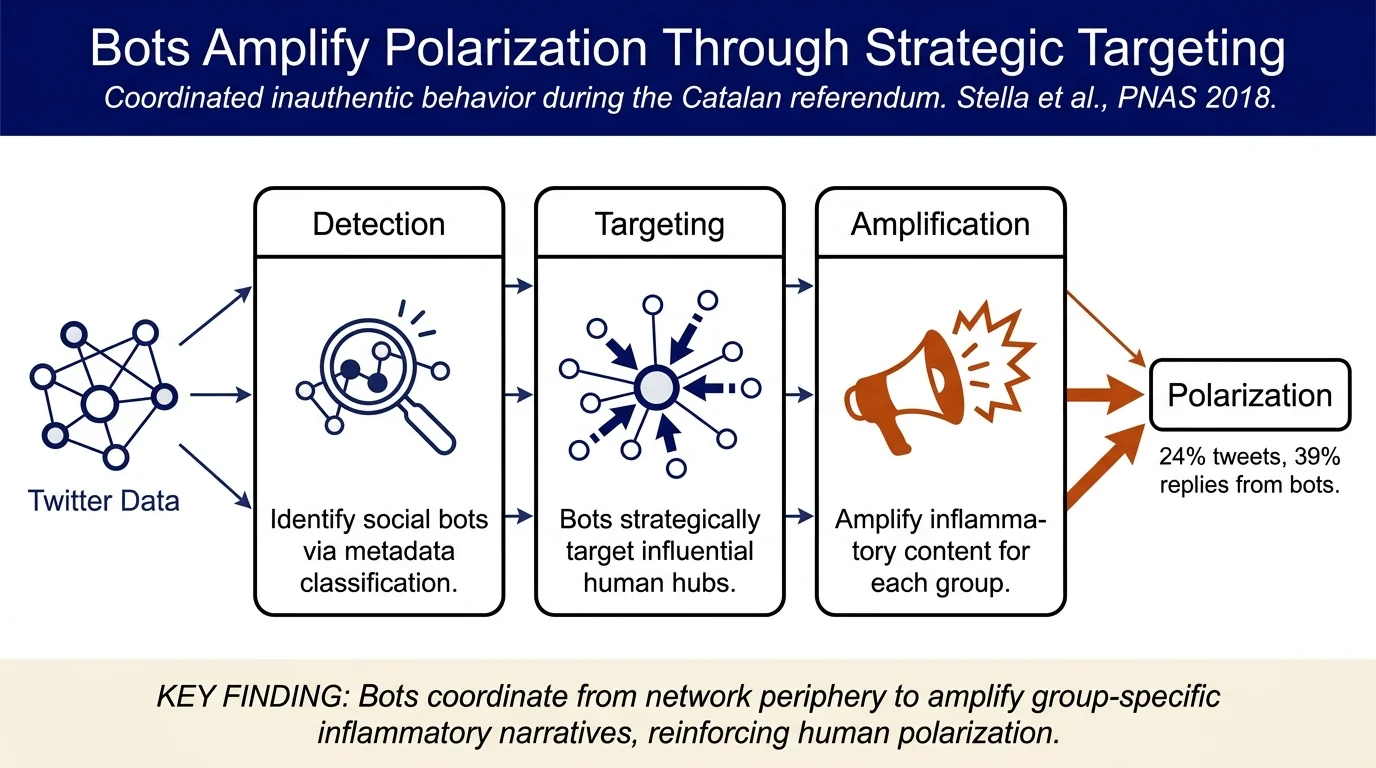
Social bots during the 2017 Catalan independence referendum strategically targeted influential humans to amplify negative and inflammatory content. Operating from network peripheries, bots coordinated sentiment-driven amplification that exacerbated polarization, with approximately one in three referendum-related tweets generated by bots.
Contributions
- Large-scale detection and characterization of social bot behavior during a real-world political event (~4M tweets, ~1M users)
- Evidence that bots operate from network peripheries yet strategically target human hubs and influencers
- Quantification of bot-specific content patterns: bots amplify group-specific inflammatory narratives (violent content for Independentists, neutral for Constitutionalists)
- Sentiment and semantic analysis showing bots exploit and reinforce human polarization rather than creating it independently
Method
The authors monitored Twitter from September 22–October 3, 2017, collecting ~3.6M tweets on the Catalan referendum using keywords (#Catalunya, #1Oct, #referendum, etc.). Bot detection used logistic regression on account metadata (precision 92–98%, recall 88–99%). Network analysis employed spectral clustering (Fiedler vector) on strong ties (retweet + reply/mention) to identify polarized groups. Sentiment analysis measured emotional content of human-to-human, human-to-bot, bot-to-human, and bot-to-bot interactions. Semantic analysis used hashtag co-occurrence networks to map group-specific conceptual associations.
Results
Key findings:
- Bot prevalence: 23.6% of tweets, 38.8% of replies generated by bots; nearly 33% of active users were bots
- Targeting pattern: 19% of human interactions came from bots; humans ~1.8× more central than bots (PageRank), yet bots strategically target human influencers (Kendall τ = 0.62, p < 10⁻⁴)
- Sentiment divergence: Human-to-human interactions show clear polarization (positive pre-referendum, negative on October 1); bot-to-bot interactions are neutral and unaffected by referendum timing
- Group-specific amplification: Bots amplify negative content in Independentist group (group 1), neutral/positive in Constitutionalist group (group 2), mirroring and reinforcing human sentiment patterns
- Semantic warfare: Concepts like "freedom," "dictatorship," "police violence" (group 1) vs. neutral terms (group 2) dominate respective bot-generated content; hashtags like "sonunesbesties" (bot-only) invoke violent connotations
Connections
- Related to Stukal et al. (2017) on Russian bot campaigns via shared focus on automated manipulation during political events
- Complements Linvill & Warren (2020) on coordinated troll-farm tactics in online polarization
- Extends sentiment-analysis approaches from Brady et al. (2017) to bot-amplified polarization
- Related to Bail et al. (2020) on IRA influence and polarization amplification
Notes
Strengths: Large real-world dataset, rigorous bot detection with cross-validation, multi-method approach (sentiment + network + semantic analysis), clear evidence of strategic targeting and group-specific amplification strategies.
Weaknesses: Bot detection limited to account metadata (though high precision/recall); causality between bot amplification and human sentiment shifts cannot be definitively established from observational data; focus on single event limits generalizability.
Significance: Demonstrates that social bots are not merely noise but sophisticated actors that exploit existing human polarization and amplify group-specific inflammatory narratives—a form of coordinated inauthentic behavior distinct from organic disinformation spread.