Explore papers
Filter by research area, year and venue. Every filter is in the address bar, so you can share a view as a link.
 Platforms, policy & societyPsychology & interventions
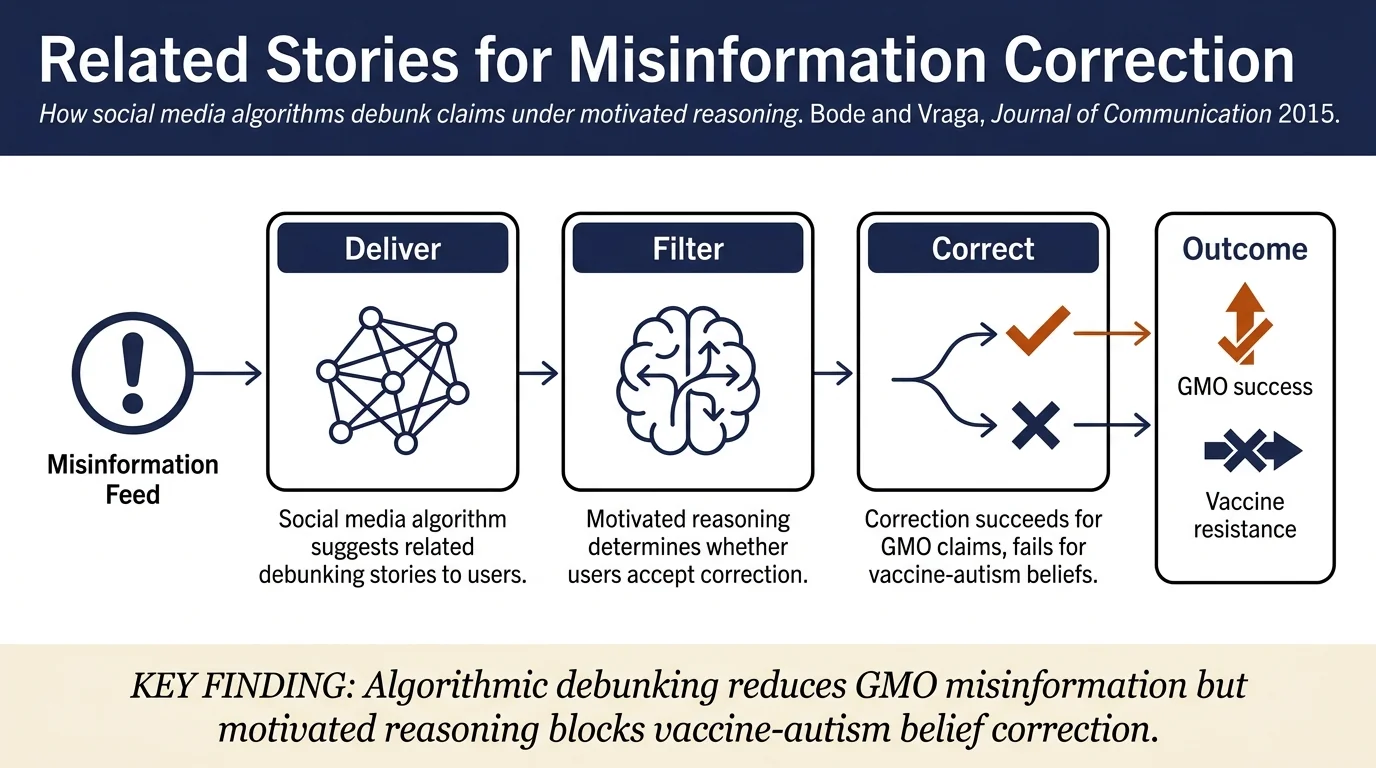
In Related News, That Was Wrong: The Correction of Misinformation Through Related Stories Functionality in Social MediaThis study tests whether Facebook's "related stories" feature can correct misinformation by exposing users to debunking information. Two experiments (students and Mechanical Turk workers) examined vaccine-autism and GMO-illness misperceptions.
 Detection methodsFact-checking & verification
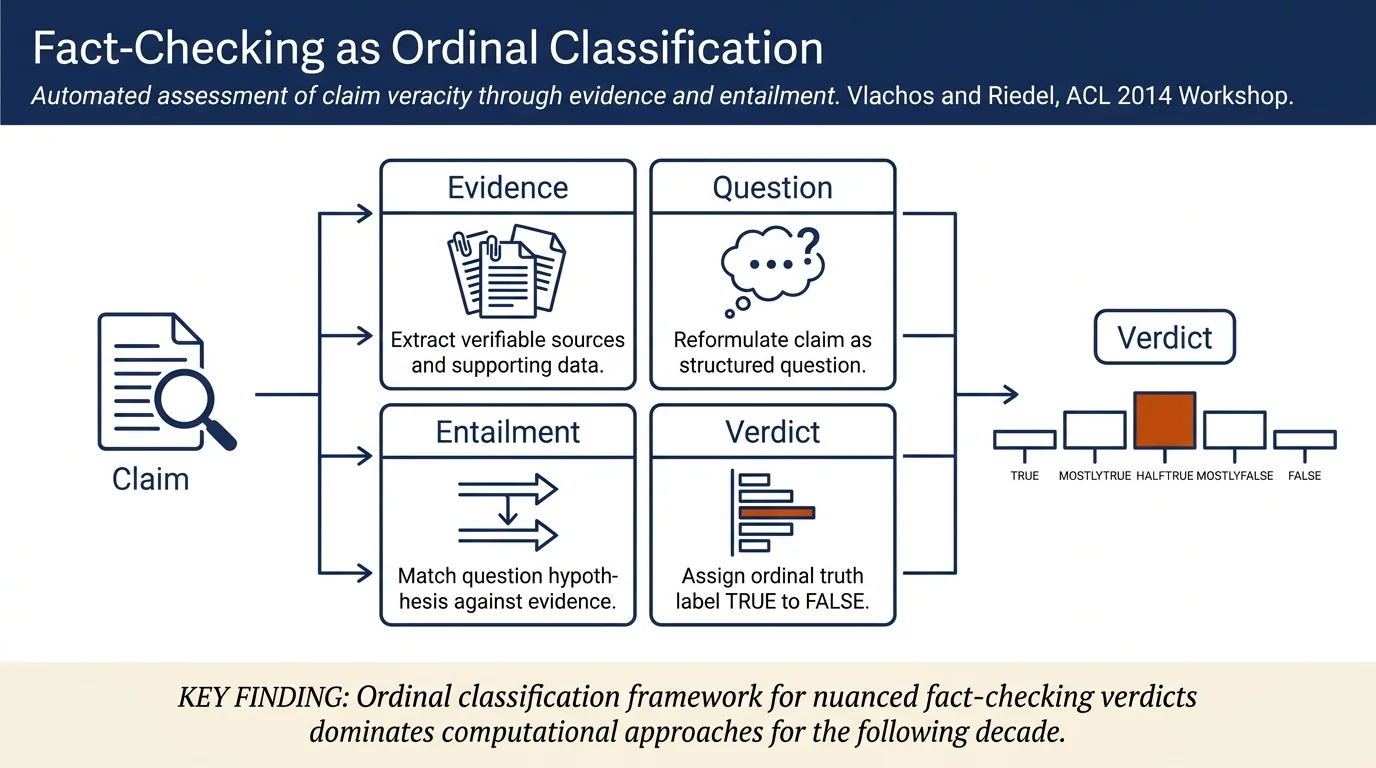
Fact Checking: Task definition and dataset constructionThis paper introduces fact-checking as a formal computational task: assessing the truthfulness of political claims as an ordinal classification problem with five labels (TRUE, MOSTLYTRUE, HALFTRUE, MOSTLYFALSE, FALSE). The authors construct a dataset of 106 objectively-verifiable fact-checked statements from PolitiFact and Channel 4 (out…
 Spread & networksDatasets & evaluation
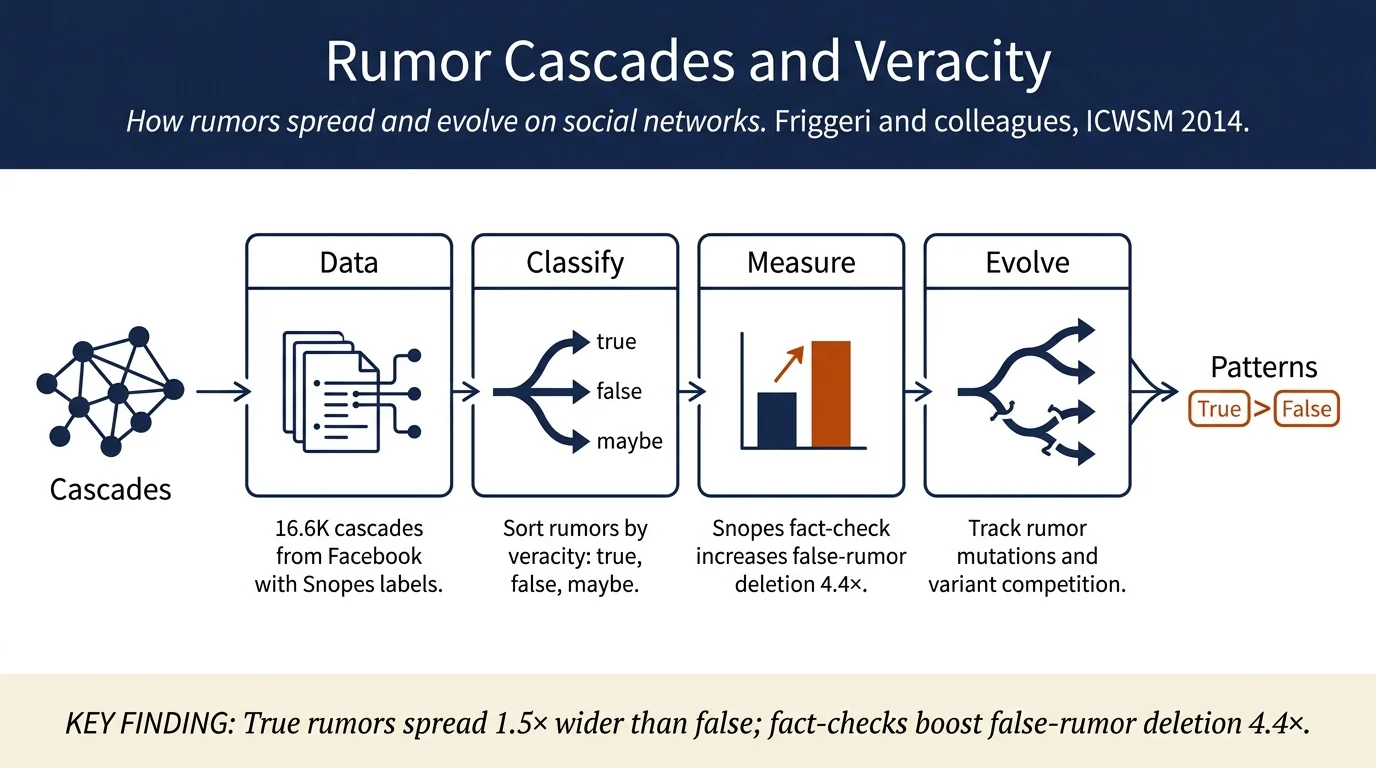
Rumor CascadesFriggeri et al. tracked thousands of rumors on Facebook using Snopes.com as ground truth, finding that rumor cascades run deeper in the social network than typical content. True rumors spread more virally than false ones despite false rumors being more frequently uploaded; Snopes fact-checks increase deletion likelihood for false rumors…
 Spread & networksDetection methods
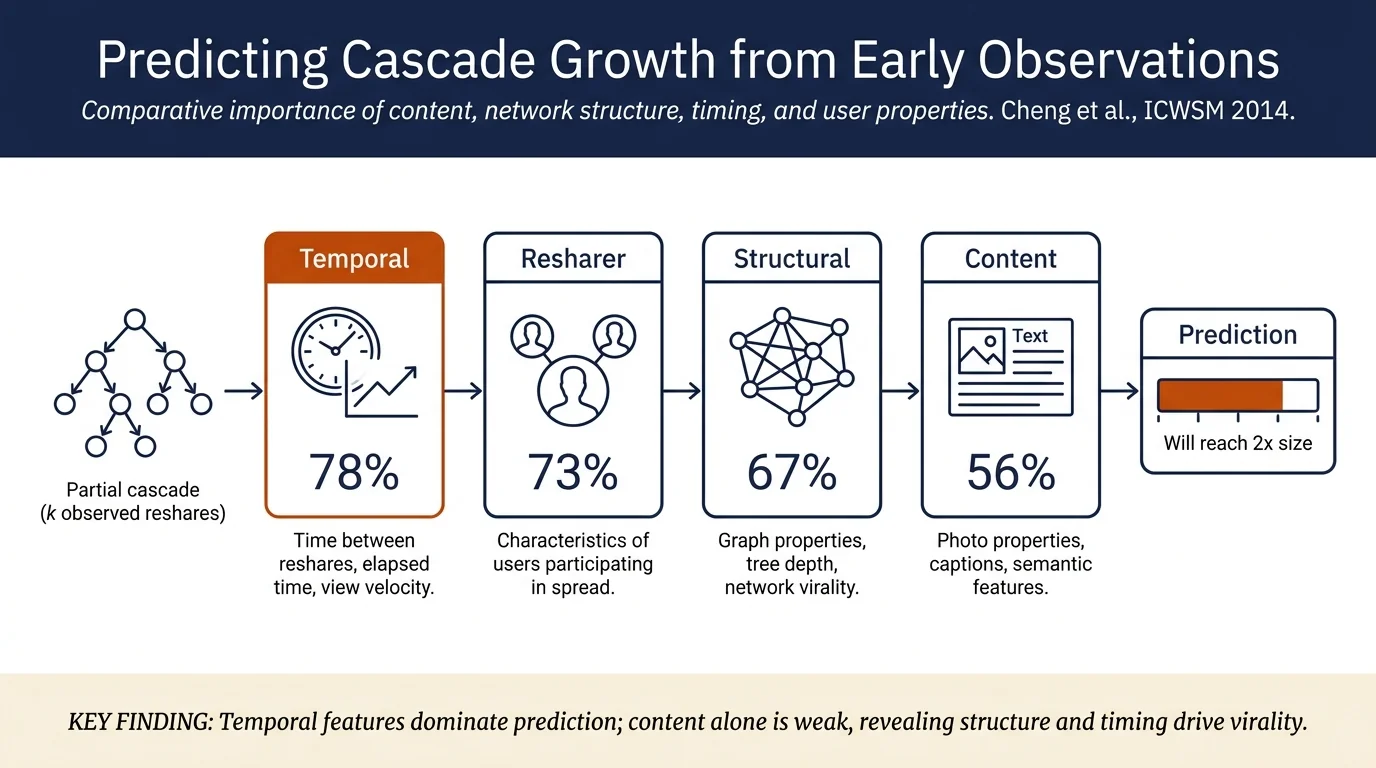
Can Cascades be Predicted?Information cascades on social networks can be predicted with reasonable accuracy (~80%) using temporal and structural features extracted from early observations. Performance improves substantially as more cascade stages are observed.
 Psychology & interventionsFact-checking & verification
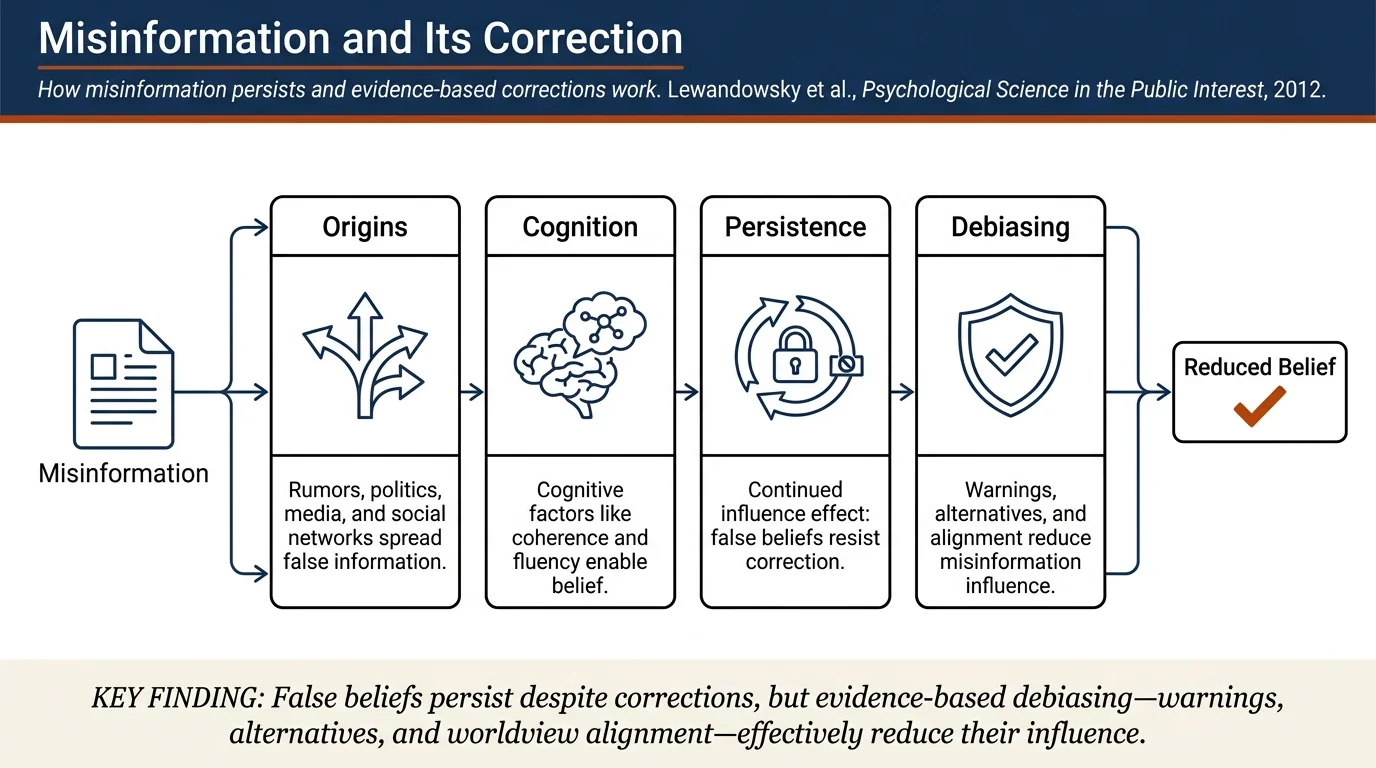
Misinformation and Its Correction: Continued Influence and Successful DebiasingThis comprehensive review synthesizes literature on why false beliefs persist despite corrections, examining cognitive mechanisms (coherence, credibility, source confusion, fluency) that render misinformation resistant to change. The authors propose evidence-based debiasing strategies—warnings, alternative explanations, repeated…
 Detection methodsSpread & networks
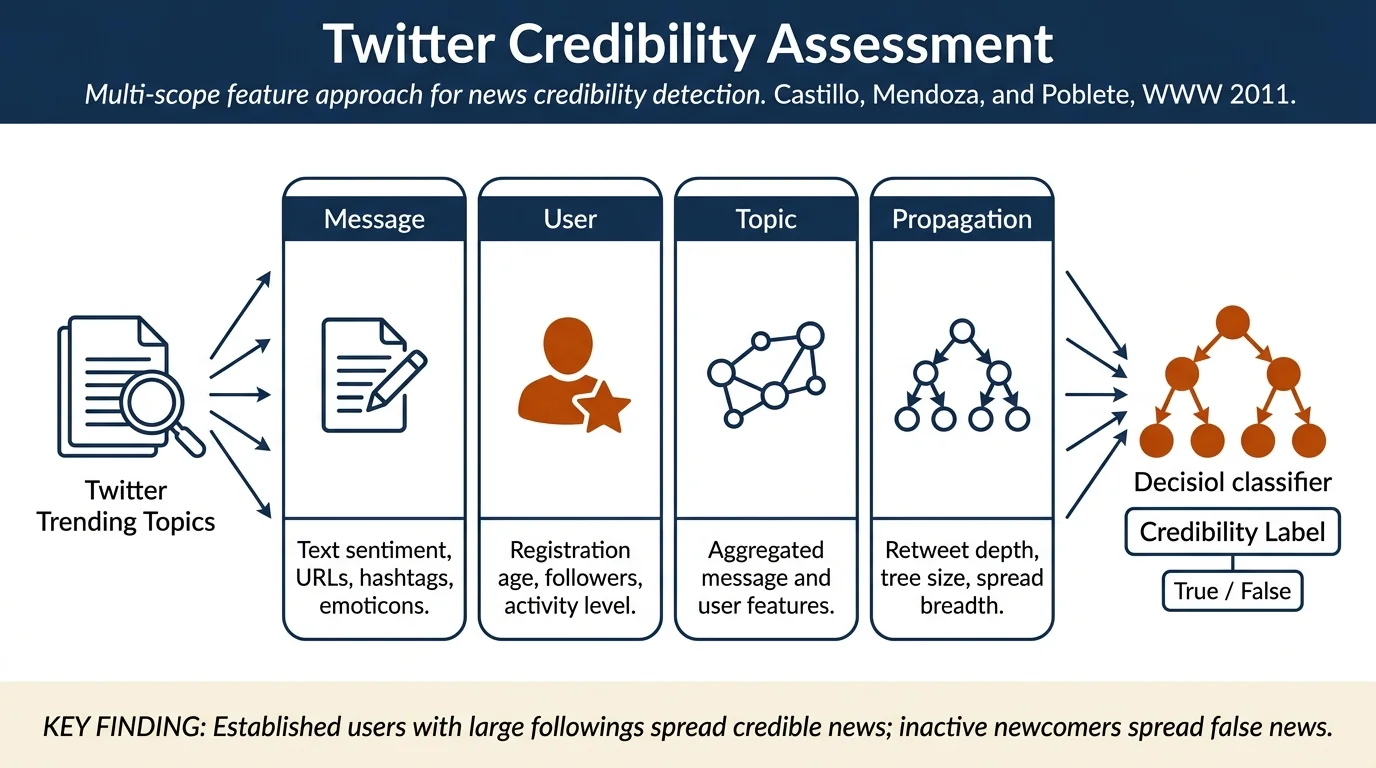
Information Credibility on TwitterThis paper proposes supervised learning classifiers to automatically assess the credibility of news discussed on Twitter. Using human-labeled topics from trending discussions, the authors extract message-level, user-level, topic-level, and propagation-level features to build classifiers that distinguish newsworthy from conversational…
 Spread & networksBots & coordinated campaigns
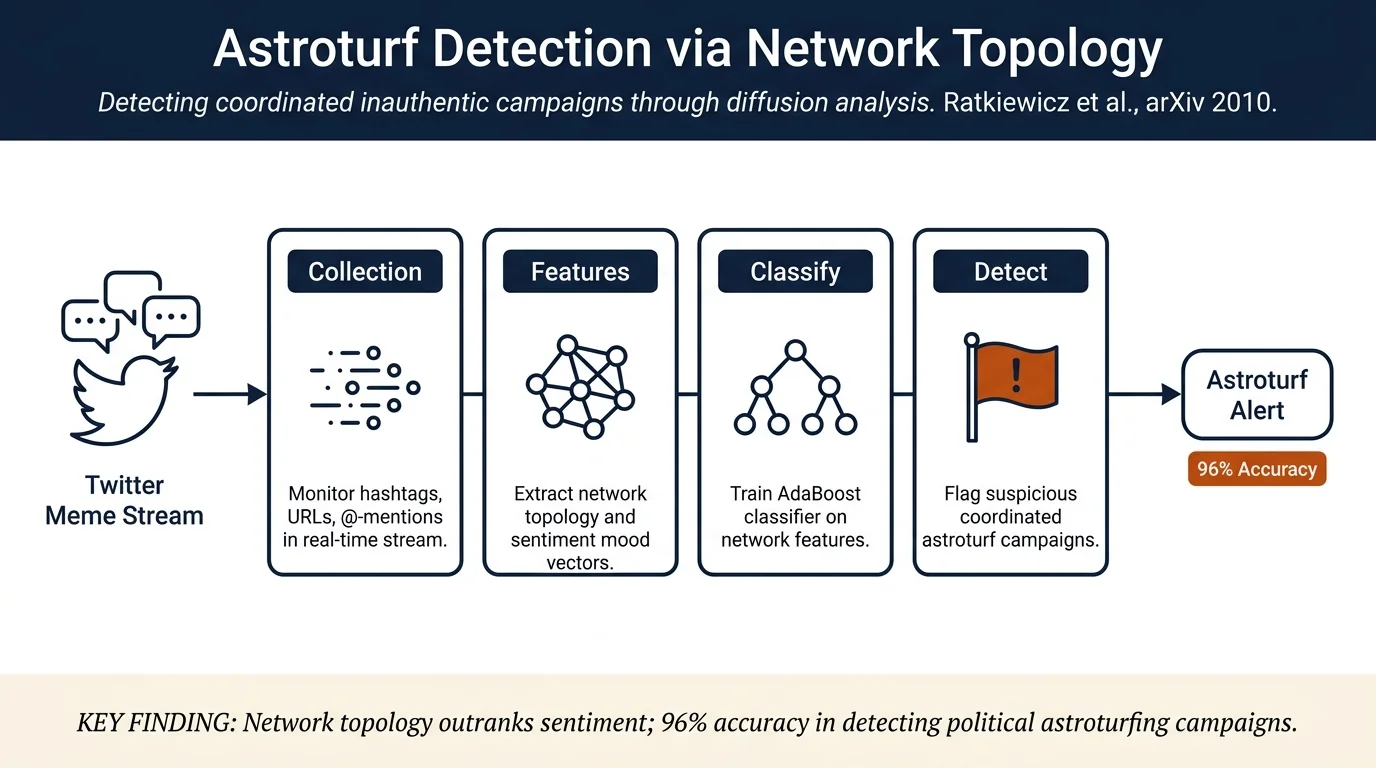
Detecting and Tracking the Spread of Astroturf Memes in Microblog StreamsPolitical campaigns increasingly use social media to amplify deceptive memes that mimic organic grassroots behavior—termed "astroturfing." This paper introduces the Truthy system, which analyzes meme diffusion networks on Twitter to detect orchestrated campaigns through network topology and sentiment analysis, achieving ~90%…
 Spread & networksDatasets & evaluation
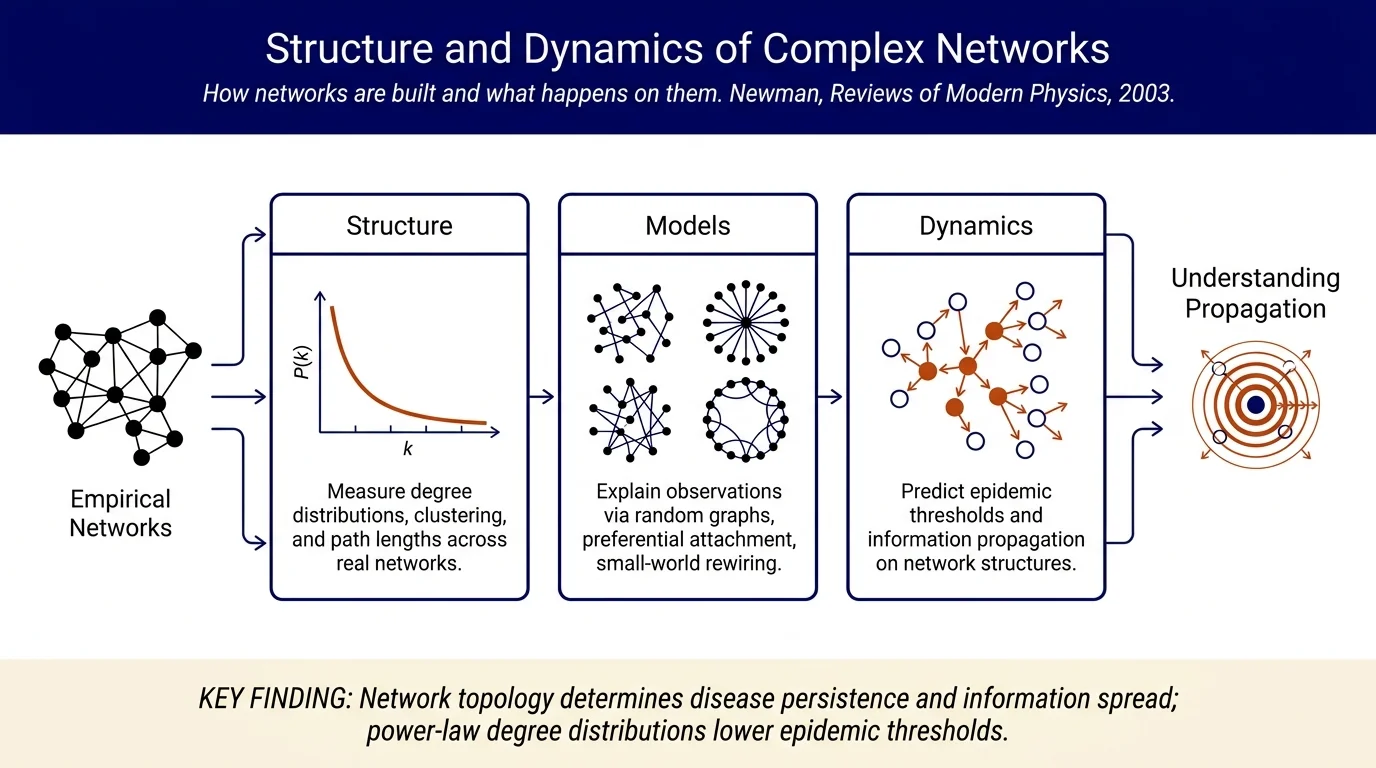
The structure and function of complex networksThis comprehensive review surveys the properties and mathematical models of complex networks across diverse domains: social networks, the Internet, biological networks, and collaboration networks. Newman covers observed structural properties (degree distributions, clustering, small-world effects), foundational models (random graphs,…
Spread & networksPsychology & interventions
A Theory of Fads, Fashion, Custom, and Cultural Change as Informational CascadesFoundational theoretical framework explaining how fads, fashions, and beliefs spread through sequential information cascades: when individuals use others' actions to infer information while ignoring their own private signals, widespread adoption of incorrect beliefs and practices can occur.