TI-CNN: Convolutional Neural Networks for Fake News Detection
Authors: Yang Yang, Lei Zheng, Jiawei Zhang, Qingcai Cui, Xiaoming Zhang, Zhoujun Li, Philip S. Yu
Venue: arXiv, 2018 — arXiv:1806.00749
TL;DR
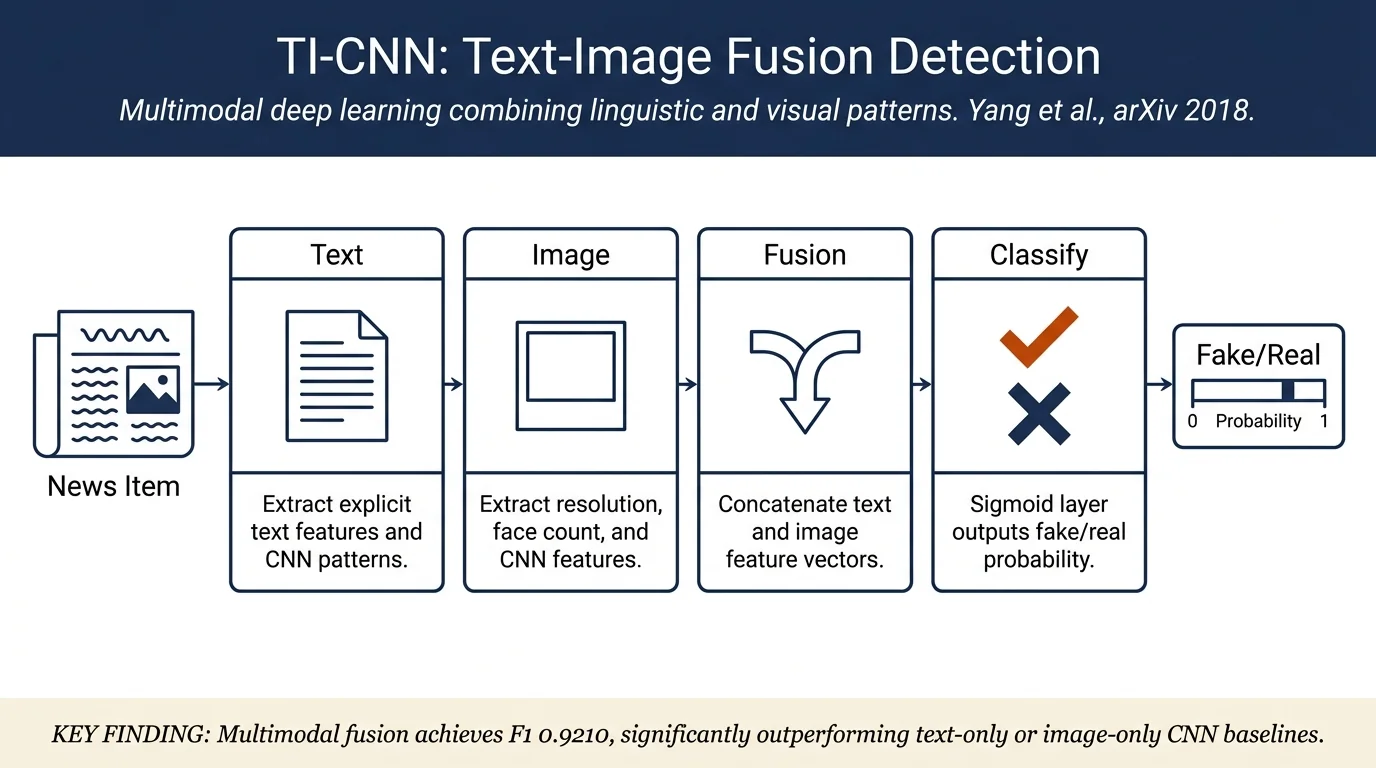
This paper proposes TI-CNN, a multimodal deep learning model that combines explicit and latent features from both text and images to detect fake news. Through analysis of 20,015 news items, the authors identify distinctive linguistic and visual patterns in fake versus real news, and demonstrate that their unified CNN-based approach achieves superior performance (F1: 0.9210) compared to text-only or image-only baselines.
Contributions
- High-quality multimodal fake news dataset with 11,941 fake and 8,074 real news items, with in-depth linguistic and visual analysis
- Comprehensive analysis of explicit text features (word count, question marks, capital letters, exclusive words, negations, first-person pronouns) that distinguish fake from real news
- Analysis of explicit image features (resolution, number of faces) showing real news uses images more effectively
- Unified TI-CNN model that extracts and fuses both explicit and latent features from text and images for improved detection
Method
The TI-CNN model has two parallel branches:
Text Branch: Extracts explicit features including word count, sentence count, question/exclamation marks, capital letters, exclusive words, negations, first-person pronouns, and motion verbs. Latent features are learned via CNN using word embeddings (dimension 100) applied to variable-length news text. The text branch uses max-pooling and fully connected layers to combine explicit and latent representations.
Image Branch: Extracts explicit features (image resolution, number of faces detected). Latent features are learned through convolutional layers with max-pooling applied to the raw image. The branch processes images of 50×50 pixel size with 32 filters in the convolutional layer.
Both branches output feature vectors that are concatenated and passed through dense layers (128 neurons) with ReLU activation, batch normalization, dropout (probability 0.5–0.8), and a sigmoid output layer for binary classification.
Results
The model was evaluated on the full dataset using 80% training, 10% validation, 10% test split. TI-CNN achieves: - Precision: 0.9220 - Recall: 0.9277 - F1-measure: 0.9210
Performance comparison with baselines: - CNN-image only: F1 0.4729 - CNN-text-400 (400-word input): F1 0.8920 - LSTM-text-400: F1 0.8920 - GRU-text-400: F1 0.8758 - TI-CNN-1000 (1000-word input): F1 0.9210
The model shows that both text and image information are necessary for effective detection, and that fusing explicit and latent features improves performance. Sensitivity analysis shows the model is relatively robust across hyperparameter settings (word embedding dimension 50–350, batch size 8–128, hidden layer size 8–256).
Connections
- Related to Multimodal fake news detection via joint text-image modeling; shares CNN architecture with Content-based fake news detection methods
- Complementary to Propagation-based fake news detection which uses network structure; differs by focusing on news content itself
- Cited along with other Fake news detection methods using Deep learning approaches for fake news classification
- Builds on Linguistic Analysis of Fake News showing patterns in deceptive language, extending to visual modality
Notes
The paper conducts valuable empirical analysis of linguistic and visual markers. Findings on explicit features—fake news having fewer question marks, fewer capital letters, fewer exclusive words, and fewer first-person pronouns—provide interpretable signals beyond the learned latent features. The image analysis (real news uses images with more faces, higher resolution) is intuitive. However, the dataset is limited to English-language news about the 2016 US presidential election, potentially limiting generalization. The paper does not compare against knowledge-based or social-context approaches, and the experimental setup (80/10/10 split on a single dataset) leaves cross-domain robustness unclear.