Explore papers
Filter by research area, year and venue. Every filter is in the address bar, so you can share a view as a link.
 Spread & networksPlatforms, policy & society
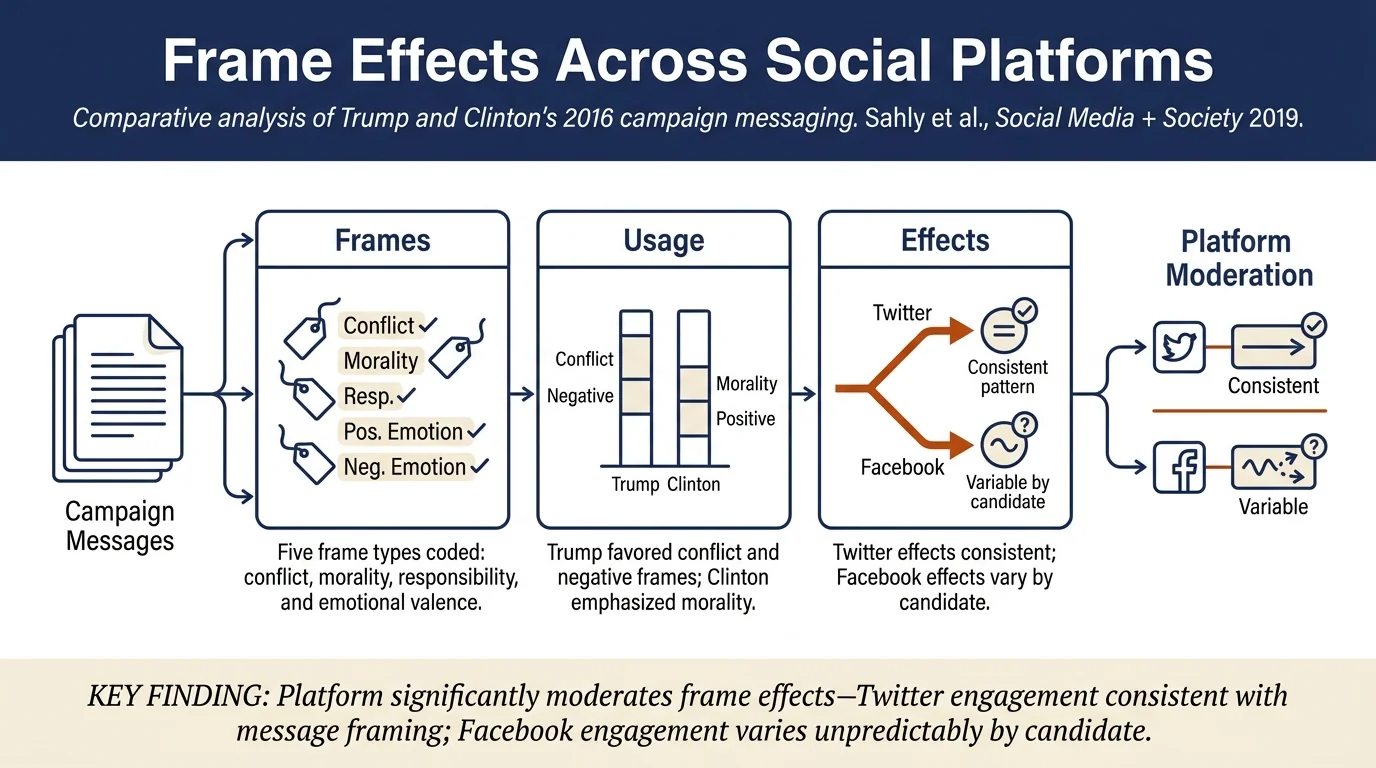
Social Media for Political Campaigns: An Examination of Trump's and Clinton's Frame Building and Its Effect on Audience EngagementThis study analyzes how Trump and Clinton's 2016 campaigns framed messages on Twitter and Facebook, and how frame type affected audience engagement. Trump relied on conflict and negative emotional frames, while Clinton used morality and positive emotional frames.
 Fact-checking & verificationPlatforms, policy & society
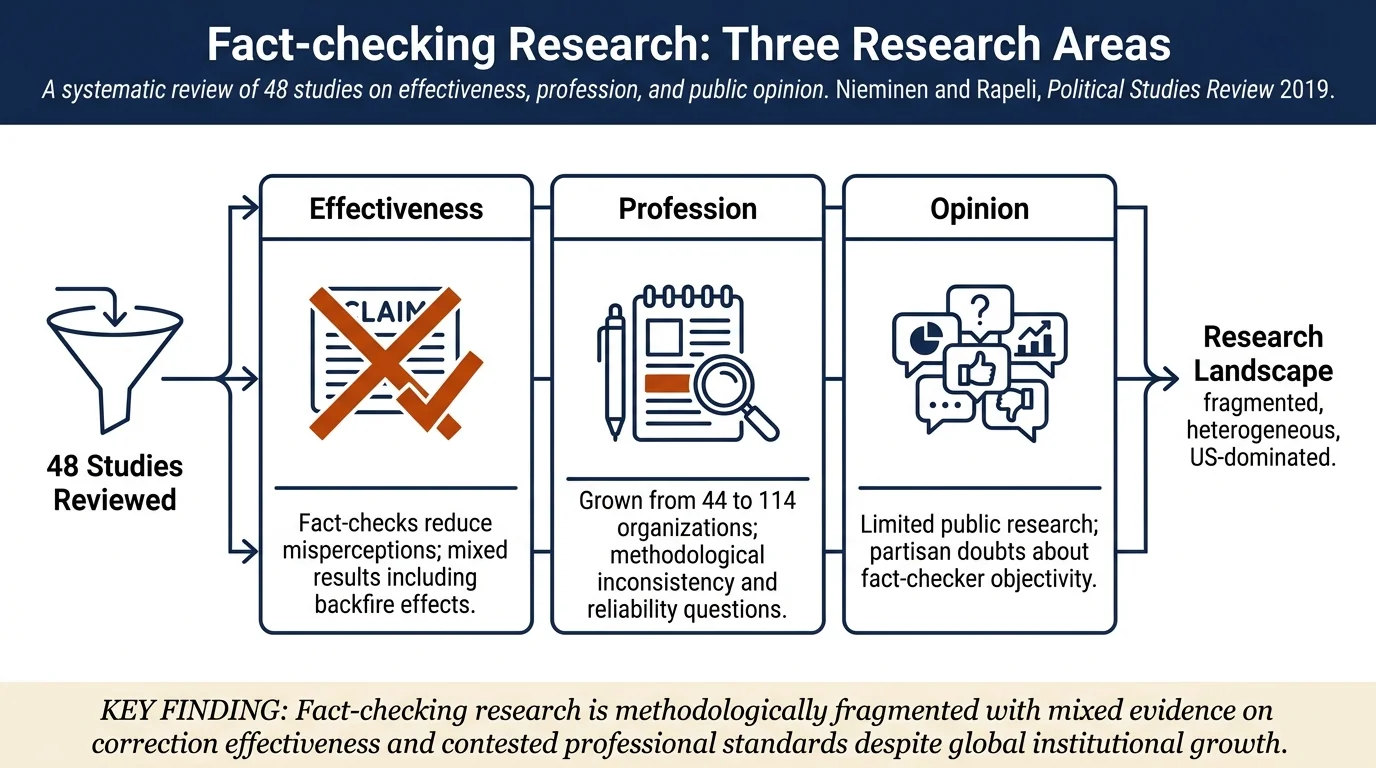
Fighting Misperceptions and Doubting Journalists' Objectivity: A Review of Fact-checking LiteratureComprehensive literature review of 48 studies on political fact-checking, organized into three research areas: (1) fact-checking effectiveness for correcting misperceptions (mixed results, including backfire effects); (2) fact-checking as a profession (contested methods and reliability); (3) public opinion about fact-checking (mostly…
 Spread & networksBots & coordinated campaigns
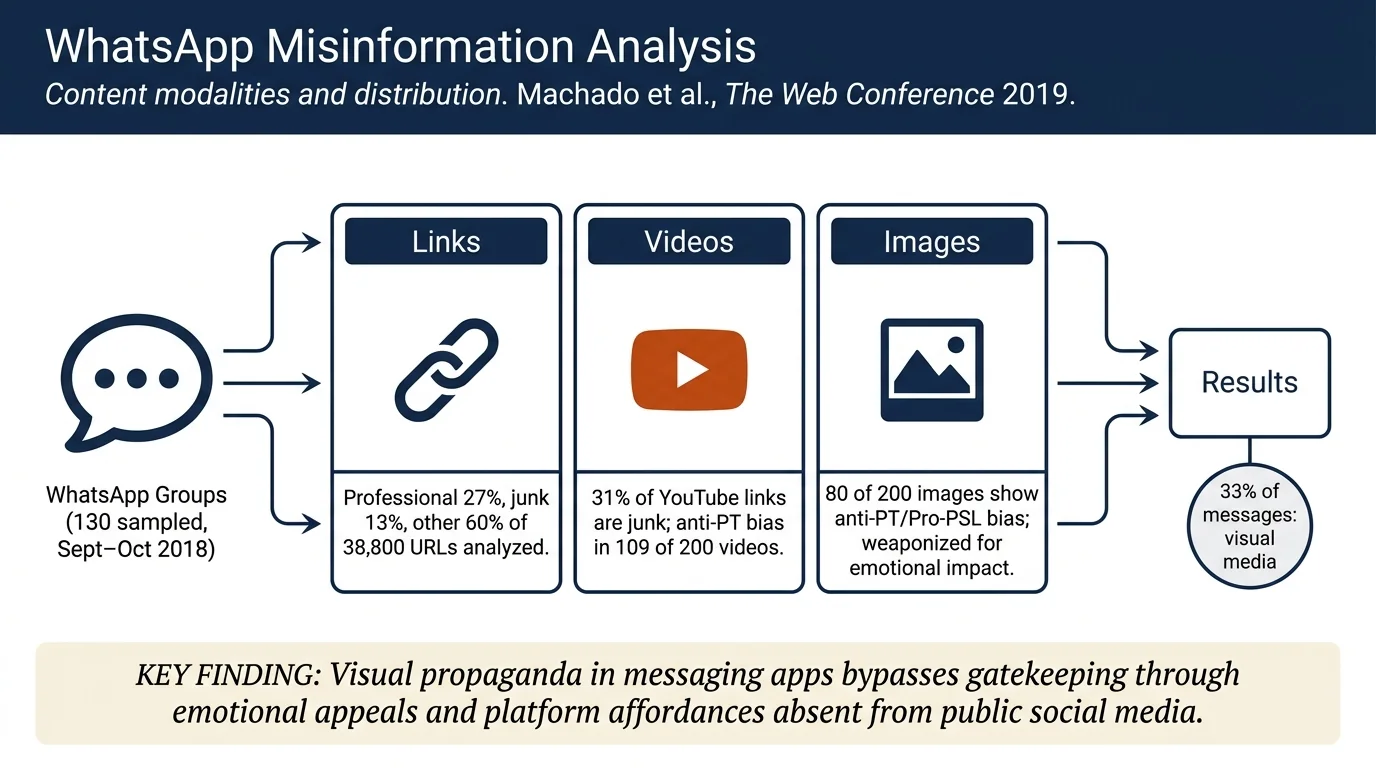
A Study of Misinformation in WhatsApp groups with a focus on the Brazilian Presidential ElectionsStudy of 130 public WhatsApp groups during the 2018 Brazilian presidential election found that 13.1% of shared links pointed to junk news sources, with 40% of links directing to YouTube—a platform used strategically to bypass platform moderation. Videos and images dominated message content (33% of all messages) and were heavily…
 Bots & coordinated campaignsPlatforms, policy & society
Coordinating a Multi-Platform Disinformation Campaign: Internet Research Agency Activity on Three U.S. Social Media Platforms, 2015 to 2017This paper analyzes Russian Internet Research Agency activity across Facebook, Twitter, and Reddit from 2015–2017 using vector autoregression models on 3,126 Facebook ads, 1.9M tweets, and 12,603 Reddit posts. Key finding: Reddit activity influenced subsequent Twitter activity (a "trial balloon" effect), but the IRA's Twitter engagement…
 Deepfakes & multimodalDetection methods
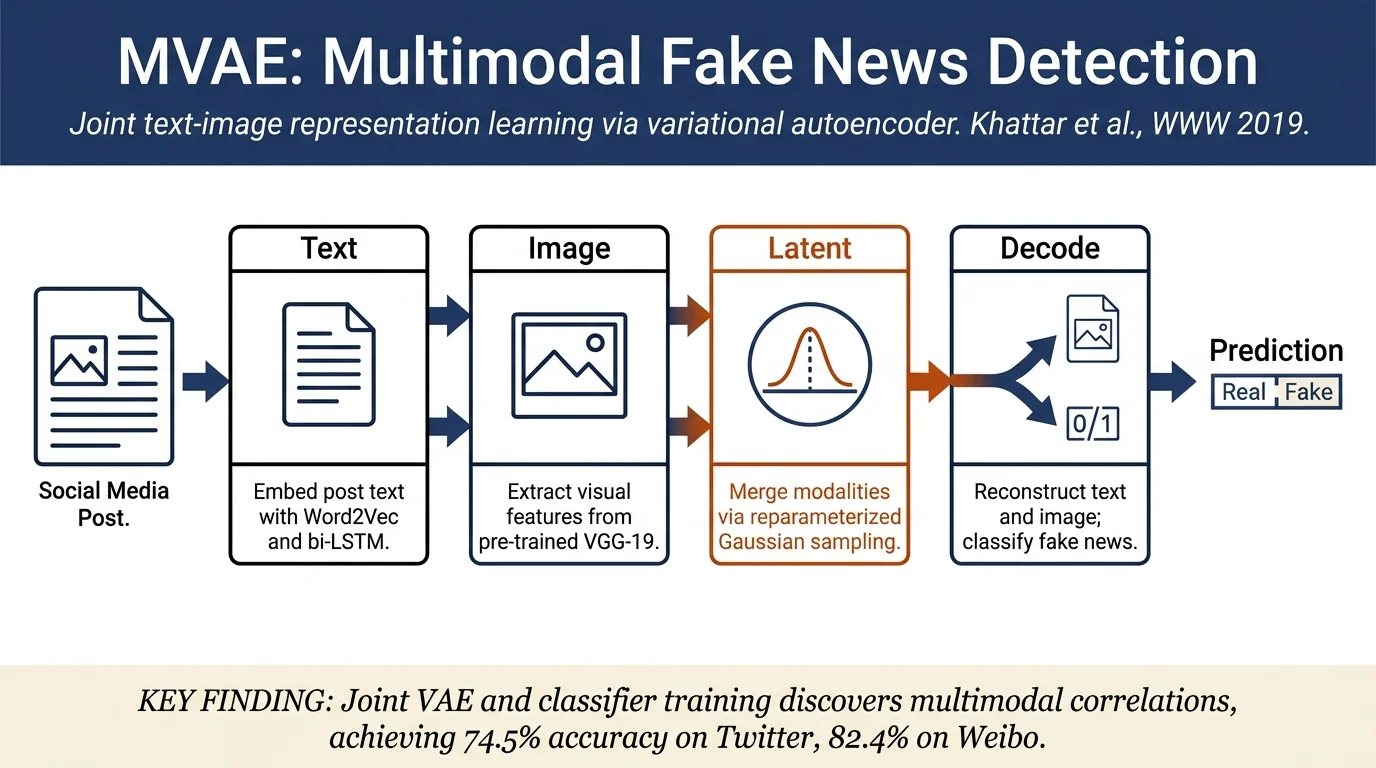
MVAE: Multimodal Variational Autoencoder for Fake News DetectionThe paper proposes MVAE, a variational autoencoder that learns shared representations of text and images in social media posts to detect fake news. The model jointly trains an encoder-decoder (to discover correlations across modalities) with a binary classifier.
 Spread & networksPsychology & interventions
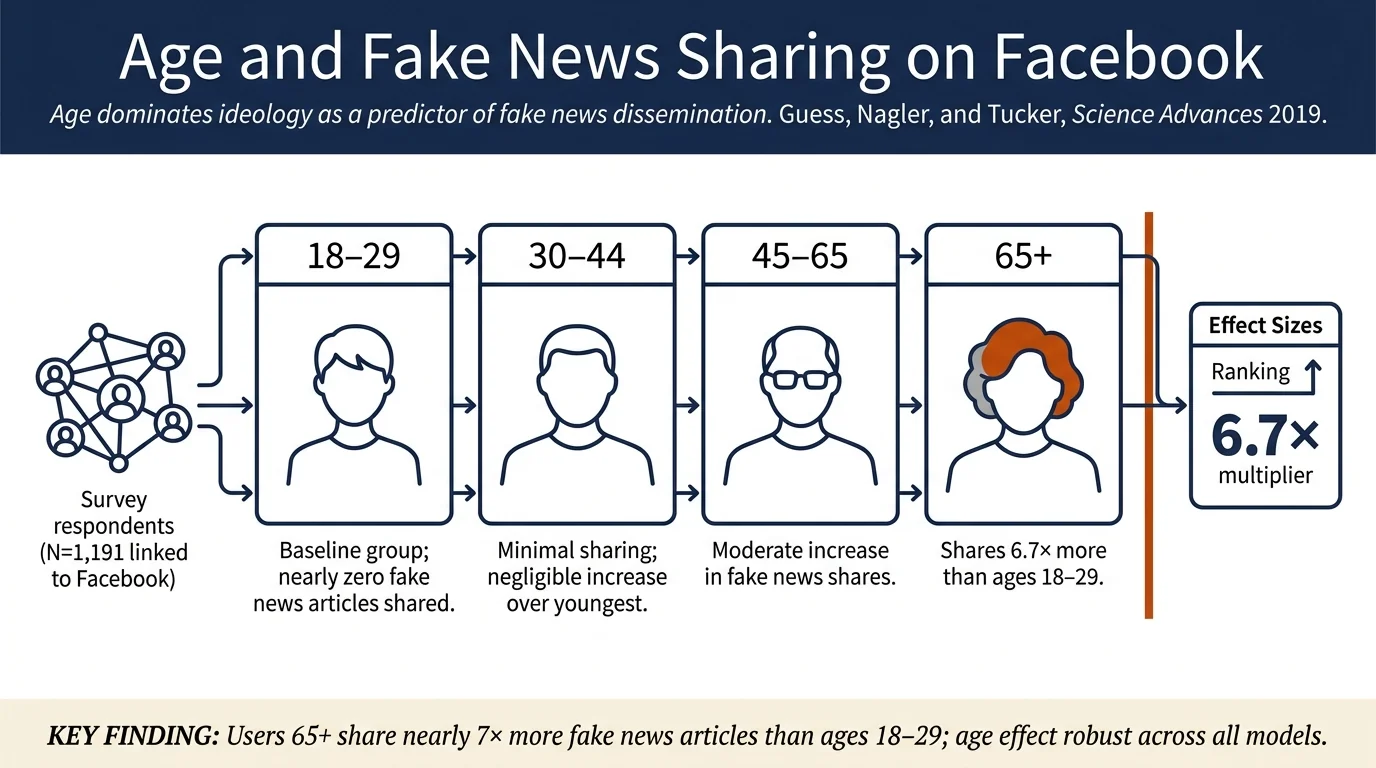
Less than you think: Prevalence and predictors of fake news dissemination on FacebookFake news dissemination on Facebook during the 2016 election was a rare behavior (8.5% of users shared at least one article), with clear demographic stratification: conservatives shared more articles from fake news domains (pro-Trump), but the strongest and most robust predictor was age—users over 65 shared nearly seven times as many…
 Spread & networksPlatforms, policy & society
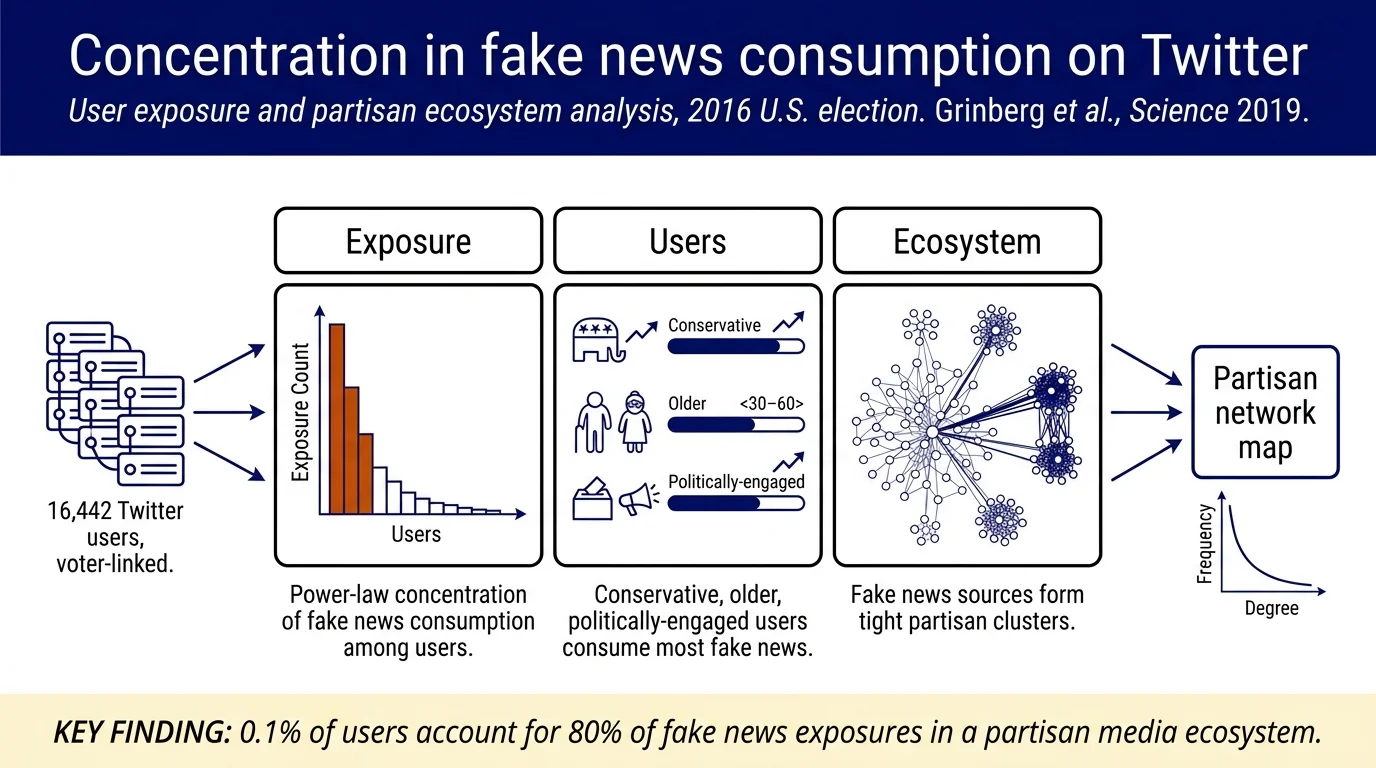
Fake news on Twitter during the 2016 U.S. presidential electionFake news consumption on Twitter during the 2016 election was extremely concentrated: only 1% of users saw 80% of exposures, and 0.1% shared 80% of fake news. Conservative-leaning, older, highly politically engaged users drove most consumption.
 Spread & networksPlatforms, policy & society
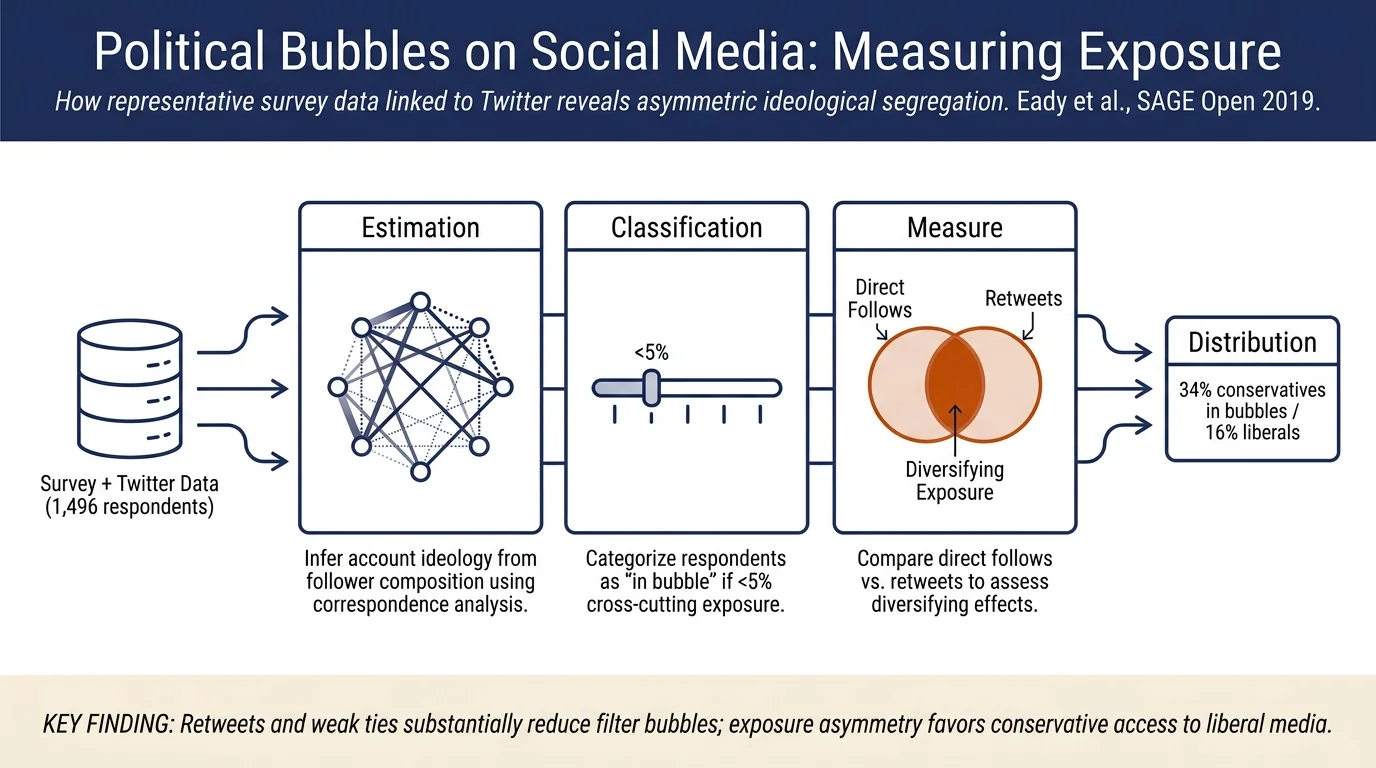
How Many People Live in Political Bubbles on Social Media? Evidence From Linked Survey and Twitter DataEady et al. link survey data from 1,496 Americans to Twitter data from 642,345 accounts and ~1.2 billion tweets to measure political polarization in media consumption. Rather than finding evidence of extreme "filter bubbles" where most people consume ideologically homogeneous content, they find substantial overlap in the accounts…
 Psychology & interventionsSpread & networks
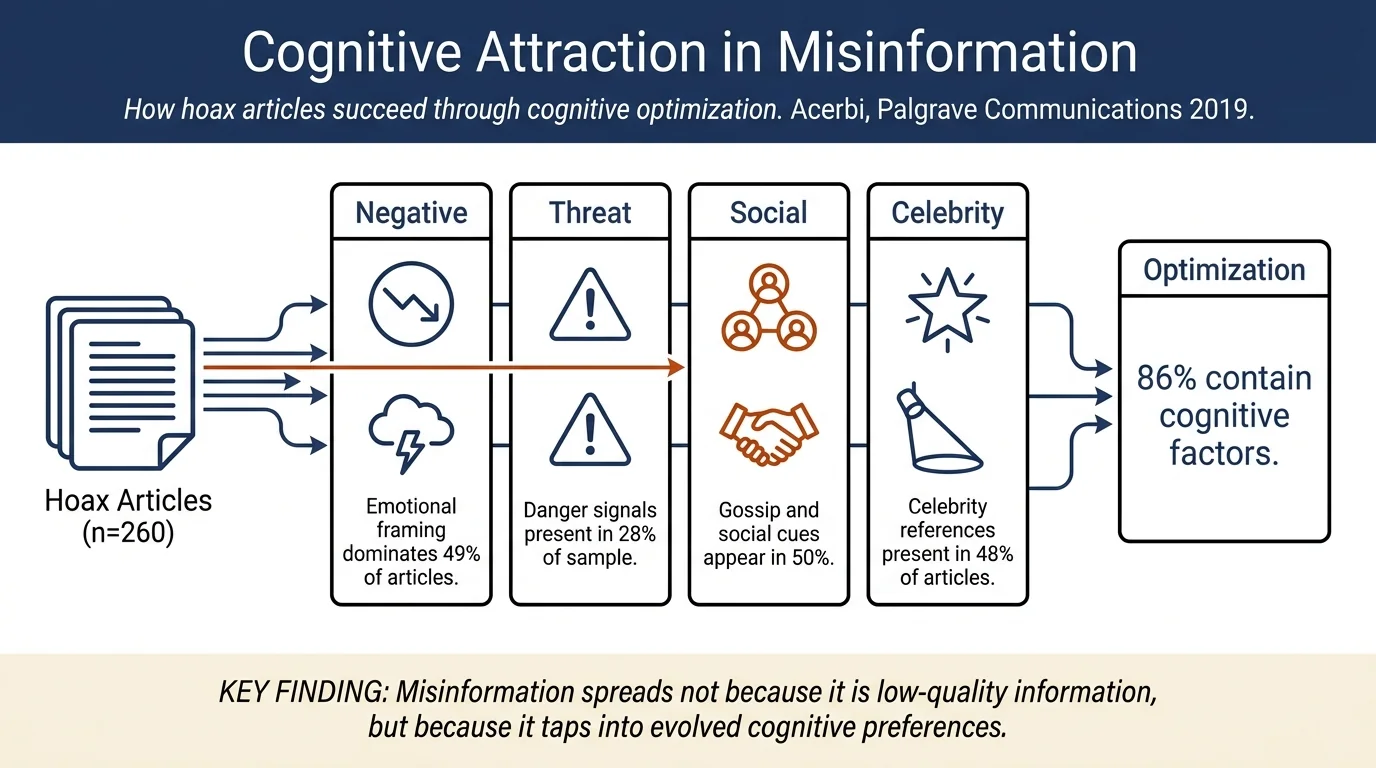
Cognitive attraction and online misinformationMisinformation spreads not because it is low-quality information constrained by digital media inefficiencies, but because it taps into general evolved cognitive preferences. A content analysis of 260 articles from 26 hoax websites shows that 86% contain at least one cognitive-appeal feature: negative framing (49%), threat descriptions…
 Spread & networksDetection methods
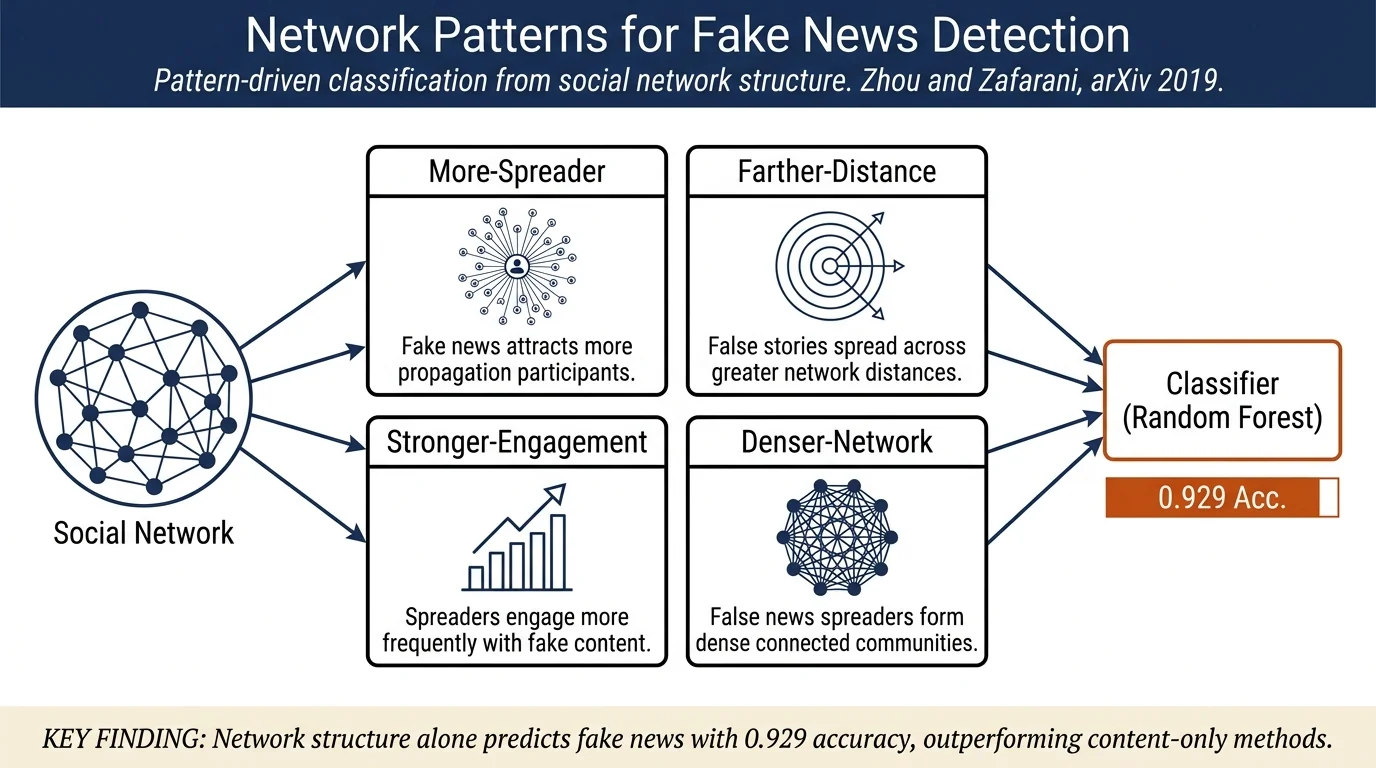
Network-based Fake News Detection: A Pattern-driven ApproachThis paper proposes a pattern-driven, network-based fake news detection model that identifies and quantifies four empirically grounded behavioral patterns in social networks: fake news attracts more spreaders, spreads farther, elicits stronger engagement, and is spread by denser networks than true news. These patterns are operationalized…
 Detection methodsDatasets & evaluation
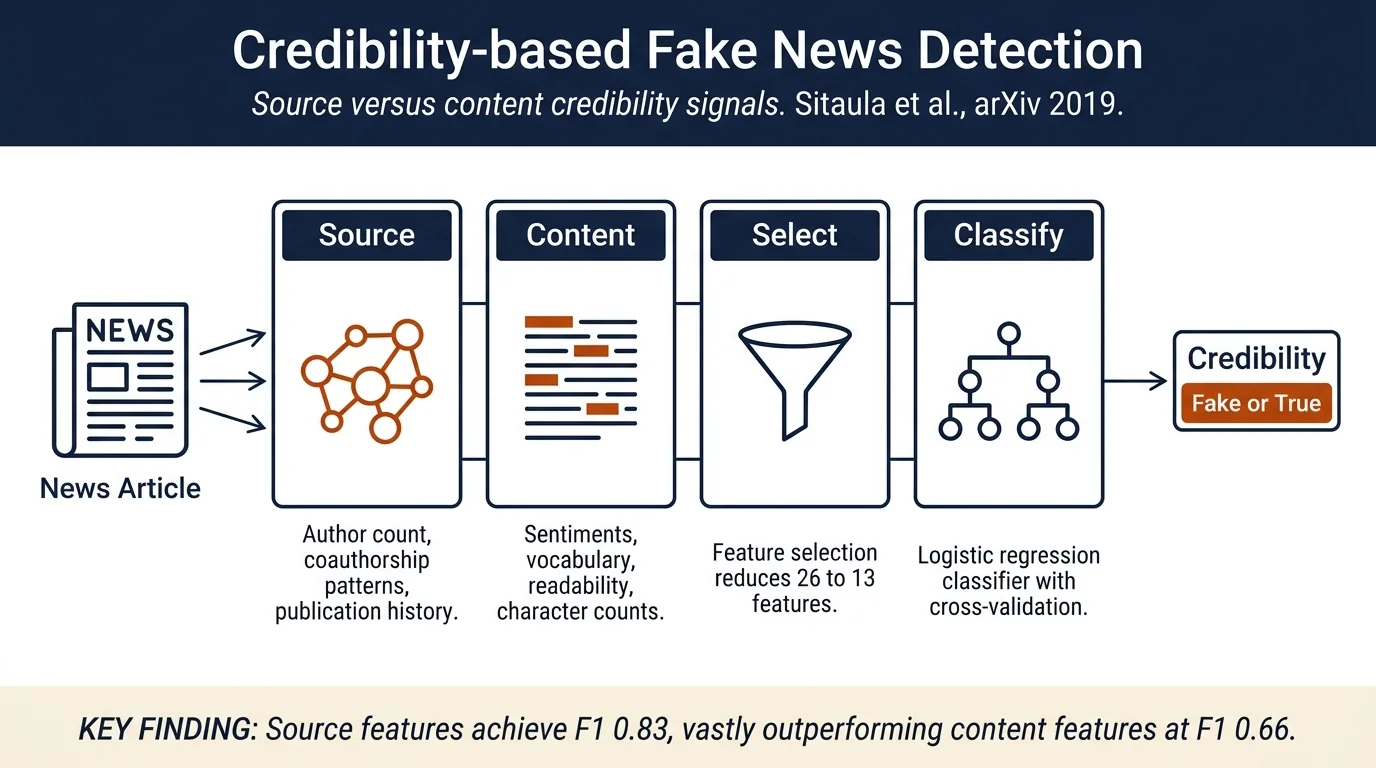
Credibility-based Fake News DetectionRather than relying solely on news text or propagation graphs, this paper frames fake news detection as a credibility assessment problem and operationalizes credibility through source-level signals (author count, coauthorship homophily, author publication history) and content-level signals (sentiments, domain vocabulary, argumentation,…
 Detection methodsDatasets & evaluation
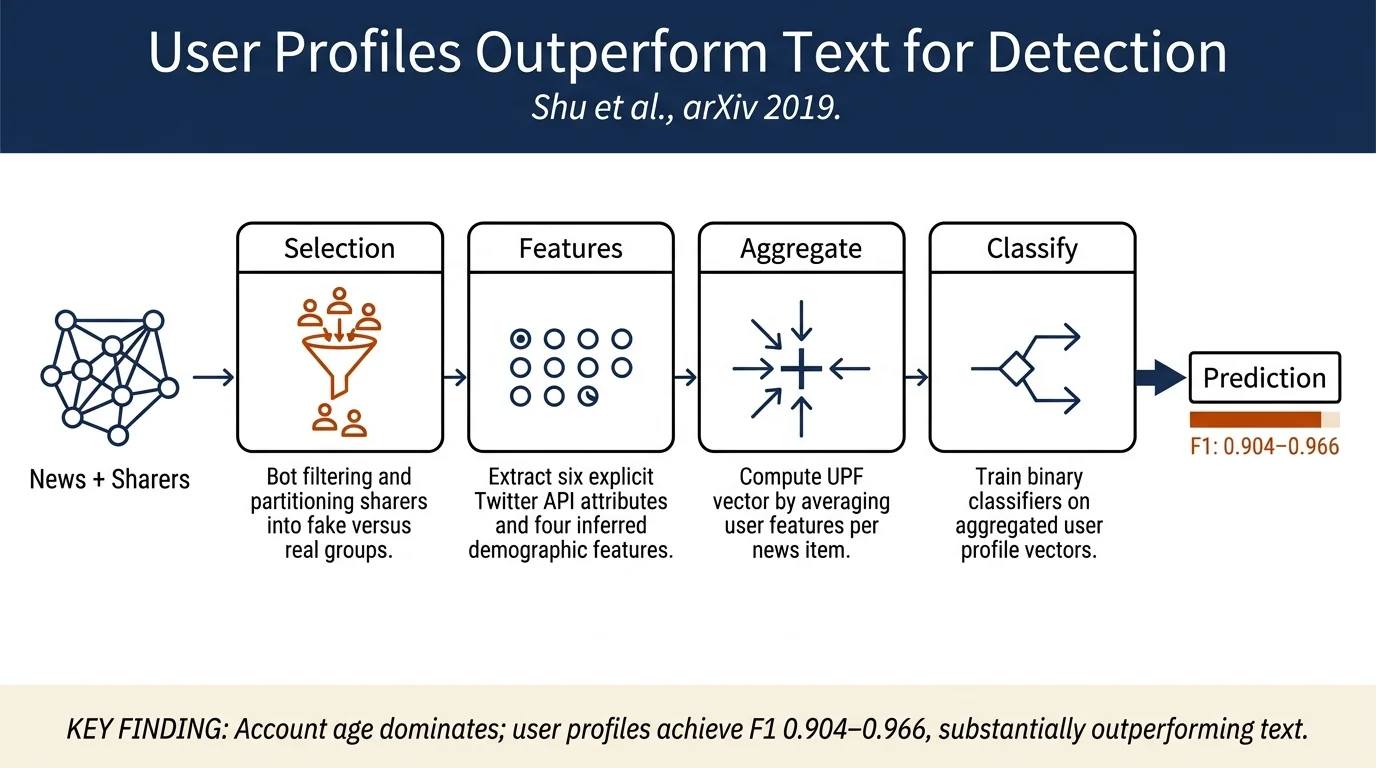
The Role of User Profiles for Fake News DetectionContent-only fake news detectors plateau because fake news is crafted to mimic real news textually. This paper systematically characterizes Twitter users who predominantly share fake versus real news across both partitions of FakeNewsNet (PolitiFact and GossipCop), comparing six explicit Twitter API attributes and four inferred implicit…
 Psychology & interventionsPlatforms, policy & society
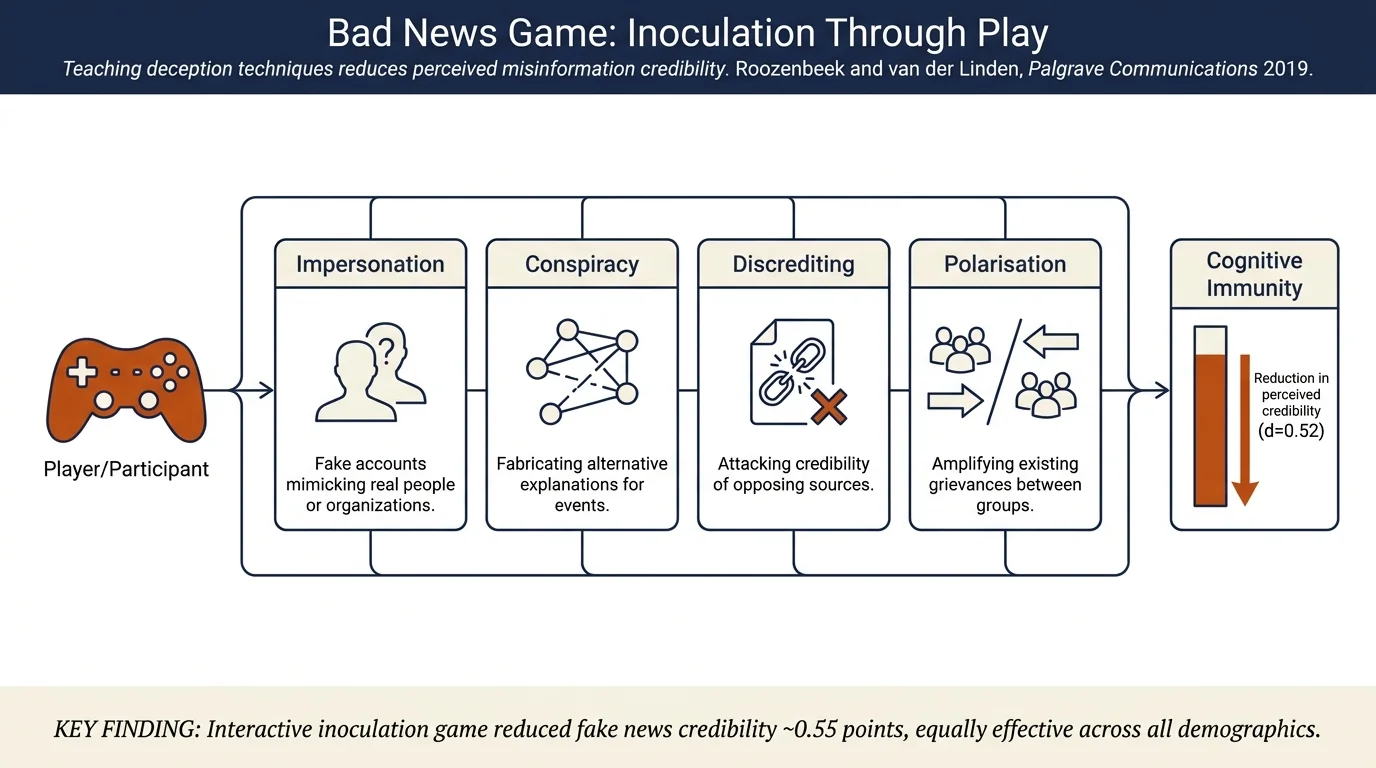
Fake news game confers psychological resistance against online misinformationThis large-scale empirical study demonstrates that a free ~15-minute online browser game teaching six common misinformation production techniques (polarisation, emotional manipulation, conspiracy theories, trolling, discrediting opponents, impersonation) significantly reduces perceived reliability of misinformation across N=15,000…
 Detection methodsDatasets & evaluation
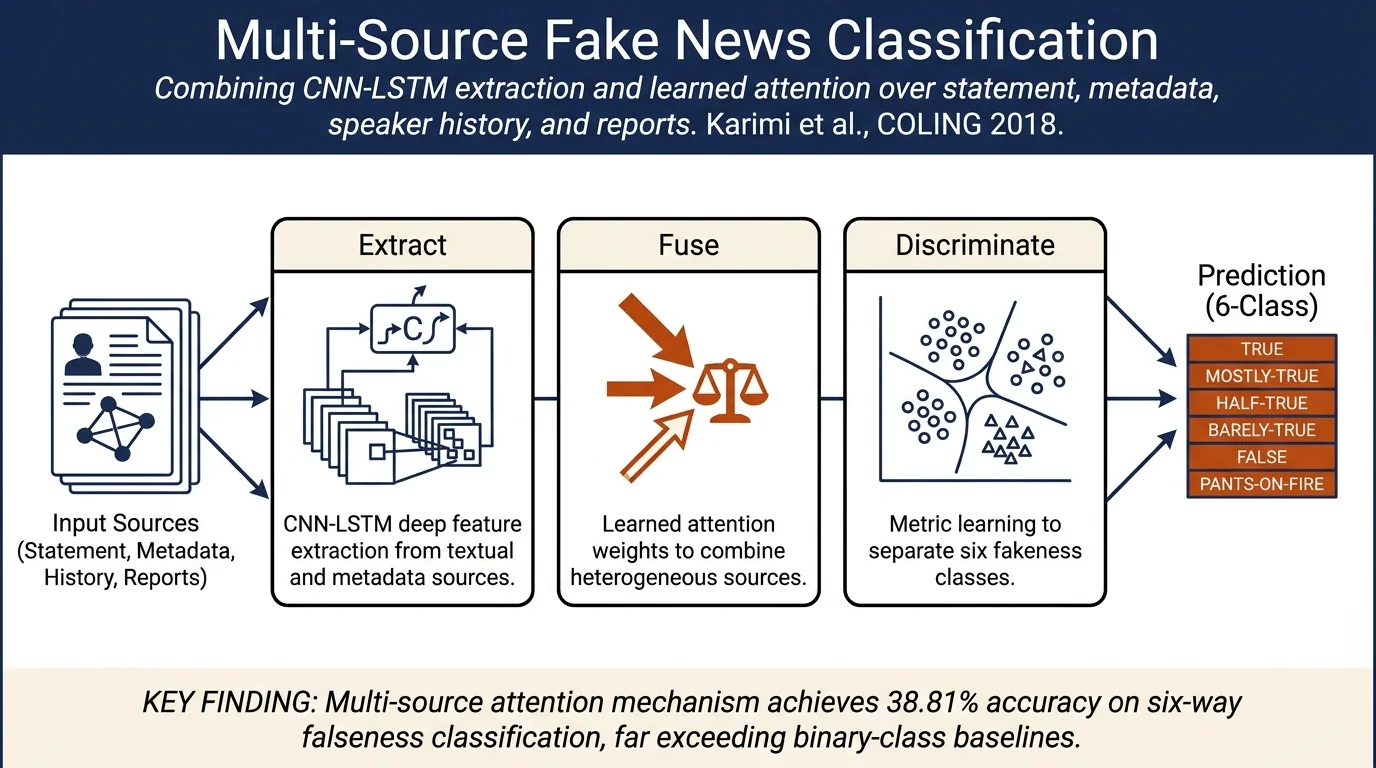
Multi-Source Multi-Class Fake News DetectionProposes MMFD, a multi-source multi-class fake news detection framework combining automated feature extraction (CNN-LSTM), interpretable multi-source fusion (attention mechanism), and fakeness discrimination. Achieves 38.81% accuracy on LIAR dataset across six classes of fakeness (true, mostly-true, half-true, barely-true, false,…
 Deepfakes & multimodalDetection methods
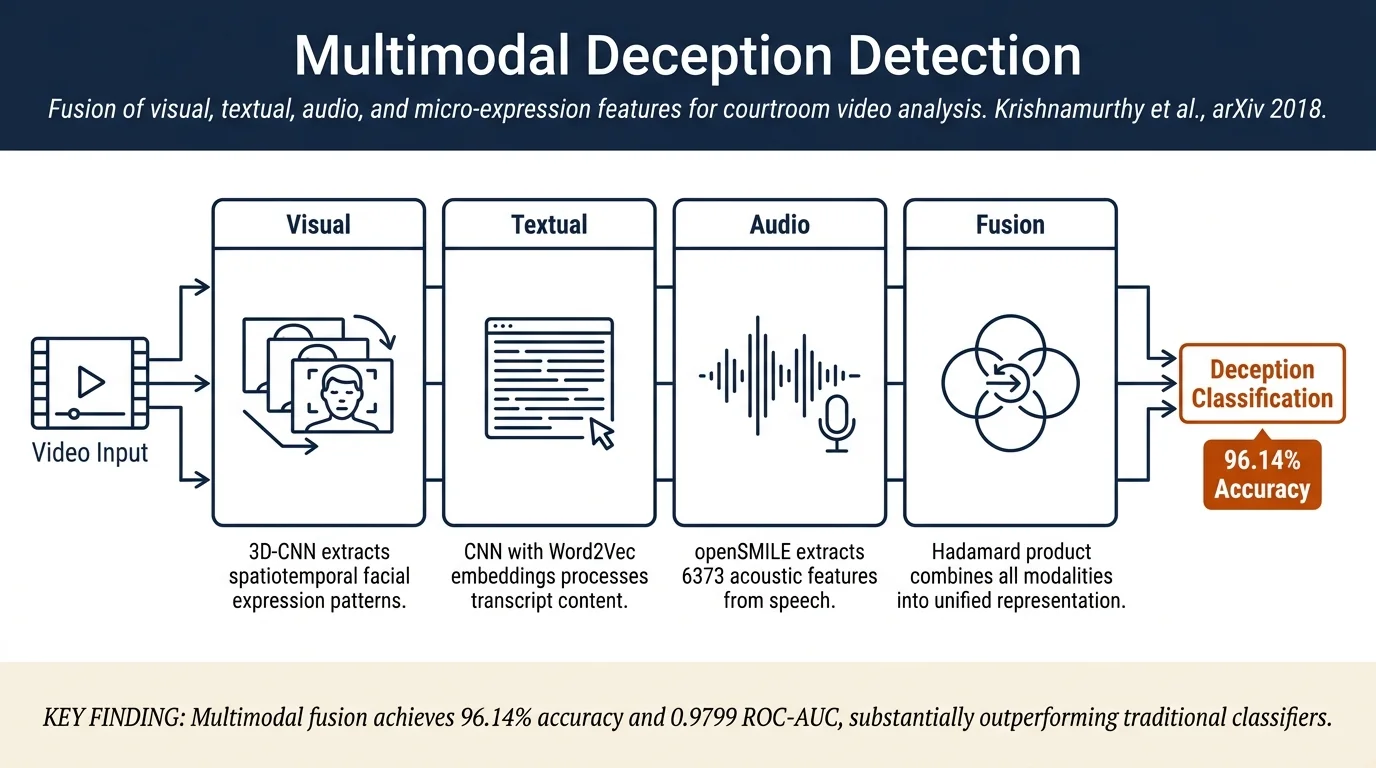
A Deep Learning Approach for Multimodal Deception DetectionThis paper proposes a multimodal neural model for detecting deception in real-life courtroom trial videos by combining visual features from 3D-CNN, audio features from openSMILE, textual features from CNN on transcripts, and manual micro-expression annotations. The model achieves 96.14% accuracy and ROC-AUC of 0.9799, substantially…
 Detection methodsDatasets & evaluation
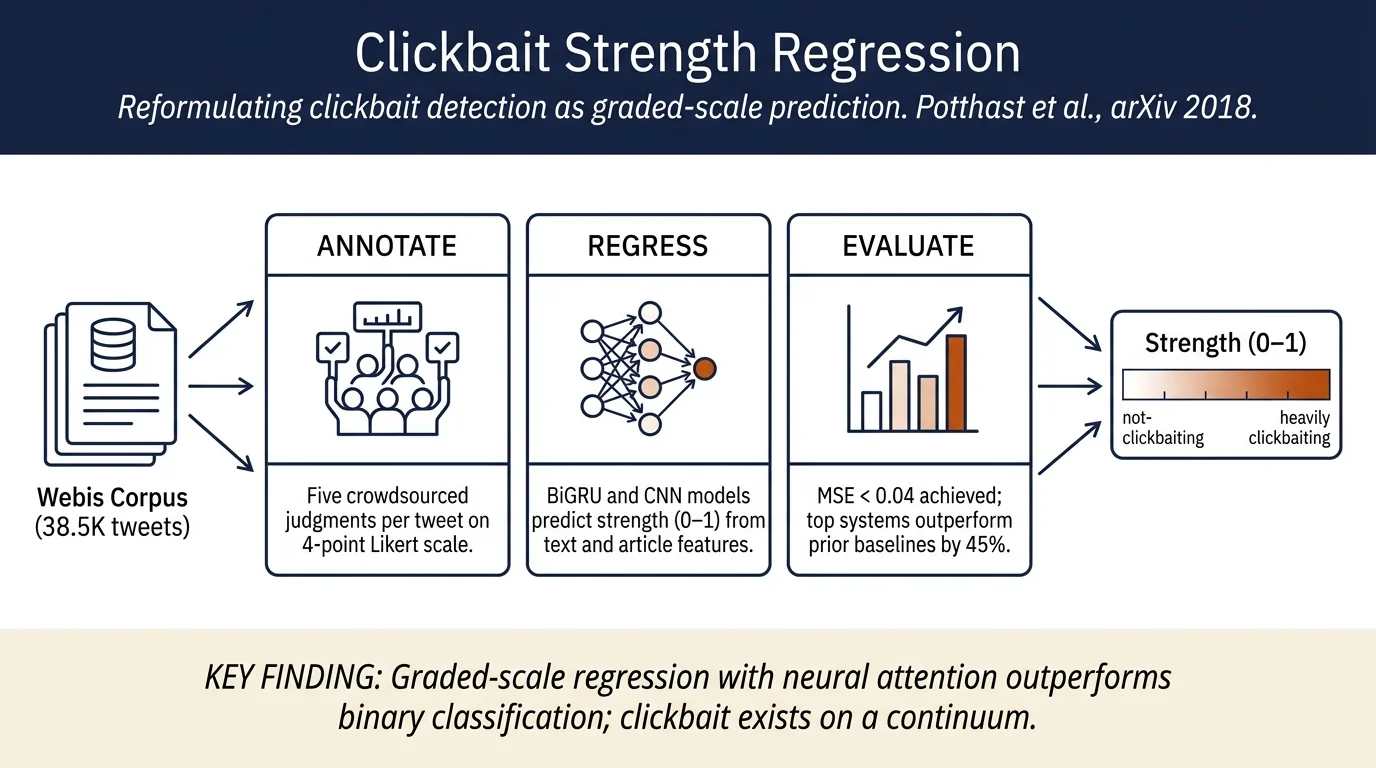
The Clickbait Challenge 2017: Towards a Regression Model for Clickbait StrengthClickbait detection is typically framed as binary classification, but teaser messages exhibit varying degrees of clickbaiting techniques. This paper organizes the Clickbait Challenge 2017, reformulating the task as regression to measure clickbait strength on a graded scale.
 Detection methodsDatasets & evaluation
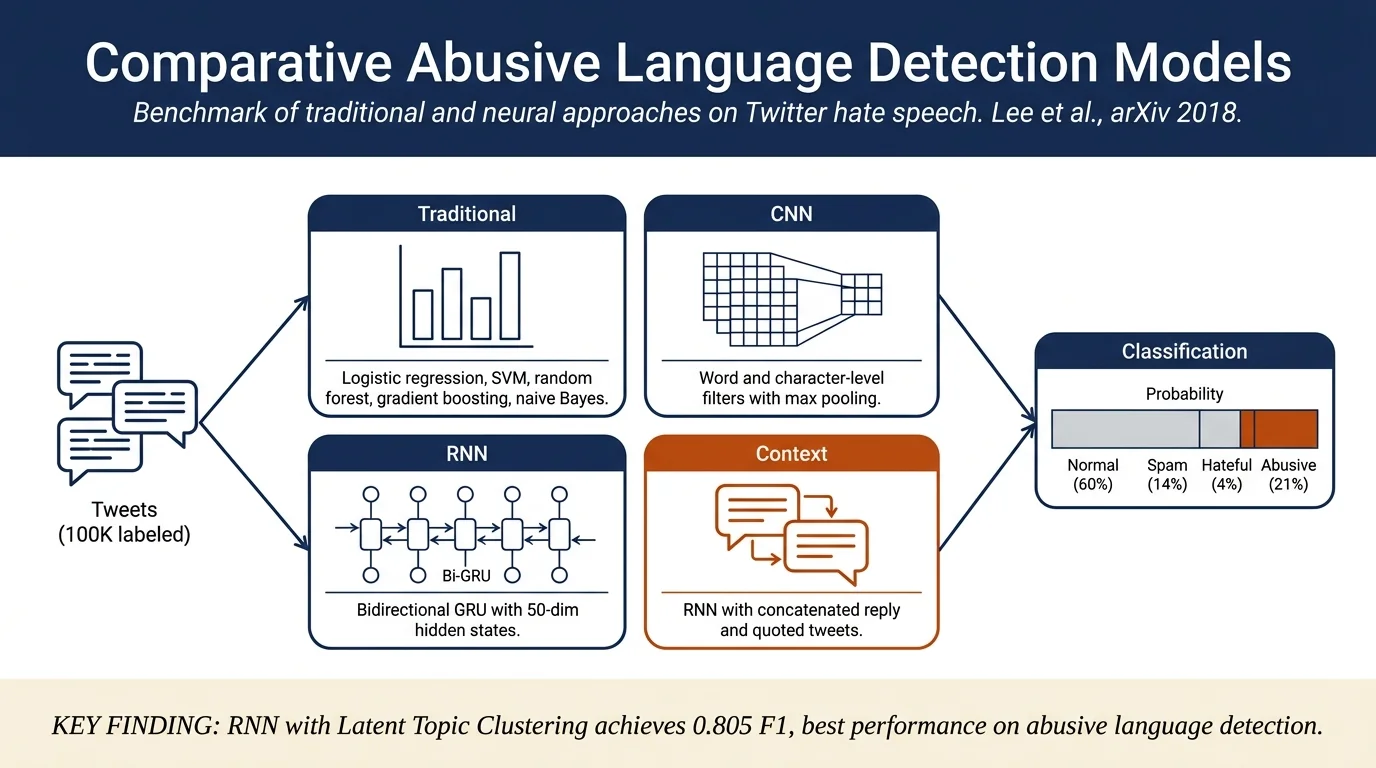
Comparative Studies of Detecting Abusive Language on TwitterConducts the first comprehensive benchmark of traditional machine learning and neural network models on the Hate and Abusive Speech on Twitter dataset (100K tweets). Bidirectional GRU networks with Latent Topic Clustering achieve the best performance (0.805 F1), outperforming traditional methods like logistic regression and SVM.
 Detection methodsLLMs & generative AI
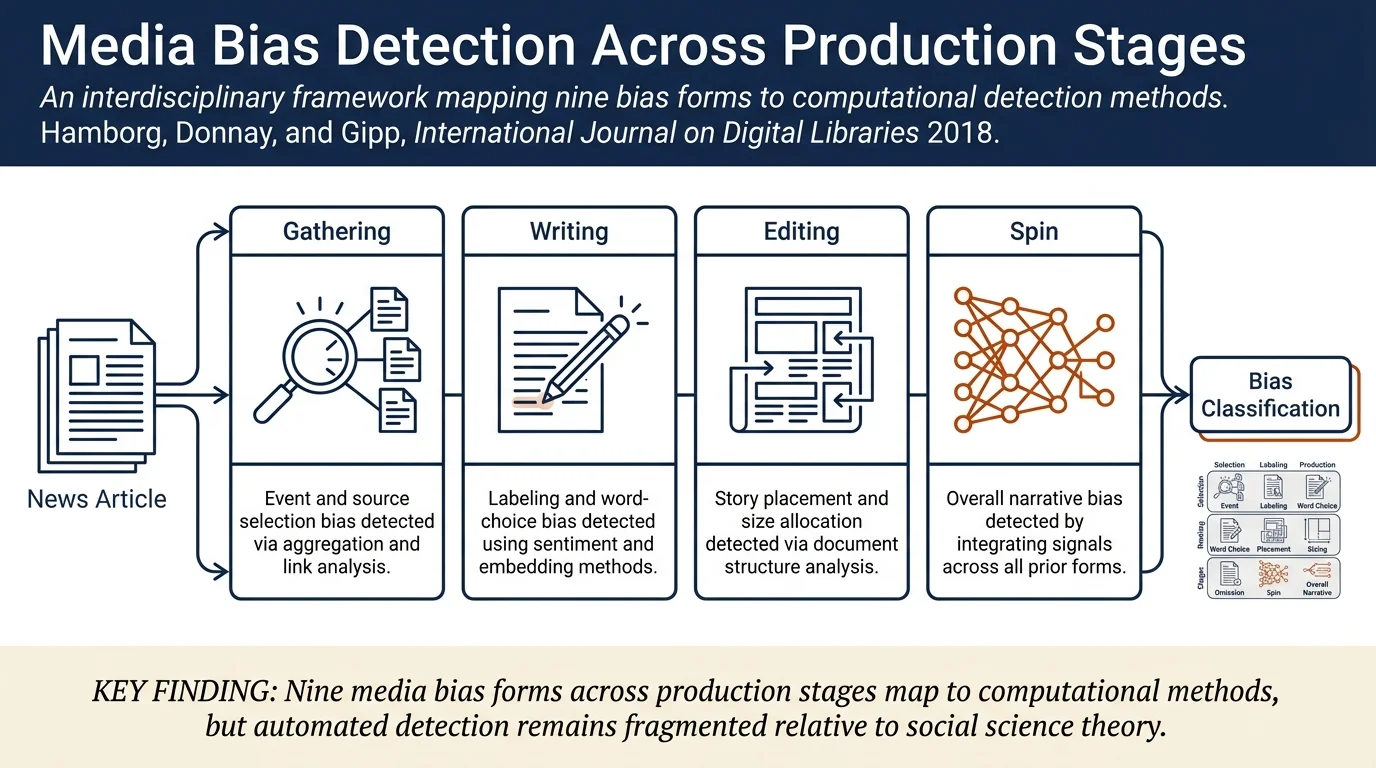
Automated identification of media bias in news articles: an interdisciplinary literature reviewThis paper surveys automated and manual methods for identifying media bias in news articles, bridging social science and computer science approaches. It defines nine distinct forms of media bias and maps social science research onto computational techniques, finding that NLP-based methods are promising for automated detection but remain…
 Platforms, policy & societyDeepfakes & multimodal
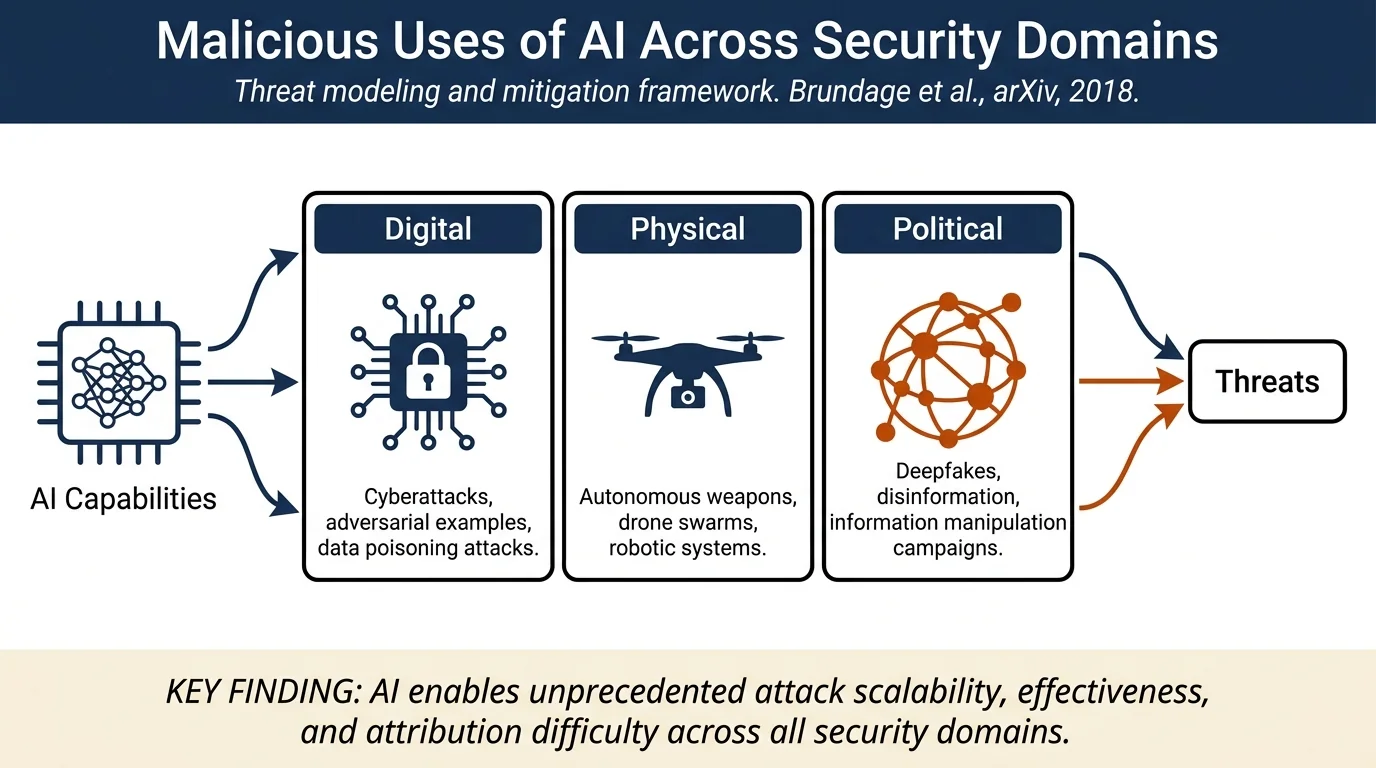
The Malicious Use of Artificial Intelligence: Forecasting, Prevention, and MitigationA landmark 2018 report surveying the landscape of potential security threats from malicious uses of AI across three domains—digital, physical, and political security. The work proposes frameworks for forecasting AI-enabled attacks, identifies specific threat scenarios including AI-generated disinformation and deepfakes, and recommends…
 Detection methodsDatasets & evaluation
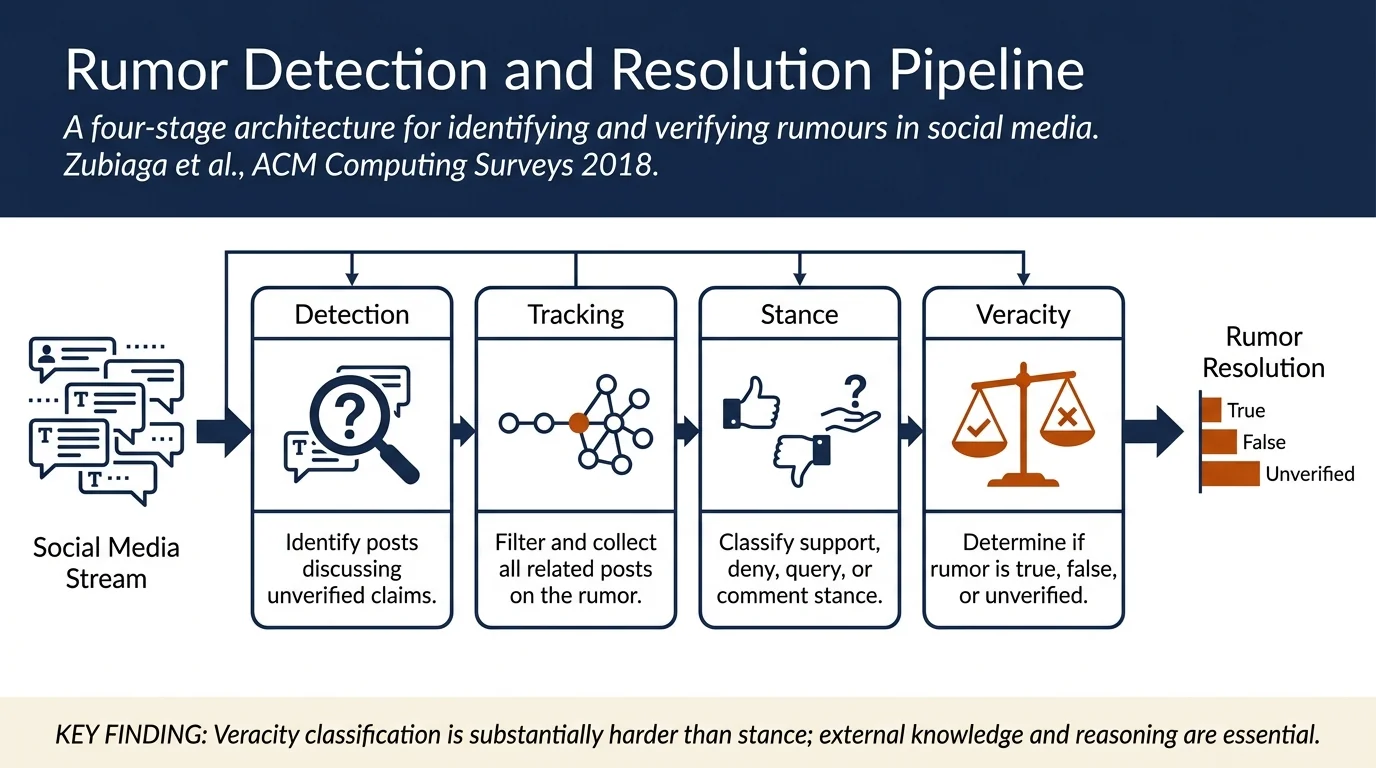
Detection and Resolution of Rumours in Social Media: A SurveyComprehensive survey of rumour detection and resolution in social media covering the entire pipeline: rumour definition and characterization, data collection strategies, annotation schemes, detection approaches for both emerging and long-standing rumours, tracking of rumour propagation, stance classification (support/deny/query/comment),…
 Deepfakes & multimodalDetection methods
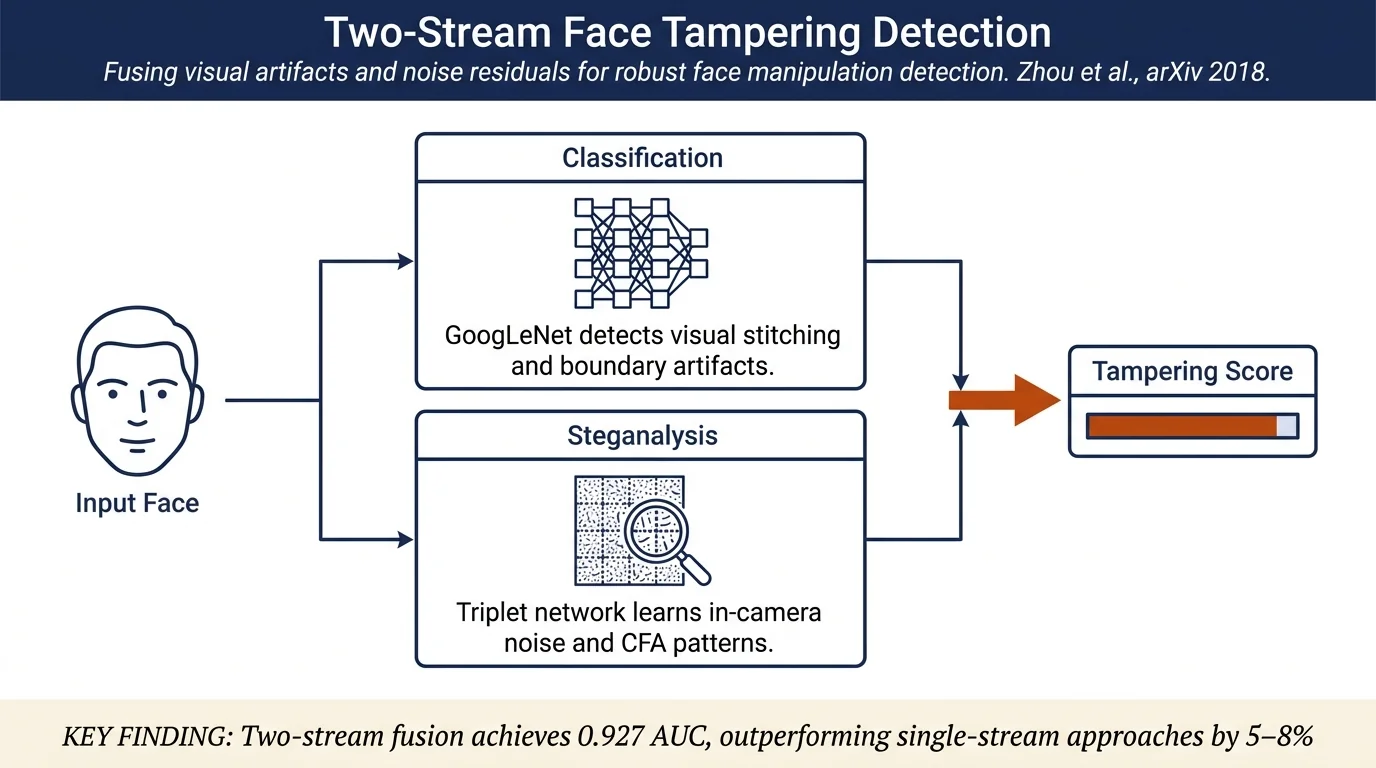
Two-Stream Neural Networks for Tampered Face DetectionThe paper proposes a two-stream neural network for detecting face tampering (face swaps) in images. One stream uses GoogLeNet to classify tampered faces by visual artifacts, while the second stream uses steganalysis features with a triplet network to capture low-level noise inconsistencies.
 Spread & networksDatasets & evaluation
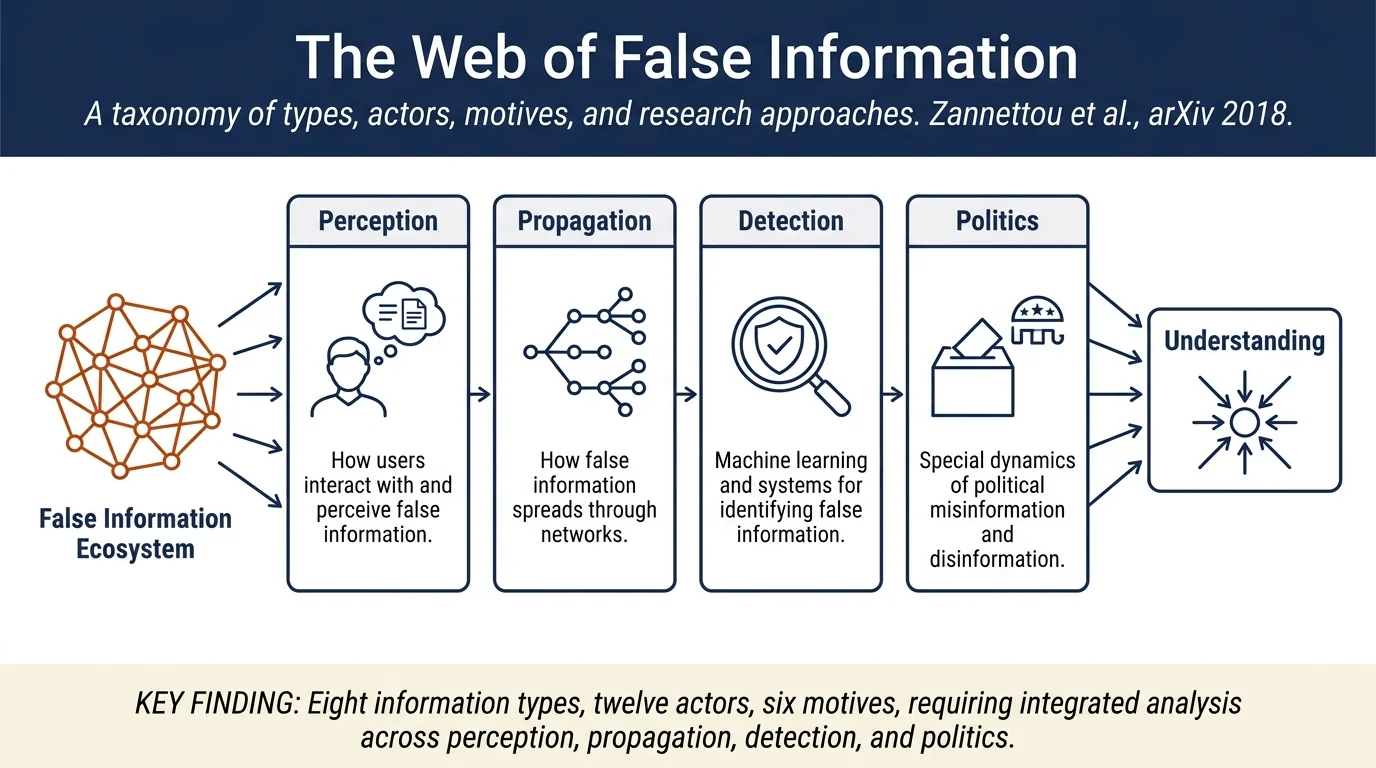
The Web of False Information: Rumors, Fake News, Hoaxes, Clickbait, and Various Other ShenanigansComprehensive typology of the false information ecosystem on the Web, identifying eight types of false information (fabricated stories, propaganda, conspiracy theories, hoaxes, biased news, rumors, clickbait, satire), twelve actor categories (bots, criminal organizations, activists, governments, paid posters, journalists, useful idiots,…
 Bots & coordinated campaignsSpread & networks
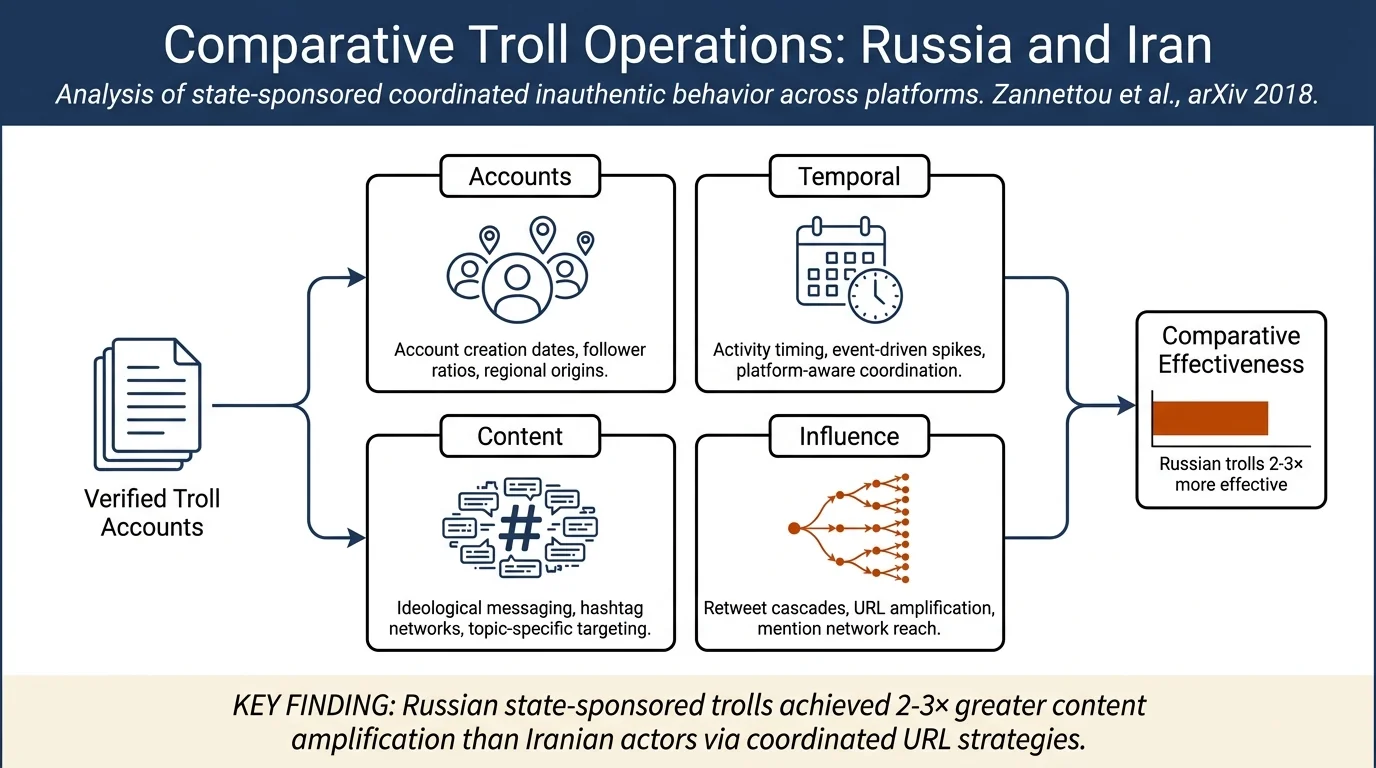
Who Let The Trolls Out? Towards Understanding State-Sponsored TrollsComparative analysis of 934 Russian and 770 Iranian state-sponsored trolls across Twitter and Reddit (10M posts) reveals distinct operational patterns: Russian trolls prioritized URL amplification (retweets, mentions) and pro-Trump messaging; Iranian trolls pursued regional and anti-Trump narratives motivated by real-world events. Both…
 Spread & networksBots & coordinated campaigns
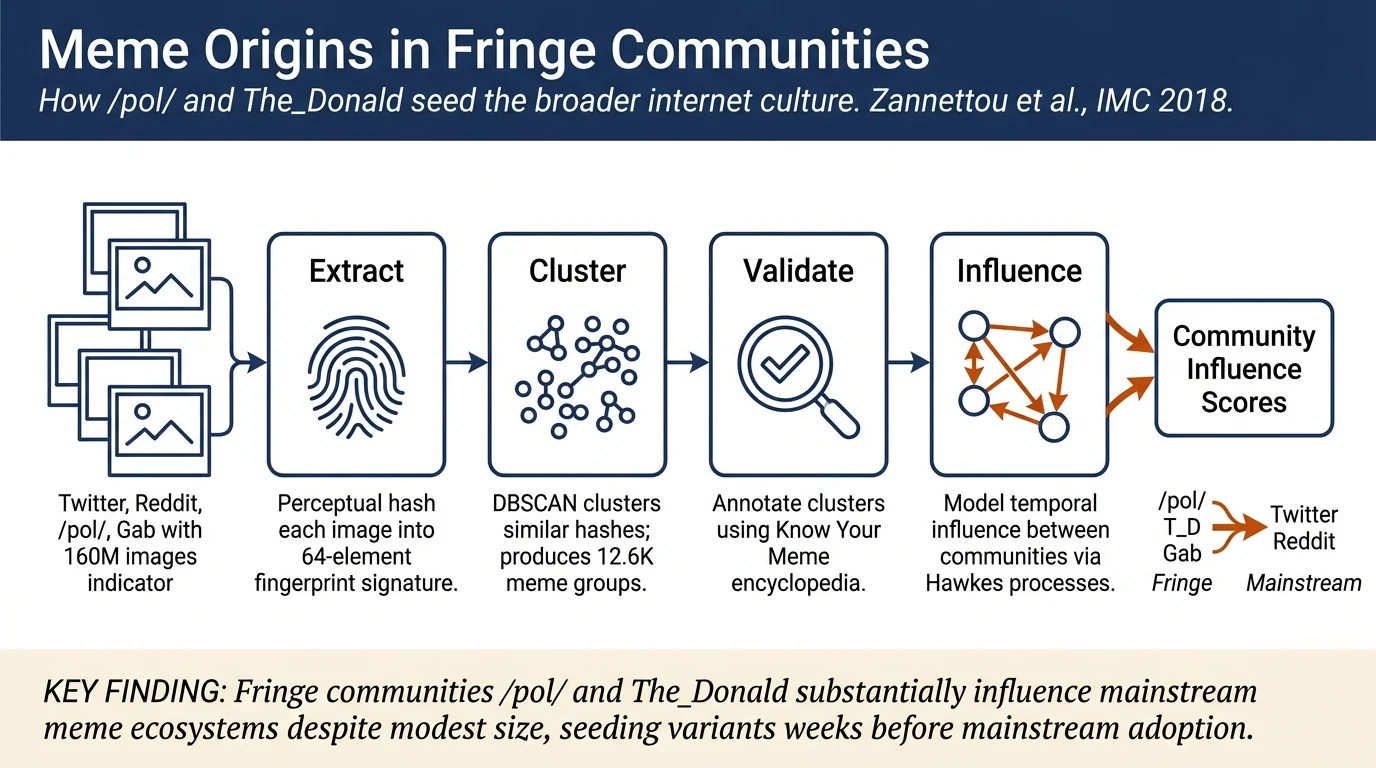
On the Origins of Memes by Means of Fringe Web CommunitiesLarge-scale empirical study of how image memes originate and propagate across fringe and mainstream Web communities. Analyzes 160M images posted to Twitter, Reddit, /pol/, and Gab (2016–2017) using perceptual hashing, clustering, and custom distance metrics.