Hate Lingo: A Target-based Linguistic Analysis of Hate Speech in Social Media
Authors: Mai ElSherief, Vivek Kulkarni, Dana Nguyen, William Yang Wang, Elizabeth Belding
Venue: ICWSM, 2018 — arXiv:1804.04257
TL;DR
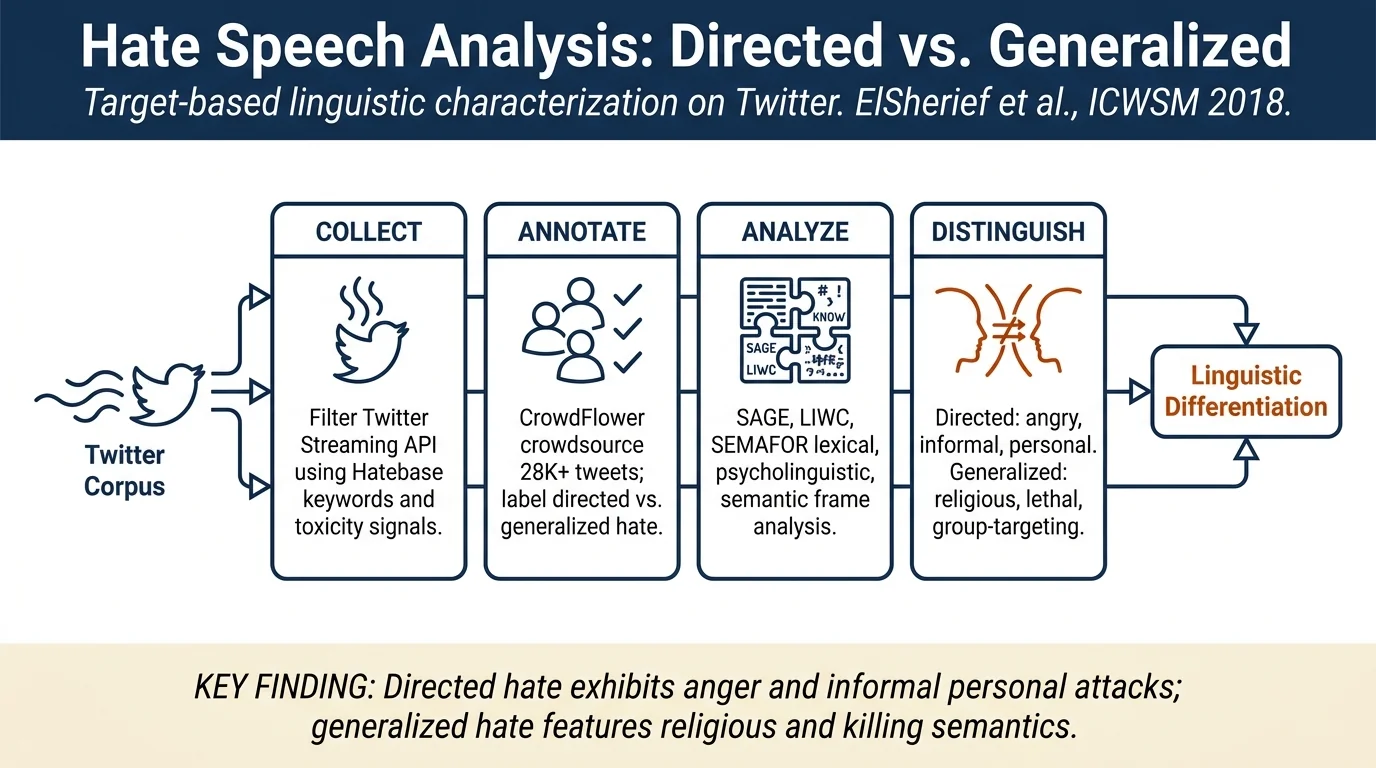
This paper presents the first large-scale linguistic and psycholinguistic analysis of hate speech categorized by its target: directed (personal attacks) versus generalized (targeting groups). The authors analyze 28,318 directed and ~2,500 generalized hate tweets, revealing that directed hate is more informal, angry, and explicitly attacks targets via name-calling; generalized hate is dominated by religious content and features lethal language and quantity words. The distinction has social and legal implications for free speech policy.
Contributions
- First extensive study of hate speech distinguished by target (individual vs. group), rather than just binary hate/non-hate classification
- Lexical analysis using SAGE (Sparse Additive Generative models) identifying salient words and semantic domains for each hate type
- Psycholinguistic analysis using LIWC showing directed hate exhibits higher clout, lower analytical thinking, and more anger than generalized hate
- Semantic frame analysis using SEMAFOR revealing directed hate invokes intentional acts and hindering frames; generalized hate evokes people-by-religion, killing, and quantity frames
- Curated dataset of 28,318 directed and ~2,500 generalized hate tweets with human annotation achieving high inter-rater reliability (Krippendorff's α = 0.622)
Method
The authors employ a multi-step dataset collection approach:
Data collection: From Twitter Streaming API (Jan 2016–July 2017), they filter using: (1) Hatebase keywords (using Perspective API to ensure high-quality toxicity scores), (2) hate-related hashtags, (3) existing public datasets (Waseem & Hovy, Davidson et al., NHSM), and (4) general 1% sample for baseline comparison. To ensure directed hate targets individuals, they require @-mentions and second-person pronouns.
Annotation: 2,000-tweet sample annotated via CrowdFlower with 3+ independent annotators per tweet; annotators filtered to 80% accuracy baseline. Final dataset achieves 97.8% agreement on directed hate detection and 94.3% agreement on directedness classification.
Linguistic analysis: - SAGE: Supervised topic modeling to extract salient words distinguishing directed vs. generalized hate within each category (archaic, class, disability, ethnicity, gender, nationality, religion, sexual orientation) - Named Entity Recognition (T-NER): Extract entities to characterize what/who is being attacked - LIWC 2015: Psycholinguistic lexicon measuring analytic thinking, clout, authenticity, emotional tone, informality, social language, pronouns, negative emotions, temporal focus, personal concerns - SEMAFOR: Semantic frame analysis to identify high-level conceptual frames evoked (e.g., intentional acts, people-by-religion, killing)
Results
Lexical findings: - Directed hate shows minimal word overlap with generalized hate; each category (disability, ethnicity, etc.) has distinct topics - Entity analysis: Directed hate has 55.8% person mentions vs. 42.1% in generalized hate; generalized contains more religious entities (Islam, Jews, Muslims, Christians)
Psycholinguistic findings: - Directed hate: higher clout (μ = 70.7, p < 0.001) and lower analytical thinking (μ = 43.9, p < 0.001) - Directed hate: higher informality (μ = 17.1) and social language (μ = 16.1) - Generalized hate: emphasizes third-person pronouns ("they," 1.4 vs. "we," 0.5; 2.8× difference, p < 0.001) - Directed hate: higher anger (μ = 7.6) > Generalized (μ = 3.6) > General (μ = 0.9) - Generalized hate: higher death references (μ = 1.2, p = 0.1) vs. Directed (μ = 0.34, p < 0.001)
Semantic frames: - Directed hate evokes intentionally_act (0.05, p < 0.01), statement, and hindering frames - Generalized hate evokes people_by_religion (0.06, p < 0.01), killing (0.03), and quantity frames - Top words for directed: do, did, get, mentions, retard, retarded - Top words for generalized: kill, murder, exterminate, jews, christians, muslims, million
Connections
- Hate speech detection — foundational linguistic characterization of hate speech types
- Toxicity detection — psycholinguistic markers of toxicity differentiate personal vs. group-targeted abuse
- Linguistic Analysis of Fake News — demonstrates application of LIWC, frame semantics, and sparse additive models to offensive language
- Content moderation — implications for platform moderation policy distinguishing directed vs. generalized threats
Notes
Strengths: Rigorous human annotation pipeline (high inter-rater reliability); multi-faceted linguistic analysis (lexical, psycholinguistic, semantic) revealing nuanced distinctions; large, well-curated dataset; clear social/legal implications (First Amendment framing). The distinction between directed and generalized hate is practically useful for moderation and policy.
Limitations: Twitter-only; relies on keyword filtering (may miss implicit hate); annotators recruited from CrowdFlower (potential cultural/geographic biases); SEMAFOR not trained on Twitter may introduce domain-shift errors. The paper acknowledges that generalized hate can have wider mobilization impact than individual attacks, complicating the legal framing.
Follow-ups: Could extend to other platforms (Facebook, TikTok, Reddit); explore whether directed vs. generalized distinction predicts effectiveness of counter-speech or moderation interventions; investigate whether the linguistic markers generalize cross-lingually or across different subcommunities.