Combating Fake News with Interpretable News Feed Algorithms
Authors: Sina Mohseni, Eric D. Ragan Venue: arXiv, 2018 — 1811.12349
TL;DR
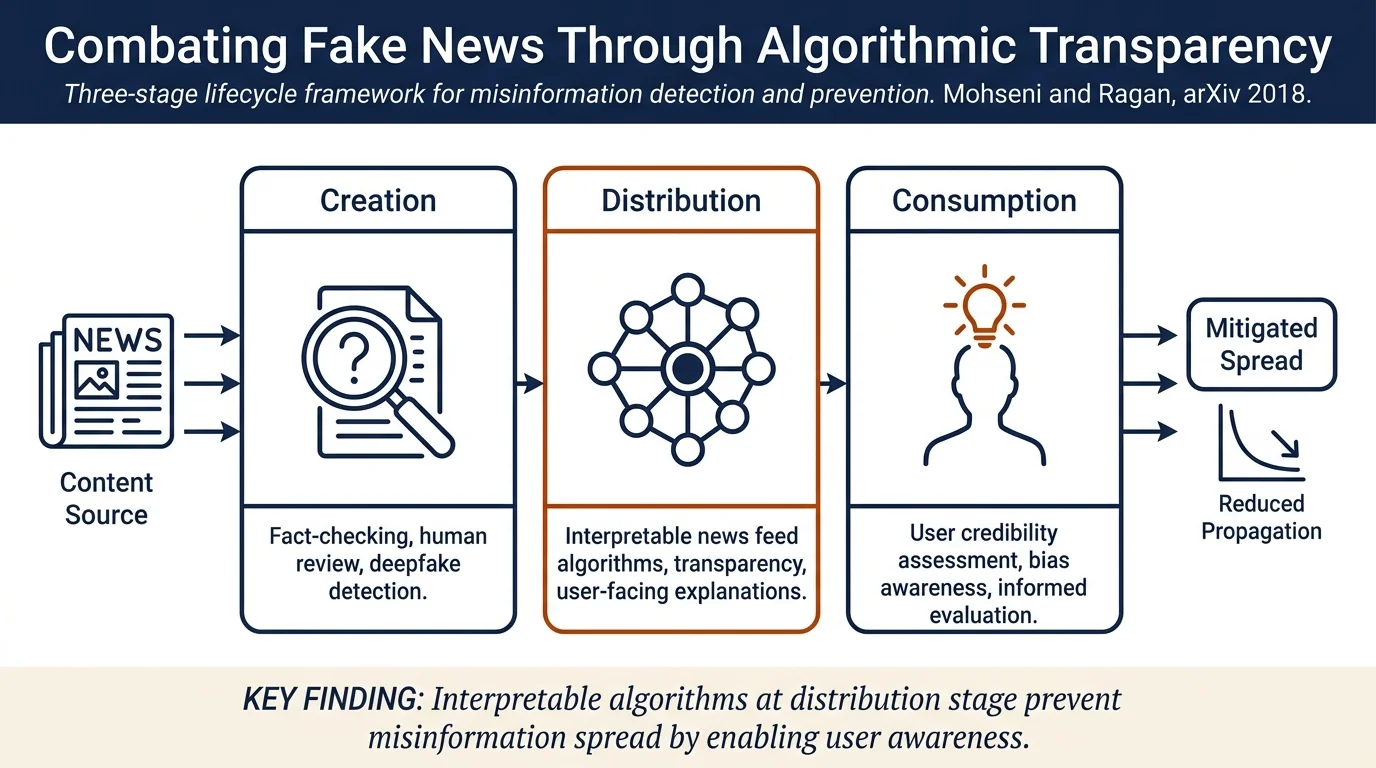
This position paper reviews fake news detection methods and argues that news feed algorithms are insufficiently transparent, enabling echo chambers and filter bubbles that amplify misinformation. The authors propose interpretable and explainable news feed algorithms as a solution, positioning transparency and user awareness as critical for combating fake content propagation at the distribution stage.
Contributions
- Comprehensive review of fake news detection across three lifecycle stages: creation (human review, content analysis), distribution (news feed algorithms), and consumption (propagation analysis, credibility assessment)
- Analysis of how news feed algorithms create echo chambers and filter bubbles, isolating users to specific perspectives and reinforcing confirmation bias
- Discussion of algorithmic bias, paid content targeting, and user data misuse in news recommendation systems
- Argument that interpretable and transparent news feed algorithms can increase user awareness and mitigate unwanted outcomes of algorithmic curation
- Framework positioning algorithmic transparency as a necessary complement to traditional fake news detection methods
Method
The paper synthesizes existing literature on fake news detection, news feed algorithms, and algorithmic transparency. It categorizes fake content detection approaches:
- Creation stage: Expert human review and fact-checking (slow but expensive), crowdsourced fact-checking (scalable but quality-variable), automated detection of forged visual content (deepfakes, manipulated images)
- Distribution stage: News feed algorithms and recommender systems that can be misused to promote falsified content; diversity measures and interpretable recommendation as countermeasures
- Consumption stage: Analysis of user stance, source credibility, and spreading patterns to identify suspicious content post-hoc
The paper emphasizes that while detection methods address content already exposed to users, interpretable news feed algorithms can prevent propagation before spread occurs by providing users with explanations of why content is selected, enabling them to detect bias and review system parameters.
Results
No empirical results—this is a position and review paper. However, the authors synthesize evidence from cited work:
- Users lack awareness of how news feed algorithms work and whether they introduce bias
- Recommendation algorithms expose users to narrower item sets over time, confirming the filter bubble effect
- Personalized news feeds can create echo chambers that reinforce confirmation bias and polarization
- Paid content can bypass regulations and target users for political manipulation (Cambridge Analytica case)
- Interpretable ML explanations improve user trust and awareness in recommendation systems, with evidence from product recommendations and preliminary news feed studies
Connections
- Lazer et al. (2018) — multidisciplinary synthesis framing fake news as involving prevalence, impacts, psychological mechanisms, and platform interventions
- Shu et al. (2017) — comprehensive data mining perspective on fake news detection, identifying detection gaps at distribution stage (the focus of this paper)
- Bail et al. (2018) — empirical evidence that algorithmic exposure to opposing views can backfire and increase polarization
- Stella, Ferrara & De Domenico (2018) — evidence of bot-driven amplification of inflammatory content through news feeds
- Cinelli et al. (2021) — large-scale comparative analysis of echo chambers across platforms, showing feed algorithms determine segregation outcomes
- Wardle & Derakhshan (2017) — complementary framework for understanding misinformation, disinformation, and mal-information
- Related to governance frameworks for algorithmic transparency and AI alignment addressing policy frontiers
Notes
Strengths: - Broad integrative view connecting fake news detection to algorithmic curation, identifying the distribution stage as understudied - Clear articulation of the echo chamber and filter bubble problem and their relationship to algorithm design - Emphasis on user awareness and transparency as preventive rather than reactive measures - Timely positioning of algorithmic explainability as a solution (pre-2019 before major advances in interpretable ML)
Limitations: - Position paper with no original empirical work; synthesizes existing literature without novel data or methods - Limited discussion of technical approaches to interpretability or how explanations should be designed for news feed contexts - Does not address the tension between algorithmic transparency and model performance (acknowledged in the field) - User preference differences for explanation interfaces and parameters not deeply explored; treats transparency as universally beneficial
Open questions: - How do users actually interact with transparent, explainable news feed algorithms in practice? (Later work begins to address this) - What level of explanation granularity is needed for users to detect bias without cognitive overload? - Can interpretability be reconciled with computational efficiency in real-world deployed systems? - Do users maintain engagement with systems that reduce algorithmic personalization in favor of diversity?