The Science of Fake News
Authors: David Lazer, Matthew Baum, Yochai Benkler, Adam Berinsky, Kelly Greenhill, Filippo Menczer, Miriam Metzger, Brendan Nyhan, Gordon Pennycook, David Rothschild, Michael Schudson, Steven Sloman, Cass Sunstein, Emily Thorson, Duncan Watts, Jonathan Zittrain
Venue: Science, 2018 — DOI
TL;DR
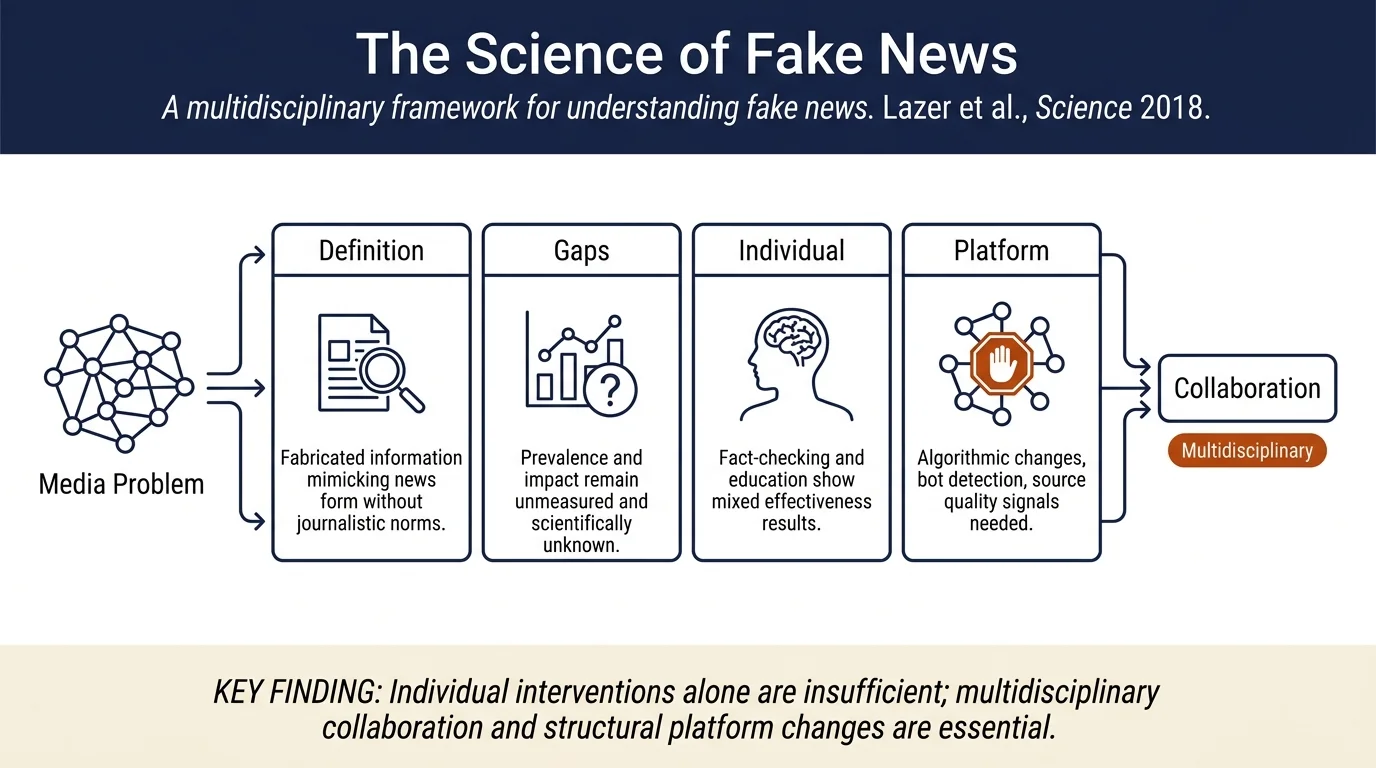
This multidisciplinary review establishes a scientific framework for studying fake news, defining it as fabricated information that mimics news media form but lacks editorial norms. The paper identifies two mitigation strategies—empowering individuals through fact-checking and education, and structural platform interventions—while highlighting pervasive gaps in knowledge about fake news prevalence, impact, and effective countermeasures. The authors call for interdisciplinary collaboration between platforms and researchers to understand the scale of the problem.
Contributions
- Provides a rigorous scientific definition of fake news as a distinct category within misinformation
- Establishes that traditional journalistic norms and media trust have eroded due to technological and geographic polarization shifts
- Documents the prevalence problem: limited data on how many Americans encounter fake news and what impact it has
- Reviews existing mitigation approaches (fact-checking, education, platform interventions) with evidence of their mixed effectiveness
- Identifies the role of social bots and algorithmic amplification in fake news spread
- Calls for multi-institutional collaboration and open data access to advance the science
Definition and Context
Fake news is defined as "fabricated information that mimics the output of the news media in form, but not in organizational process or intent." It is a subset of misinformation (incorrect or misleading information). The paper traces the historical bulwarks against misinformation—journalistic norms of objectivity and balance that emerged after World War I propaganda—and shows how the Internet has dismantled the media oligopolies that sustained these norms. U.S. newspaper circulation fell 30% from 1990 to 2012, and trust in media collapsed, especially among Republicans (from 41% in 1997 to 14% by 2016). Geographic polarization and homogenous social networks have created conditions where fake news can thrive.
Prevalence and Impact
A central gap the paper identifies is the lack of scientific answers to basic questions: How prevalent is fake news? How much impact does it have? One study estimated the average American encountered 1–3 fake news stories in the month before the 2016 election, but this likely underestimates. The paper notes that exposure does not equal impact, and that measuring the medium- to long-run effects of fake news exposure on political behavior is almost nonexistent in the literature. Researchers need collective resources to evaluate how news exposure affects actual people.
Individual-Level Interventions
Fact-checking: Despite its intuitive appeal, evidence for fact-checking's effectiveness is mixed. People prefer media for gratification over truth-seeking, exhibit selective exposure to ideologically compatible news, and display confirmation bias. Crucially, those most deceived by fake news are least likely to believe corrections. Memory effects also complicate fact-checking: unless conducted carefully, it may increase familiarity and acceptance of false claims.
Education: There has been a proliferation of efforts to teach critical information skills in schools, but the paper finds no research on the causal impact of such training on accurate news source credibility assessment. Moreover, emphasizing fake news may unintentionally reduce perceived credibility of real news outlets.
The paper concludes that individual-level interventions alone are insufficient, as they conflict with broader patterns of collective cognition and structural polarization.
Platform-Based Interventions
The paper highlights that approximately 44% of Americans get news from social media, with Facebook dominant. Platforms are designed to maximize engagement through complex statistical models and personalization algorithms, which may amplify selective exposure. Bots and cyborgs manipulate platforms extensively—they were responsible for significant political content during the 2016 campaign and have attempted to influence other elections.
Possible platform interventions include: - Providing users signals of source quality - Incorporating source quality into algorithmic rankings - Minimizing personalization of political information - Excluding bot activity from trending metrics - Curbing automated spread of news by bots and cyborgs
The paper emphasizes that platform claims about their effectiveness (e.g., Facebook's claim that manipulations account for less than 0.1% of civic content) are unverifiable and self-serving. It advocates for transparent, third-party audits of how major platforms filter information.
Call for Collaboration and Regulation
The paper argues for ethical responsibility of platforms to collaborate with academics on evaluating the scope of the problem and effectiveness of interventions. It discusses regulatory options—direct government regulation carries risks of impartiality, while tort liability under Section 230 of the Communications Decency Act faces legal obstacles. The fundamental question is how the vast powers of Internet oligopolies should be exercised.
Connections
- Foundational for fake news detection literature; directly shapes research agenda
- Cites extensive literature on confirmation bias and selective exposure
- Related to platform accountability and algorithmic filter bubbles
- Builds on post-WWII propaganda research by Lazarsfeld and others
- Directly referenced by subsequent misinformation intervention studies
- Establishes multidisciplinary framing adopted in computational propaganda research
Notes
This paper is foundational in establishing fake news as a legitimate scientific problem deserving multidisciplinary attention. Its definition is widely adopted in subsequent research, though some scholars debate the "fake news" terminology given its political weaponization. The paper's honest assessment of knowledge gaps—particularly on prevalence and long-term impact—sets a rigorous bar for the field and has driven subsequent empirical work. The 2018 publication date places it early in the modern fake news research era (post-2016 election), and its call for platform-academic collaboration has influenced the landscape, though with mixed results due to platform resistance to scrutiny. The technical discussion of bots and algorithmic amplification remains prescient given subsequent research on coordinated inauthentic behavior and content moderation.