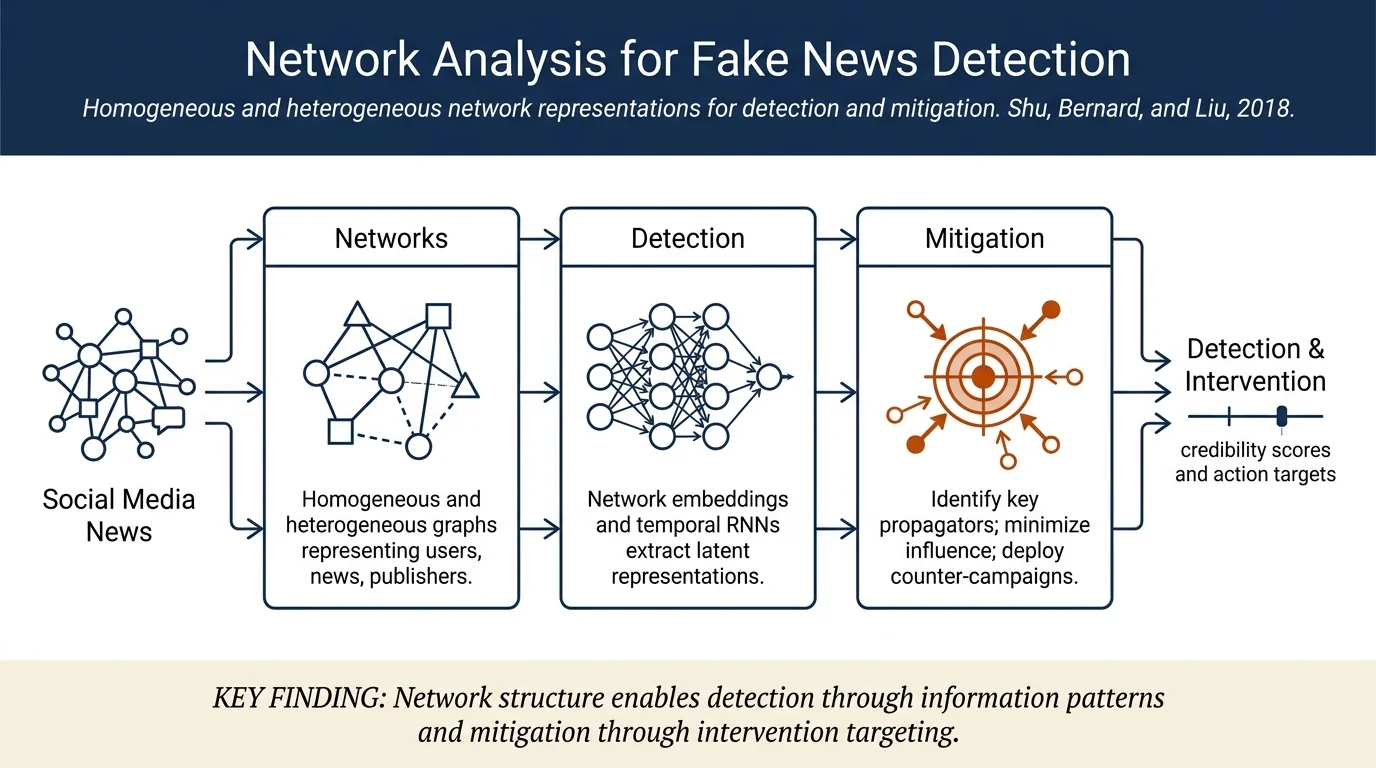
Studying Fake News via Network Analysis: Detection and Mitigation
Authors: Kai Shu, H. Russell Bernard, Huan Liu
Affiliation: Arizona State University
Year: 2018 — arXiv:1804.10233
TL;DR
This chapter surveys network-based approaches to fake news detection and mitigation on social media, organizing fake news dissemination along three dimensions (content, social, temporal) and introduces methods exploiting network structure: homogeneous networks (friendship, diffusion, credibility) and heterogeneous networks (knowledge, stance, interaction) for detection; mitigation strategies include identifying key propagators, estimating affected populations, and intervention through user blocking or mitigating campaigns.
Contributions
- Comprehensive framework characterizing fake news dissemination via three interdependent dimensions: content (news pieces), social (publishers, spreaders, consumers), and temporal (timeline of engagement)
- Detailed treatment of network properties enabling fake news spread: echo chambers, individual user roles (persuaders, gullible users, clarifiers), filter bubbles, and malicious accounts (bots, trolls, cyborg users)
- Taxonomy of six network types: three homogeneous (friendship, diffusion, credibility) and three heterogeneous (knowledge, stance, interaction) applicable to fake news research
- Technical methods for detection via network embeddings and temporal representations: interaction network embedding using nonnegative matrix factorization; user and news embeddings from user-credibility bipartite graphs; temporal RNN models capturing engagement sequences
- Mitigation strategies: provenance identification via information propagation models; K-leader selection for persuader identification; network size estimation for quantifying impact; influence minimization and mitigating campaigns to interrupt or redirect information flow
- Knowledge network matching using path finding and flow optimization to fact-check news claims against structured knowledge bases
Method
The paper introduces multiple network representations and feature learning approaches:
Network Types: Homogeneous networks (same node type, e.g., users connected via friendships) capture structural relationships; heterogeneous networks (multiple node types, e.g., users, news, publishers, knowledge entities) encode interactions. Credibility networks are undirected graphs where edge weights represent agreement or opposition on viewpoints, useful for inferring news veracity.
Detection via Interaction Network Embedding: Embeds different entity types (news, users, publishers) into shared latent space via nonnegative matrix factorization. News embedding uses document-word matrix and low-rank factorization; user embedding preserves social homophily and credibility correlation; publisher embedding incorporates partisan bias signals. Learned latent features are combined into coherent news representation for classification.
Temporal Diffusion Representation: Models news dissemination as temporal sequence of user engagements. Recurrent neural networks (RNNs) process engagement sequences to extract temporal features (number of engagements, time intervals, content). RNNs with embedding layer + fully connected layer enable transfer of temporal patterns to downstream fake news classification.
Friendship Network Embedding: Preserves structural properties (first-order proximity via adjacency, second-order proximity via shared neighbors, community structure) via community-preserving node embedding (e.g., DeepWalk, LINE, Modularized Nonnegative Matrix Factorization). Learns latent user representations reflecting polarization and echo chamber effects.
Credibility Network Propagation: Optimizes credibility scores of social media posts via Belief Propagation, leveraging relationships where supporting posts raise credibility and conflicting posts lower it. Iterative update rules propagate credibility from initial estimates to convergence.
Knowledge Network Matching: Fact-checking via knowledge graphs (e.g., YAGO, DBdata) by: i) path finding — locate all knowledge paths from claim subject to object; ii) specificity scoring — fewer paths indicate more specific/trustworthy claims; iii) flow optimization — compute maximum-flow minimum-cost for redundancy and robustness.
Stance Network Aggregation: Infers news veracity from user stances via Beta-Binomial model capturing user credibility (reliability to identify true vs. false news) and news veracity (propensity to elicit controversial stances). Semi-supervised learning with partially labeled data.
Results
The paper does not present empirical benchmark results, instead providing conceptual frameworks and algorithms for practitioners. Key technical contributions:
- Interaction network embedding via low-rank NMF with optimization objectives balancing user-credibility correlation and publisher-bias signals
- Temporal RNN framework for news representation learning from engagement sequences
- Provenance path identification in diffusion networks via degree/closeness centrality heuristics, approximable in polynomial time
- K-leader identification as submodular optimization problem with constant approximation
- Influence minimization via Independent Cascade Model with blocking strategies
- Mitigating campaign framework using Multivariate Hawkes Processes to maximize exposure to both fake and real news
Connections
- Shu et al. (2017) — Fake News Detection on Social Media — earlier survey organizing detection by content vs. context; this chapter extends with detailed network methods
- Shu et al. (2018) — FakeNewsNet — benchmark dataset with social context; provides evaluation platform for methods in this chapter
- Zhou & Zafarani (2020) — surveys detection approaches across four perspectives (knowledge, style, propagation, credibility); this chapter deep-dives on propagation and credibility via networks
- Propagation-based fake news detection — shared focus on information diffusion structure for detection
- Information diffusion in social networks — foundational topic on how cascades spread; this chapter applies to misinformation context
- Credibility assessment for fake news detection — network-based credibility inference via user stance integration
- Echo Chambers — network property explaining fake news susceptibility via homophily
Notes
Strengths: Comprehensive treatment bridging network science and misinformation research; systematic taxonomy of homogeneous and heterogeneous networks; conceptual clarity on how network structure enables both detection (information traces patterns) and mitigation (intervention points). Positions network analysis as complementary to content-based methods.
Weaknesses: No empirical evaluation on benchmark datasets; methods described algorithmically but comparison with baselines or ablation studies absent. Knowledge network matching assumes curated knowledge bases (YAGO, DBdata) which may be incomplete or biased. Mitigation strategies (influence minimization, campaigns) focus on network topology but assume known propagation probabilities and influence functions, which are difficult to estimate in practice. Limited discussion of adversarial robustness or how malicious actors might evade detection via network manipulation.
Open questions: How well do these methods generalize across platforms (Twitter, Facebook, Reddit) with different network structures? How sensitive are results to incomplete or noisy network information? Can network-based detection be deployed in near-real-time given computational complexity of some algorithms? How do network interventions interact with platform-level content moderation?