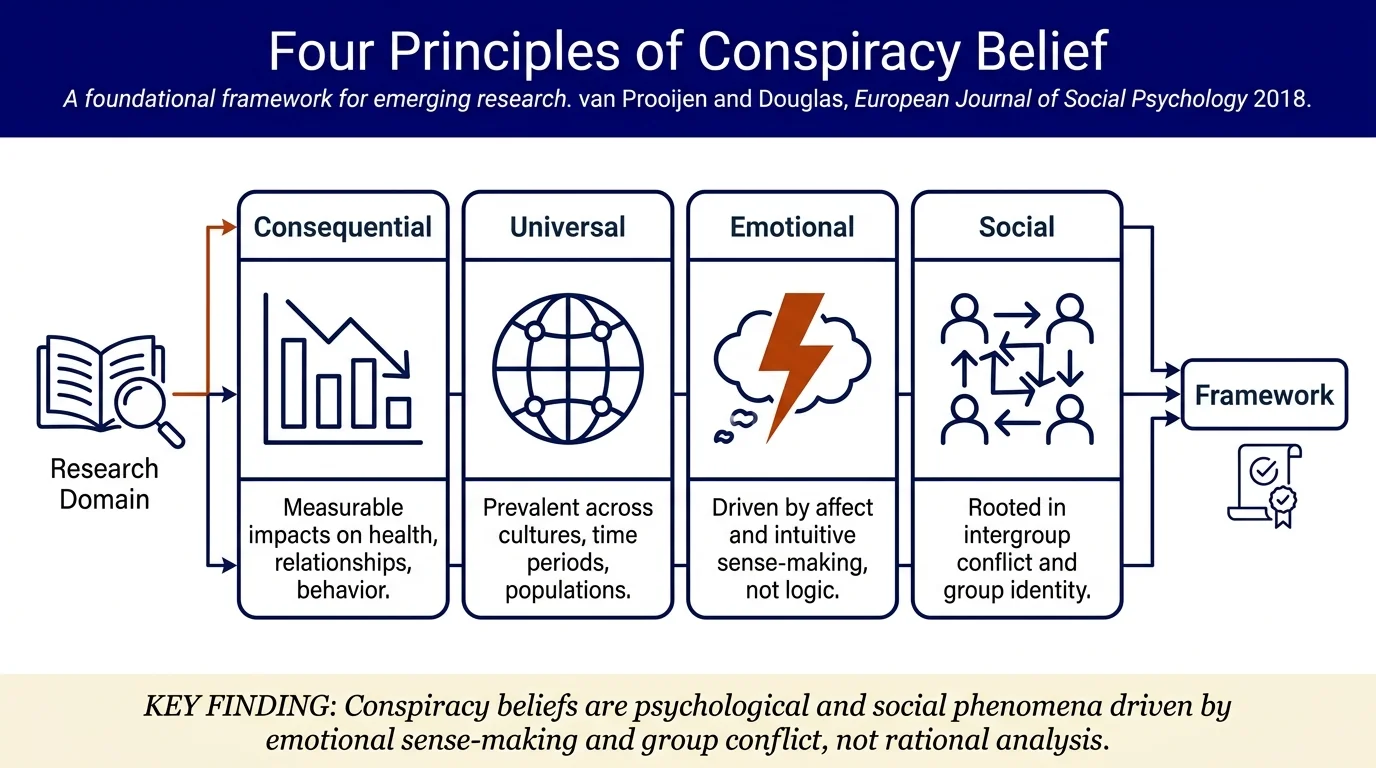
Belief in conspiracy theories: Basic principles of an emerging research domain
Authors: Jan-Willem van Prooijen, Karen M. Douglas
Venue: European Journal of Social Psychology, Vol. 48(4), 2018 — DOI
TL;DR
This special issue introduction proposes four foundational principles for the emerging scientific study of conspiracy belief: conspiracy beliefs are consequential (with real impacts on health and relationships), universal (across cultures and historical periods), emotional (driven by sense-making rather than logic), and social (rooted in intergroup conflict). Together these principles provide a framework for understanding why conspiracy theories appeal to people across diverse contexts and what consequences they produce.
Contributions
The paper articulates an organizing framework for the rapidly expanding field of conspiracy-theory research by distilling two key insights from a decade of empirical work: (1) conspiracy beliefs operate through similar psychological processes across disparate content domains, and (2) conspiracy theories are consequential for individuals, groups, and society. The four basic principles follow from existing theory and provide scaffolding for new theoretical and empirical work.
Principle 1: Conspiracy beliefs are consequential
Conspiracy theories have measurable impacts on health, relationships, and safety. For example, conspiracy belief about vaccines predicts lower vaccination intentions and behavior. In South Africa, AIDS conspiracy theories (that HIV was deliberately created) led to government non-adoption of antiretroviral treatment, with approximately 330,000 preventable deaths between 2000 and 2005. Conspiracy belief also damages interpersonal relationships: people who express conspiracy theories face stigmatization, social exclusion, and reduced trust from others.
Principle 2: Conspiracy beliefs are universal
Conspiracy theories are not restricted to specific times, cultures, or social groups. Research documents conspiracy beliefs in wealthy and developing nations, across Western and non-Western societies, in rural and urban communities, and among educated and less-educated populations. The Adaptive Conspiracism Hypothesis proposes that humans evolved a conspiracy-detection system to identify intergroup threats; this system activates when people perceive coalitional conflict and generates adaptive outputs (vigilance, skepticism) but can be overactivated in modern environments, producing false-positive conspiracy beliefs.
Principle 3: Conspiracy beliefs are emotional
Conspiracy theories appeal to people not primarily through logical argument but through emotional and intuitive sense-making. Pattern perception (seeing meaningful connections in random stimuli) is triggered by emotionally arousing events and negative affect. Anxiety, uncertainty, and loss-of-control experiences increase conspiracy thinking. These sense-making motivations tend toward intuition and affect-based reasoning rather than analytic deliberation. The confirmation bias and pattern perception operate automatically, even when people are presented with explicit evidence. Negative emotions activate agency detection (attributing intent to events), which aligns with conspiracy narratives. While higher education and analytic thinking skills predict lower conspiracy belief, the fundamental emotional origins of conspiracy thinking suggest that logic-based interventions face barriers.
Principle 4: Conspiracy beliefs are social
Conspiracy theories emerge from and reinforce intergroup conflict. Conspiracy beliefs are particularly prevalent among members of low-status or stigmatized groups (ethnic minorities, religious minorities, groups experiencing discrimination). Conspiracy beliefs serve social motives: they protect group self-esteem by attributing negative outcomes to hostile out-groups rather than group failure; they strengthen in-group identity; they explain intergroup dominance hierarchies. At both individual and collective levels, conspiracy beliefs track feelings of intergroup threat. For instance, Muslim identity salience and perceived Western threat both predict conspiracy theorizing about Western plots. However, not all conspiracy beliefs map neatly onto intergroup conflict: some reflect distrust of particular powerful actors (e.g., corporations, governments) without invoking broad hostile groups.
Limitations and future research
The paper notes several gaps in the current field:
- Measurement heterogeneity: Early studies relied on correlational designs with small effects and inconsistent operationalizations of conspiracy belief.
- Consequences remain understudied: While drivers of conspiracy belief have received substantial attention, longitudinal and experimental research on consequences (especially on behavior and social relationships) remains sparse.
- Theoretical fragmentation: The field lacks a unified theoretical framework contextualizing when and why conspiracy beliefs emerge, persist, and change.
- Behavioral mechanisms: Research focusing on observed behavioral outcomes (rather than attitudinal measures) is needed, particularly in naturalistic settings.
The authors call for the field to move toward more sophisticated theories integrating these four principles, stronger empirical methodologies (particularly preregistered experiments and behavioral measures), and investigation of real-world consequences under field conditions.
Notes
This paper serves as the special issue introduction for EJSP vol. 48(4), presenting a synthesis of the field's emerging consensus on fundamental properties of conspiracy thinking. The four principles are broad enough to encompass diverse conspiracy theories (from historical-institutional conspiracies to contemporary misinformation) while specific enough to generate testable hypotheses about when and how conspiracy beliefs form and propagate.
The emotional principle is particularly notable given that earlier research sometimes portrayed conspiracy belief as purely a cognitive error or knowledge deficit. This paper's emphasis on automatic processes, sense-making, and affect corrects that framing and aligns with contemporary work on how misinformation appeals through emotional and intuitive channels rather than through logical persuasion.
The social principle reframes conspiracy belief as fundamentally a group-level phenomenon, consistent with work on ingroup identity, intergroup bias, and system justification. This shifts focus from individual pathology to normative group processes activated under threat, conflict, or marginalization.
Connections
- Conspiracy theories topic page — overview of belief drivers, consequences, and emerging research domain.
- Psychology of belief formation — broader framework of epistemic, existential, and social motives.
- Emotional language in misinformation — mechanisms of emotional appeal in conspiracy narratives.
- Intergroup conflict — social foundations of conspiracy belief and motivated reasoning.
- Douglas, Sutton & Cichocka (2017) — The Psychology of Conspiracy Theories — earlier related review organizing conspiracy-belief drivers around epistemic, existential, and social motives.
- Cognitive reflection and belief — analytic thinking as protective factor against conspiracy theories.
- Motivated reasoning — theoretical foundation for why people adopt conspiracy beliefs.