Social Media for Political Campaigns: An Examination of Trump's and Clinton's Frame Building and Its Effect on Audience Engagement
Authors: Abdulsamad Sahly, Chun Shao, K. Hazel Kwon Venue: Social Media + Society, Vol. 5, No. 2, 2019 — DOI
TL;DR
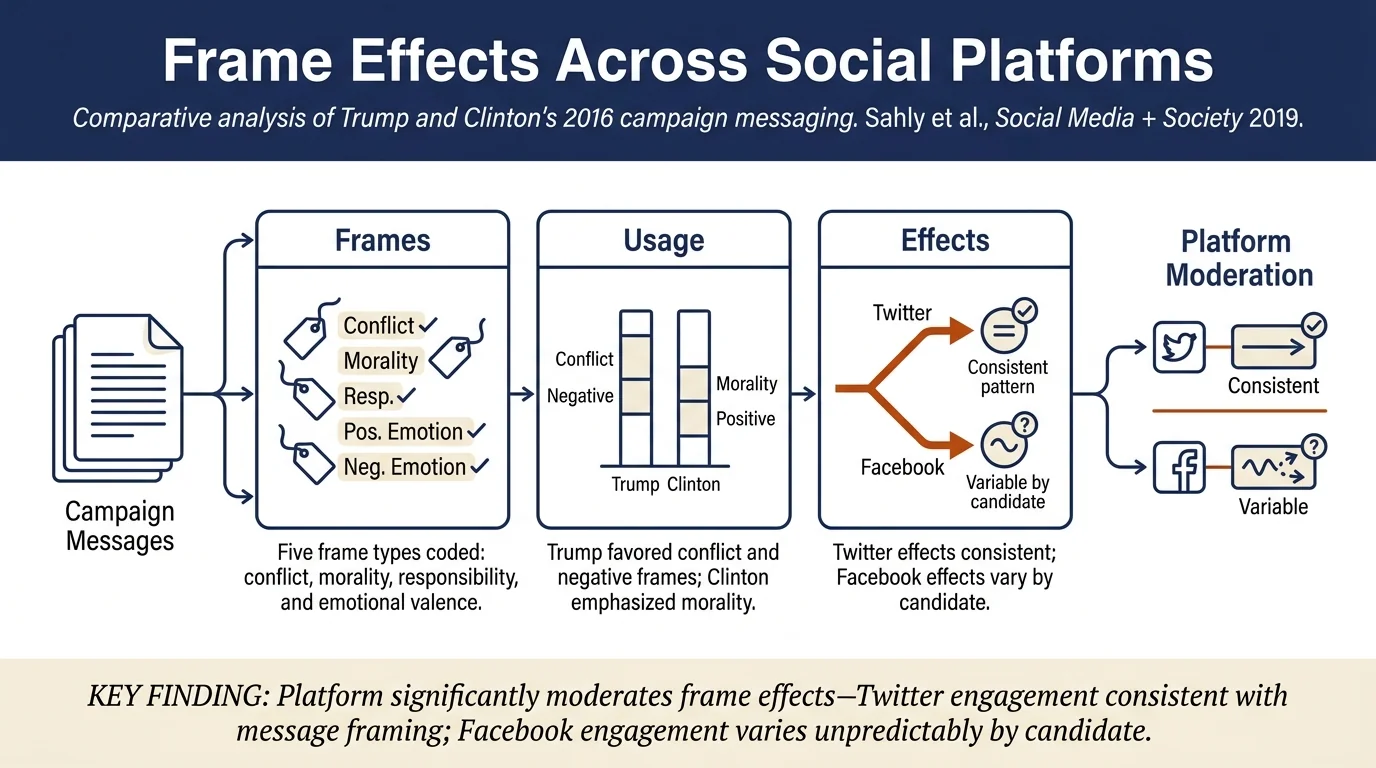
This study analyzes how Trump and Clinton's 2016 campaigns framed messages on Twitter and Facebook, and how frame type affected audience engagement. Trump relied on conflict and negative emotional frames, while Clinton used morality and positive emotional frames. Frame effects on engagement were consistent on Twitter (conflict and morality frames drove retweets) but inconsistent on Facebook, suggesting platform-specific engagement dynamics.
Contributions
- Comparative analysis of frame-building strategies across two major 2016 presidential candidates
- First study to examine multiple generic frames (conflict, morality, attribution of responsibility) plus emotional frames in political social media campaigns
- Cross-platform examination of the same candidates' frame strategies on Twitter and Facebook
- Empirical evidence that frame effects vary significantly by platform
Method
Data Collection: - Tweet sample: 3,805 tweets from Trump's official account, 655 from Clinton (July 19 – November 9, 2016) - Facebook sample: 303 posts from Trump, 352 from Clinton in the same period - Engagement metrics collected: retweets and favorites (Twitter); shares, comments, likes/reactions (Facebook)
Frames Coded: Two graduate students conducted content analysis after training (12 days, 3 hours per session). Five frame types were coded as binary variables (present/absent in each message): - Conflict frame: message mentions conflict between individuals, groups, or institutions - Morality frame: message interprets an issue through moral or religious values - Attribution of responsibility frame: message attributes responsibility or blame to entities and demands action - Positive emotional frame: uses positive emotional words (love, sweet, hope, inspiring) - Negative emotional frame: uses negative emotional words (fear, hate, anger, sad)
Cohen's Kappa reliability scores: conflict K = .91, morality K = .75, responsibility K = .75, negative emotional K = .87 (all p < .001).
Analysis: Chi-square tests assessed frame-building differences. Negative binomial regression models examined frame effects on engagement metrics. All analyses conducted in SPSS v.23.
Results
Frame Building (Frame Prevalence):
On Twitter, Trump used conflict frame in 40% of tweets vs. Clinton's 33.4%. Trump also favored negative emotional frames (32% vs. Clinton's 21.5%). Clinton used morality frame more frequently (8.7% vs. Trump's 21.6%) and positive emotional frames (32.2% vs. Trump's 31.2%). Differences were statistically significant (all p < .001).
On Facebook, conflict frame appeared in 24.1% of Trump's posts vs. Clinton's 28.5% (not significant). Morality frame: Trump 17.5% vs. Clinton 5.8% (p < .001). Positive emotional frames: Trump 52.5% vs. Clinton 24.9% (p < .001).
Frame Effects on Engagement:
On Twitter, conflict frame increased retweets for both Trump (b = .17, p < .001) and Clinton (b = .32, p < .001). Morality frame increased engagement for both candidates. Negative emotional frame increased Trump's retweets (b = .04, p < .05) but had no effect on Clinton's. Positive emotional frame increased favoring behaviors for both candidates, but morality and responsibility frames showed decreasing effects on Trump's favoring engagement.
On Facebook, results were inconsistent between candidates. Morality frame increased engagement on Trump's Facebook page, while conflict frame increased sharing on Clinton's page. Neither candidate's emotional frames showed consistent effects on Facebook commenting behavior.
Key Insight: Platform appears to moderate frame effects—Twitter engagement showed consistent patterns aligned with message framing, while Facebook engagement varied unpredictably by candidate, suggesting audience and algorithmic differences between platforms.
Connections
- Extends Brady et al. (2017) by examining morality in structured campaign contexts rather than organic social media
- Related to Grinberg et al. (2019) in analyzing 2016 campaign messaging, but focuses on frame analysis rather than information exposure
- Complements Allcott & Gentzkov (2017) in examining social media's role in elections
- Relevant to Barsela Cross Platform Misinformation for cross-platform strategy comparison
Notes
Strengths: The study addresses a gap in political communication research by moving beyond one-sided frame analysis to comparative candidate strategies. The inclusion of multiple frames (not just conflict or emotion) provides nuance. Cross-platform comparison is valuable, as campaign strategies must account for platform-specific affordances.
Limitations: The sample captures only official campaign accounts, not supporter-generated content or paid amplification, which may differ in framing. Facebook sample is much smaller (655 posts total vs. 3,805 tweets), limiting generalizability. The study uses 2016 data; campaign strategies may have evolved. No analysis of bot amplification or coordinated behavior that might skew engagement metrics.
Extensions: Unclear whether frame effects persist after controlling for account followers, post timing, or content length. The "inconsistency" on Facebook warrants investigation—are differences algorithmic (what gets shown), behavioral (who engages), or both? Replication in other elections or with other candidates would strengthen causal claims.