Cognitive attraction and online misinformation
Author: Alberto Acerbi
Venue: Palgrave Communications, 2019 — DOI
TL;DR
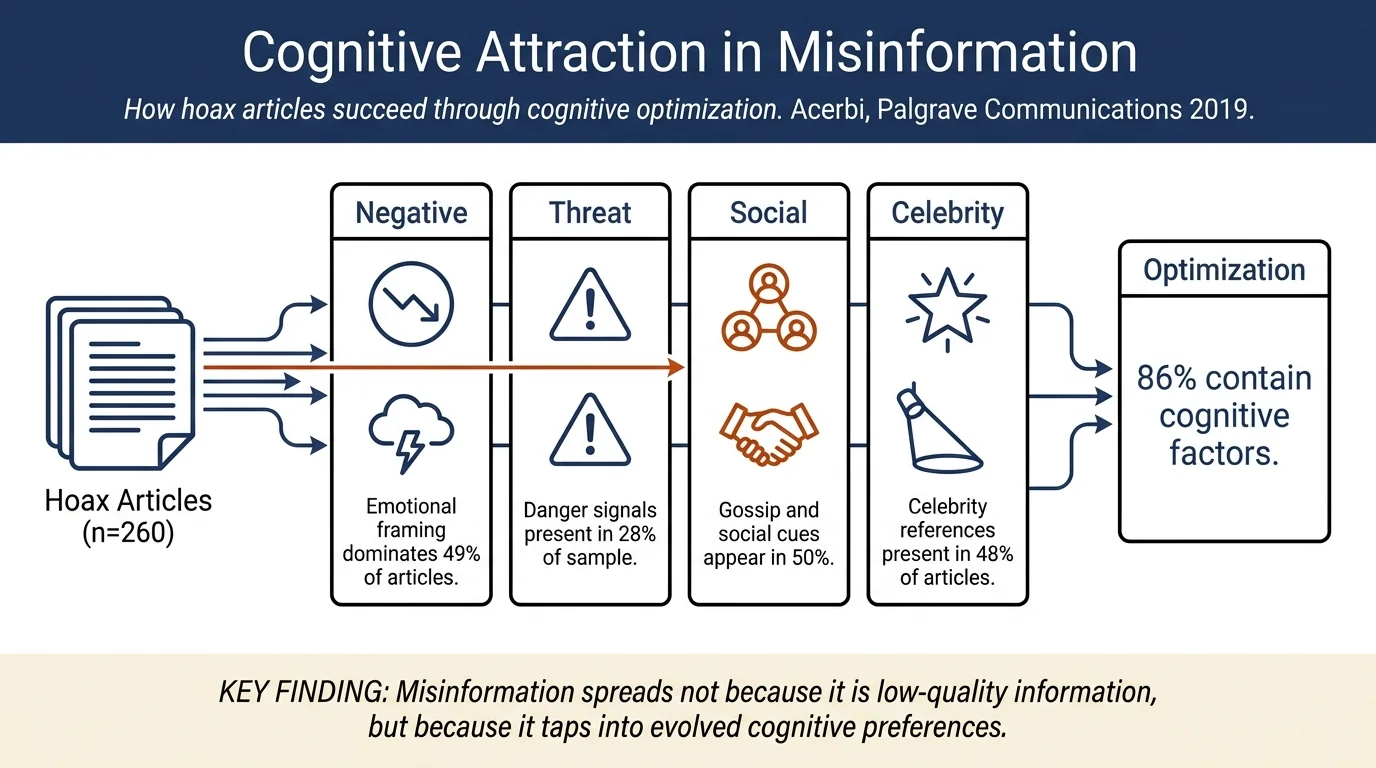
Misinformation spreads not because it is low-quality information constrained by digital media inefficiencies, but because it taps into general evolved cognitive preferences. A content analysis of 260 articles from 26 hoax websites shows that 86% contain at least one cognitive-appeal feature: negative framing (49%), threat descriptions (28%), social information (50%), and celebrities (48%) dominate, while the paper argues that psychological appeal, not truthfulness, explains why misinformation succeeds culturally.
Contributions
- Demonstrates that online misinformation contains cognitive-attraction features (negative bias, threat-related content, social information, disgust elements) that make it culturally successful
- Reframes misinformation as "high-quality" content optimized for psychological appeal rather than low-quality noise
- Shows that political misinformation is only 40% of the sample; non-political misinformation is substantial and may be understudied
- Analyzes co-occurrence patterns of cognitive factors, revealing threat-related content appears less frequently with sexual or disgust elements than those two appear with each other
Method
Analyzed 260 articles from 26 websites in authoritative lists of hoax/fake-news publishers (Snopes.com, BuzzFeed lists updated 2017). Articles were manually coded by the author and four independent coders (87% ± 1.7% inter-coder agreement) for: - General emotional tone (negative, neutral, positive) - Threat-related information (28% of articles) - Sexually related content (17%) - Disgust-evoking elements (15%) - Minimally counterintuitive (MCI) content (13%, with 64% being violations of essentialist beliefs) - Social information and gossip (50%) - Presence of celebrities (48%) - Political vs. non-political framing (40% political)
Results
Headline findings: - Negative content dominant: 128 articles (49%) negative, 110 (42%) neutral, 22 (9%) positive - Multi-factor structure: 224 articles (86%) contained at least one coded cognitive factor; 63% had 1–2 factors - Threat most diffuse specific factor: 28% of articles; social information and celebrity presence (50% and 48%) most common overall - Political vs. non-political contrast: Political articles overrepresented for "social" and "celebrities"; 19% of political articles vs. 57% of non-political contained factors other than social/celebrity
Connections
- Related to The psychological drivers of misinformation belief and its resistance to correction via shared focus on cognitive/emotional drivers
- Complements The Spread of True and False News Online by explaining why false narratives spread through cognitive appeal rather than just documenting spread
- Cited by work on digital-media transmission and rumor psychology; aligns with Neutralizing misinformation through inoculation: Exposing misleading argumentation emphasis on narrative structure
Notes
Strength: Ground-breaking perspective shift from "misinformation spreads because digital media is broken" to "misinformation succeeds because it is cognitively optimized." The content-analysis approach is systematic and inter-coder agreement is high.
Limitation: The sample reflects what misinformation websites publish, not what users consume or share—engagement-weighting could shift findings. Political content may be overrepresented in Google/BuzzFeed lists and thus in the sample; the author notes 40% political but acknowledges sampling bias. Future work (acknowledged by author) should compare false vs. true news head-to-head on the same factors.
The framing of misinformation as "high-quality" because psychologically appealing is polemical but defensible; reframes the policy discussion from "regulate disinformation" to "understand and compete with the cognitive appeal of narratives."