Explore papers
Filter by research area, year and venue. Every filter is in the address bar, so you can share a view as a link.
 Bots & coordinated campaignsPlatforms, policy & society
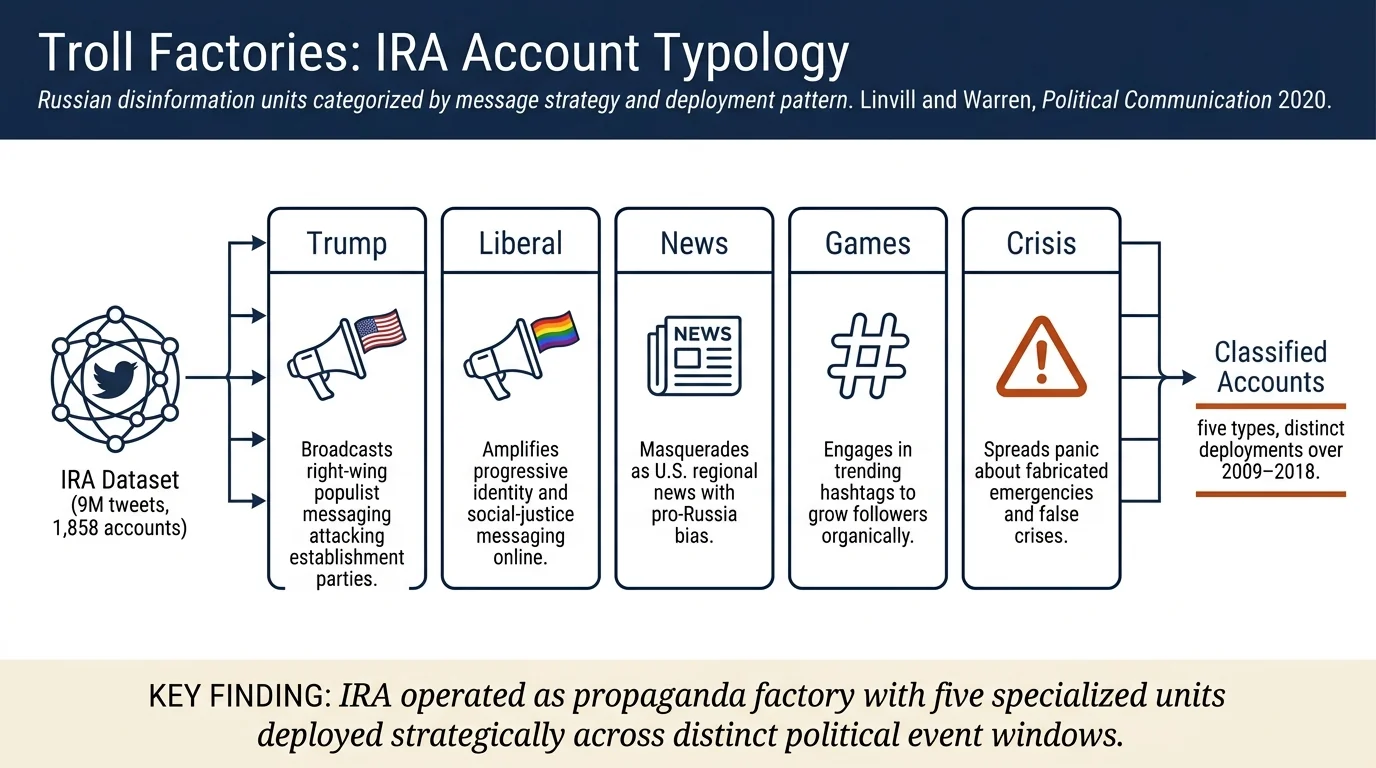
Troll Factories: Manufacturing Specialized Disinformation on TwitterLinvill and Warren analyze 9.04 million tweets from Russia's Internet Research Agency (IRA) spanning 2009–2018, identifying five specialized account categories—Right Troll, Left Troll, News Feed, Hashtag Gamer, and Fearmonger—each with distinct behavioral patterns, temporal deployment strategies, and communication styles. The authors…
 Fact-checking & verificationPlatforms, policy & society
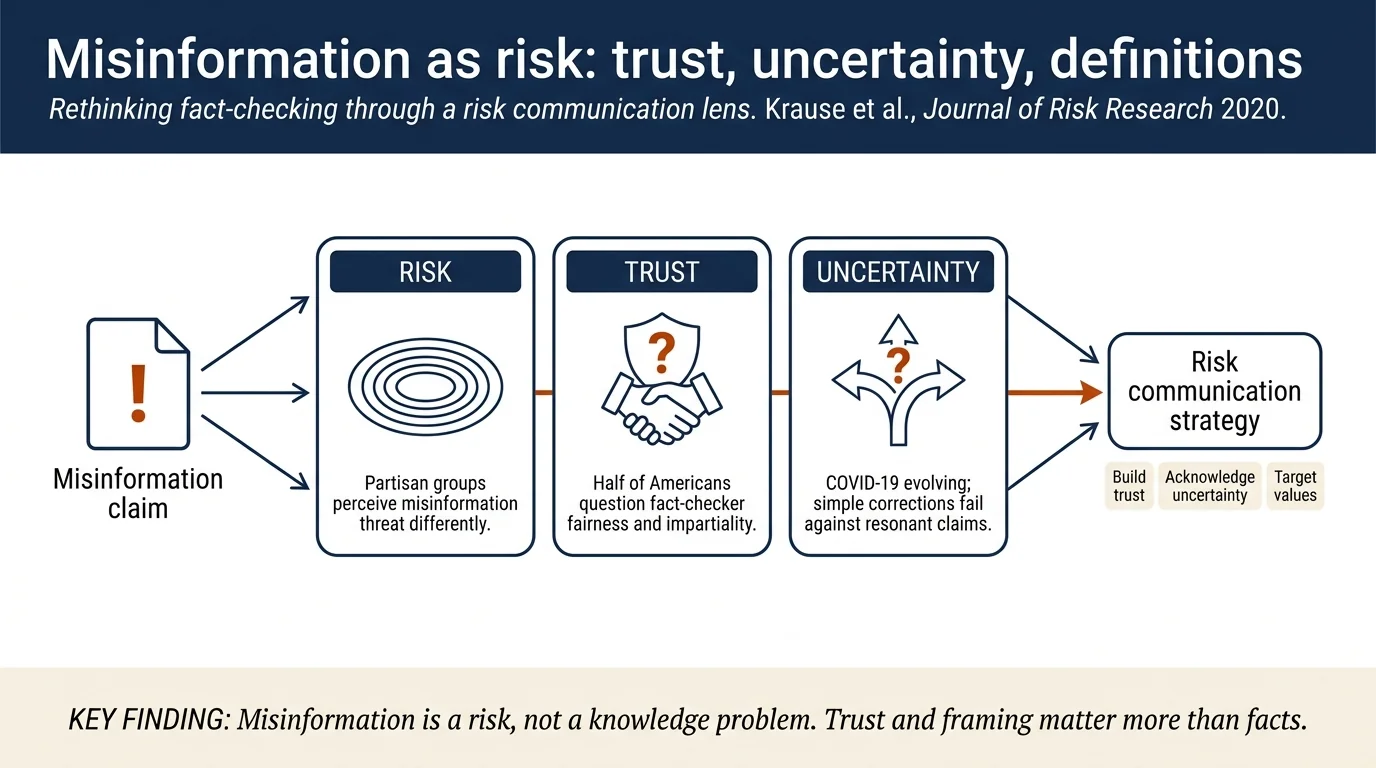
Fact-checking as risk communication: the multi-layered risk of misinformation in times of COVID-19COVID-19 misinformation should be viewed as a risk in its own right, not just a communication failure. Fact-checking efforts face three key challenges: defining misinformation differently across political subgroups, earning trust in an environment of low press credibility, and communicating amid genuine uncertainty.
 Psychology & interventionsPlatforms, policy & society
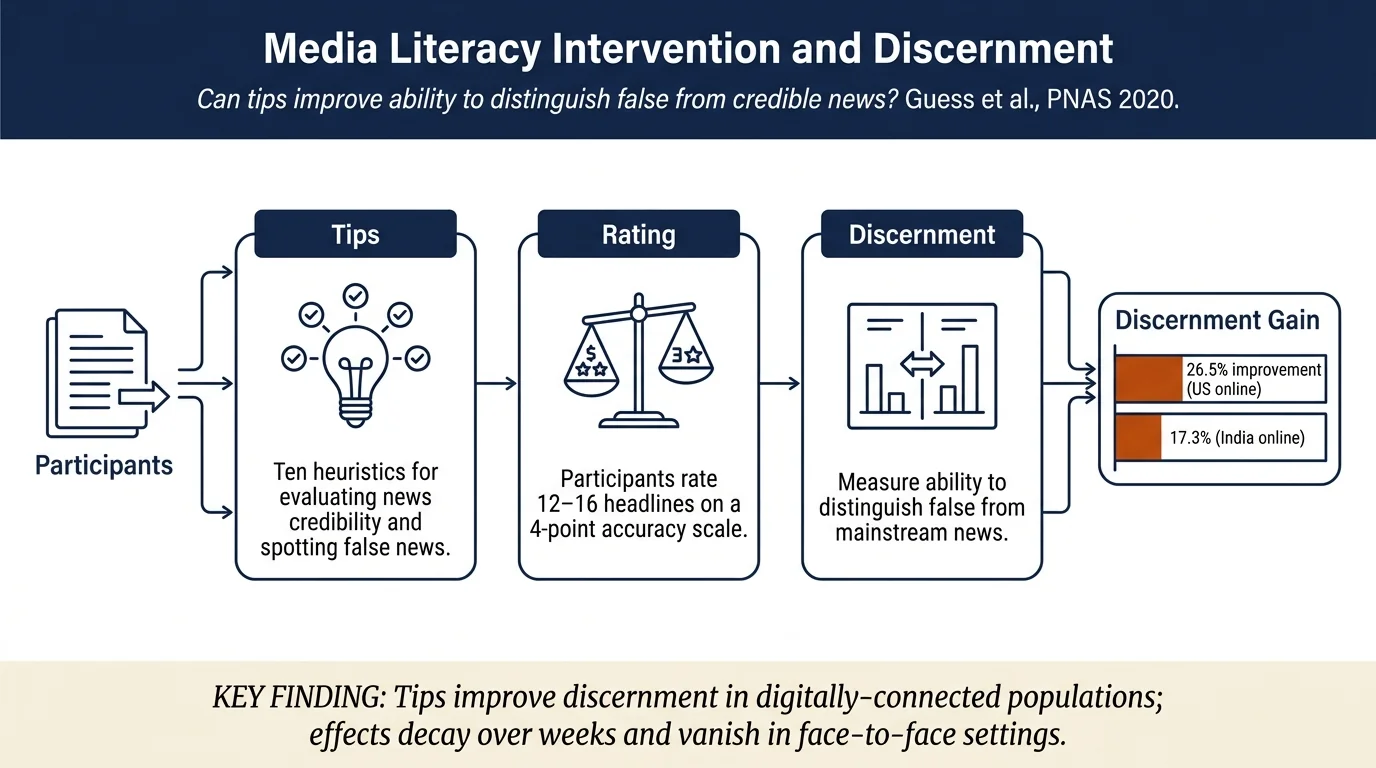
A digital media literacy intervention increases discernment between mainstream and false news in the United States and IndiaA randomized experiment tests Facebook's "Tips to Spot False News" intervention in the US and India, finding it increases discernment between mainstream and false news (26.5% in US, 17.3% in India online). The intervention reduces belief in false headlines more than it reduces belief in mainstream ones.
 Bots & coordinated campaignsPlatforms, policy & society
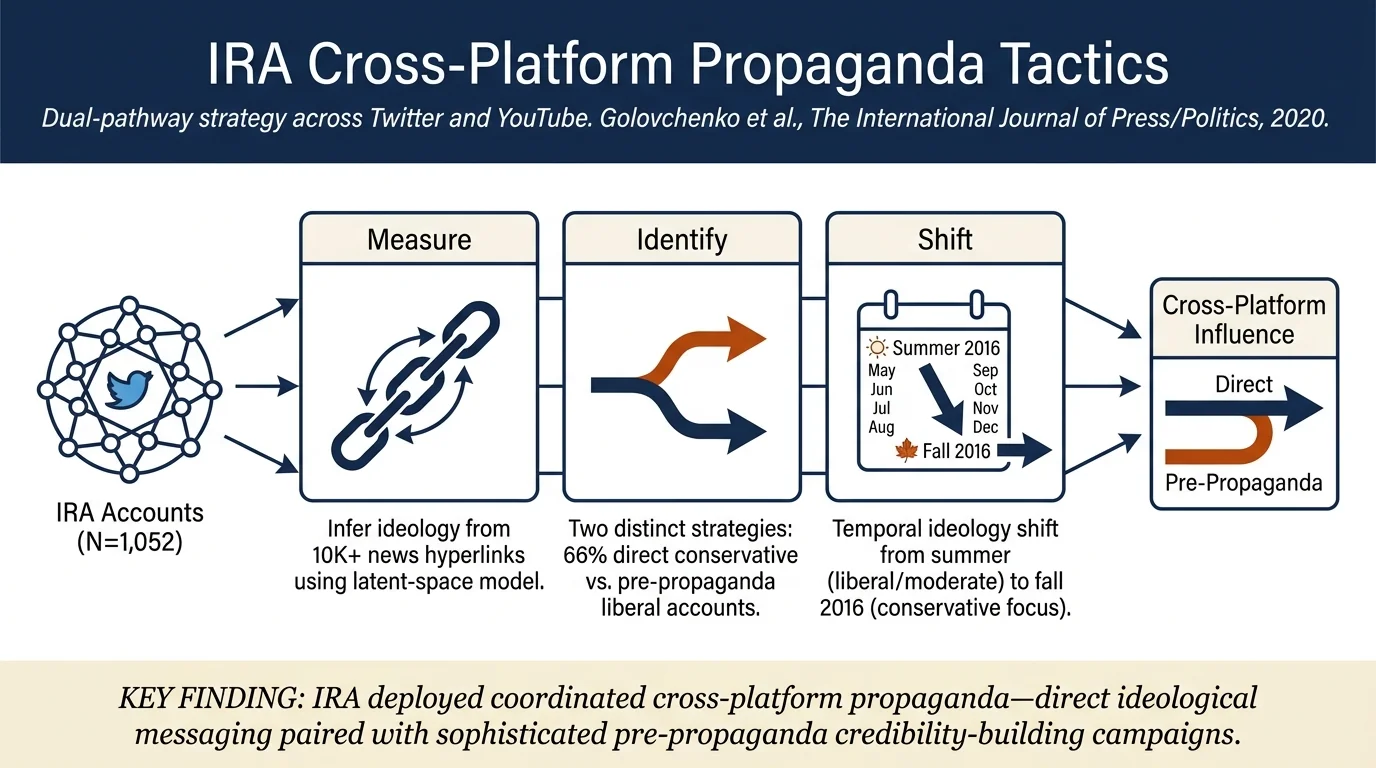
Cross-Platform State Propaganda: Russian Trolls on Twitter and YouTube during the 2016 U.S. Presidential ElectionThis paper analyzes 1,052 Russian IRA Twitter accounts to understand their propaganda strategy during the 2016 U.S. presidential election. By examining hyperlinks to news stories and YouTube videos, the authors find IRA accounts linked to conservative sources more frequently than liberal ones, consistent with supporting Trump.
 Bots & coordinated campaignsSpread & networks
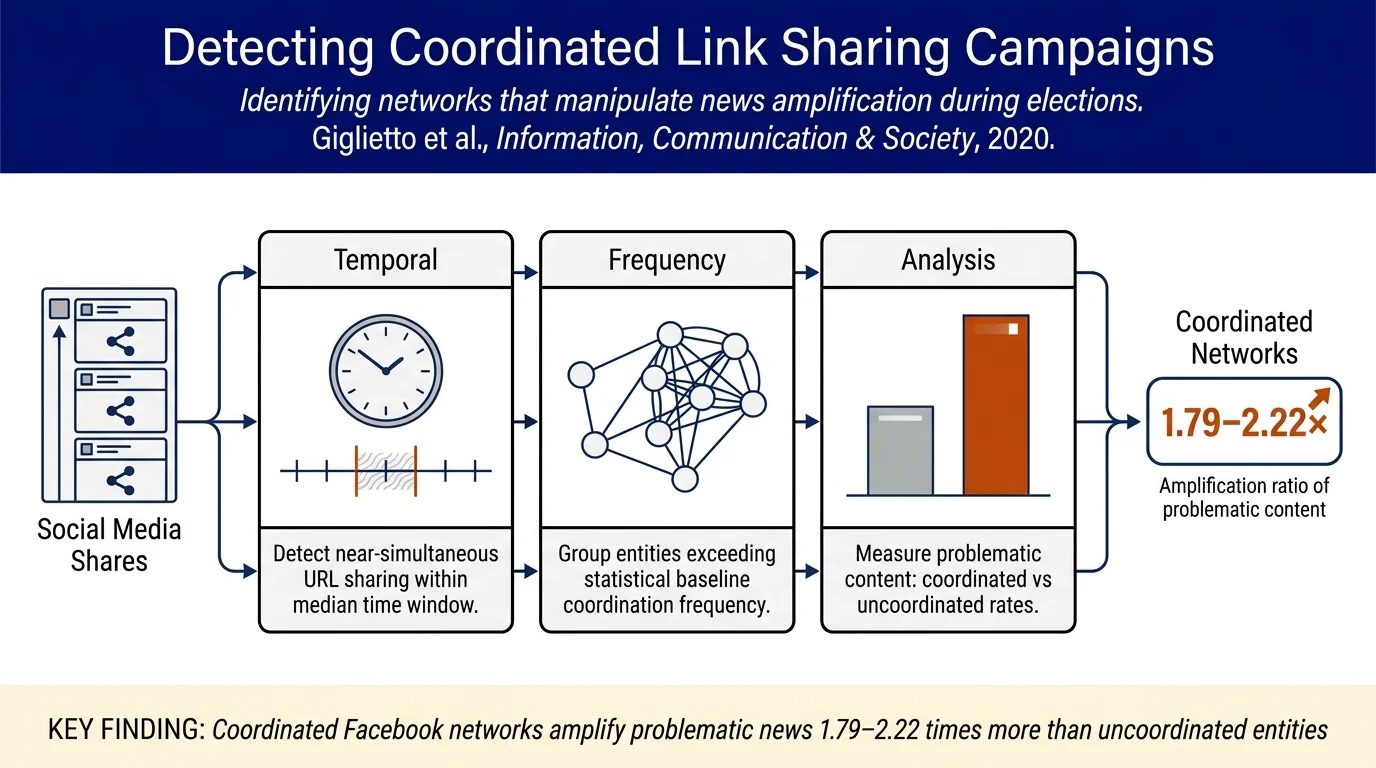
It takes a village to manipulate the media: coordinated link sharing behavior during 2018 and 2019 Italian electionsCoordinated networks of Facebook pages and groups substantially amplified problematic news during Italian elections: coordinated entities shared problematic domains 1.79×–2.22× more frequently than uncoordinated ones. The paper introduces a method to detect "coordinated inauthentic behavior" by identifying entities that…
 Psychology & interventionsSpread & networks
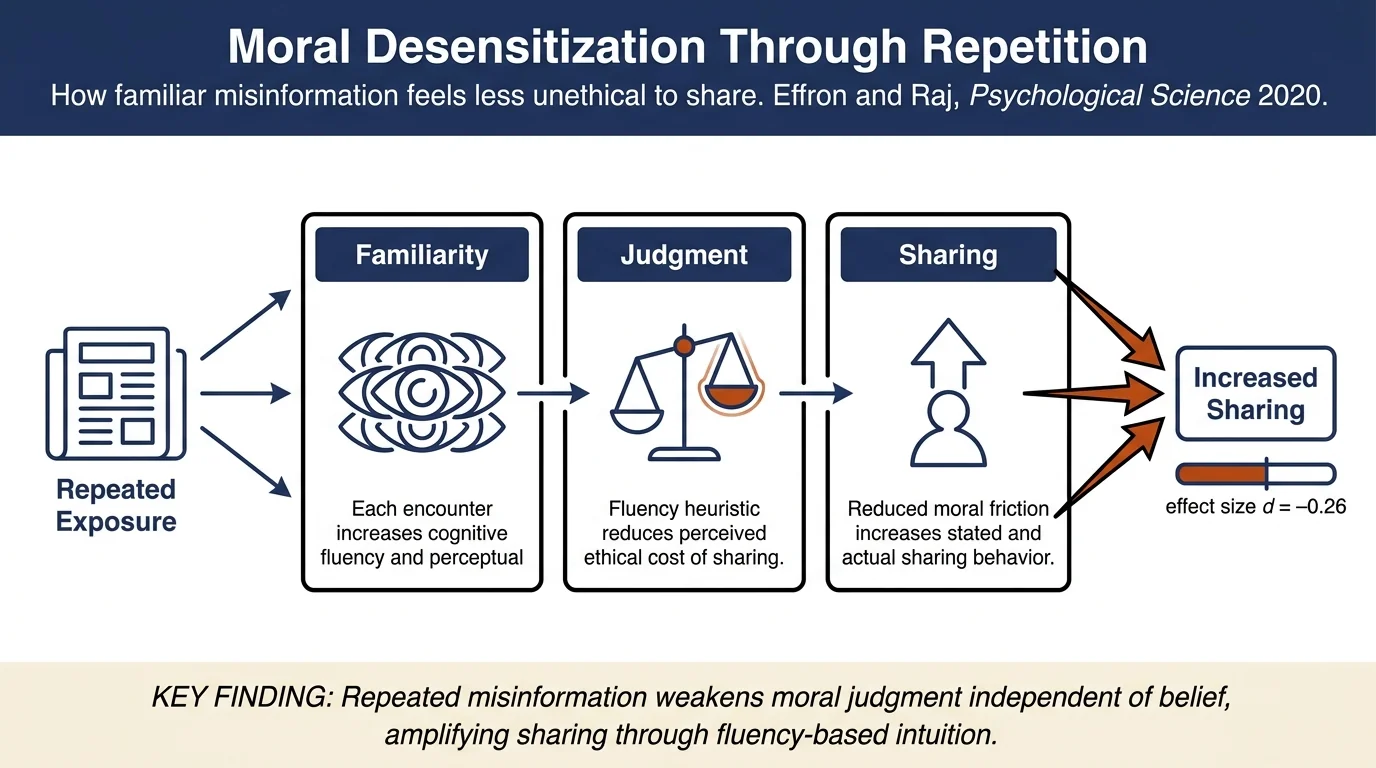
Misinformation and Morality: Encountering Fake-News Headlines Makes Them Seem Less Unethical to Publish and ShareFour preregistered experiments (N=2,587) show that repeatedly encountering fake-news headlines reduces moral condemnation of spreading them—regardless of whether people believe them. This "moral repetition effect" operates via fluency: familiar headlines feel less unethical to share, stronger inclinations to promote them online, and…
 Bots & coordinated campaignsPlatforms, policy & society
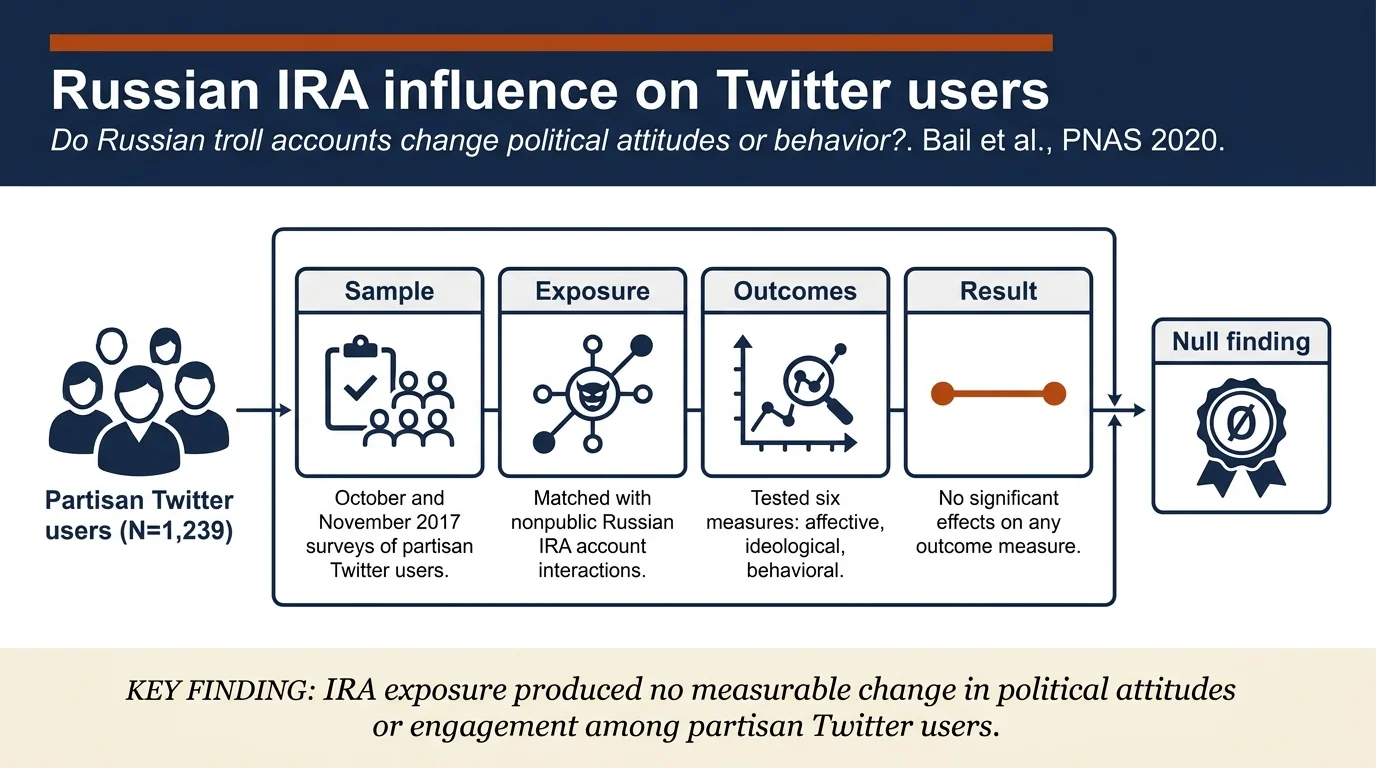
Assessing the Russian Internet Research Agency's impact on the political attitudes and behaviors of American Twitter users in late 2017Combining longitudinal survey data from 1,239 partisan Twitter users with nonpublic IRA account data, Bail et al. find no evidence that interaction with Russian Internet Research Agency accounts substantially impacted six measures of political attitudes (affective/ideological polarization) or behaviors (political engagement, network…
 Spread & networksPlatforms, policy & society
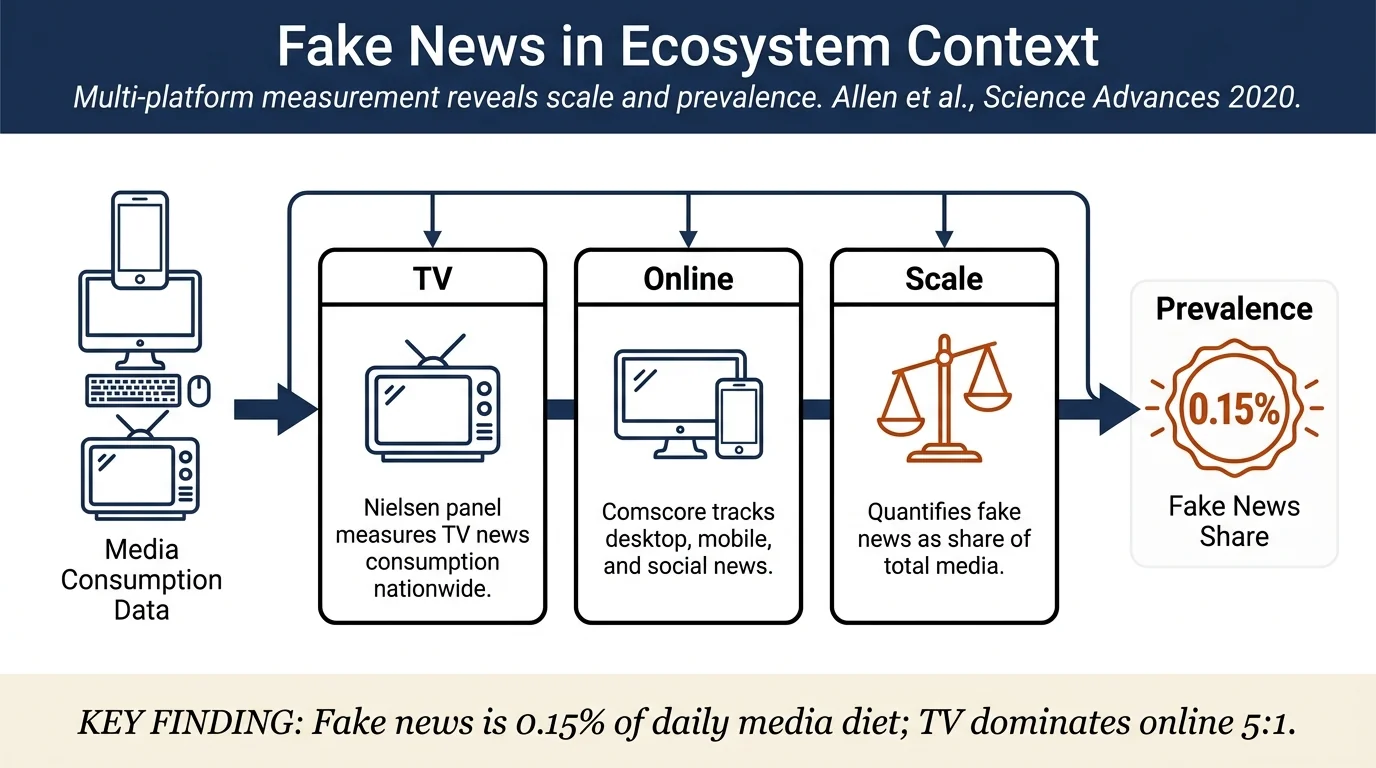
Evaluating the fake news problem at the scale of the information ecosystemUsing nationally representative data on mobile, desktop, and TV consumption spanning 2016–2018, the authors show that fake news comprises only 0.15% of Americans' daily media diet, while TV dominates news consumption by a 5:1 ratio over online. The paper challenges the widespread narrative of fake news as a pervasive crisis and suggests…
 Deepfakes & multimodalDetection methods
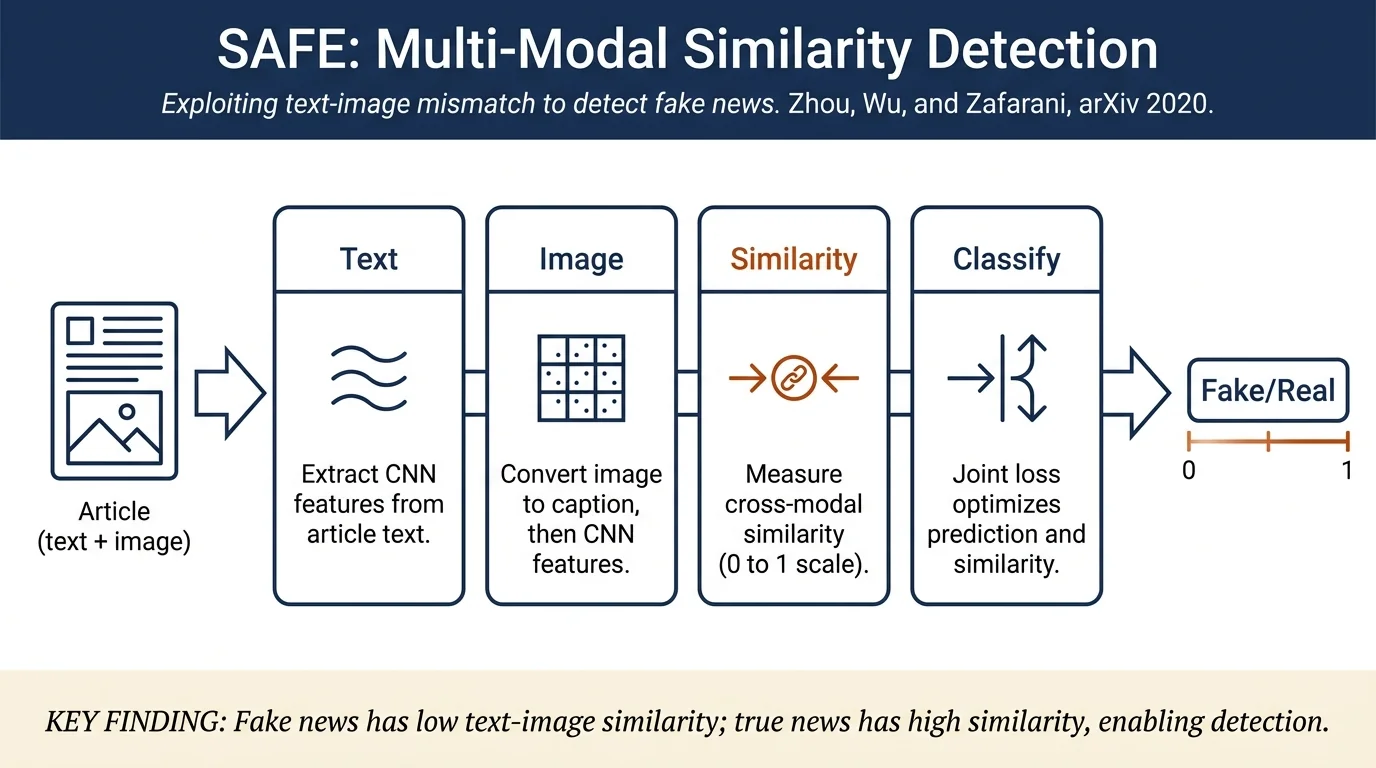
SAFE: Similarity-Aware Multi-Modal Fake News DetectionFake news articles frequently pair misleading textual claims with irrelevant or manipulative images, creating a detectable gap between the two modalities. SAFE addresses this by extracting separate neural representations of a news article's text and images — using the same Text-CNN architecture applied to an image2sentence embedding for…
 Datasets & evaluationDeepfakes & multimodal
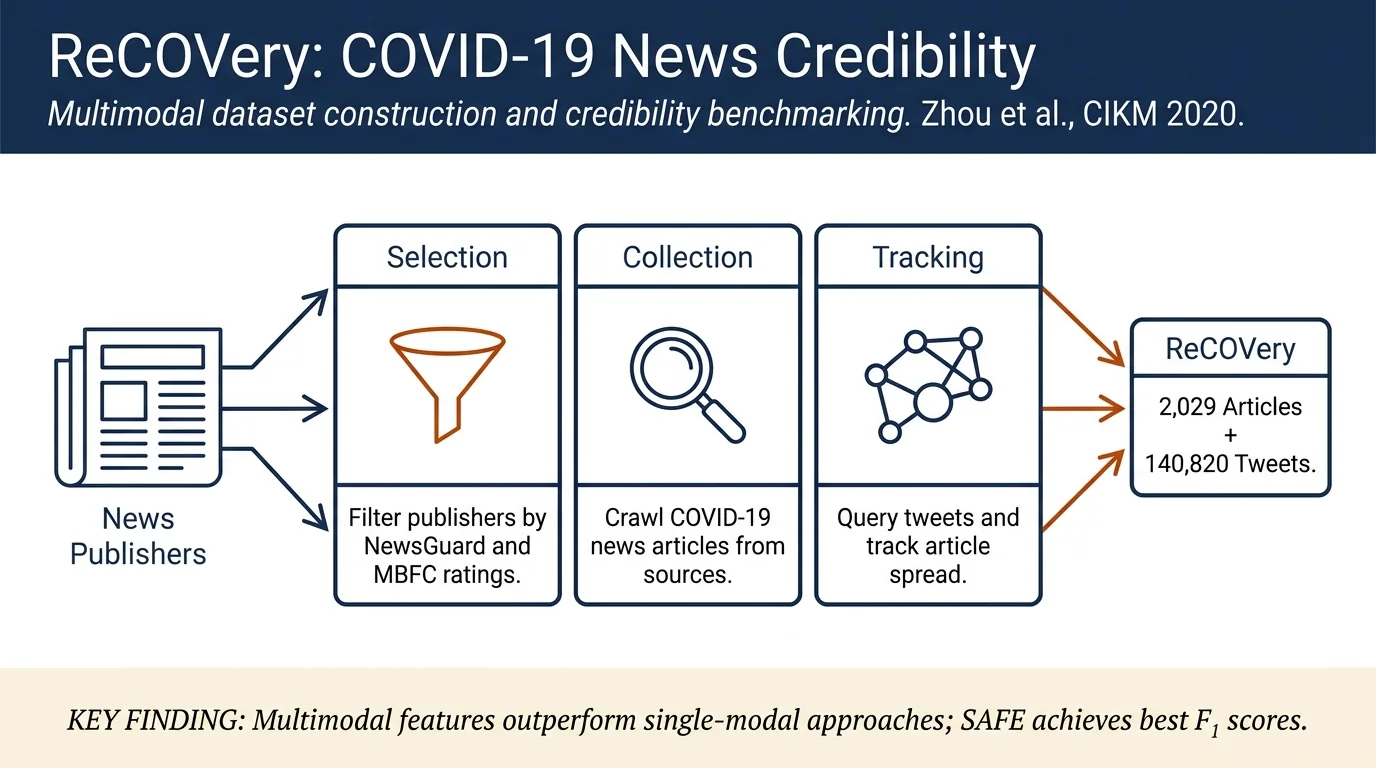
ReCOVery: A Multimodal Repository for COVID-19 News Credibility ResearchThe COVID-19 pandemic triggered a parallel "infodemic" of low-credibility news; this paper constructs ReCOVery, a multimodal repository of 2,029 COVID-19 news articles with binary credibility labels inherited from their publisher's NewsGuard/MBFC ratings, paired with 140,820 tweets tracking social spread. The key design trade-off is…
 Spread & networksDetection methods
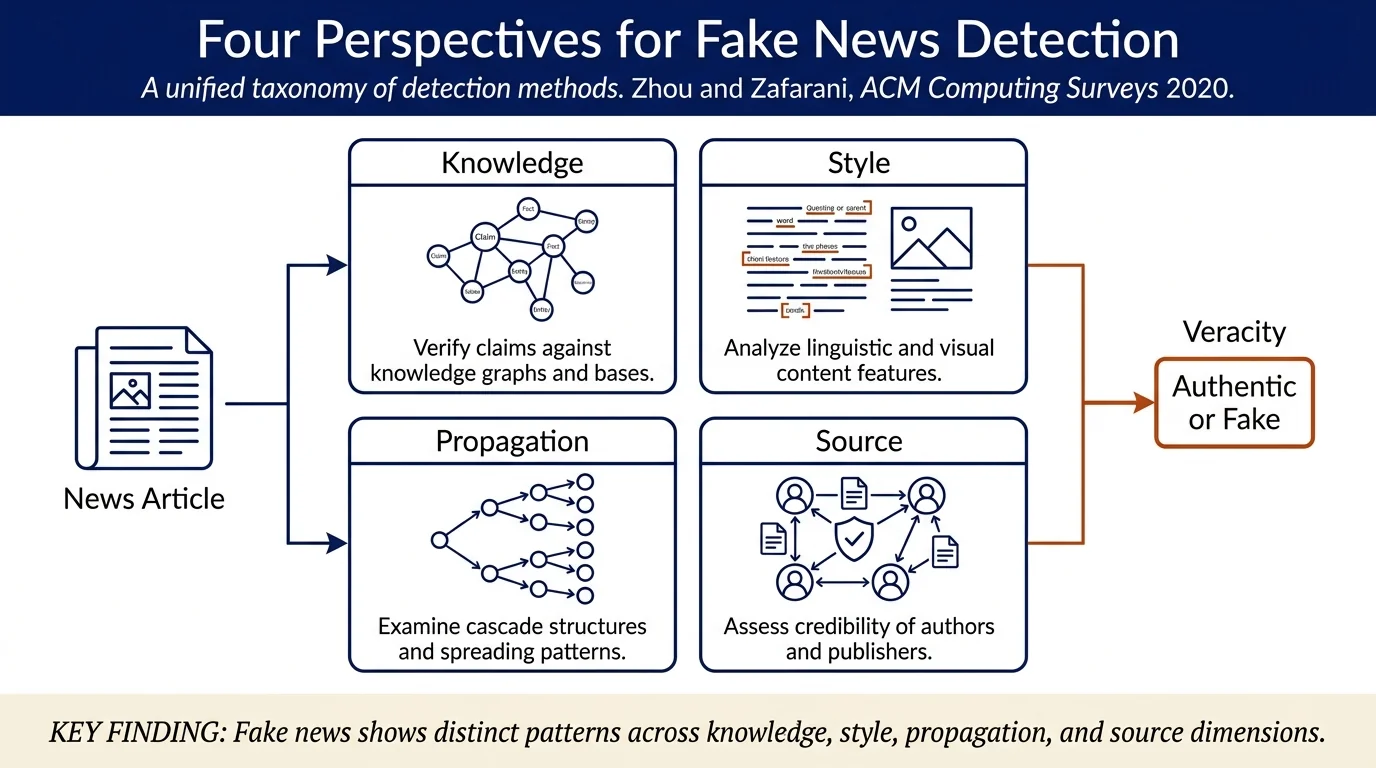
A Survey of Fake News: Fundamental Theories, Detection Methods, and OpportunitiesThis comprehensive survey defines fake news across both broad and narrow framings, systematizes detection methods across four perspectives (knowledge, style, propagation, source), connects detection strategies to interdisciplinary theories from psychology and social sciences, and identifies six open research challenges including early…
 Detection methodsLLMs & generative AI
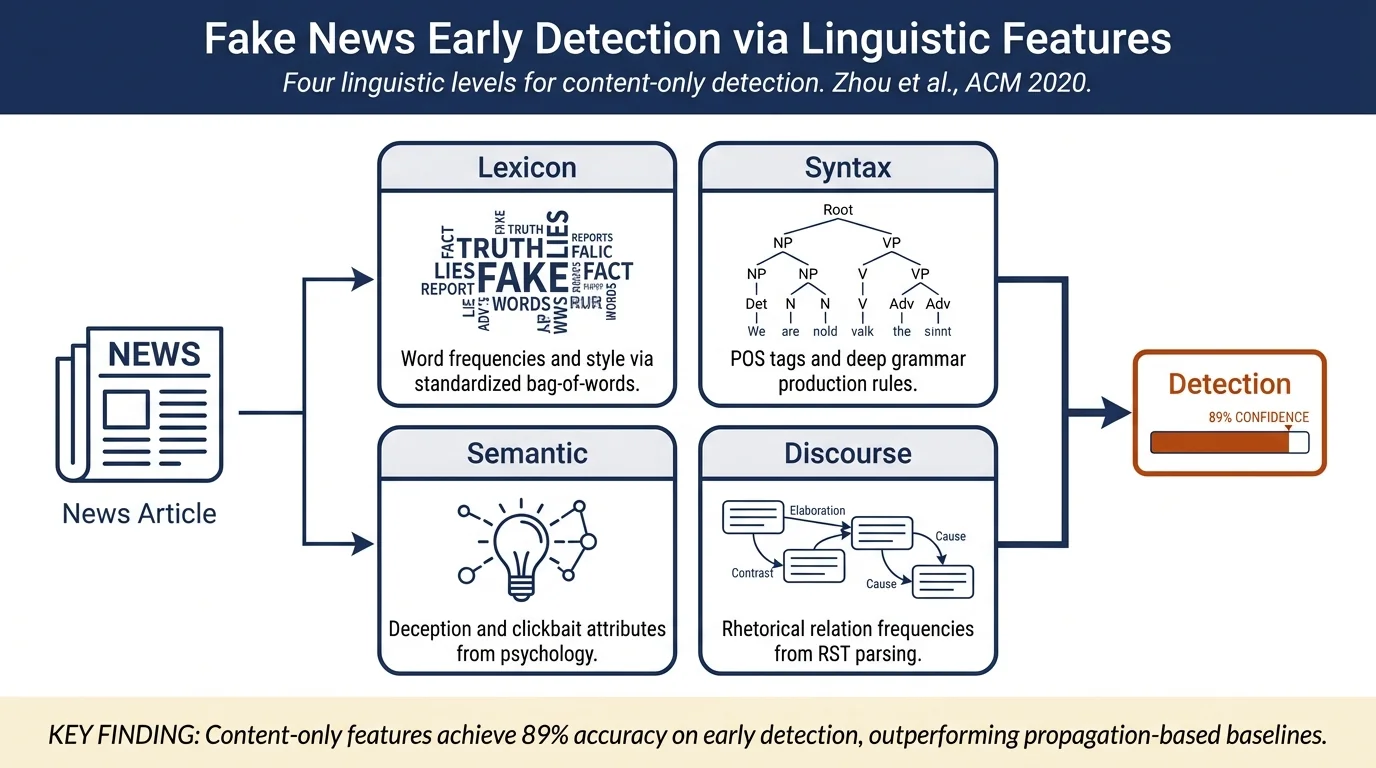
Fake News Early Detection: An Interdisciplinary StudyThis paper proposes a theory-driven, content-only model for fake news detection at publication time — before social-media propagation data exists. News articles are represented at four linguistic levels (lexicon, syntax, semantic, and discourse) using features grounded in social and forensic psychology; classical supervised classifiers…
 Datasets & evaluationDetection methods
CHECKED: Chinese COVID-19 Fake News DatasetCHECKED is the first Chinese-language, fact-checked COVID-19 social media dataset — 2,104 Weibo microblogs (344 fake, 1,760 real) spanning December 2019 to August 2020, labeled using Weibo's expert-operated Community Management Center for fake posts and People's Daily official account for real posts. Each microblog carries rich…
 Spread & networksDetection methods
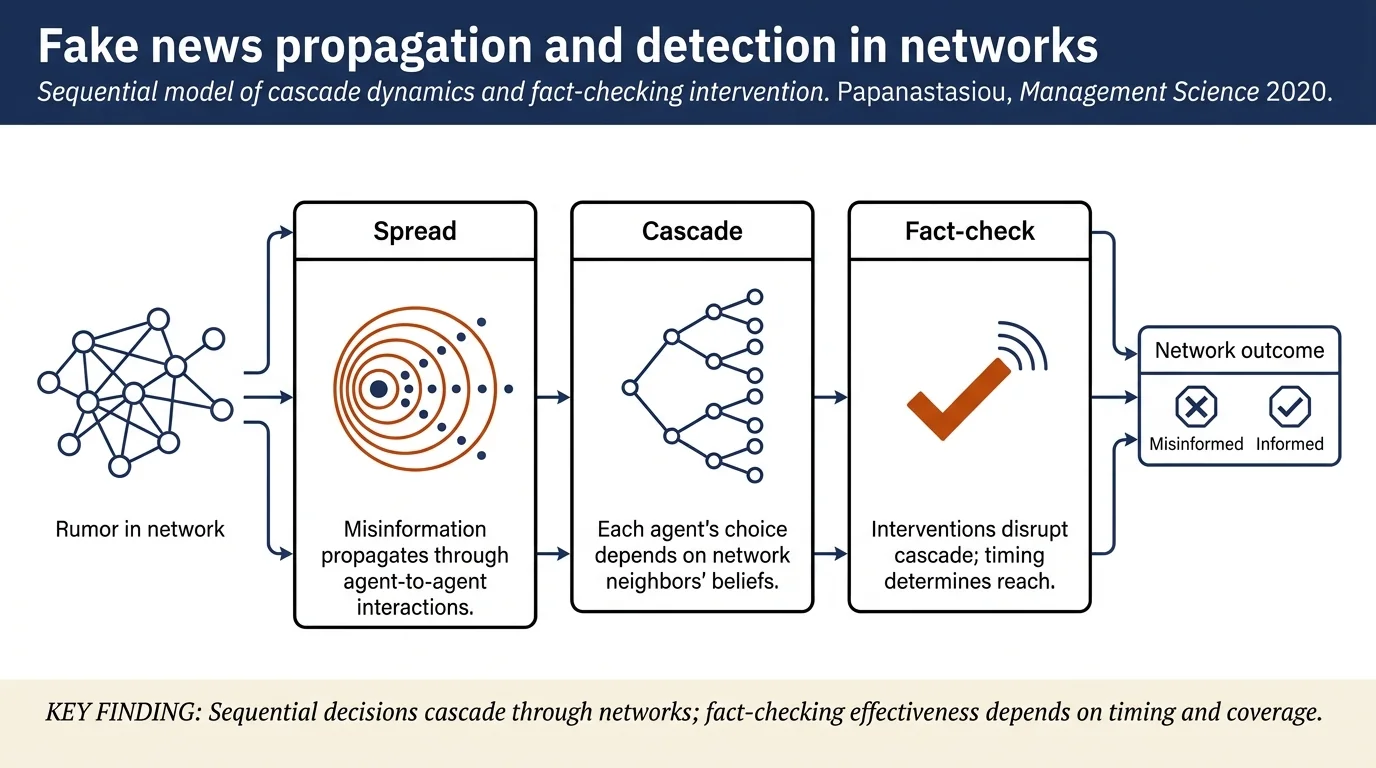
Fake news propagation and detection: A sequential modelFoundational sequential social learning model of misinformation spread and fact-checking. Introduces the framework for analyzing how agents' decisions cascade through a network and how fact-checking affects collective outcomes.
 Deepfakes & multimodalDetection methods
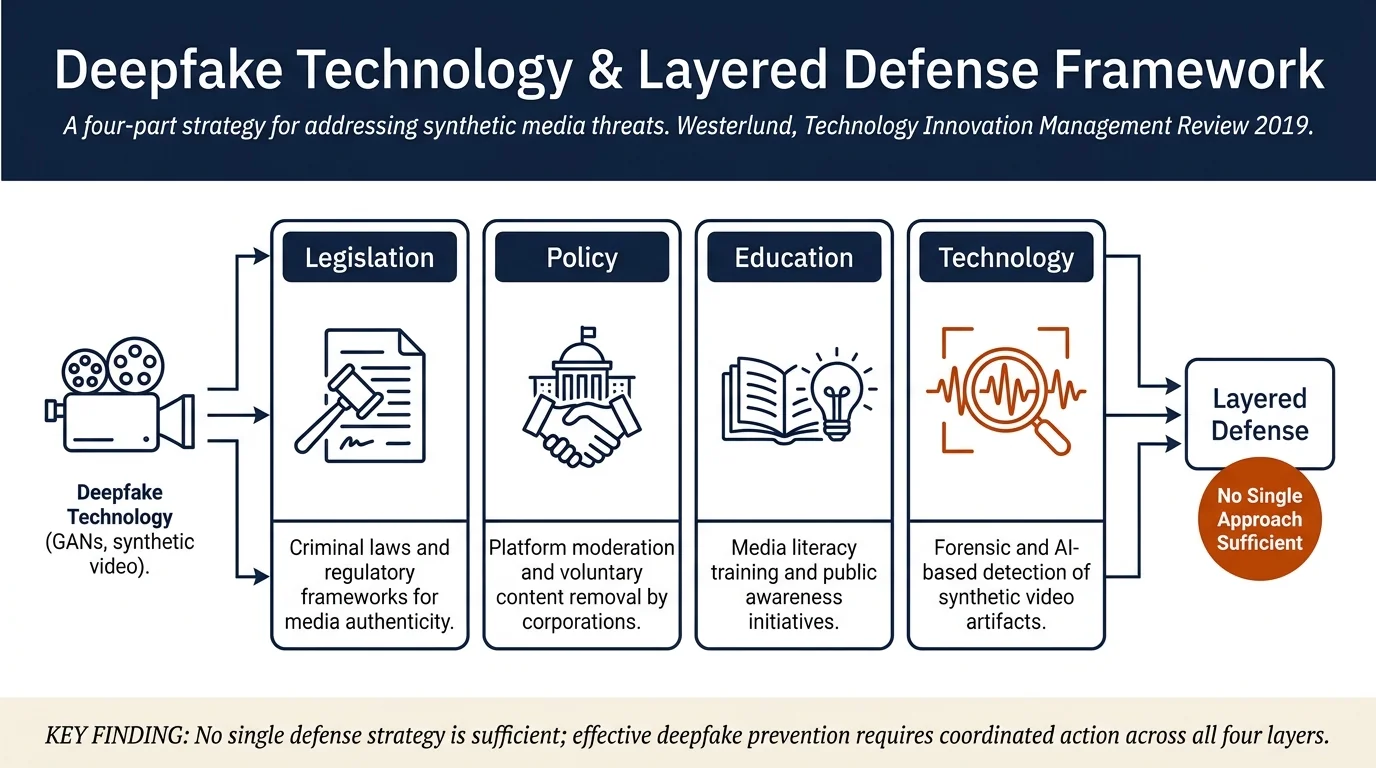
The Emergence of Deepfake Technology: A ReviewThis review analyzes 84 news articles about deepfakes to synthesize understanding of synthetic video technology, its applications, threats, and countermeasures. Deepfakes—hyper-realistic videos created using AI (primarily GANs)—lower the barrier to video forgery and represent a significant threat to trust, elections, and security.
 Deepfakes & multimodalDetection methods
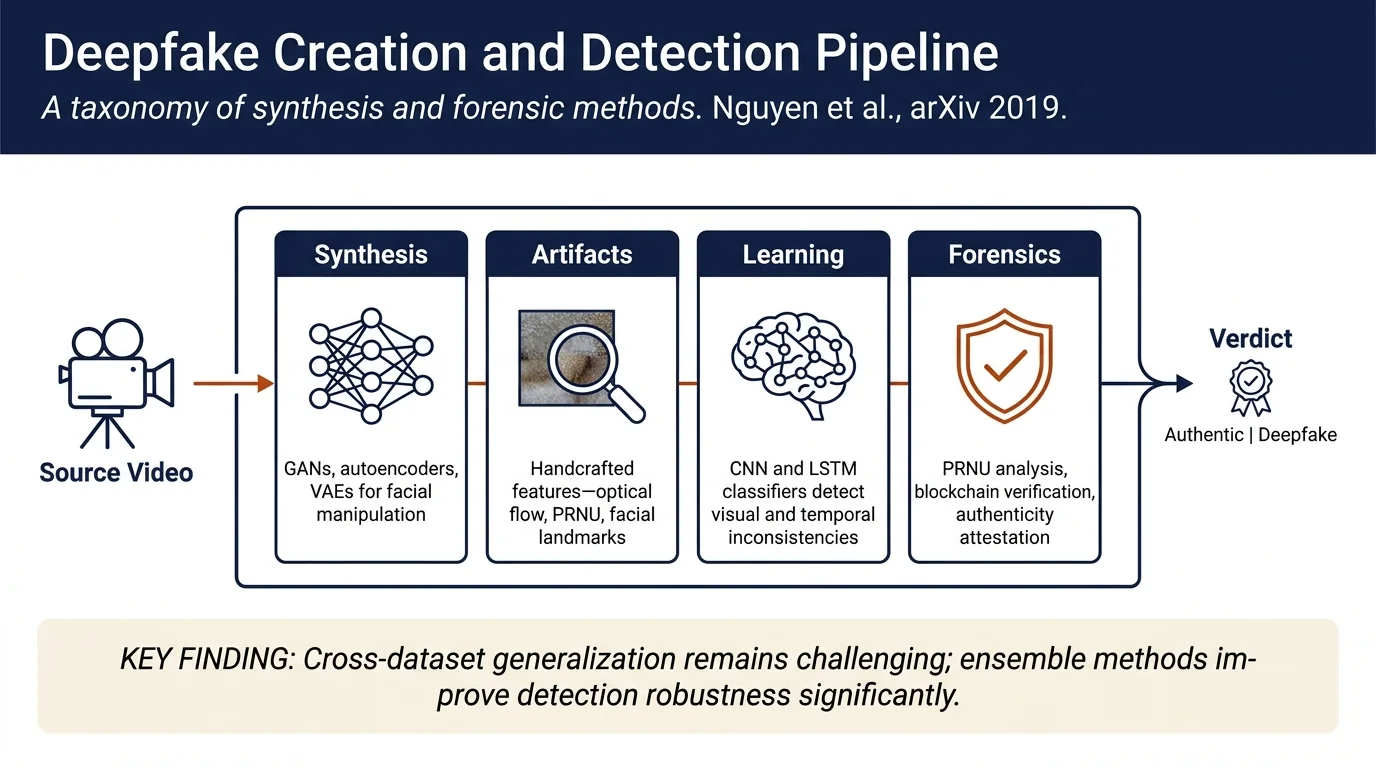
Deep Learning for Deepfakes Creation and Detection: A SurveyComprehensive survey of deep learning methods for creating and detecting deepfakes, covering face-swapping and lip-syncing generation techniques (GANs, autoencoders, encoder-decoder pairs), detection approaches (visual artifacts, temporal features, forensics), and challenges in cross-dataset generalization. The paper discusses…
 Spread & networksPlatforms, policy & society
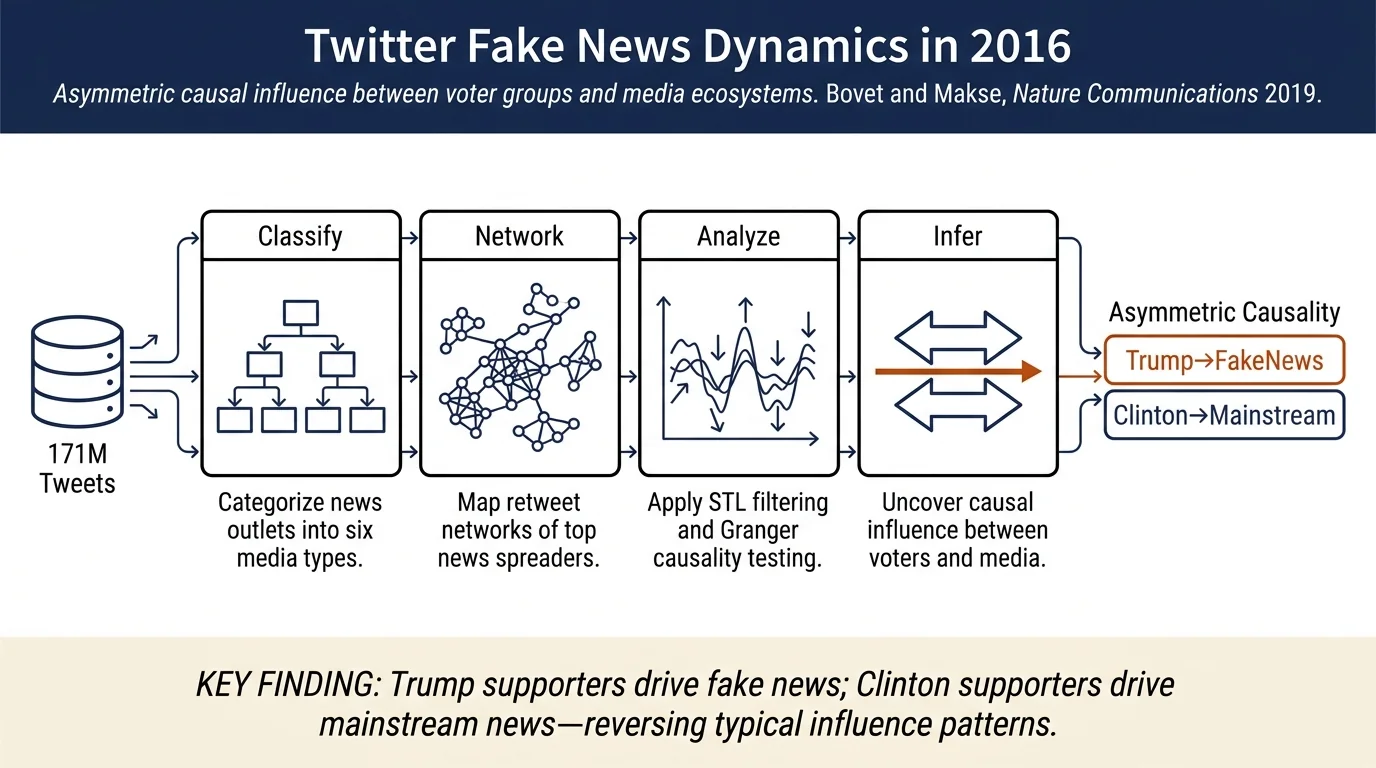
Influence of fake news in Twitter during the 2016 US presidential electionUsing 171 million tweets from the five months preceding the 2016 U.S. election, this study found that 25% of news-sharing tweets contained fake or extremely biased content. Network analysis revealed distinct clusters of fake, biased, and mainstream news spreaders.
 LLMs & generative AIDetection methods
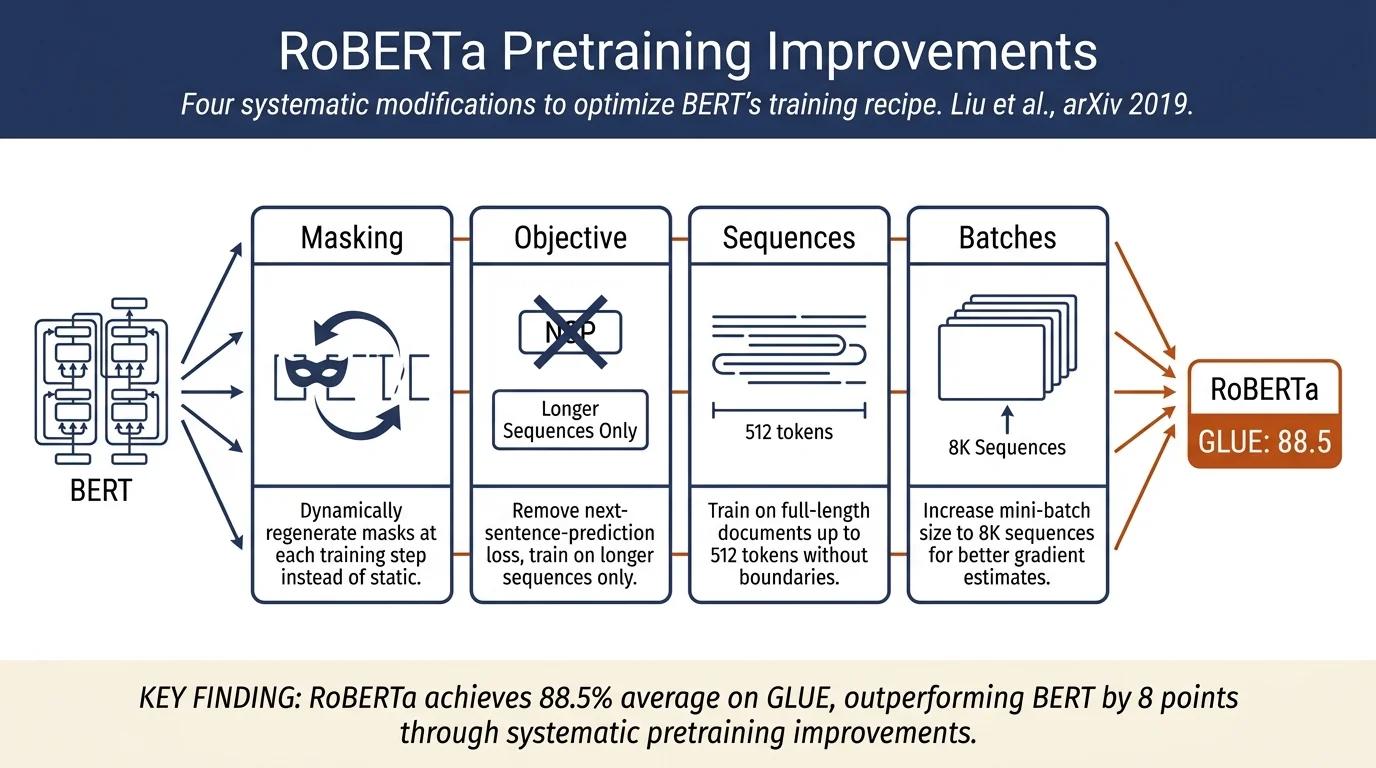
RoBERTa: A Robustly Optimized BERT Pretraining ApproachA replication and improvement study of BERT pretraining showing that BERT was significantly undertrained. RoBERTa introduces four key improvements—training longer with larger batches and more data, removing the next-sentence-prediction objective, training on longer sequences, and dynamically masking tokens—to achieve state-of-the-art…
 Platforms, policy & society
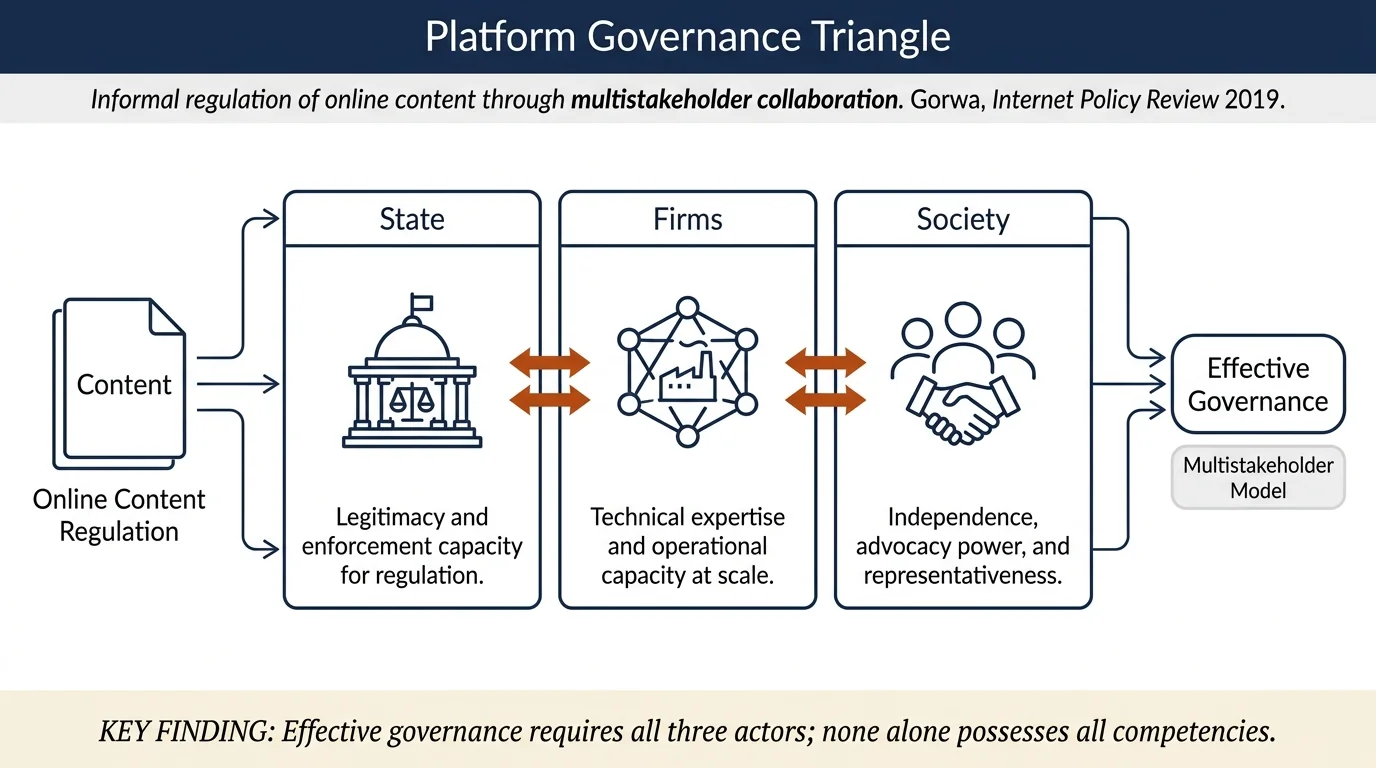
The platform governance triangle: conceptualising the informal regulation of online contentThis paper applies Abbott and Snidal's "governance triangle" framework to analyze how state actors, technology firms, and civil society organizations informally regulate online content through voluntary standards, codes of conduct, and multistakeholder initiatives. The analysis maps the European platform governance landscape, showing how…
 Detection methodsDatasets & evaluation
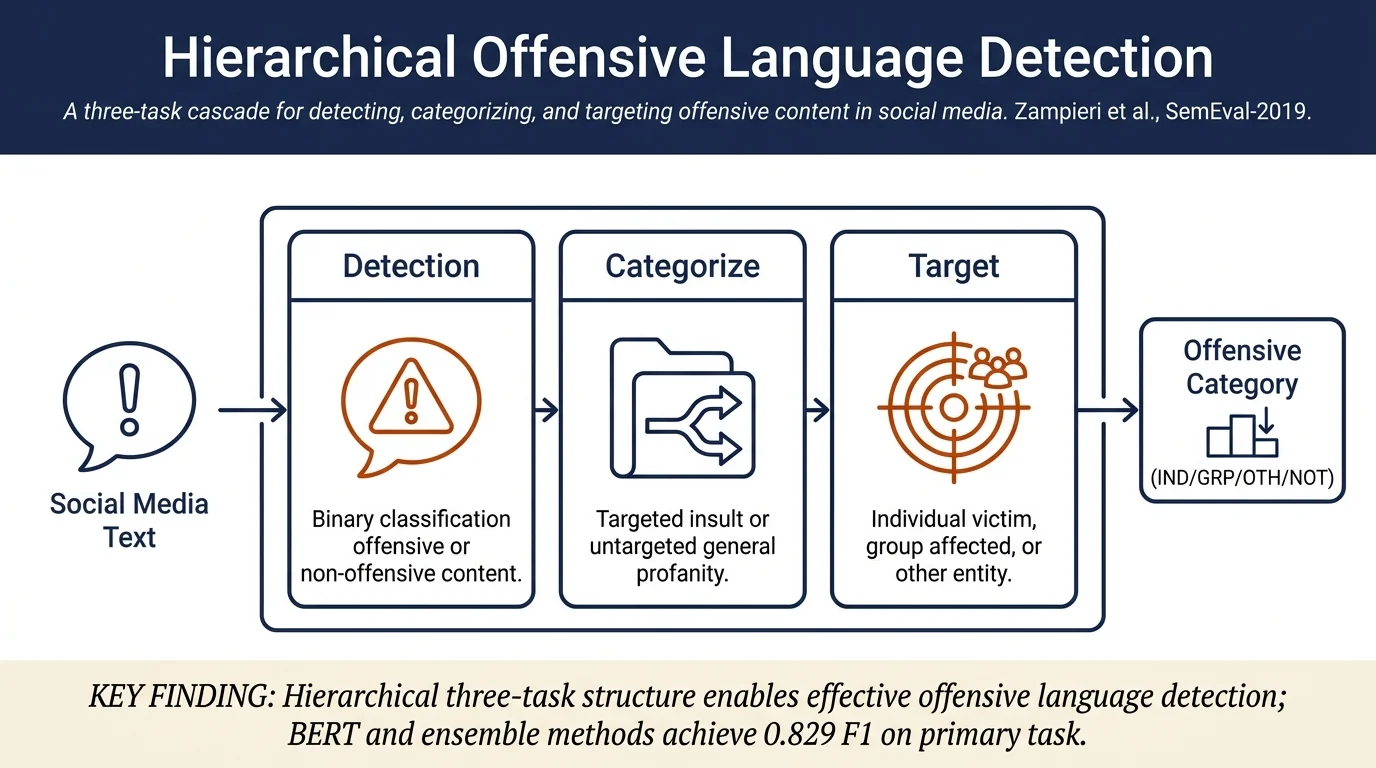
SemEval-2019 Task 6: Identifying and Categorizing Offensive Language in Social MediaSemEval-2019 Task 6 reports on a shared task competition for identifying and categorizing offensive language in social media using the OLID dataset. Approximately 800 teams registered and 115 submitted results across three sub-tasks: offensive language detection (104 teams), offense type categorization (71 teams), and offense target…
 Datasets & evaluationDetection methods
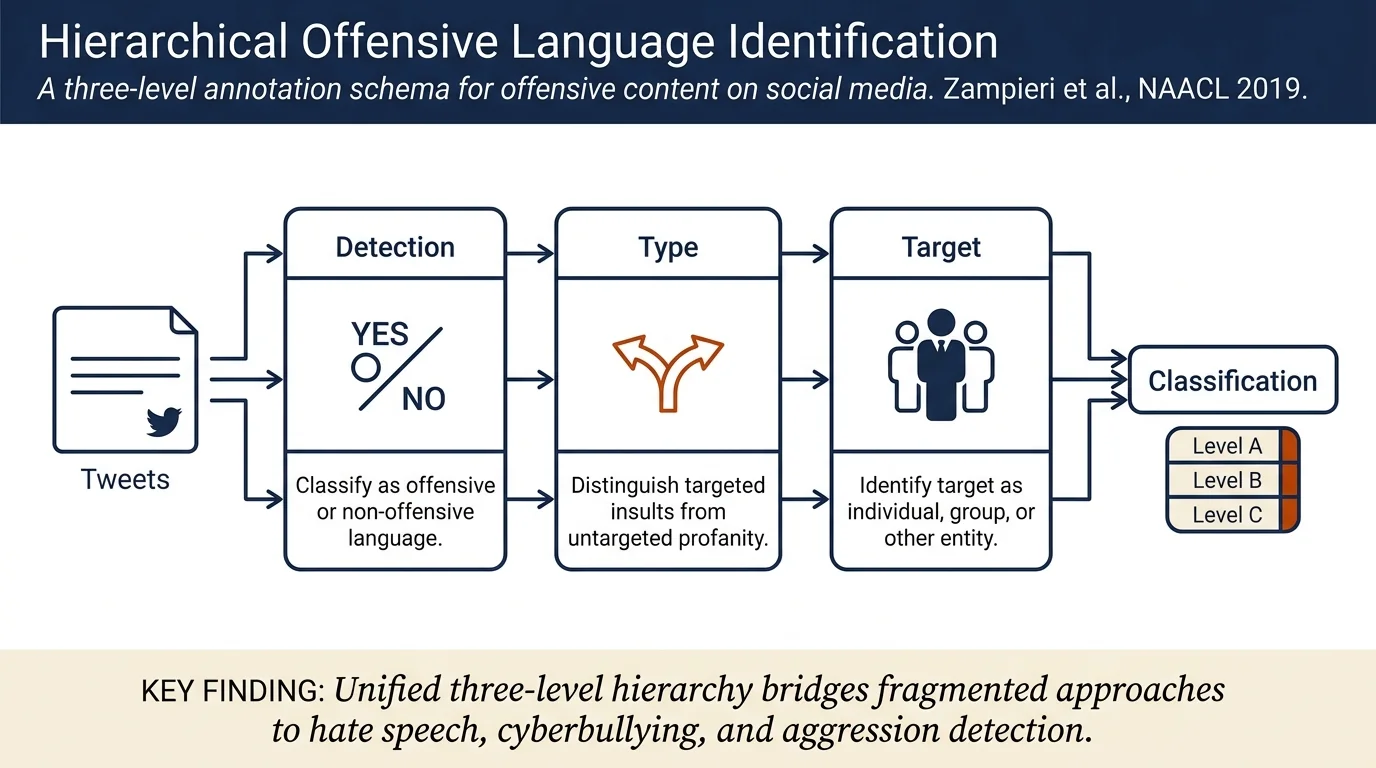
Predicting the Type and Target of Offensive Posts in Social MediaThis paper introduces OLID (Offensive Language Identification Dataset), a large-scale dataset of 14,100 English tweets annotated with a three-level hierarchical schema for detecting offensive content. The hierarchy distinguishes offensive from non-offensive posts (Level A), categorizes offense type as targeted insults or untargeted…
 Detection methodsLLMs & generative AI
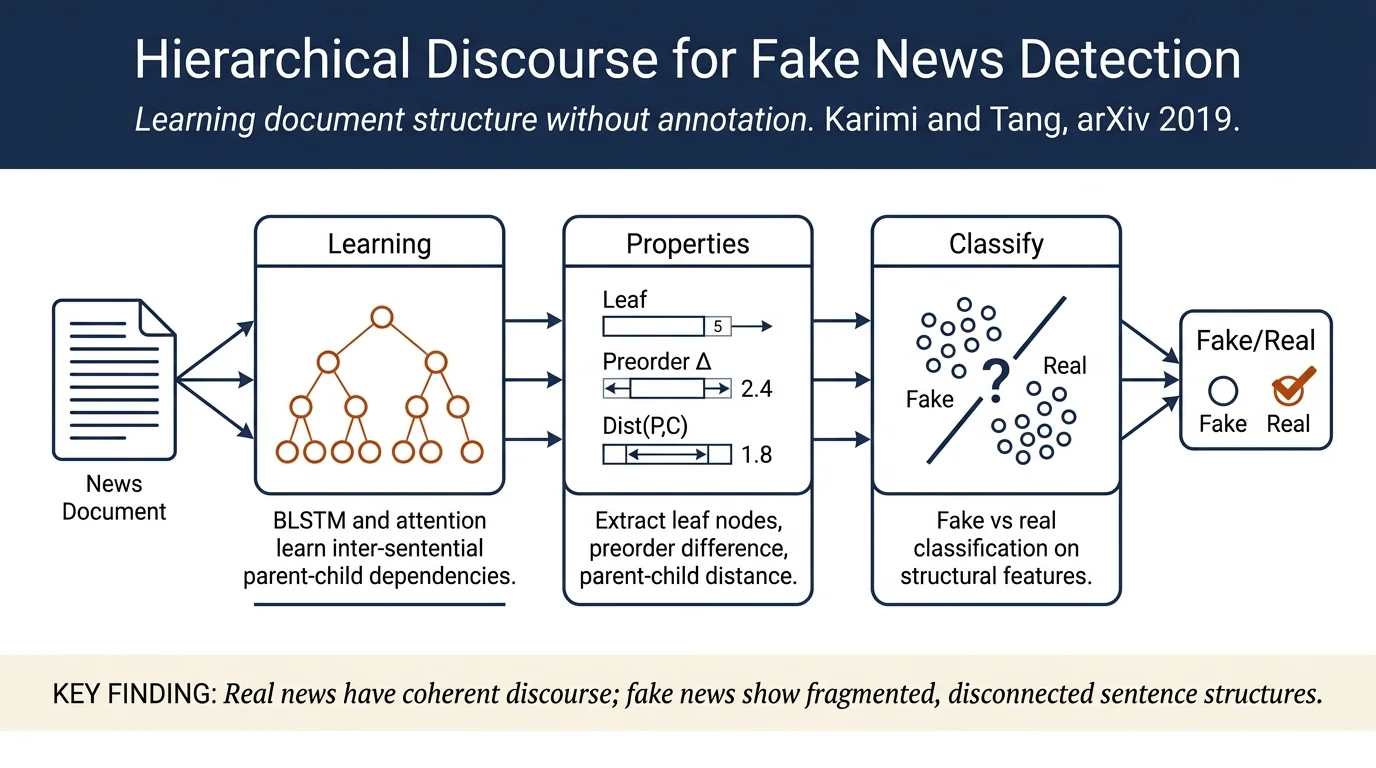
Learning Hierarchical Discourse-level Structure for Fake News DetectionProposes HDSF, a framework that learns hierarchical discourse-level structure (dependency trees of sentences) for fake news detection without annotated corpora. Identifies three structure-related properties that distinguish fake from real news and shows HDSF achieves 82.19% accuracy, outperforming linguistic baselines.
 Spread & networksPlatforms, policy & society
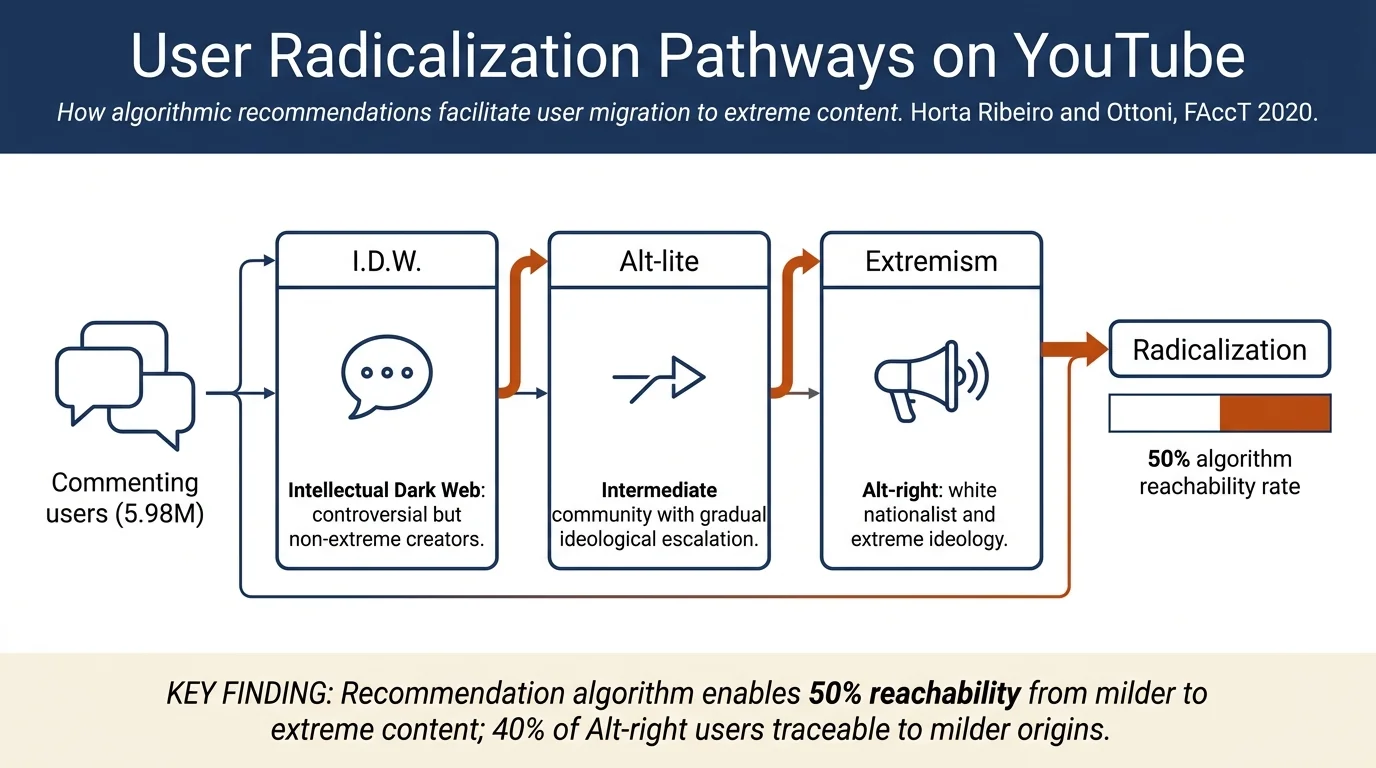
Auditing Radicalization Pathways on YouTubeFirst large-scale quantitative audit of user radicalization on YouTube. The authors tracked 349 channels across three ideological communities (Intellectual Dark Web, Alt-lite, Alt-right) and found strong evidence that users systematically migrate toward more extreme content.
 Fact-checking & verificationDatasets & evaluation
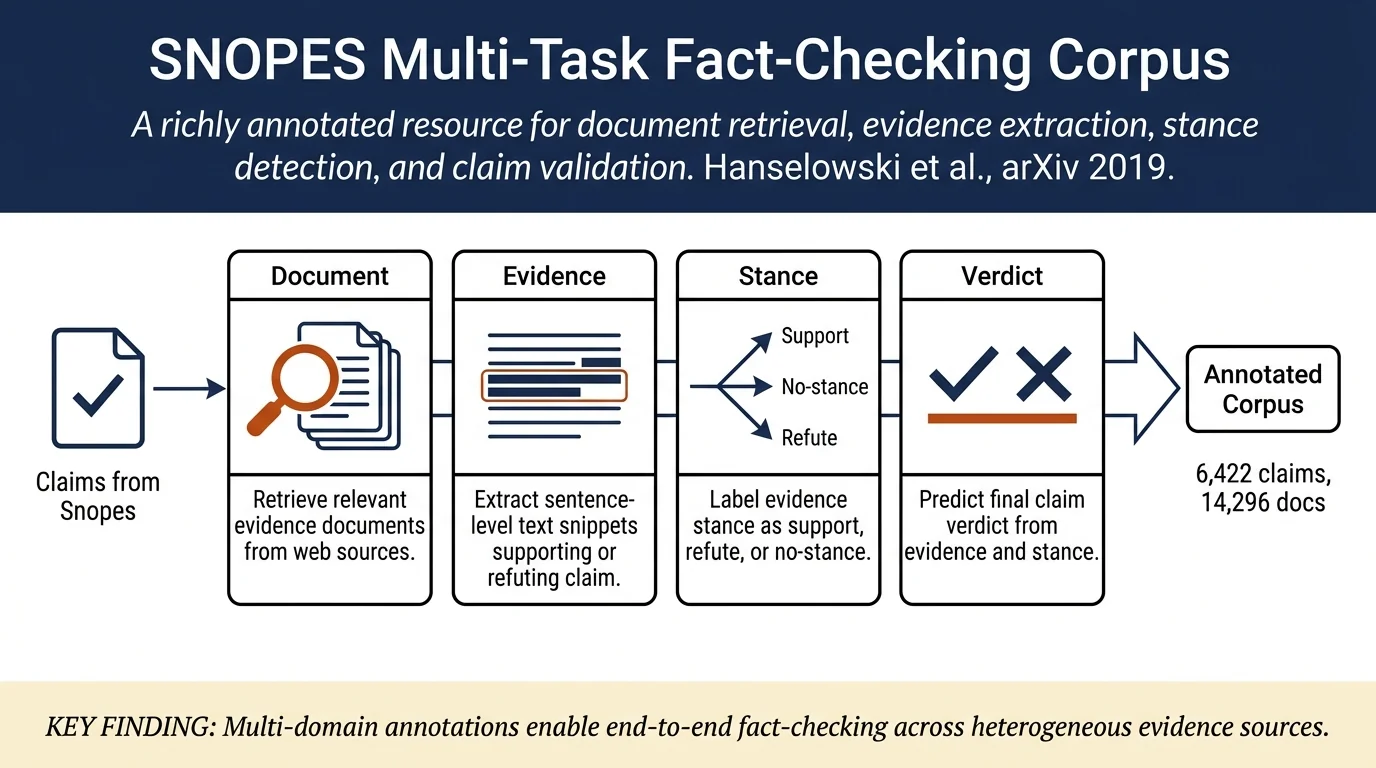
A Richly Annotated Corpus for Different Tasks in Automated Fact-CheckingThe paper introduces SNOPES, a large-scale fact-checking corpus with 6,422 validated claims and 14,296 documents covering multiple domains (news, social media, blogs). Each claim is annotated with evidence text snippets, evidence stance (support/refute/no stance), and verdicts, enabling training of models for four core fact-checking…