A Study of Misinformation in WhatsApp groups with a focus on the Brazilian Presidential Elections
Authors: Caio Machado, Beatriz Kira, Vidya Narayanan, Bence Kollanyi, Philip N. Howard
Venue: The Web Conference (WWW '19), May 13–17, 2019, San Francisco
DOI: 10.1145/3308560.3316738
TL;DR
Study of 130 public WhatsApp groups during the 2018 Brazilian presidential election found that 13.1% of shared links pointed to junk news sources, with 40% of links directing to YouTube—a platform used strategically to bypass platform moderation. Videos and images dominated message content (33% of all messages) and were heavily weaponized for polarizing and conspiratorial framing, suggesting messaging apps enable visual propaganda at scale through lower friction than public platforms.
Contributions
- Develops grounded typology classifying news sources (professional news, professional political, junk/conspiratorial) and media content (campaign support, polarizing/junk, religion, celebrities, hate/gore/porn, satire).
- First empirical study of WhatsApp's role in political misinformation during a major election; addresses shift from public (Twitter, Facebook) to private messaging platforms.
- Documents strategic use of YouTube and Facebook links within WhatsApp to expose users to junk content and evade platform scrutiny.
- Analyzes 45,072 links (86% coverage) and typology-coded 200 videos and 200 images to characterize political content distribution.
Method
Data collection: 130 public WhatsApp groups identified through search repositories (Gruposwhats.com, Gruposdezap.com) and snowball sampling; researchers posted consent requests upon joining. Period: September 21 – October 20, 2018 (leading up to second round of Brazilian presidential election).
Link Analysis: Extracted 50,795 URLs from chat history; removed 5,723 WhatsApp group invites; analyzed 38,800 links achieving 86.1% coverage. Coded links at domain/subdomain level except YouTube and Facebook (where multiple links from same channel/page receive single label). Coder reliability measured by Krippendorff's α = 0.84 (high).
Typology: Grounded typology tested across Twitter/Facebook during multiple elections and political events; classifies links into six categories: - Professional News: Major brands, local news, new media/startups, tabloids - Professional Political: Government, experts, political parties/candidates - Polarizing/Conspiratorial: Junk news (must meet ≥3 of 5 criteria: lack professionalism, false information, bias, counterfeit appearance, Russian origin) - Other Political: Political blogs, citizen/civil society, political commentary - Social Media & Aggregators - Video/Image Sharing
Media Analysis: Random sample of 200 videos and 200 images (Sept 21–28) classified by political affiliation (Pro-PSL, Anti-PSL, Pro-PT, Anti-PT, Other) and content type (campaign/support, polarizing/junk, religion, celebrities, hate/gore/porn, satire, other).
Results
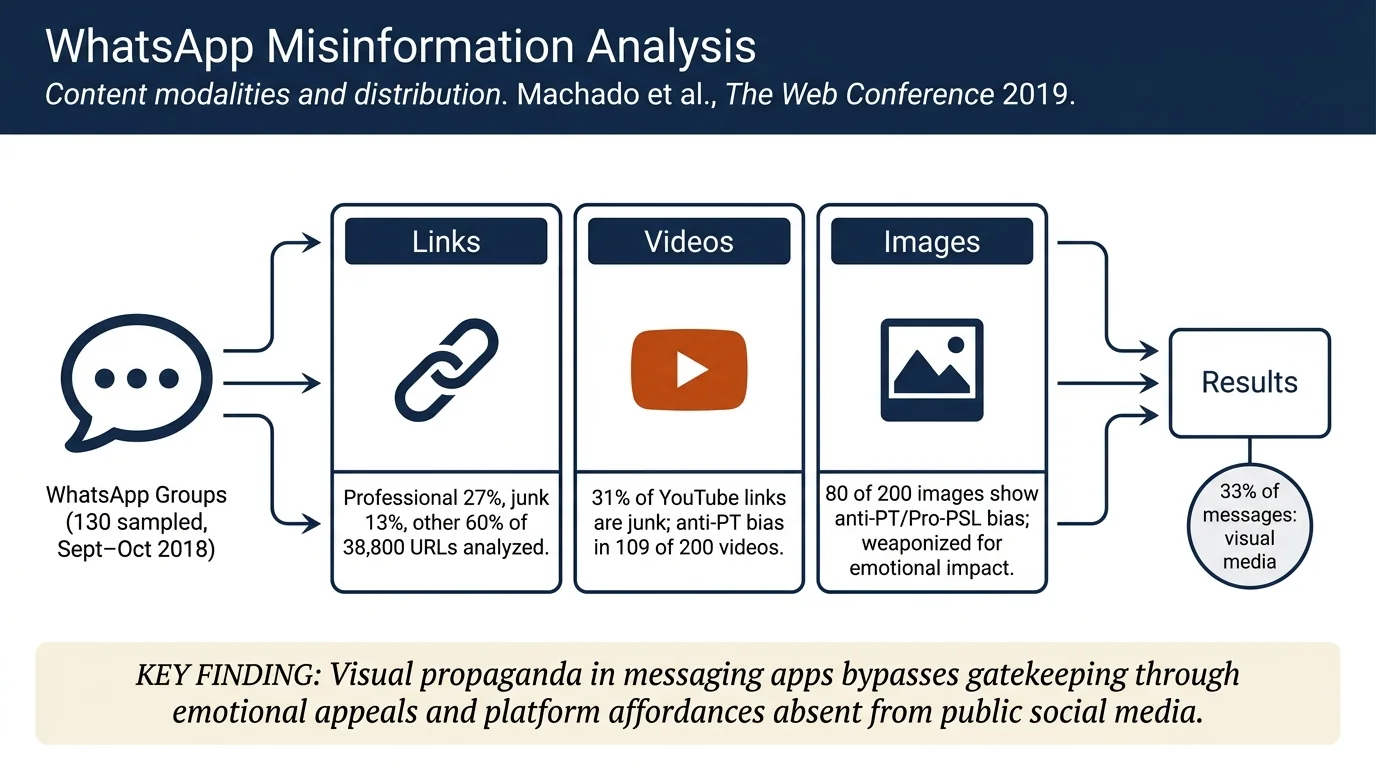
Link Distribution (Table 1): - Professional news outlets: 27.3% (news brands 27.1%, tabloids 0.2%) - Professional political: 2.7% (parties/candidates 1.6%, government 0.7%, experts 0.3%) - Junk news: 13.1% - Other political news: 30.7% (video/image sharing 16.8%, citizen/civil society 4.7%, political blogs 4.4%) - Social media & aggregators: 26.3%
Platform-Specific Junk Content (Table 2): - YouTube: 30.9% of coded links (11,255 of 17,702 total YouTube links) - Facebook: 42.3% of coded links (209 of 494) - Other news sources: 7.2% (1,407 of 19,549)
Media Content Distribution (Tables 3 & 4): Video sample (200 videos): - Anti-PT/Pro-PSL: 109 videos (56 campaign/support, 35 polarizing/junk, 18 other) - Anti-PSL/Pro-PT: 10 videos (4 campaign/support, rest other) - Other/Non-Political: 81 videos
Image sample (200 images): - Anti-PT/Pro-PSL: 80 images (37 campaign/support, 33 polarizing/junk) - Anti-PSL/Pro-PT: 14 images - Other/Non-Political: 37 images
Key Findings: 1. WhatsApp content shift toward visual media: 99,988 media files (33% of 298,892 total messages) dominated message volume. 2. Majority of videos/images were Anti-PT/Pro-PSL (supporting Bolsonaro), attributed to: (a) WhatsApp as broadcast system was novel tactic used by one campaign, (b) foreign advertising agencies hired exclusively by Bolsonaro campaign. 3. Visual misinformation operates differently than junk news—memes and videos don't attempt to fake source authority; instead strategically exploit emotional appeals and bypass traditional media gatekeeping. 4. High percentages of polarizing/junk content (35 of 91 Anti-PT/Pro-PSL videos, 33 of 70 Anti-PT/Pro-PSL images) and hate/gore/porn content.
Connections
- Related to How Many People Live in Political Bubbles on Social Media? Evidence From Linked on how audiences self-segregate into political bubbles; complements by showing platform affordances (private, group-based distribution) enable segregation at scale.
- Related to The Spread of True and False News Online on diffusion speed; WhatsApp's intimate, network-based sharing model contrasts with public Twitter/Facebook cascade analysis.
- Related to EANN: Event Adversarial Neural Networks for Multi-Modal Fake News Detection and MVAE: Multimodal Variational Autoencoder for Fake News Detection on multimodal detection; this paper demonstrates the scale of visual misinformation in real campaigns.
- Related to Allcott & Gentzkov (2017) on 2016 U.S. election fake news; extends analysis to different geography, platform (messaging vs. social), and modality (visual vs. text).
- Related to Coordinating a Multi-Platform Disinformation Campaign: Internet Research Agency on coordinated cross-platform strategy; shows WhatsApp as terminal node in funnel (other platforms feed into messaging apps).
- Cited in Disinformation, Propaganda, Political communication topic pages.
Notes
Strength: First major empirical study of messaging-app misinformation during real election; rigorous sampling, high coder reliability (α=0.84), and consent-based ethics. Documents platform affordances (intimate, network-based, hard-to-moderate) that differ fundamentally from public social media.
Limitation: Sample bias toward groups with public invitation links; snowball sampling may over-represent groups with similar political alignment. Authors acknowledge; remains largest available dataset of this kind.
Significance: Challenges research focus on public platforms (Twitter, Facebook) by showing political communication migrating to private channels where monitoring is difficult and visual propaganda is more effective. Explains Bolsonaro's WhatsApp strategy as intentional exploitation of platform affordances for campaign advantage.
Open questions: How do YouTube recommendations operate within WhatsApp forwarding chains? Do users who enter via WhatsApp/YouTube links have different engagement patterns than those on mainstream platforms? What role did foreign actors play in organizing group invites and seeding content?