Less than you think: Prevalence and predictors of fake news dissemination on Facebook
Authors: Andrew Guess, Jonathan Nagler, Joshua Tucker Venue: Science Advances, Vol. 5, No. 1, eaau4586 — DOI
TL;DR
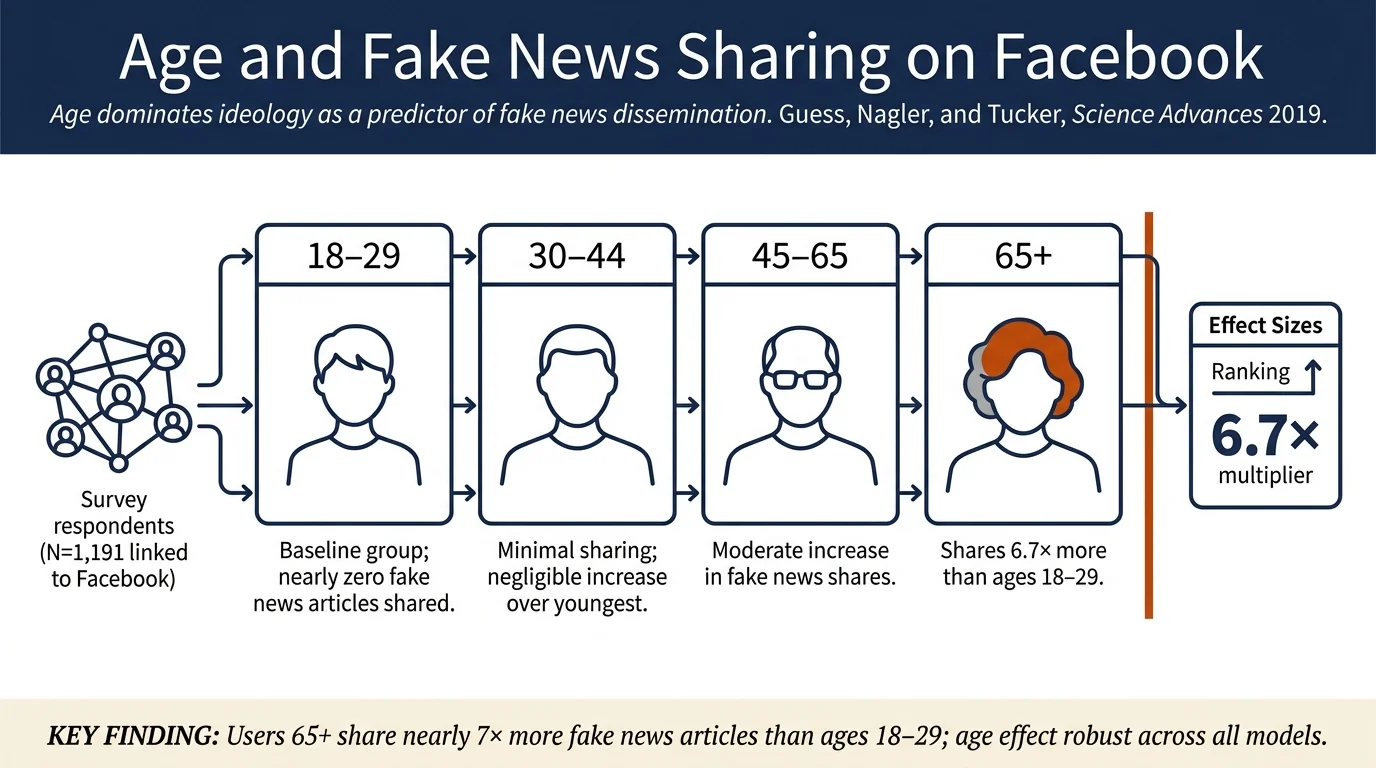
Fake news dissemination on Facebook during the 2016 election was a rare behavior (8.5% of users shared at least one article), with clear demographic stratification: conservatives shared more articles from fake news domains (pro-Trump), but the strongest and most robust predictor was age—users over 65 shared nearly seven times as many fake news articles as those aged 18–29, persisting even after controlling for ideology and education.
Contributions
- Empirical prevalence measure — linked representative survey (N=3,500) to actual Facebook profile data (N=1,191 with complete linkage), establishing that fake news sharing was rare, with 91.5% of respondents sharing zero fake news articles
- Robust demographic findings — identified conservative ideology and extreme age (65+) as significant predictors; age effect particularly notable because it persists after controlling for partisanship, ideology, education, and other demographics
- Methodological rigor — overcame known biases in self-reported online behavior by directly observing Facebook shares; used multiple definitions of fake news (Silverman list vs. Allcott & Gentzkov list) for robustness
- Mechanistic hypotheses — proposed two competing explanations for age effect: (1) lower digital media literacy in older cohorts, (2) cognitive aging effects on memory and resistance to "illusions of truth"
Method
The study combined survey and digital trace data:
Survey component (Wave 1–3): YouGov panel survey administered April–November 2016 to 3,500 respondents on social media use and political behavior; matched respondents to Facebook profile data.
Facebook profile data: Starting November 16, 2016, respondents who consented (1,331 of 2,711 Facebook users; 1,191 with successful linkage) shared access to their Facebook timeline posts via OAuth app. Data collection captured: - Posts containing external links (parsed for domain) - Public profile information (political views, religious views) - "Like" activity (to assess engagement levels) - Did not include News Feed composition or friend network, limiting causal inference on exposure
Fake news definition: Two complementary measures: 1. Silverman list (primary): 21 pro-Trump domains (abcnews.com.co, Denver Guardian, Ending the Fed, etc.) curated by BuzzFeed journalist Craig Silverman; filtered to exclude "hard news" domains via supervised learning classifier 2. Allcott & Gentzkov list (robustness): 948 fact-checked false claims; extracted publisher domains; removed hard news
Modeling: Quasi-Poisson and negative binomial regression with YouGov sample-matching weights. Dependent variable: count of fake news articles shared by each respondent.
Covariates: Age (18–29, 30–44, 45–65, 65+), gender, race, education, income, ideology (five-point), party ID (three-point), number of links posted (overall Facebook activity).
Results
Prevalence: - 91.5% of respondents (1,090 of 1,191) shared zero fake news articles during the campaign - Among those who did share, distribution was highly right-skewed: 5.3% shared 1, 1.0% shared 2, <1% shared 3+ - Maximum observed was 50 shares for a single user
Party and ideology effects: - Republicans (18.1%) were more likely than Democrats (3.5%) to share at least one fake news article - Conservatives and very conservatives had higher average shares (0.75 and 1.0 respectively) vs. liberals and very liberals - However, effect is conditional on exposure to pro-Trump content; not clear whether conservatives are more susceptible or simply exposed to more fake news
Age effect (strongest finding): - Users 65+ shared average of 0.75 fake news articles (95% CI 0.515–0.977) - Users 45–65 shared 0.26 articles - Users 30–44 shared negligible amounts - Users 18–29 shared negligible amounts - Multivariate model coefficient: e^1.9 ≈ 6.69 (over 65 vs. 18–29), or approximately 2.27× the next age group (45–65) - Robust to specification: persists across multiple model formulations, alternative fake news measures, and additional controls for political knowledge
Other demographics: - Gender, race, education, income showed no consistent predictive effect on fake news sharing - Interestingly, those who posted the most content overall were less likely to share fake news, suggesting media-literate power users can discern content quality
Connections
- Related to Grinberg et al. (2019) — Fake news on Twitter during the 2016 U.S. presidential election which documents similar age-driven concentration of fake news consumption on Twitter (1% of users see 80%)
- Builds on Allcott & Gentzkov (2017) — Social Media and Fake News in the 2016 Election which provides aggregate traffic data; this paper adds individual-level behavior linked to survey data
- Relevant to Shu et al. (2019) — The Role of User Profiles for Fake News Detection for demographic profiling of fake news sharers
- Cited by later work on age and digital literacy
Notes
Strengths: - Novel linkage of representative survey to verified behavioral data overcomes known self-report biases - Most robust finding (age effect) is genuinely surprising and well-documented; persists across multiple specifications - High response rate and careful sample matching weights address selection bias concerns - Transparent about limitations: half of Facebook users opted not to share data; composition of News Feeds unobserved
Weaknesses & limitations: - Cross-sectional design; cannot infer causality from observed associations - Observational data only; cannot distinguish between exposure (News Feed composition) vs. susceptibility (willingness to share given exposure) - Potential deletion bias: respondents may have deleted fake news posts before sharing data; authors argue this would reduce noise, not introduce bias - Limited mechanistic insight: age effect could reflect digital literacy, cognitive aging, cohort effects, or social trust in peer endorsements; paper proposes hypotheses but cannot adjudicate
Follow-up questions: - Is the age effect driven by cohort effects (generational differences in digital socialization) vs. aging effects (decline with individual age)? - How much of the age effect reflects lower media literacy vs. differences in susceptibility to "illusions of truth" and belief persistence? - What is the role of News Feed curation (exposure) vs. user choice (share likelihood) in explaining observed patterns? - Do interventions to increase digital literacy or prebunk false claims differ in effectiveness across age groups?
Significance: This paper is foundational empirical work in establishing that fake news sharing, despite prominent media narratives, was a statistically rare behavior during 2016. Its key insight—that age is a stronger and more robust predictor than ideology—challenges political-science orthodoxy that stable partisan predispositions drive behavior. The finding has implications for literacy and media interventions: efforts to combat misinformation may need to be age-targeted rather than ideology-targeted.