Fighting Misperceptions and Doubting Journalists' Objectivity: A Review of Fact-checking Literature
Authors: Sakari Nieminen, Lauri Rapeli
Venue: Political Studies Review, Vol. 17(3), pp. 296–309 — DOI
TL;DR
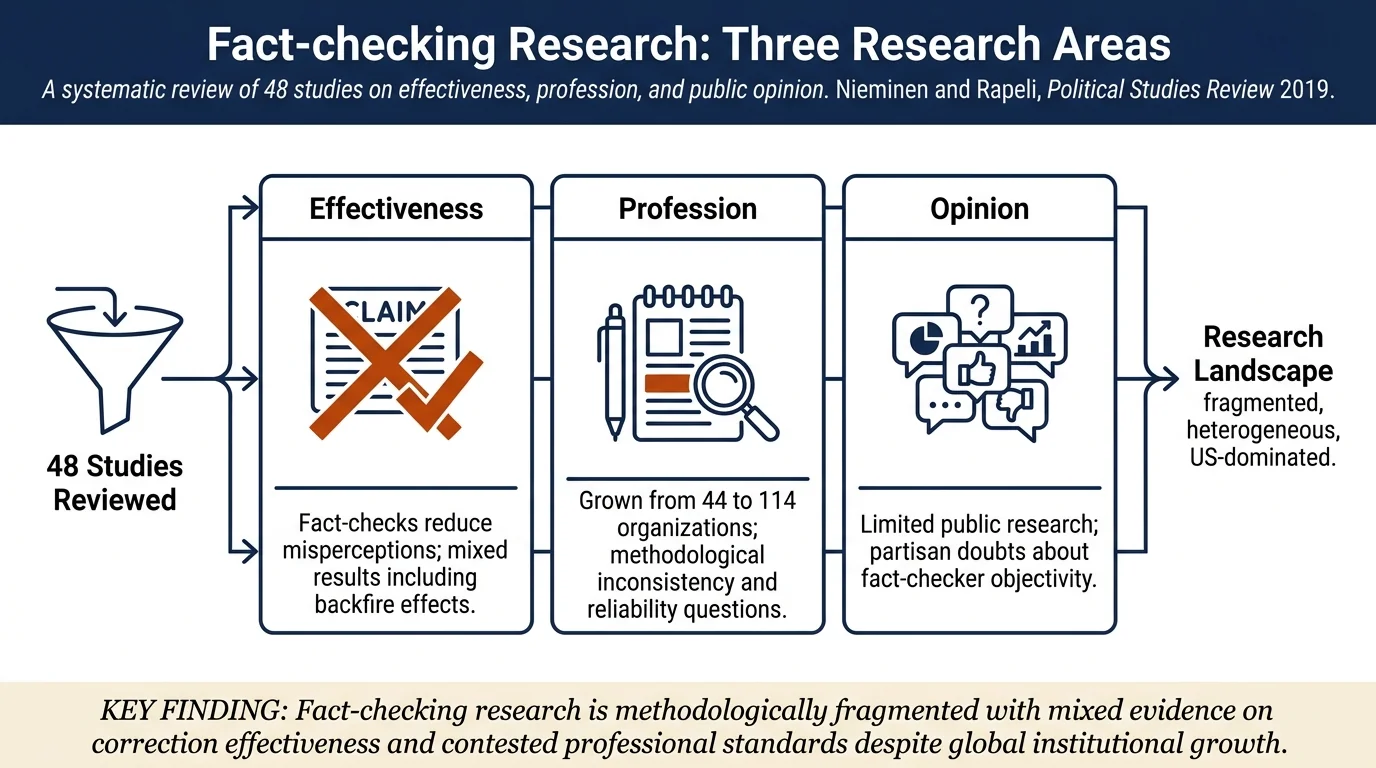
Comprehensive literature review of 48 studies on political fact-checking, organized into three research areas: (1) fact-checking effectiveness for correcting misperceptions (mixed results, including backfire effects); (2) fact-checking as a profession (contested methods and reliability); (3) public opinion about fact-checking (mostly negative perceptions despite positive effects). The field is dominated by US-focused research; methodological diversity undermines cross-study comparison; scholars debate whether fact-checkers consistently reach reliable conclusions.
Contributions
- Systematic categorization of fact-checking research into three main areas: effectiveness, profession, and public opinion
- Evidence synthesis showing mixed effectiveness: some studies find fact-checks reduce misperceptions, others find corrections fail or produce backfire effects
- Documentation of methodological inconsistencies across studies that limit comparability
- Critical assessment of fact-checker reliability and consistency (some studies find low agreement between fact-checkers on identical claims)
- Analysis of geographic and institutional bias in the literature (88% of studies involve US-affiliated contributors)
Method
The authors conducted a content analysis of scholarly literature gathered from Scopus and Web of Science databases (search conducted April 9, 2018). Selection criteria: (1) publications with "fact-checking" in abstracts or keywords; (2) English-language publications in scientific journals; (3) peer-reviewed work excluding dissertations and conference proceedings; (4) focus on political fact-checking (excluding non-political domains). Three major topics identified: effects of fact-checking, fact-checking as a profession, and public opinion about fact-checking. Tables 1 and 2 summarize the 48 reviewed studies by their methods, data sources, and key findings.
Key Findings
Effectiveness of fact-checking
Mixed evidence on whether corrections reduce misperceptions: - Some studies (Weeks & Garrett, 2014; Fracchiolla, 2015) find fact-checks can correct false beliefs - Others report the "backfire effect" where corrections strengthen false beliefs, particularly among ideologically motivated audiences (Nyhan & Reiffer, 2010) - Effectiveness varies by context: corrections more effective for non-political claims, less effective when politically identity-protective - Format matters: text-based corrections less persuasive than multimodal corrections - Psychological factors (ideology, sophisticated reasoning, media diet) moderate effectiveness
Fact-checking as a profession
- Fact-checking has grown enormously (44 organizations in 2014 expanded to 114 by 2017)
- Two competing professional models: journalistic fact-checkers (objective, full-time) vs. partisan fact-checkers
- Methodological inconsistency: Graves (2016) describes five phases in a typical fact-check (claim selection, contacting targets, consulting sources, expertise consultation, transparent publication), yet critics question whether fact-checkers reliably apply these steps
- Reliability concerns: Uscinski & Butler (2013) argue inconsistency between fact-checkers (same claim rated differently by different organizations) undermines credibility
- Most research documents the US fact-checking movement; European fact-checking (StopFake in Ukraine, Full Fact in UK) emerged more recently
Public opinion about fact-checking
- Limited research on general public views about fact-checking
- Available studies show mixed attitudes: some appreciate fact-checking, others view fact-checkers as politically biased
- Partisan effects: Republicans more likely than Democrats to doubt fact-checkers' objectivity
- Social media comments on fact-check articles typically negative
- Few studies examine how ordinary citizens evaluate fact-checker credibility
Connections
- Fact-checking and corrections — comprehensive review of what research shows about fact-checking effectiveness
- Correction effectiveness — meta-analytic reviews on backfire effects and moderators
- Misinformation responses — broader category of how people correct and respond to false information
- Backfire effects — detailed examination of the backfire phenomenon across contexts
- Political communication — fact-checking as a political phenomenon and media practice
- Meta-analysis and systematic reviews — methodological contribution to understanding the state of knowledge
Notes
Strengths: - Systematic organization of a fragmented and rapidly growing literature - Clear identification of the three major research themes - Honest assessment of methodological heterogeneity, which is often a barrier to synthesis - Recognition that fact-checking's global emergence raises questions about comparative methodology - Documentation that US dominance (88% of studies) limits generalizability of findings
Limitations and open questions: - The review identifies that fact-checking research lacks standardized methods and definitions, making it difficult to compare across studies - The "backfire effect" literature remains contested; later work (Wood & Porter 2019) questions whether backfire is real or an artifact of measurement - The review period (through April 2018) predates much COVID-19 fact-checking research, which would likely expand these categories - Public opinion research on fact-checking is sparse; most studies focus on effects rather than attitudes - Institutional diversity of fact-checking (NGOs vs. journalism vs. state initiatives) raises questions about whether "fact-checking" is a coherent research object across countries - The authors note that fact-checking as a scientific research topic has gained legitimacy but that methodological standards remain contested among scholars
Future research directions: - Standardization of methods and measures to enable cross-study comparison - Comparative analysis beyond the US (the field is globalizing but research is not) - Investigation of consistency and reliability across fact-checkers - Better understanding of public perception and trust in fact-checkers - Examination of institutional factors affecting fact-checking practice