How Many People Live in Political Bubbles on Social Media?
Authors: Gregory Eady, Jonathan Nagler, Andrew Guess, Jan Zilinsky, Joshua A. Tucker
Venue: SAGE Open, 2019, Vol. 9, Issue 1 — DOI
Affiliations: New York University (Eady, Nagler, Guess, Zilinsky, Tucker)
TL;DR
Eady et al. link survey data from 1,496 Americans to Twitter data from 642,345 accounts and ~1.2 billion tweets to measure political polarization in media consumption. Rather than finding evidence of extreme "filter bubbles" where most people consume ideologically homogeneous content, they find substantial overlap in the accounts followed across the political spectrum—though asymmetries emerge, with conservatives more likely to follow left-leaning media outlets than liberals follow right-leaning outlets. Their core claim: political polarization on social media exists, but the popular narrative of mutually exclusive information cocoons overstates the case.
Contributions
- Methodological: Bridges survey-based self-reported ideology with large-scale behavioral Twitter data, enabling validation of ideology estimates from social media behavior against survey self-placement.
- Measurement: Develops fine-grained measures of ideological exposure through three lenses—accounts followed, tweets received, and retweets—showing that different measurement choices yield different conclusions about bubbles.
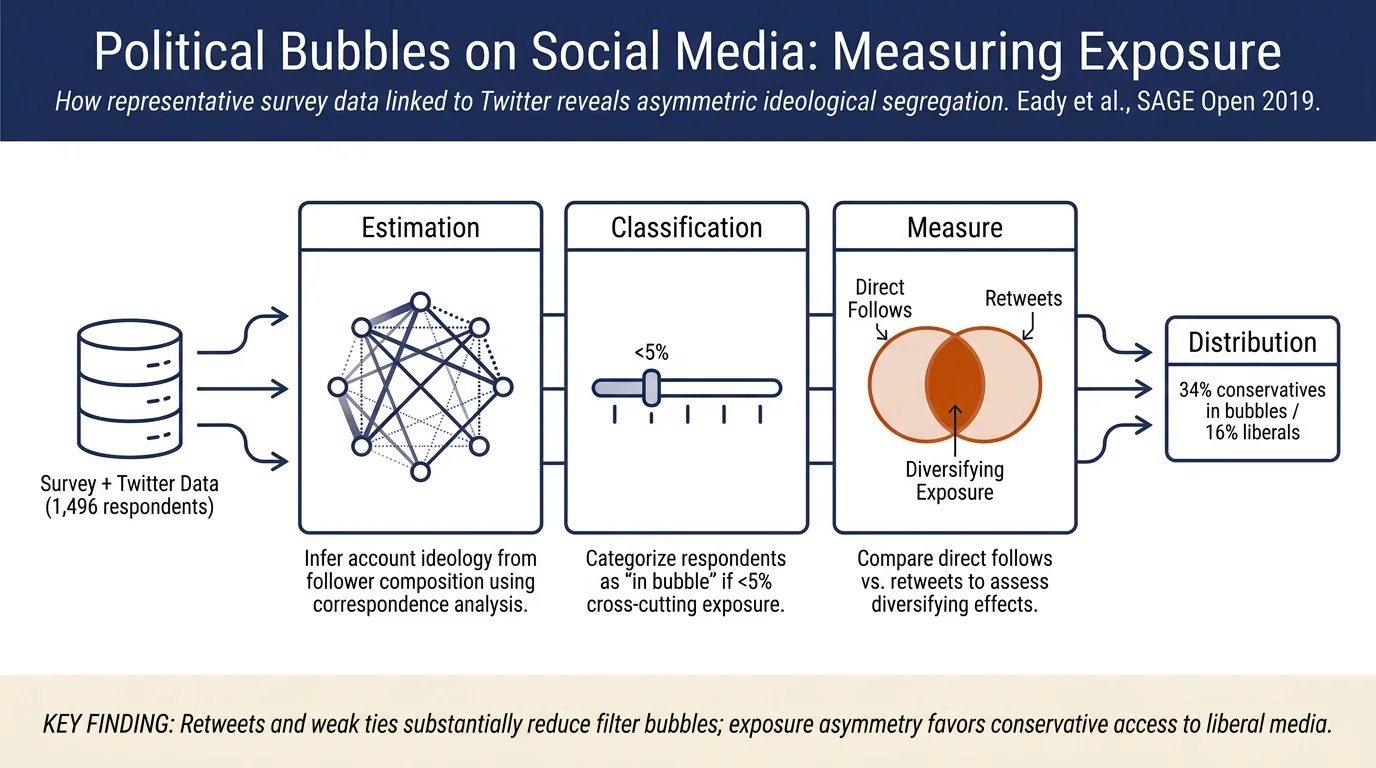
- Empirical: Quantifies the distribution of "bubble-ness" across individuals: while 34% of the most conservative quintile live in extreme conservative bubbles (following <5% ideologically distant accounts), 85% of liberals in that quintile are not in such bubbles.
- Mechanism: Identifies retweets and weak ties as important bridges across ideological divides that complement (and often compensate for) homophilic direct following behavior.
Method
Survey design: Representative sample of Americans (N=1,496) drawn from YouGov's online panel during 2016. Respondents self-placed on an ideological scale (0–100, liberal to conservative) and reported their Twitter handles. The researchers cross-referenced 1,496 survey respondents to gather 642,345 unique Twitter accounts they followed and ~1.2 billion tweets from those accounts.
Ideological coding of accounts: Rather than hand-labeling, Eady et al. estimated the ideology of each Twitter account by measuring the ideological composition of its followers. Following Barberá et al. (2015), they assumed users tend to follow ideologically similar accounts (homophily) and inferred account ideology from the distribution of follower ideologies. Ideology estimates were validated via correspondence analysis.
Categorization of accounts: Accounts were classified as (a) media elites (major news organizations), (b) political elites (politicians, journalists, commentators), or (c) non-elites (regular users). These categories were anchored at fixed reference points (e.g., MSNBC on the left, Fox News on the right) to enable cross-quintile comparison.
Bubble measure: A respondent was classified as living in a "bubble" if fewer than 5% of the accounts they followed fell outside a ±1 unit range on the ideological scale (roughly one standard deviation from their own position). The 5% threshold is somewhat arbitrary but reflects the sense of "substantial exposure to cross-cutting ideology."
Overlap analysis: To assess whether two users inhabit overlapping information environments, Eady et al. computed the distributional overlap between the ideological distributions of accounts they individually follow and the tweets they each receive. High overlap suggests shared information environments; low overlap suggests distinct filter bubbles.
Results
Finding 1: Moderate ideological segregation in following behavior. - 53% of the survey sample follow at least one media account overall. - Over half (53%) of respondents follow political accounts; conservatives and liberals follow roughly equal numbers of political elites. - Media accounts are less polarized than political elite accounts in followers' distributions. - Asymmetry: 78% of liberal respondents follow at least one account as far left as MSNBC; only 31% of conservatives follow MSNBC. By contrast, 53% of conservatives follow accounts as far right as Fox News, but only 40% of liberals do.
Finding 2: Bubble prevalence is lower than folk theories suggest. - Only 34% of the most conservative quintile live in extreme "bubbles" (fewer than 5% cross-ideological exposure via direct accounts). - Only 16% of the most liberal quintile live in such bubbles. - When offline TV consumption is factored in (with conservative respondents more likely to watch cable news), the proportion of conservatives in media bubbles drops further.
Finding 3: Weak ties and retweets diversify exposure. - Retweets expose users to a broader ideological range than accounts they directly follow. - Non-elite accounts that people follow are more ideologically heterogeneous than media or political elite accounts. - Respondents in the most conservative quintile receive tweets from considerably more liberal and moderate sources via retweets than they would if exposed only to accounts they directly follow. - Mean within-quintile overlap is large (0.51 between any two accounts within the most liberal quintile; 0.57 between the most conservative quintile).
Finding 4: Asymmetric filter bubble exposure. - Conservatives are more prone to following ideologically extreme accounts (Fox News, Breitbart on the right). - Liberals are more likely to inhabit bubbles of mainstream/center-left outlets (MSNBC, New York Times). - This asymmetry could reflect supply-side factors (partisan media market structure) and demand-side factors (norms around journalistic professionalism trusted more by liberals).
Connections
- Related to Cinelli et al. (2021) on echo chambers across platforms; this work provides ground truth from a representative survey that Cinelli et al. can validate against.
- Contrasts with Bail et al. (2018) by showing that exposure to opposing views is substantial and non-random, challenging filter bubble determinism.
- Builds on Mosleh et al. and Mosleh et al. on cognitive reflection by examining partisanship as one dimension of bubbles and introducing individual-level heterogeneity in bubble-ness.
- Methodologically aligned with Castillo et al. (2011) in linking social media structure to outcomes inferred from behavioral data.
- Related to Grinberg et al. (2019) on media diet diversity during elections; complements with explicit ideology coding.
Notes
Strengths: - Large-scale, nationally representative survey linked to behavioral data—a rare and valuable combination that mitigates selection bias in self-selected social media users. - Multiple operationalizations of exposure (accounts followed, tweets received, retweets) show sensitivity to measurement choices; results are robust but not uniform across measures. - Distinction between media elites, political elites, and non-elites reveals that non-elite accounts are crucial bridges—a finding that survey-only or elite-account-focused studies would miss. - Sophisticated ideology estimation using correspondence analysis and validated against survey self-placement.
Weaknesses: - The 5% cross-cutting threshold for "bubbles" is somewhat arbitrary; results are sensitive to where this threshold is set (the paper shows this and discusses it). - Offline media exposure (TV, print, radio) is estimated from survey questions rather than observed directly, and the magnitudes are influenced by the respondents' recall and willingness to report. - The paper focuses on U.S. Twitter users in 2016; generalization to other platforms, countries, or time periods is unclear. - Ideology estimation via follower composition assumes homophily and may conflate (e.g.) mainstream-news brands followed across the spectrum with genuinely left-leaning outlets.
Implications: - Challenges both "apocalyptic" (everyone in bubbles) and "utopian" (social media is diverse) narratives. The ground truth is messier: substantial exposure exists, but is non-random and skewed by ideology, platform design, and individual choice. - Suggests that interventions to reduce polarization should target weak ties and algorithmic amplification of retweets rather than assume people never encounter opposing viewpoints. - The asymmetry in liberal-conservative following patterns invites further research into supply-side factors (what media outlets exist) vs. demand-side factors (what people prefer).