The Web of False Information
Authors: Savvas Zannettou, Michael Sirivianos, Jeremy Blackburn, Nicolas Kourtellis Venue: arXiv, 2018 — 1804.03461
TL;DR
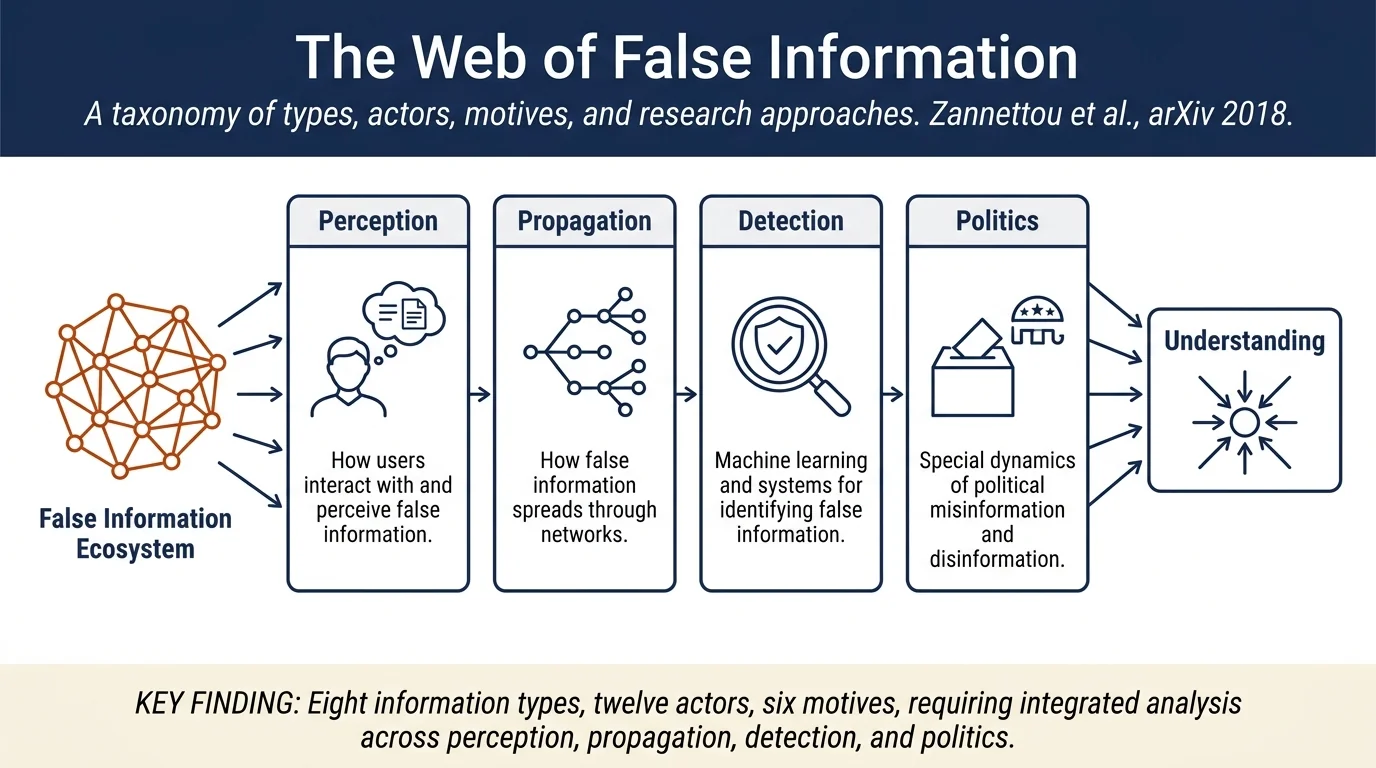
Comprehensive typology of the false information ecosystem on the Web, identifying eight types of false information (fabricated stories, propaganda, conspiracy theories, hoaxes, biased news, rumors, clickbait, satire), twelve actor categories (bots, criminal organizations, activists, governments, paid posters, journalists, useful idiots, true believers, profit-seekers, trolls), and six motives (malicious intent, influence, discord, profit, passion, fun). Literature review across user perception, propagation dynamics, detection approaches, and political misinformation.
Contributions
- Typology of false information ecosystem: Fine-grained categorization of false information types and their characteristics, addressing overlaps and distinctions between categories.
- Comprehensive actor taxonomy: Systematic enumeration of actors disseminating false information, from automated systems (bots) to human actors (government, activist, criminal organizations).
- Motivation framework: Classification of motives driving false information propagation (malicious intent, influence, sow discord, profit, passion, fun).
- Literature synthesis: Structured overview of 200+ papers organized by four lines of work: user perception, propagation dynamics, detection/containment, and political false information.
- Research gap identification: Documents understudied areas including cross-platform propagation, multi-format information (text, images, video), temporal dynamics of user perception, and containment strategies.
Method
The paper is a literature review and taxonomy-building exercise rather than an empirical study. The authors:
- Develop a typology of false information types based on systematic categorization of how false information manifests on the Web, building on existing literature (particularly [Kumar & Shah 2018]).
- Identify and characterize the range of actors involved in false information dissemination, from automated systems (bots controlled by botnets) to human actors (terrorists, activists, governments, journalists, trolls).
- Enumerate and describe motives driving actors' behavior, with analysis of how motives sometimes overlap.
- Conduct a comprehensive literature review organized into four major research lines: (i) user perception and interaction with false information, studied via OSN data analysis, questionnaires/interviews, and crowdsourcing; (ii) propagation dynamics, studied via epidemiological models and statistical approaches; (iii) detection and containment via machine learning, systems, and hybrid approaches; (iv) political false information, with separate coverage due to its consequentiality.
- Synthesize methodologies and identify gaps in coverage across the literature.
Results
False information typology: - Fabricated (F): completely fictional stories disconnected from reality - Propaganda (P): false stories targeting specific parties with political intent; widespread in political contexts - Conspiracy Theories (CT): explanations invoking unproven conspiracies; typically present unsourced information as fact - Hoaxes (H): news with false or inaccurate facts presented as legitimate; overlaps with myths and rumors - Biased/One-sided (B): extremely biased or one-sided stories - Rumors (R): stories whose truthfulness is ambiguous or never confirmed; widely propagated on OSNs - Clickbait (CL): misleading headlines and thumbnails; rapid growth with OSN proliferation - Satire (S): irony and humor; sites like TheOnion and SatireWire disclose nature but readers often miss this
Actor taxonomy: Identifies twelve main actor categories including bots, criminal/terrorist organizations, activist/political organizations, governments, hidden paid posters, state-sponsored trolls, journalists, useful idiots (manipulated believers), true believers, individuals benefiting from false information, and trolls (motivated by disruption/amusement). Overlaps noted (e.g., hidden paid posters and state-sponsored trolls can have multiple motives).
Literature findings by research line:
- User perception: Methods include OSN data analysis, questionnaires/interviews, and crowdsourcing. Key findings show teenagers less interested in news credibility; adults can identify bias but may not do so; students more prone to sharing false information; users can mostly distinguish rumors except when conspiracy-themed.
- Propagation: Research focuses on rumor spreading, conspiracy theory discussion, biased news, and fabricated content. Key findings show rumors spread fast and are persistent; false stories propagate faster/further than true stories when compared within same networks; reputable accounts help stop spread; small-degree nodes and network structure affect propagation patterns.
- Detection: Approaches span machine learning (credibility assessment, rumor detection, hoax detection, conspiracy theories, satire, clickbait, fabricated content), systems (RumorLens, credibility assessment dashboards), and other models/algorithms. Performance varies by false information type—hoaxes >95% accuracy (Random Forest), rumors <80% (various methods).
- Political false information: Machine learning approaches detect propaganda and biased news with varying accuracy; systems for real-time detection and credibility assessment exist; political false information propagates faster and with different dynamics than other types.
Connections
- Relates to Defining "Fake News": A typology of scholarly definitions on conceptual definitions and typology of false information; complements with actor and motive taxonomy.
- Builds on Information Disorder: Toward an Interdisciplinary Framework for Research and framework of misinformation vs. disinformation; extends to comprehensive actor/motive model.
- Cross-references with The Science of Fake News foundational Science article but provides more granular typology.
- Cited by subsequent survey work and detection papers using this taxonomy.
- Shares detection methodologies with Fake News Detection on Social Media: A Data Mining Perspective and Combating Fake News: A Survey on Identification and Mitigation Techniques.
Notes
Strengths: Comprehensive synthesis of a rapidly evolving literature; useful typology addressing overlaps between false information types; systematic enumeration of actors and motives; identification of research gaps. Clear organization of 200+ papers into coherent research lines.
Weaknesses: Primarily a literature review with limited novel empirical contribution; typology itself not empirically validated (e.g., no user studies confirming distinctiveness of categories). Limited discussion of cross-platform dynamics despite growing evidence that false information propagates across platforms. Missing coverage of emerging modalities (deepfakes were nascent in 2018) and platform-specific mechanisms. Containment strategies discussed only briefly despite policy relevance.
Follow-up directions: The paper identifies major gaps that subsequent work has pursued: multi-format false information detection, cross-platform propagation, temporal user perception dynamics, and effective containment without censorship concerns.