Auditing Radicalization Pathways on YouTube
Authors: Manoel Horta Ribeiro, Raphael Ottoni, Robert West, Virgilio A. F. Almeida, Wagner Meira Jr.
Venue: Proceedings of the ACM Conference on Fairness, Accountability, and Transparency (FAccT), 2020 — arXiv
TL;DR
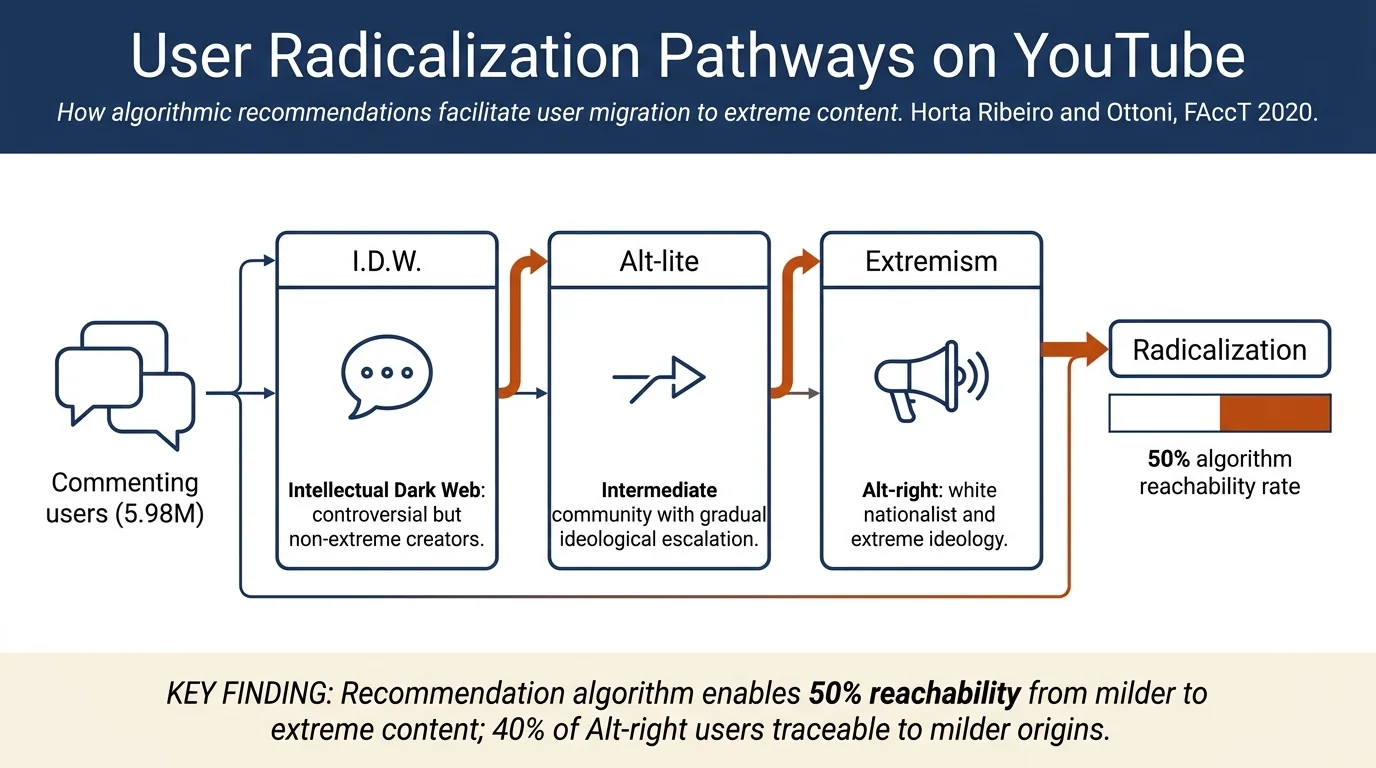
First large-scale quantitative audit of user radicalization on YouTube. The authors tracked 349 channels across three ideological communities (Intellectual Dark Web, Alt-lite, Alt-right) and found strong evidence that users systematically migrate toward more extreme content. YouTube's recommendation algorithm facilitates this radicalization: Alt-right channels are easily discoverable, and the algorithm recommends Alt-right content with measurable probability across multiple community entry points.
Contributions
-
First large-scale quantitative audit of user radicalization on YouTube — examined 349 channels, 330,925 videos, 72.6M comments, and 5.98M commenting users over a decade.
-
Characterized three contrarian communities — Intellectual Dark Web (I.D.W.), Alt-lite, and Alt-right; established clear ideological distinctions and estimated community membership through keyword clustering and channel curation.
-
Demonstrated systematic user migration to extreme content — Users who initially consume only Alt-lite or I.D.W. content show cumulative migration toward Alt-right channels over time. By 2018, roughly 40% of Alt-right commenting users could be traced back to exclusively milder-community content in prior years.
-
Quantified YouTube's recommendation algorithm role — Built a recommendation graph from channel-to-channel recommendations and performed random walk simulations. Found that Alt-right channels are approximately 50% reachable from Alt-lite and I.D.W. channels, and that YouTube's recommendation algorithm facilitates this reachability better than a null model.
-
Documented algorithmic steering toward extremism — Analysis of the recommendation algorithm's actual output shows that while Alt-right channels do not dominate YouTube, users who comment on Alt-right content report recommendations for even more extreme channels, consistent with a radicalization pathway.
Method
Data collection: - Curated 349 YouTube channels by manually identifying 16 prominent channels per community (I.D.W., Alt-lite, Alt-right) and expanding via YouTube's recommendation engine, search functionality, and featured-channel lists. - Collected metadata on 330,925 videos (title, upload date, views, likes, comment counts). - Extracted all 72.6M comments from videos across these channels using the YouTube API (spanning 2009–2019). - Identified 5.98M unique commenting users across all three communities.
Community identification: The authors validated community membership through annotation and keyword clustering. Following convention from prior work, they label the three communities as: - Intellectual Dark Web (I.D.W.): Creators discussing controversial social, political, and cultural topics (e.g., Sam Harris, Jordan Peterson) without endorsing extreme views. - Alt-lite: Creators who deny embracing white supremacist ideology but flirt with concepts associated with it (e.g., the "Great Replacement", globalist conspiracies). Authors cite public statements distinguishing them from the Alt-right (e.g., Brittany Pettibone, Jack Posobiec). - Alt-right: Creators explicitly endorsing white nationalist, anti-Semitic, or ethno-state positions (e.g., Richard Spencer, Christopher Cantwell).
User radicalization analysis: For each user, the authors tracked the chronological sequence of channels they commented on. They classified users by their "exposure level" to Alt-right content: - Light: <10% of videos watched from Alt-right channels - Mild: 10–50% - Severe: >50%
For users initially appearing only in I.D.W. or Alt-lite communities, they tracked whether they later appear in Alt-right channels in subsequent years. This captures gradual migration rather than requiring a single session trajectory.
Recommendation algorithm audit: Using YouTube's recommendation API and manual channel inspection, the authors extracted recommendation edges: if a video recommends another channel, they record a directed edge. They constructed a recommendation graph and performed random walk simulations with 10K iterations, starting from each of the three communities. The random walker follows recommendations for 5 steps and records the probability of reaching each community at each step.
Results
Community growth and engagement: - All three communities grew exponentially over the 2009–2019 decade, with accelerated growth after 2015 (concurrent with the U.S. presidential election). - Active channels increased: I.D.W. from ~0 to ~150, Alt-lite from ~0 to ~100, Alt-right from ~0 to ~80. - Likes, views, and comments all increased roughly linearly after 2013, with steep gains post-2016. - Commenting users exhibit more engagement in Alt-right channels than in media channels: nearly 1 comment per 5 views in Alt-right channels by 2018 (vs. ~1 per 100 views in mainstream media).
User migration to extreme content: - Users initially commenting only on I.D.W. or Alt-lite videos increasingly migrate to Alt-right channels. By 2018, ~3% of all Alt-right commenting users were lightly exposed; 23% mildly exposed; 25% severely exposed—and of the severely exposed, 40% had traceable previous activity in milder communities. - The migration is monotonic and steady: users rarely revert from Alt-right back to milder communities. - The intersection between commenting user sets shows high overlap: ~60% of I.D.W. commenters also commented on Alt-lite in 2018, and ~35% of Alt-lite commenters had also commented on Alt-right.
Recommendation algorithm findings: - Random walks starting from Alt-lite community have ~50% probability of reaching Alt-right at step 2; starting from I.D.W., probability is lower (~35% at step 2) but converges upward by step 5. - Alt-right channels are reached with measurably higher probability than media channels through recommendations. - The algorithm does not personalize (the authors did not log in), so recommendations reflect YouTube's default ranking behavior. - Notably, the "Other" sink (a special node representing videos not in the curated channel set) has high reachability, suggesting many recommendations point outside the studied communities. However, for users within the three communities studied, radicalization-pathway recommendations are clearly present.
Limitations and caveats: The analysis is based on comments as a proxy for engagement; comment activity is not uniform across users or time. The authors note that most users viewing Alt-right content do not comment, so this analysis captures only engaged users. Additionally, the random walk simulation assumes uniform edge weights (all recommendations count equally), but YouTube's personalized ranking would assign different weights.
Connections
- Related to Right-Wing YouTube: A Supply and Demand Perspective via empirical audit of right-wing YouTube ecosystems; Munger et al. apply a supply-and-demand framing while this work focuses on the algorithmic recommendation pathway.
- Complements Examining the consumption of radical content on YouTube which uses national web-browsing panels to test the radicalization hypothesis at population scale and finds weaker algorithmic effects, suggesting these works represent complementary methodologies with different trade-offs.
- Builds on The Science of Fake News framework for understanding misinformation ecosystems and their role in radicalization.
- Informs debates over algorithmic accountability (citations in Evaluating the fake news problem at the scale of the information ecosystem and platform governance work).
- Methodologically echoes earlier audits of algorithmic bias (e.g., Online Human-Bot Interactions: Detection, Estimation, and Characterization for platform auditing techniques).
Notes
Strengths: - First large-scale quantitative audit of this specific radicalization hypothesis on YouTube; combines multiple data streams (channels, videos, comments, recommendation graphs) for convergent evidence. - Transparent about community definitions and boundary cases (e.g., the blurry line between Alt-lite and Alt-right). - Random walk simulation is an intuitive and reproducible way to measure algorithmic reachability. - Strong correlation between recommendation reachability and actual user migration trajectories.
Limitations: - Comments are an imperfect proxy for actual viewing or radicalization. Commenting users are likely more engaged than passive viewers and may not represent the broader user base. - The random walk model assumes YouTube's recommendation system behaves like a Markov chain with uniform edge weights; in reality, personalization and ranking bias distort this. - Cannot directly observe users' recommendation feeds or track causal sequences (e.g., which specific recommendation led a user to radical content). The analysis is correlational. - Community membership is defined by author curation and keyword matching, which introduces subjectivity. Some boundary cases (e.g., creators who deny Alt-right labels but attract Alt-right audiences) are inherently ambiguous. - Data ends in 2019; YouTube's enforcement and algorithmic changes post-2020 are not captured.
Broader implications: The paper presents strong evidence that YouTube's recommendation system, even without personalization or deliberate amplification, enables radicalization pathways from milder to more extreme content. This supports policy arguments for algorithmic transparency and intervention, though it does not resolve the question of whether recommendations are the primary cause of radicalization or a secondary factor in a larger ecosystem.