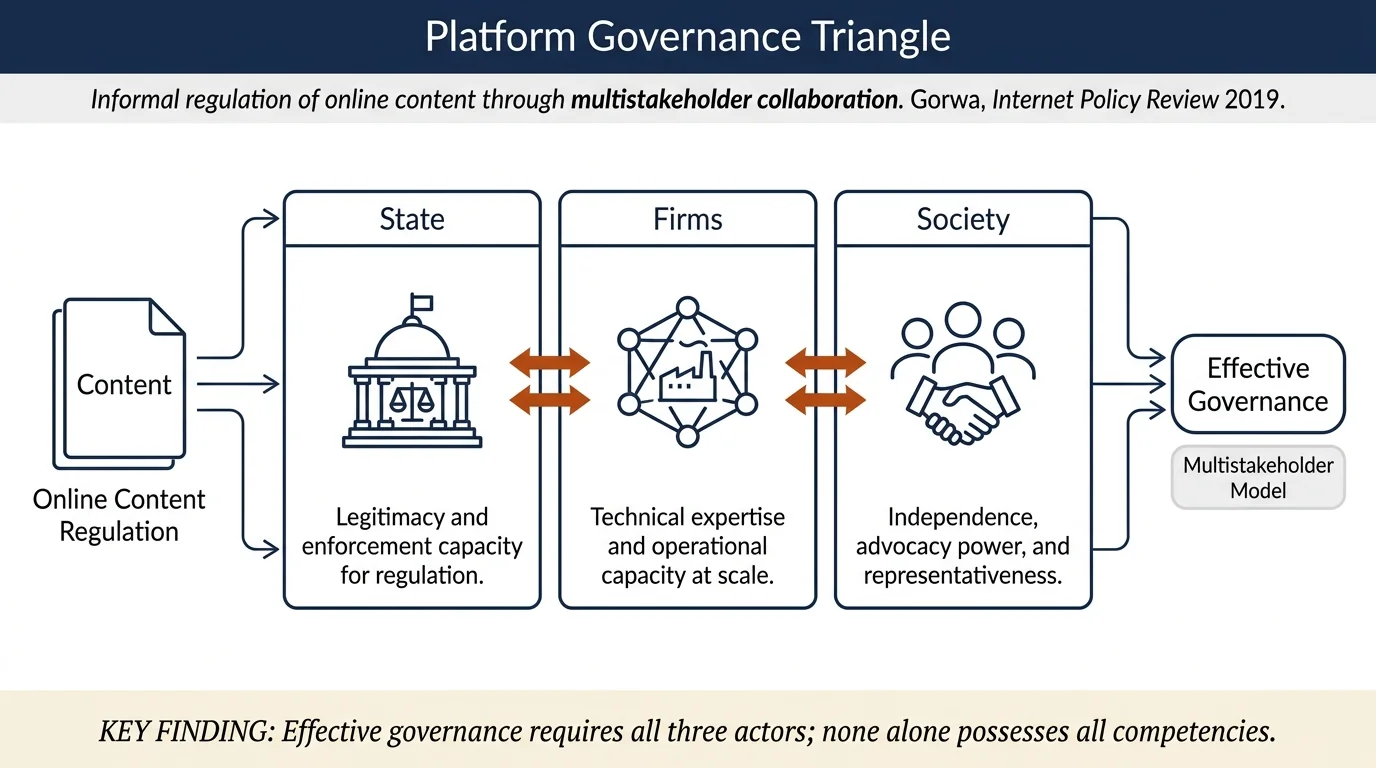
The platform governance triangle: conceptualising the informal regulation of online content
Author: Robert Gorwa Venue: Internet Policy Review, Vol. 8, No. 2, June 2019 — DOI
TL;DR
This paper applies Abbott and Snidal's "governance triangle" framework to analyze how state actors, technology firms, and civil society organizations informally regulate online content through voluntary standards, codes of conduct, and multistakeholder initiatives. The analysis maps the European platform governance landscape, showing how different arrangements balance actor competencies (expertise, resources, independence) and power relations. The work demonstrates that effective informal governance requires collaboration across all three actor types, as no single actor possesses all necessary competencies for regulation.
Contributions
- Conceptual mapping of informal regulatory arrangements using the governance triangle model to categorize initiatives by dominant actor(s) and their scope
- Empirical inventory of major European content governance initiatives (NetzDG, AVMSD, Code of Conduct on Terror and Hate Content, Code of Practice on Disinformation, Facebook Oversight Board, Global Network Initiative, Twitter Trust and Safety Council, etc.)
- Framework for analyzing three key dynamics in informal governance: legitimation politics, actor competencies, and power relations between state, civil society, and industry
Method
The paper applies the "governance triangle" framework from Abbott and Snidal (2009), which positions governance initiatives in a conceptual space defined by three actor groups: State, NGOs/civil society, and Firms. Each initiative is located based on which actors dominate it and its geographic/sectoral scope. The author analyzes European platform governance arrangements (2008–2019) to show how these informal arrangements have emerged as mechanisms to regulate content that traditional command-and-control regulation struggles to address. The analysis examines single-actor initiatives, state-firm collaborations, state-NGO arrangements, firm-NGO partnerships, and full multistakeholder initiatives.
Results
The mapping identifies that: - Single-actor initiatives (dominated by one actor type) have limited long-run success without collaboration - State actors provide legitimacy and enforcement capacity but lack technical expertise - Firms have operational capacity and technical expertise but lack independence and representativeness - NGOs bring independence and advocacy power but cannot implement or enforce without corporate and state support - Multistakeholder arrangements (combining all three) have emerged as a preferred governance model, particularly in Europe, with examples including: - Global Network Initiative (firm-NGO-academic) - EU Code of Practice on Disinformation (state-firm-NGO) - Facebook Oversight Board (firm-NGO with quasi-independent structure)
The paper shows that contested legitimacy ("legitimation politics") arises when initiatives are perceived as captured by particular interests, and that power asymmetries—particularly favoring firms and against civil society participation—are endemic to these arrangements.
Connections
- Related to Platform moderation via analysis of how companies regulate content in practice
- Compared to Content moderation literature which often focuses on algorithmic approaches
- Cites and builds on Snidal Abbott governance triangle concept
- Discusses Facebook Oversight Board as emerging institutional form
- Connected to Transnational Governance and Multi Stakeholder Governance approaches
- Relevant to policy responses documented in Regulation and Digital Policy topics
Notes
Strengths: - Rigorous conceptual framework (governance triangle) that cleanly categorizes a complex landscape of overlapping initiatives - Comprehensive empirical mapping of European initiatives, particularly useful for documenting the proliferation of codes of conduct post-2015 - Identifies a genuine tension: effective governance requires multistakeholder collaboration, but such arrangements struggle with legitimacy and unequal power distribution - Early and prescient analysis of Facebook Oversight Board as a potential model
Limitations: - Focused primarily on European and North American initiatives; global governance landscape more fragmented - The governance triangle is acknowledged as a heuristic, not a precise categorization—boundaries are fuzzy - Limited empirical assessment of whether these arrangements actually work (effectiveness of NetzDG, enforcement rates of codes, etc.) - Written before 2020s escalation in regulatory pressure (e.g., Digital Services Act, broader legislative frameworks in multiple jurisdictions) - Does not deeply examine the question of whether multistakeholder arrangements are genuinely more legitimate or just better at appearing legitimate
Follow-up questions the paper raises: - How do the dynamics Gorwa maps in 2019 hold up under stricter 2020s regulation (DSA, Online Safety Bill, etc.)? - What is the actual impact of these informal arrangements on harmful content prevalence or user safety? - How are civil society actors actually shaping these initiatives vs. rubber-stamping industry preferences?