It takes a village to manipulate the media: coordinated link sharing behavior during 2018 and 2019 Italian elections
Authors: Fabio Giglietto, Nicola Righetti, Luca Rossi, Giada Marino
Venue: Information, Communication & Society, vol. 23, no. 6, 2020 — DOI
TL;DR
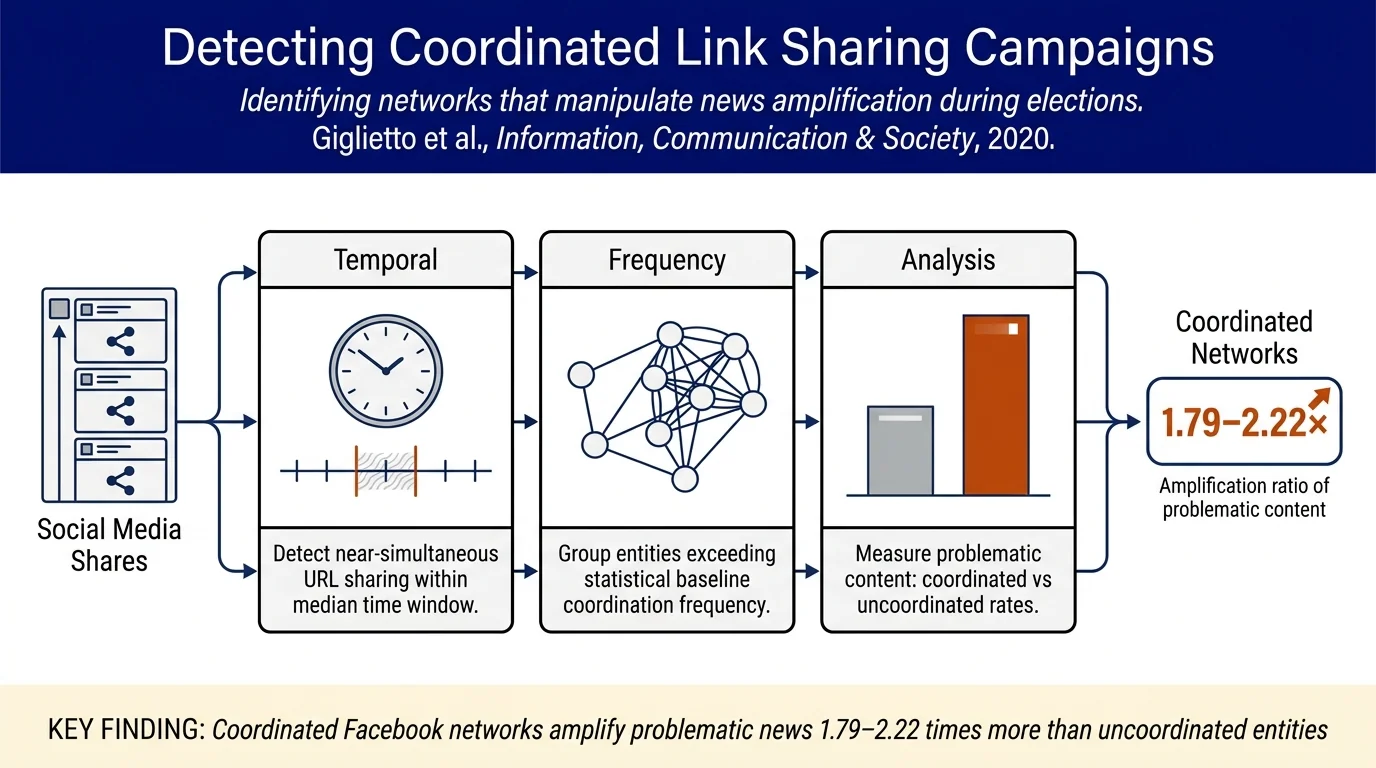
Coordinated networks of Facebook pages and groups substantially amplified problematic news during Italian elections: coordinated entities shared problematic domains 1.79×–2.22× more frequently than uncoordinated ones. The paper introduces a method to detect "coordinated inauthentic behavior" by identifying entities that near-simultaneously share the same URLs, distinguishing political networks from deceptive entertainment pages.
Contributions
- Defines and operationalizes "coordinated inauthentic behavior" by combining coordination (collective action) with authenticity (transparency of identity and intent)
- Presents an algorithm to detect coordinated link sharing networks: identifying time thresholds for near-simultaneous sharing, filtering for repeating patterns, and grouping entities above statistical baselines
- Demonstrates empirically that coordinated networks disproportionately spread problematic content: 5.62% of 2018 coordinated shares vs 3.15% uncoordinated; 3.87% of 2019 coordinated vs 1.74% uncoordinated
- Shows structural and strategic differences: political networks self-identify and concentrate shares narrowly; non-political networks (masquerading as entertainment) disperse shares across more domains
Method
The authors analyze 107,842 shares (2018) and 222,877 shares (2019) of Italian political news via the CrowdTangle API, covering shares by 6,215 and 8,148 unique Facebook entities (pages, groups, verified profiles). They identify coordinated networks through a two-step funnel:
-
Time-threshold estimation: For each URL shared by multiple entities, compute time-differences between shares. Set threshold at the median time for fastest 10% of URLs to reach 50% of their shares—operationalizing "near-simultaneous" (10 seconds for 2018; 23 seconds for 2019).
-
Frequency-based grouping: Identify entities that coordinate frequently (above 90th percentile): sharing the same story ≥4 times (2018) or ≥3 times (2019) within the threshold window. Result: 24 coordinated networks with 82 entities (2018); 92 networks with 606 entities (2019).
For each coordinated network, measure politicalness (0–1 scale: coded by presence of political language/actors in entity description) and structural properties (centralization and clustering coefficients). Assess problematic content using Italian fact-checking debunking lists (buta.it, bufale.net, etc.) and Avaaz's list of problematic Facebook entities.
Results
Coordinated networks significantly outpace uncoordinated entities in sharing problematic domains: - 2018: 5.62% of coordinated shares vs 3.15% uncoordinated (RR: 1.79; 95% CI [1.08, 2.96]) - 2019: 3.87% of coordinated shares vs 1.74% uncoordinated (RR: 2.22; 95% CI [1.33, 3.67])
Problematic Facebook entities (pages/groups) in coordinated networks are 19.24× (2018) and 23.19× (2019) more common than in uncoordinated ones.
Coordinated networks employ distinct strategies: political networks (44% in 2018, 17% in 2019) concentrate shares across fewer domains (negative Spearman correlation with politicalness, r = −0.76 in 2018, r = −0.63 in 2019). Non-political networks (27% in 2018, 19% in 2019), often masking as entertainment venues, spread shares widely and are harder to detect.
Network structure clusters into two ideal types: highly centralized (hub-and-spoke) or highly clustered (tribal). Networks show no significant correlation between politicalness and centralization/clustering—both structures appear across ideological orientations.
Connections
- Extends Propagation-based fake news detection by shifting focus from individual content virality to actor coordination and network topology
- Shares conceptual framework with coordinated inauthentic behavior detection research, formalizing Facebook's Gleicher (2018) definition
- Complements media manipulation campaign studies on amplification tactics in electoral contexts
- Related to social bot detection via shared emphasis on anomalous behavioral patterns
Notes
Strengths: Novel operationalization of coordination through near-simultaneous temporal proximity rather than explicit API metadata (Facebook later deprecated CrowdTangle for this purpose). Clearly separates the concepts of coordination and inauthenticity, allowing structured analysis of both political and deceptive actors. Italian election context provides controlled comparison (2018 and 2019 elections). Large-scale validation against known problematic entities (Avaaz list, fact-checking debunking lists).
Limitations: CrowdTangle's coverage is incomplete by design—biased toward high-engagement entities. Time thresholds are heuristic (10–23 seconds) and may conflate genuine simultaneity with algorithmic amplification. The study cannot observe private messaging or coordination on external platforms (Telegram, Signal). Small networks (two entities) are excluded from structural analysis. Italian-specific findings may not generalize to other electoral contexts or platform ecosystems.
Follow-ups: The paper notes that high clustering and centralization both correlate with problematic content—future work should explain why both structures can support coordination. The shift from political to non-political deceptive networks (44% → 17% political) between 2018 and 2019 merits deeper investigation. Extending the method to comments, shares of shares, and cross-platform coordination (e.g., Instagram-to-Facebook) would strengthen detection capabilities.