Cross-Platform State Propaganda: Russian Trolls on Twitter and YouTube during the 2016 U.S. Presidential Election
Authors: Yevgeniy Golovchenko, Cody Buntain, Gregory Eady, Megan A. Brown, Joshua A. Tucker
Venue: The International Journal of Press/Politics, 2020, Vol. 25(3) — DOI
TL;DR
This paper analyzes 1,052 Russian IRA Twitter accounts to understand their propaganda strategy during the 2016 U.S. presidential election. By examining hyperlinks to news stories and YouTube videos, the authors find IRA accounts linked to conservative sources more frequently than liberal ones, consistent with supporting Trump. However, they also identify a "pre-propaganda" strategy where liberal-leaning accounts built credibility before amplifying conservative content, suggesting the IRA pursued multiple ideological outcomes simultaneously.
Contributions
- First large-scale quantitative study of IRA cross-platform (Twitter-YouTube) propaganda behavior during 2016 election
- Novel measurement strategy using hyperlink ideology to infer both media source ideology and IRA account ideology
- Latent-space model for estimating ideology of news organizations from sharing patterns by political elites
- Evidence of sophisticated "pre-propaganda" strategy exploiting platform interconnections to manipulate audiences
- Temporal analysis revealing how IRA ideological focus shifted across the election cycle
Method
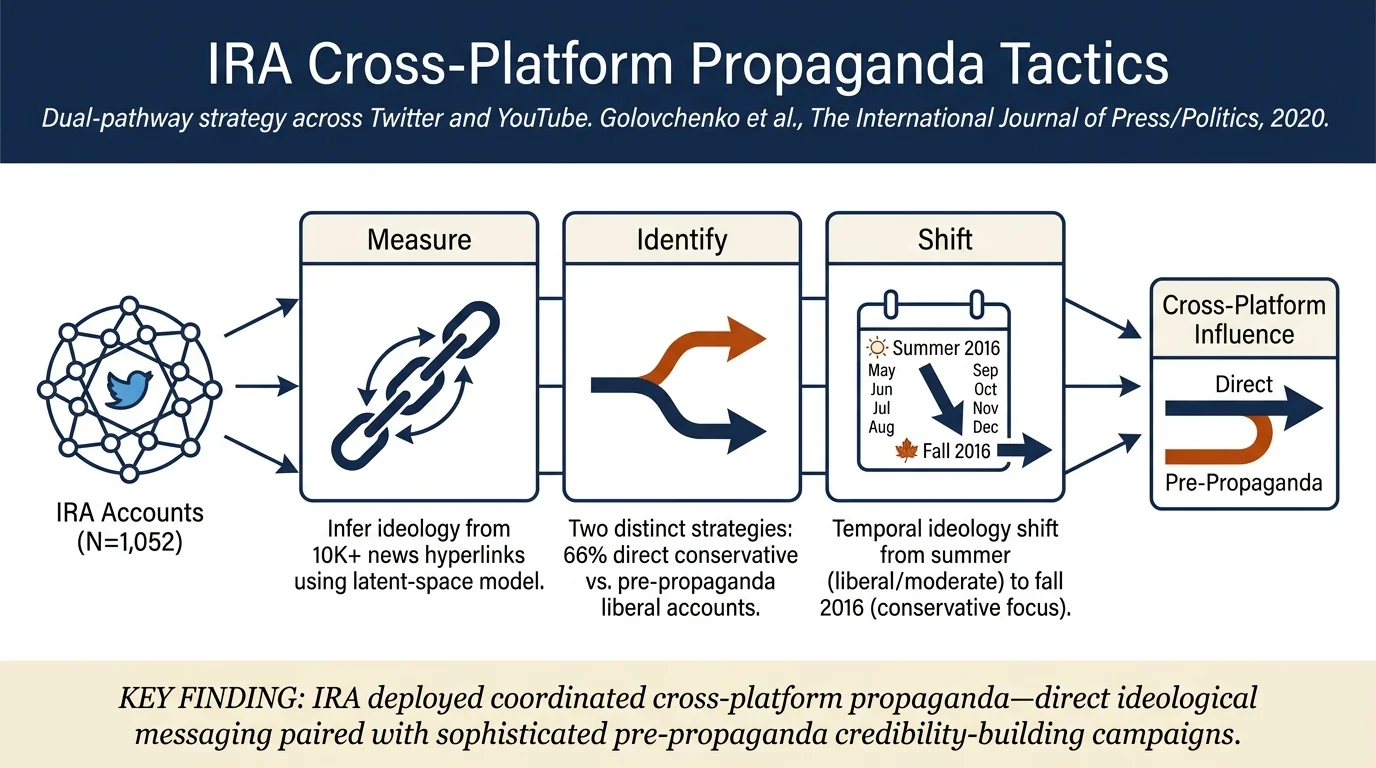
The authors analyzed 108,781 tweets from 1,052 confirmed IRA accounts posted between November 2015 and December 2018. They extracted 10,450 URLs linking to news stories from 2,002 unique domains and 855 links to 499 YouTube videos.
To measure ideology, they employed two complementary approaches. For news media links, they used a latent-space model based on the Defective Source Model: they estimated the ideology of news media organizations by analyzing how hyperlinks to those sources were shared by political elites (members of Congress, governors, politicians). The intuition is that conservative-leaning politicians disproportionately link to conservative news outlets, allowing ideology scores to be inferred from sharing behavior.
For YouTube videos, manual annotation was necessary due to YouTube's complexity. Three annotators independently coded videos for whether they contained politically relevant content and, if so, whether the content was liberal, moderate, or conservative. The final coding achieved Krippendorff's α = 0.80 for political content identification and 0.79 for ideology coding.
The authors formulated four hypotheses based on two main theories: (H1) IRA accounts sought to increase support for Trump via conservative content; (H2) IRA accounts sought to sow discord by promoting both conservative and liberal arguments. Sub-hypotheses tested link ideology (H1.1: more conservative than liberal links; H2.1: equal liberal and conservative links), account ideology (H1.2/H2.2: differences in account composition), and temporal consistency (H1.3/H2.3/H1.4/H2.4: consistency in ideology over time).
Results
IRA accounts linked to conservative news sources more frequently (66% of links) than liberal sources (34%), partially supporting H1. However, the ideological composition of accounts varied: some accounts primarily linked to conservative content, while others linked to both liberal and conservative sources.
A key finding was the "pre-propaganda" strategy: a subset of IRA accounts primarily linked to liberal and moderate news sources, building apparent credibility as ordinary news consumers. These liberal-leaning accounts engaged pre-propaganda — using the Defective Source Model technique of sharing seemingly neutral or oppositional content to establish legitimacy before amplifying ideologically extreme conservative messaging.
The temporal analysis revealed that IRA ideology shifted over the election cycle. During summer 2016 (national conventions), liberal and moderate news sharing briefly outpaced conservative sharing. By September 2016, the pattern reversed, with consistent preference for conservative content. This suggests the IRA adapted its strategy in response to the election context and political opportunities.
Regarding YouTube, IRA accounts linked to conservative news media before linking to YouTube, but the YouTube videos themselves showed mixed ideology. IRA accounts linked to both liberal and moderate YouTube content alongside conservative content, though overall the pattern skewed conservative.
The results do not uniformly support either H1 or H2, but the authors' interpretation leans toward H1 (supporting Trump) as the primary goal, with tactical deployment of discord-sowing on the side.
Connections
- Related to Fake news on Twitter during the 2016 U.S. presidential election which examined fake news diffusion on Twitter during the 2016 election
- Cited by Troll Factories: Manufacturing Specialized Disinformation on Twitter on IRA account organization and specialization
- Extends Stewart et al. (2018) on IRA trolls and ideological alignment
- Contributes to literature on foreign interference and state-sponsored disinformation
- Methodologically related to Eady et al. (2019) on inferring ideology from news-sharing patterns
- Complements Badawy et al. on quantitative analysis of IRA behavior
Notes
Strengths: - First systematic quantitative study of IRA cross-platform behavior; hyperlink-based ideology inference is a novel and scalable measurement approach - Large dataset (1,052 accounts, 108K tweets) and careful hypothesis testing - The pre-propaganda concept is theoretically important and well-documented - Temporal analysis adds nuance beyond aggregate statistics
Limitations and open questions: - IRA accounts are likely not representative of the full Russian propaganda ecosystem; YouTube analysis is limited to links shared on Twitter, missing direct YouTube subscriptions or comments - The ideology estimates for news media depend on the assumption that Members of Congress accurately reflect underlying media ideology, which may not hold for all outlets - The paper focuses on the 2016 election; unclear whether the pre-propaganda strategy was context-specific or part of Russia's broader playbook - The "mixed" evidence on whether IRA supported Trump versus sowed discord may reflect genuine strategic ambiguity or decentralized decision-making within the IRA rather than a false dichotomy - Future work should examine whether YouTube itself amplifies IRA content differently across ideologies, as the platform's recommendation algorithm may independently favor conservative content