Explore papers
Filter by research area, year and venue. Every filter is in the address bar, so you can share a view as a link.
 Spread & networksDetection methods
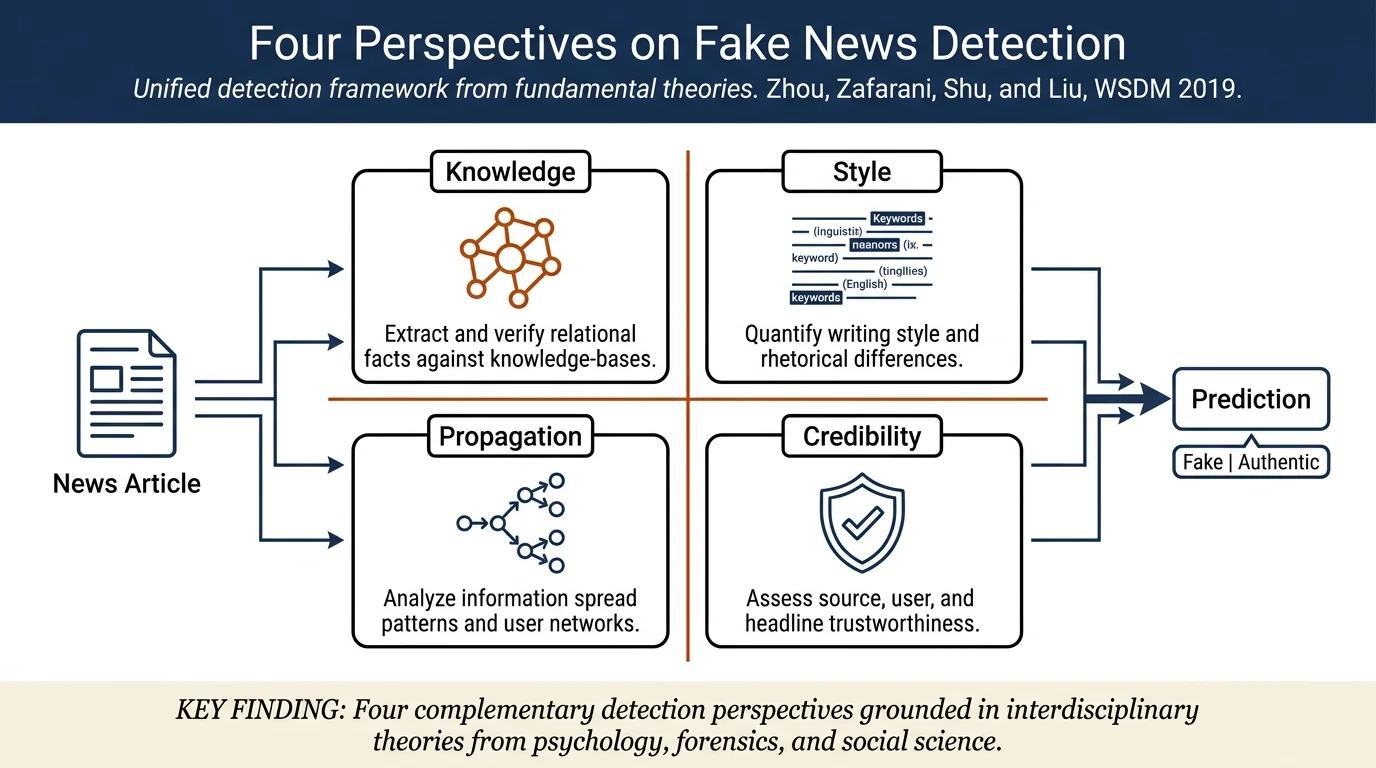
Fake News: Fundamental Theories, Detection Strategies and ChallengesA comprehensive tutorial framework addressing fake news research across three dimensions: (1) fundamental theories from psychology, social science, economics, and forensics explaining human vulnerability to misinformation and why individuals participate in fake news activities; (2) detection strategies unified across four perspectives…
 Spread & networksPlatforms, policy & society
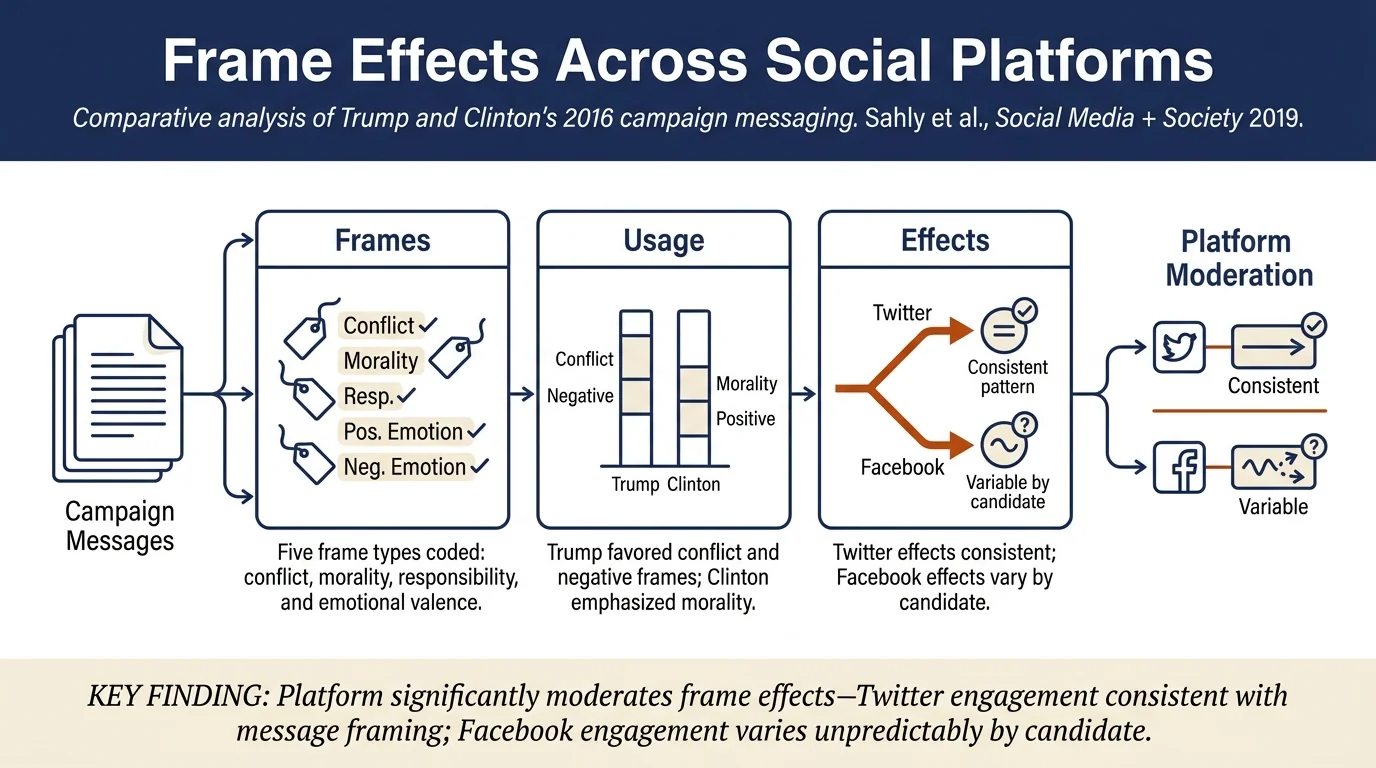
Social Media for Political Campaigns: An Examination of Trump's and Clinton's Frame Building and Its Effect on Audience EngagementThis study analyzes how Trump and Clinton's 2016 campaigns framed messages on Twitter and Facebook, and how frame type affected audience engagement. Trump relied on conflict and negative emotional frames, while Clinton used morality and positive emotional frames.
 Fact-checking & verificationPlatforms, policy & society
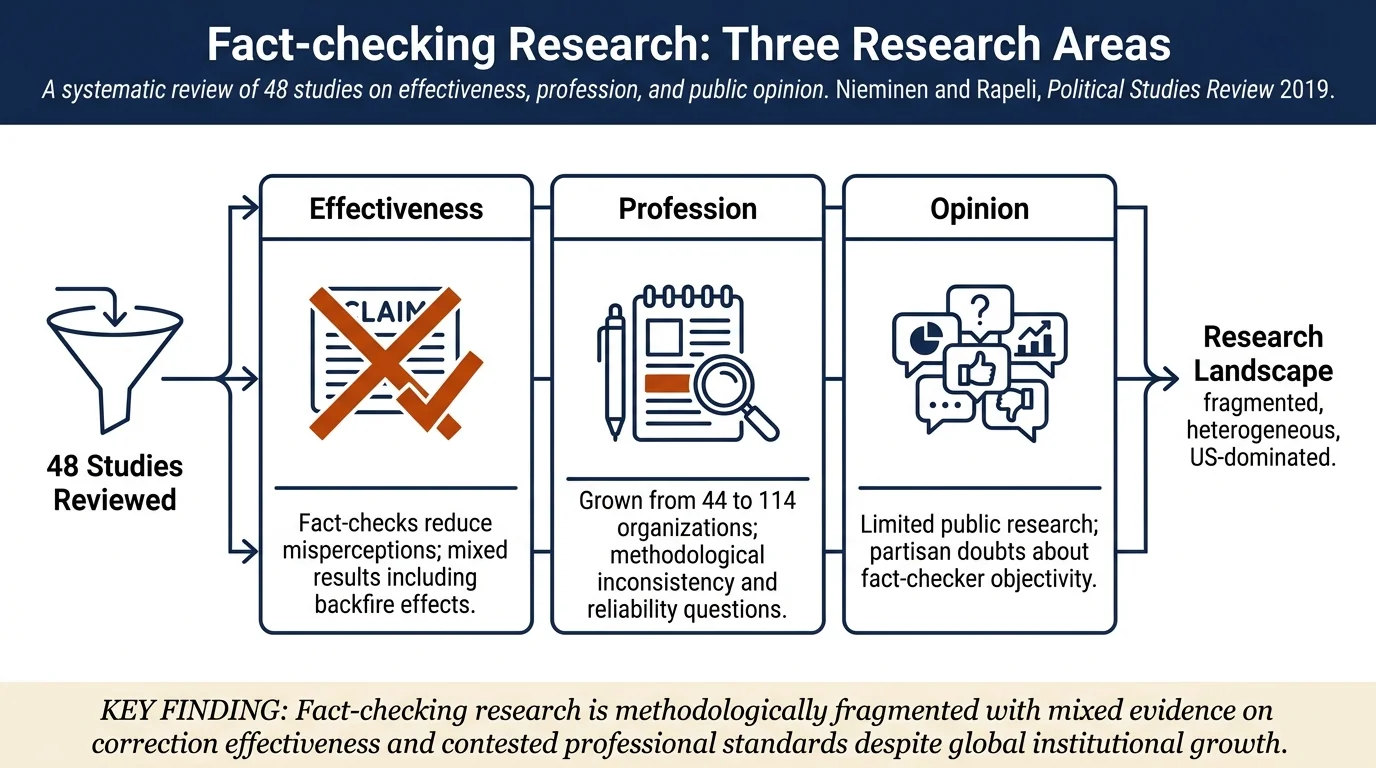
Fighting Misperceptions and Doubting Journalists' Objectivity: A Review of Fact-checking LiteratureComprehensive literature review of 48 studies on political fact-checking, organized into three research areas: (1) fact-checking effectiveness for correcting misperceptions (mixed results, including backfire effects); (2) fact-checking as a profession (contested methods and reliability); (3) public opinion about fact-checking (mostly…
 Spread & networksPsychology & interventions
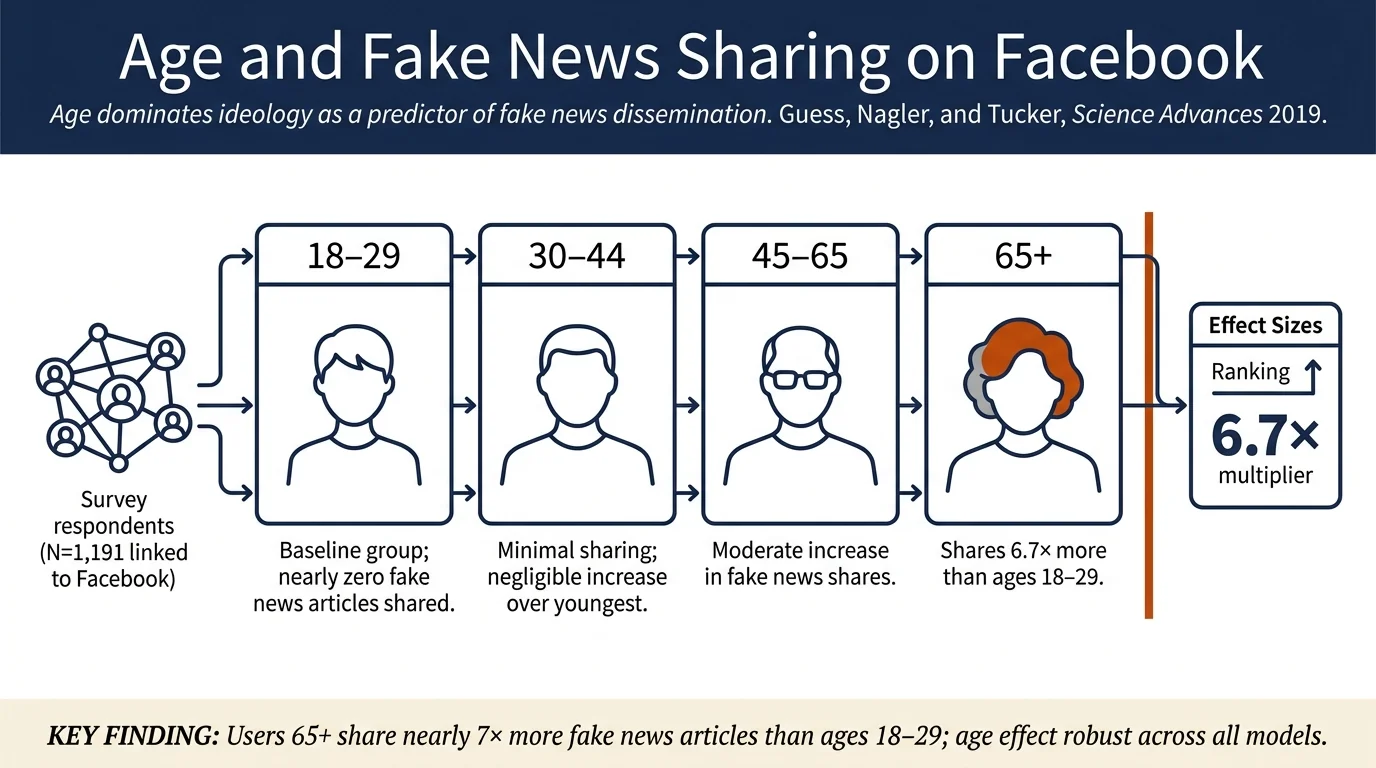
Less than you think: Prevalence and predictors of fake news dissemination on FacebookFake news dissemination on Facebook during the 2016 election was a rare behavior (8.5% of users shared at least one article), with clear demographic stratification: conservatives shared more articles from fake news domains (pro-Trump), but the strongest and most robust predictor was age—users over 65 shared nearly seven times as many…
 Spread & networksPlatforms, policy & society
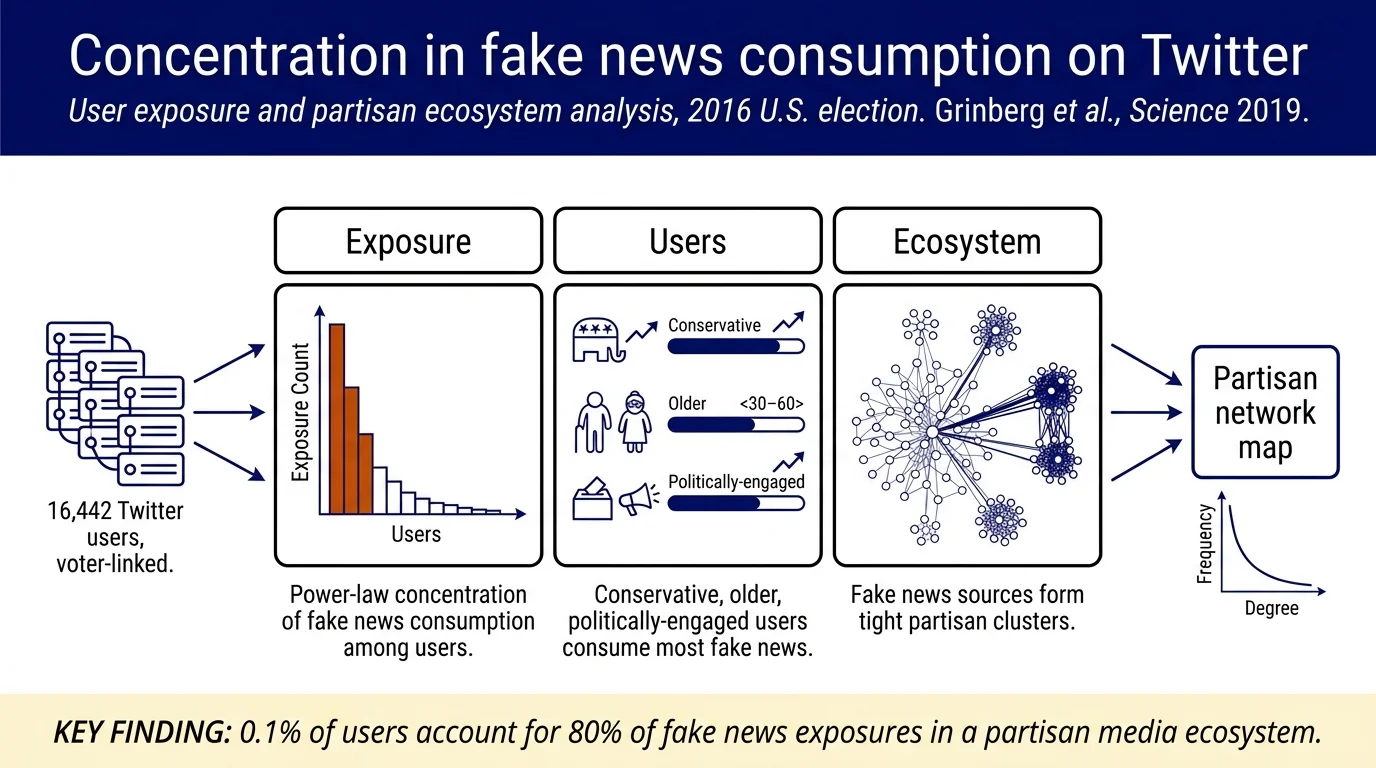
Fake news on Twitter during the 2016 U.S. presidential electionFake news consumption on Twitter during the 2016 election was extremely concentrated: only 1% of users saw 80% of exposures, and 0.1% shared 80% of fake news. Conservative-leaning, older, highly politically engaged users drove most consumption.
 Spread & networksPlatforms, policy & society
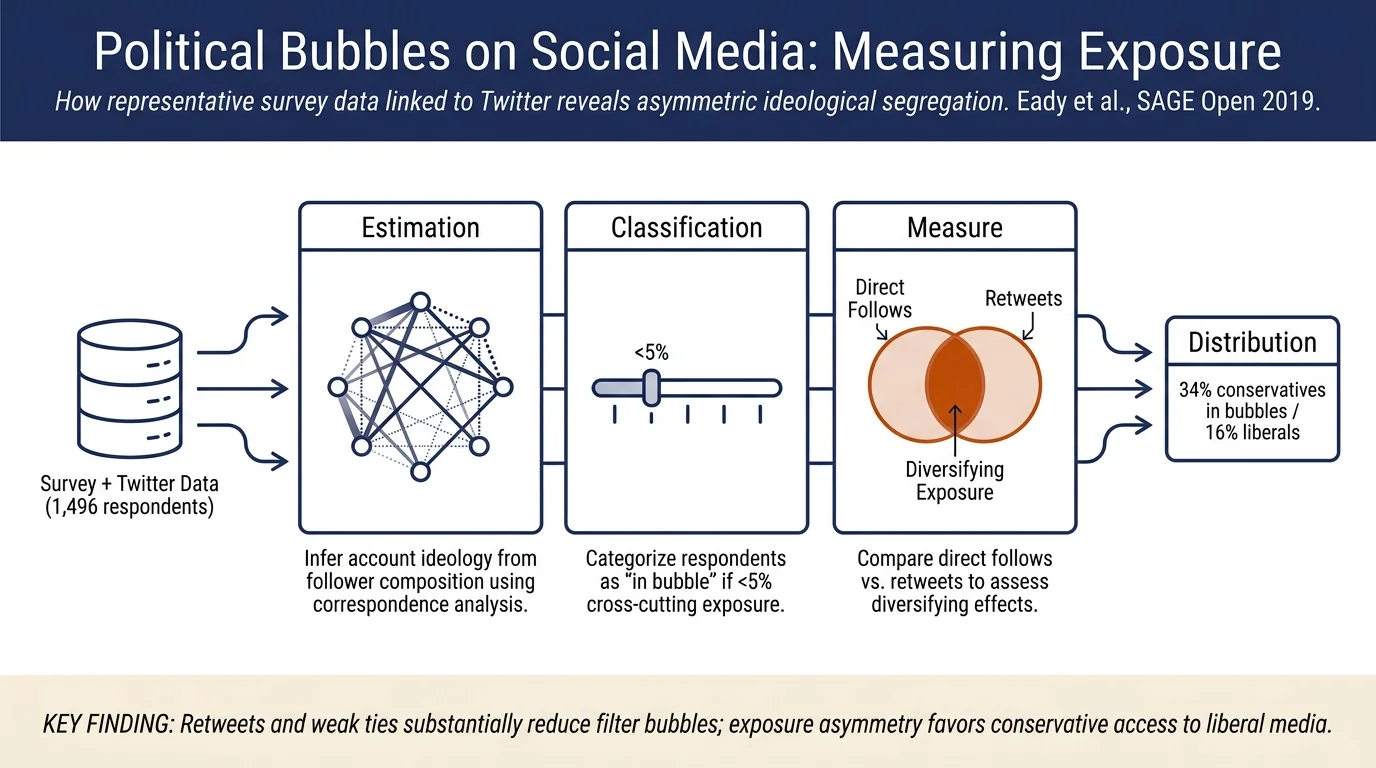
How Many People Live in Political Bubbles on Social Media? Evidence From Linked Survey and Twitter DataEady et al. link survey data from 1,496 Americans to Twitter data from 642,345 accounts and ~1.2 billion tweets to measure political polarization in media consumption. Rather than finding evidence of extreme "filter bubbles" where most people consume ideologically homogeneous content, they find substantial overlap in the accounts…
 Psychology & interventionsSpread & networks
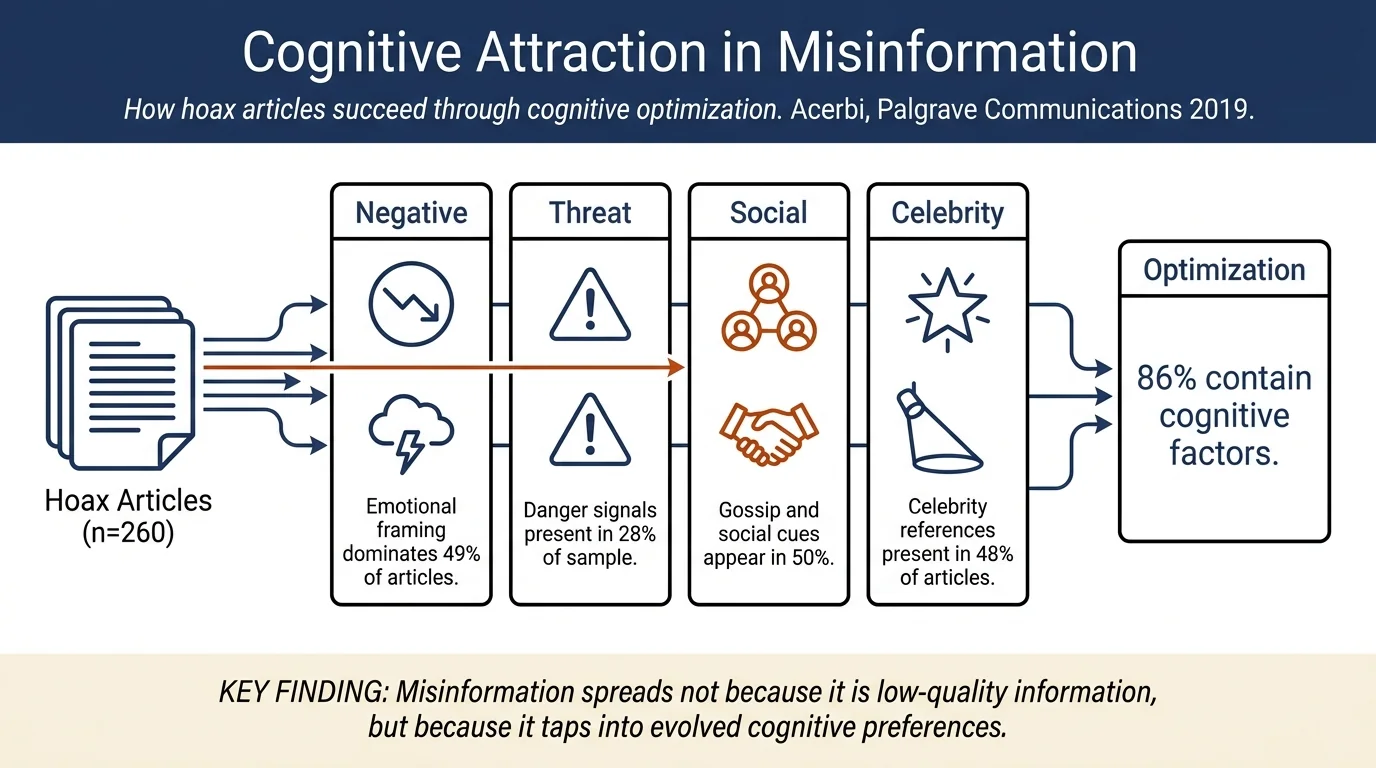
Cognitive attraction and online misinformationMisinformation spreads not because it is low-quality information constrained by digital media inefficiencies, but because it taps into general evolved cognitive preferences. A content analysis of 260 articles from 26 hoax websites shows that 86% contain at least one cognitive-appeal feature: negative framing (49%), threat descriptions…
 Psychology & interventionsPlatforms, policy & society
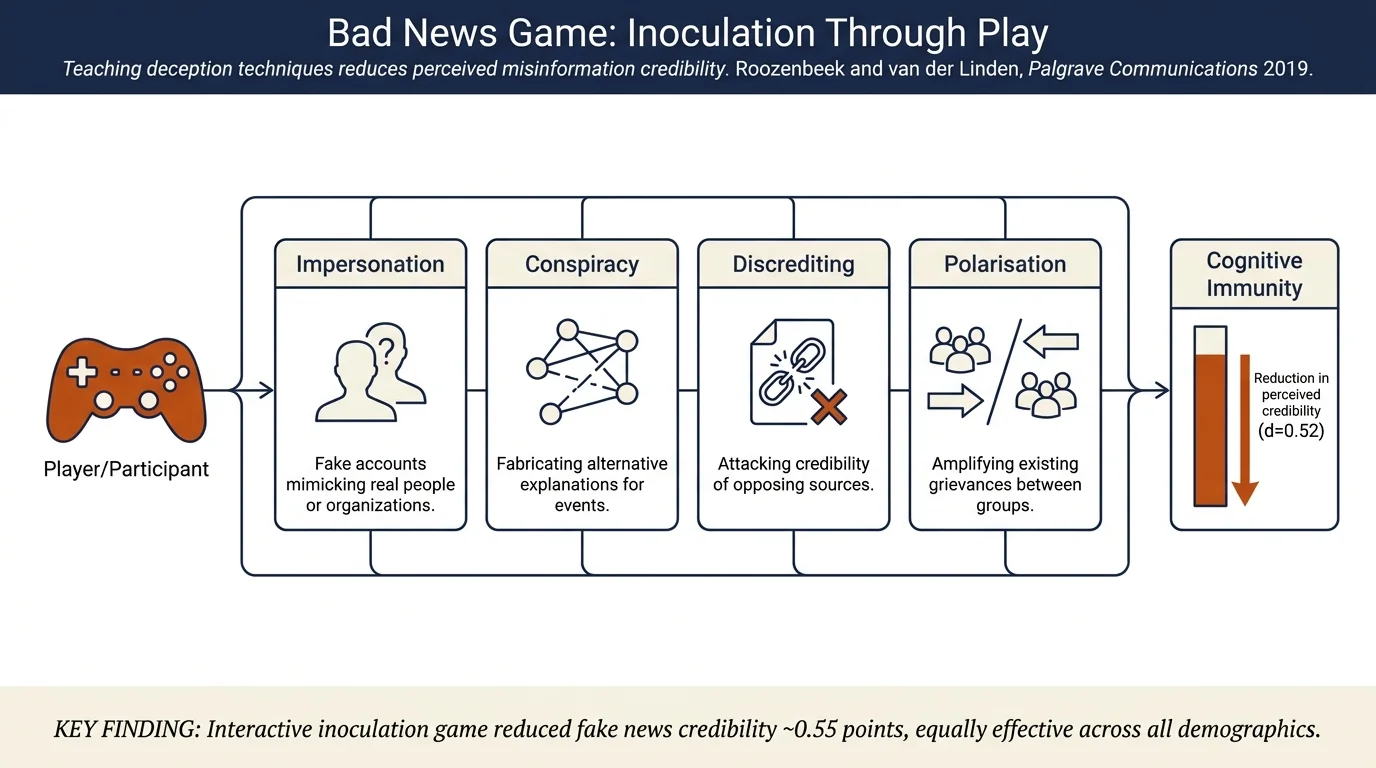
Fake news game confers psychological resistance against online misinformationThis large-scale empirical study demonstrates that a free ~15-minute online browser game teaching six common misinformation production techniques (polarisation, emotional manipulation, conspiracy theories, trolling, discrediting opponents, impersonation) significantly reduces perceived reliability of misinformation across N=15,000…
 Detection methodsLLMs & generative AI
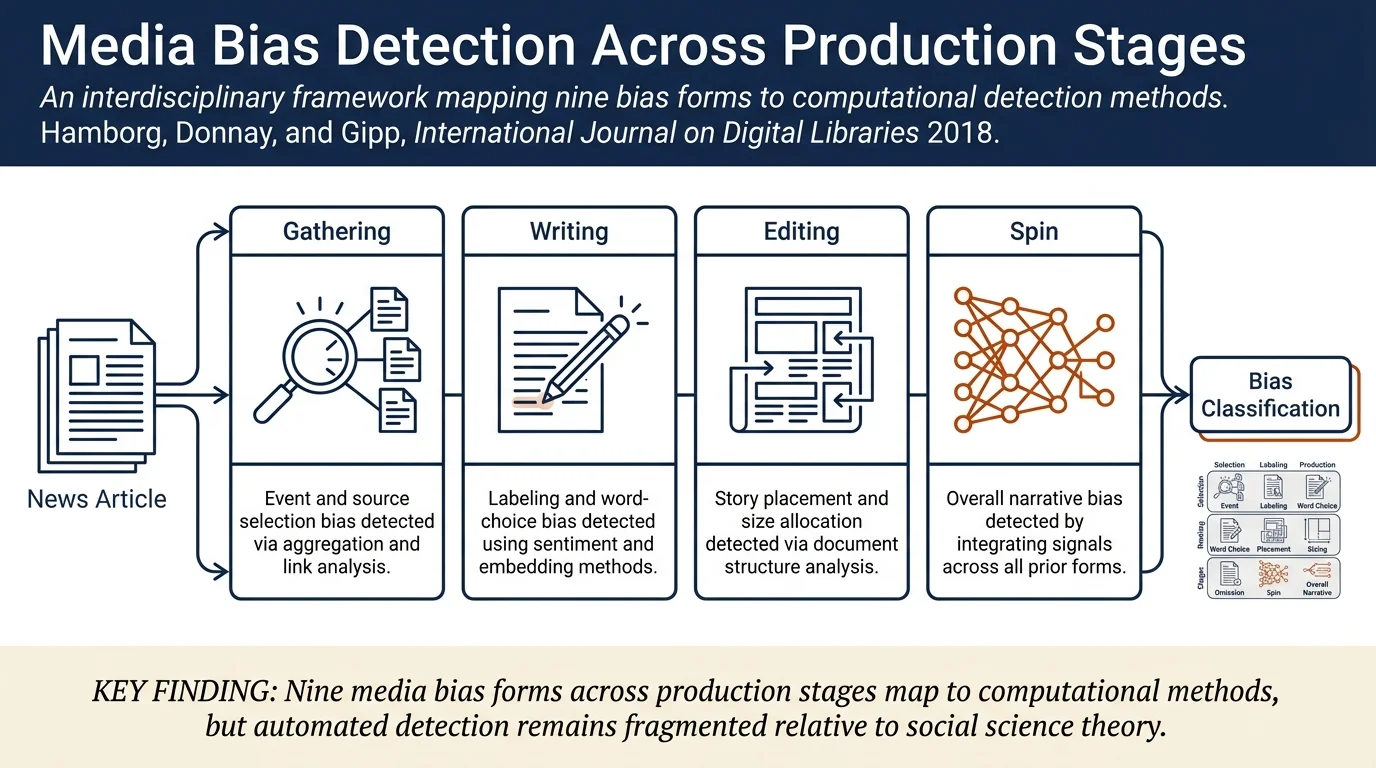
Automated identification of media bias in news articles: an interdisciplinary literature reviewThis paper surveys automated and manual methods for identifying media bias in news articles, bridging social science and computer science approaches. It defines nine distinct forms of media bias and maps social science research onto computational techniques, finding that NLP-based methods are promising for automated detection but remain…
 Spread & networksBots & coordinated campaigns
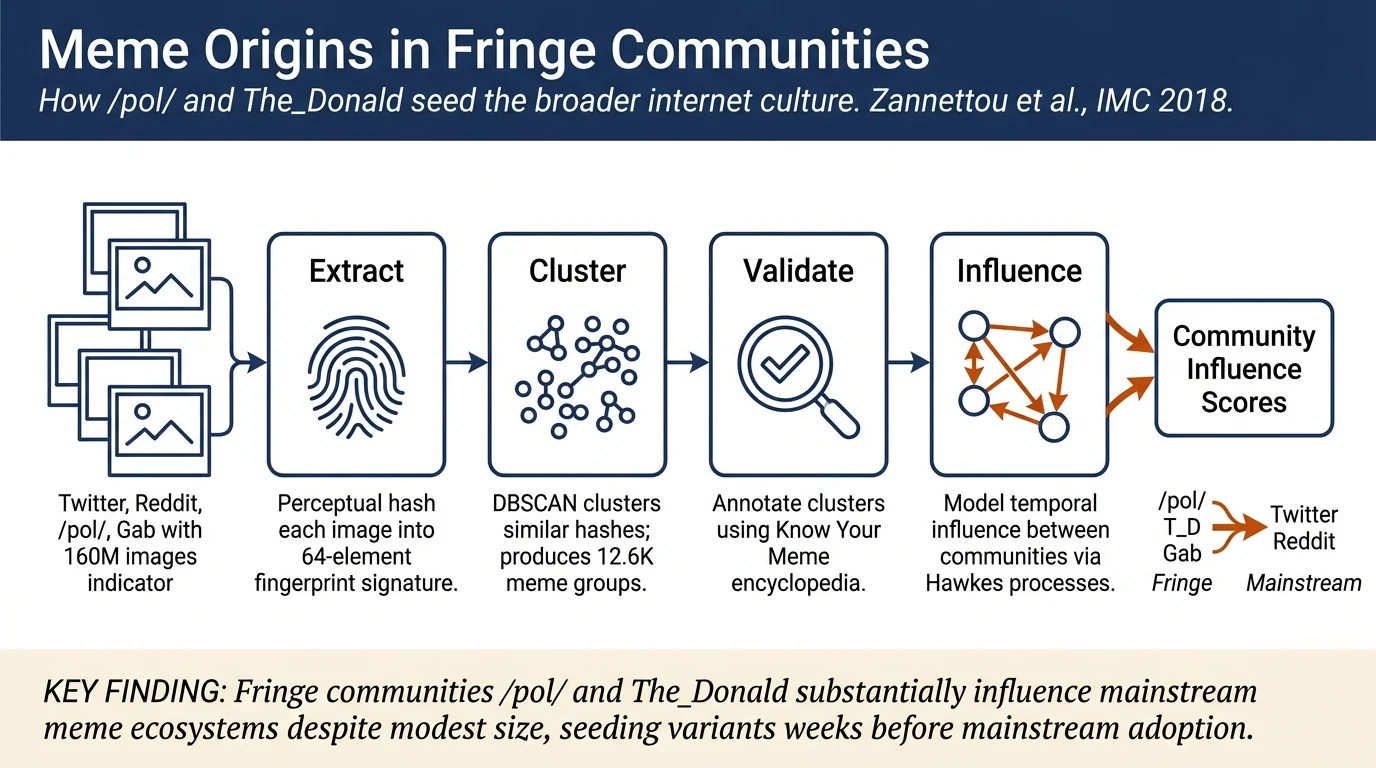
On the Origins of Memes by Means of Fringe Web CommunitiesLarge-scale empirical study of how image memes originate and propagate across fringe and mainstream Web communities. Analyzes 160M images posted to Twitter, Reddit, /pol/, and Gab (2016–2017) using perceptual hashing, clustering, and custom distance metrics.
 Psychology & interventionsPlatforms, policy & society
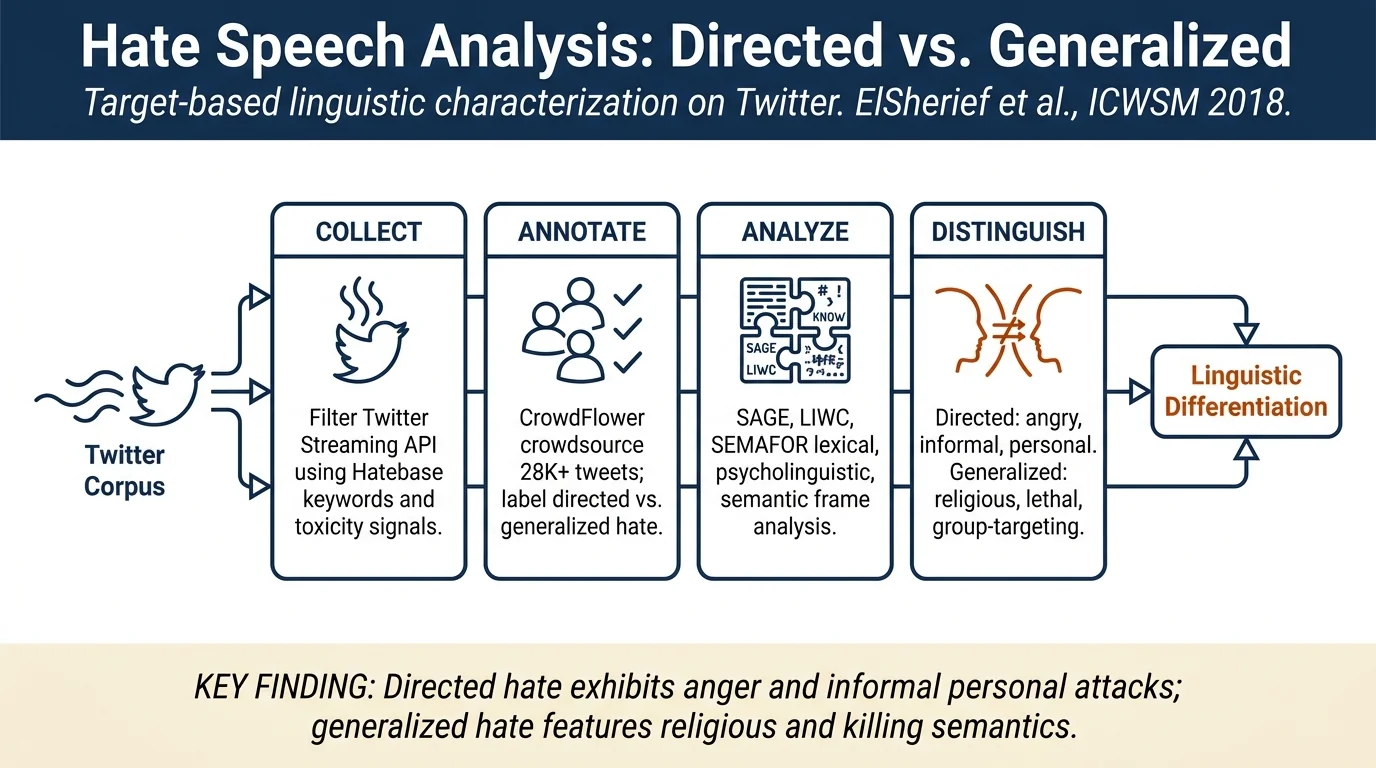
Hate Lingo: A Target-based Linguistic Analysis of Hate Speech in Social MediaThis paper presents the first large-scale linguistic and psycholinguistic analysis of hate speech categorized by its target: directed (personal attacks) versus generalized (targeting groups). The authors analyze 28,318 directed and ~2,500 generalized hate tweets, revealing that directed hate is more informal, angry, and explicitly…
 Platforms, policy & societyFact-checking & verification
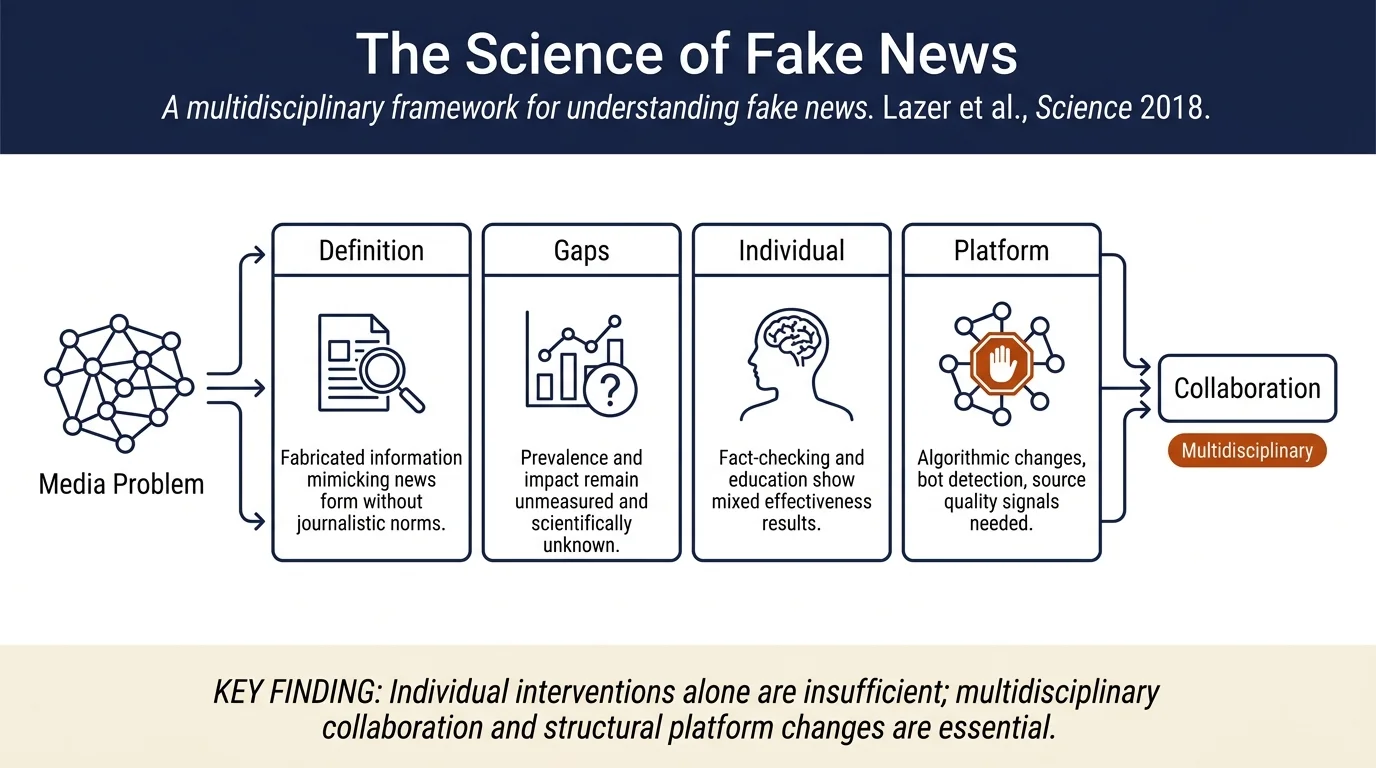
The Science of Fake NewsThis multidisciplinary review establishes a scientific framework for studying fake news, defining it as fabricated information that mimics news media form but lacks editorial norms. The paper identifies two mitigation strategies—empowering individuals through fact-checking and education, and structural platform interventions—while…
 Psychology & interventionsPlatforms, policy & society
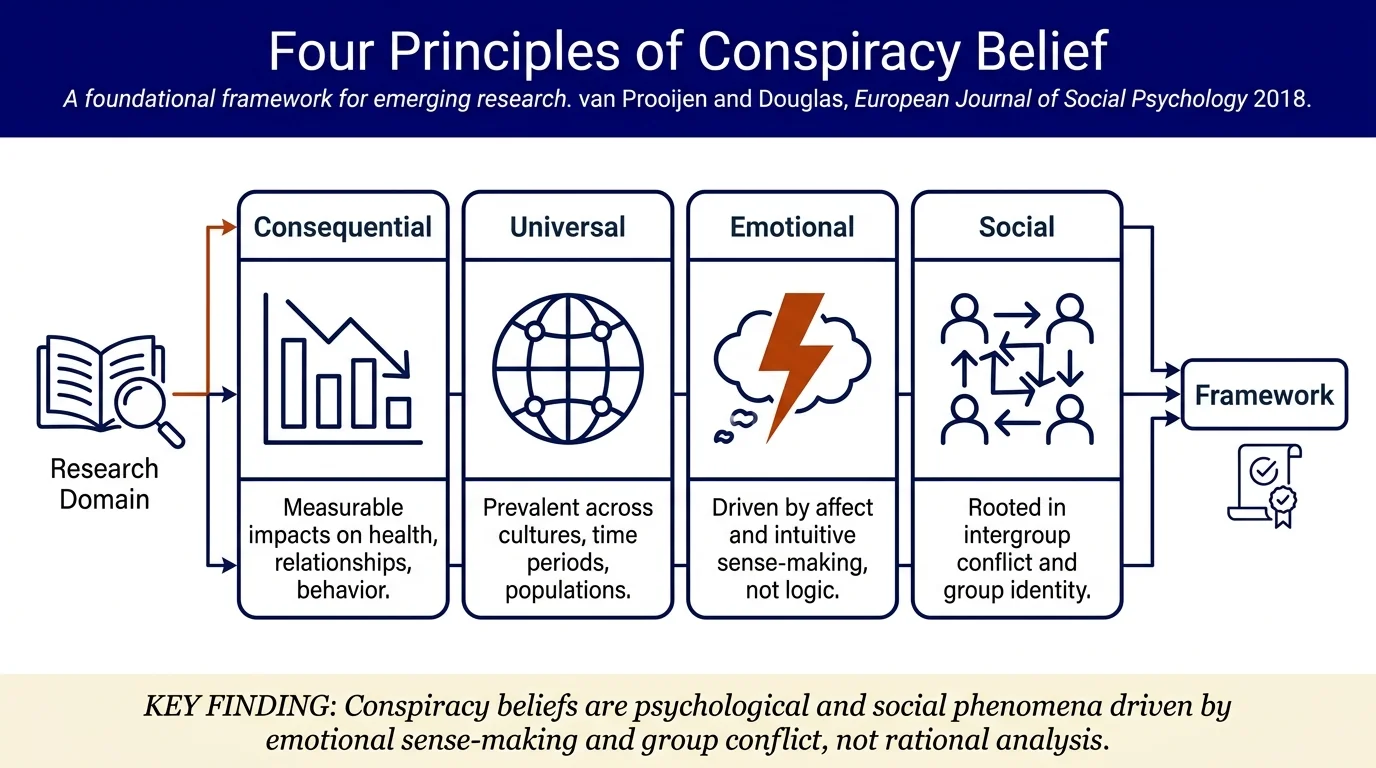
Belief in conspiracy theories: Basic principles of an emerging research domainThis special issue introduction proposes four foundational principles for the emerging scientific study of conspiracy belief: conspiracy beliefs are consequential (with real impacts on health and relationships), universal (across cultures and historical periods), emotional (driven by sense-making rather than logic), and social (rooted in…
 Spread & networksPsychology & interventions
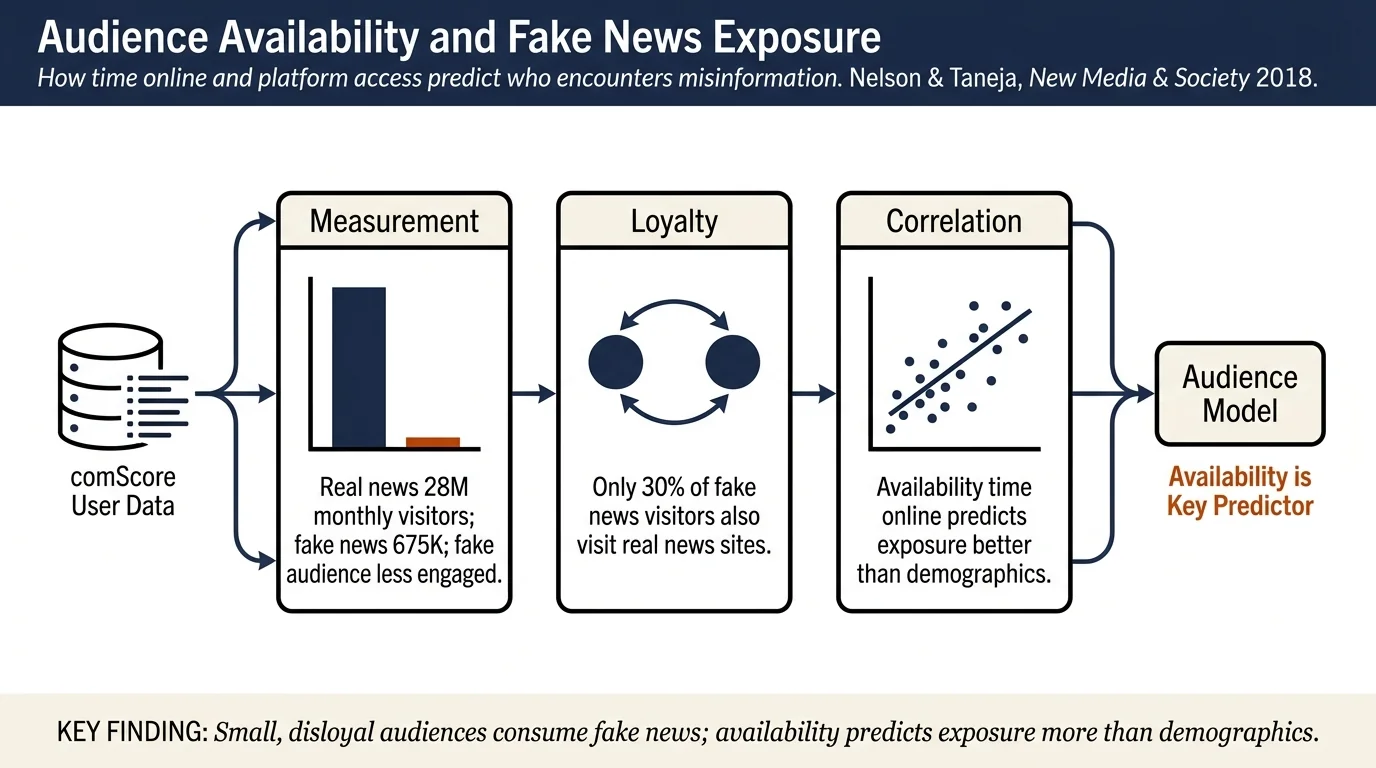
The small, disloyal fake news audience: The role of audience availability in fake news consumptionContrary to claims that fake news has reached a broad audience, this empirical analysis of comScore data shows the fake news audience is small and comprises heavy internet users. Applying the Law of Double Jeopardy from media theory, the authors show that fake news attracts disloyal audiences disproportionately from social platforms.
 Spread & networksPlatforms, policy & society
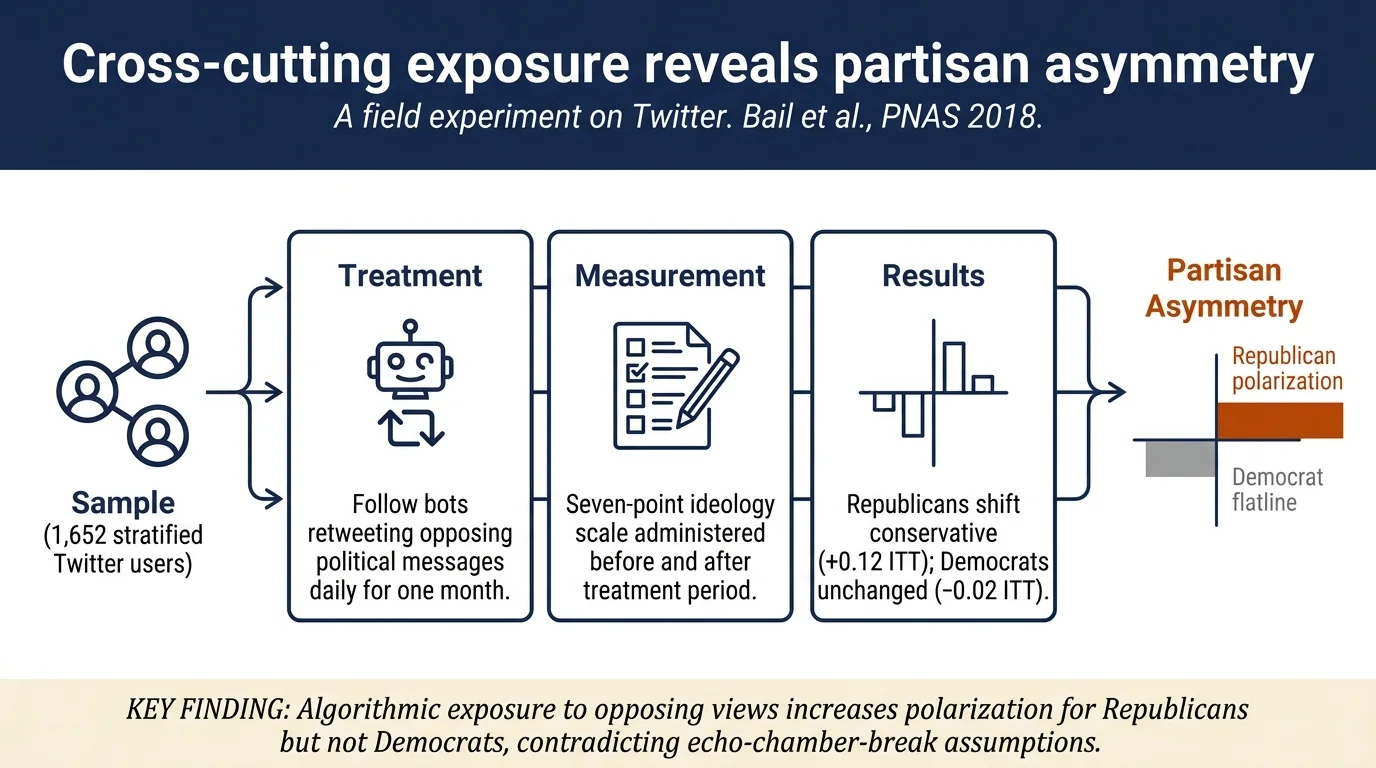
Exposure to opposing views on social media can increase political polarizationThis field experiment tested whether exposure to opposing political views on social media reduces polarization. Twitter users (Republicans and Democrats) were randomly offered money to follow bots retweeting messages from opposing politicians and opinion leaders for one month.
 Detection methodsLLMs & generative AI
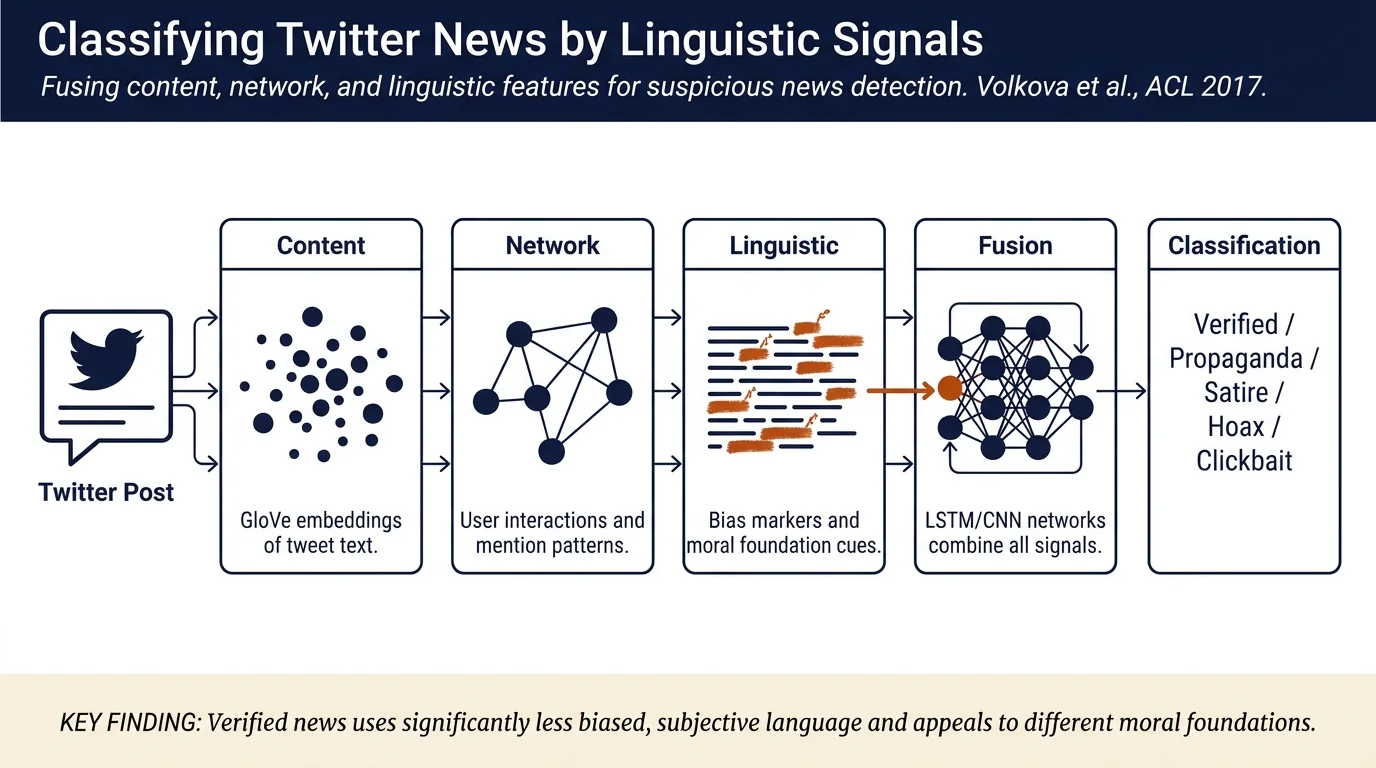
Separating Facts from Fiction: Linguistic Models to Classify Suspicious and Trusted News Posts on TwitterThis paper presents neural network models combining tweet content, social network interactions, and linguistic features (bias markers, subjectivity cues, moral foundations) to classify Twitter news posts as suspicious (propaganda, hoaxes, clickbait, satire) or verified. The models achieve 95% accuracy on binary classification and 0.7…
 Spread & networksDetection methods
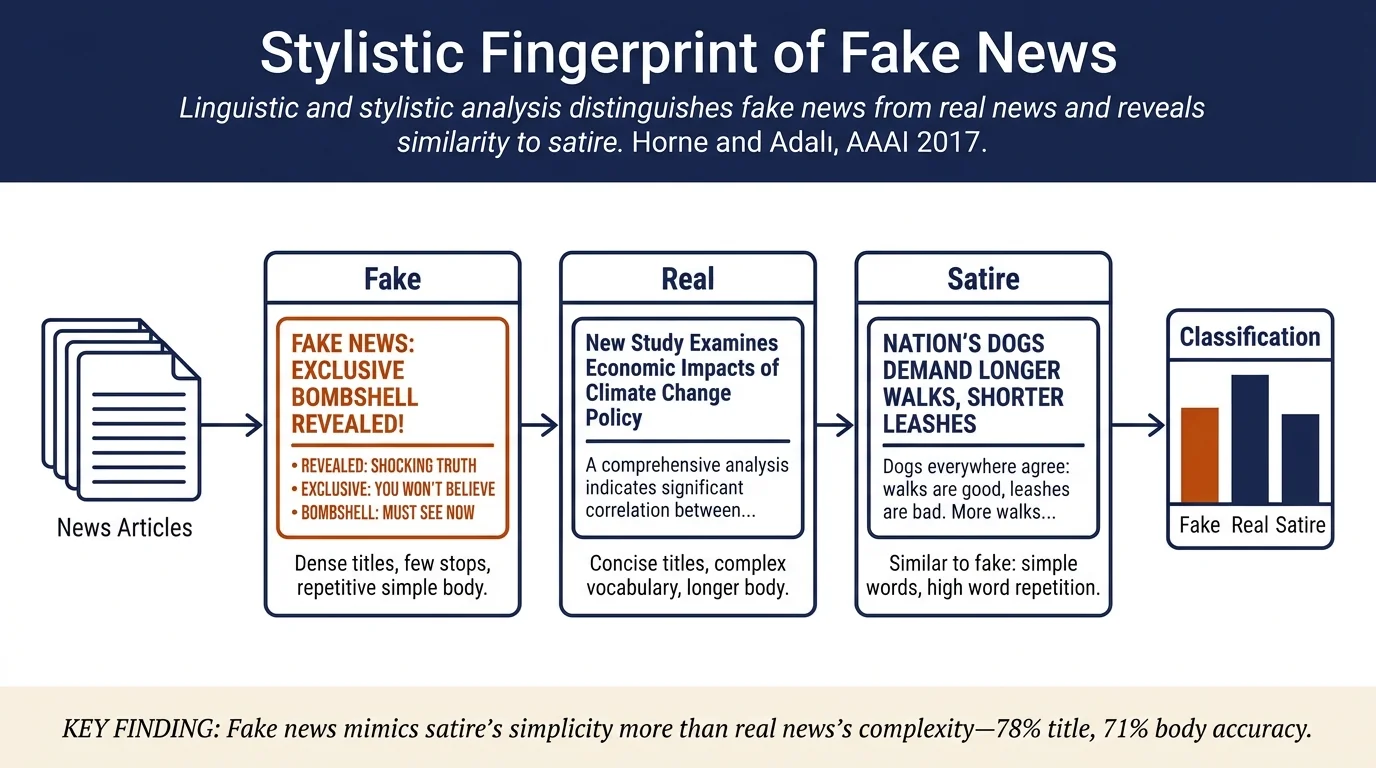
This Just In: Fake News Packs a Lot in Title, Uses Simpler, Repetitive Content in Text Body, More Similar to Satire than Real NewsFake news differs systematically from real news in stylistic features, especially titles. Contrary to the assumption that fake news mimics real news, it is actually more similar to satire: packed titles with fewer stop words and more proper nouns, combined with shorter, repetitive body text with simpler language.
 Fact-checking & verificationPsychology & interventions
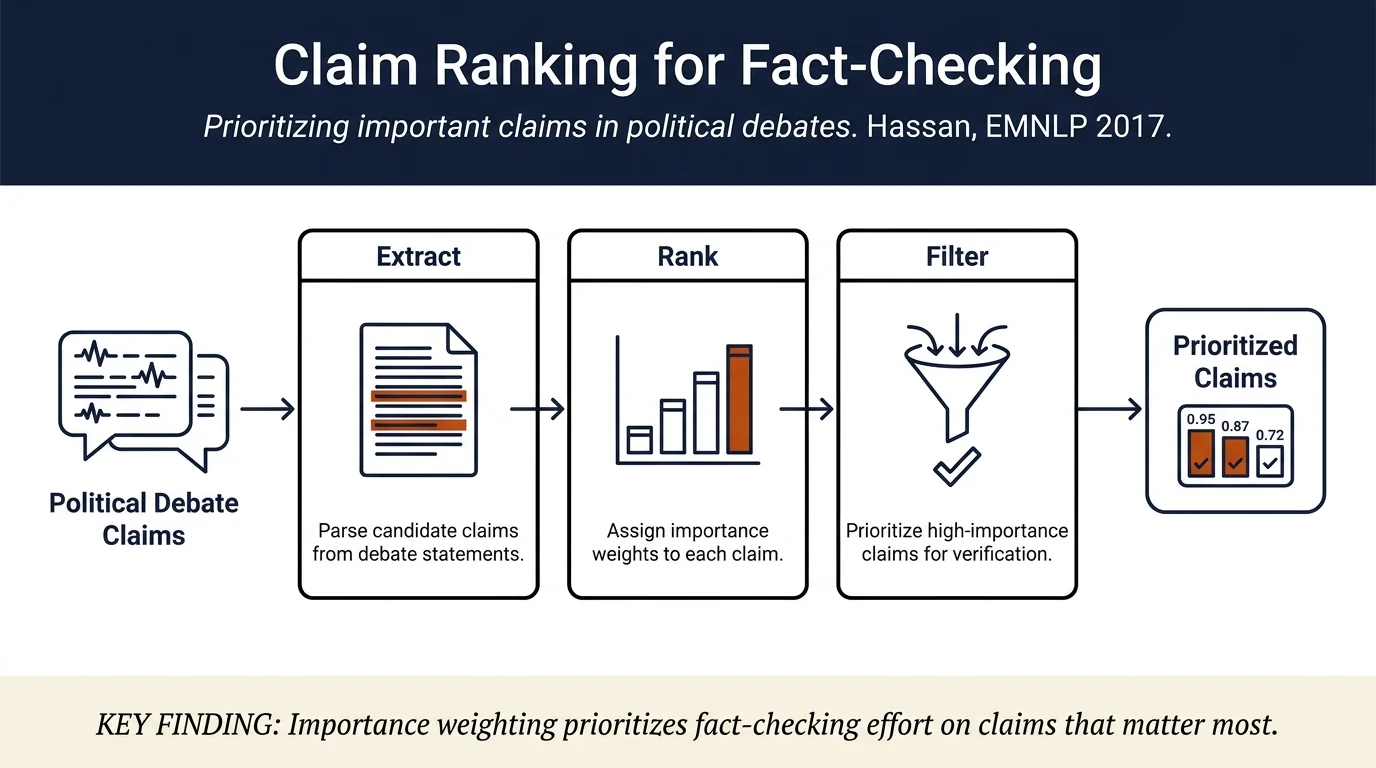
Claim Ranking in Political DebatesEarly work framing check-worthiness as claim ranking; introduces the notion of "importance weighting" for prioritizing claims for fact-checking in political debates. Foundational for understanding which claims warrant verification effort.
 Detection methodsDatasets & evaluation
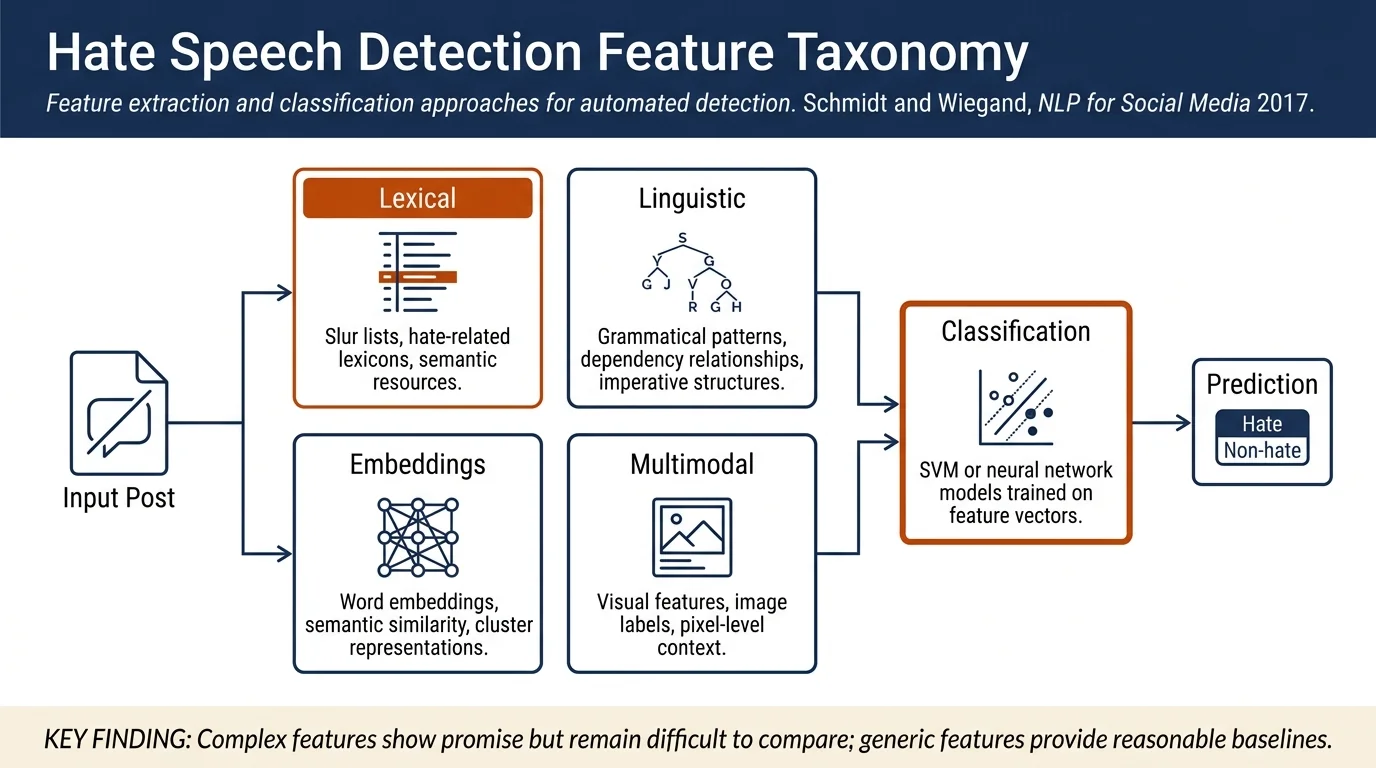
A Survey on Hate Speech Detection using Natural Language ProcessingThis survey systematically reviews automatic hate speech detection methods, covering feature extraction techniques (surface features, embeddings, sentiment analysis, lexical resources, linguistic features, knowledge bases), classification approaches (mostly supervised learning with SVMs and neural networks), annotation practices, and key…
 Psychology & interventionsPlatforms, policy & society
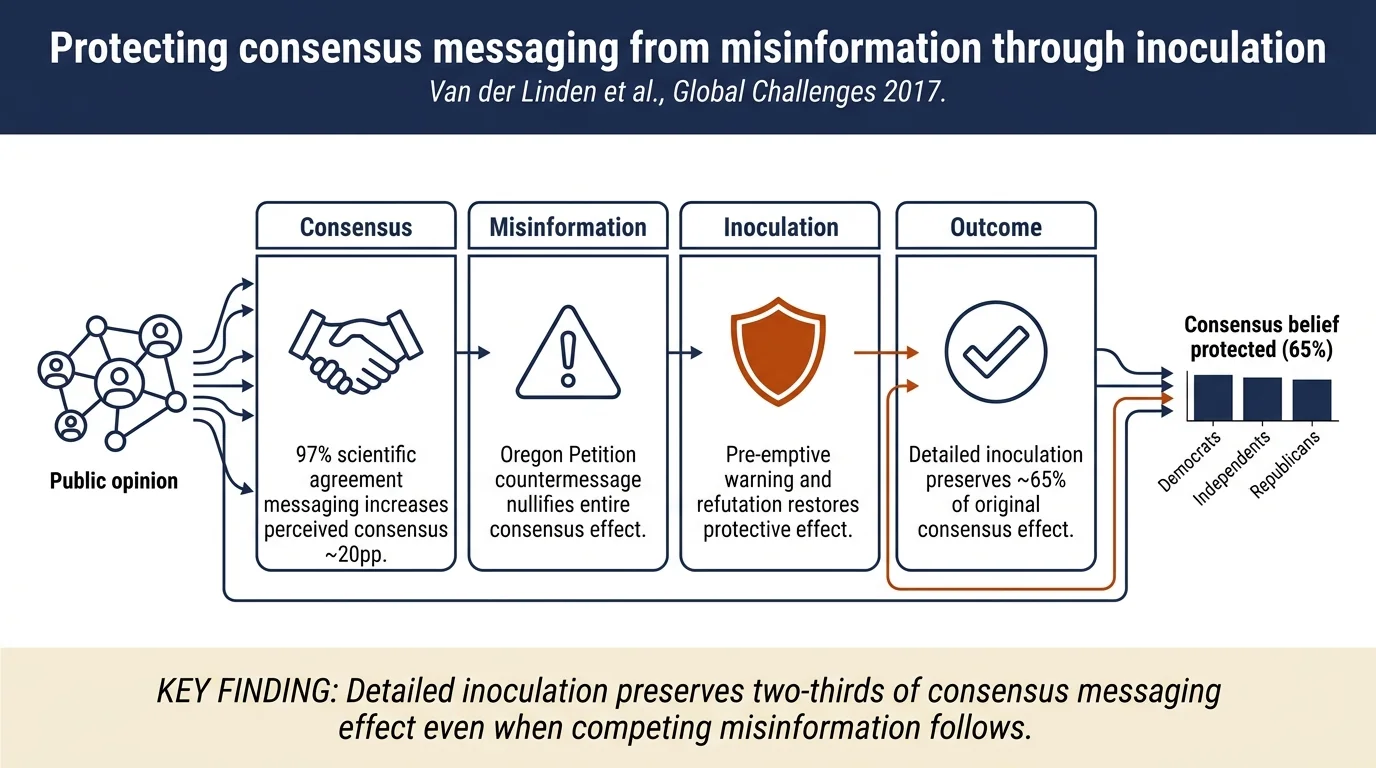
Inoculating the Public against Misinformation about Climate ChangeLarge-scale experiments (N=2,167) demonstrate that misinformation about scientific consensus on climate change nullifies the effect of consensus messaging. Pre-emptive inoculation—warning people about misleading tactics and providing refutations—preserves two-thirds of the consensus effect.
 Platforms, policy & societyFact-checking & verification
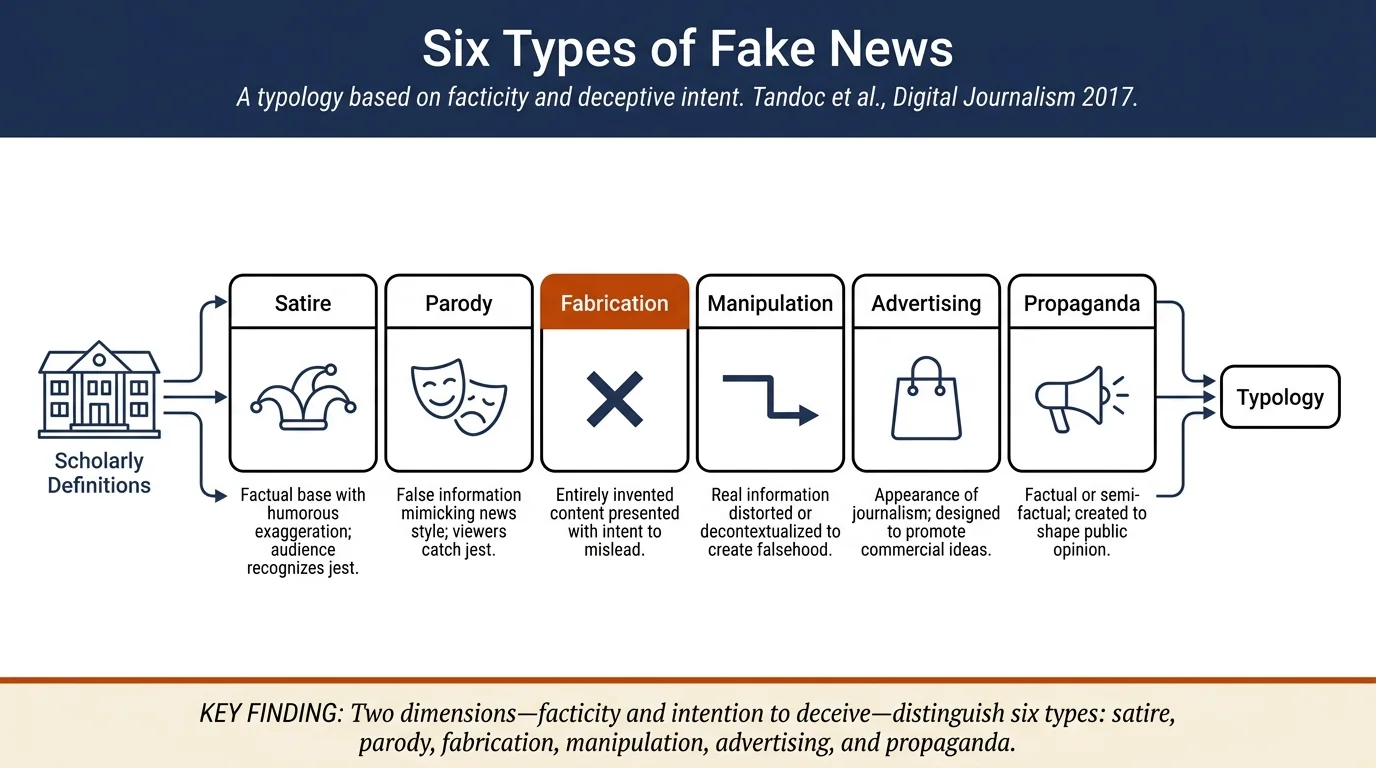
Defining "Fake News": A typology of scholarly definitionsThis paper reviews 34 academic studies (2003–2017) that use the term "fake news" and proposes a unified typology based on two dimensions: level of facticity (reliance on facts) and author's intention to deceive. The typology identifies six distinct types—satire, parody, fabrication, manipulation, advertising, and propaganda—clarifying…
 Spread & networksPsychology & interventions
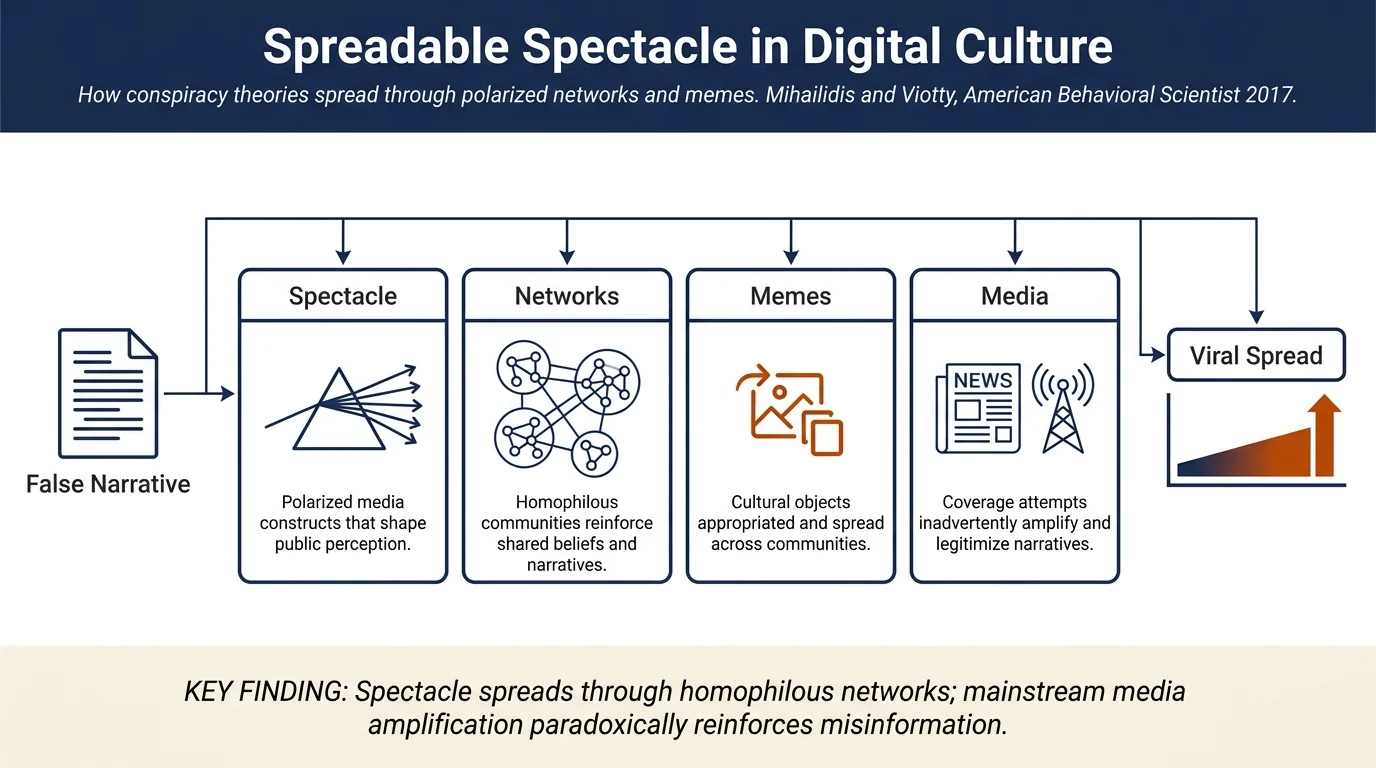
Spreadable Spectacle in Digital Culture: Civic Expression, Fake News, and the Role of Media Literacies in "Post-Fact" SocietyThis paper explores how spectacle—media constructs outside ordinary routine that capitalize on polarization—spreads through digital culture during the 2016 U.S. election. Using the Pizzagate conspiracy theory as a case study, the authors argue that citizen-driven spectacle leverages homophilous networks, memes, and appropriated cultural…
 Psychology & interventions
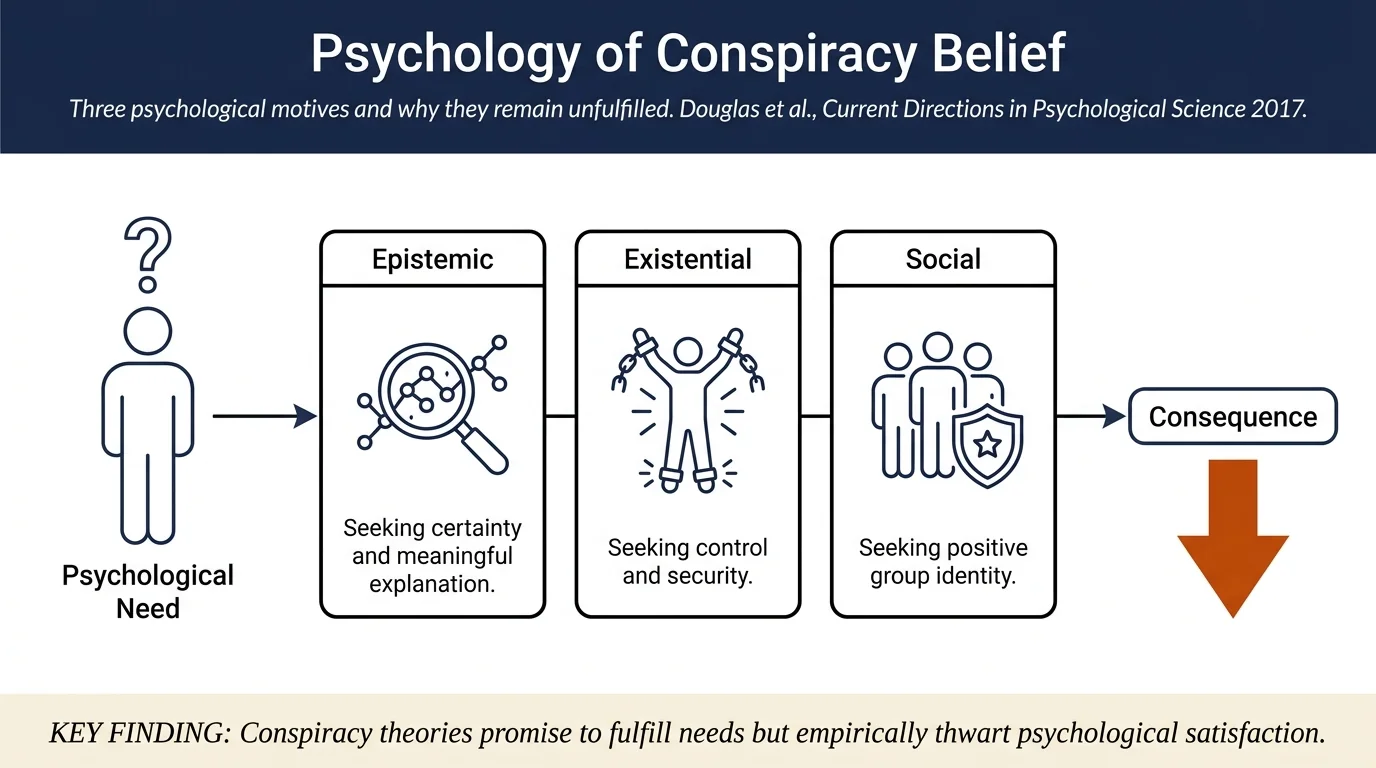
The Psychology of Conspiracy TheoriesPeople are drawn to conspiracy theories via three distinct psychological motives: epistemic (seeking understanding and certainty), existential (seeking control and security), and social (maintaining positive self and group image). However, experimental evidence suggests conspiracy theories ultimately frustrate rather than satisfy these…
 Spread & networksPsychology & interventions
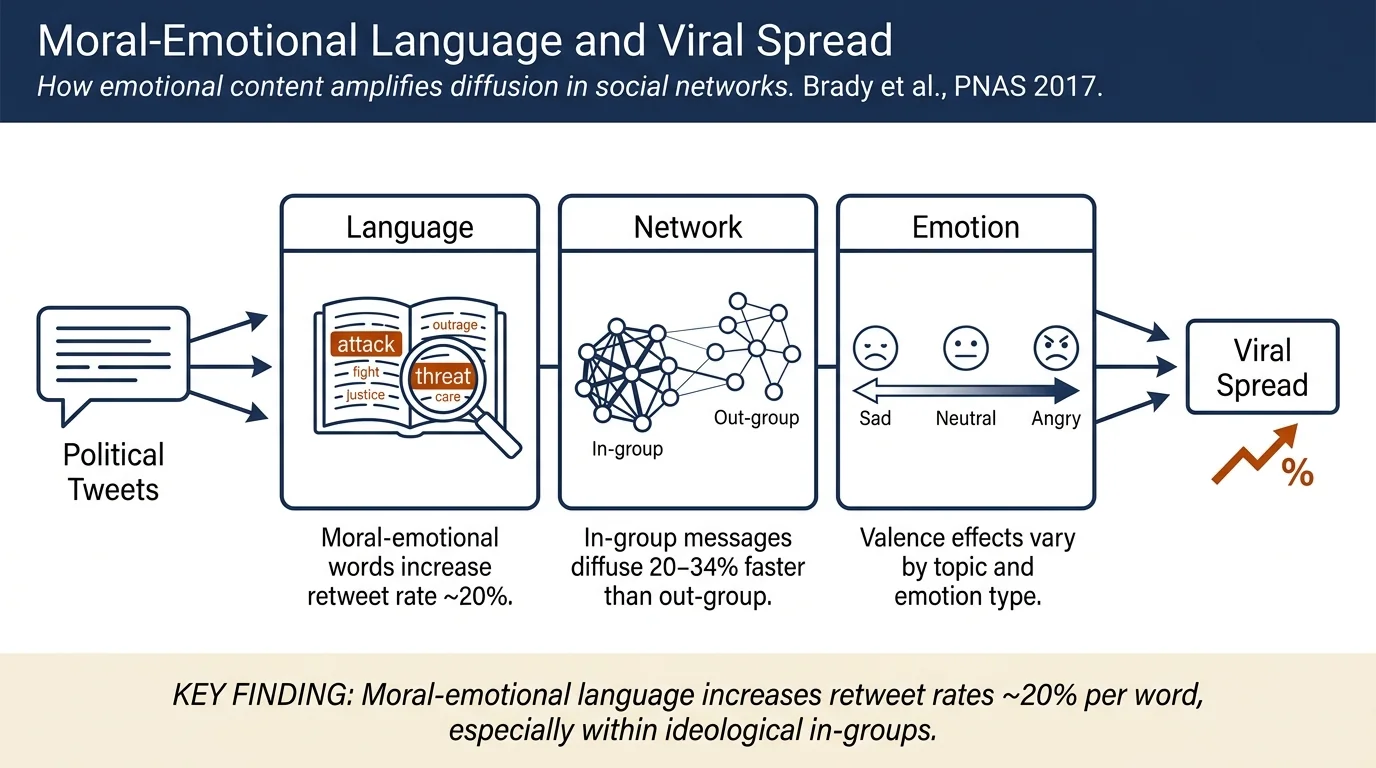
Emotion shapes the diffusion of moralized content in social networksMoral-emotional language (words combining moral and emotional content) increases message diffusion in social networks by ~20% per word. This effect is stronger within political in-groups than out-groups, explaining how moral and political ideas spread within polarized "echo chambers" on platforms like Twitter.