Exposure to opposing views on social media can increase political polarization
Authors: Christopher A. Bail, Lisa P. Argyle, Taylor W. Brown, John P. Bumpus, Haohan Chen, M. B. Fallin Hunzaker, Jaemin Lee, Marcus Mann, Friedolin Merhout, Alexander Volfovsky
Venue: PNAS, September 11, 2018, vol. 115, no. 37 — DOI
TL;DR
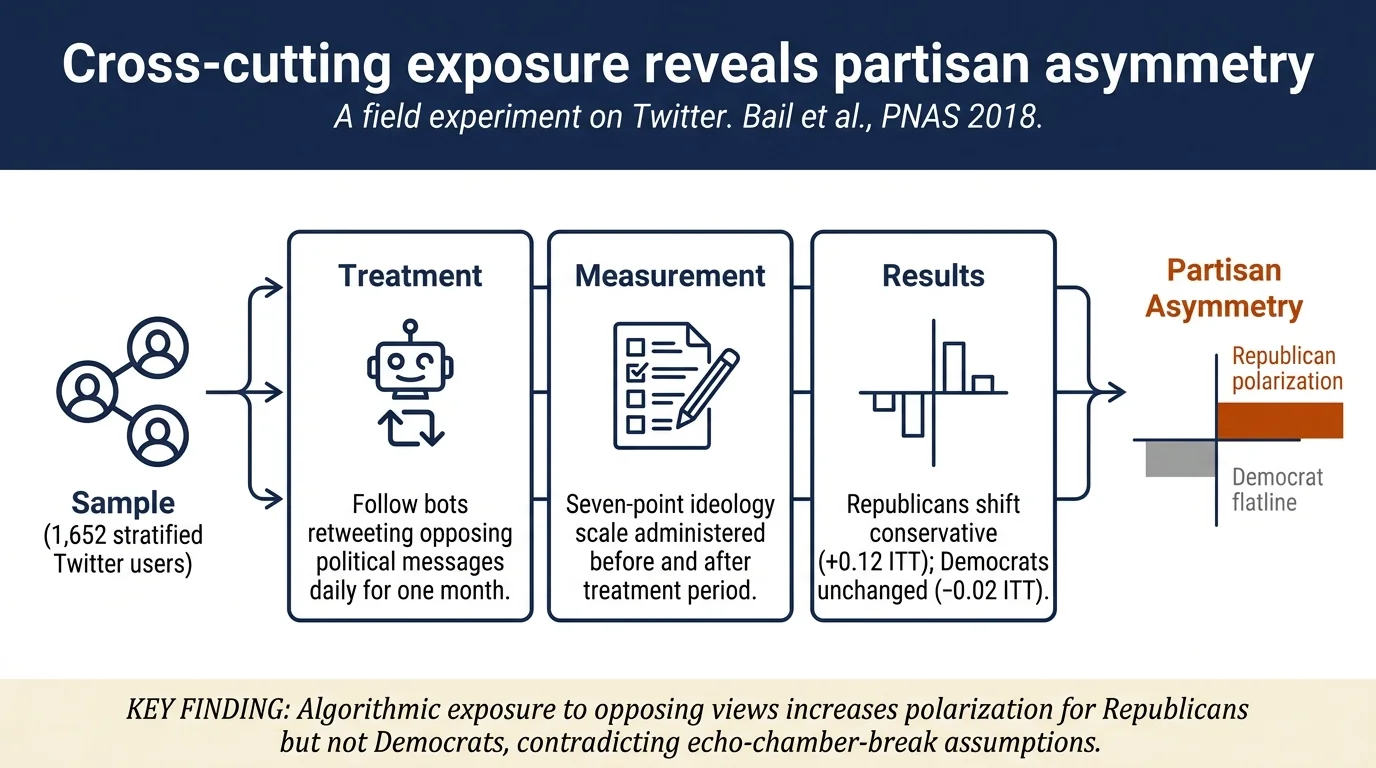
This field experiment tested whether exposure to opposing political views on social media reduces polarization. Twitter users (Republicans and Democrats) were randomly offered money to follow bots retweeting messages from opposing politicians and opinion leaders for one month. Republicans became substantially more conservative (backfire effect), while Democrats showed no significant change. The finding challenges the common assumption that cross-cutting exposure reduces polarization.
Contributions
- First large-scale causal field experiment on the effect of algorithmic exposure to opposing views on Twitter
- Demonstrates significant partisan asymmetry: conservative backfire effects for Republicans, but not for Democrats
- Preregistered hypotheses and rigorous compliance measurement; controls for alternative explanations (Hawthorne effects, demographic sorting, ideological extremity variation)
- Methodological innovation combining survey research, bot technology, and digital trace data for treatment compliance measurement
Method
The study recruited 1,652 Twitter users (901 Democrats, 751 Republicans) who visited Twitter at least three times weekly. A 10-item survey measured political ideology on a seven-point scale (α = .91) across policy issues.
Participants were stratified by party attachment, interest in current events, and Twitter frequency, then randomized to treatment or control. Treatment participants were offered $11 to follow a Twitter bot for one month that retweeted 24 messages daily from a curated list of 4,176 political accounts (elected officials, opinion leaders, media organizations, nonprofits). The bots were created using network sampling: accounts were scored on a liberal-conservative continuum via correspondence analysis of following patterns among elected officials and presidential candidates. One bot retweeted messages from the 1–3 quantile (liberal); another from the 5–7 quantile (conservative).
To verify compliance, participants earned up to $18 by answering weekly questions about bot content and identifying an animal figure retweeted daily. At one month, participants completed the same ideology survey. The authors measured three compliance levels: "minimally compliant" (followed throughout), "partially compliant" (answered some weekly questions), and "fully compliant" (answered all questions).
Results
Republicans assigned to treatment showed a statistically significant increase in conservatism. Intent-to-treat (ITT) effect: 0.12 points on a seven-point scale (p=0.008). Complier Average Causal Effects (CACE) grew with compliance: minimally compliant +0.19 (p<0.007), partially compliant +0.31, fully compliant +0.60 (p<0.01). These correspond to 0.11–0.59 standard deviations.
Democrats showed slight increases in liberal attitudes (ITT −0.02), but these were not statistically significant across all compliance levels.
Acceptance rates differed: 64.9% of Democrats vs. 57.2% of Republicans accepted the bot-following offer. Compliance was moderate: approximately 62% answered weekly content questions correctly; 50.2% correctly identified the daily animal image.
Connections
- Contrasts with van der Linden et al. (2017) on inoculation: that work found warnings could preserve two-thirds of consensus effects, while this study finds opposing messages can backfire
- Related to Brady et al. (2017) on how moral-emotional content drives selective sharing within ideological groups, explaining echo chamber reinforcement
- Cited extensively in Mosleh et al. (2021) on network homophily, which finds partisan preference directly drives echo chamber formation independent of algorithms
- Builds on Bail et al. (2020) (same PI) examining whether exposure to state-sponsored disinformation polarizes Twitter users—finds no effect, suggesting that e-mail-driven exposure differs from organic exposure
Notes
Strengths: Rare causal field experiment; large sample; preregistered; multiple compliance measures; thoughtful controls for Hawthorne effects, demographic variation, and ideological extremity. The network-based bot-curation method is sophisticated and transparent.
Limitations: Limited to frequent Twitter users, not nationally representative; cannot distinguish the precise mechanism (backfire could reflect motivated reasoning, defensive reactions to opposing messages, or increased exposure to women/minorities whose accounts were retweeted by the liberal bot). Authors acknowledge these; honest discussion prevents over-generalization.
Why it matters: The backfire finding contradicts the popular assumption that "echo chamber breaks" (forcing users to see opposing views) reduce polarization. It suggests future interventions must target the content of cross-cutting messages and the manner of exposure (e.g., messages from nonelites or offline contact may differ from elite social media messages). Implications for platform design, media literacy, and democratic deliberation.
Open questions: Does the effect persist after one month? What about offline or interpersonal contact with opposing views? Do nonpolarized, non-Twitter users respond differently?