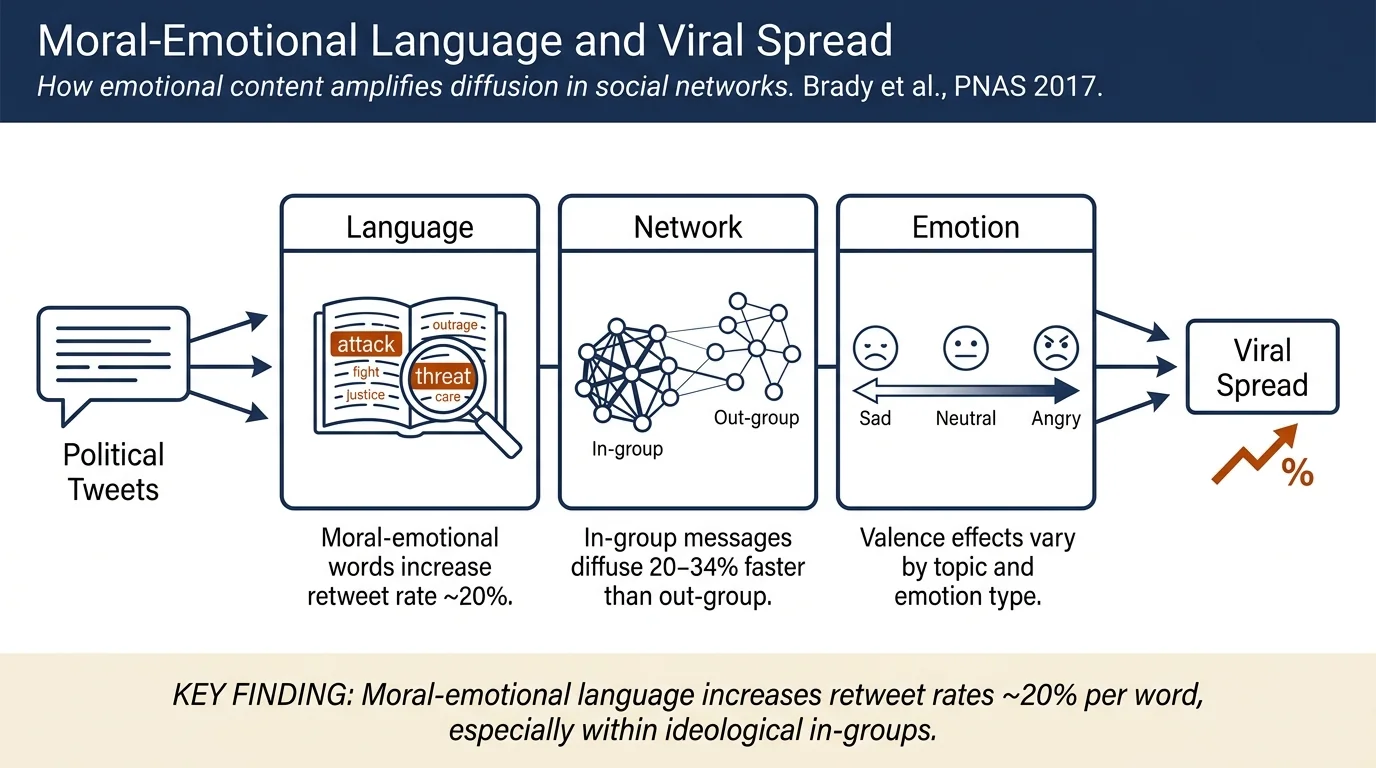
Emotion shapes the diffusion of moralized content in social networks
Authors: William J. Brady, Julian A. Wills, John T. Jost, Joshua A. Tucker, Jay J. Van Bavel
Venue: Proceedings of the National Academy of Sciences (PNAS), 2017, vol. 114, no. 28 — DOI
TL;DR
Moral-emotional language (words combining moral and emotional content) increases message diffusion in social networks by ~20% per word. This effect is stronger within political in-groups than out-groups, explaining how moral and political ideas spread within polarized "echo chambers" on platforms like Twitter.
Contributions
- Demonstrates that moral-emotional language is key for social transmission of moral and political ideas, distinct from basic emotional contagion
- Analyzes 563,312 tweets across three polarizing topics (gun control, same-sex marriage, climate change) with validated dictionaries
- Shows moral contagion is bounded by group membership—more diffusion within ideological networks than between them
- Identifies that both positive and negative moral emotions drive spread, though effects are topic-specific
- Reveals low-arousal emotions (sadness) suppress diffusion while high-arousal moral emotions amplify it
Method
The authors analyzed Twitter discourse on three contentious political topics using naturally occurring social media data. They employed validated dictionaries to categorize words as distinctly moral, distinctly emotional, or moral-emotional (appearing in both dictionaries). Each message was coded for word type frequency, and retweet counts indexed contagion.
Three studies examined different topics:
- Study 1: Gun control (n = 102,328 tweets)
- Study 2: Same-sex marriage (n = 47,373 tweets)
- Study 3: Climate change (n = 413,611 tweets)
Negative-binomial regression models predicted retweet counts from word frequencies while controlling for covariates (follower count, verified status, presence of URLs or media). Political ideology was estimated using a validated follower-network algorithm to classify in-group vs. out-group retweets.
Results
Main findings:
-
Moral-emotional language drives contagion: Across all three topics, adding each moral-emotional word increased expected retweet rate by ~20% (gun control: 19%, same-sex marriage: 17%, climate change: 24%), independent of distinctly moral or distinctly emotional words.
-
Valence effects are topic-dependent: For gun control, both negative and positive moral-emotional language increased diffusion. For same-sex marriage, positive moral-emotional language drove spread while negative language suppressed it (reflecting the pro-marriage-equality sentiment online at the time). For climate change, negative moral-emotional language (referring to environmental harms) increased diffusion while positive language did not.
-
Discrete emotions vary in impact: Sadness consistently decreased social transmission across topics (mean IRR = 0.73). Anger was context-specific: increased diffusion for climate change but decreased it for same-sex marriage. Disgust showed no consistent effects.
-
In-group advantage: Moral-emotional language increased retweet rates more strongly within in-group networks than out-group networks. For gun control, estimated 20% higher diffusion within in-groups; for climate change, a larger effect (34% higher). Same-sex marriage showed similar directionality but was not statistically significant. Conservative networks showed stronger in-group advantages than liberal networks for climate change.
Connections
- Related to Propagation-based fake news detection on how message properties affect spread
- Builds on Information diffusion in social networks research to explain moral discourse transmission
- Contributes to understanding Political polarization and ideological echo chambers and echo-chamber dynamics
- Relevant to Emotional language in online discourse in misinformation contexts
- Examined via social network analysis methods for information diffusion
Notes
Strengths:
Large, real-world dataset with high ecological validity compared to lab studies. Cross-topic replication with consistent findings. Careful distinction between moral-emotional language and basic emotional contagion. Novel insight that moral contagion is stronger within ideological groups, directly explaining echo-chamber and polarization phenomena.
Limitations:
The method of classifying political ideology via follower networks has known limitations for users near the ideological center. Some variability in effect sizes across topics, especially for same-sex marriage, possibly due to temporal data collection artifacts (hashtag #lovewins). Observational design prevents causal inference about whether exposure to moral-emotional language changes attitudes. Future work should validate findings through controlled laboratory experiments.
Implications for fake news: This work illuminates why moral and emotional language amplifies message reach in social networks. Bad-faith actors and misinformation campaigns likely exploit moral-emotional framing to maximize viral spread within ideological communities, while the in-group advantage partially insulates opposing groups from exposure to correcting information.