Spreadable Spectacle in Digital Culture
Authors: Paul Mihailidis, Samantha Viotty Venue: American Behavioral Scientist, Vol. 61(4), pp. 441–454, 2017 — DOI
TL;DR
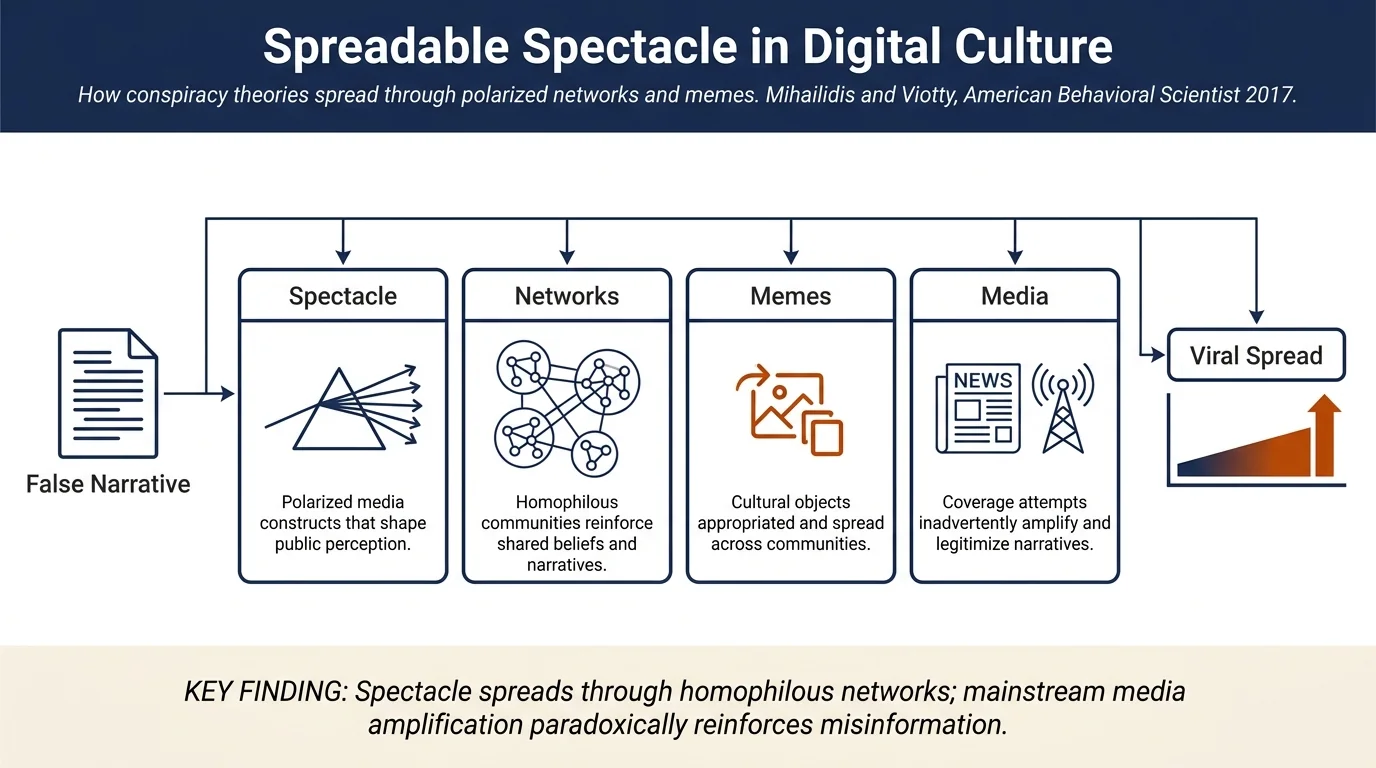
This paper explores how spectacle—media constructs outside ordinary routine that capitalize on polarization—spreads through digital culture during the 2016 U.S. election. Using the Pizzagate conspiracy theory as a case study, the authors argue that citizen-driven spectacle leverages homophilous networks, memes, and appropriated cultural symbols (e.g., Pepe the Frog) to propagate rapidly. They propose repositioning media literacy education toward critique, creation, and civic engagement as a counterbalance to spreadable spectacle.
Contributions
- Applies Guy Debord's concept of spectacle to contemporary digital culture and the 2016 election
- Documents the technical and social mechanisms through which spectacle spreads via spreadable media, online communities, and meme culture
- Demonstrates how mainstream media coverage legitimizes spectacle by covering it, even while attempting to debunk it
- Provides a detailed case study of Pizzagate as an exemplar of spreadable spectacle
- Proposes four reoriented approaches to media literacy: repositioning for spreadable connectivity, caring, everyday engagement, and intentional civic impact
Spectacle and Spreadability
Building on Debord (1967), the paper defines spectacle as a social relationship mediated by images and networked publicly where dominant representations shape perception. In digital culture, "spreadable media" enables users to create, share, and remix content freely. The authors argue that spectacle in digital environments is fundamentally different from mass-media spectacle: it emerges through decentralized, grassroots efforts in homophilous networks where like-minded individuals reinforce shared beliefs and ideologies.
The case of Pizzagate illustrates this mechanism. Online communities—especially on Reddit forums dedicated to Donald Trump—initially developed and sustained the false conspiracy theory. As the narrative spread, mainstream media outlets attempted to debunk it but inadvertently amplified it. The story gained traction because it aligned with existing narratives about Hillary Clinton and provided a compelling frame for political engagement in these communities.
Memes as Spectacle Vectors
The paper analyzes how memes function as vehicles for spectacle. Pepe the Frog, originally a benign cartoon character, became appropriated by alt-right communities and weaponized into a symbol of white identity and hate. Unlike traditional political symbols, memes are democratized and malleable—each user can remix and reinterpret them, making them powerful tools for spreading contested meanings. This appropriation shows how spectacle can emerge through cultural commodities that bypass traditional gatekeepers.
Mainstream Media's Role
Contrary to assumptions that mainstream media offers a counterweight, the paper documents how mainstream outlets inadvertently legitimize spectacle through coverage. News organizations dedicate resources to debunking viral rumors, but in doing so, they amplify and extend the lifespan of false narratives. The pressure to cover "breaking" online stories means that verification takes a back seat to rapid dissemination, creating a landscape where misinformation spreads faster than corrections.
Repositioning Media Literacy
Rather than positioning media literacy as a solution to identifying "false" versus "true" information, the authors propose four reorientations:
- For spreadable connectivity: Frame media literacy as practice that moves beyond individual critique toward connected, dialogical engagement across difference.
- As mechanisms for caring: Position literacy as relational, focusing on how pedagogy can facilitate genuine connection and empathy.
- As facilitators of everyday engagement: Move media literacy from abstract skill-building to active participation in local civic issues.
- As intentionally civic: Directly connect media literacy to democratic participation and structural change rather than neutral "critical thinking."
Connections
- Related to Misinformation and fake news detection via shared analysis of false narrative propagation
- Builds on Spectacle Theory and Debord's historical work
- Connected to Meme culture and politics for understanding symbol appropriation
- Relevant to 2016 Election Misinformation studies
- Complements Media literacy work on critical pedagogy
- Similar scope to Pizzagate Analysis case studies
Notes
The paper's strength lies in its ground-level analysis of how spectacle actually spreads—through communities, memes, and networked sharing—rather than top-down messaging. The Pizzagate case is exceptionally detailed and traces the phenomenon from obscure Reddit threads to mainstream coverage.
A limitation is that the media literacy recommendations, while thoughtful, remain somewhat abstract and lack concrete implementation details for classroom practice. The paper also precedes substantial platform policy changes (2018+) that may have disrupted some of the mechanisms described (e.g., tighter community moderation on Reddit, Twitter, Facebook).
The paper is foundational for understanding how "post-fact" culture emerged not from information scarcity but from abundance in homophilous, polarized networks where correction attempts paradoxically amplify false narratives.