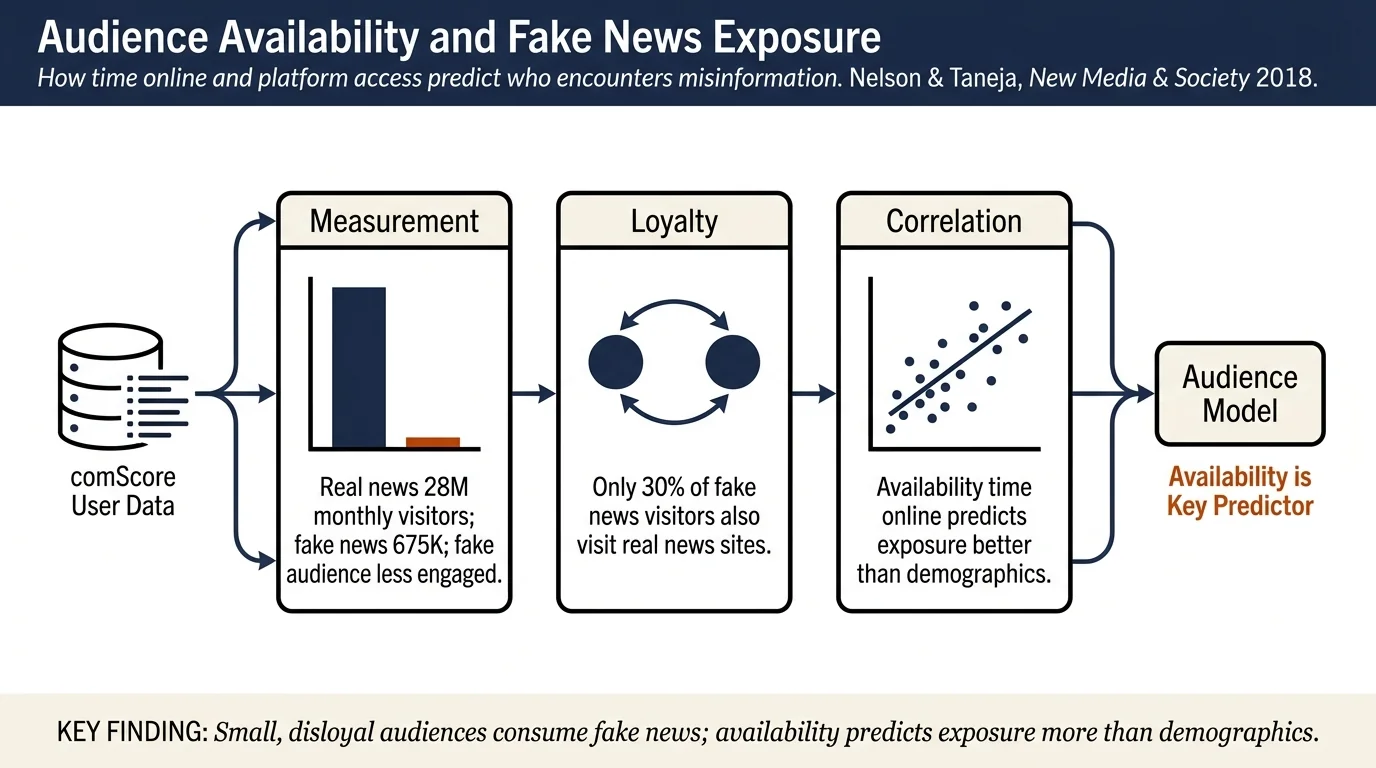
The small, disloyal fake news audience: The role of audience availability in fake news consumption
Authors: Jacob L Nelson, Harsh Taneja Venue: New Media & Society, 20(10) — DOI
TL;DR
Contrary to claims that fake news has reached a broad audience, this empirical analysis of comScore data shows the fake news audience is small and comprises heavy internet users. Applying the Law of Double Jeopardy from media theory, the authors show that fake news attracts disloyal audiences disproportionately from social platforms. Audience availability—the amount of time spent online—is a stronger predictor of fake news exposure than broader demographic factors.
Contributions
- Empirical measurement of fake news audience size relative to real news (675K vs 28M unique monthly visitors in October 2016)
- Application of the Law of Double Jeopardy to explain fake news consumption patterns
- Analysis of cross-visitation: how much of the fake news audience also visits real news sites vs vice versa
- Evidence that audience availability, not audience size, explains fake news exposure
- Platform-specific analysis showing heavy reliance on Facebook and Google for fake news traffic
Method
Using comScore data from ~1 million US users, the authors compared visitation patterns to 30 fake news sites (e.g., The Onion, InfoWars, 70 News) against 24 real news outlets (major newspapers, broadcasters, digital-first publishers) across desktop and mobile platforms. They focused on October 2016 (around the election) to detect patterns in audience behavior.
The study employed audience duplication analysis: measuring what percentage of fake news visitors also visited real news sites, and vice versa. Using Point-Biserial Correlation, they tested whether being a fake news visitor was significantly associated with smaller audience size, lower engagement (average time per visitor), and specific traffic sources (Facebook, LogOn, etc.).
Results
Fake news sites attracted far smaller and less engaged audiences than real news. In October 2016: - Real news audience: ~28M unique visitors; average time spent ~9-10 minutes per month - Fake news audience: ~675K unique visitors; average time spent ~4-6 minutes per month
The fake news audience was strongly disloyal: only 30% of fake news visitors also visited real news sites, while 50%+ of real news visitors visited fake news sites. Heavy internet users (especially those who accessed Facebook frequently) were disproportionately exposed to fake news. Point-Biserial Correlations were significant: being a fake news visitor correlated with smaller audience size (r = –0.544, p < 0.001) and lower engagement (r = –0.367, p < 0.01).
Desktop visitors drove most fake news traffic (~80% of October visits), but mobile users made up a larger portion of the engagement. Cross-visitation analysis showed that more than half of fake news visitors also visited Yahoo-ABC News and other mainstream outlets, suggesting the fake news audience overlaps more with general audiences than prior discourse suggested.
Connections
- Related to social media platforms as the primary distribution channel for fake news traffic
- Complements Polarization work by showing how audience segmentation drives information asymmetries
- Connects to credibility assessment by highlighting the role of audience characteristics in exposure
Notes
This paper provides crucial pushback against the "fake news crisis" narrative. By grounding analysis in actual audience measurement rather than extrapolation, it shows that concern about massive fake news reach may be overblown. However, the small-but-heavy-user finding is sobering for another reason: the audience most likely to be exposed to misinformation is also the most engaged online, potentially amplifying their influence through social networks.
The reliance on comScore limits the study (no in-app mobile metrics, demographic data limited), but the core finding—that availability (time online) matters more than broad audience appeals—has held up in subsequent research on information diets.