The Psychology of Conspiracy Theories
Authors: Karen M. Douglas, Robbie M. Sutton, Aleksandra Cichocka Venue: Current Directions in Psychological Science, 2017, Vol. 26(6) — DOI
TL;DR
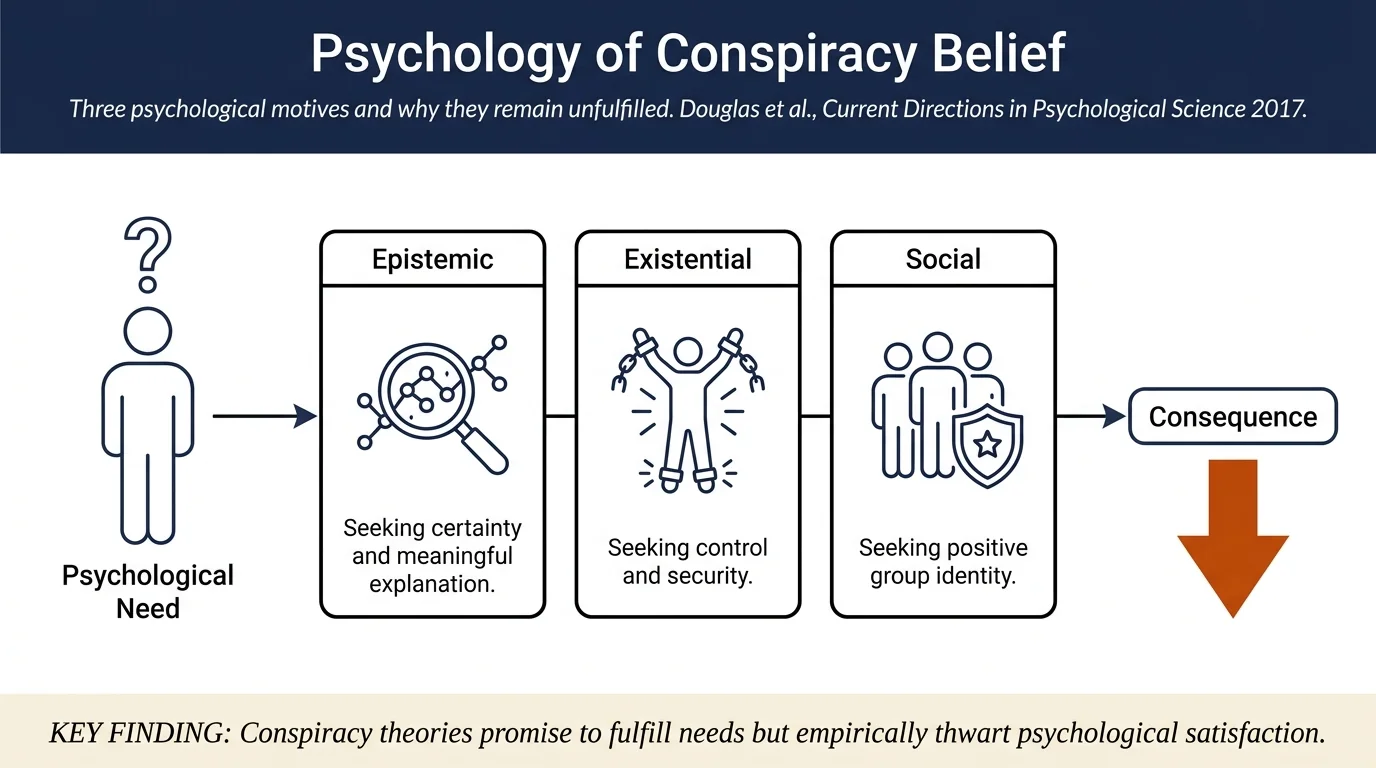
People are drawn to conspiracy theories via three distinct psychological motives: epistemic (seeking understanding and certainty), existential (seeking control and security), and social (maintaining positive self and group image). However, experimental evidence suggests conspiracy theories ultimately frustrate rather than satisfy these needs, making them a self-defeating form of motivated reasoning.
Contributions
The paper provides a unified taxonomy of psychological motives driving conspiracy belief, derived from system-justification theory, synthesizing a decade of empirical findings on why conspiracy theories appeal to people and what their consequences are.
Epistemic motives
Conspiracy theories attract people seeking explanations for large, significant events. Unlike parsimonious scientific explanations, conspiracy theories are speculative (posit hidden actions), complex (coordinating multiple actors), and resistant to falsification (posit cover-up mechanisms). These properties align poorly with causal explanation norms but appeal to people motivated to preserve beliefs against disconfirmation. Research shows conspiracy belief is stronger when:
- People are experimentally induced to seek patterns in the environment
- People habitually seek meaning and patterns (correlates with paranormal belief)
- Events are large-scale and leave people dissatisfied with mundane explanations
- People experience cognitive closure needs (require decision closure on ambiguous evidence)
- People feel uncertain and distressed by ambiguity
However, the epistemic benefit is illusory. Conspiracy theories may shield beliefs from uncertainty but are less likely to be accurate. Empirical research shows conspiracy belief is correlated with lower analytic thinking, lower education, overestimation of co-occurring event likelihood, and perception of agency where none exists. When researchers expose people to conspiracy theory arguments (on vaccination, climate change), participants report increased uncertainty, not reduced.
Existential motives
Conspiracy theories offer compensatory psychological control when people feel powerless. They allow people to reject official narratives and feel they possess an alternative understanding. Research shows conspiracy belief increases when people:
- Feel anxious about their environment
- Lack instrumental control over outcomes
- Experience low sociopolitical control or psychological empowerment
Experimental manipulations confirm: heightening lack-of-control increases conspiracy belief; affirming sense of control reduces it. Yet exposure to conspiracy theories then immediately suppresses people's sense of autonomy and makes them less likely to engage in mainstream political action (voting, party participation, organizational commitment) that could actually boost control. Conspiracy theories thus appear to undermine the very motive they initially satisfy.
Social motives
Conspiracy theories provide identity and blame-attribution function: by attributing negative outcomes to powerful malevolent others, they allow in-groups to maintain positive self-image as competent and moral (but sabotaged). Research shows conspiracy belief increases among:
- People experiencing ostracism
- Members of low-status groups (by ethnicity or income)
- People on the losing side of political processes
- People with narcissistic traits or collective narcissism (inflated group greatness + perceived external disrespect)
- Groups that feel victimized
Yet conspiracy theories' negative, distrustful representations of others erode social capital. Exposure experiments show conspiracy theories decrease trust in institutions (even unrelated ones) and cause disenchantment with politicians and scientists—the opposite of cultivating positive social belonging.
Consequences
A central contribution is the observation that research on motivational drivers of conspiracy belief far outpaces research on whether belief actually satisfies those motives. Preliminary evidence suggests conspiracy theories are more psychologically appealing than satisfying—they promise to fulfill motives but empirically thwart them further.
Notes
This paper's three-part taxonomy (epistemic, existential, social) is now canonical in the conspiracy-theory literature. The critical insight—that conspiracy theories are self-defeating—shifts the focus from why they appeal to why people remain trapped by them despite their psychological costs. The paper appropriately acknowledges that experimental samples (undergraduates, survey panelists) are not the populations most likely to benefit from conspiracy theories. Longitudinal and experimental work on truly disadvantaged populations remains sparse but needed to answer definitively whether conspiracy belief ever successfully compensates for threatened needs.
The paper also notes that conspiracy theories sometimes fulfill legitimate expose function: corporate and political elites do conspire, and conspiracy-theory communities have historically brought real misdeeds to light. This nuance prevents overreach but leaves unresolved the question of how to distinguish truth-seeking conspiracy inquiry from motivated belief.
Connections
- Conspiracy theories topic page — overview of belief drivers and field context.
- Psychology of belief formation — broader framework of motivated reasoning.
- Motivated reasoning — theoretical foundation for belief preservation mechanisms.
- COVID-19 misinformation and the infodemic — empirical case of conspiracy-theory proliferation and monological belief systems.
- Roozenbeek et al. (2020) — Susceptibility to misinformation about COVID-19 — demonstrates intercorrelation of COVID conspiracy beliefs consistent with monological belief systems.