Inoculating the Public against Misinformation about Climate Change
Authors: Sander van der Linden, Anthony Leiserowitz, Seth Rosenthal, Edward Maibach
Venue: Global Challenges, 2017 — DOI
TL;DR
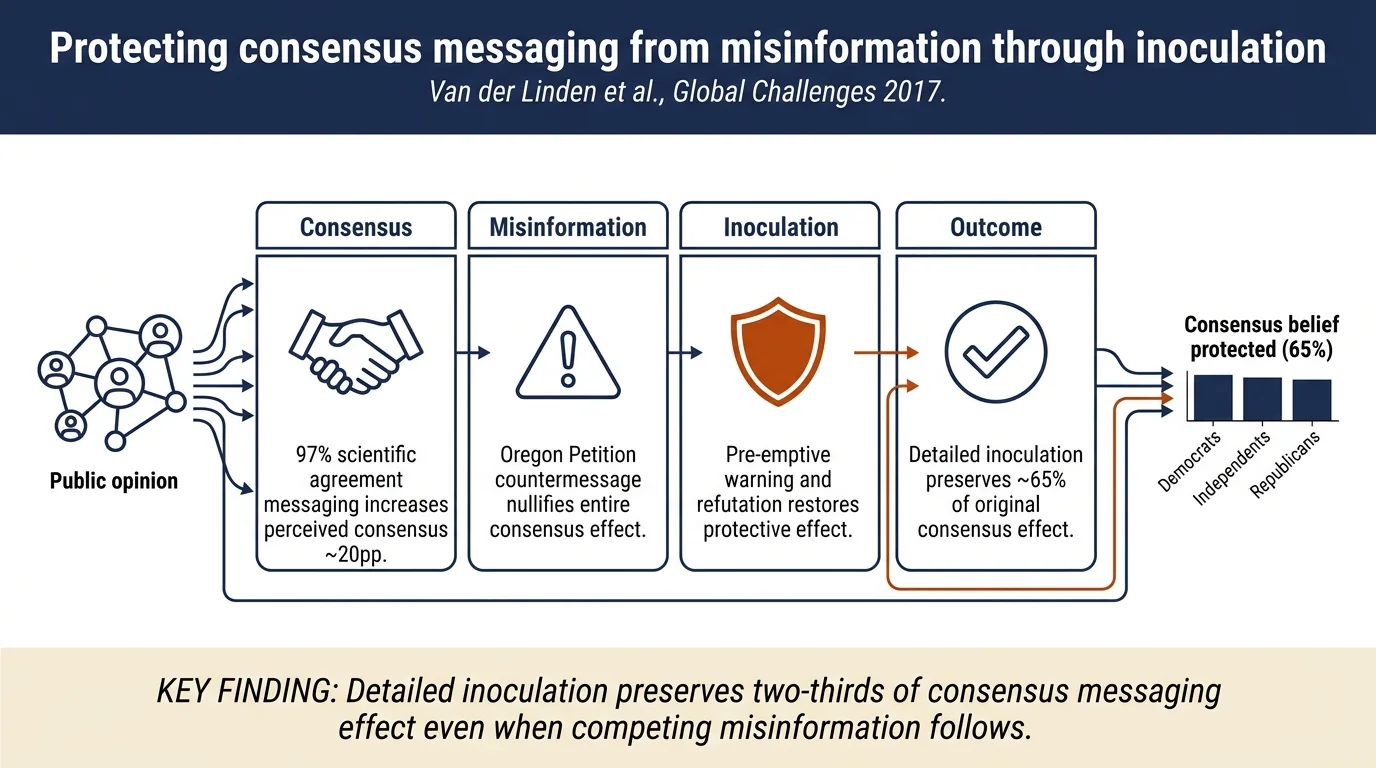
Large-scale experiments (N=2,167) demonstrate that misinformation about scientific consensus on climate change nullifies the effect of consensus messaging. Pre-emptive inoculation—warning people about misleading tactics and providing refutations—preserves two-thirds of the consensus effect. The protective effect holds across the political spectrum, suggesting inoculation is a viable strategy for defending public understanding of expert agreement.
Contributions
- Empirical demonstration that consensus messaging alone (stating 97% of climate scientists agree) increases perceived consensus by ~20 percentage points but is completely negated when followed by a competing claim that there is no consensus.
- Novel application of attitudinal inoculation theory to climate change: pre-emptively warning about politically motivated misinformation campaigns and providing specific refutations significantly protects consensus messaging.
- Identification of the most persuasive climate misinformation among the US public: the claim that there is "no scientific consensus" on climate change.
- Evidence that inoculation effectiveness is robust across political party affiliation (Democrats, Independents, Republicans), counter to polarization backfire predictions.
Method
Two studies:
Study 1 (N=1,000, nationally representative): Tested six common climate misinformation statements on two dimensions (familiarity and persuasiveness). Found the Oregon Petition ("over 31,000 American scientists state there is no scientific evidence for human-caused climate change") as the most familiar and convincing.
Study 2 (N=2,167, Amazon Mechanical Turk, within-subject design): Randomized experiment with six conditions: 1. Control: neutral word puzzle 2. Consensus treatment (CT): pie chart showing "97% of climate scientists have concluded that human-caused climate change is happening" 3. Countermessage (CM): Oregon Petition 4. CT | CM: consensus followed sequentially by countermessage 5. General inoculation (In1) | CM: consensus + warning about politically motivated misleading tactics + generic refutation, then countermessage 6. Detailed inoculation (In2) | CM: consensus + general inoculation + specific refutation of the Oregon Petition (e.g., signatories include non-scientists, fictitious names like Charles Darwin), then countermessage
Main dependent variable: perceived scientific consensus (0–100 scale). Secondary measures: certainty of estimate, likelihood climate change is happening, belief it is human-caused, worry level, support for action.
Results
Within-subject changes in perceived consensus: - Control: +0.35 percentage points (no change) - CT alone: +19.72 percentage points - CM alone: −8.99 percentage points - CT | CM: −0.51 percentage points (neutralized) - In1 | CM: +6.47 percentage points (33% of original consensus effect preserved) - In2 | CM: +12.71 percentage points (65% of original consensus effect preserved)
ANCOVA confirmed all between-group differences significant (p < 0.001), except control vs. "neutralizing" condition.
Political subgroup analysis (Table 4) revealed: - Consensus effect larger for Republicans (Mdiff = 23.00) and Independents (Mdiff = 19.05) than Democrats (Mdiff = 15.78). - Misinformation "neutralizes" the effect for Democrats and Independents but shows modest backfire for Republicans (Mdiff = −8.03), though smaller than the independent misinformation effect. - Inoculation equally effective across all three groups, preserving ~33–67% of consensus effect.
Belief certainty also increased with inoculation (Mdiff = 0.90–1.21 on 1–7 scale vs. 0.62 in presence of misinformation alone).
Connections
- Extends Cook et al. (2017) on inoculation to the specific case of scientific consensus messaging, in a more realistic information environment with competing claims.
- Related to Fake news game confers psychological resistance against online misinformation via shared inoculation mechanism, though this paper emphasizes consensus-specific threats and pre-emptive warnings.
- Directly addresses gateway belief model framework: consensus perception as a "gateway cognition" to downstream beliefs about climate reality, causation, and urgency.
- Rebuts claims from cultural cognition thesis (e.g., Kahan) that consensus messaging causes polarization; finds no backfire effect.
- Empirical grounding for scientific consensus communication strategy as a depolarizing public engagement tool.
Notes
Strengths: Large, diverse online sample. Rigorous experimental design comparing additive inoculation strategies. Tested realism (used actual misinformation petition). Political subgroup analysis. Robust effects across the spectrum.
Limitations: Laboratory experiment, not field test—structured information environment may not match real media consumption. No long-term follow-up on decay of inoculation effect (though cited research suggests persistence). Amazon Mechanical Turk sample may differ from general population (slightly higher education), though demographics approximate 2013 census reasonably well. Consensus message tested in isolation; real-world climate communication often bundled with other framings.
Open questions: Do inoculation effects persist over weeks/months? Does the intervention translate to behavioral outcomes (policy support, personal action)? How does message source (trusted vs. partisan source) affect inoculation efficacy?