Fake News: Fundamental Theories, Detection Strategies and Challenges
Authors: Xinyi Zhou, Reza Zafarani, Kai Shu, Huan Liu Venue: WSDM '19 (The Twelfth ACM International Conference on Web Search and Data Mining), February 11–15, 2019, Melbourne, VIC, Australia — DOI
TL;DR
A comprehensive tutorial framework addressing fake news research across three dimensions: (1) fundamental theories from psychology, social science, economics, and forensics explaining human vulnerability to misinformation and why individuals participate in fake news activities; (2) detection strategies unified across four perspectives (knowledge-based, style-based, propagation-based, and credibility-based) with techniques from data mining, machine learning, NLP, and information retrieval; (3) open challenges including timeliness, cross-domain transfer, and efficiency constraints for real-world deployment.
Contributions
- Interdisciplinary theoretical foundation: Synthesizes over 20 theories from psychology (Undeutsch hypothesis, social identity theory), economics, and social science to explain both why misinformation succeeds and why people spread it unintentionally.
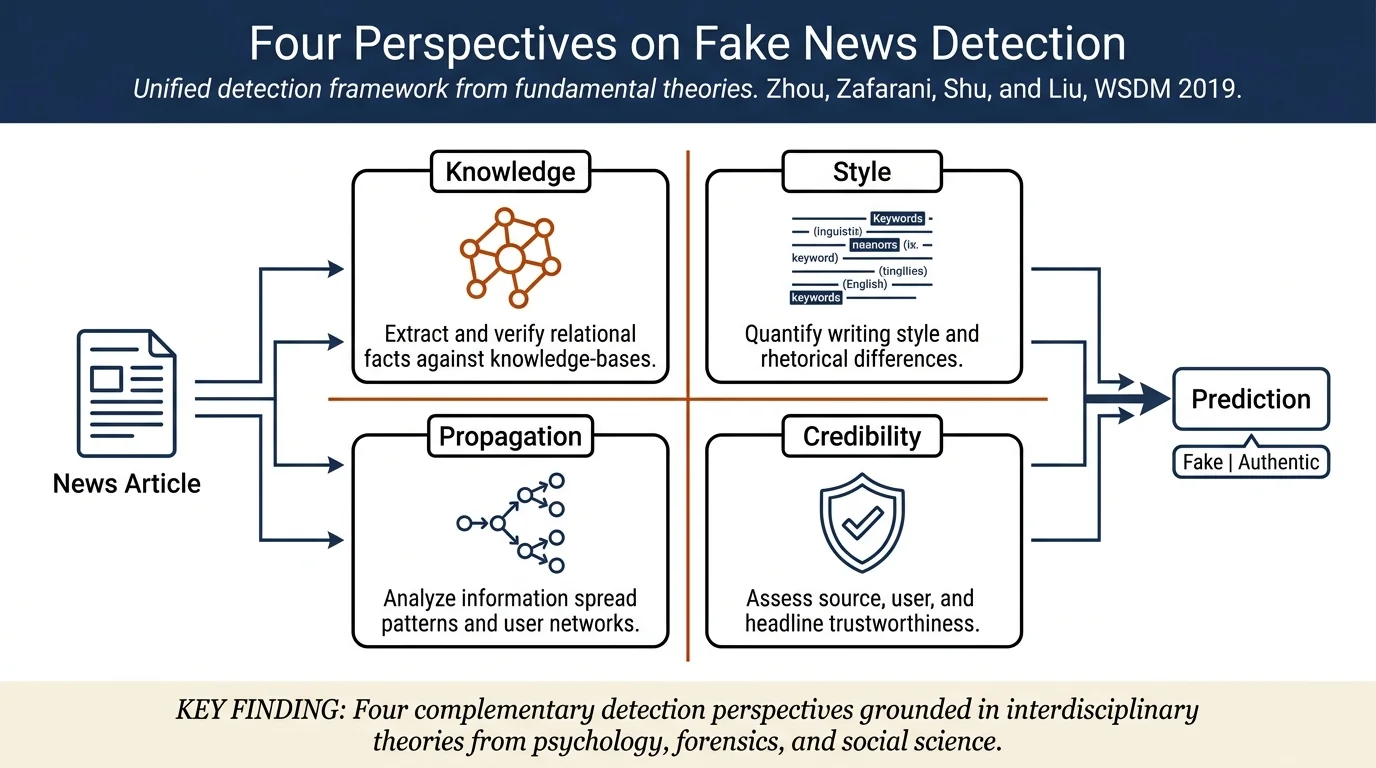
- Unified detection framework: Organizes detection strategies into four complementary perspectives:
- Knowledge-based: Comparison between extracted relational knowledge from news and fact knowledge-bases
- Style-based: Quantifying writing style differences between fake and true news (forensic linguistics)
- Propagation-based: Leveraging information from news dissemination patterns and spreader networks
- Credibility-based: Assessing credibility of headlines, sources, comments, and users to indirectly detect fake news
- Clear problem formulation: Distinguishes fake news from related concepts (rumors, satire, opinion, misinformation) and identifies why detection differs from other verification tasks (e.g., fake reviews, fake statements).
- Landscape review: Surveys datasets, patterns, and models across perspectives; identifies integration points for multi-perspective approaches analyzed from creation through dissemination.
Detection Perspectives
Knowledge-based detection
Extracts relational knowledge from to-be-verified news articles and compares against knowledge-bases representing ground truth (e.g., Freebase, YAGO). Relies on knowledge mining and graph completion techniques.
Style-based detection
Captures writing style differences between fake and true news through linguistic features, discourse patterns, and rhetorical devices. Rooted in forensic psychology and deception literature; operationalized through lexical, syntactic, semantic, and discourse-level features.
Propagation-based detection
Uses information from news dissemination patterns, including spreader networks, retweet cascades, temporal dynamics, and structural patterns of how stories spread through social media. Complements content-based approaches with network and temporal signals.
Credibility-based detection
Assesses trustworthiness of multiple dimensions: - Headline credibility: Detection of clickbait and sensationalism - Source credibility: Publisher reputation, domain trust, registration patterns - Comment credibility: Opinion spam detection, sentiment analysis of user reactions - User credibility: User profiles, posting history, network position
Challenges and Future Directions
Timeliness: Fake news requires rapid detection, but propagation-based methods require observable spread. Early detection at publication time demands content-only approaches; later detection can leverage network signals.
Odd news characteristics: Unlike other misinformation (reviews, statements), news has timeliness and novelty that create unique challenges—check-worthy content is often novel and thus less representable in training data.
Cross-domain transfer: Models trained on one dataset (e.g., political elections) often fail on others (e.g., health, COVID-19), requiring domain adaptation and transfer learning.
Efficiency and scalability: Automatic detection must handle high volume while maintaining accuracy; hybrid content-network approaches incur computational cost.
Explainability: Users and stakeholders need interpretable reasoning for decisions; purely neural approaches resist explanation.
Changing landscapes: Detection systems face concept drift as adversaries evolve tactics; annotation schemes shift as fact-checking practices mature.
Connections
- Extends prior work on Zhou & Zafarani (2020), which presents the full survey paper in ACM Computing Surveys with substantially expanded depth and datasets.
- Presents the same four detection perspectives (knowledge, style, propagation, credibility) that underpin subsequent work on Fake News Early Detection, network-based detection, linguistic-style-aware networks, and multimodal approaches.
- Cites and integrates findings from Vosoughi, Roy & Aral on false news spreading faster online; Grinberg et al. on concentrated fake news consumption; and Shu et al. on user profile-based detection.
- Provides theoretical grounding for interdisciplinary perspectives reviewed in Wardle & Derakhshan on information disorder and Ecker et al. on psychological drivers of false belief.
Notes
This tutorial summary serves as the roadmap for the full 2020 survey paper and remains a canonical entry point for researchers seeking to understand the landscape of fake news detection. The four-perspective framework (knowledge, style, propagation, credibility) has become standard in the field. The emphasis on interdisciplinary theory is prescient—subsequent work has increasingly drawn on psychology (inoculation theory in Roozenbeek & van der Linden, continued influence effects in Ecker et al.), social identity (in Allcott & Gentzkov), and behavioral economics (in Mosleh et al.). The identification of timeliness and novelty as differentiating challenges for news (vs. other misinformation) anticipates the COVID-19 detection challenge: when entirely new topics (vaccines, pandemic origins) emerge, historical training data becomes less valuable, driving the creation of new datasets like ReCOVery and CHECKED.