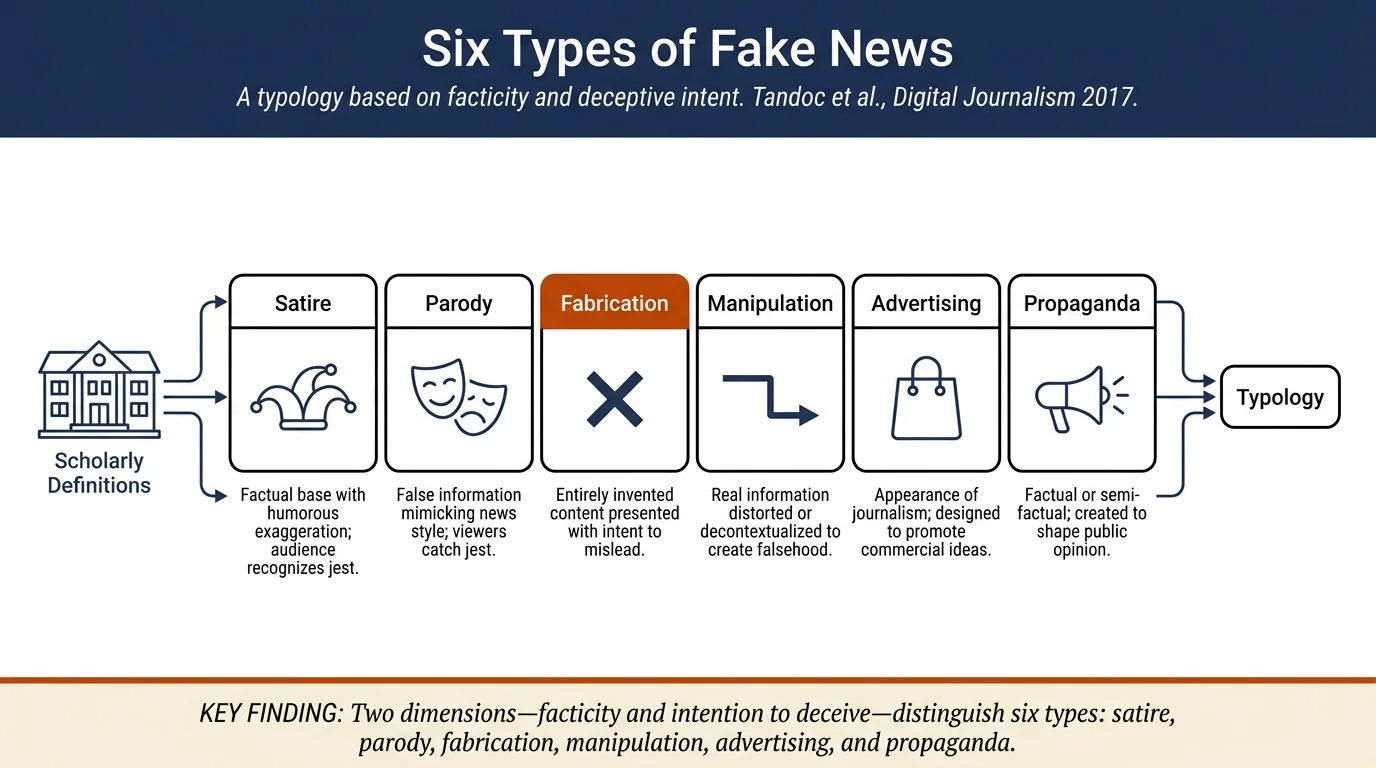
Defining "Fake News": A typology of scholarly definitions
Authors: Edson C. Tandoc Jr., Zheng Wei Lim, Richard Ling
Venue: Digital Journalism, Vol. 6, No. 2, 2017 — DOI
TL;DR
This paper reviews 34 academic studies (2003–2017) that use the term "fake news" and proposes a unified typology based on two dimensions: level of facticity (reliance on facts) and author's intention to deceive. The typology identifies six distinct types—satire, parody, fabrication, manipulation, advertising, and propaganda—clarifying how the term has been operationalized across disciplines.
Contributions
- Systematic review of how "fake news" has been defined and operationalized across 34 academic publications.
- Proposes a two-dimensional framework (facticity × intention to deceive) that maps existing definitions into a coherent typology.
- Identifies six types of fake news: news satire, news parody, fabrication, manipulation, native advertising, and propaganda.
- Highlights the role of the audience in constructing and perceiving fake news on social media.
- Connects fake news definitions to the historical evolution of misinformation and changes in news distribution via digital platforms.
Method
The authors conducted a literature review using Google Scholar and academic databases, searching for the term "fake news" across publications from 2003 to 2017. They examined 34 articles that explicitly operationalized the term. For each article, they recorded how fake news was defined and applied, then distilled the definitions along two dimensions:
- Level of facticity — the degree to which the content relies on or is grounded in facts (high facticity: based on real events; low facticity: invented or heavily altered).
- Author's immediate intention to deceive — whether the creator's primary goal is to mislead (high intention: explicit goal to deceive; low intention: content presented as entertainment or satire with acknowledged non-factuality).
This 2×2 framework yields four quadrants, further subdivided to capture six observed types.
Results
The typology
| Level of facticity | High facticity | Low facticity |
|---|---|---|
| High intention to deceive | Manipulation, Native advertising, Propaganda | Fabrication |
| Low intention to deceive | News satire | News parody |
Key characteristics:
- News satire: Uses factual base and real events but presents them in a humorous, exaggerated format. Audiences are expected to recognize the entertainment intent (e.g., The Daily Show).
- News parody: Deliberately mimics the style of news but contains false information, with the understanding that viewers will catch the jest (e.g., The Onion).
- Fabrication: Entirely invented content presented as news, with the explicit intent to mislead readers. No factual basis.
- Manipulation: Takes real information or images but distorts, decontextualizes, or alters them to create a false narrative. Often used in political contexts.
- Native advertising: Content presented with the appearance of journalism but designed to promote a product, idea, or organization. High in facticity but motivated by commercial or political goals.
- Propaganda: Factual or semi-factual content created by political entities to shape public perception and influence action. Intent is to persuade, not necessarily to entertain.
Key observations
- Social media amplification: Social platforms have created new channels for fake news distribution and accelerated its spread through algorithmic amplification and user-driven sharing.
- Blurred authority: The rise of citizen journalism and non-professional news production has challenged the traditional link between "news" and "journalists," allowing non-institutional actors to produce news-like content.
- Audience role: Fake news succeeds partly because audiences may not perceive it as such. On social media, the loss of organizational cues and editorial markers makes legitimacy ambiguous.
- Image manipulation: Visual manipulation has become increasingly common and sophisticated, with implications for how fake news spreads and is perceived as credible.
- News bots: Automated systems that distribute content can amplify fake news reach without human curation.
Connections
- Related to A Survey of Fake News: Fundamental Theories, Detection Methods, and Opportunities via shared typological framing and comprehensive scope.
- Cited in Information Disorder: Toward an Interdisciplinary Framework for Research and for conceptual clarity on terminology.
- Complements The Spread of True and False News Online on the mechanics of false-news spread on social media.
- Informs detection approaches by providing definitional clarity; see Misinformation Detection Methods for method-specific papers.
- Foundational for propaganda detection and Manipulation Detection work.
Notes
Strengths: - Addresses a critical gap: despite widespread use of "fake news" in public discourse, the term lacked consistent academic definition. This paper provides much-needed clarity. - The two-dimensional framework is intuitive and actionable. It distinguishes fake news from related but distinct phenomena (parody, satire, advertising). - Comprehensive scope (2003–2017) captures the term's evolution and reveals disciplinary variation. - The audience dimension, while brief, is important: fake news is partly a matter of perception and reception.
Limitations: - The typology is derived from existing academic definitions rather than empirical ground truth. It maps the discourse, not necessarily the phenomenon itself. - Focused on textual/content definitions; less attention to spread mechanisms or consequences. - The two dimensions are continuous rather than binary, yet the framework presents them as discrete. In practice, many pieces fall on boundaries (e.g., is satire with no clear irony markers still satire?). - Limited attention to non-English scholarship and non-Western perspectives.
Relevance: This paper is foundational for fake news research. Any work claiming to study "fake news" should engage with this typology, either adopting it or explicitly departing from it and stating why. The taxonomy helps prevent talking past one another when discussing fake news.