Explore papers
Filter by research area, year and venue. Every filter is in the address bar, so you can share a view as a link.
 Psychology & interventionsPlatforms, policy & society
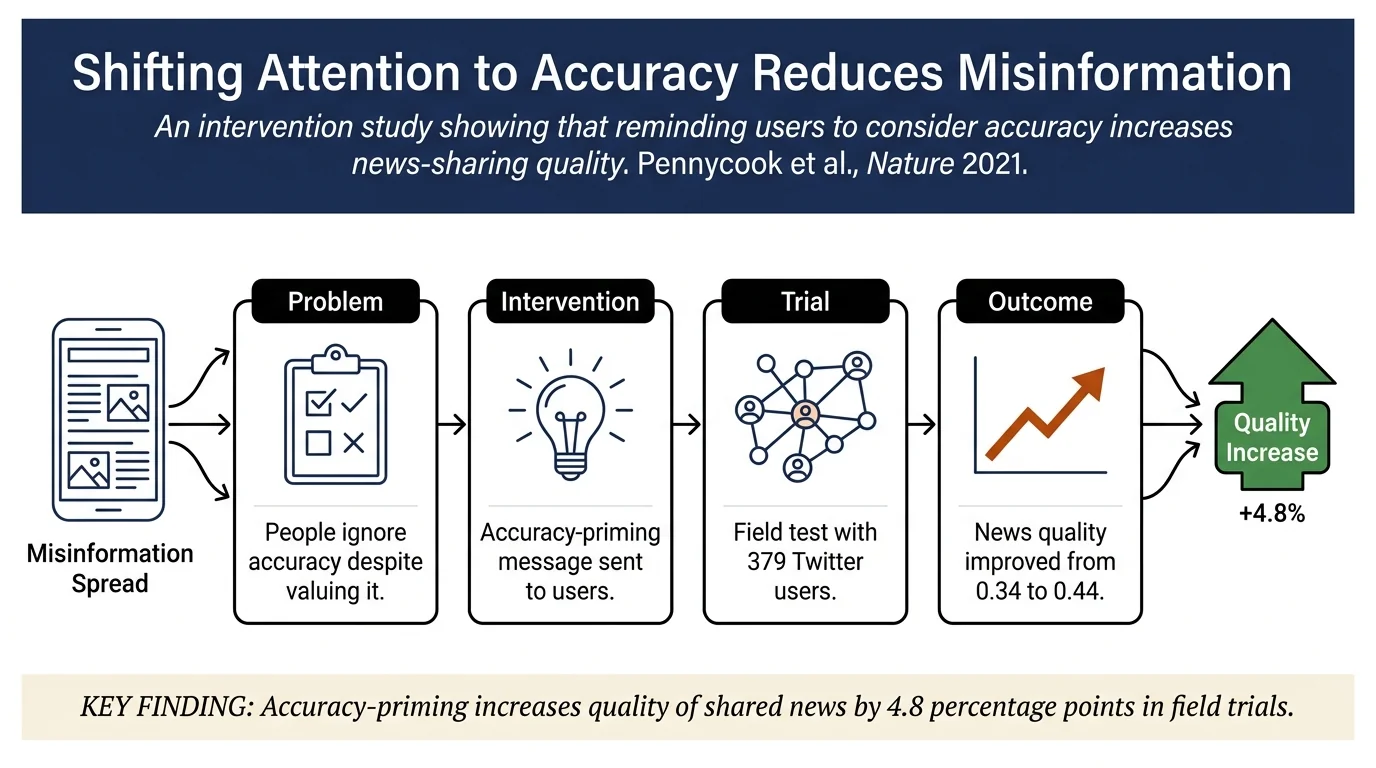
Shifting attention to accuracy can reduce misinformation onlineThe paper shows through six online experiments and a Twitter field trial that simply drawing people's attention to accuracy can substantially reduce their sharing of misinformation. When asked to rate the accuracy of headlines before deciding whether to share them, participants share more accurate content; a Twitter field experiment…
 Detection methodsLLMs & generative AI
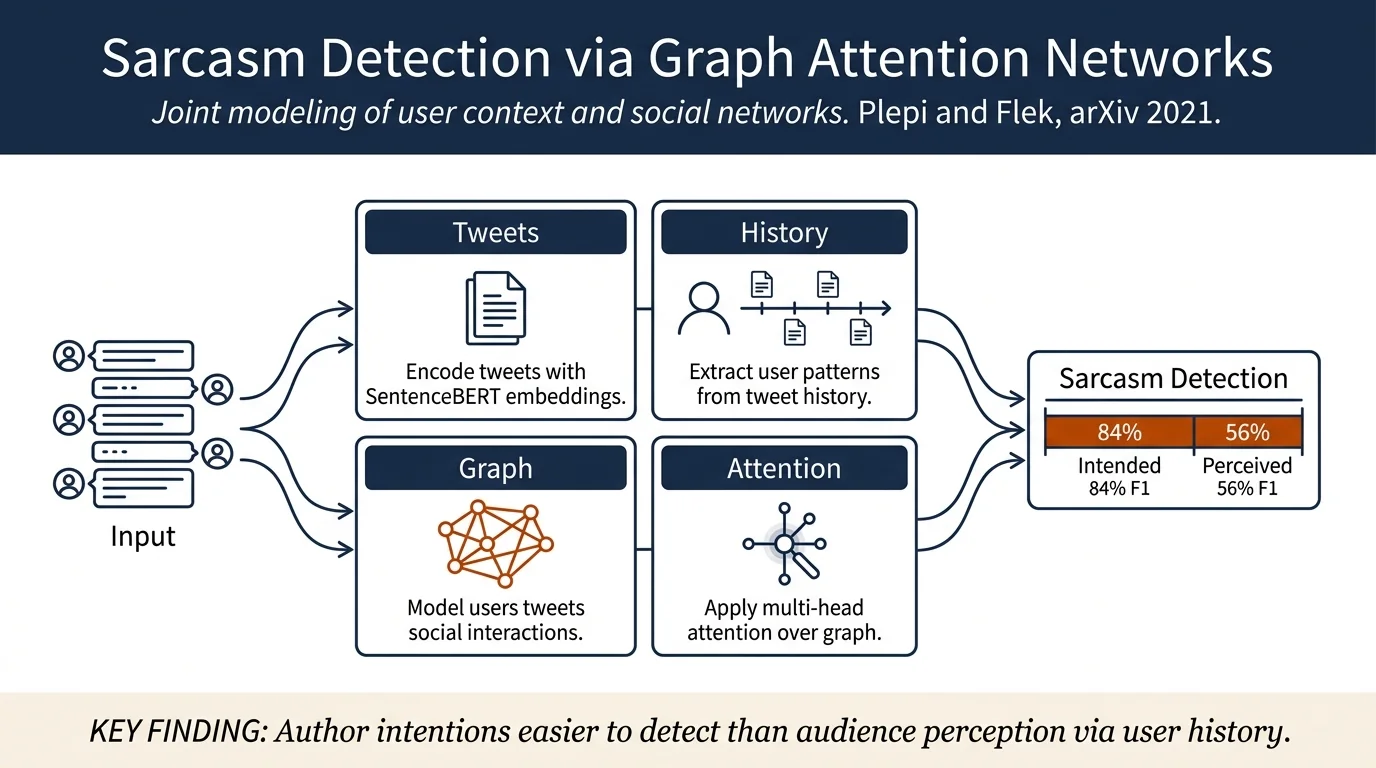
Perceived and Intended Sarcasm Detection with Graph Attention NetworksSarcasm detection requires understanding both the author's intent and the audience's perception. This work proposes a graph attention network (GAT) that jointly models user historical context and conversational social network information on Twitter, achieving state-of-the-art results on the SPIRS dataset and showing that detecting…
 Spread & networksPsychology & interventions
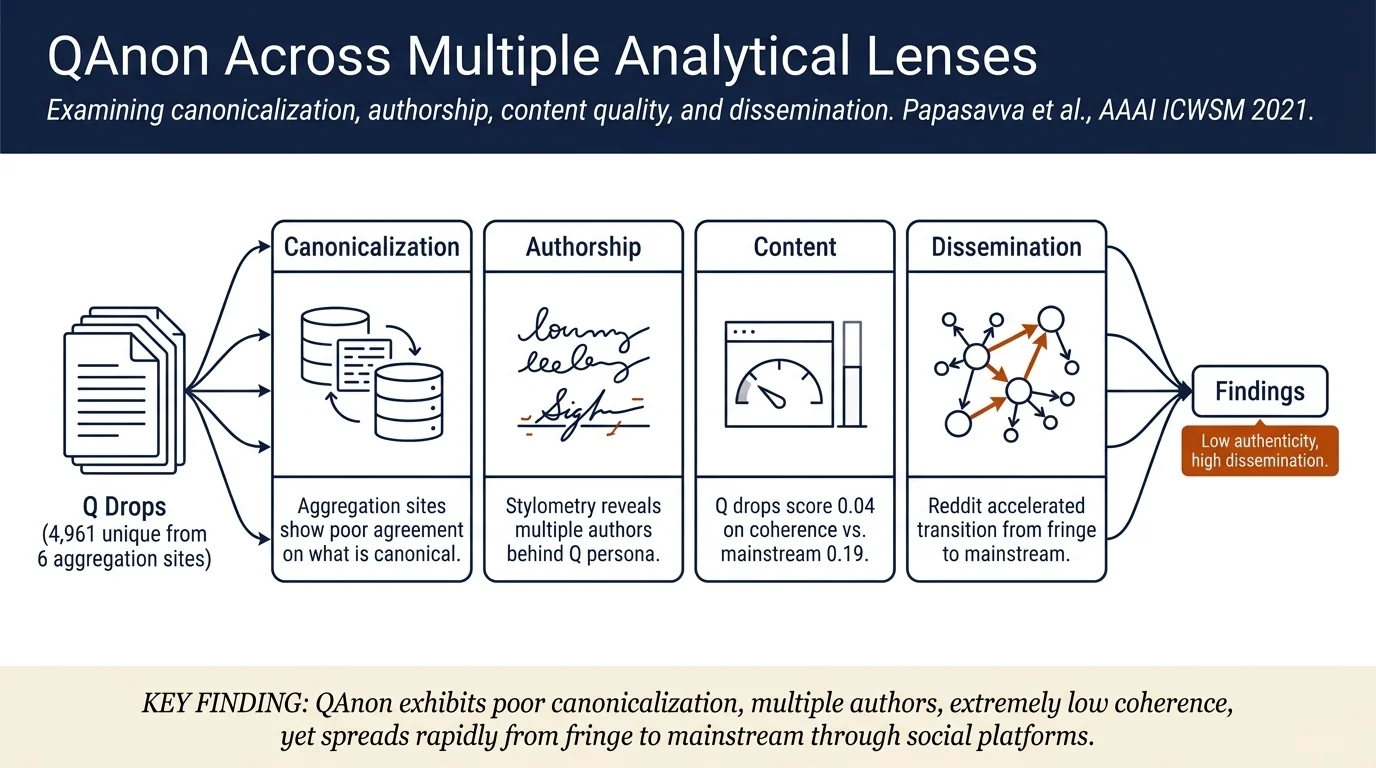
The Gospel According to Q: Understanding the QAnon Conspiracy from the Perspective of Canonical InformationThis paper systematically studies the QAnon conspiracy theory by collecting and analyzing 4,961 unique Q drops from six aggregation sites. The authors find that aggregation sites show poor agreement on what constitutes a canonical Q drop, that Q drops are incoherent and low-quality relative to other social media platforms, and that…
 Fact-checking & verificationDatasets & evaluation
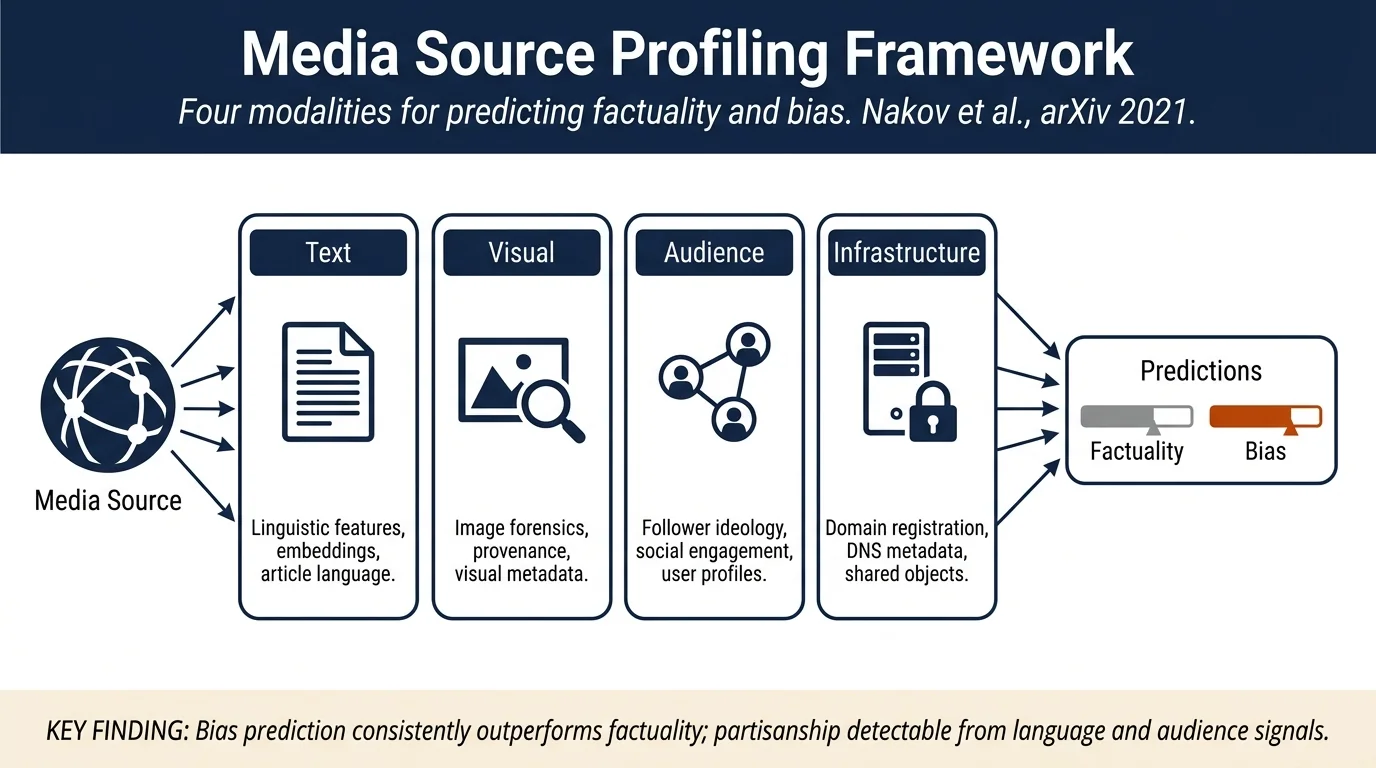
A Survey on Predicting the Factuality and the Bias of News MediaSurvey of media-level profiling methods for predicting news outlet factuality and political bias. Rather than checking individual claims or articles, the approach profiles entire news sources to enable early detection of unreliable content at publication time.
 LLMs & generative AIDatasets & evaluation
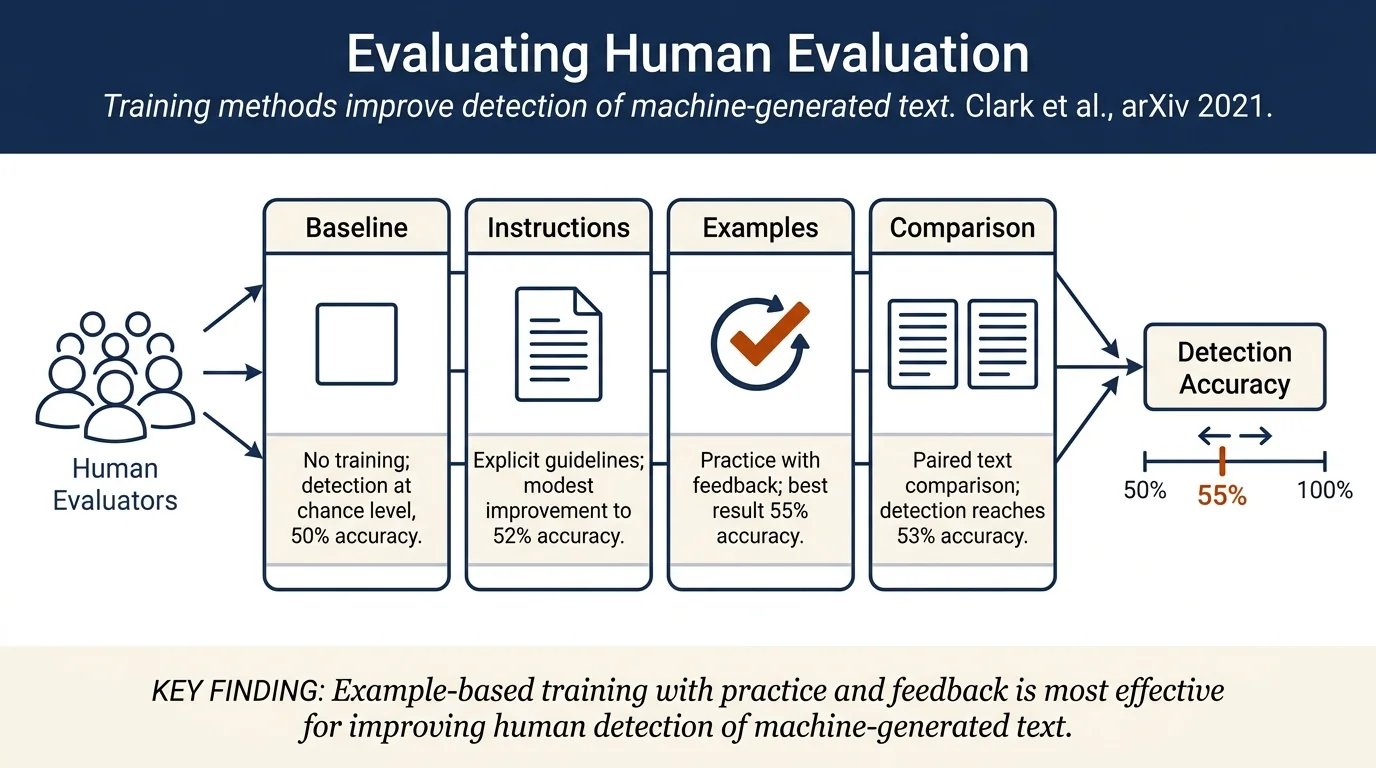
All That's 'Human' Is Not Gold: Evaluating Human Evaluation of Generated TextHuman evaluators cannot reliably distinguish machine-generated text from human-written text without training, focusing instead on superficial features like grammar and style. Three training approaches (instructions, examples, and comparisons) improve evaluator accuracy modestly, with example-based training showing the most improvement…
 Psychology & interventionsSpread & networks
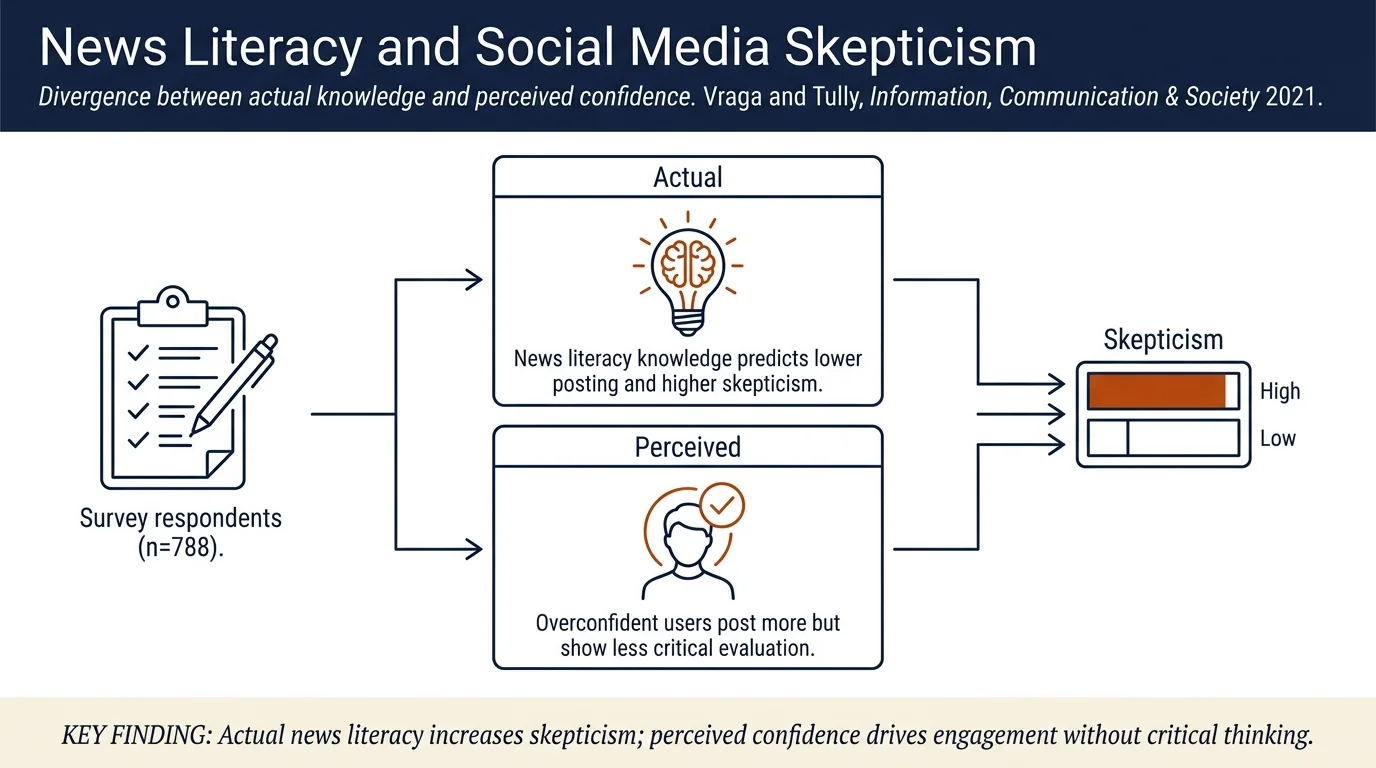
News literacy, social media behaviors, and skepticism toward information on social mediaA national survey of 788 Americans examines how news literacy relates to what people see and share on social media, and whether it predicts skepticism toward information shared in these spaces. The key finding: people with higher news literacy see and post less political content on social media, but when they do engage, they're…
 Spread & networksPsychology & interventions
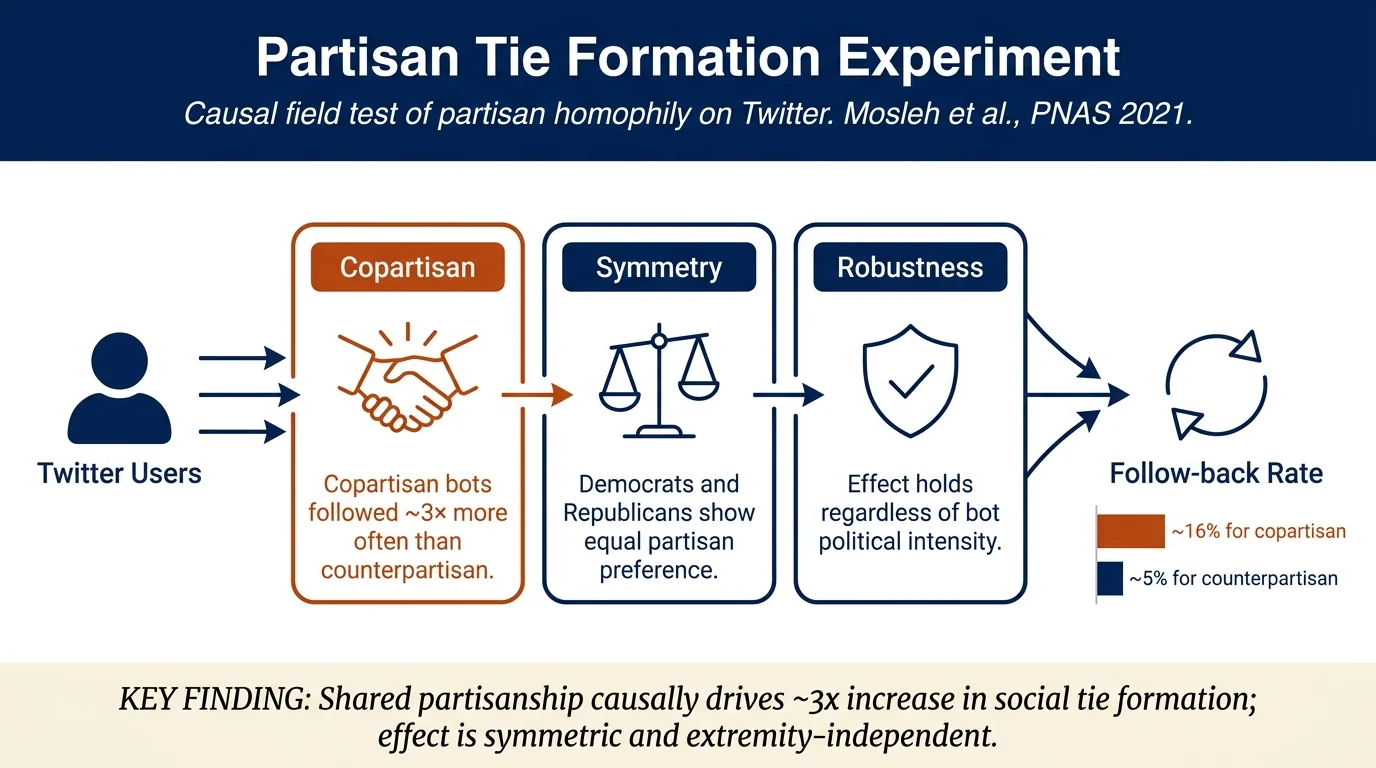
Shared partisanship dramatically increases social tie formation in a Twitter field experimentA Twitter field experiment with bot accounts reveals that shared partisanship causally drives social tie formation: users were nearly three times more likely to reciprocally follow accounts matching their political party, regardless of the account's partisan intensity. Critically, this preference was symmetric—Democrats and Republicans…
 Psychology & interventionsSpread & networks
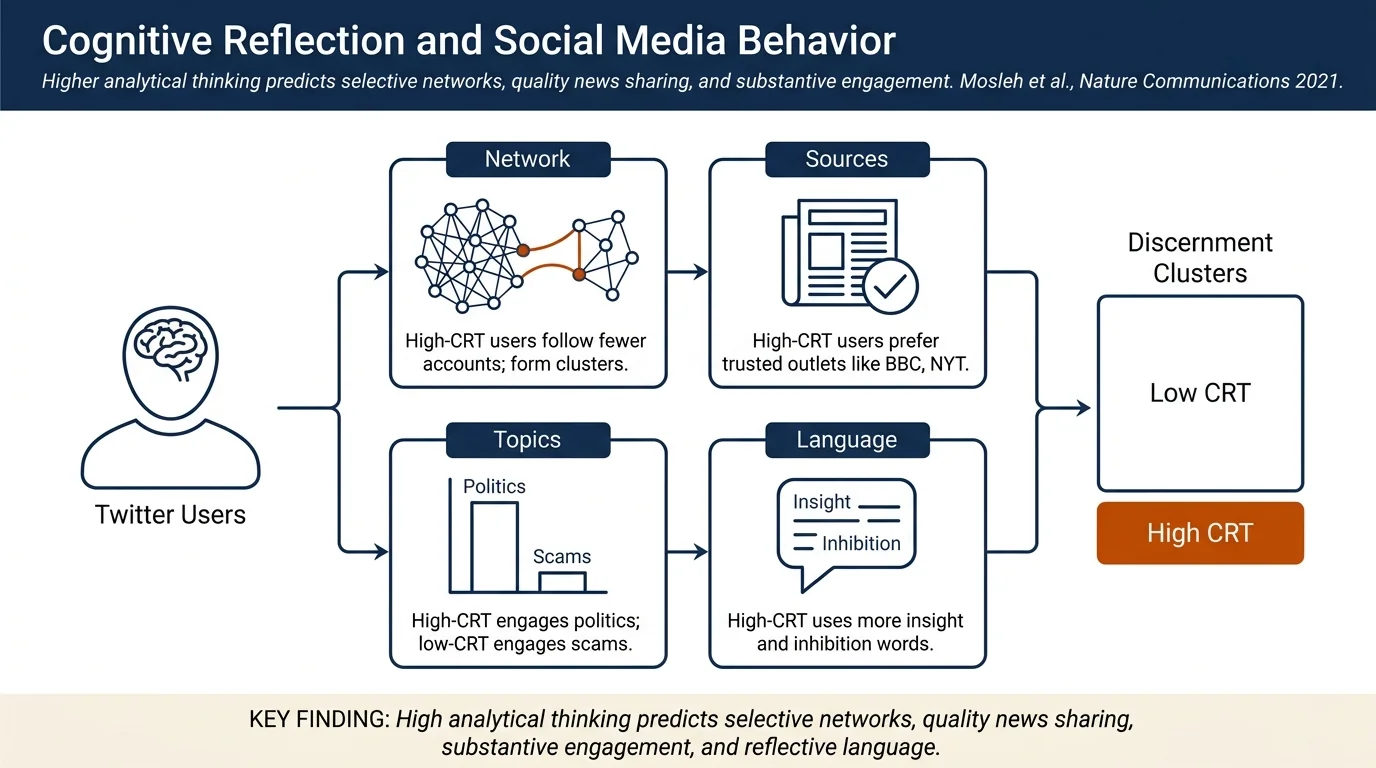
Cognitive reflection correlates with behavior on TwitterHigh scorers on the Cognitive Reflection Test (CRT)—a measure of analytical thinking—are more discerning social media users: they follow fewer accounts, share news from more reliable sources, and engage more with substantive topics like politics. The study identifies "cognitive echo chambers" where low-CRT users preferentially follow…
 Psychology & interventionsPlatforms, policy & society
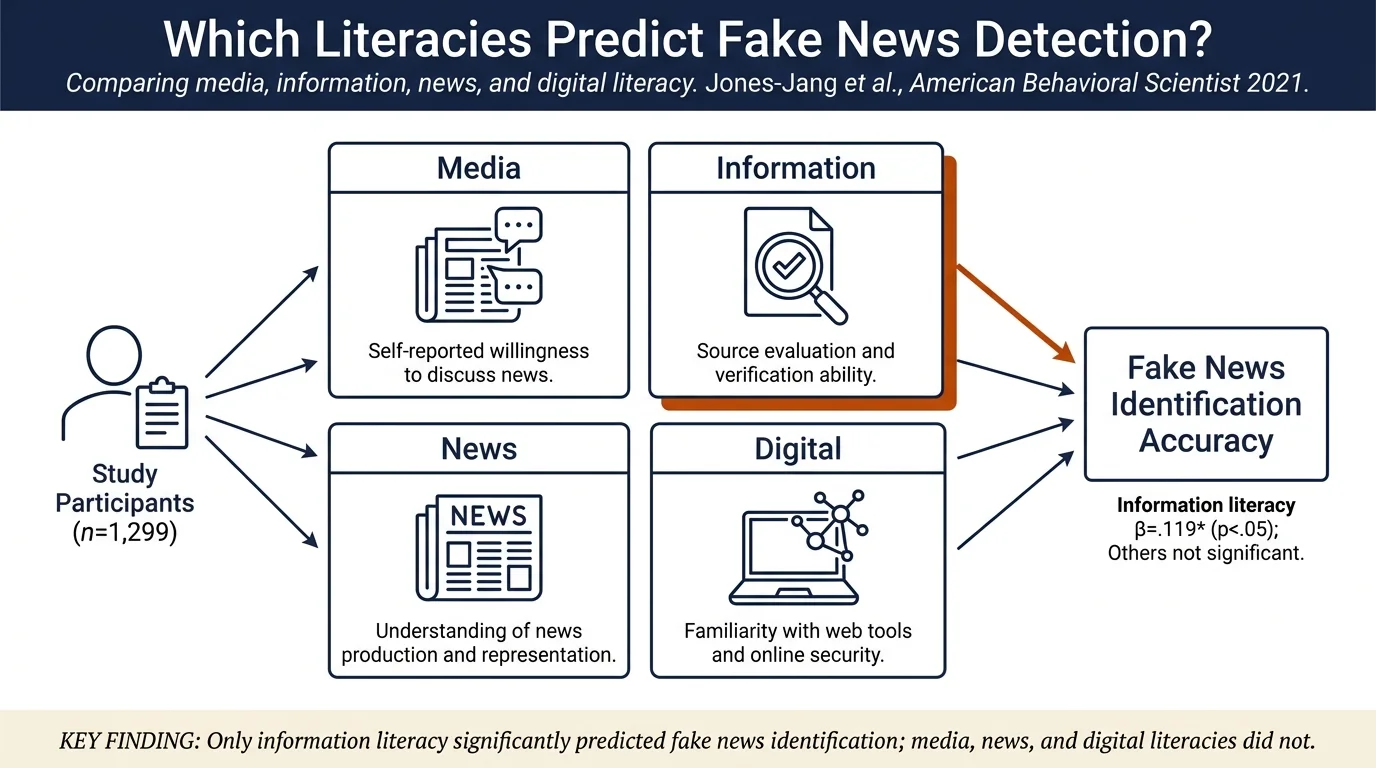
Does Media Literacy Help Identification of Fake News? Information Literacy Helps, but Other Literacies Don'tA survey of 1,299 U.S. citizens tests whether four types of media literacy—media, information, news, and digital—predict ability to identify fake news. Only information literacy (the ability to search and evaluate verified sources) significantly improves fake news identification; media, news, and digital literacies showed no significant…
 Spread & networksPlatforms, policy & society
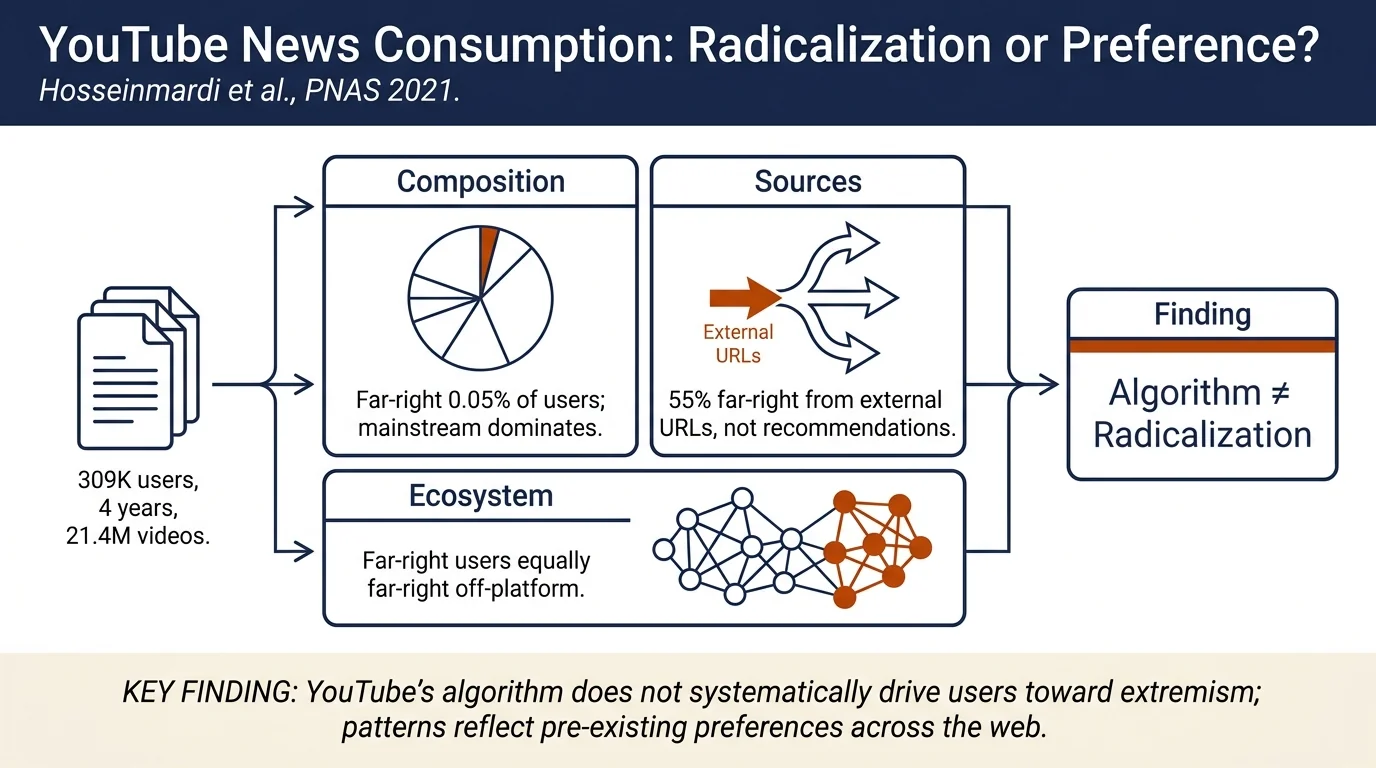
Examining the consumption of radical content on YouTubeLarge-scale study of 309,813 U.S. users' YouTube and web browsing from 2016–2019 finds that news consumption on YouTube is dominated by mainstream, centrist sources. While far-right content exists and engages users intensely, it remains a small and stable share.
 Spread & networksPlatforms, policy & society
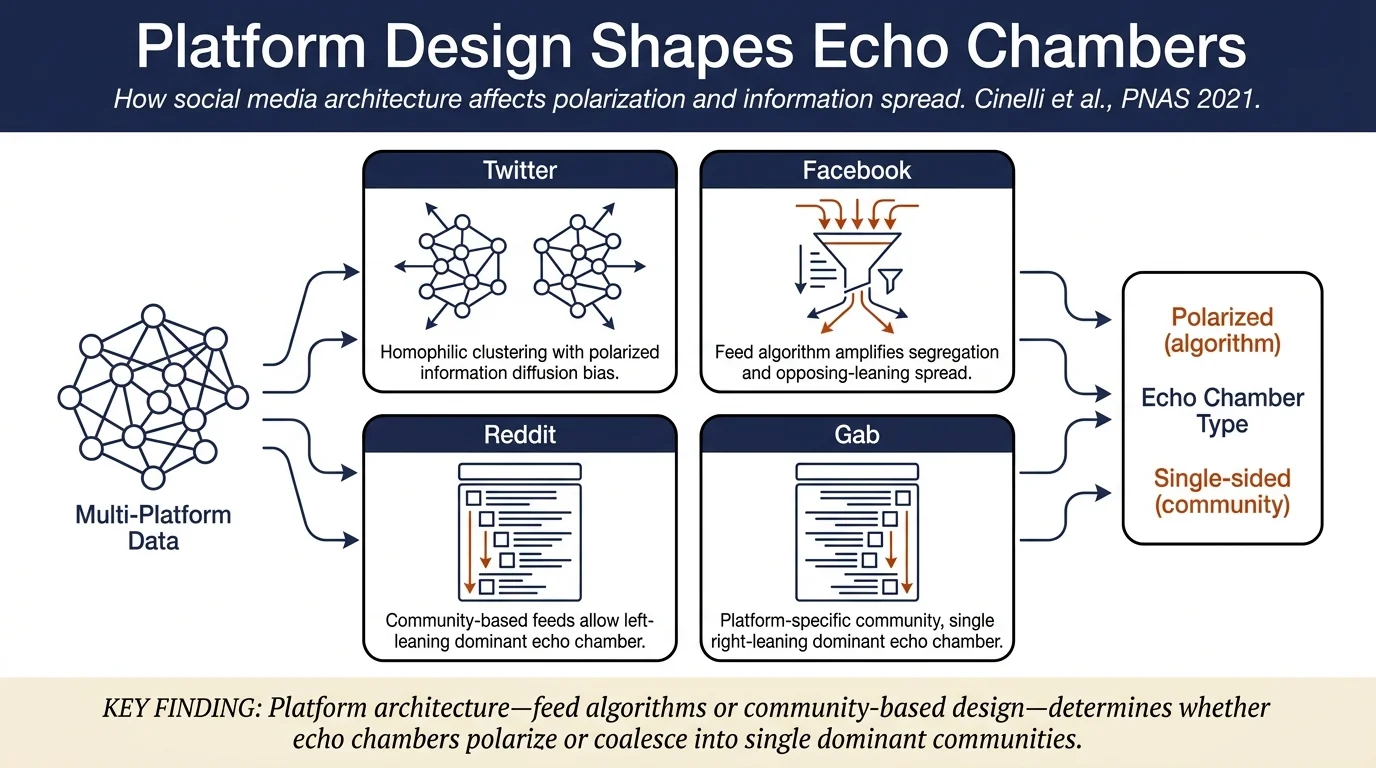
The echo chamber effect on social mediaComparative analysis of 100+ million posts across Twitter, Facebook, Reddit, and Gab on controversial topics shows echo chambers operate differently by platform: Facebook and Twitter exhibit strong homophilic clustering and polarized information diffusion, while Reddit and Gab show single-sided communities without the biased diffusion…
 Spread & networksPlatforms, policy & society
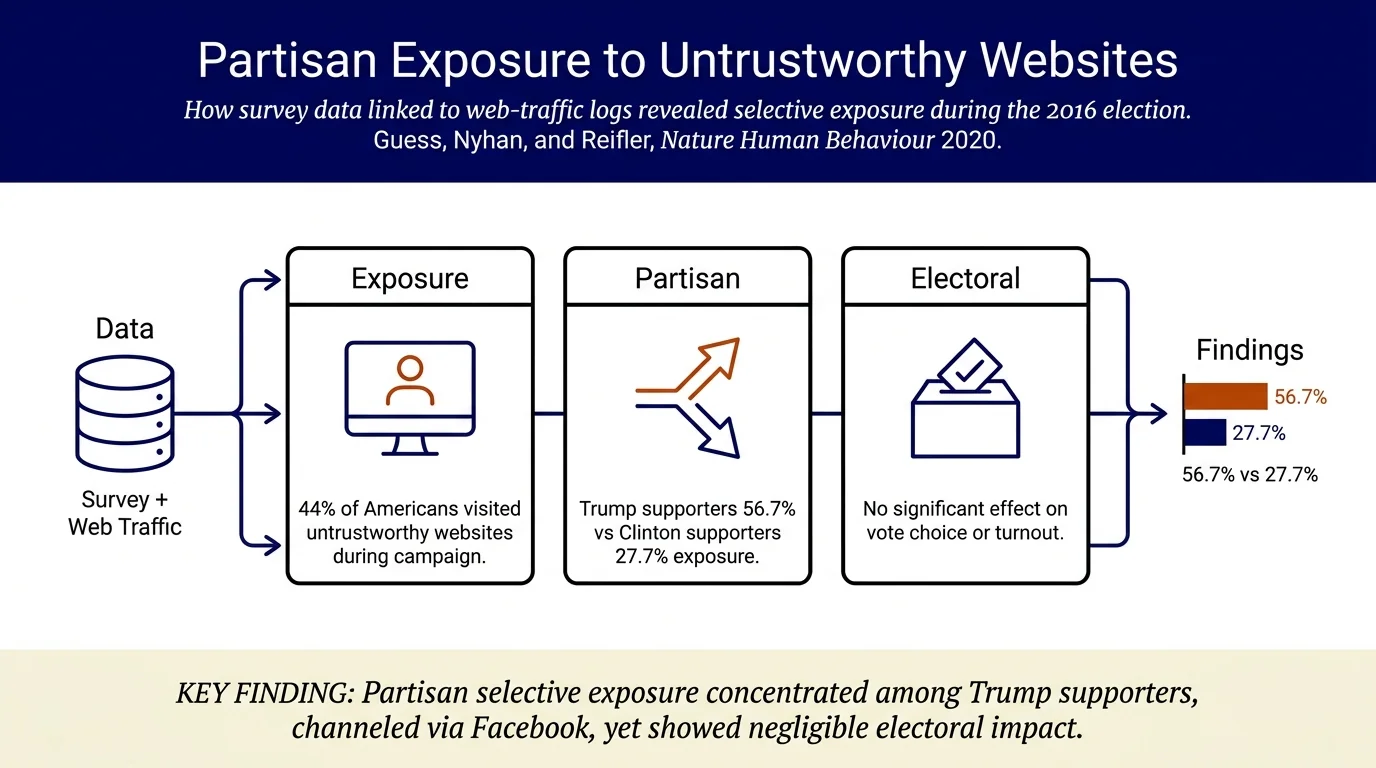
Exposure to untrustworthy websites in the 2016 US electionUsing combined survey and web-traffic data from the 2016 US presidential election, Guess et al. found that while 44.3% of Americans aged 18+ visited an untrustworthy website during the campaign, actual exposure was highly concentrated among Trump supporters (56.7% of Trump supporters vs. 27.7% of Clinton supporters). Facebook played a…
 Psychology & interventionsPlatforms, policy & society
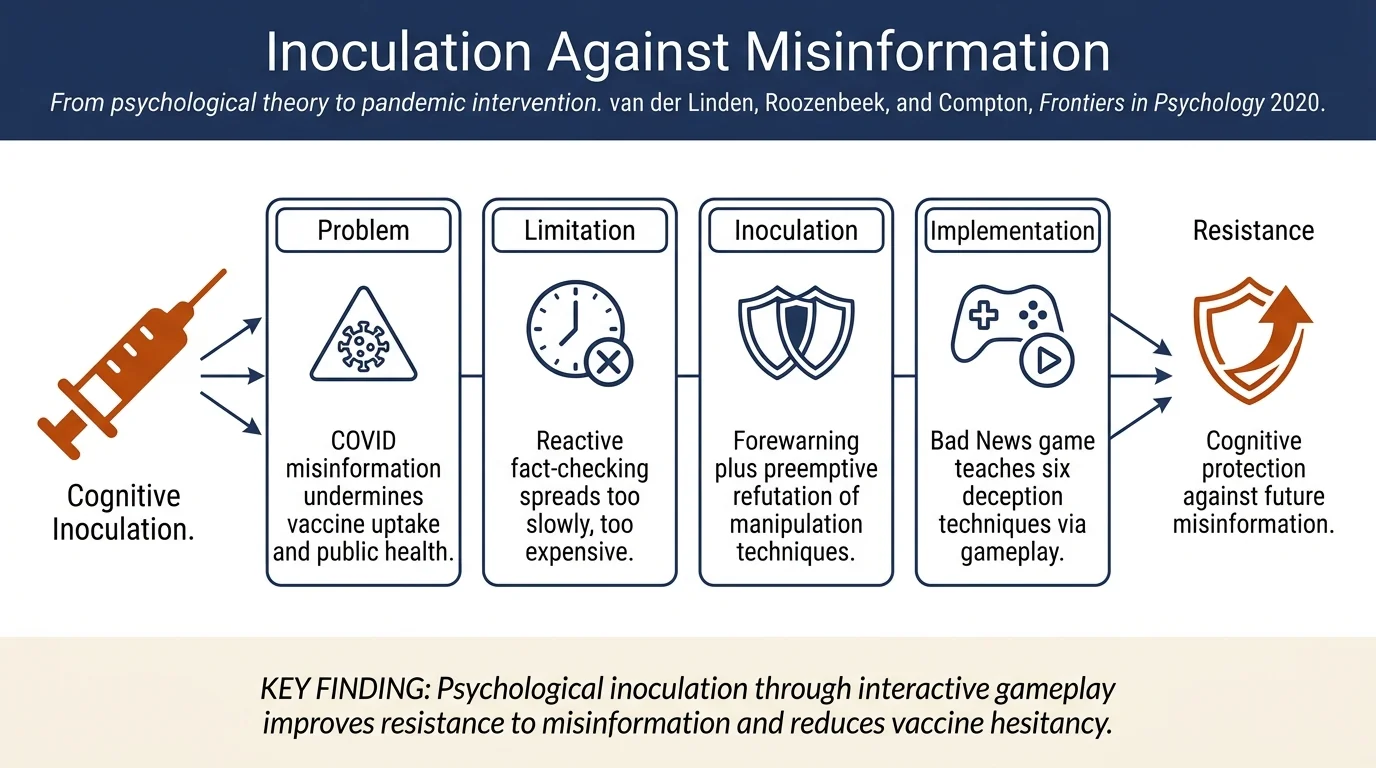
Inoculating Against Fake News About COVID-19COVID-19 misinformation has proliferated rapidly on social media, undermining public health responses and vaccination uptake. Rather than relying on post-hoc fact-checking (which spreads slower than misinformation), the authors propose psychological inoculation—exposing people to weakened doses of misinformation techniques beforehand to…
 Deepfakes & multimodalFact-checking & verification
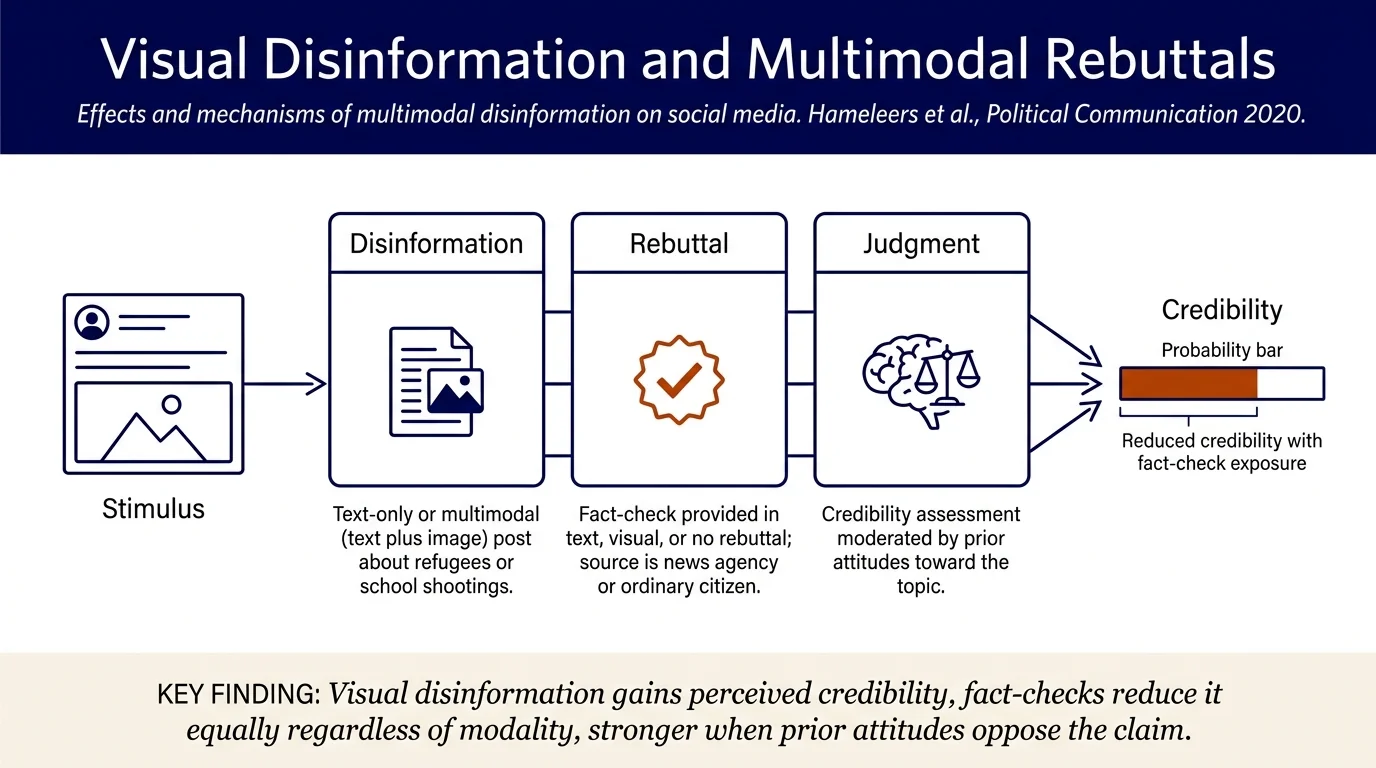
A Picture Paints a Thousand Lies? The Effects and Mechanisms of Multimodal Disinformation and Rebuttals Disseminated via Social MediaMultimodal disinformation (paired text and images) is perceived as more credible than text-only misinformation, but fact-checkers can overcome this effect. Importantly, the modality of fact-checks (visual or textual) matters less than their presence; fact-checks are more persuasive for people whose prior attitudes already oppose the…
 Fact-checking & verificationPsychology & interventions
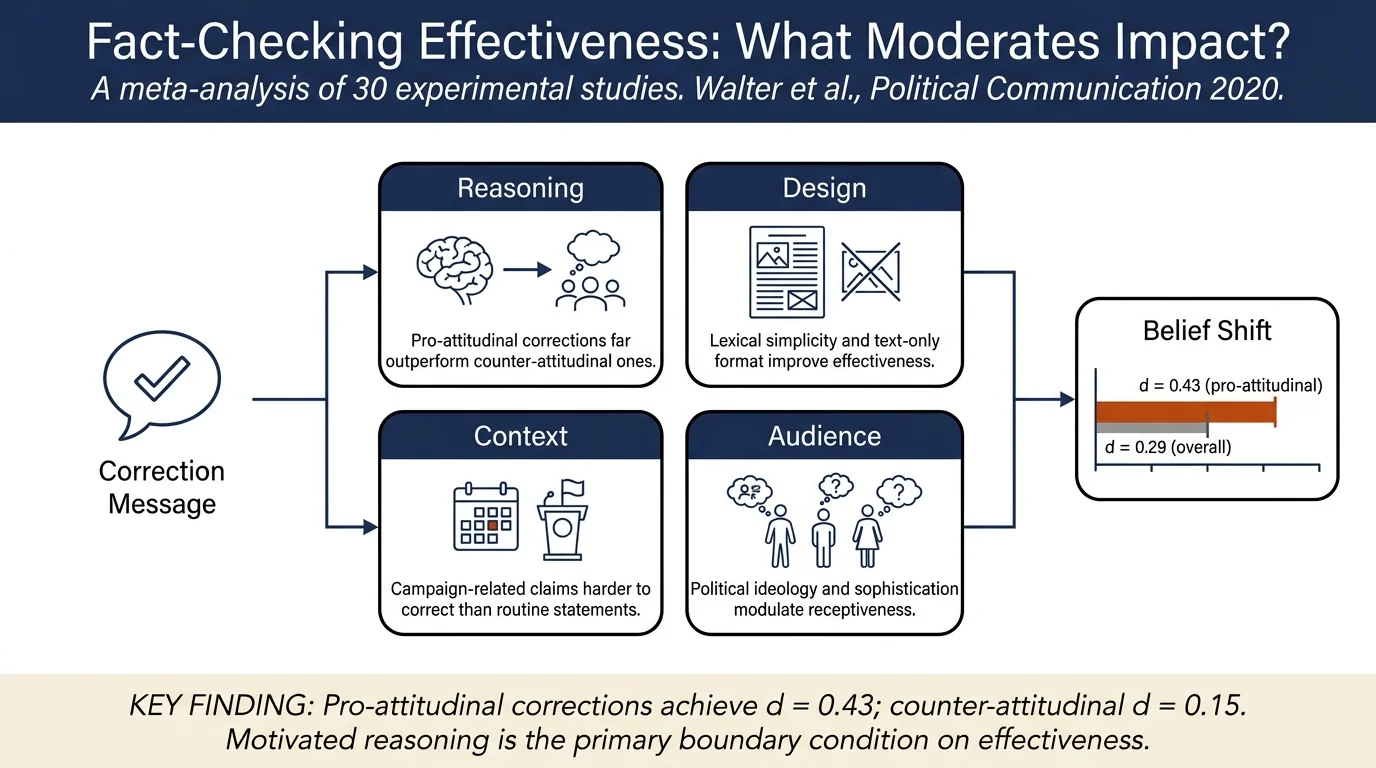
Fact-Checking: A Meta-Analysis of What Works and for WhomMeta-analysis of 30 studies on fact-checking effectiveness finds modest but significant positive effects (d = 0.29) on belief correction. However, effects are substantially moderated by motivated reasoning, political ideology, message design, and context: pro-attitudinal fact-checking works better than counter-attitudinal corrections,…
 Deepfakes & multimodalPlatforms, policy & society
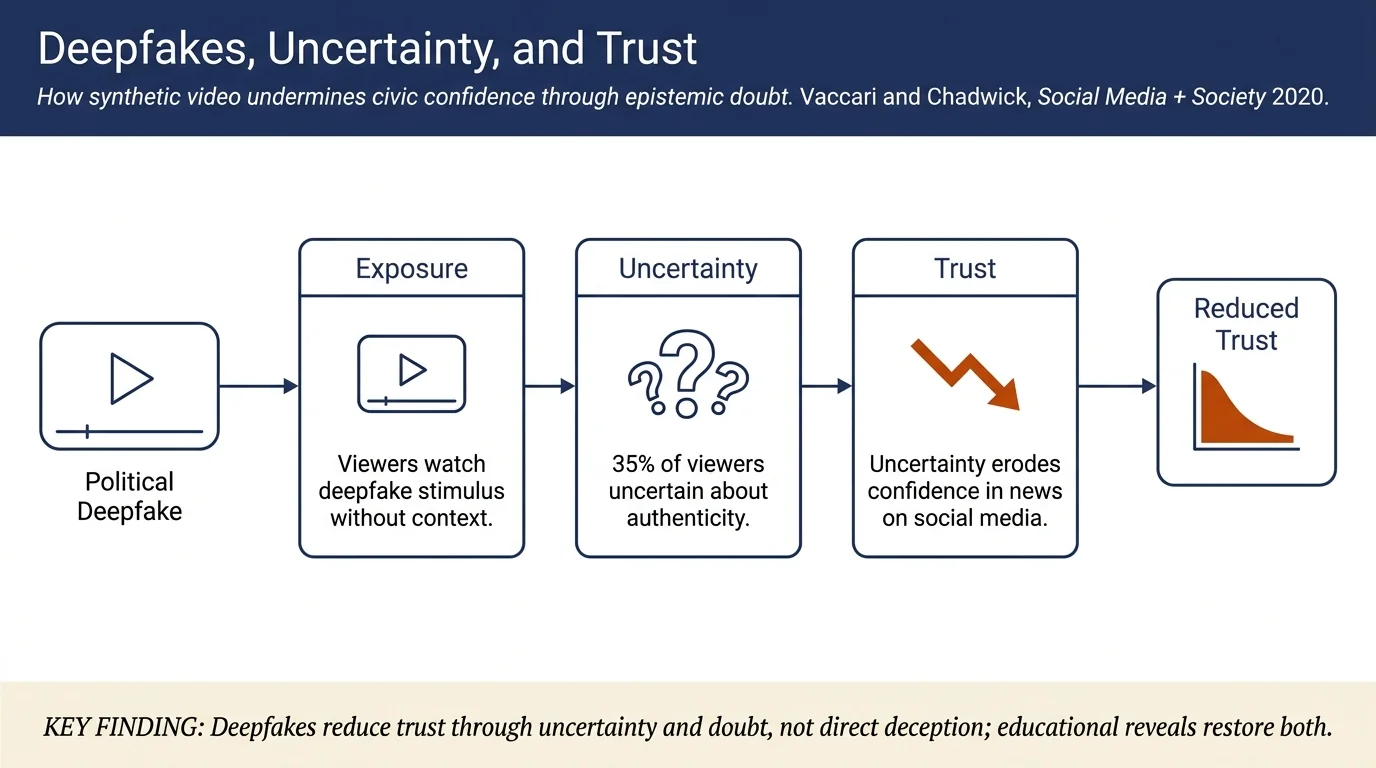
Deepfakes and Disinformation: Exploring the Impact of Synthetic Political Video on Deception, Uncertainty, and Trust in NewsExperimental study (N=2,005 UK respondents) testing how political deepfakes affect deception and trust in news. Deepfakes increased uncertainty about content, and that uncertainty mediated reduced trust in news on social media.
 Spread & networksPlatforms, policy & society
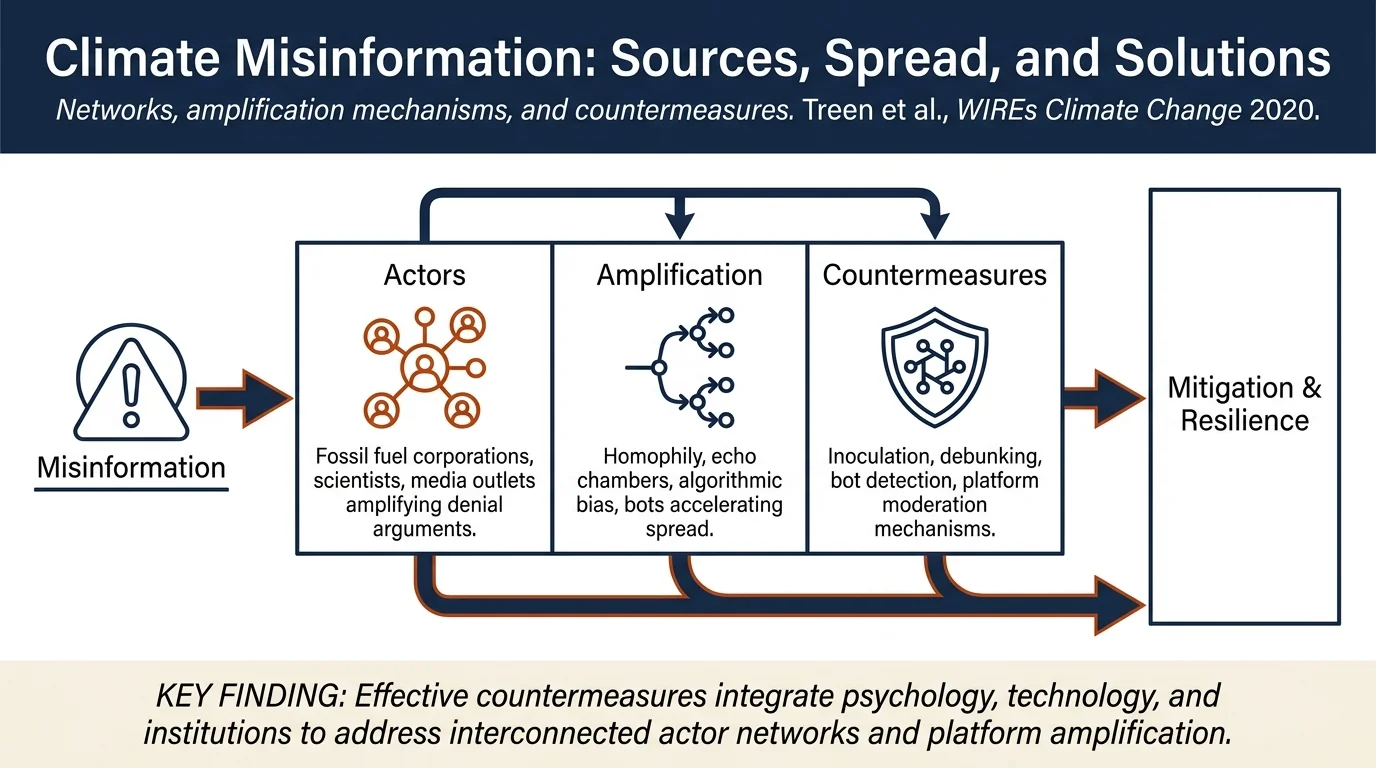
Online misinformation about climate changeComprehensive literature review examining climate change misinformation from multiple disciplinary angles. Defines misinformation vs. disinformation, identifies networks of actors (scientists, governments, industry, media) spreading false claims, examines how social media characteristics (homophily, echo chambers, algorithmic bias)…
 Psychology & interventionsPlatforms, policy & society
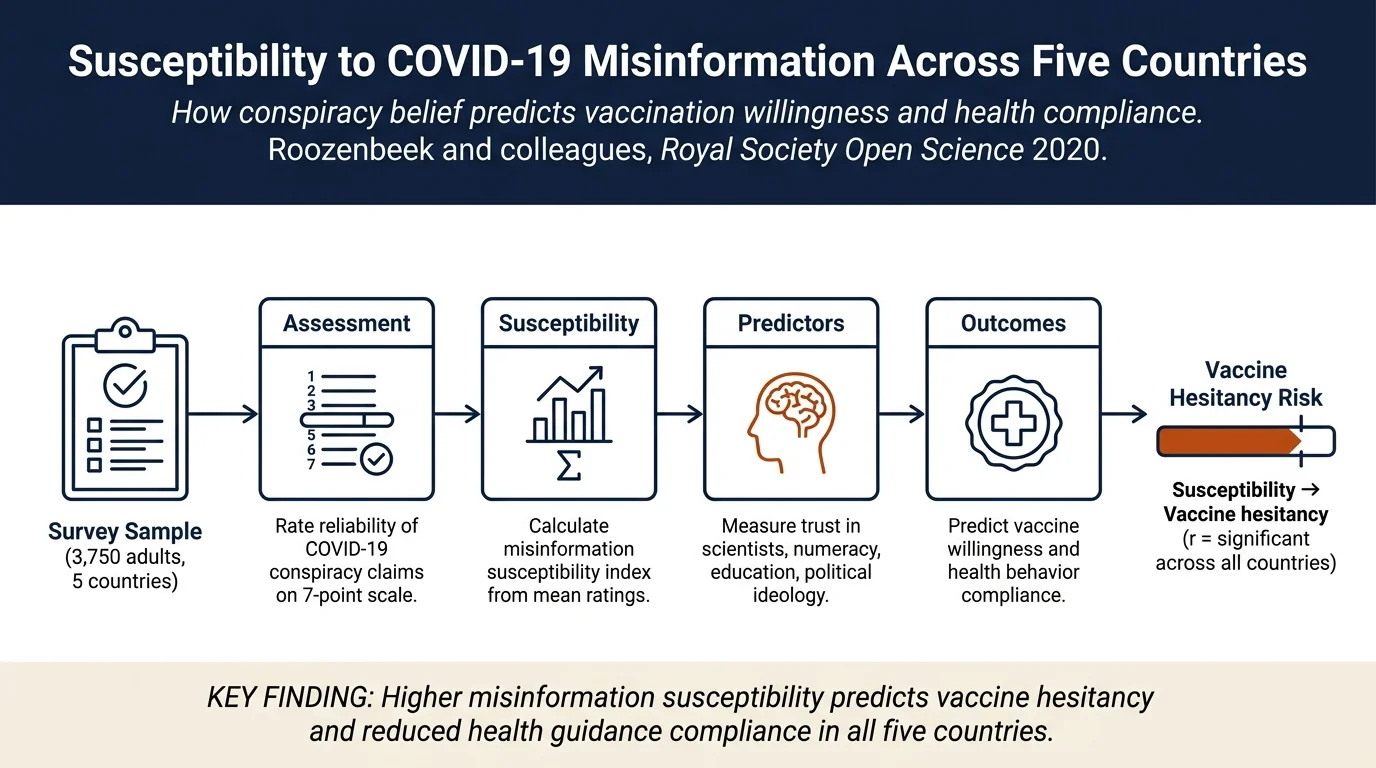
Susceptibility to misinformation about COVID-19 around the worldAn international survey of 3,750 adults across five countries (UK, Ireland, USA, Spain, Mexico) measured susceptibility to COVID-19 misinformation and examined how it predicts public health behaviors. While majorities in each country did not find COVID-19 misinformation credible, higher susceptibility to misinformation was strongly…
 Psychology & interventionsPlatforms, policy & society
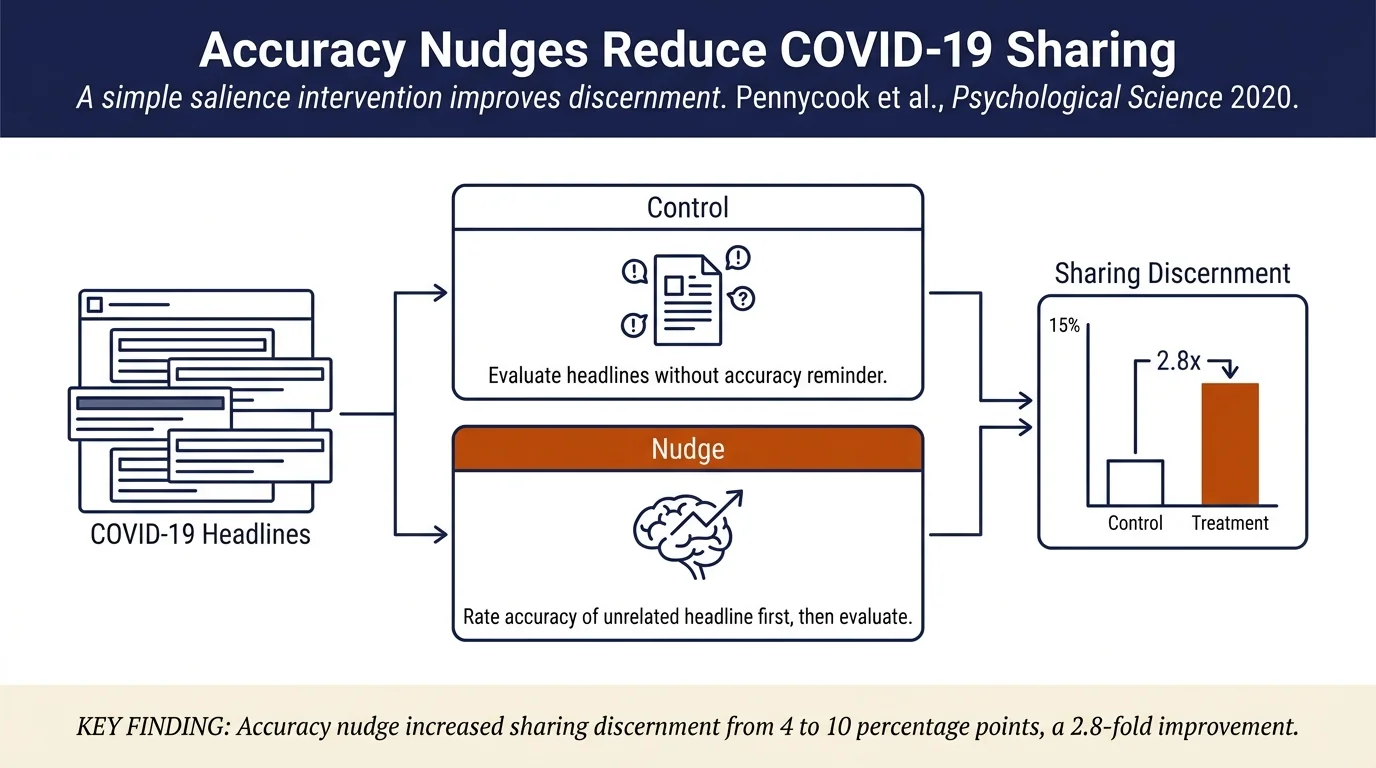
Fighting COVID-19 Misinformation on Social Media: Experimental Evidence for a Scalable Accuracy-Nudge InterventionTwo pre-registered experiments with 1,700+ U.S. adults show that a simple accuracy nudge — asking people to rate the accuracy of an unrelated headline before the main task — nearly tripled their ability to discriminate true from false COVID-19 headlines when deciding what to share on social media. The intervention is scalable, requires…
 Fact-checking & verificationPlatforms, policy & society
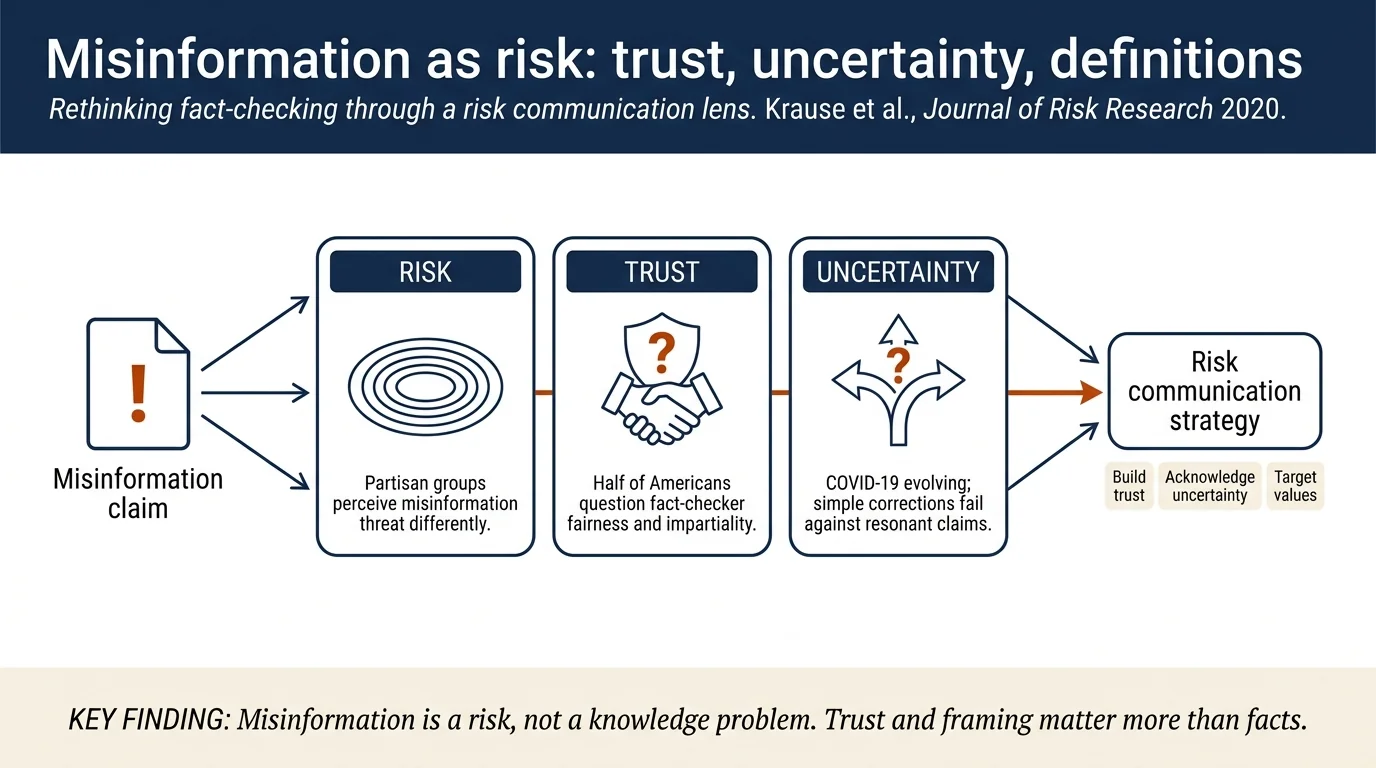
Fact-checking as risk communication: the multi-layered risk of misinformation in times of COVID-19COVID-19 misinformation should be viewed as a risk in its own right, not just a communication failure. Fact-checking efforts face three key challenges: defining misinformation differently across political subgroups, earning trust in an environment of low press credibility, and communicating amid genuine uncertainty.
 Psychology & interventionsPlatforms, policy & society
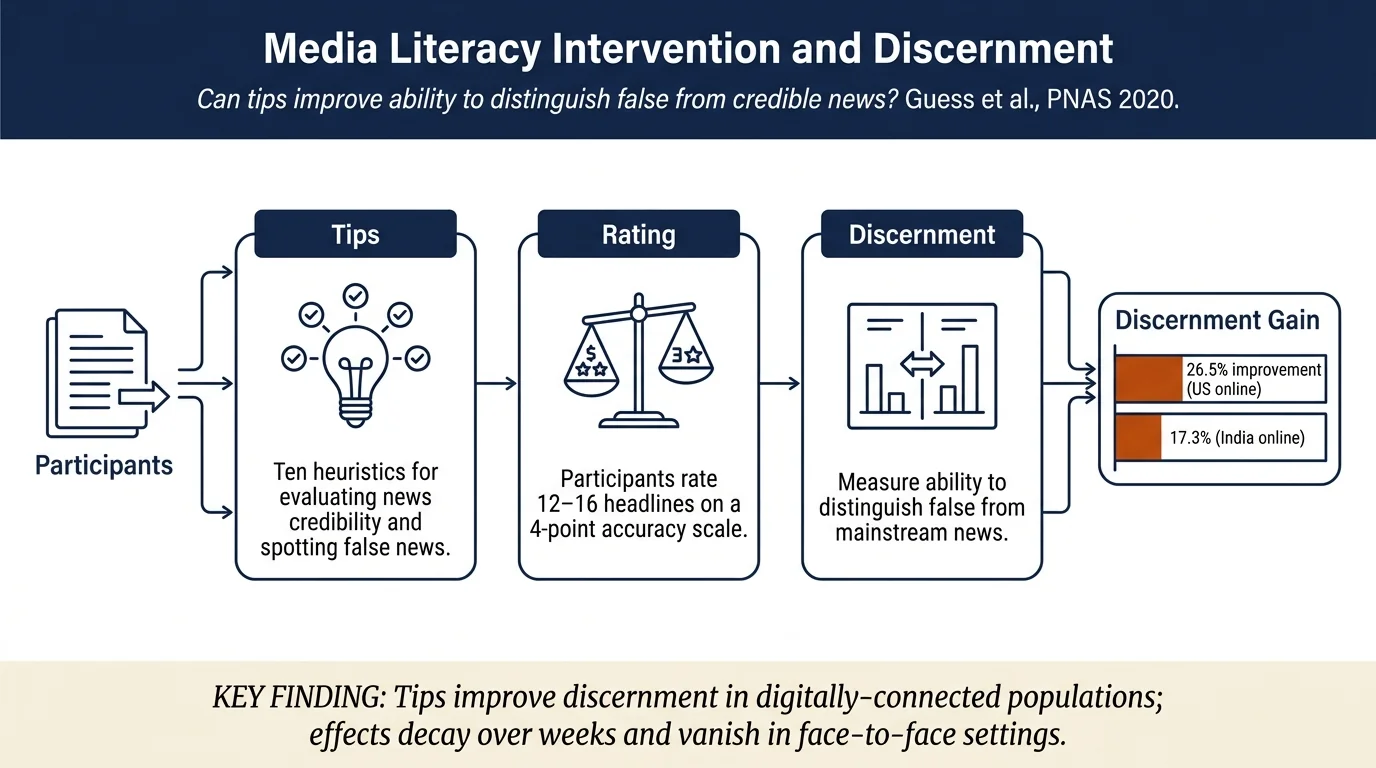
A digital media literacy intervention increases discernment between mainstream and false news in the United States and IndiaA randomized experiment tests Facebook's "Tips to Spot False News" intervention in the US and India, finding it increases discernment between mainstream and false news (26.5% in US, 17.3% in India online). The intervention reduces belief in false headlines more than it reduces belief in mainstream ones.
 Psychology & interventionsSpread & networks
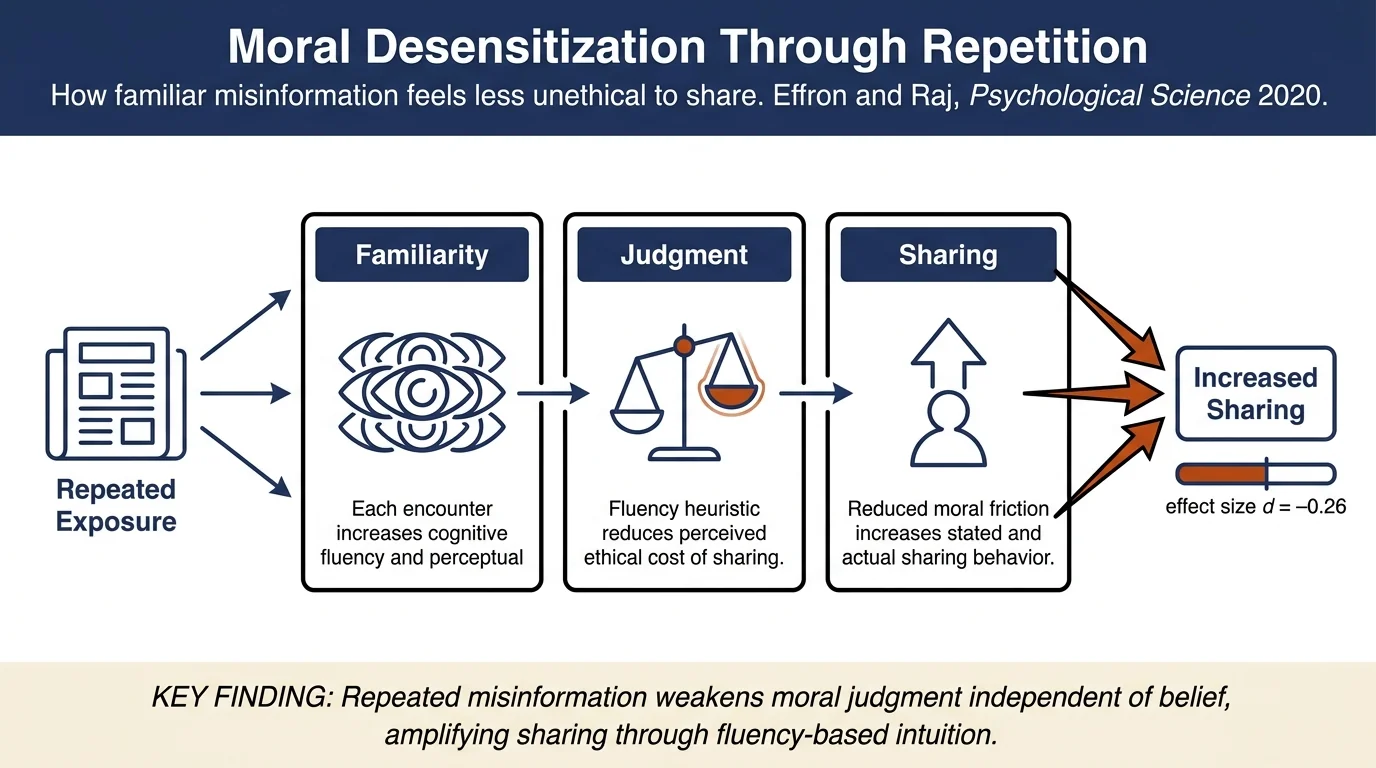
Misinformation and Morality: Encountering Fake-News Headlines Makes Them Seem Less Unethical to Publish and ShareFour preregistered experiments (N=2,587) show that repeatedly encountering fake-news headlines reduces moral condemnation of spreading them—regardless of whether people believe them. This "moral repetition effect" operates via fluency: familiar headlines feel less unethical to share, stronger inclinations to promote them online, and…
 Bots & coordinated campaignsPlatforms, policy & society
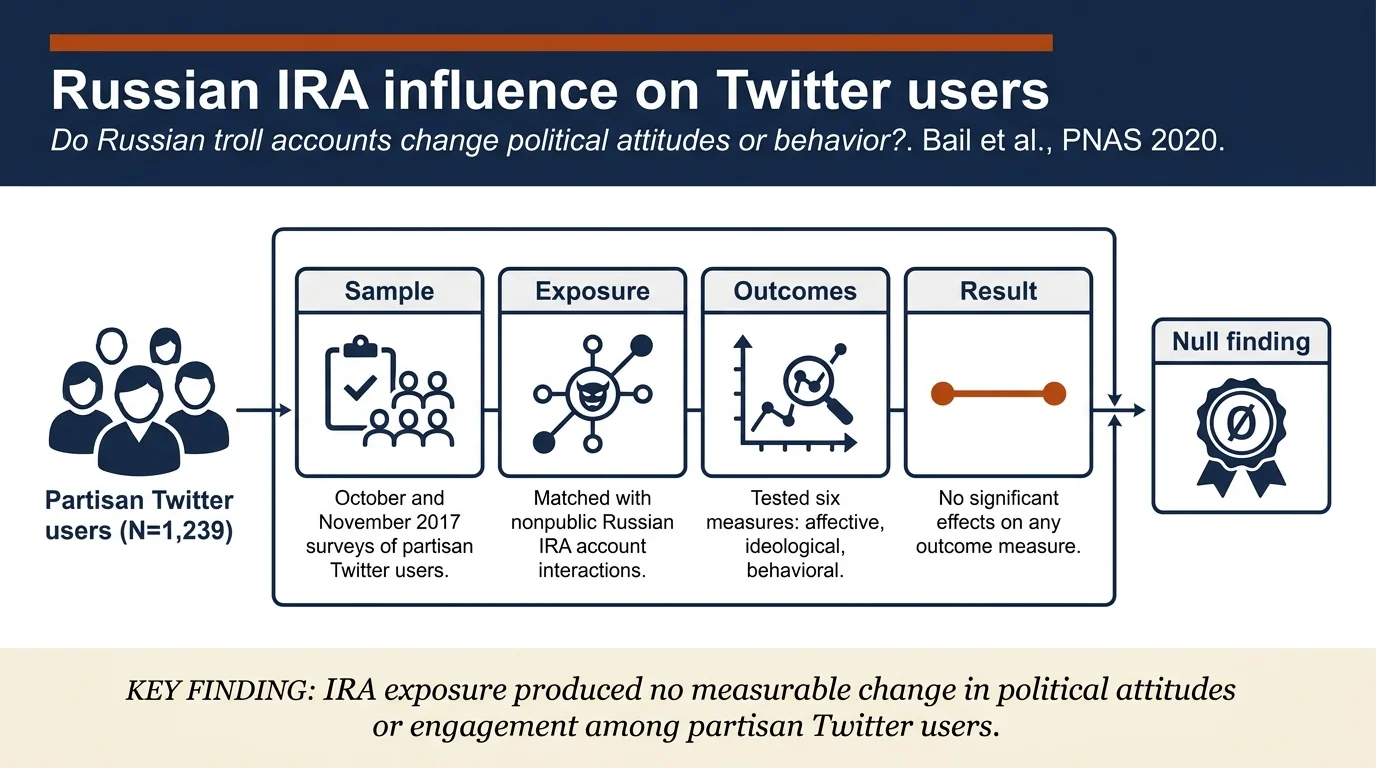
Assessing the Russian Internet Research Agency's impact on the political attitudes and behaviors of American Twitter users in late 2017Combining longitudinal survey data from 1,239 partisan Twitter users with nonpublic IRA account data, Bail et al. find no evidence that interaction with Russian Internet Research Agency accounts substantially impacted six measures of political attitudes (affective/ideological polarization) or behaviors (political engagement, network…
 Spread & networksPlatforms, policy & society
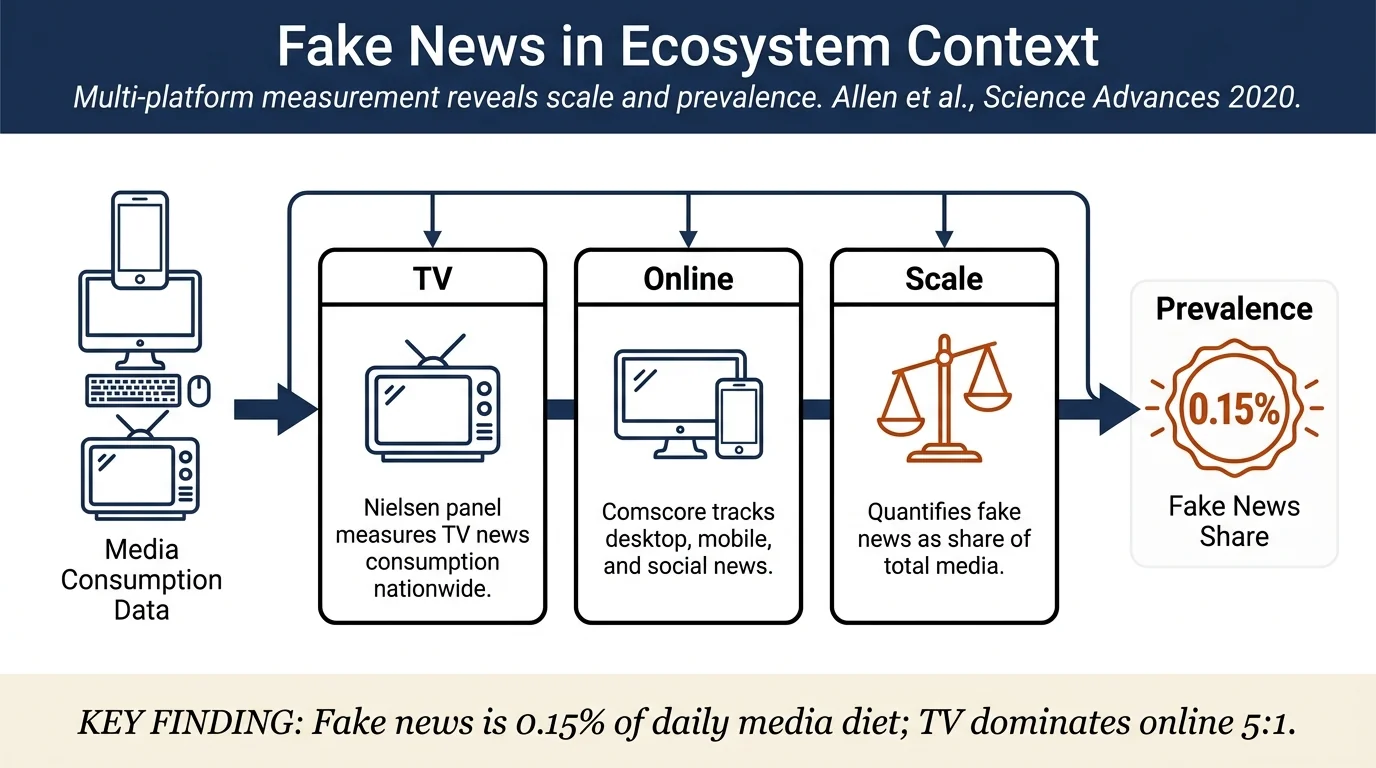
Evaluating the fake news problem at the scale of the information ecosystemUsing nationally representative data on mobile, desktop, and TV consumption spanning 2016–2018, the authors show that fake news comprises only 0.15% of Americans' daily media diet, while TV dominates news consumption by a 5:1 ratio over online. The paper challenges the widespread narrative of fake news as a pervasive crisis and suggests…