Explore papers
Filter by research area, year and venue. Every filter is in the address bar, so you can share a view as a link.
 Fact-checking & verificationDatasets & evaluation
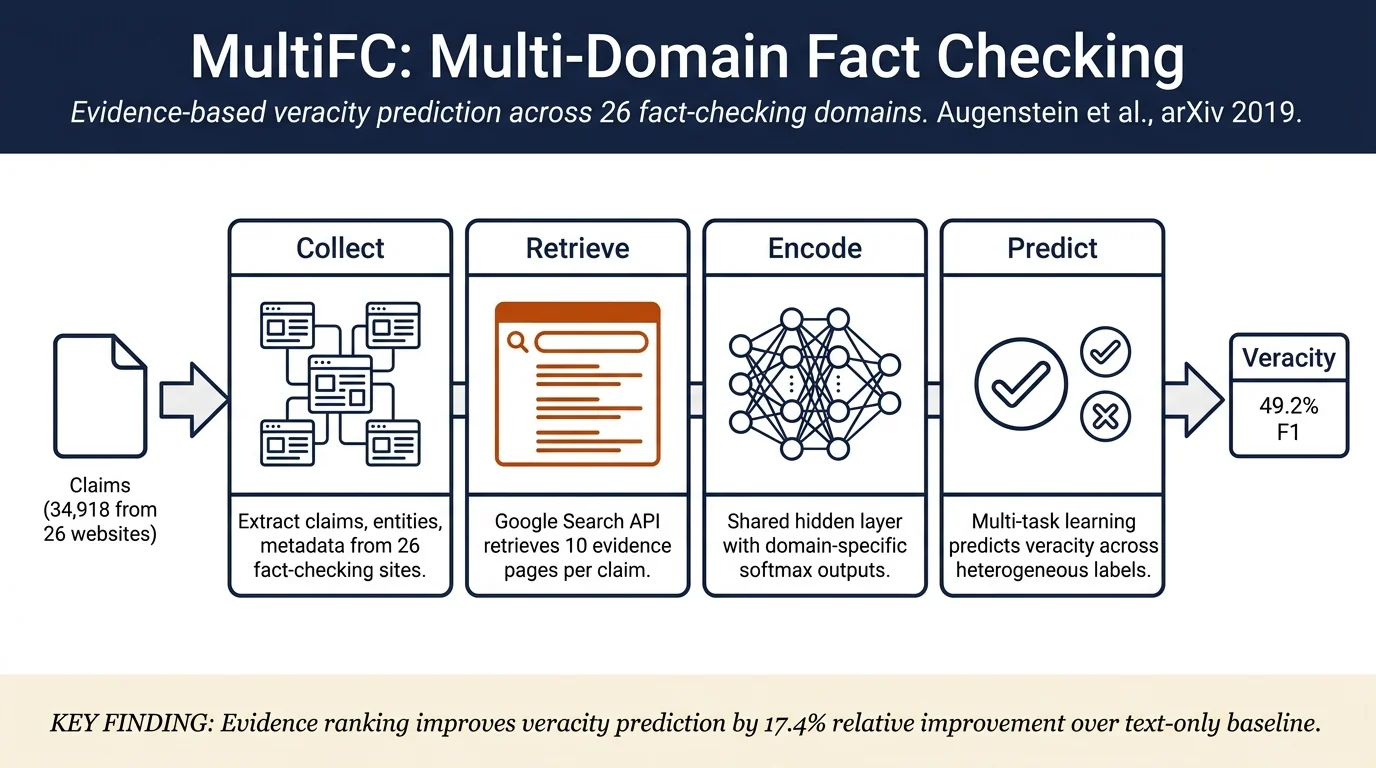
MultiFC: A Real-World Multi-Domain Dataset for Evidence-Based Fact Checking of ClaimsMultiFC is the largest publicly available real-world dataset of naturally occurring factual claims (34,918 claims) collected from 26 fact-checking websites, with rich metadata, evidence pages retrieved via Google Search, and entity linking to Wikipedia. The paper demonstrates that evidence ranking combined with veracity prediction…
 Bots & coordinated campaignsDatasets & evaluation
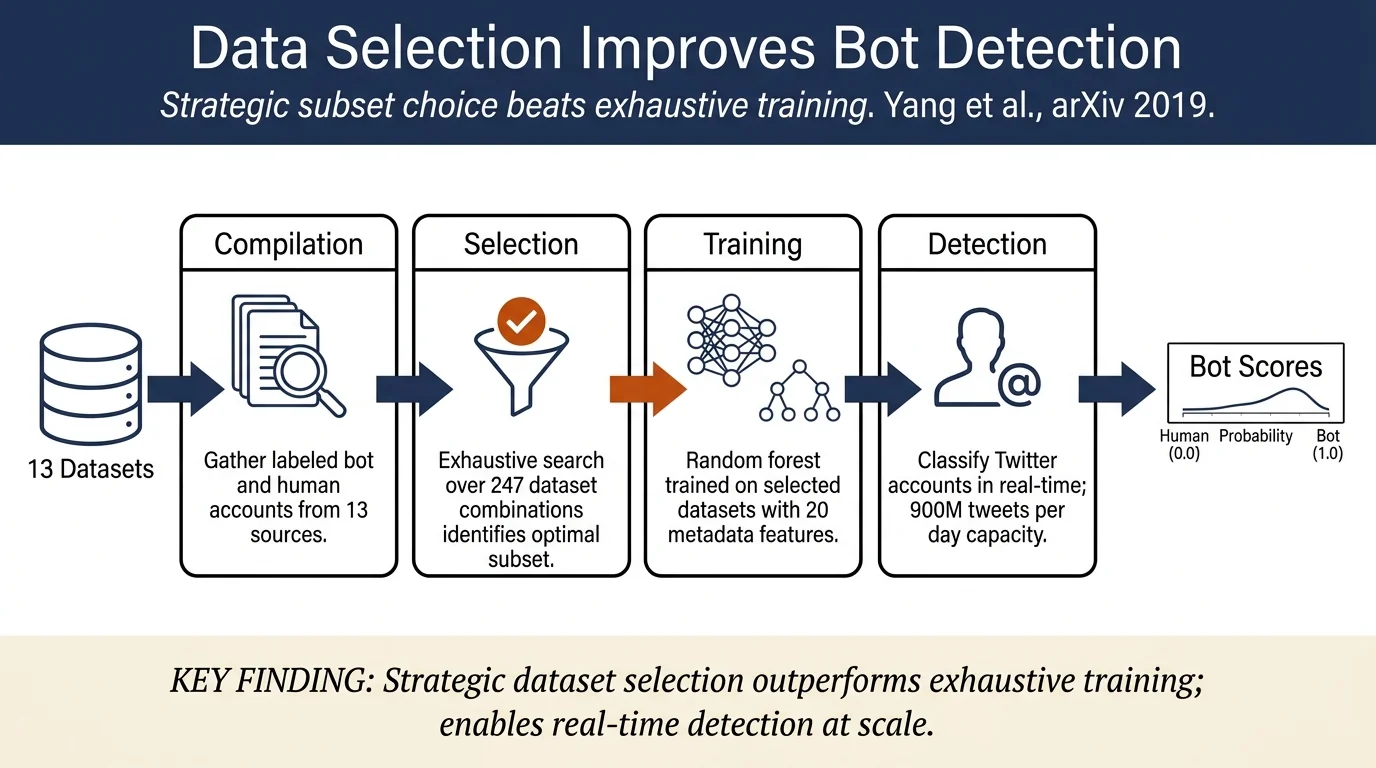
Scalable and Generalizable Social Bot Detection through Data SelectionThis paper addresses scalability and generalization challenges in social bot detection by proposing a framework using only 20 user metadata features, enabling real-time analysis of the full Twitter stream. The key insight is that strategic data selection—training on a carefully chosen subset of 13 compiled datasets—achieves better…
 Bots & coordinated campaignsDatasets & evaluation
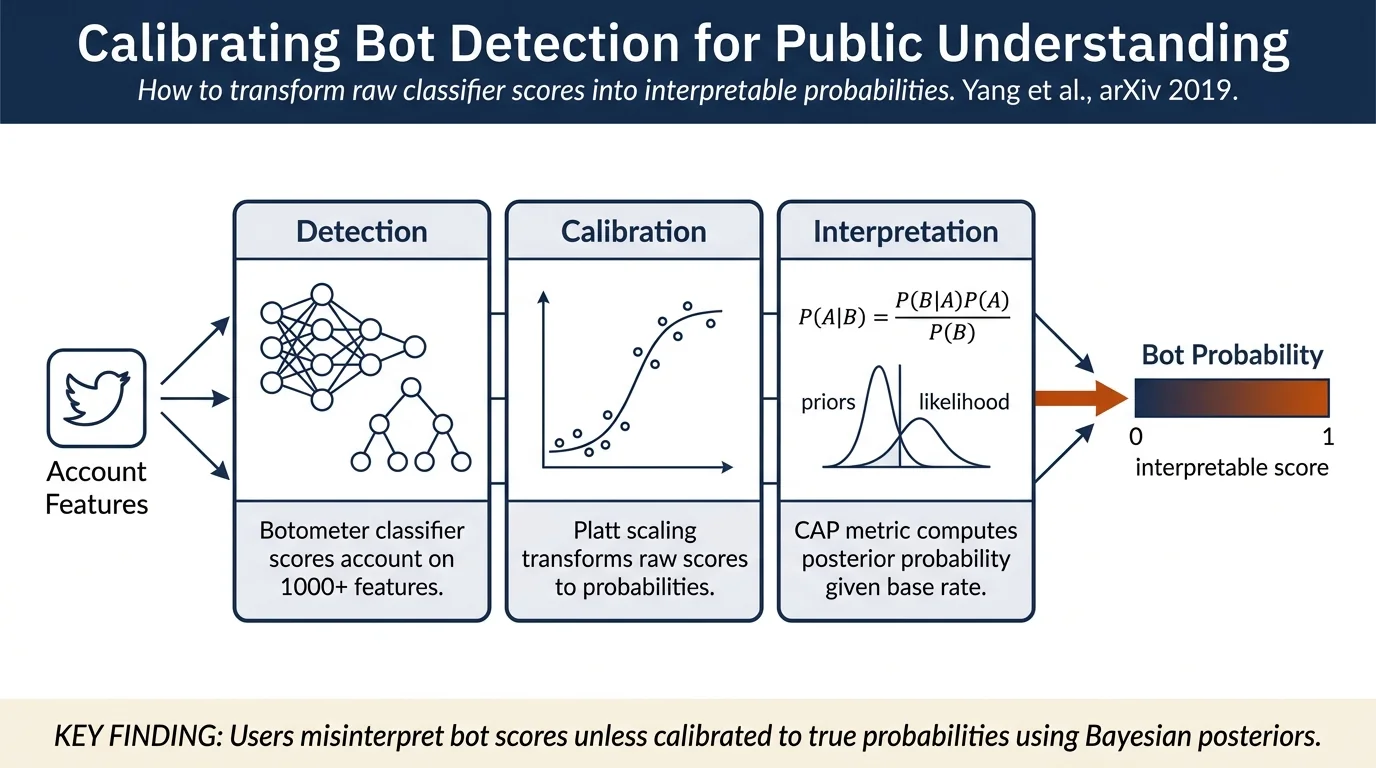
Arming the public with artificial intelligence to counter social botsThis paper reviews social bot types, their impact on online discourse, and detection methods, then presents Botometer as a case study in how detection tools are used and interpreted by the public. The authors conducted a user experience survey (731 participants) revealing that while users find the tool useful, they struggle with…
 Detection methodsDatasets & evaluation
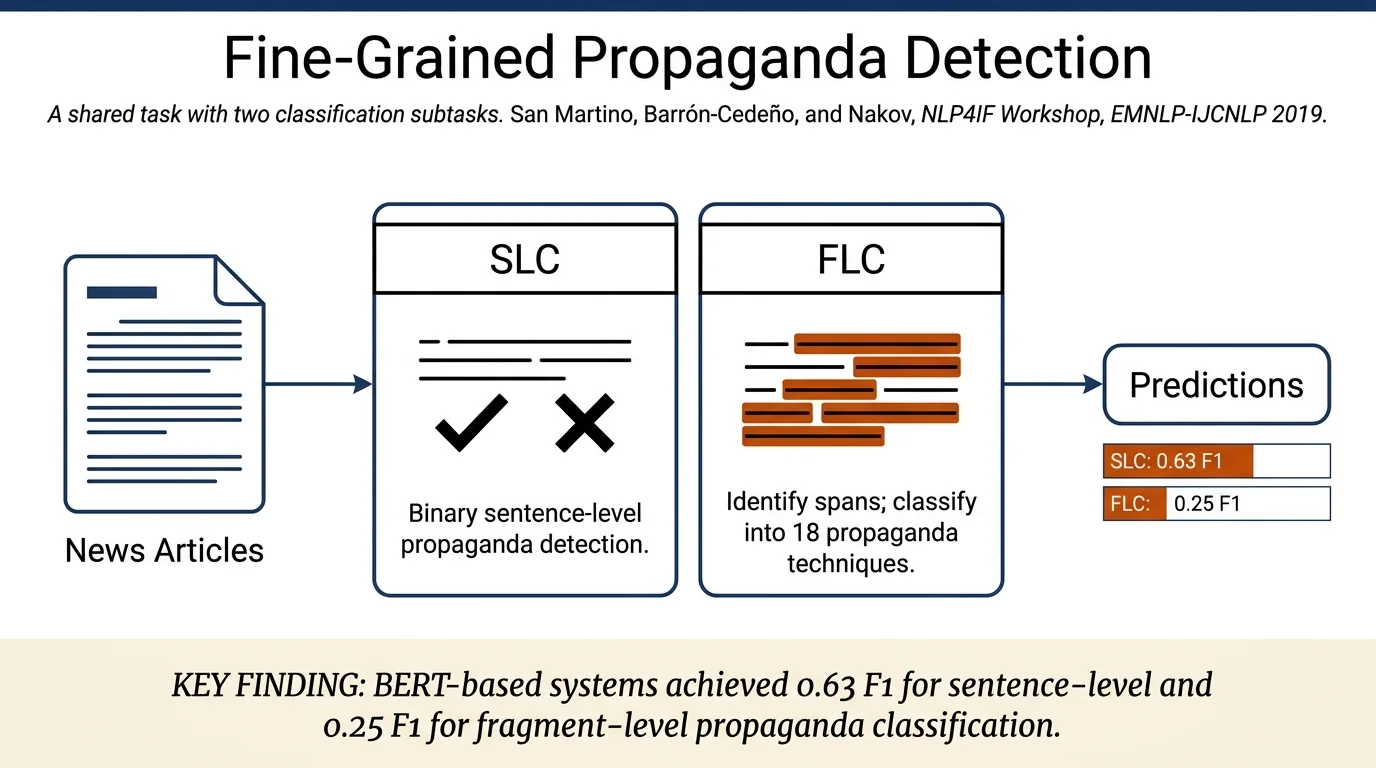
Findings of the NLP4IF-2019 Shared Task on Fine-Grained Propaganda DetectionThis paper reports findings from a shared task on fine-grained propaganda detection in news articles, featuring two subtasks: fragment-level identification and classification into 18 propaganda techniques, and sentence-level binary propaganda detection. The task attracted 90 registered teams with 39 making submissions; winning systems…
 Deepfakes & multimodalDetection methods
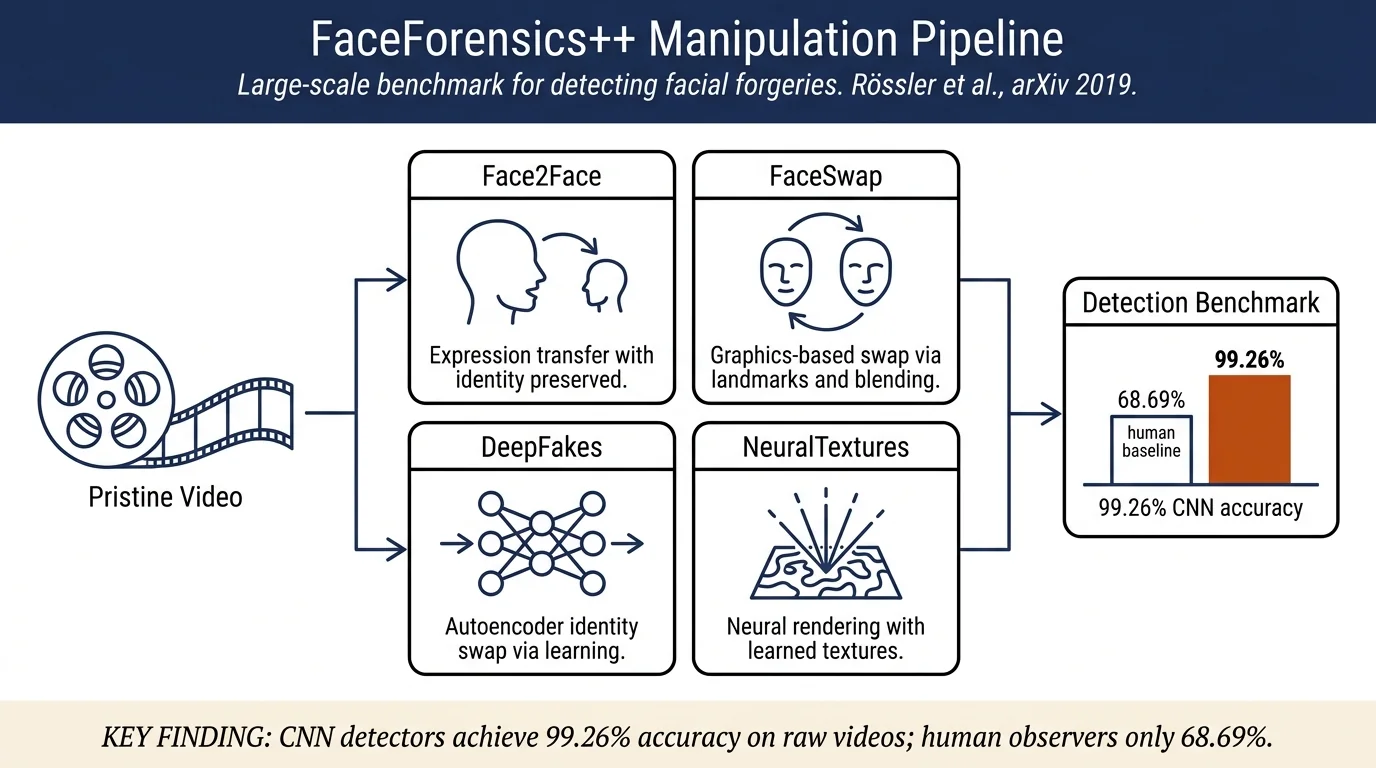
FaceForensics++: Learning to Detect Manipulated Facial ImagesFaceForensics++ introduces a large-scale benchmark (1.8+ million manipulated images from 1,000+ videos) for detecting facial manipulations created with four state-of-the-art methods: Face2Face, FaceSwap, DeepFakes, and NeuralTextures. The paper comprehensively evaluates detection methods from stegananalysis to deep learning,…
 Datasets & evaluationSpread & networks
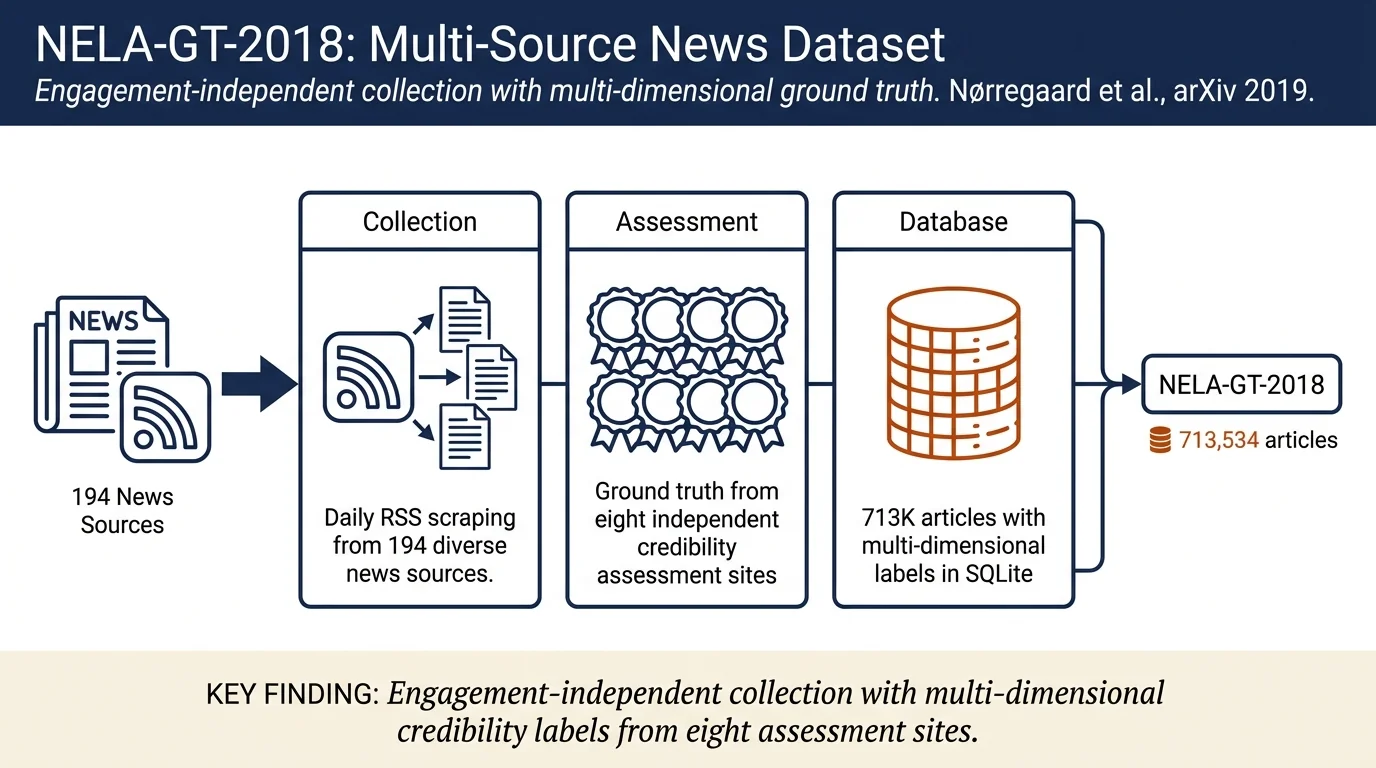
NELA-GT-2018: A Large Multi-Labelled News Dataset for The Study of Misinformation in News ArticlesNELA-GT-2018 is a large, engagement-independent collection of 713,534 news articles from 194 sources across 10 months (Feb–Nov 2018). It combines multi-source-level ground truth labels from eight independent assessment sites (NewsGuard, Pew Research, Wikipedia, OpenSources, Media Bias/Fact Check, AllSides, BuzzFeed News, PolitiFact)…
 Datasets & evaluationDeepfakes & multimodal
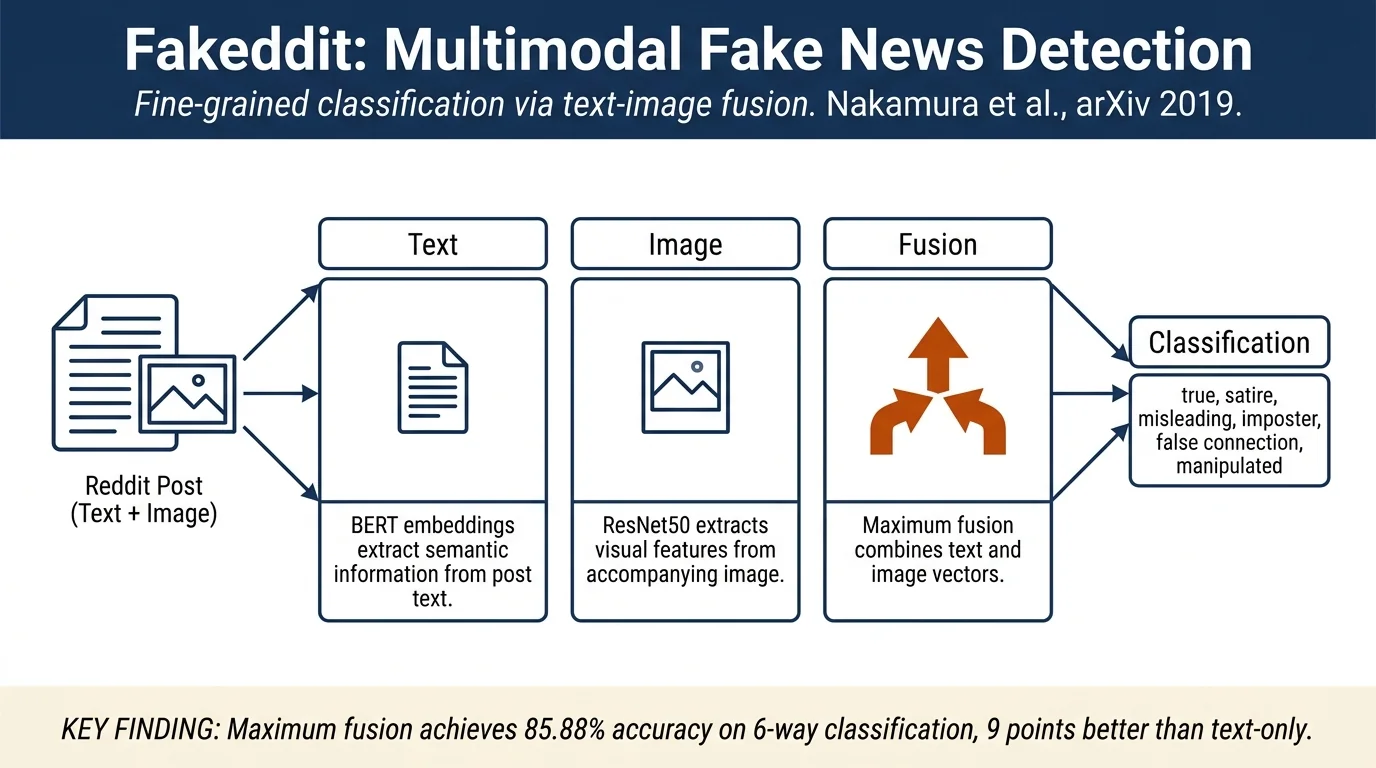
r/Fakeddit: A New Multimodal Benchmark Dataset for Fine-grained Fake News DetectionFakeddit is a large-scale multimodal fake news detection dataset with over 1 million Reddit samples labeled with 2-way, 3-way, and 6-way classification schemes. Multimodal models combining text (BERT) and image (ResNet50) features achieve 86.0% accuracy on 6-way classification, demonstrating the importance of jointly leveraging text and…
 Detection methodsDatasets & evaluation
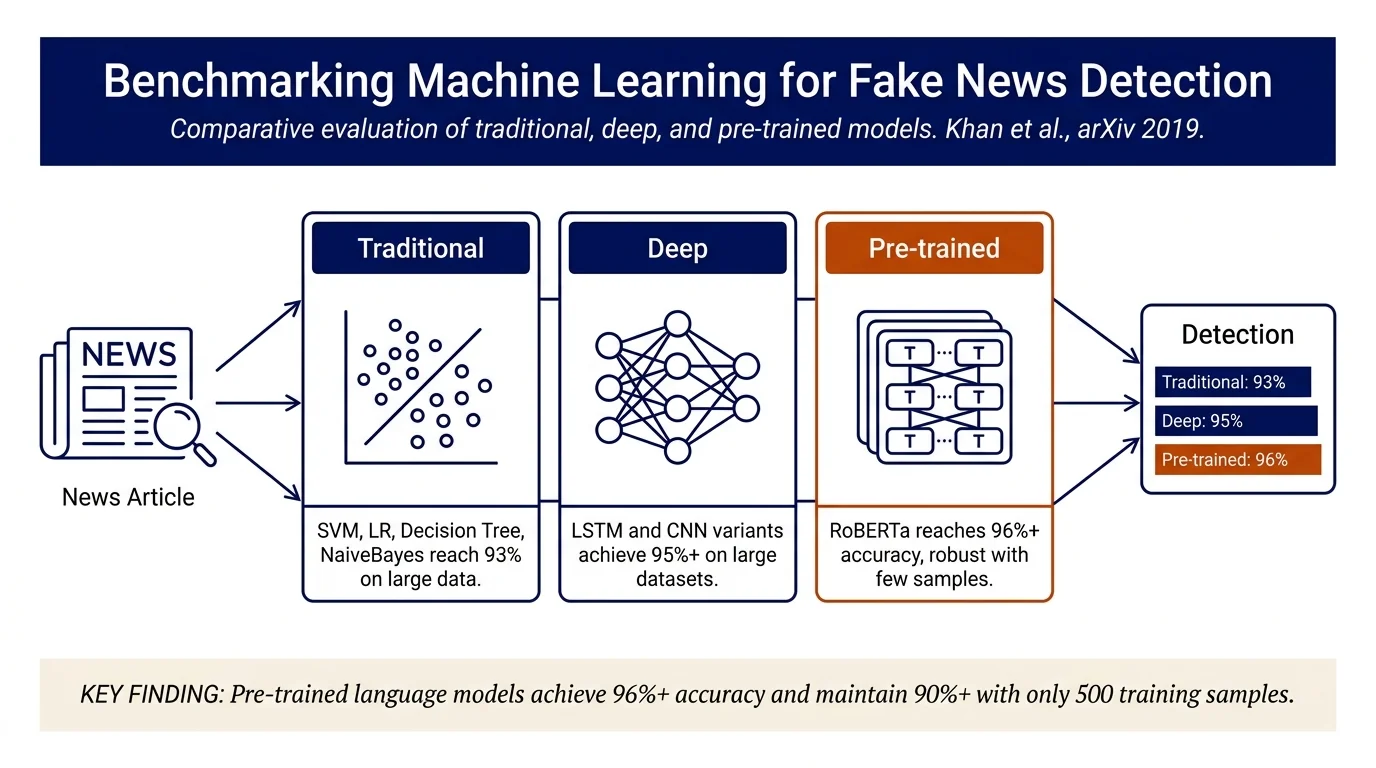
A Benchmark Study of Machine Learning Models for Online Fake News DetectionComprehensive benchmark of 19 machine learning approaches across three fake news datasets (LIAR, Fake or Real News, and an 80k-news combined corpus spanning politics, health, sports, and other topics). Key finding: BERT-based pre-trained models (especially RoBERTa) substantially outperform traditional and deep learning approaches,…
 Spread & networksDatasets & evaluation
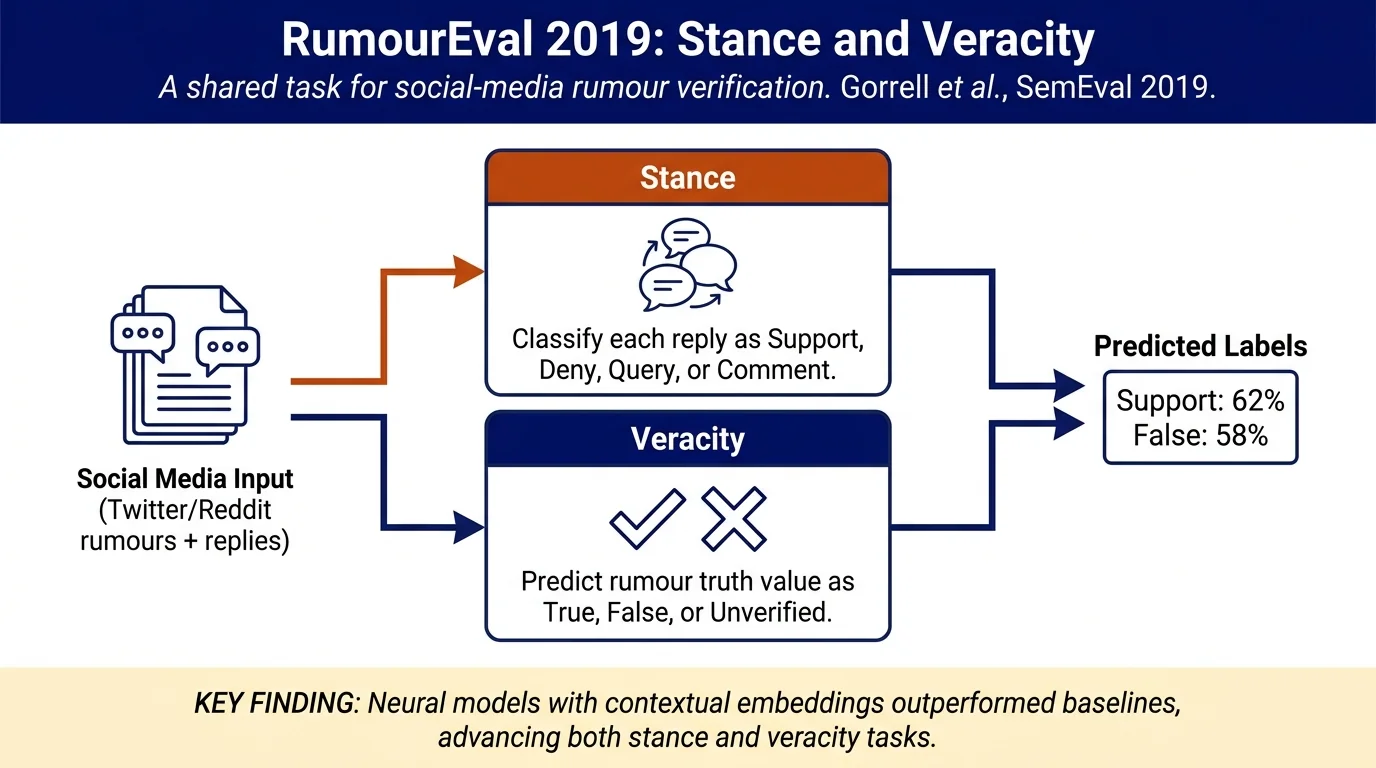
RumourEval 2019: Determining Rumour Veracity and Support for RumoursRumourEval 2019 is a shared task for rumour stance detection and veracity prediction on social media. Extending the 2017 edition, it introduces Reddit data alongside Twitter, provides datasets annotated for SDQC stance (Support/Deny/Query/Comment) and three-way veracity labels, and received 22 system submissions showing that modern…
 Detection methodsDatasets & evaluation
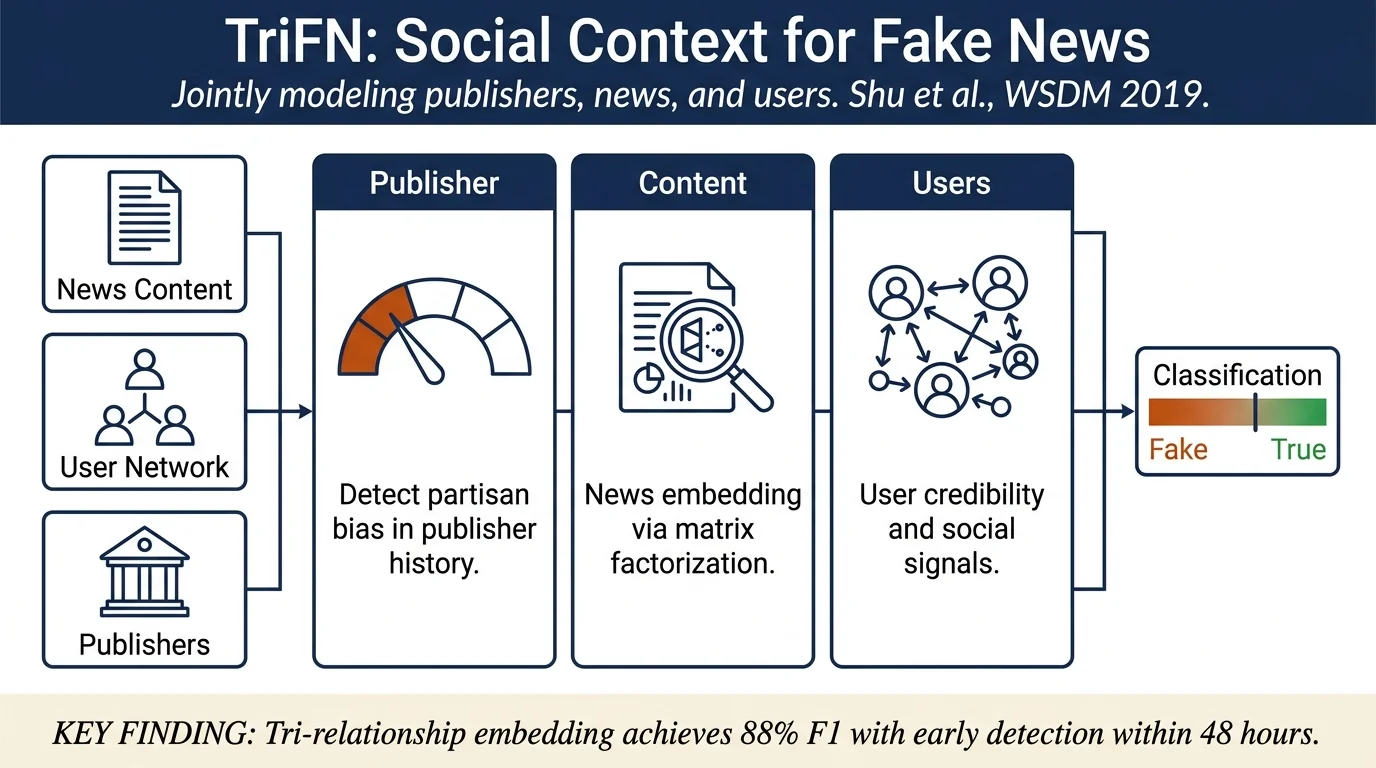
Beyond News Contents: The Role of Social Context for Fake News DetectionContent-only detection is insufficient because fake news is crafted to mimic real news. This paper argues that the tri-relationship among publishers, news pieces, and users forms rich social context for detection: partisan-biased publishers more likely publish fake news, and low-credibility users more likely share it.
 Spread & networksDetection methods
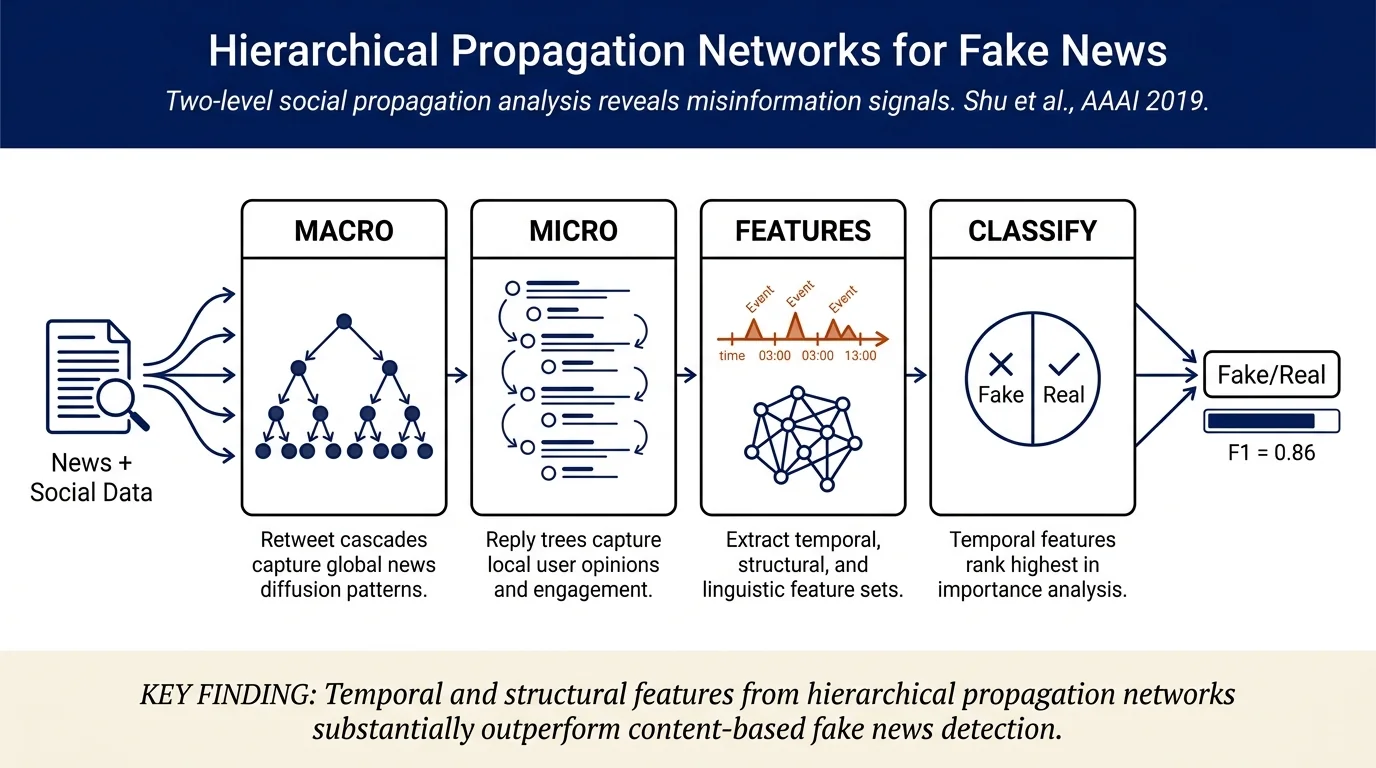
Hierarchical Propagation Networks for Fake News Detection: Investigation and ExploitationContent-only fake news detection has limited performance because fake news is deliberately crafted to mimic real news. This paper constructs hierarchical propagation networks from both macro-level (tweet/retweet cascade) and micro-level (reply conversation) granularity, extracts structural, temporal, and linguistic features from both…
 Deepfakes & multimodalDetection methods
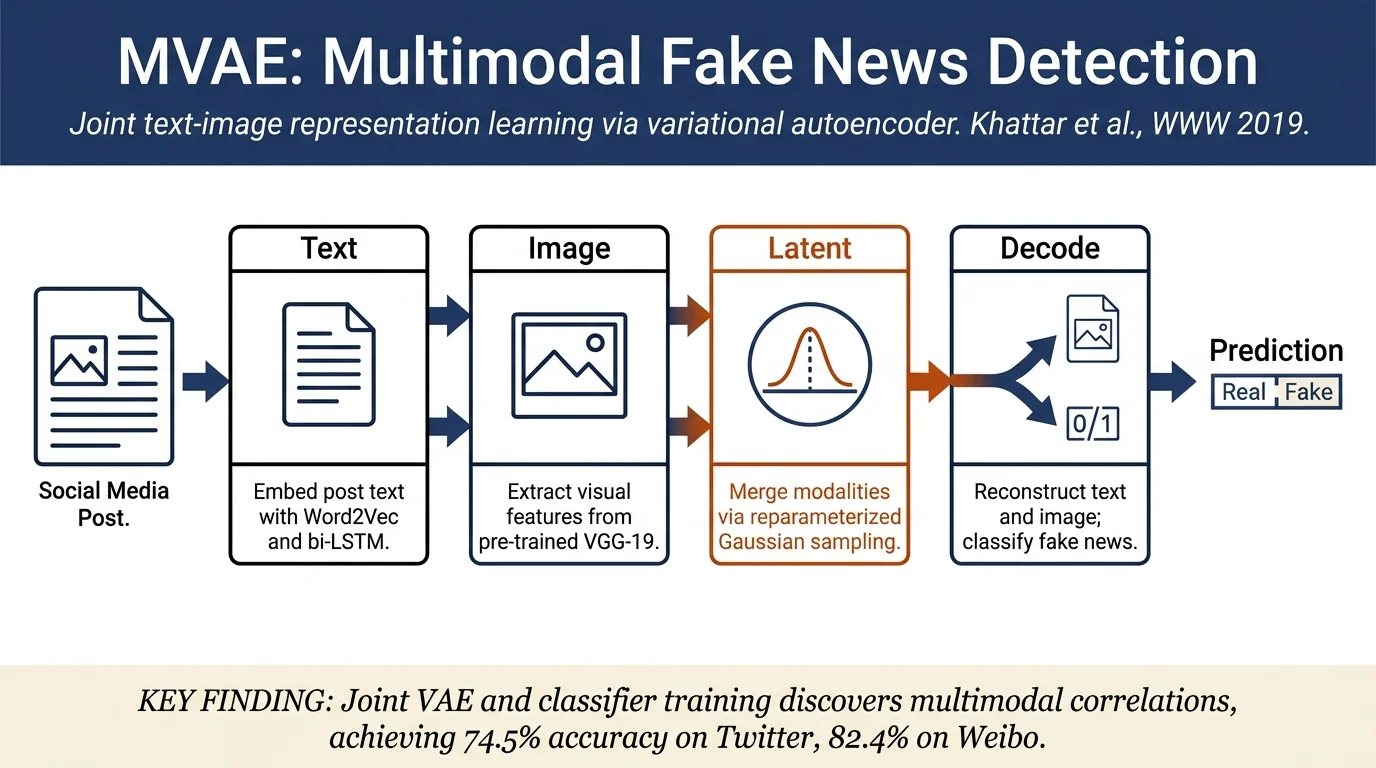
MVAE: Multimodal Variational Autoencoder for Fake News DetectionThe paper proposes MVAE, a variational autoencoder that learns shared representations of text and images in social media posts to detect fake news. The model jointly trains an encoder-decoder (to discover correlations across modalities) with a binary classifier.
 Spread & networksDetection methods
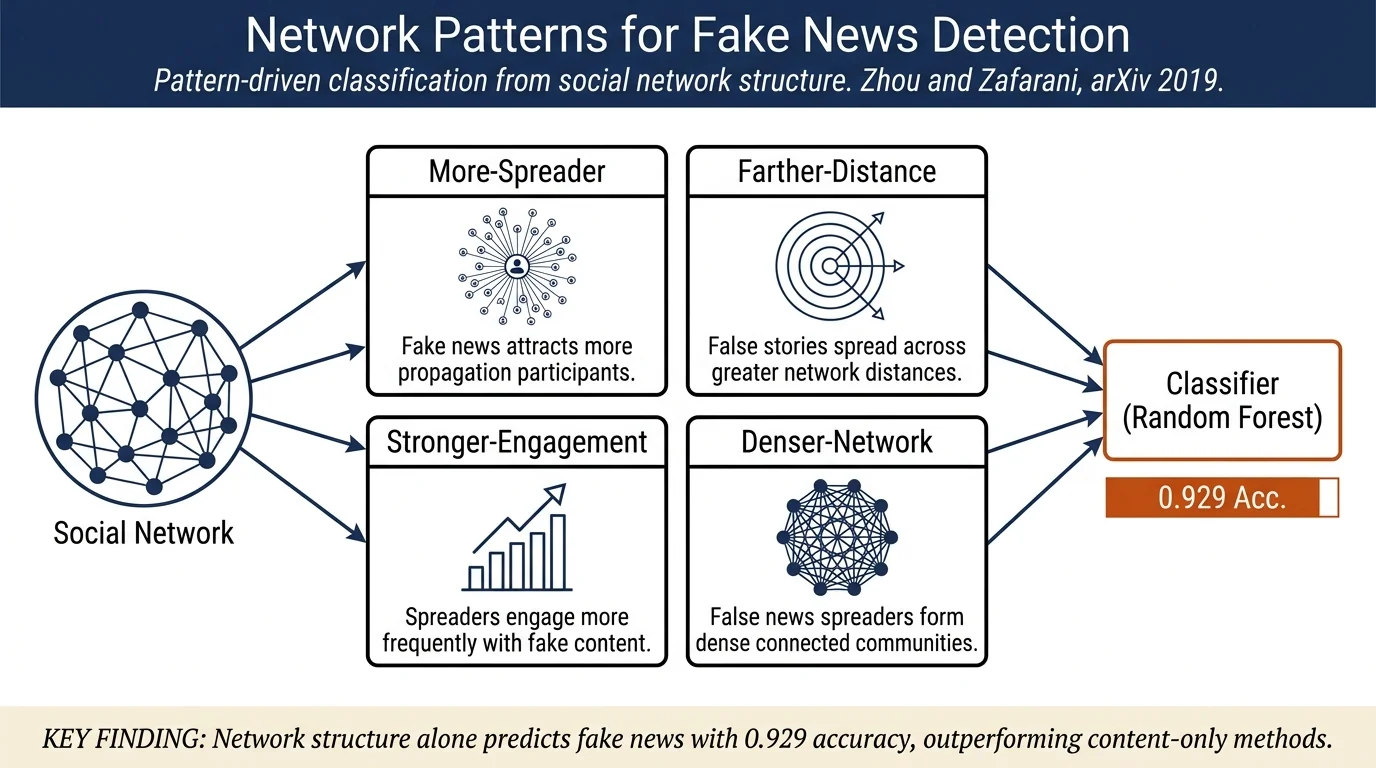
Network-based Fake News Detection: A Pattern-driven ApproachThis paper proposes a pattern-driven, network-based fake news detection model that identifies and quantifies four empirically grounded behavioral patterns in social networks: fake news attracts more spreaders, spreads farther, elicits stronger engagement, and is spread by denser networks than true news. These patterns are operationalized…
 Detection methodsDatasets & evaluation
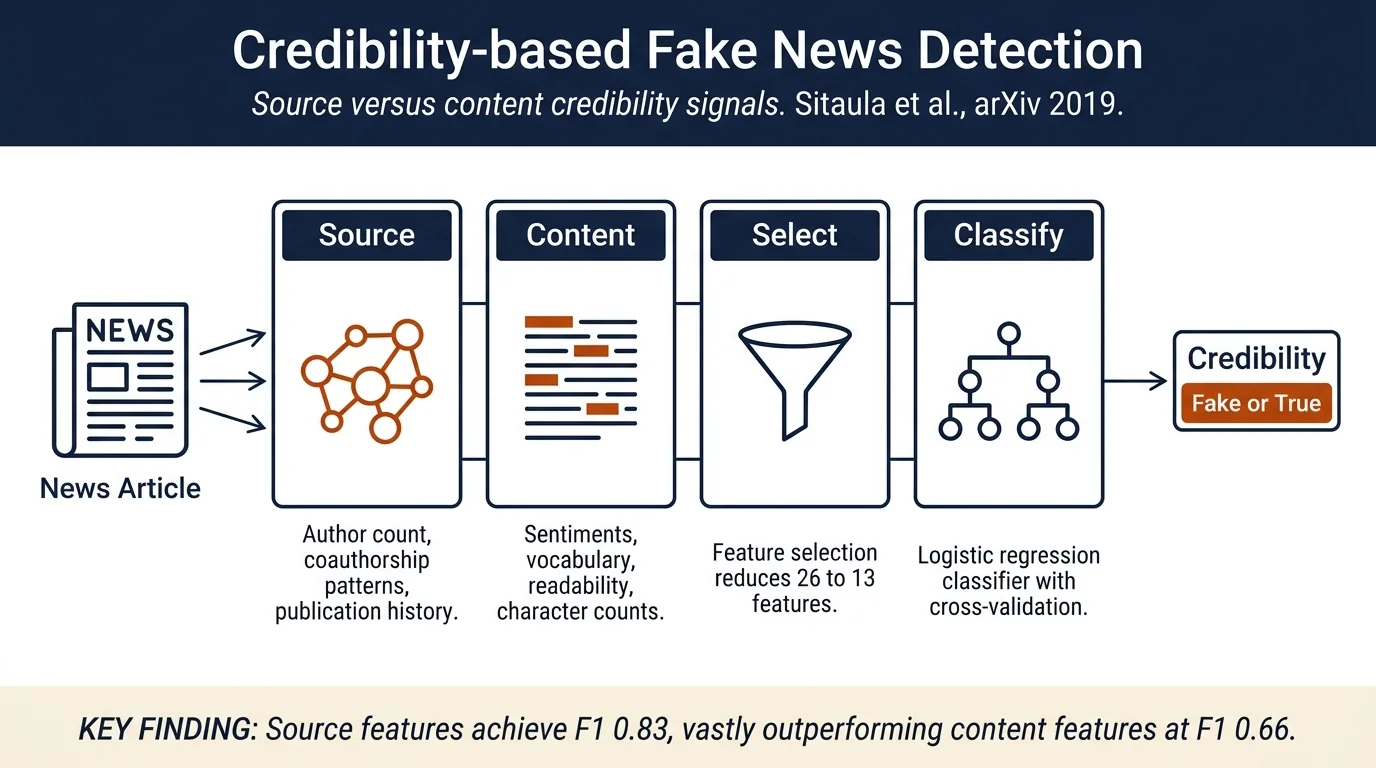
Credibility-based Fake News DetectionRather than relying solely on news text or propagation graphs, this paper frames fake news detection as a credibility assessment problem and operationalizes credibility through source-level signals (author count, coauthorship homophily, author publication history) and content-level signals (sentiments, domain vocabulary, argumentation,…
 Detection methodsDatasets & evaluation
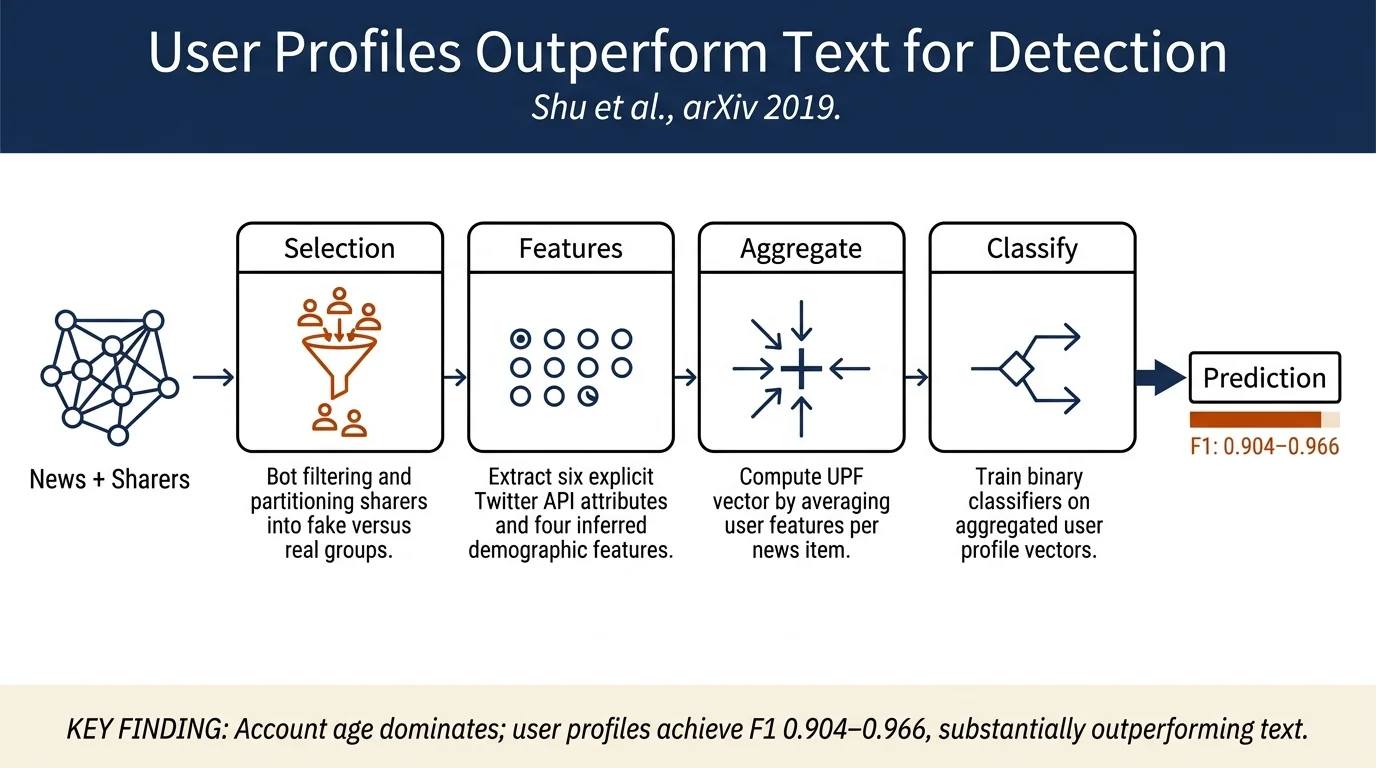
The Role of User Profiles for Fake News DetectionContent-only fake news detectors plateau because fake news is crafted to mimic real news textually. This paper systematically characterizes Twitter users who predominantly share fake versus real news across both partitions of FakeNewsNet (PolitiFact and GossipCop), comparing six explicit Twitter API attributes and four inferred implicit…
 Detection methodsDatasets & evaluation
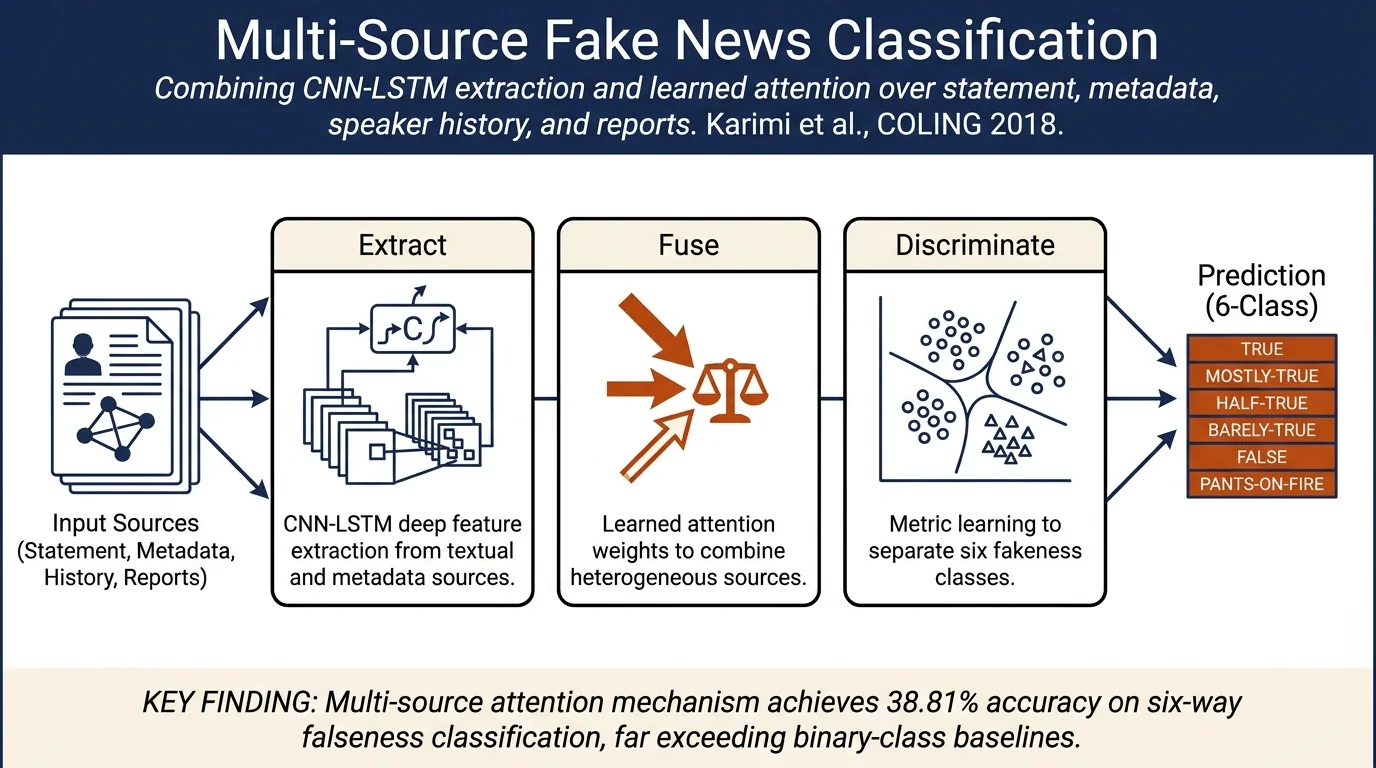
Multi-Source Multi-Class Fake News DetectionProposes MMFD, a multi-source multi-class fake news detection framework combining automated feature extraction (CNN-LSTM), interpretable multi-source fusion (attention mechanism), and fakeness discrimination. Achieves 38.81% accuracy on LIAR dataset across six classes of fakeness (true, mostly-true, half-true, barely-true, false,…
 Detection methodsDatasets & evaluation
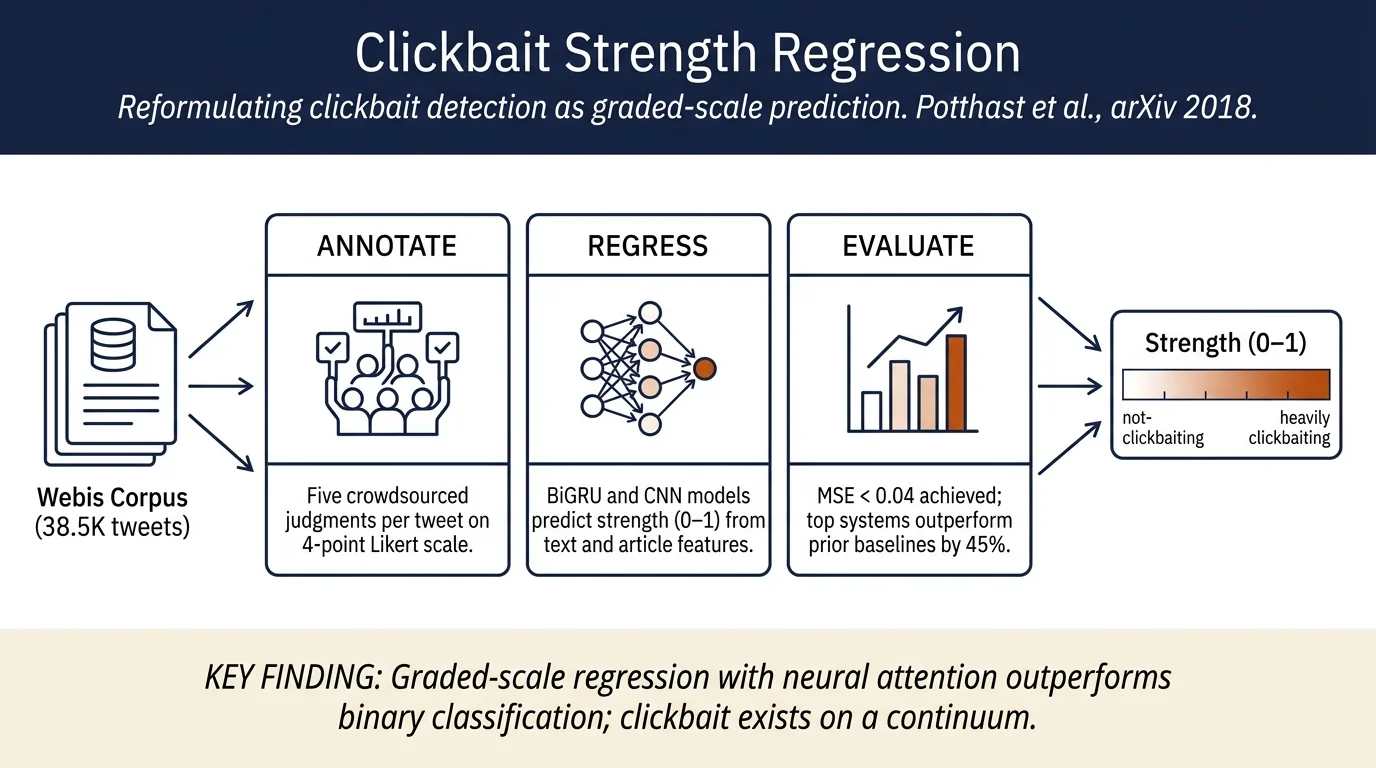
The Clickbait Challenge 2017: Towards a Regression Model for Clickbait StrengthClickbait detection is typically framed as binary classification, but teaser messages exhibit varying degrees of clickbaiting techniques. This paper organizes the Clickbait Challenge 2017, reformulating the task as regression to measure clickbait strength on a graded scale.
 Detection methodsDatasets & evaluation
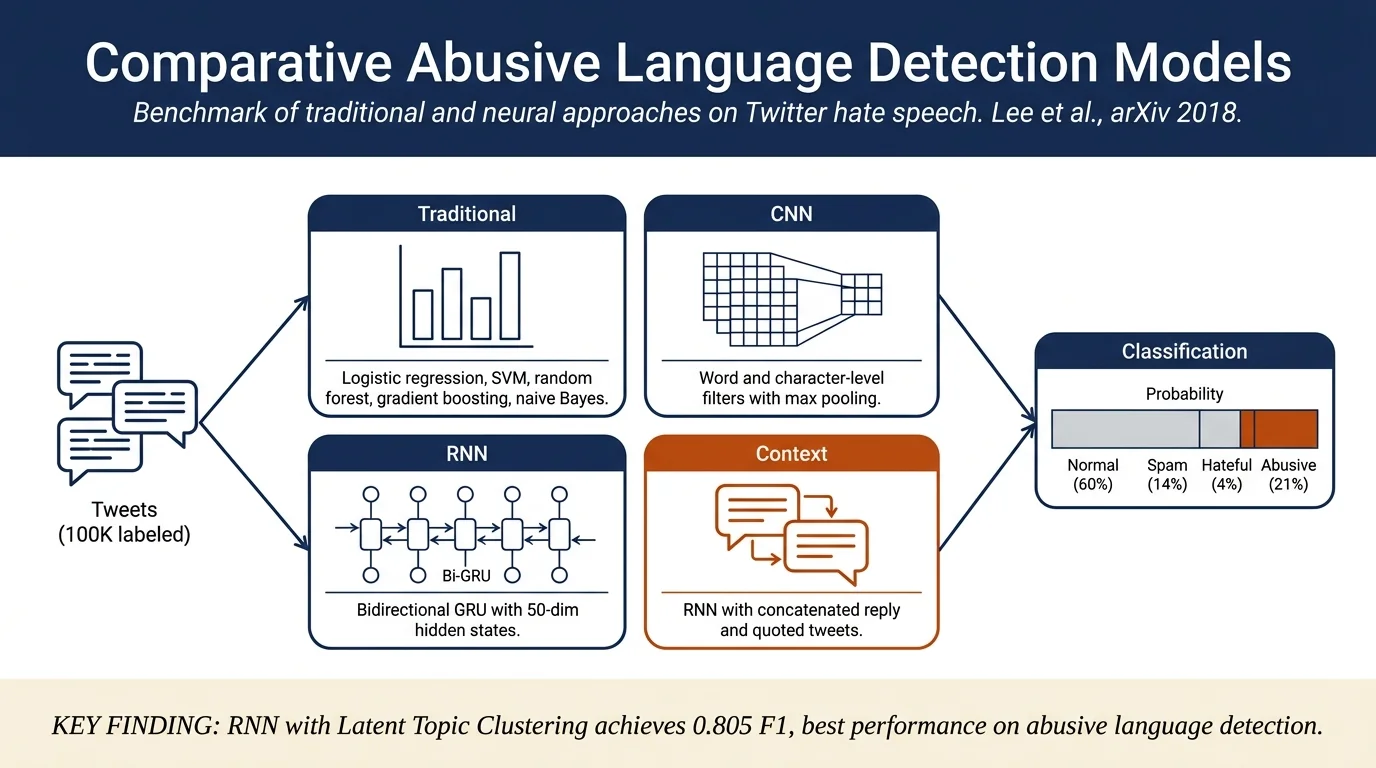
Comparative Studies of Detecting Abusive Language on TwitterConducts the first comprehensive benchmark of traditional machine learning and neural network models on the Hate and Abusive Speech on Twitter dataset (100K tweets). Bidirectional GRU networks with Latent Topic Clustering achieve the best performance (0.805 F1), outperforming traditional methods like logistic regression and SVM.
 Detection methodsDatasets & evaluation
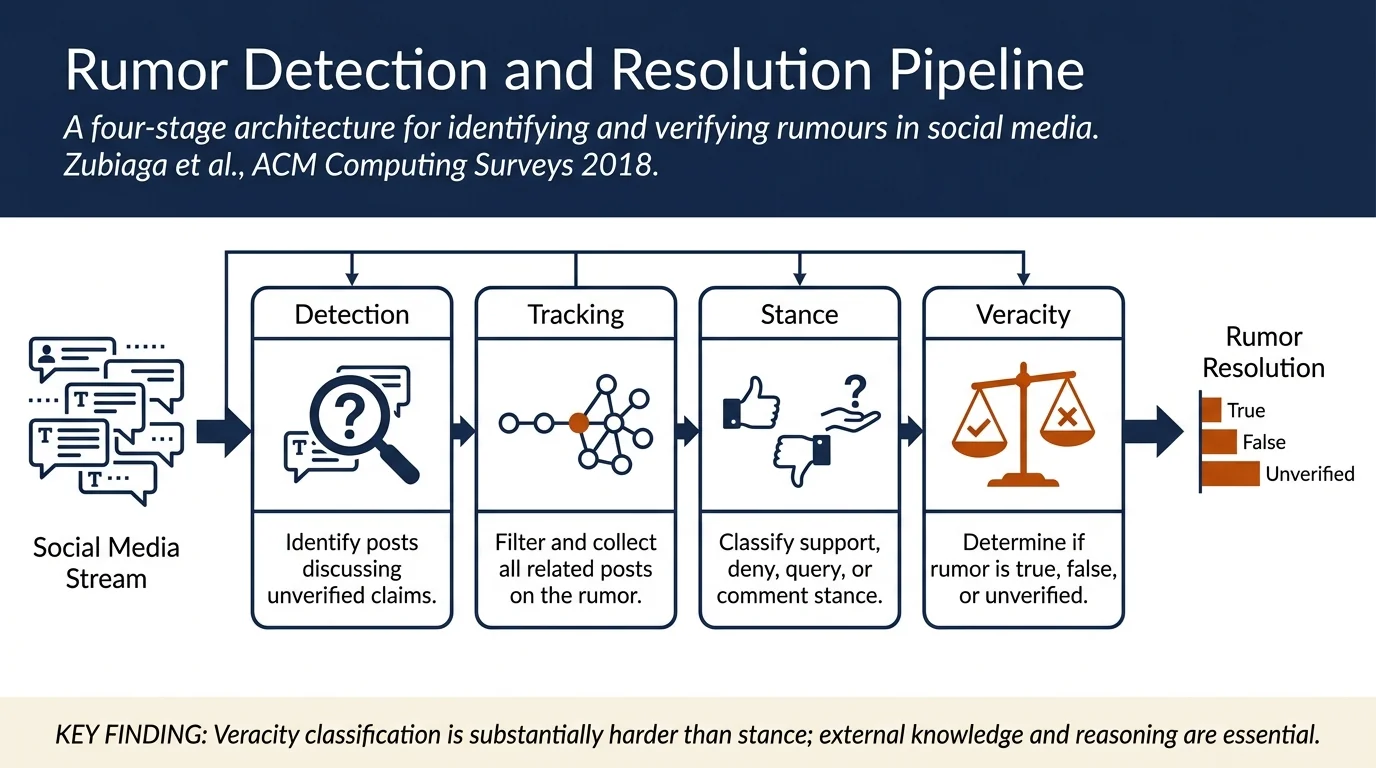
Detection and Resolution of Rumours in Social Media: A SurveyComprehensive survey of rumour detection and resolution in social media covering the entire pipeline: rumour definition and characterization, data collection strategies, annotation schemes, detection approaches for both emerging and long-standing rumours, tracking of rumour propagation, stance classification (support/deny/query/comment),…
 Deepfakes & multimodalDetection methods
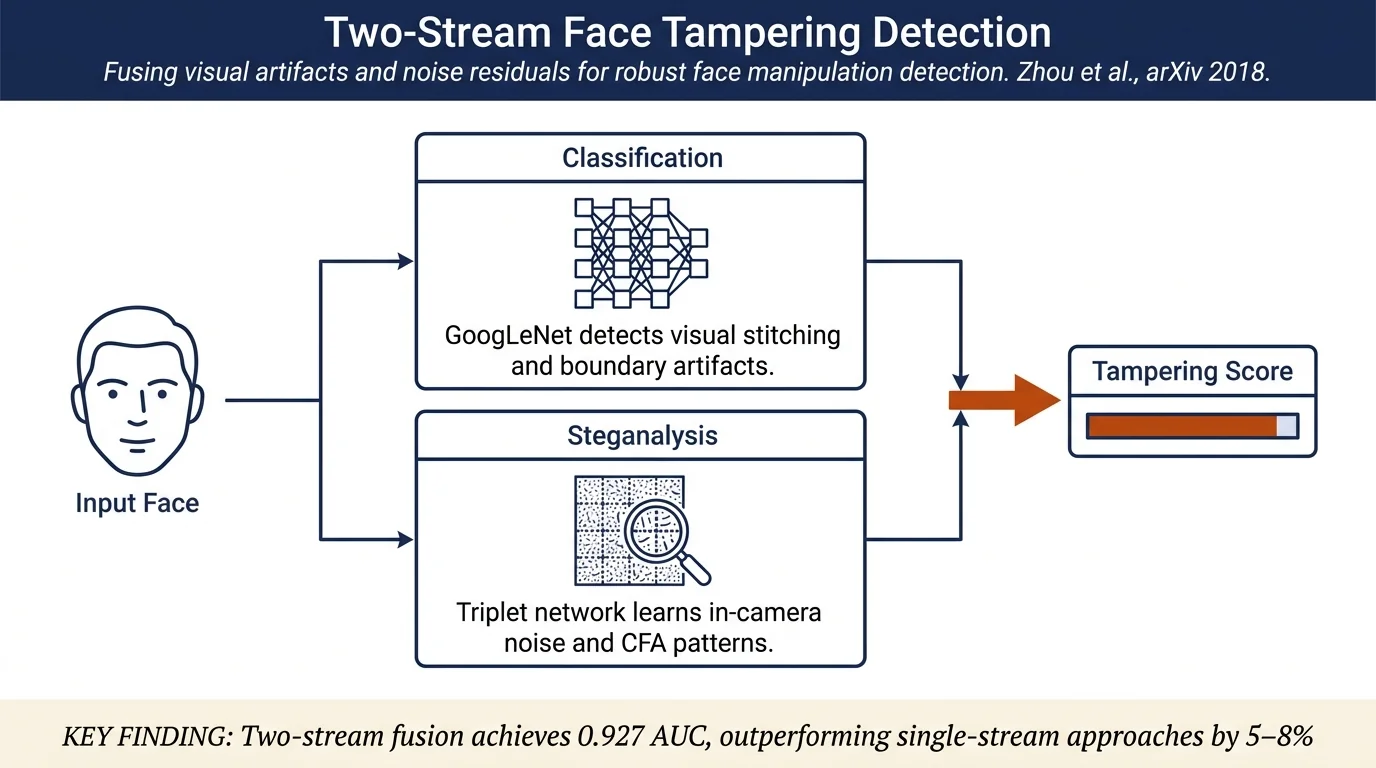
Two-Stream Neural Networks for Tampered Face DetectionThe paper proposes a two-stream neural network for detecting face tampering (face swaps) in images. One stream uses GoogLeNet to classify tampered faces by visual artifacts, while the second stream uses steganalysis features with a triplet network to capture low-level noise inconsistencies.
 Spread & networksDatasets & evaluation
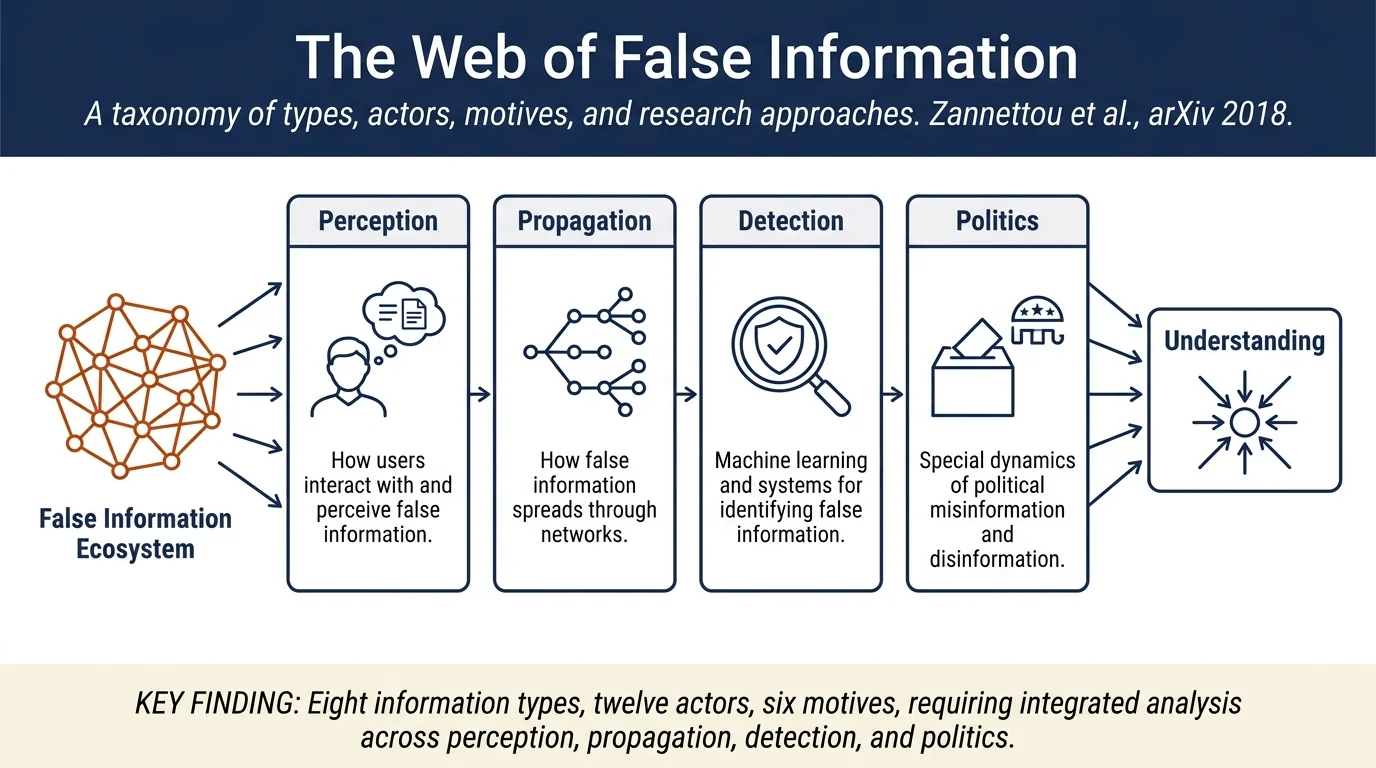
The Web of False Information: Rumors, Fake News, Hoaxes, Clickbait, and Various Other ShenanigansComprehensive typology of the false information ecosystem on the Web, identifying eight types of false information (fabricated stories, propaganda, conspiracy theories, hoaxes, biased news, rumors, clickbait, satire), twelve actor categories (bots, criminal organizations, activists, governments, paid posters, journalists, useful idiots,…
 Detection methodsDeepfakes & multimodal
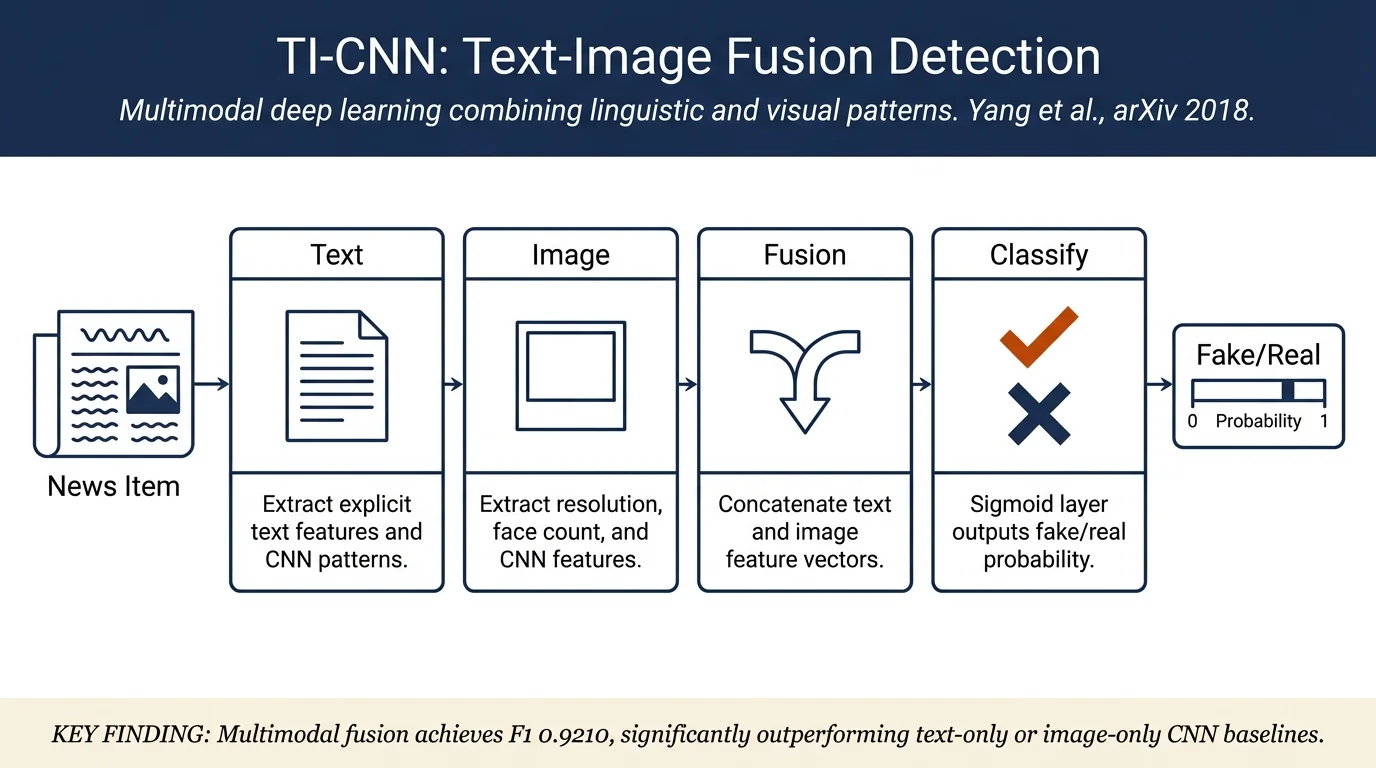
TI-CNN: Convolutional Neural Networks for Fake News DetectionThis paper proposes TI-CNN, a multimodal deep learning model that combines explicit and latent features from both text and images to detect fake news. Through analysis of 20,015 news items, the authors identify distinctive linguistic and visual patterns in fake versus real news, and demonstrate that their unified CNN-based approach…
 Fact-checking & verificationDatasets & evaluation
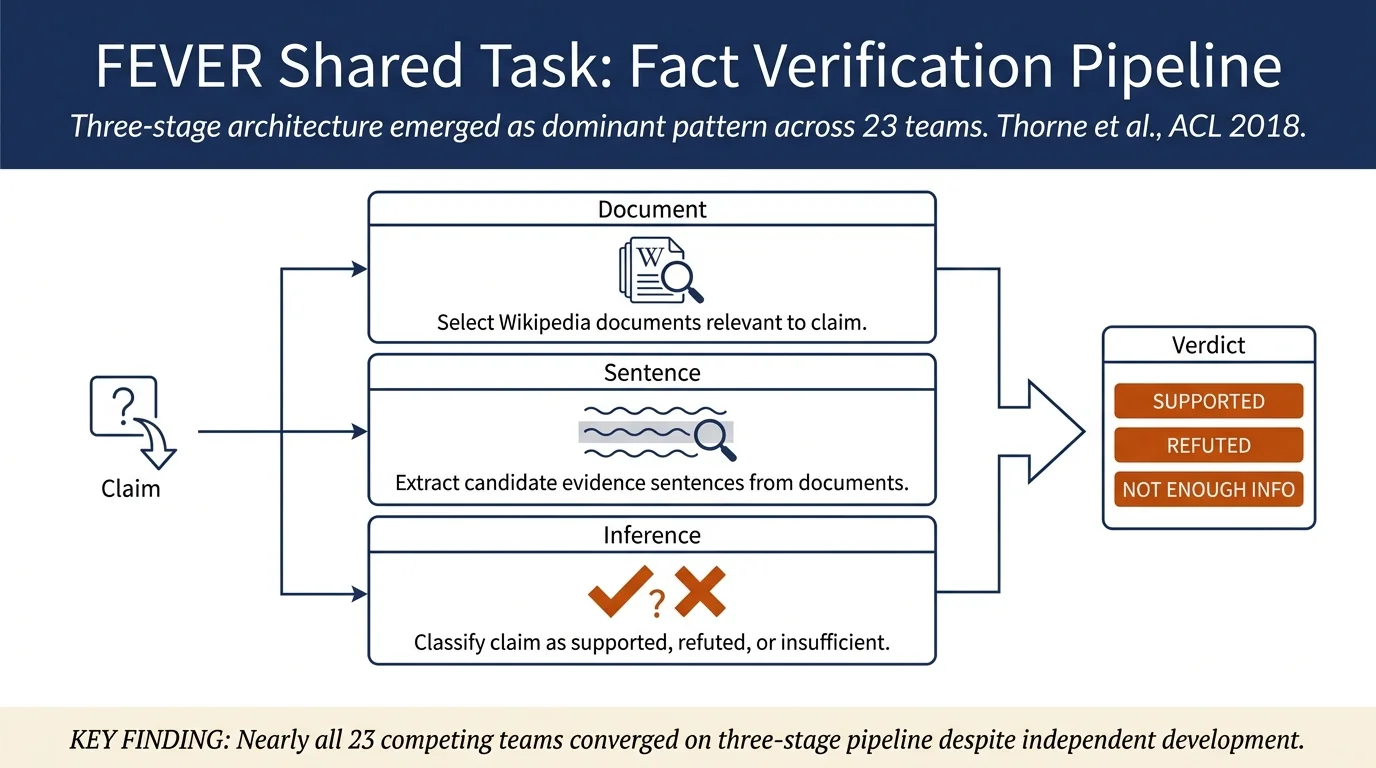
The Fact Extraction and VERification (FEVER) Shared TaskThis paper presents results of the first FEVER shared task competition, which challenged 23 teams to classify whether human-written factoid claims could be SUPPORTED or REFUTED using evidence retrieved from Wikipedia. The best system achieved 64.21% FEVER score, demonstrating the difficulty of joint evidence retrieval and natural…
 Fact-checking & verificationDatasets & evaluation
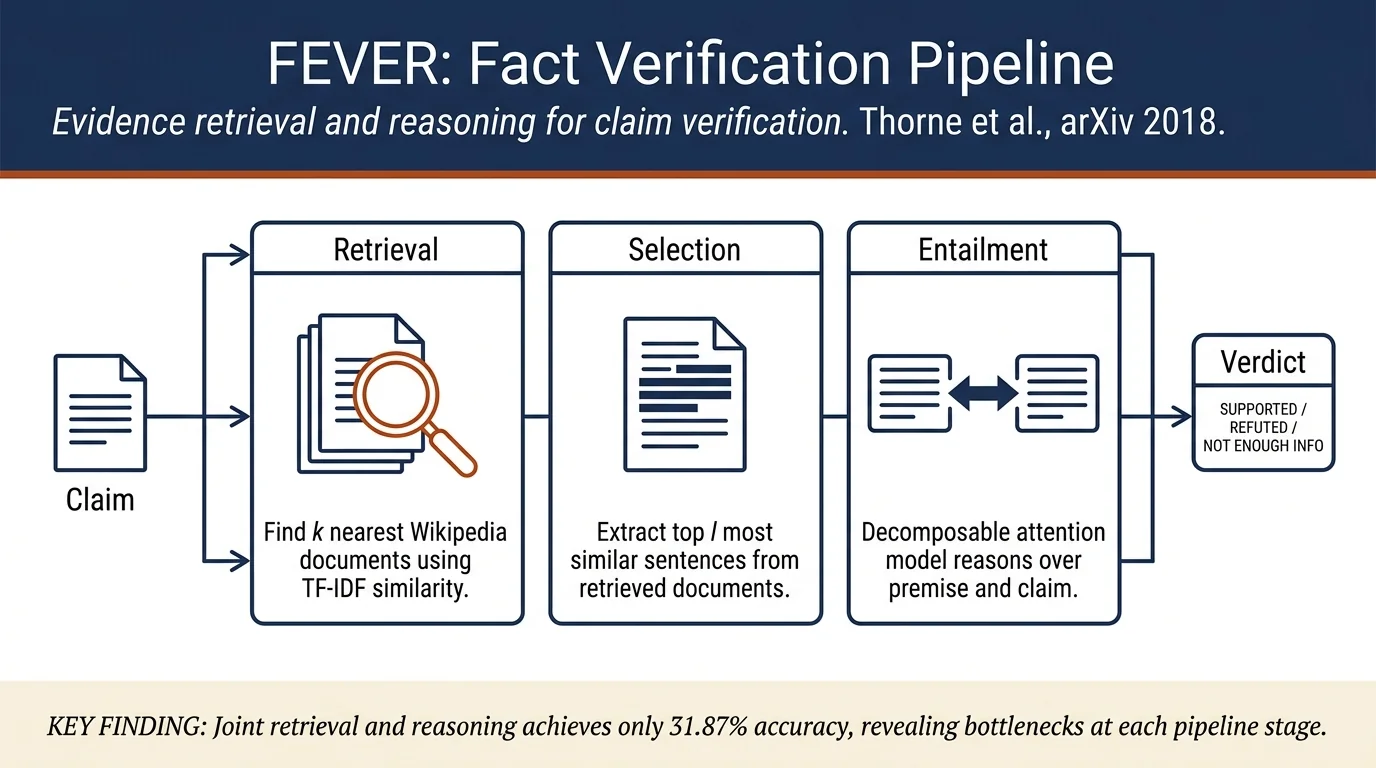
FEVER: A Large-Scale Dataset for Fact Extraction and VERificationThis paper introduces FEVER, a large-scale dataset of 185,445 human-verified claims with Wikipedia evidence for training fact verification systems. Claims are generated from Wikipedia and labeled as SUPPORTED, REFUTED, or NOT ENOUGH INFO; the paper presents a three-stage baseline pipeline (document retrieval, sentence selection, textual…