Explore everything
Filter by research area, year and venue. Every filter is in the address bar, so you can share a view as a link.
 Datasets & evaluationSpread & networks
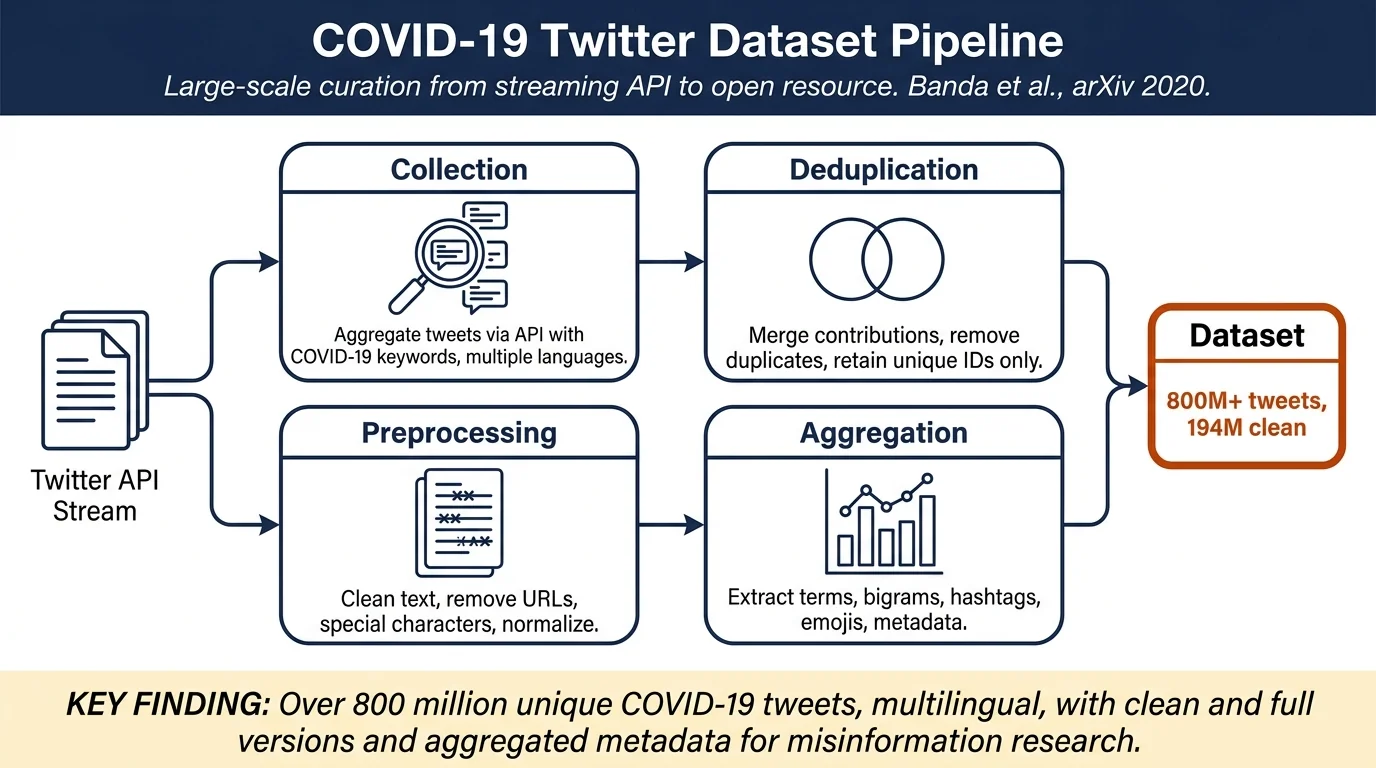
A large-scale COVID-19 Twitter chatter dataset for open scientific research - an international collaborationBanda et al. release a massive curated corpus of 800+ million COVID-19–related tweets collected from January through November 2020, with deduplication and language diversity. The dataset adheres to FAIR principles and provides both raw tweets and metadata (terms, bigrams, trigrams, hashtags, emojis, mentions) to support research on…
 Detection methodsLLMs & generative AI
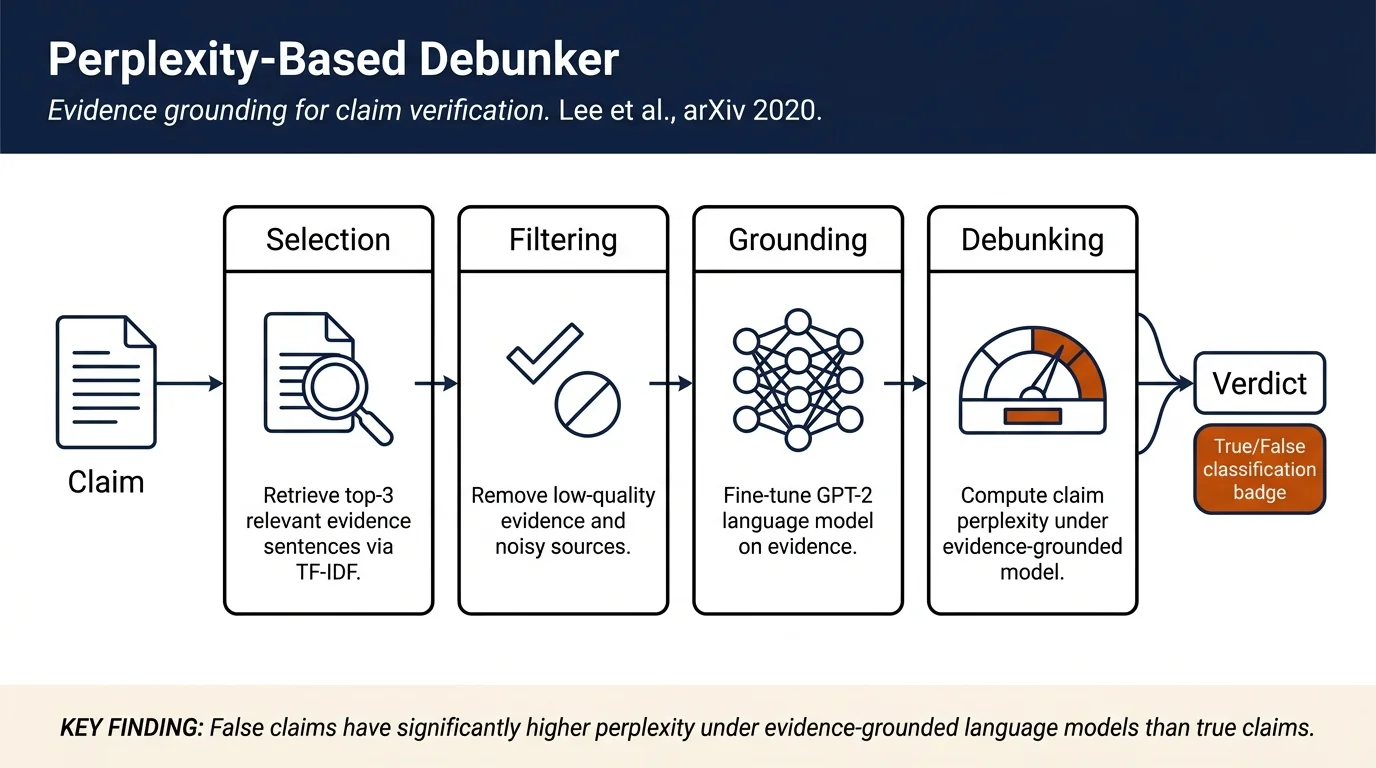
Misinformation Has High PerplexityFalse claims have measurably higher perplexity when scored by a language model primed with truthful evidence, while true claims have lower perplexity. The authors exploit this observation to build an unsupervised debunker that achieves 75% accuracy on scientific COVID-19 claims with minimal labeled data, releasing two new annotated test…
 Deepfakes & multimodalDetection methods
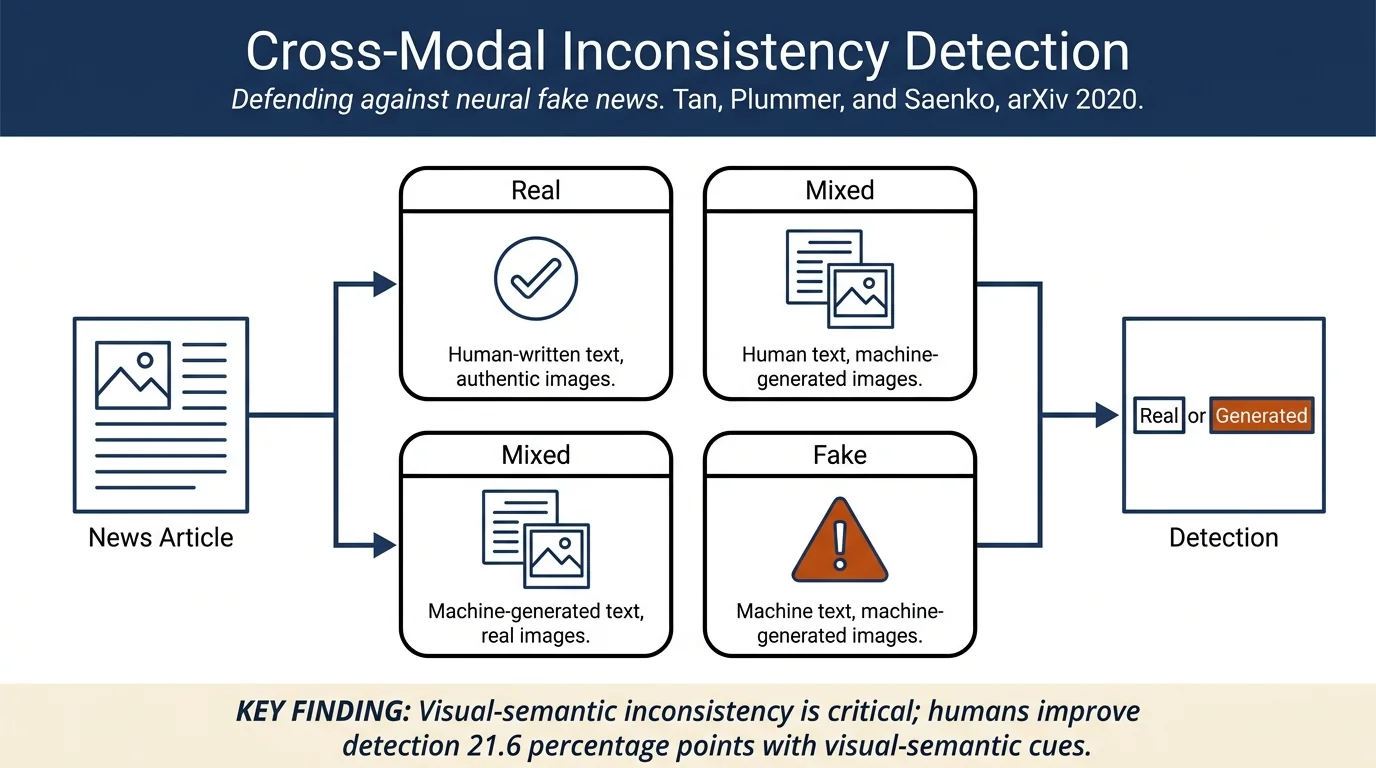
Detecting Cross-Modal Inconsistency to Defend Against Neural Fake NewsMachine-generated news articles with images and captions exploit visual-semantic inconsistencies that humans struggle to detect. This paper introduces DIDAN, a named entity-based approach to identify cross-modal semantic mismatches, and the NeuralNews dataset of 128K articles to benchmark multimodal fake news detection.
 Spread & networksDetection methods
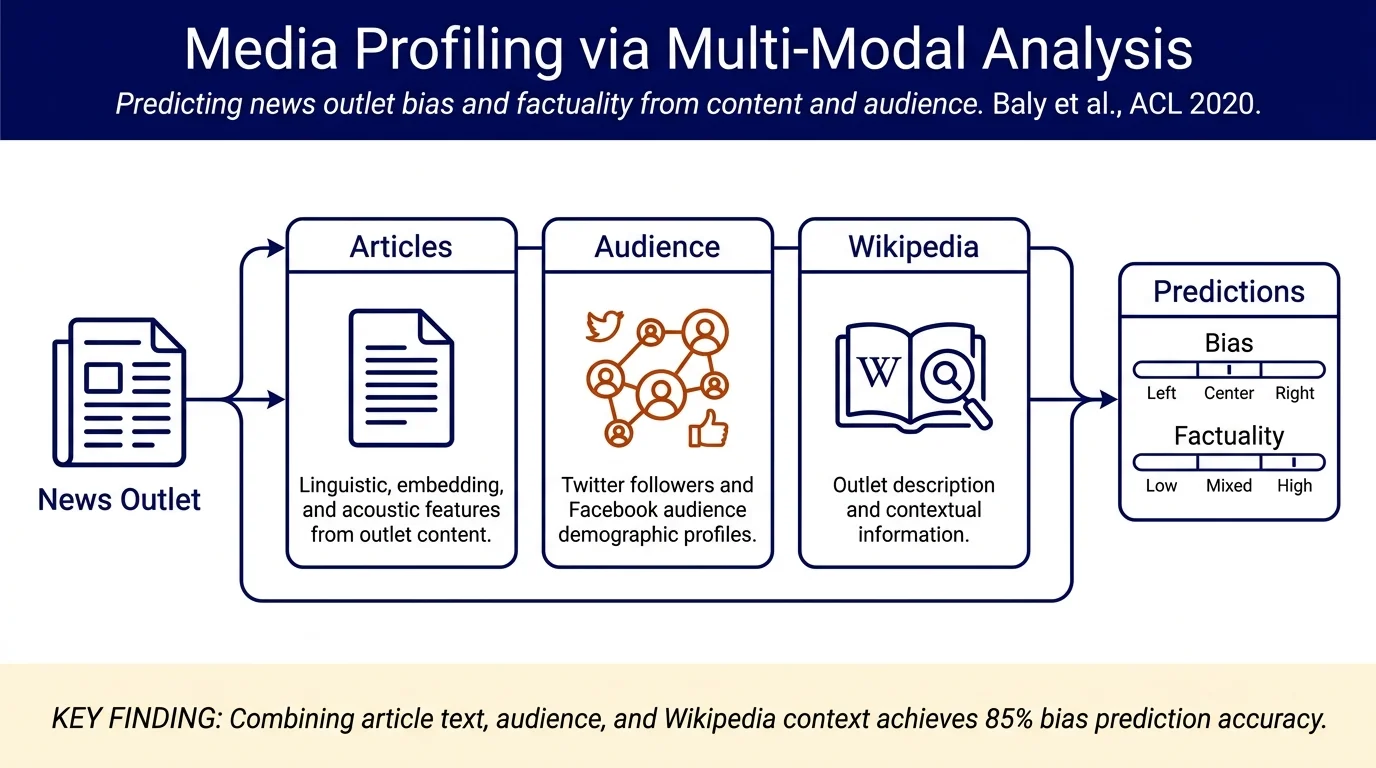
What Was Written vs. Who Read It: News Media Profiling Using Text Analysis and Social Media ContextThis paper predicts the political bias (left/center/right) and factuality (low/mixed/high) of news outlets by analyzing what articles they publish, who follows them on social media, and what Wikipedia says about them. The system achieves 85% accuracy on bias prediction by combining article text, YouTube video features, Twitter audience…
 Bots & coordinated campaignsDatasets & evaluation
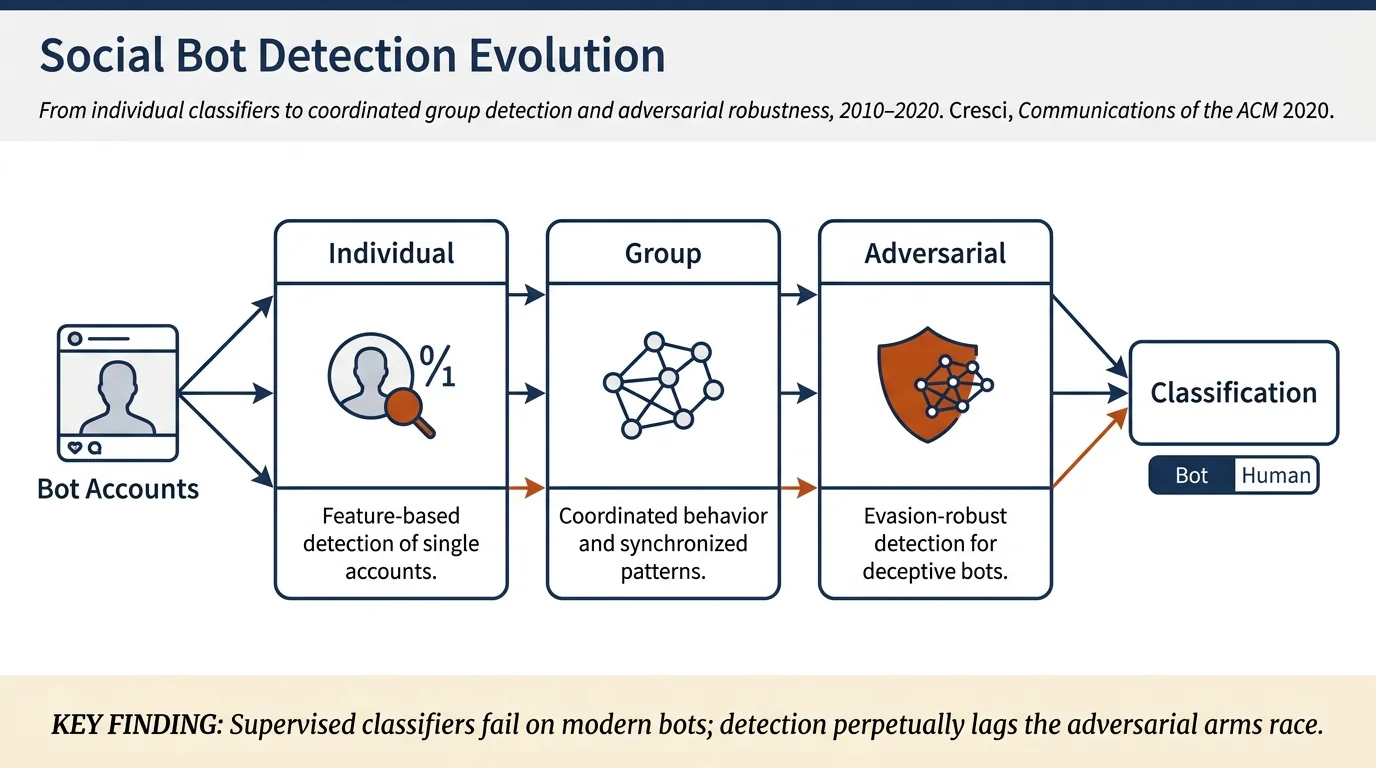
A Decade of Social Bot DetectionA comprehensive review of social bot detection research from 2010 to 2020, documenting the evolution from supervised individual-account detection to group-level approaches targeting coordinated inauthentic behavior. The paper traces the escalating "arms race" between bot developers and detection researchers, illustrates bots' documented…
 Datasets & evaluationSpread & networks
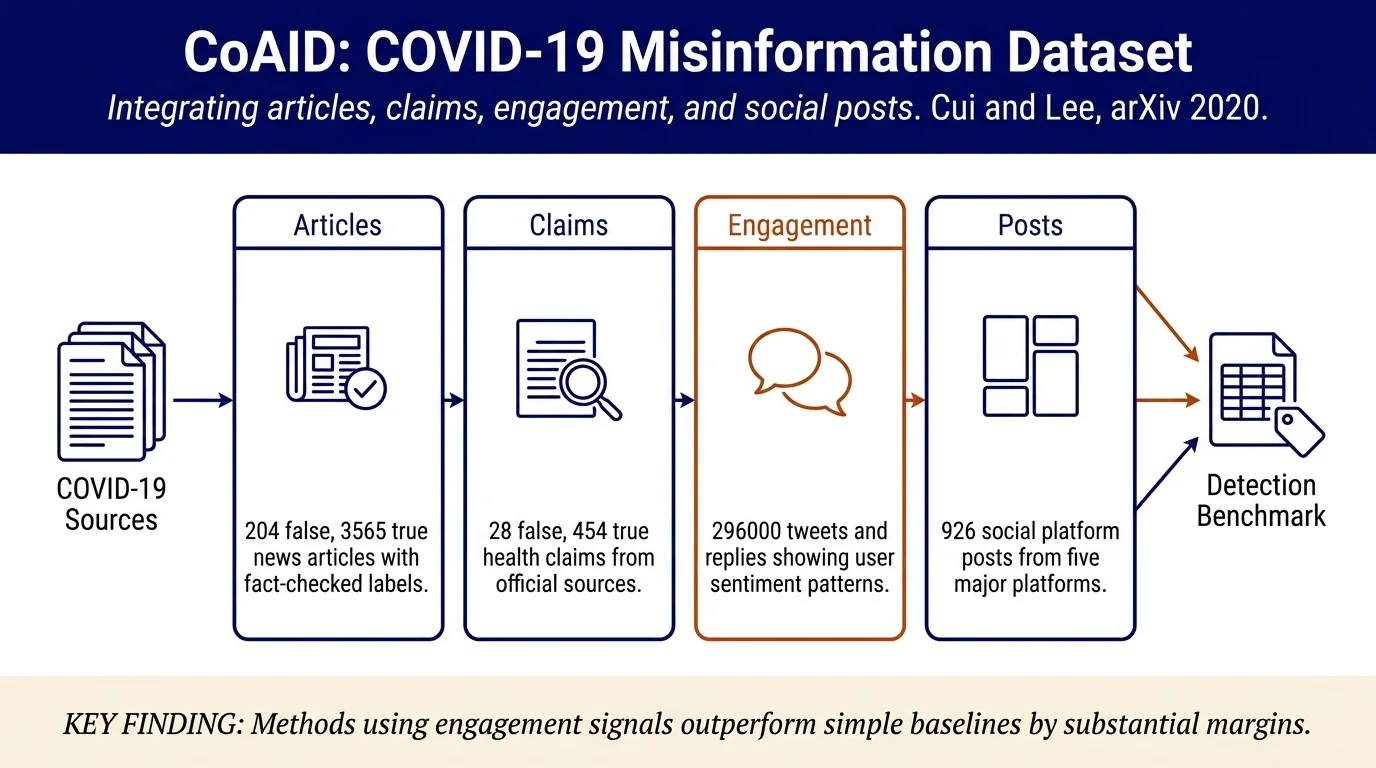
CoAID: COVID-19 Healthcare Misinformation DatasetCoAID is a benchmark dataset for COVID-19 healthcare misinformation detection comprising 4,251 news articles (204 fake, 3,565 true), 28 fake claims and 454 true claims, 296,000 user engagements from social platforms, and 926 social media posts with ground-truth labels. The dataset bridges text content, user engagement features, and…
 Deepfakes & multimodalDatasets & evaluation
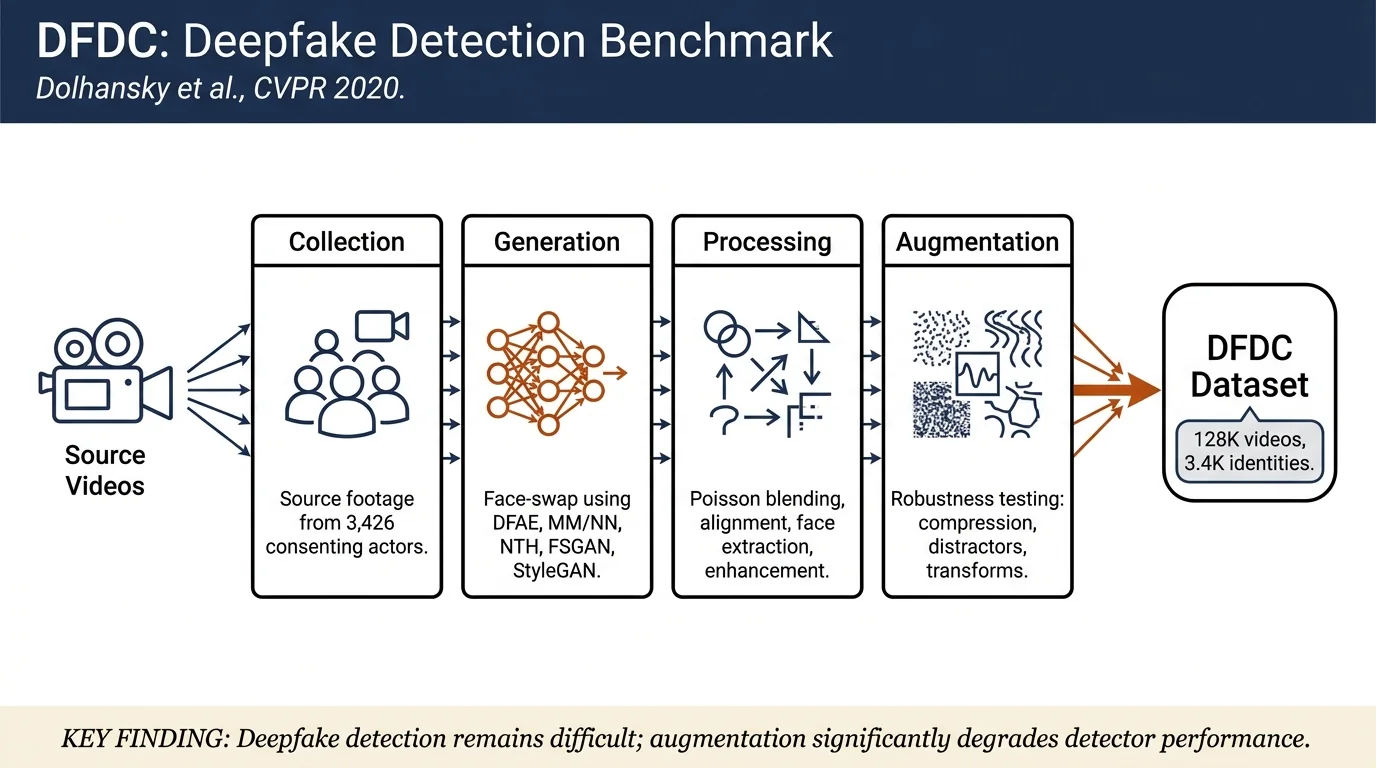
The DeepFake Detection Challenge (DFDC) DatasetThis paper introduces the DFDC Dataset, the largest publicly available deepfake detection benchmark at the time with 128,154 videos from 3,426 consented actors and 100,000 face-swapped clips. The dataset addresses ethical and methodological limitations of prior deepfake benchmarks by requiring explicit participant consent, including…
 Deepfakes & multimodalDatasets & evaluation
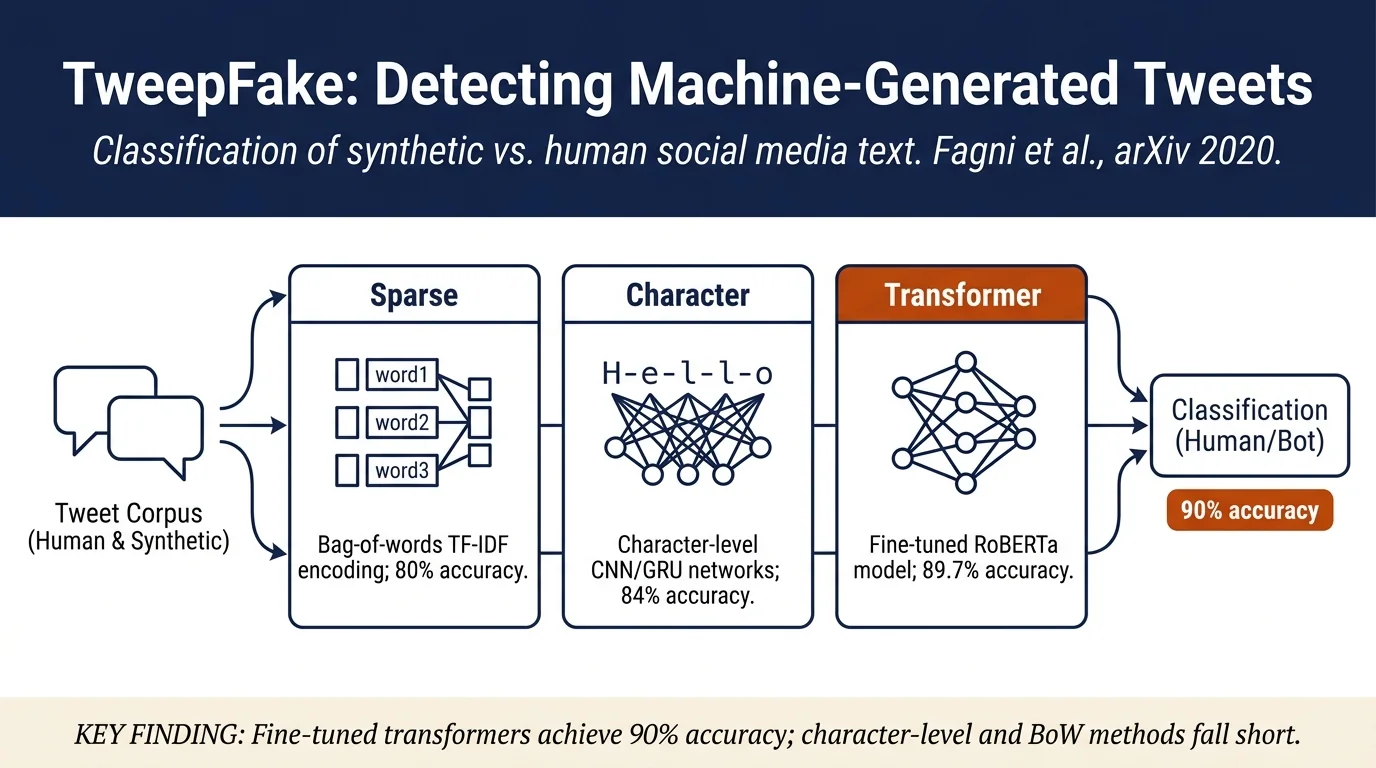
TweepFake: about detecting deepfake tweetsFirst publicly available dataset of real human-written and machine-generated tweets (TweepFake: 25,572 tweets, half human, half bot-generated from GPT-2, RNN, LSTM, Markov Chains, etc.). Benchmarks 13 detection methods and finds that transformer-based models fine-tuned on this task (RoBERTa) achieve ~90% accuracy, while BoW approaches…
 Datasets & evaluationDetection methods
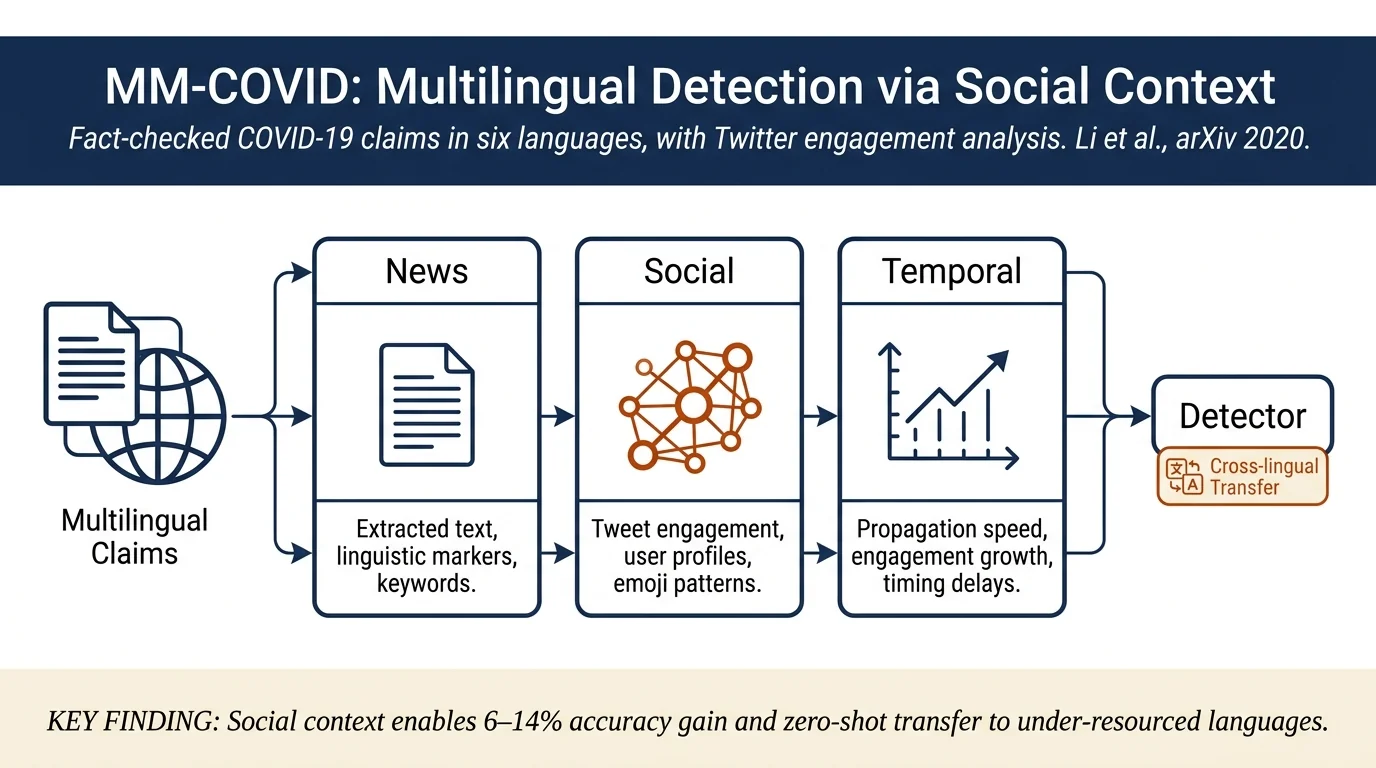
MM-COVID: A Multilingual and Multimodal Data Repository for Combating COVID-19 DisinformationThe paper introduces MM-COVID, a multilingual and multimodal dataset of COVID-19 fake news and social engagements in six languages (English, Spanish, Portuguese, Hindi, French, Italian). The dataset includes 3,981 fake news pieces with 7,192 tweets, fact-checking metadata, user profiles, and temporal propagation information.
 Deepfakes & multimodalDetection methods
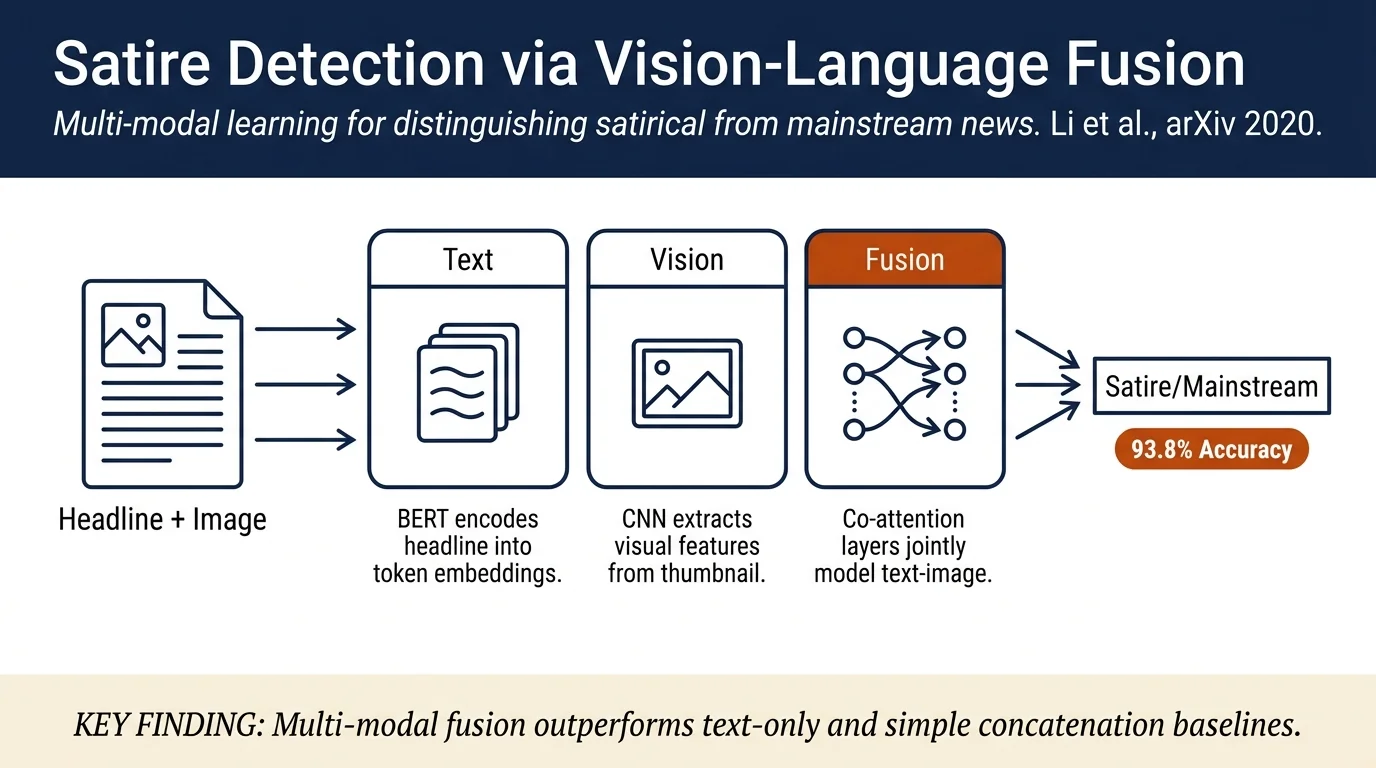
A Multi-Modal Method for Satire Detection using Textual and Visual CuesSatirical news articles are often misinterpreted as legitimate news. This work proposes a multi-modal approach using ViLBERT to detect satire by jointly analyzing headline text and thumbnail images, achieving 93.8% accuracy on a new dataset of 10,000 articles (4000 satirical, 6000 mainstream).
 Detection methodsDatasets & evaluation
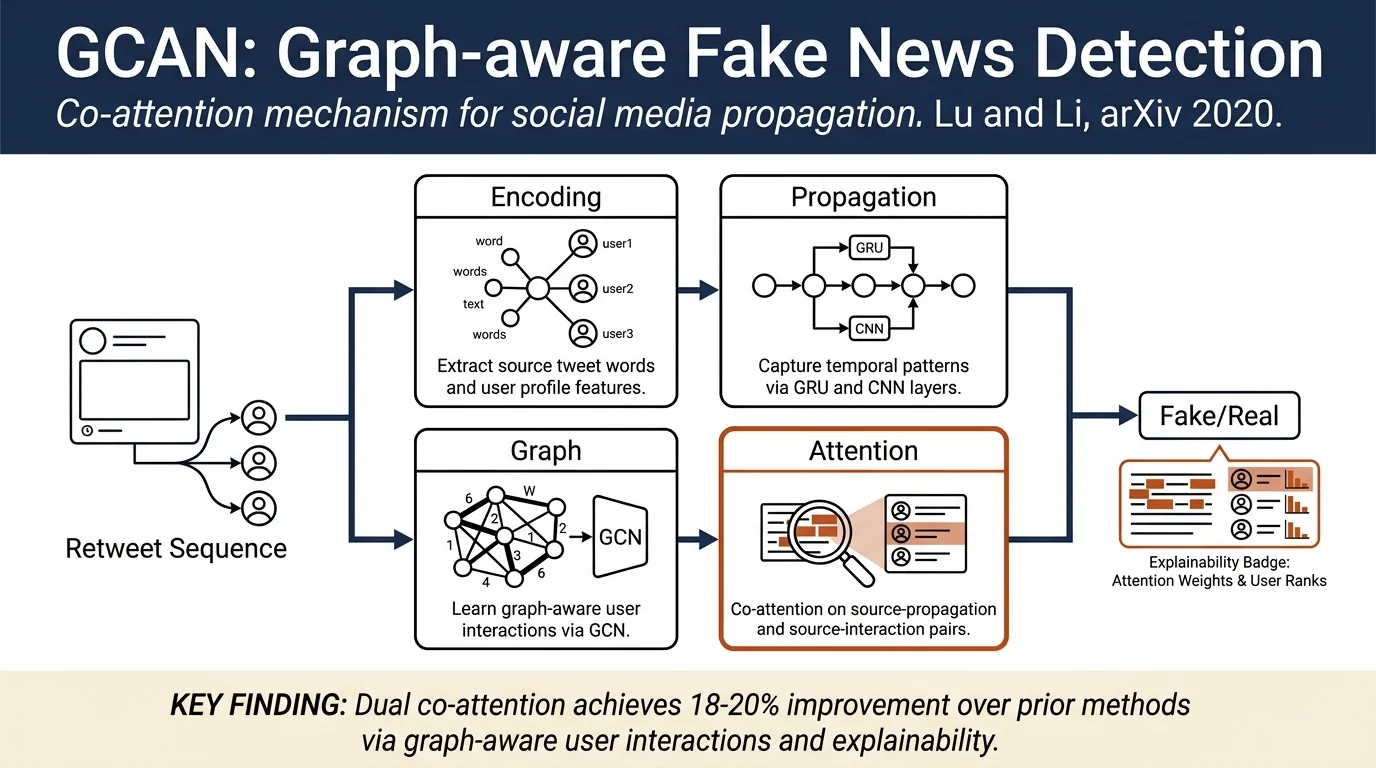
GCAN: Graph-aware Co-Attention Networks for Explainable Fake News Detection on Social MediaGCAN tackles fake news detection on Twitter with only source tweets and retweet sequences—no user comments or network structure required. The model combines graph convolution networks to capture user interactions with a dual co-attention mechanism to highlight suspicious retweeters and words.
 Datasets & evaluationSpread & networks
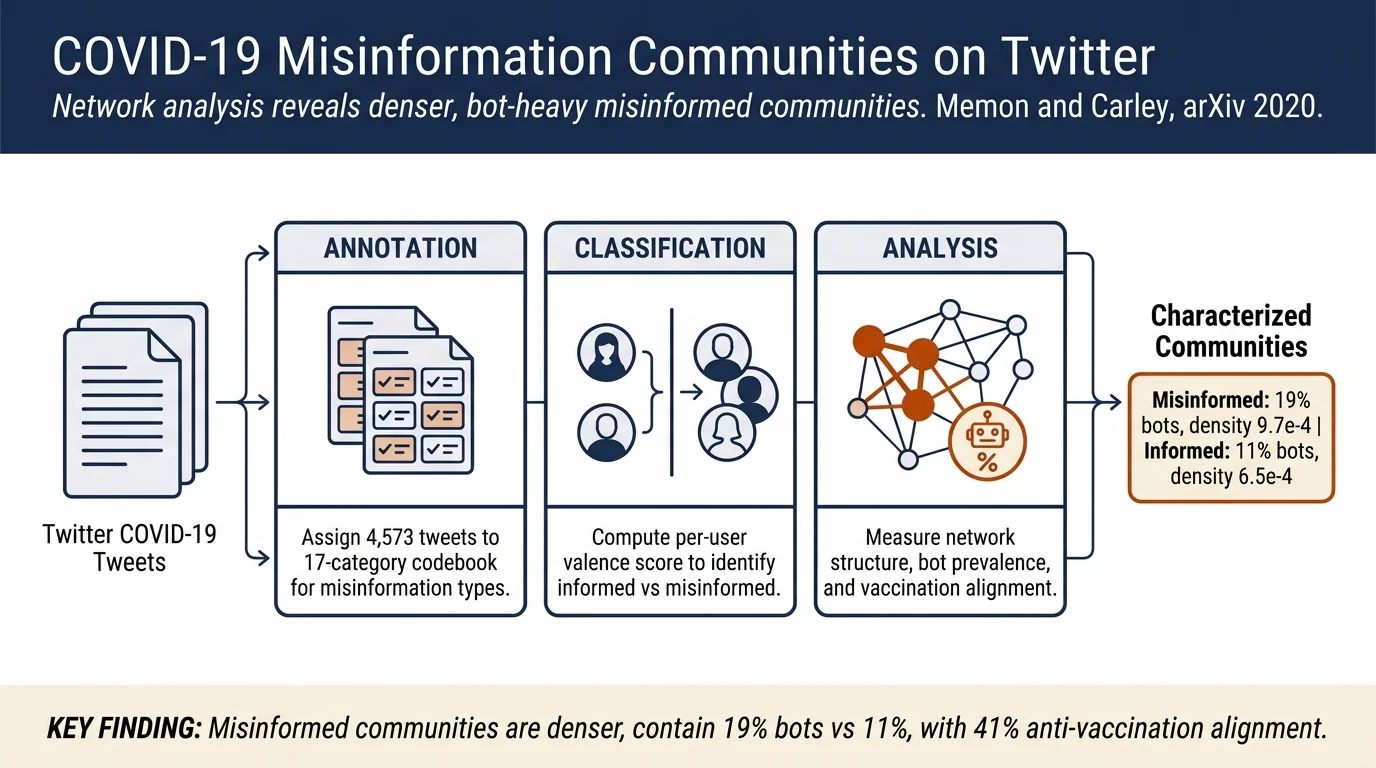
Characterizing COVID-19 Misinformation Communities Using a Novel Twitter DatasetThis paper presents CMU-MisCOV19, a manually annotated Twitter dataset of 4,573 COVID-19 tweets across 17 categories, and characterizes misinformed versus informed online communities. Key findings: misinformed communities are significantly denser (higher network density), contain more bots (19% vs 11%), and demonstrate higher…
 Datasets & evaluationDetection methods
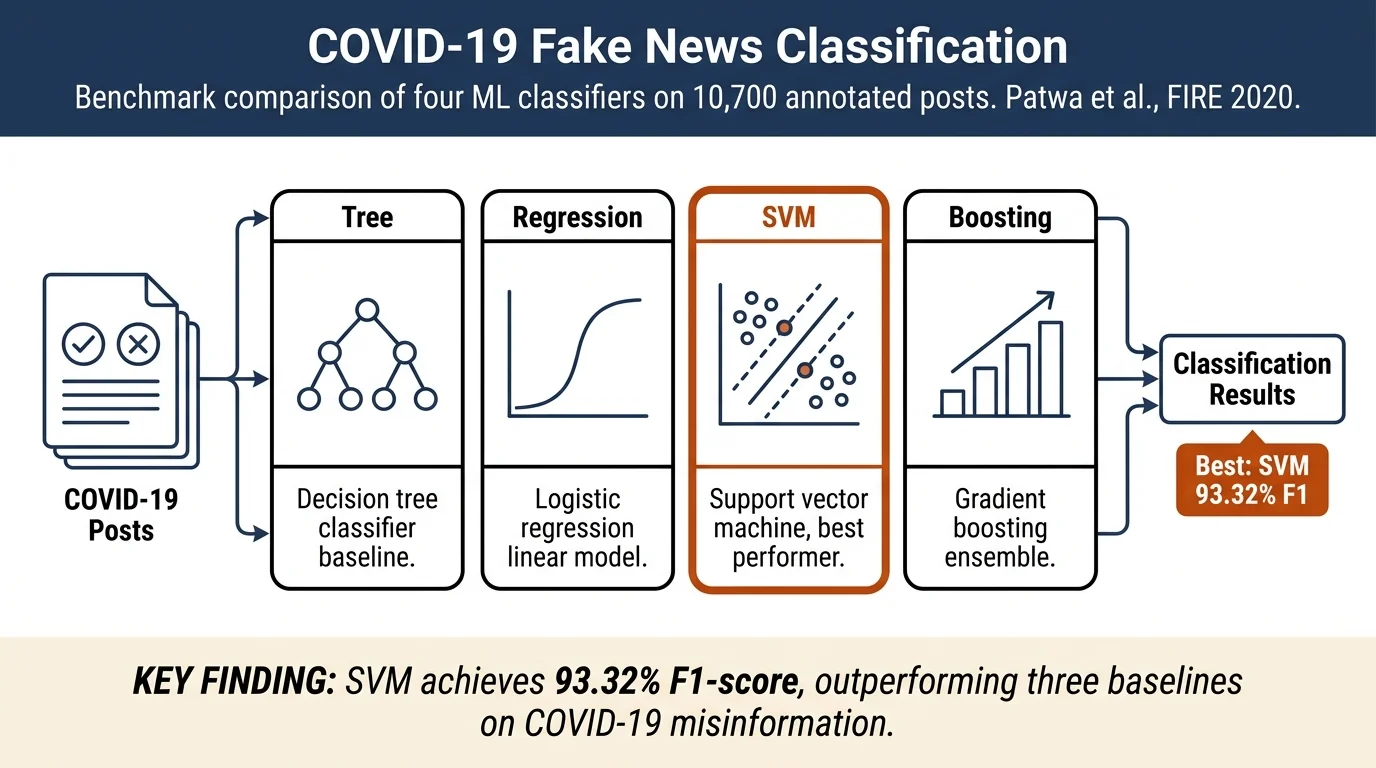
Fighting an Infodemic: COVID-19 Fake News DatasetThe authors present a manually annotated dataset of 10,700 COVID-19 related posts and articles (52% real, 48% fake) collected from social media and fact-checking websites. They benchmark four machine learning baselines (Decision Tree, Logistic Regression, SVM, Gradient Boost), achieving 93.32% F1-score with SVM, and release both the…
 Bots & coordinated campaignsDetection methods
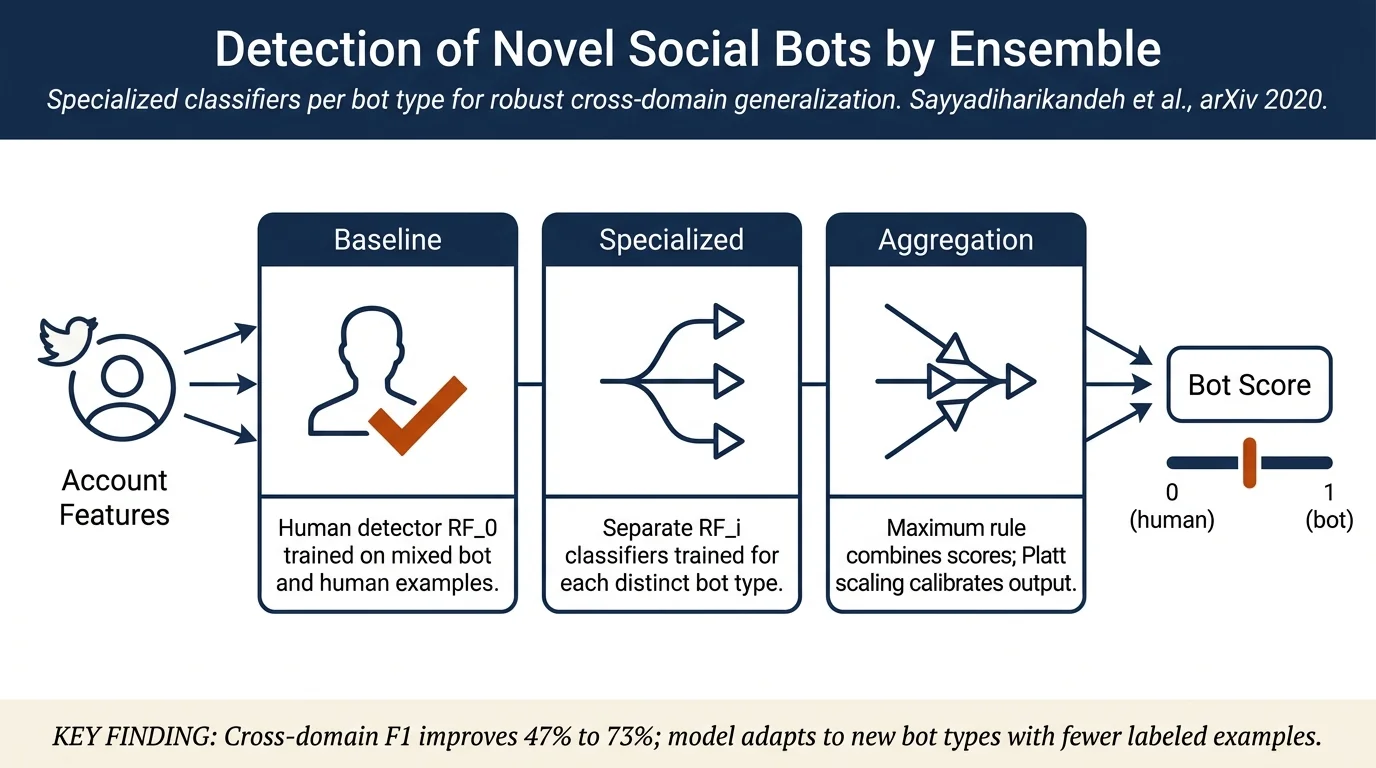
Detection of Novel Social Bots by Ensembles of Specialized ClassifiersDifferent types of social bots exhibit heterogeneous behavioral features; training a single classifier on all bots fails to generalize to novel bot types. The authors propose ESC (Ensemble of Specialized Classifiers), which trains separate classifiers for each bot class and combines their decisions via a maximum rule, achieving a 56%…
 Deepfakes & multimodalDetection methods
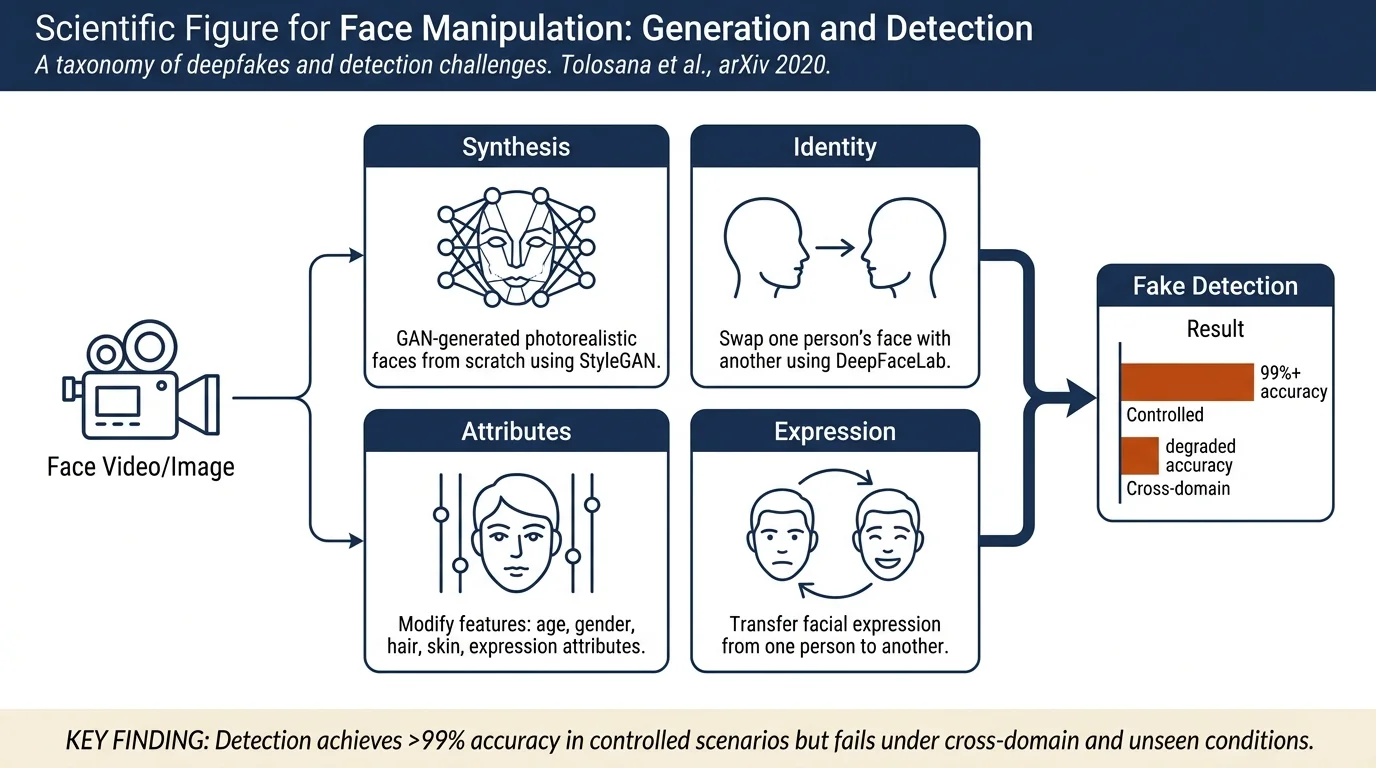
DeepFakes and Beyond: A Survey of Face Manipulation and Fake DetectionThis comprehensive survey reviews face manipulation techniques and detection methods in the era of deep learning. It categorizes facial manipulations into four types—entire face synthesis, identity swap, attribute manipulation, and expression swap—and surveys both generation and detection approaches across public datasets and benchmarks.
 Detection methodsDatasets & evaluation
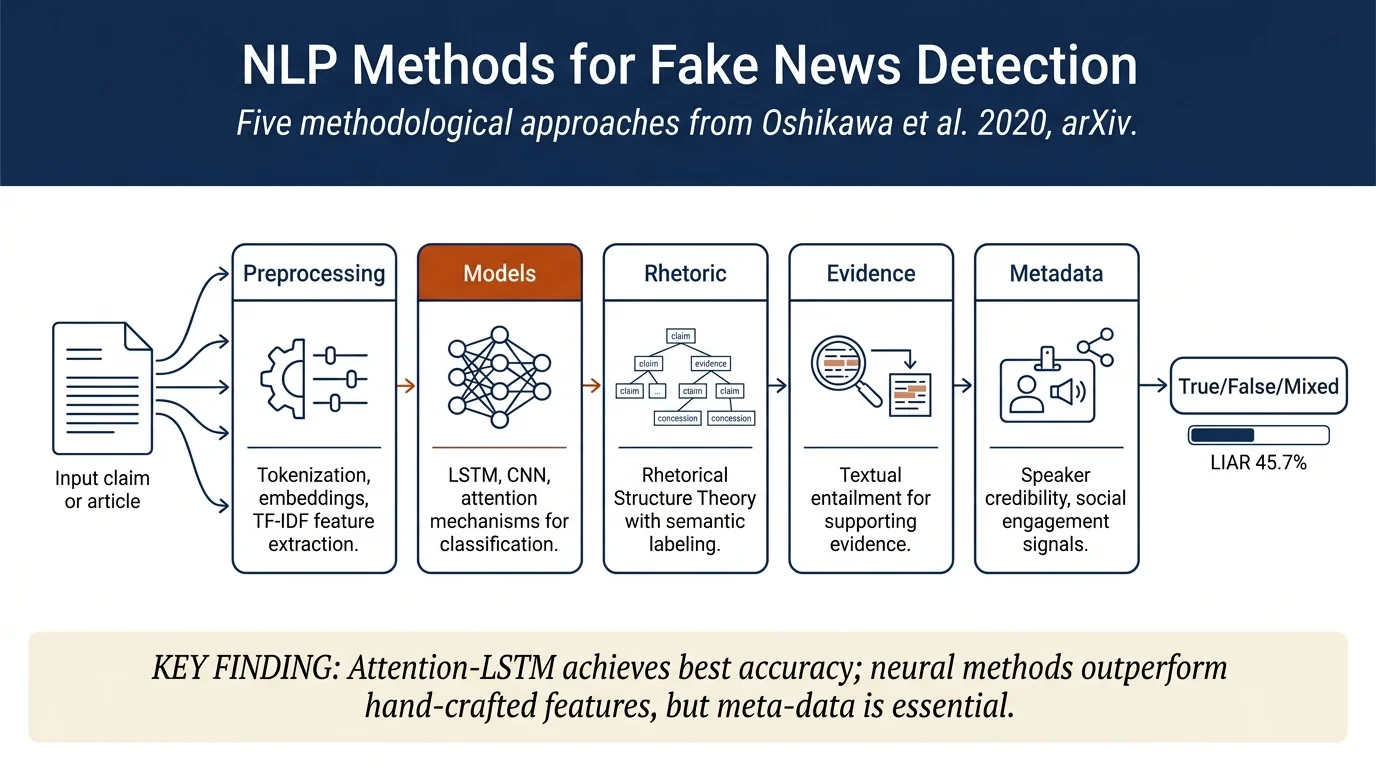
A Survey on Natural Language Processing for Fake News DetectionThis survey comprehensively reviews NLP methods for fake news detection, systematically comparing task formulations (classification vs. regression), nine benchmark datasets (LIAR, FEVER, FakeNewsNet, Twitter/SNS datasets), and five methodological approaches (preprocessing, machine learning models, rhetorical structure, evidence…
 Datasets & evaluationDetection methods
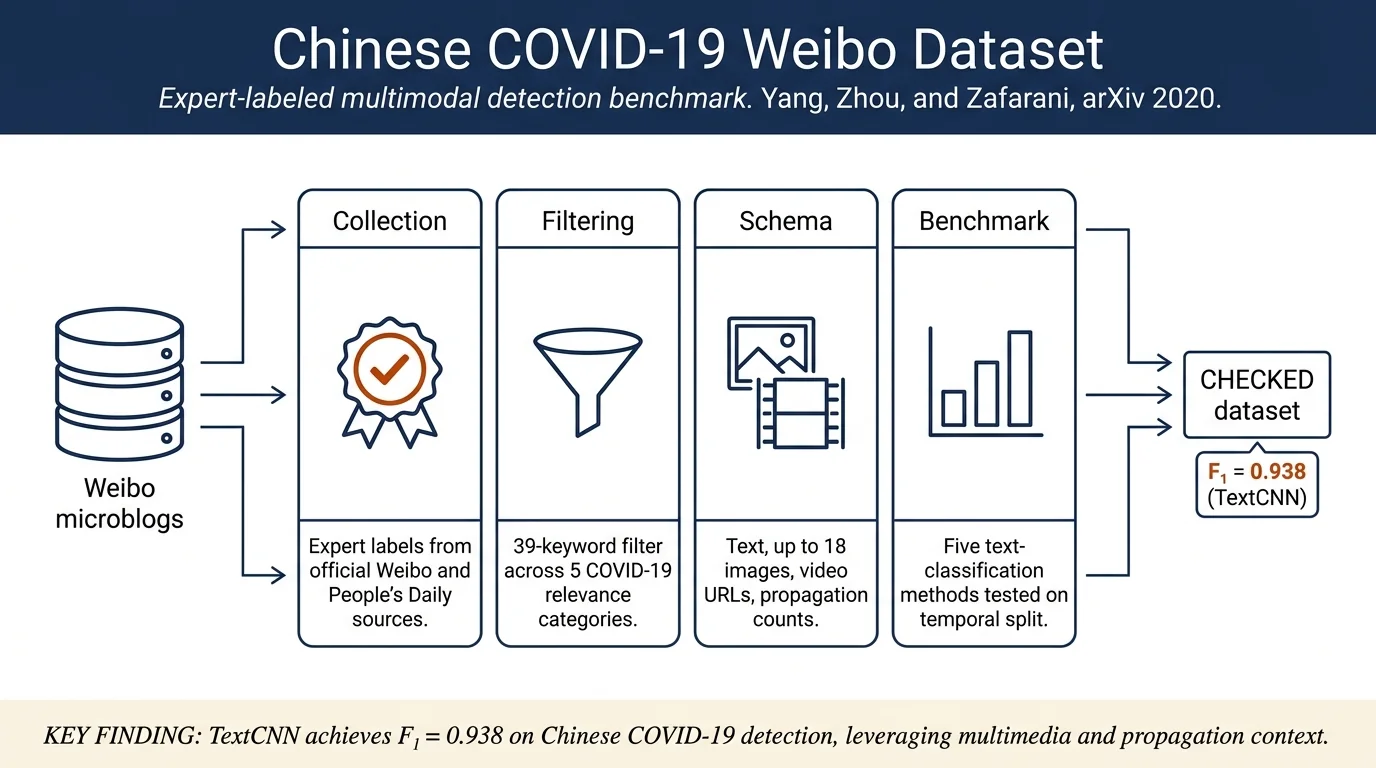
CHECKED: Chinese COVID-19 Fake News DatasetCHECKED is the first Chinese-language, fact-checked COVID-19 social media dataset — 2,104 Weibo microblogs (344 fake, 1,760 real) spanning December 2019 to August 2020, labeled using Weibo's expert-operated Community Management Center for fake posts and People's Daily official account for real posts. Each microblog carries rich…
 Datasets & evaluationDeepfakes & multimodal
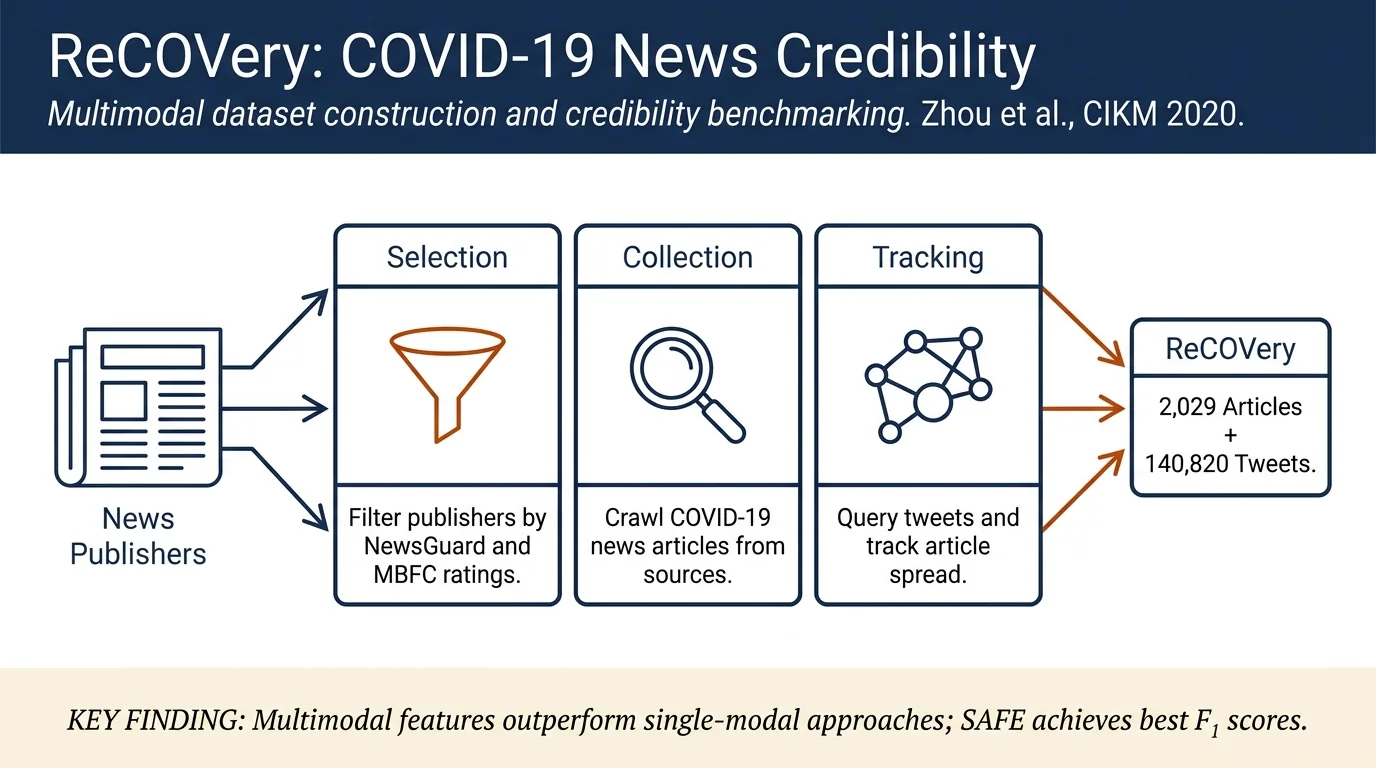
ReCOVery: A Multimodal Repository for COVID-19 News Credibility ResearchThe COVID-19 pandemic triggered a parallel "infodemic" of low-credibility news; this paper constructs ReCOVery, a multimodal repository of 2,029 COVID-19 news articles with binary credibility labels inherited from their publisher's NewsGuard/MBFC ratings, paired with 140,820 tweets tracking social spread. The key design trade-off is…
 Deepfakes & multimodalDetection methods
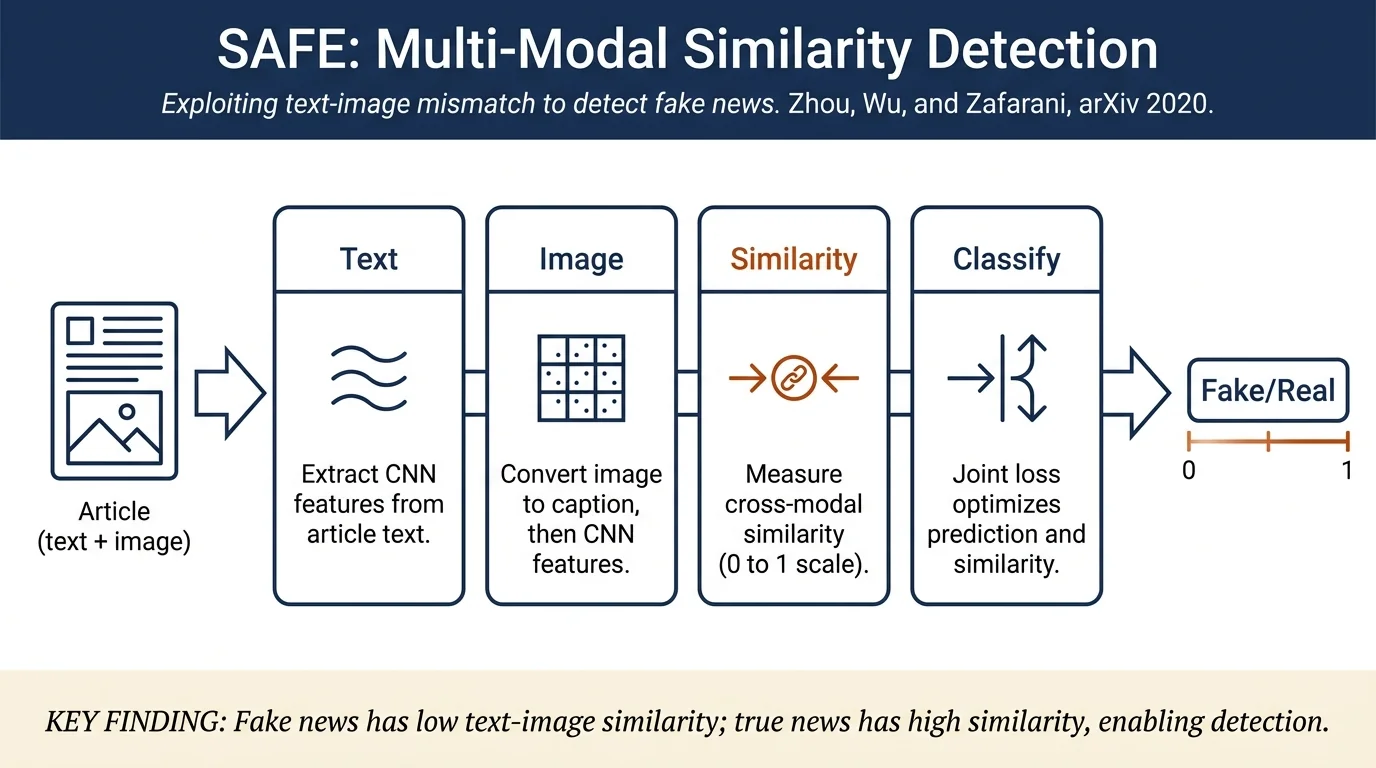
SAFE: Similarity-Aware Multi-Modal Fake News DetectionFake news articles frequently pair misleading textual claims with irrelevant or manipulative images, creating a detectable gap between the two modalities. SAFE addresses this by extracting separate neural representations of a news article's text and images — using the same Text-CNN architecture applied to an image2sentence embedding for…
 LLMs & generative AIDetection methods
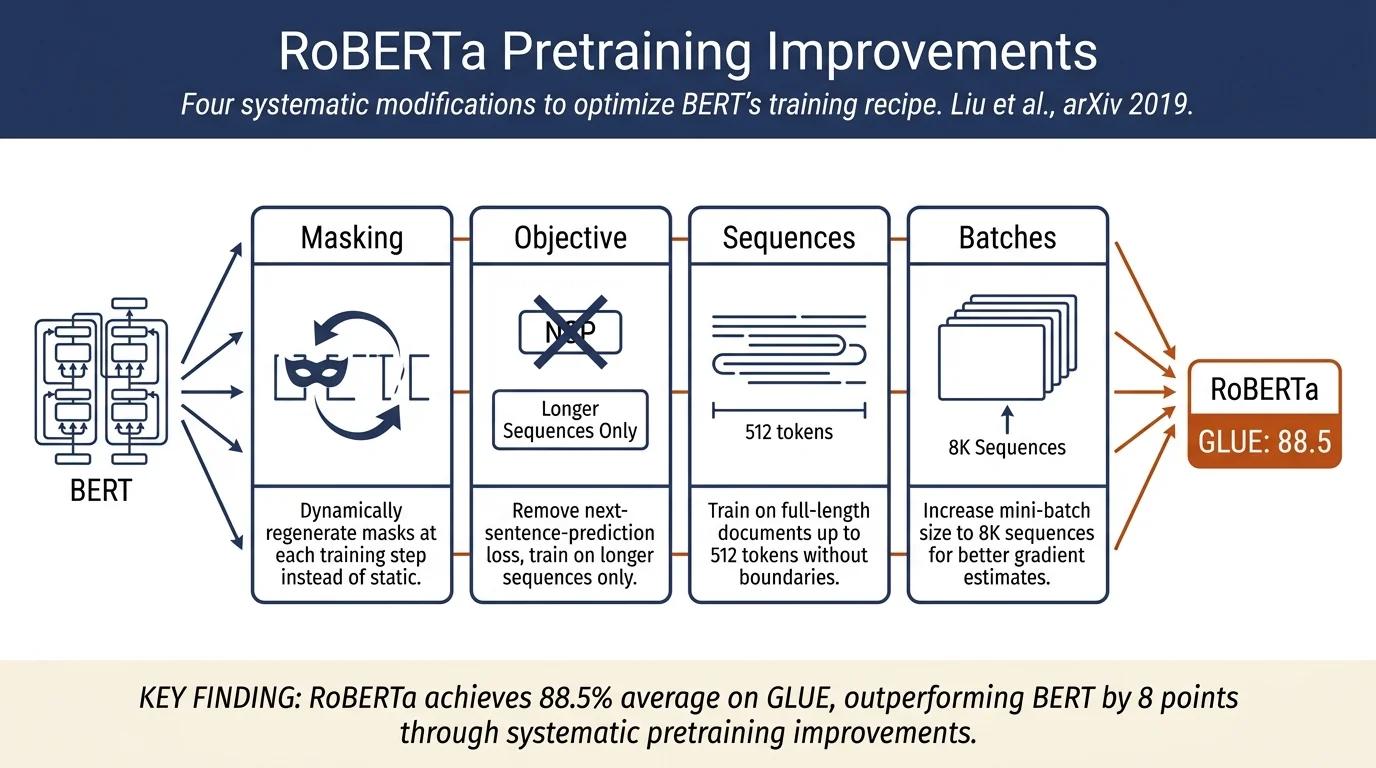
RoBERTa: A Robustly Optimized BERT Pretraining ApproachA replication and improvement study of BERT pretraining showing that BERT was significantly undertrained. RoBERTa introduces four key improvements—training longer with larger batches and more data, removing the next-sentence-prediction objective, training on longer sequences, and dynamically masking tokens—to achieve state-of-the-art…
 Fact-checking & verificationDatasets & evaluation
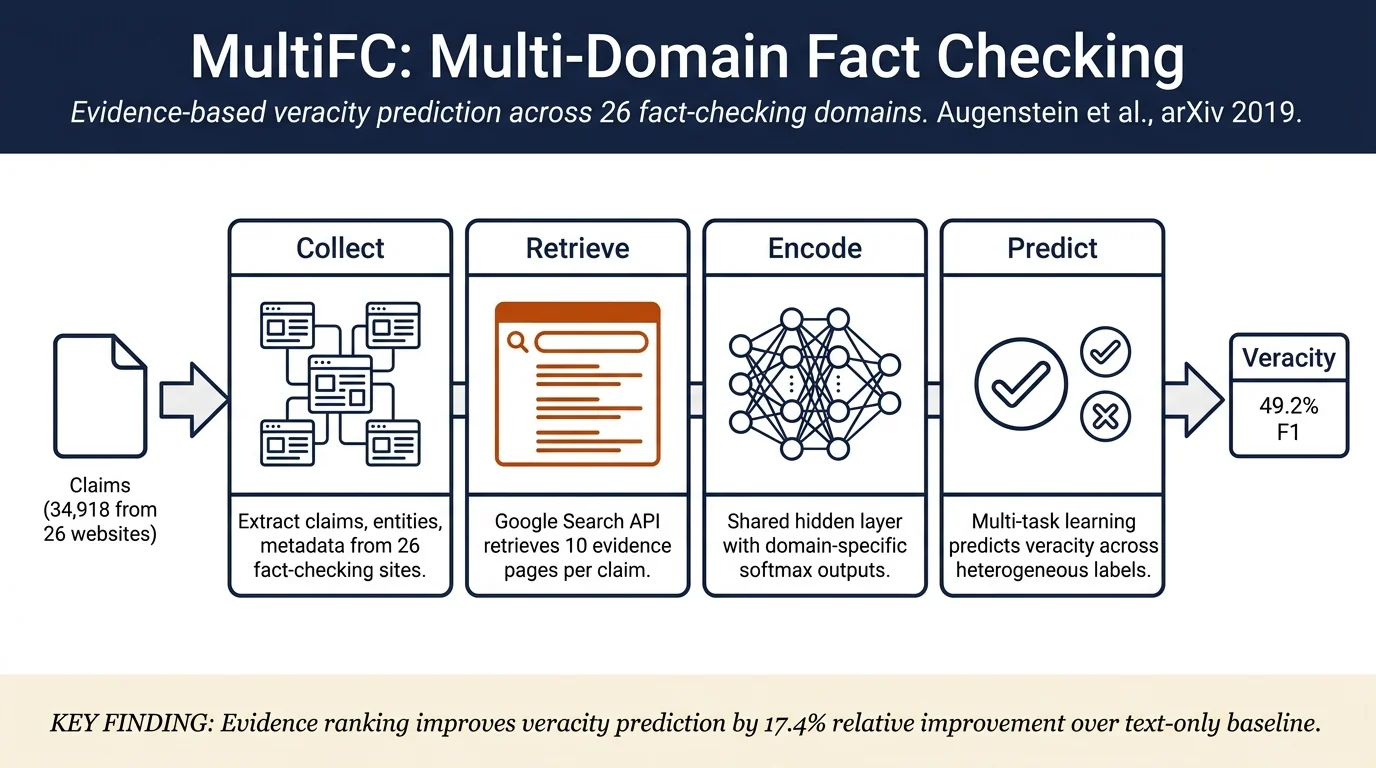
MultiFC: A Real-World Multi-Domain Dataset for Evidence-Based Fact Checking of ClaimsMultiFC is the largest publicly available real-world dataset of naturally occurring factual claims (34,918 claims) collected from 26 fact-checking websites, with rich metadata, evidence pages retrieved via Google Search, and entity linking to Wikipedia. The paper demonstrates that evidence ranking combined with veracity prediction…
 Fact-checking & verificationDatasets & evaluation
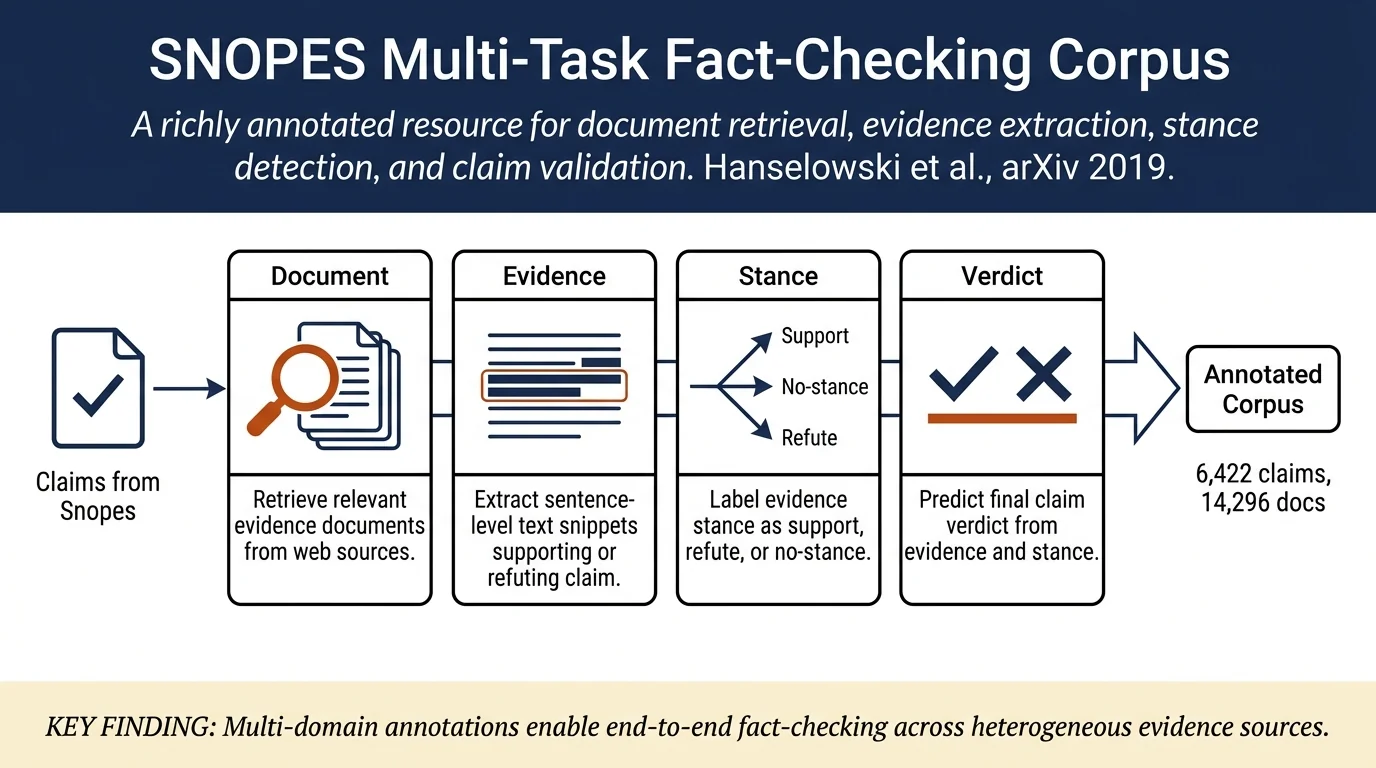
A Richly Annotated Corpus for Different Tasks in Automated Fact-CheckingThe paper introduces SNOPES, a large-scale fact-checking corpus with 6,422 validated claims and 14,296 documents covering multiple domains (news, social media, blogs). Each claim is annotated with evidence text snippets, evidence stance (support/refute/no stance), and verdicts, enabling training of models for four core fact-checking…
 Detection methodsLLMs & generative AI
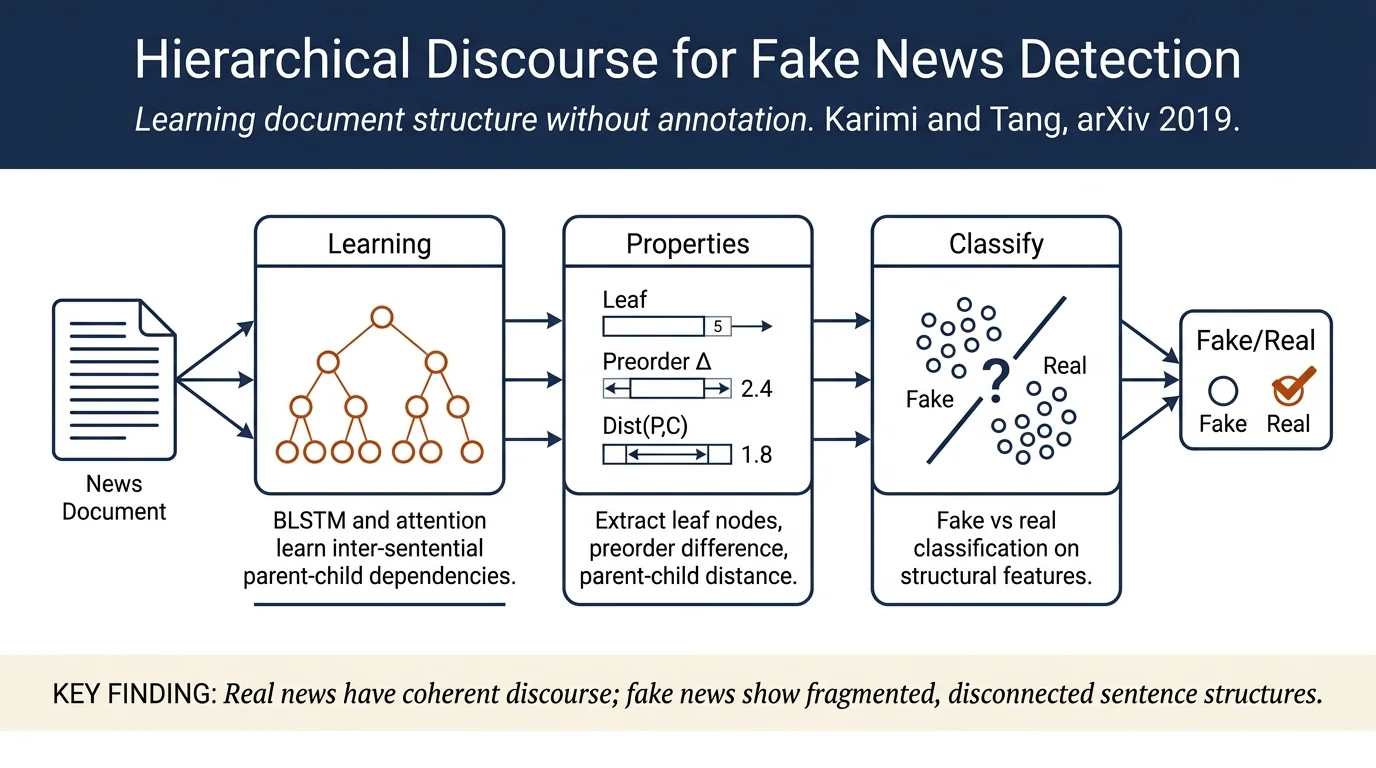
Learning Hierarchical Discourse-level Structure for Fake News DetectionProposes HDSF, a framework that learns hierarchical discourse-level structure (dependency trees of sentences) for fake news detection without annotated corpora. Identifies three structure-related properties that distinguish fake from real news and shows HDSF achieves 82.19% accuracy, outperforming linguistic baselines.
 Datasets & evaluationDetection methods
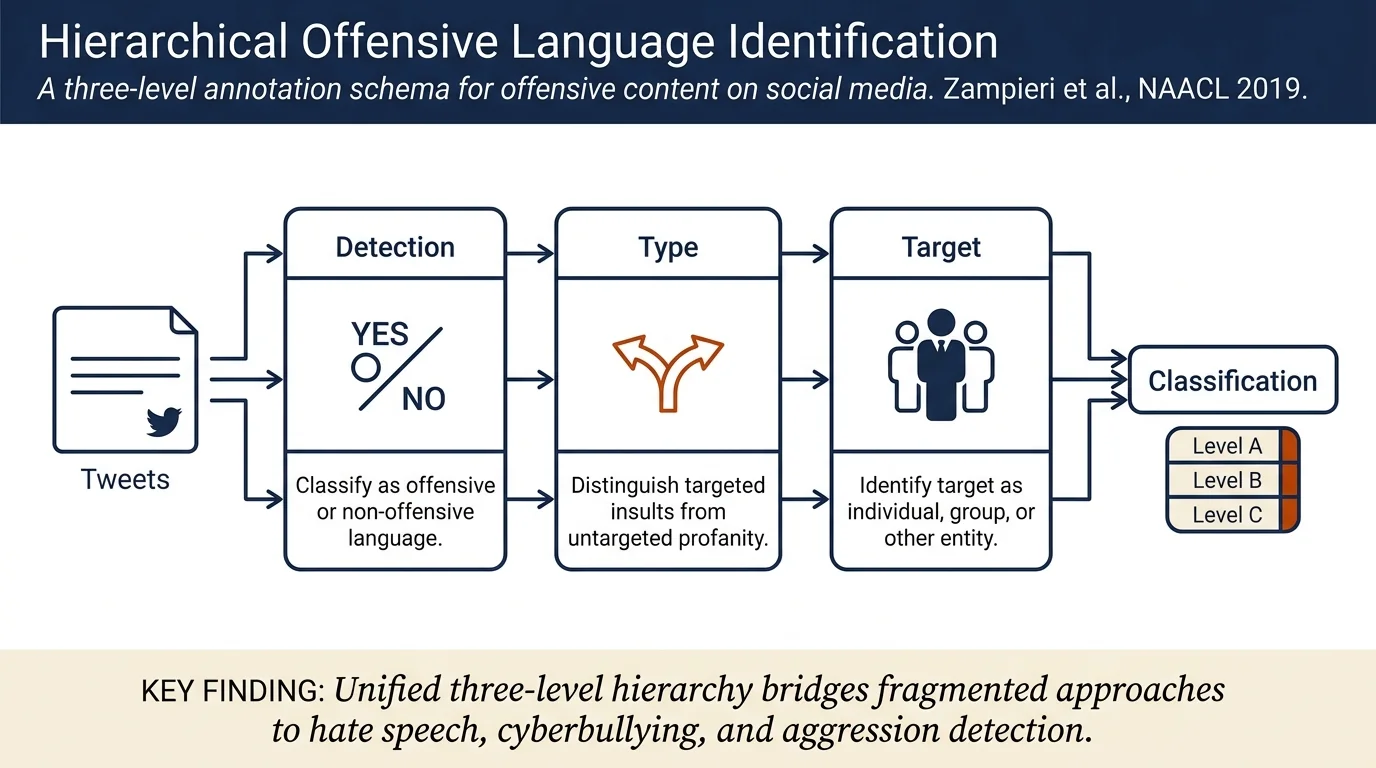
Predicting the Type and Target of Offensive Posts in Social MediaThis paper introduces OLID (Offensive Language Identification Dataset), a large-scale dataset of 14,100 English tweets annotated with a three-level hierarchical schema for detecting offensive content. The hierarchy distinguishes offensive from non-offensive posts (Level A), categorizes offense type as targeted insults or untargeted…