GCAN: Graph-aware Co-Attention Networks for Explainable Fake News Detection on Social Media
Authors: Yi-Ju Lu, Cheng-Te Li
Affiliation: National Cheng Kung University, Taiwan
Year: 2020 — arXiv:2004.11648
TL;DR
GCAN tackles fake news detection on Twitter with only source tweets and retweet sequences—no user comments or network structure required. The model combines graph convolution networks to capture user interactions with a dual co-attention mechanism to highlight suspicious retweeters and words. It achieves 87.7% accuracy on Twitter15 and 90.8% on Twitter16, outperforming prior work by ~18% while providing interpretable explanations.
Contributions
- Addresses a realistic detection scenario: short-text tweets, no user response comments, no explicit network topology
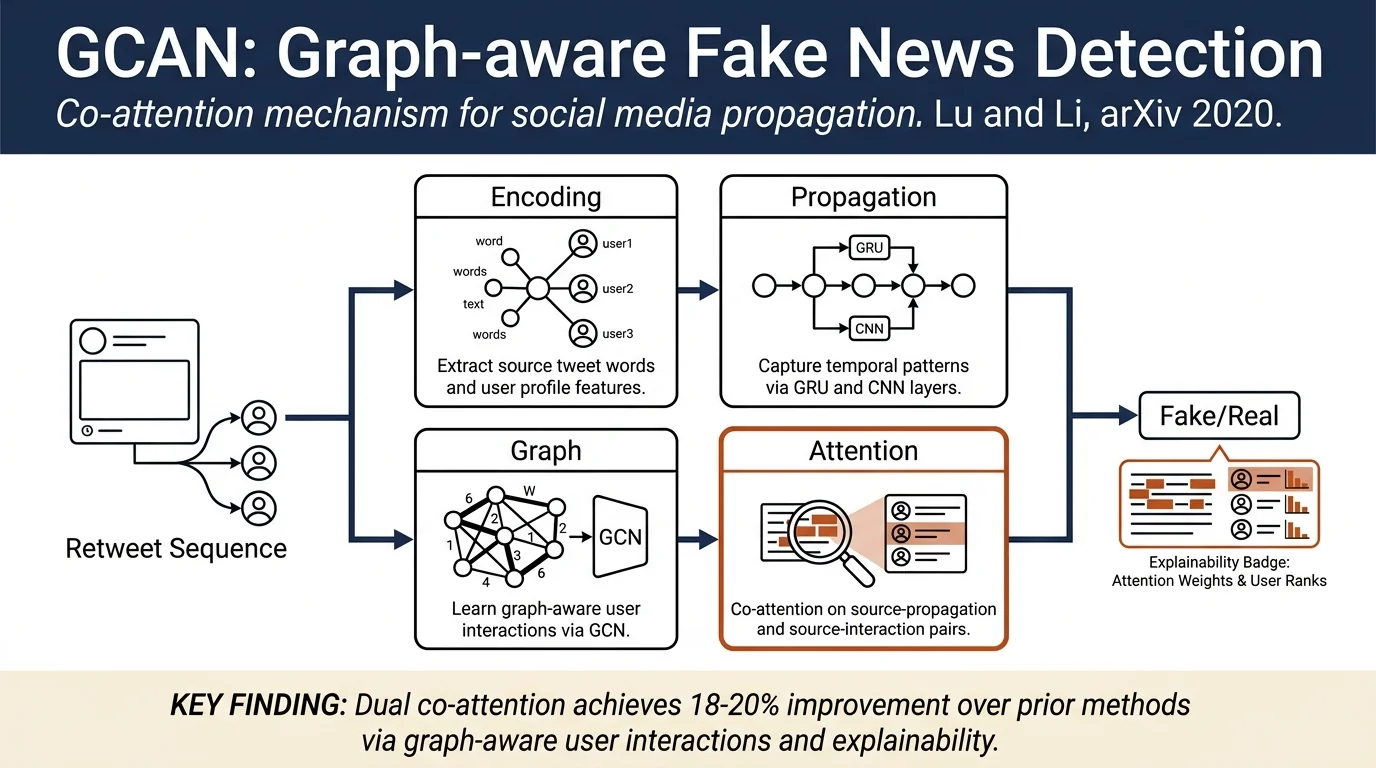
- Proposes GCAN, combining CNN/RNN propagation representations with graph-aware user interactions via GCN
- Develops a dual co-attention mechanism (source-propagation and source-interaction) that provides explainability
- Demonstrates early detection capability: achieves 90% accuracy with only 10 retweets
- Extensive experiments on Twitter15 and Twitter16 show 18–20% improvement over state-of-the-art (CSI, dEFEND, CRNN)
Method
GCAN consists of five components:
User Characteristics Extraction: Extracts 10 features from each retweeting user's profile: self-description length, followers, following count, account age, verification status, location settings, temporal features, and retweet path distance.
Source Tweet Encoding: GRU processes word embeddings of the source tweet to capture sequential word dependencies.
User Propagation Representation: Models the retweet sequence using: - GRU-based: captures temporal patterns in user characteristics across the retweet chain - CNN-based: learns local sequential correlations among consecutive retweeters
Graph-aware Propagation Representation: Constructs a fully-connected graph where nodes are retweeting users and edge weights are cosine similarities between user feature vectors. A two-layer GCN then learns graph-aware node representations.
Dual Co-Attention Mechanism: Two attention modules: - Source-propagation co-attention: learns which source tweet words are attended to by which users in the retweet sequence, enabling explainability on both words and user order - Source-interaction co-attention: learns the correlation between source tweet words and user interactions (graph-aware features)
The final prediction concatenates outputs from both co-attention paths plus the GRU propagation representation through a feedforward network.
Results
Main Results (Table 3): - Twitter15: 87.67% accuracy, 82.50 F1 (vs. best competitor dEFEND: 73.83%, 65.41 F1) — 18.7% improvement - Twitter16: 90.84% accuracy, 75.93 F1 (vs. best competitor dEFEND: 70.16%, 63.11 F1) — 19.9% improvement - GCAN-G (without GCN) still outperforms prior work by 14–3%, showing the value of both graph structure and co-attention
Early Detection: With only 10 retweeters observed, GCAN achieves ~90% accuracy on Twitter15, significantly faster than baselines.
Ablation: Each component contributes meaningfully; removing co-attention or propagation representations causes the largest performance drops.
Explainability
The co-attention weights reveal: - Word-level: Fake news tends to attract attention to dramatic/sensational words ("breaking", "strict"), while real news highlights confirmatory language ("confirmed", "irrelevant") - User-level: Suspicious users for fake news are often unverified, have short account histories, and shorter paths to the source - Temporal: Fake news characteristics appear evenly distributed across retweet order, suggesting early detection is feasible but requires analyzing the full sequence
The model provides reasonable explanations without requiring long-text articles or user comments.
Connections
- Related to FakeNewsNet: A Data Repository with News Content, Social Context and Spatiotemporal and dEFEND: Explainable Fake News Detection via shared explainable detection goal, but GCAN works with short text and no comments
- Extends Detect Rumors in Microblog Posts Using Propagation Structure via Kernel Learning and Rumor Detection on Twitter with Tree-structured Recursive Neural Networks by replacing tree structures with fully-connected graphs and adding co-attention
- Builds on EANN: Event Adversarial Neural Networks for Multi-Modal Fake News Detection and CSI: A Hybrid Deep Model for Fake News Detection by incorporating graph-aware user interactions and dual attention
- Related to Propagation-based fake news detection and Graph Neural Networks topics
Notes
Strengths: - Realistic scenario (short tweets, no comments, no explicit network structure) reflects how most tweets actually propagate - Explainability is a strong practical feature for deployment; attention weights align with linguistic intuitions about fake news - Early detection with few retweets is valuable for timely intervention - Comprehensive comparison against 8 baselines and ablation studies validate each component
Limitations: - Evaluation limited to two Twitter datasets; generalization to other platforms (Facebook, Reddit) unclear - Fully-connected graph assumption may not reflect true user interactions; privacy-preserving alternative to explicit retweet graphs but potentially wasteful for large audiences - Hyperparameter choices (40 users, 32-dim embeddings) appear dataset-specific; sensitivity analysis missing - No user-level ground truth; cannot directly validate whether flagged users are actually suspicious
Future directions: Event-specific feature removal for robustness, cross-platform generalization, and extension to other short-text classification tasks.