A Decade of Social Bot Detection
Author: Stefano Cresci
Venue: Communications of the ACM, 2020 — DOI — arXiv
TL;DR
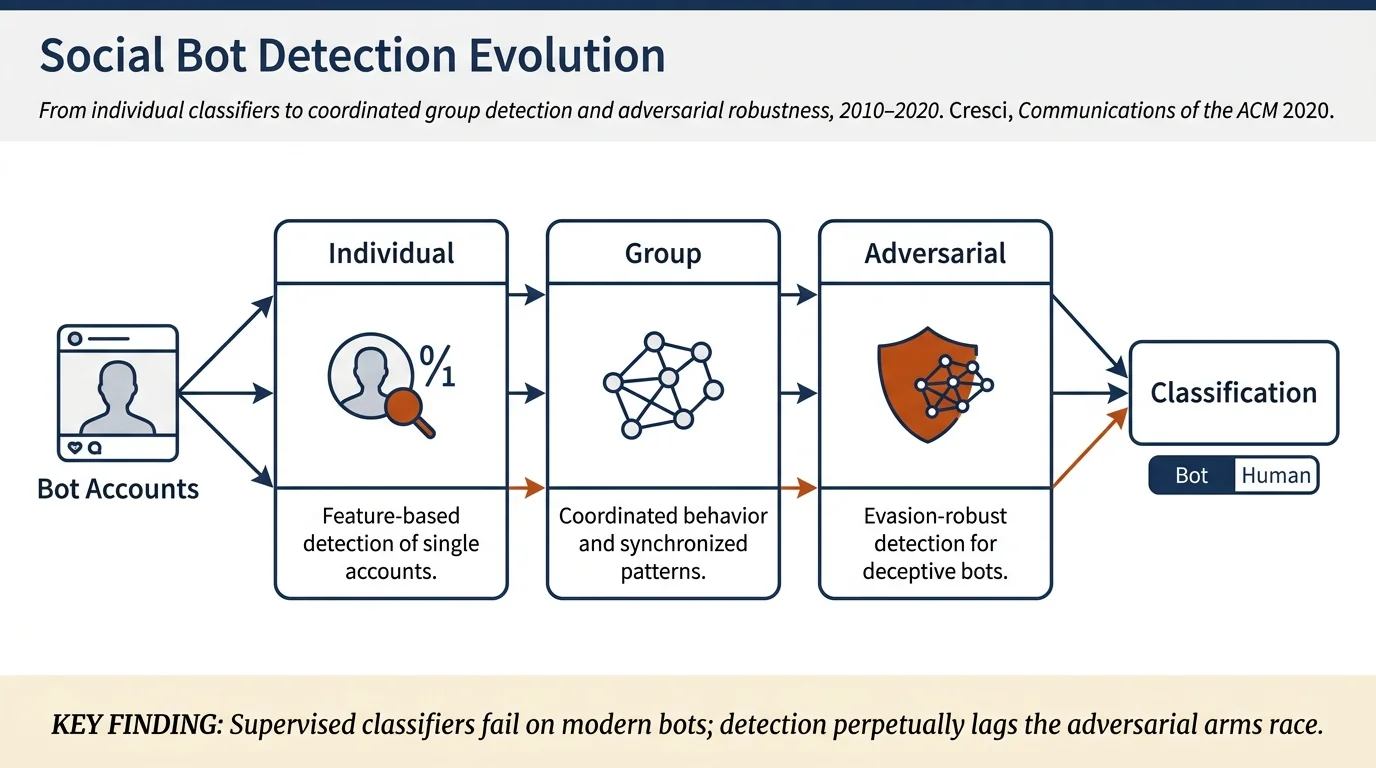
A comprehensive review of social bot detection research from 2010 to 2020, documenting the evolution from supervised individual-account detection to group-level approaches targeting coordinated inauthentic behavior. The paper traces the escalating "arms race" between bot developers and detection researchers, illustrates bots' documented role in political manipulation worldwide, and analyzes 230+ bot detectors across detection paradigms (supervised, unsupervised, crowdsourcing, heuristic, adversarial). Key finding: machine learning-based approaches assume stationarity and neutrality that no longer hold in practice, making detection increasingly challenging.
Contributions
- Longitudinal analysis of bot detection research trends over a decade, with publication growth accelerating sharply after 2014
- Systematic categorization of 230+ bot detection techniques across two orthogonal dimensions: individual vs. group detection, and methodological approach
- Documentation of bot evolution: early simple bots (circa 2011) → sophisticated, credible bots with stolen identities (circa 2016) → evolved hybrid bot-human accounts that blur automation boundaries
- World map showing 39 countries where scientific literature has documented political manipulation via bots
- Evidence that shift from individual to group-based detection is driven by bots' increasingly coordinated, synchronized behavior and social media platforms' challenge in removing sophisticated accounts
Method
The paper surveys and categorizes existing literature on social bot detection through 2019. The author classifies detectors along two key dimensions:
-
Detection scope: Individual accounts vs. groups of accounts. Early detectors (2010–2014) focused on separating bots from humans via account features (follower ratios, tweeting patterns, profile information). Newer approaches (2015+) exploit traces of coordination and synchronized behavior left by botnets.
-
Methodological approach: Five categories—(i) supervised machine learning (requires labeled training data); (ii) unsupervised machine learning (clustering, anomaly detection); (iii) crowdsourcing (human labeling); (iv) heuristic/rule-based systems; (v) adversarial approaches (designed to detect specific evasion tactics).
The author reviews 230+ detectors published since 2010 and traces how the composition of these approaches shifted over time. Figure 5 quantifies this evolution, showing group-based approaches overtaking individual detectors around 2015–2016.
Results
Publication trends: The field shows exponential growth. Approximately 1 new paper per day is published on bot detection (as of 2020), compared to roughly 1 per week in 2015.
Methodological evolution: - 2010–2014: Dominated by supervised individual-account detectors - 2014–2016: Rise of unsupervised approaches and first group detectors - 2016+: Sustained growth in both group and supervised detectors; rise of adversarial approaches starting 2017
Geographic scope: Political manipulation by bots documented in 39 countries across six continents, with the United States, Russia, China, and Brazil particularly prominent.
Bot evolution: Three "waves" of bots identified—(i) simplistic 2011-era bots with few followers and obvious automation markers; (ii) 2013–2015 "evolved" bots with detailed profiles and social connections; (iii) 2016+ hybrid accounts blurring the bot–human distinction via deepfake profiles and human-like posting patterns.
Detection performance paradox: Supervised detectors trained on 2011-era bots fail dramatically on modern bots. One study found that 24% of accounts labeled as bots by crowdsourcing were never removed, while 91% of older bots were successfully removed, indicating classifier drift.
Connections
- Relates to Arming the public with artificial intelligence to counter social bots on leveraging machine learning for public bot detection
- Complements Bots increase exposure to negative and inflammatory content in online social on coordinated bot behavior in specific events
- Cited by work on Coordinated inauthentic behavior and Strategic Information Operations
- Related to Assessing the Russian Internet Research Agency's impact on the political attitudes on state-sponsored disinformation campaigns
- Connects to Anatomy of an online misinformation network on how bots amplify false information
Notes
This is a high-level, accessible survey aimed at ACM Communications readership—technical but not a methods paper. Strengths: excellent longitudinal perspective showing how the field adapted to bot evolution; clear visualization of the shift toward group detection; frank acknowledgment that current ML approaches have fundamental limitations (non-stationarity, non-neutrality). Weakness: limited treatment of why platforms struggle to enforce bot removal at scale, and brief on solutions. The paper positions bot detection as an inherently adversarial, reactive endeavor, with detection lagging behind evasion. Essential reading for understanding the landscape; particularly valuable for contextualization of newer adversarial and graph-based approaches.