Explore papers
Filter by research area, year and venue. Every filter is in the address bar, so you can share a view as a link.
 Spread & networksPlatforms, policy & society
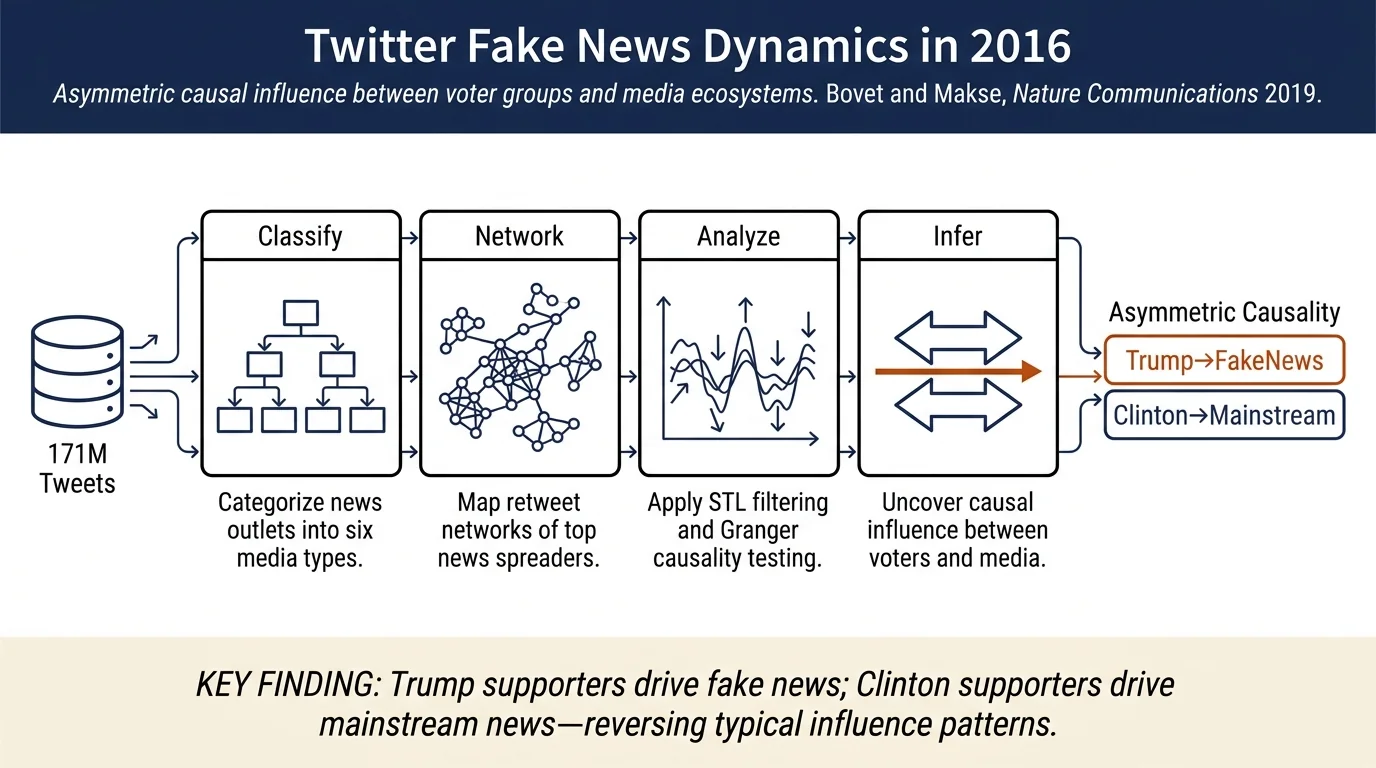
Influence of fake news in Twitter during the 2016 US presidential electionUsing 171 million tweets from the five months preceding the 2016 U.S. election, this study found that 25% of news-sharing tweets contained fake or extremely biased content. Network analysis revealed distinct clusters of fake, biased, and mainstream news spreaders.
 Spread & networksPlatforms, policy & society
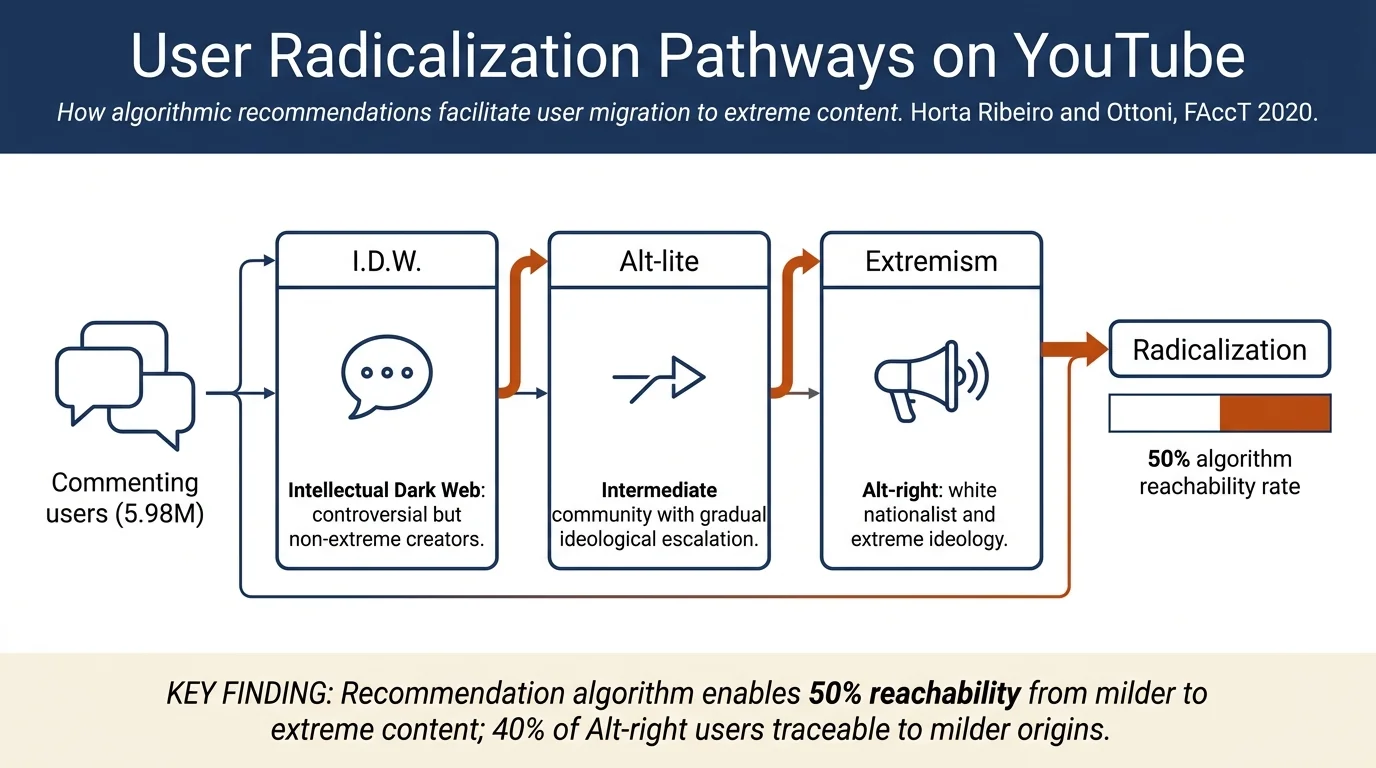
Auditing Radicalization Pathways on YouTubeFirst large-scale quantitative audit of user radicalization on YouTube. The authors tracked 349 channels across three ideological communities (Intellectual Dark Web, Alt-lite, Alt-right) and found strong evidence that users systematically migrate toward more extreme content.
 Detection methodsSpread & networks
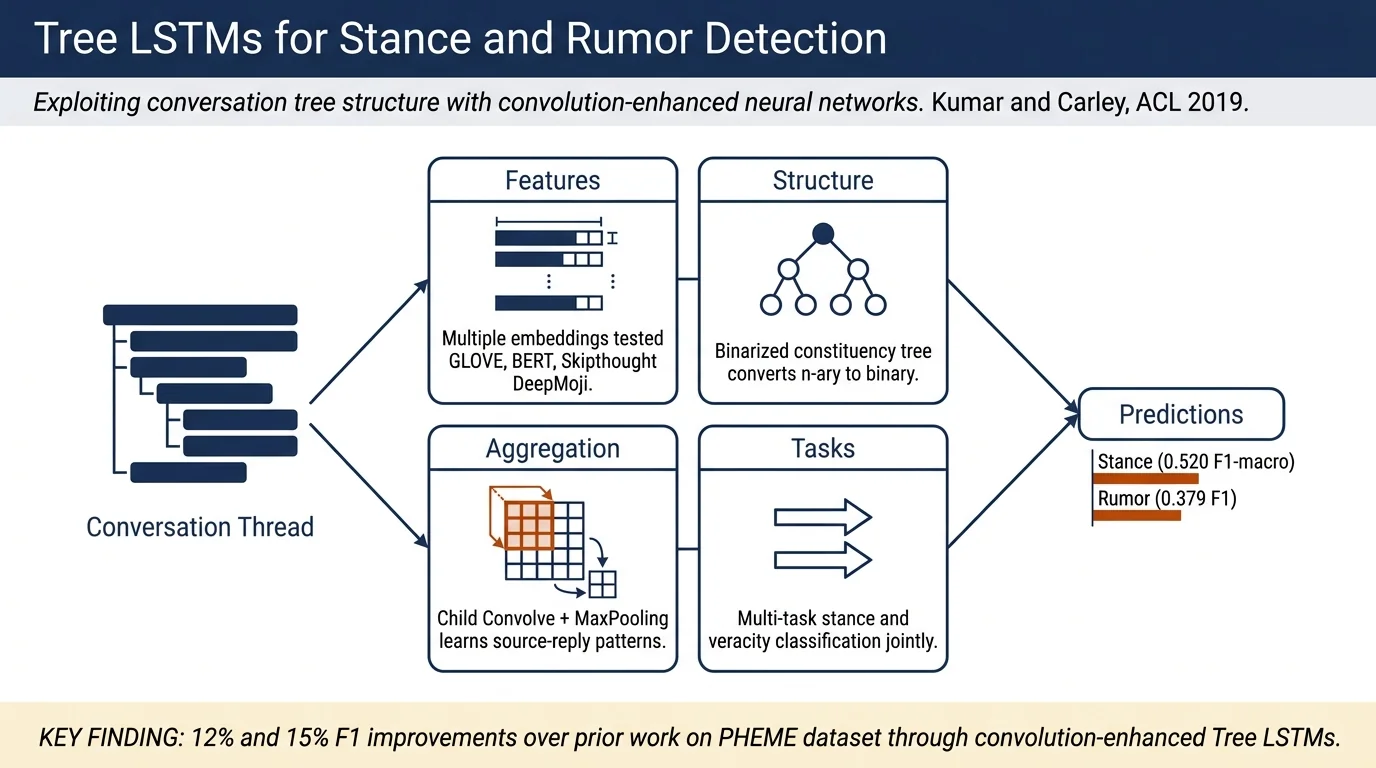
Tree LSTMs with Convolution Units to Predict Stance and Rumor Veracity in Social Media ConversationsProposes Tree LSTM and Binarized Constituency Tree (BCTree) LSTM architectures enhanced with convolution units to classify stance and predict rumor veracity in social media conversation threads. The approach exploits the tree structure inherent in threaded conversations (source post with nested replies) and combines it with convolutional…
 Spread & networksDatasets & evaluation
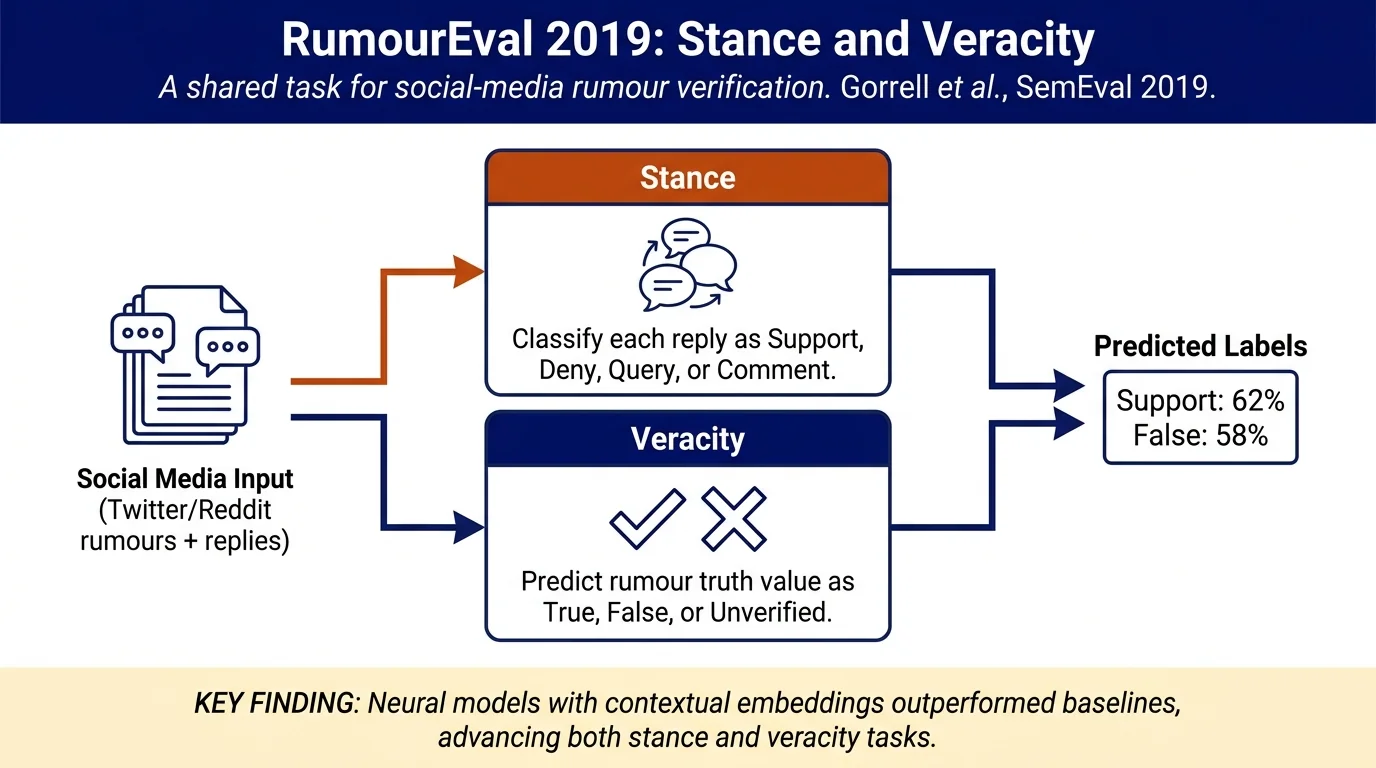
RumourEval 2019: Determining Rumour Veracity and Support for RumoursRumourEval 2019 is a shared task for rumour stance detection and veracity prediction on social media. Extending the 2017 edition, it introduces Reddit data alongside Twitter, provides datasets annotated for SDQC stance (Support/Deny/Query/Comment) and three-way veracity labels, and received 22 system submissions showing that modern…
 Spread & networksDetection methods
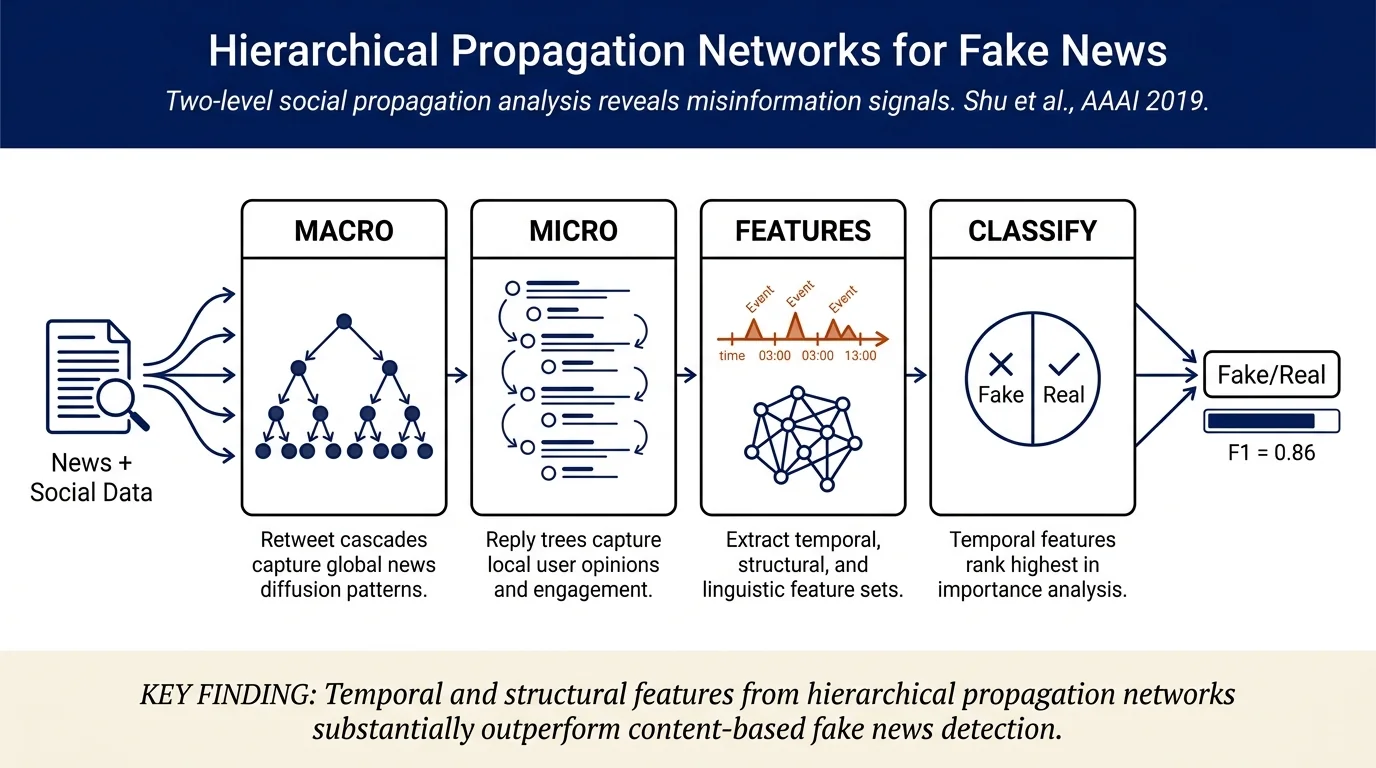
Hierarchical Propagation Networks for Fake News Detection: Investigation and ExploitationContent-only fake news detection has limited performance because fake news is deliberately crafted to mimic real news. This paper constructs hierarchical propagation networks from both macro-level (tweet/retweet cascade) and micro-level (reply conversation) granularity, extracts structural, temporal, and linguistic features from both…
 Spread & networksDetection methods
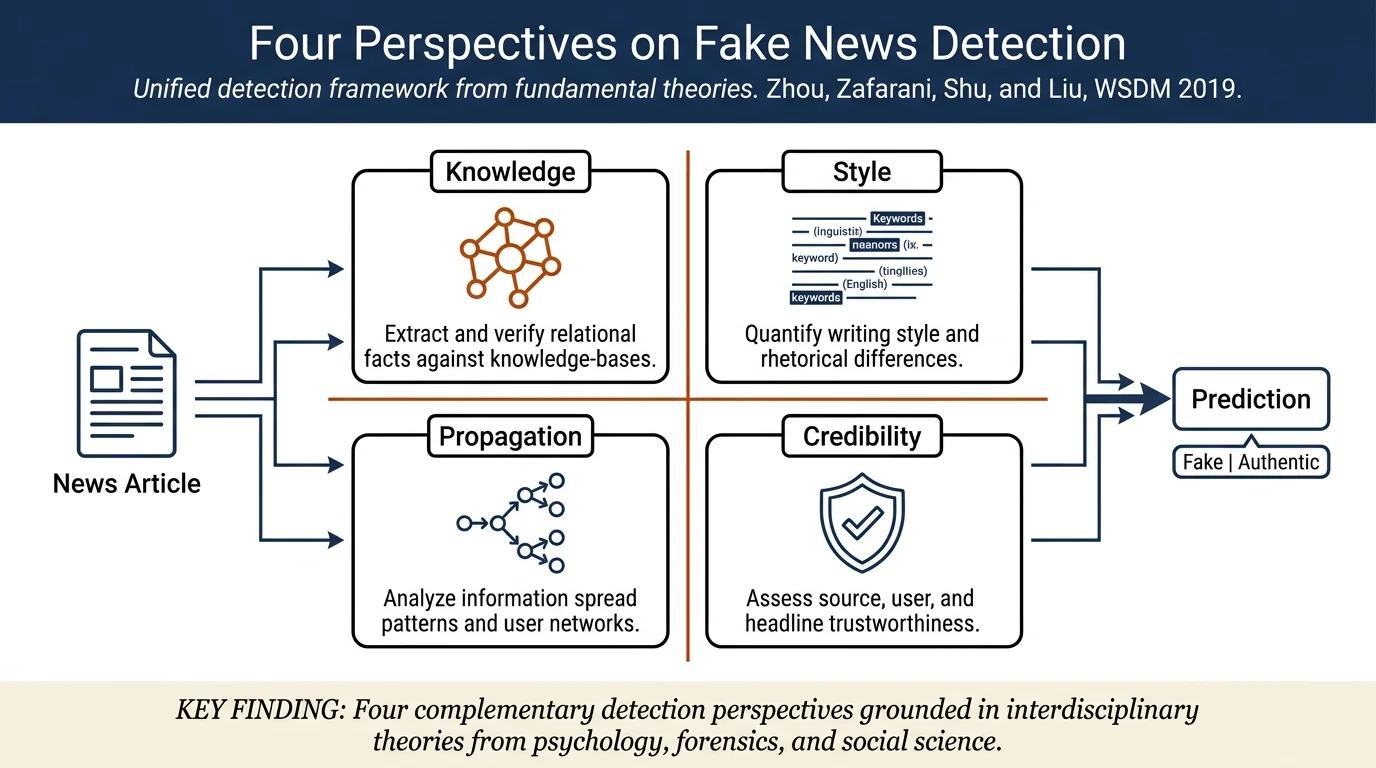
Fake News: Fundamental Theories, Detection Strategies and ChallengesA comprehensive tutorial framework addressing fake news research across three dimensions: (1) fundamental theories from psychology, social science, economics, and forensics explaining human vulnerability to misinformation and why individuals participate in fake news activities; (2) detection strategies unified across four perspectives…
 Detection methodsSpread & networks
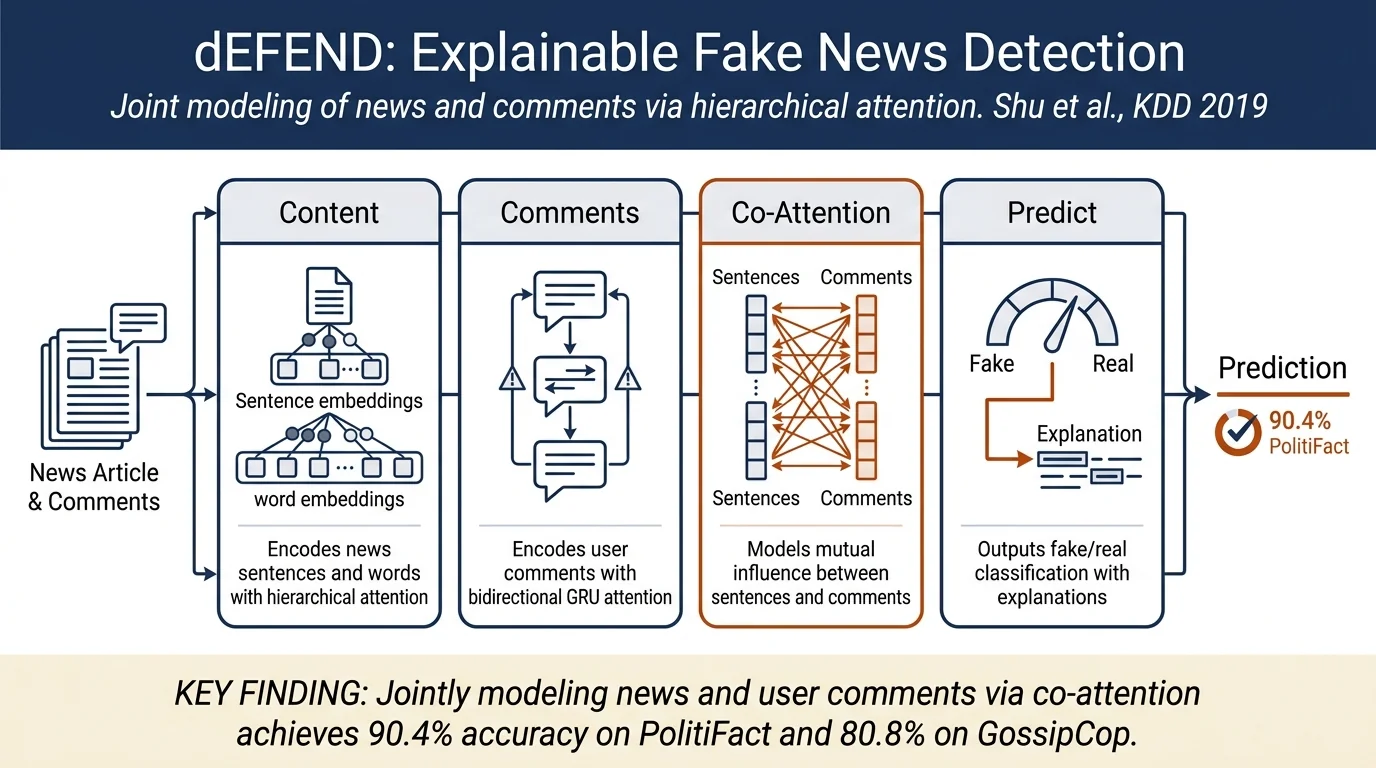
dEFEND: Explainable Fake News DetectionFake news detection on social media typically focuses on content alone, but user comments and reactions provide complementary signals. This paper proposes dEFEND, a hierarchical attention neural network that jointly encodes news sentences and user comments to both detect fake news and explain why a piece of news is detected as fake by…
 Spread & networksPlatforms, policy & society
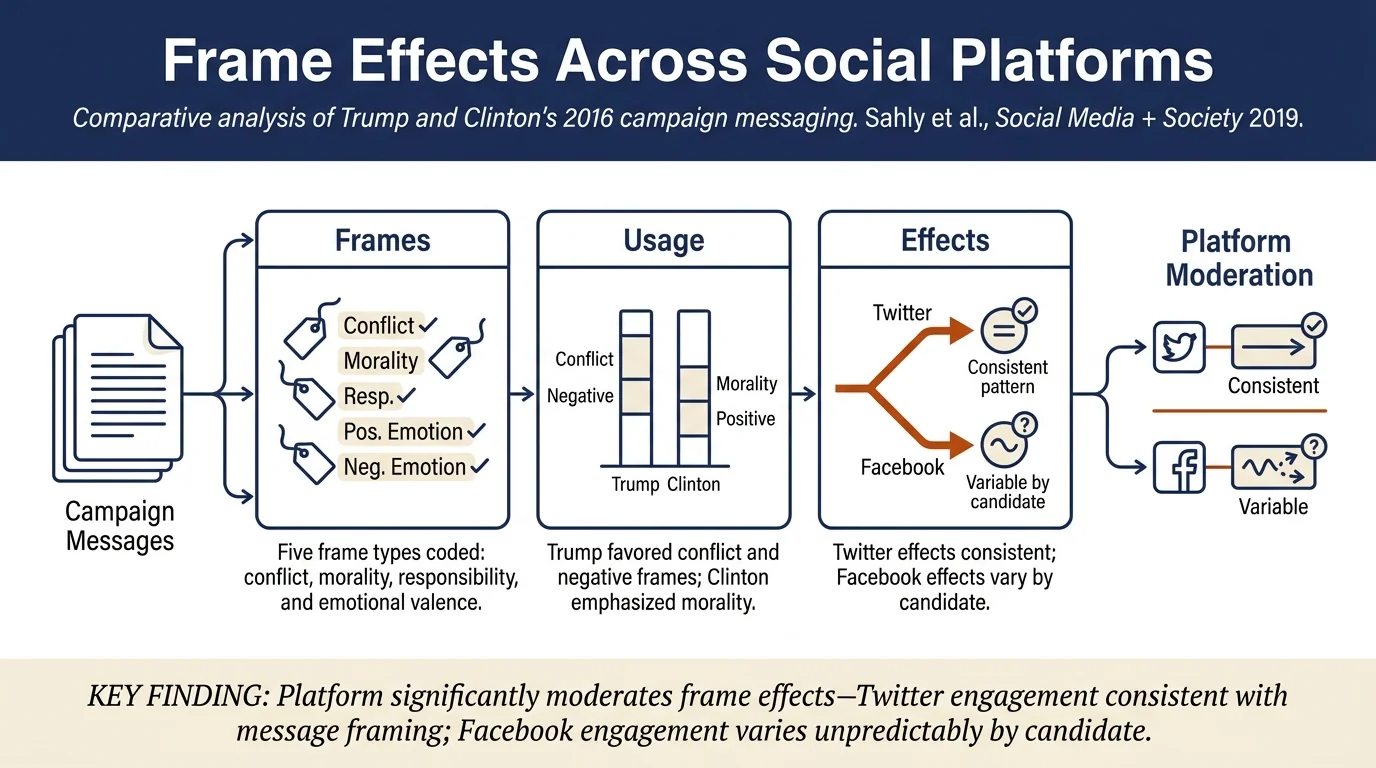
Social Media for Political Campaigns: An Examination of Trump's and Clinton's Frame Building and Its Effect on Audience EngagementThis study analyzes how Trump and Clinton's 2016 campaigns framed messages on Twitter and Facebook, and how frame type affected audience engagement. Trump relied on conflict and negative emotional frames, while Clinton used morality and positive emotional frames.
 Spread & networksBots & coordinated campaigns
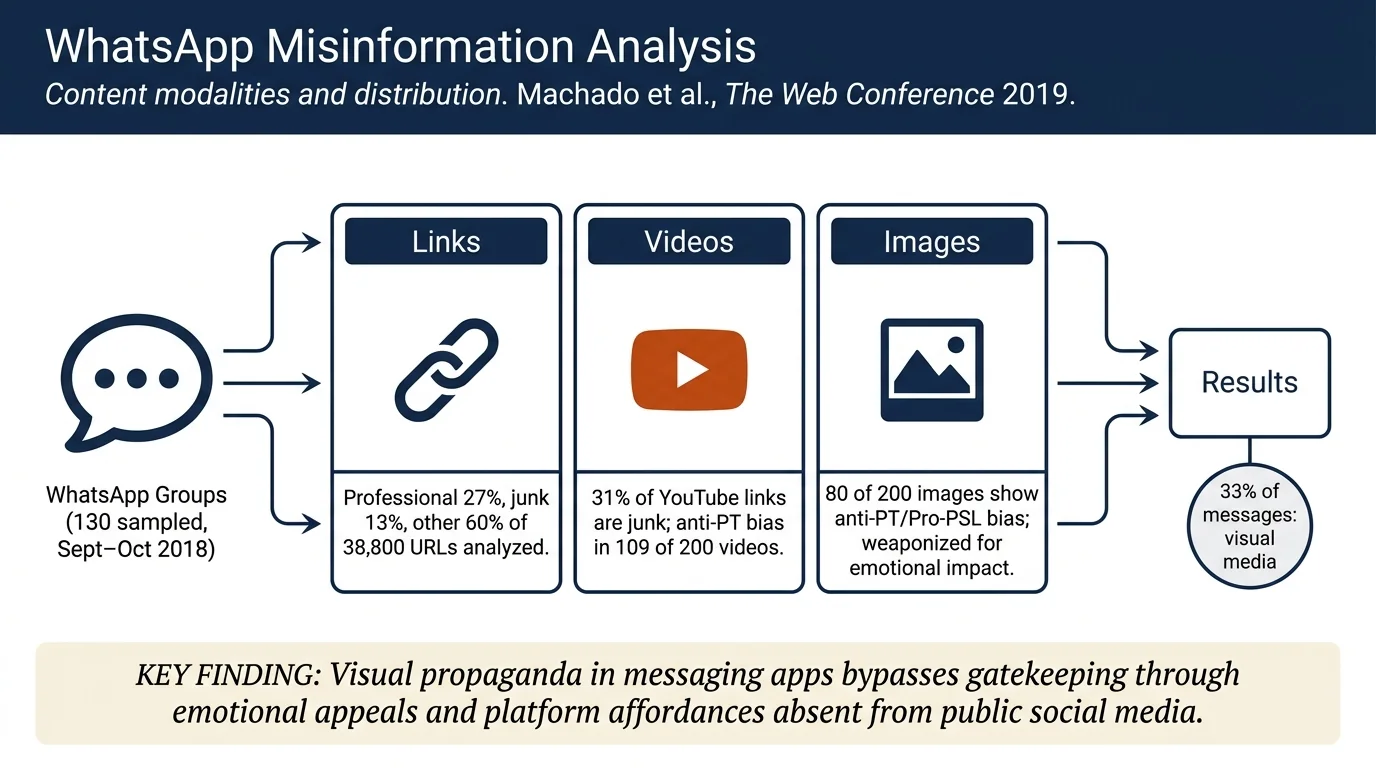
A Study of Misinformation in WhatsApp groups with a focus on the Brazilian Presidential ElectionsStudy of 130 public WhatsApp groups during the 2018 Brazilian presidential election found that 13.1% of shared links pointed to junk news sources, with 40% of links directing to YouTube—a platform used strategically to bypass platform moderation. Videos and images dominated message content (33% of all messages) and were heavily…
 Bots & coordinated campaignsPlatforms, policy & society
Coordinating a Multi-Platform Disinformation Campaign: Internet Research Agency Activity on Three U.S. Social Media Platforms, 2015 to 2017This paper analyzes Russian Internet Research Agency activity across Facebook, Twitter, and Reddit from 2015–2017 using vector autoregression models on 3,126 Facebook ads, 1.9M tweets, and 12,603 Reddit posts. Key finding: Reddit activity influenced subsequent Twitter activity (a "trial balloon" effect), but the IRA's Twitter engagement…
 Spread & networksPsychology & interventions
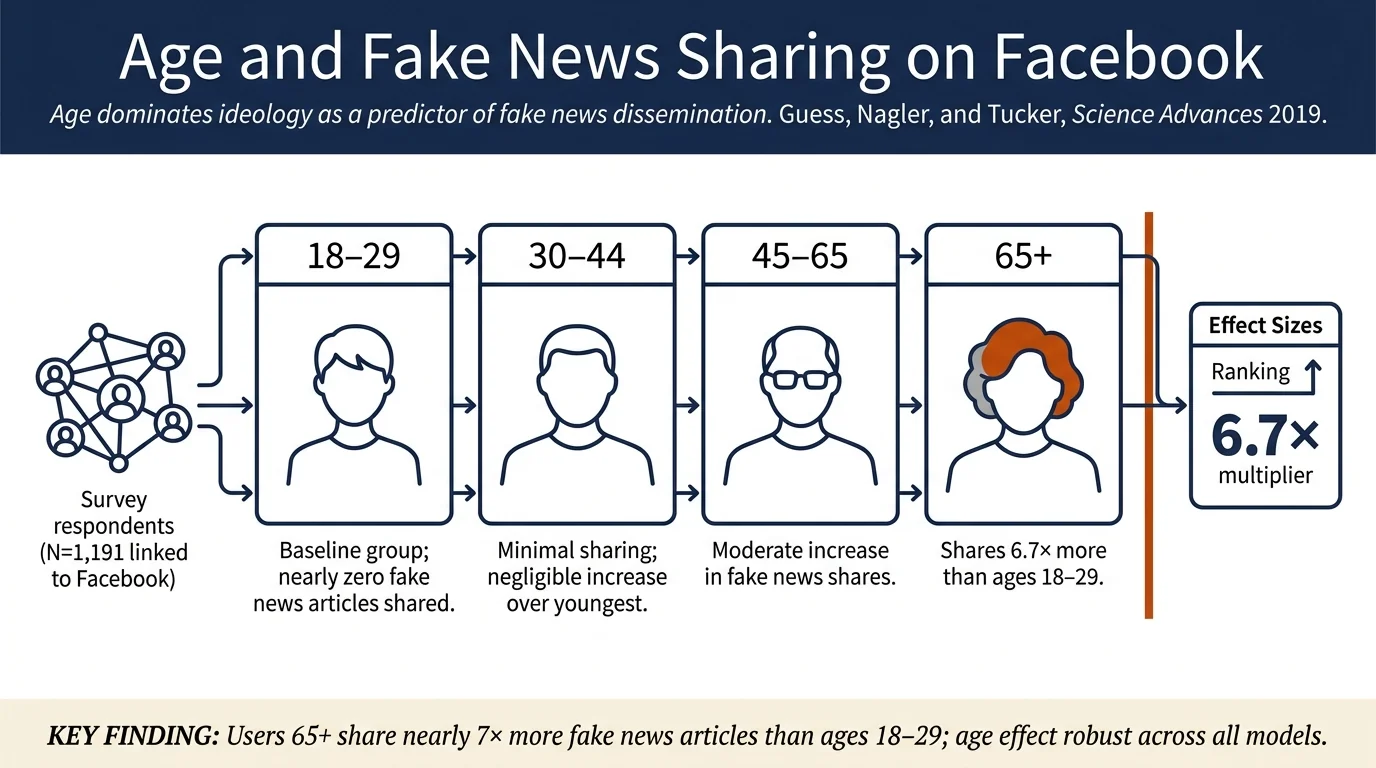
Less than you think: Prevalence and predictors of fake news dissemination on FacebookFake news dissemination on Facebook during the 2016 election was a rare behavior (8.5% of users shared at least one article), with clear demographic stratification: conservatives shared more articles from fake news domains (pro-Trump), but the strongest and most robust predictor was age—users over 65 shared nearly seven times as many…
 Spread & networksPlatforms, policy & society
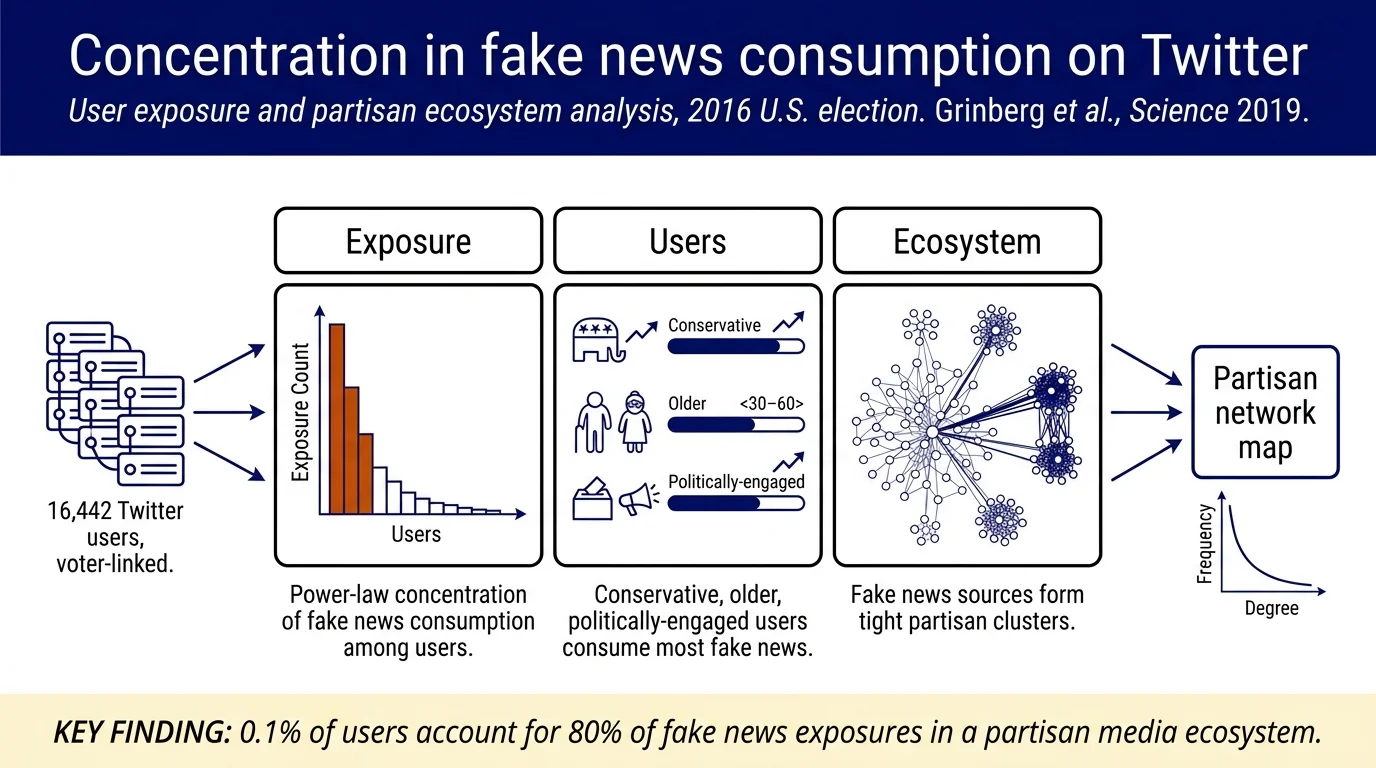
Fake news on Twitter during the 2016 U.S. presidential electionFake news consumption on Twitter during the 2016 election was extremely concentrated: only 1% of users saw 80% of exposures, and 0.1% shared 80% of fake news. Conservative-leaning, older, highly politically engaged users drove most consumption.
 Spread & networksPlatforms, policy & society
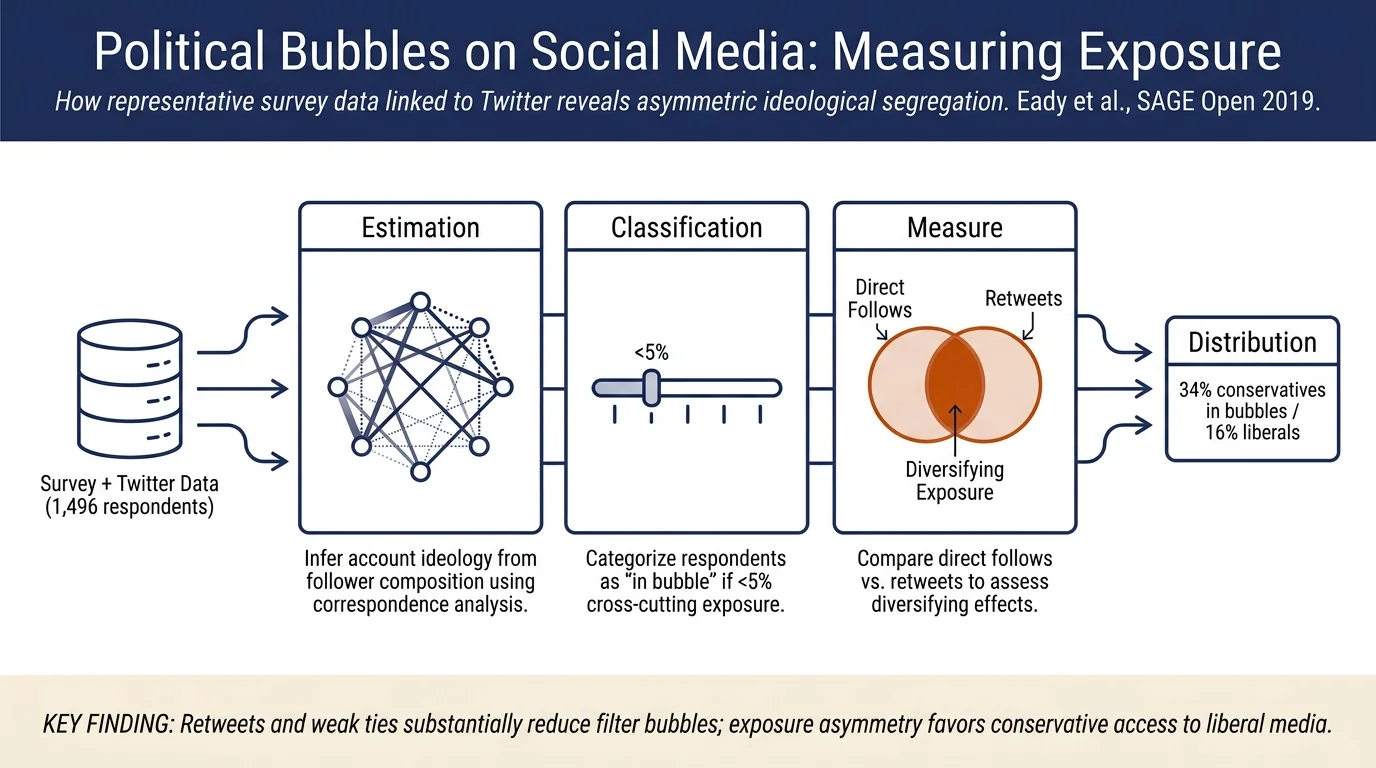
How Many People Live in Political Bubbles on Social Media? Evidence From Linked Survey and Twitter DataEady et al. link survey data from 1,496 Americans to Twitter data from 642,345 accounts and ~1.2 billion tweets to measure political polarization in media consumption. Rather than finding evidence of extreme "filter bubbles" where most people consume ideologically homogeneous content, they find substantial overlap in the accounts…
 Psychology & interventionsSpread & networks
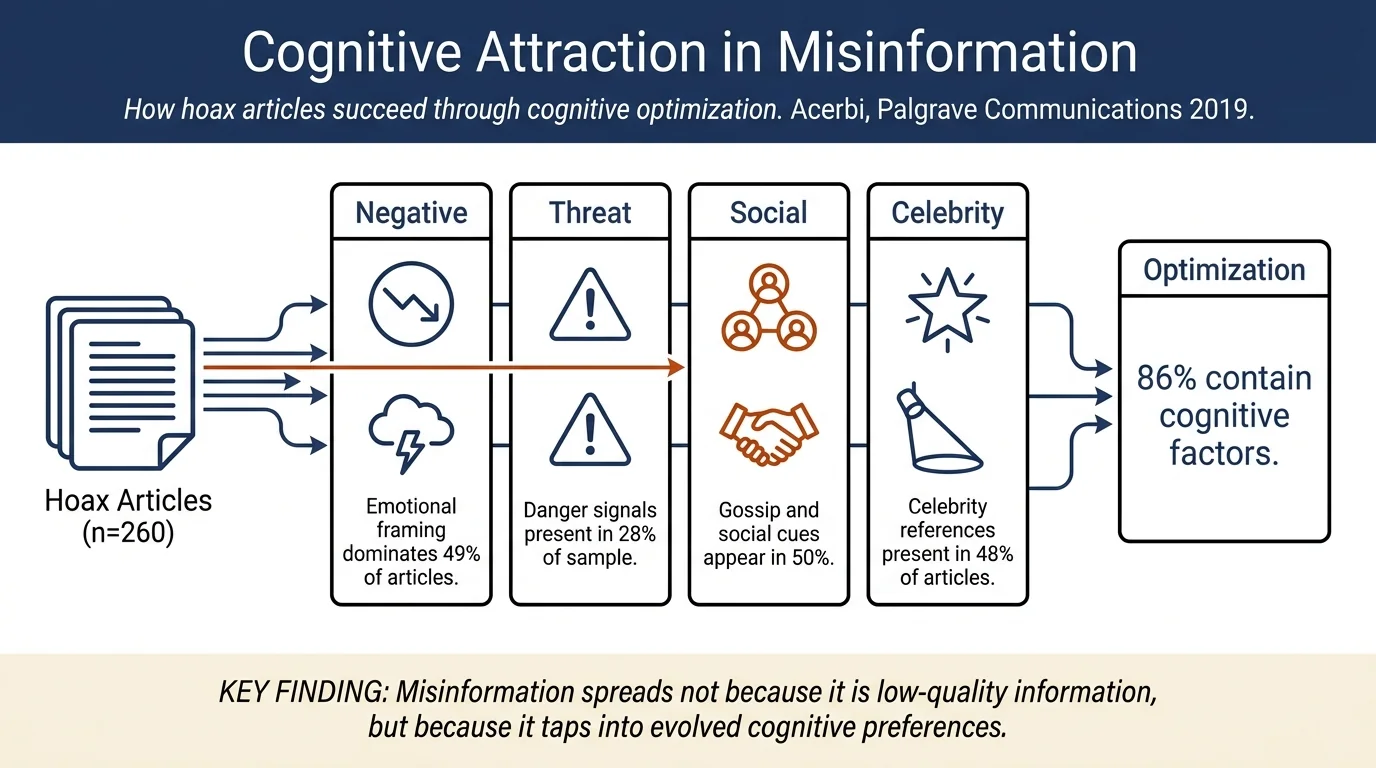
Cognitive attraction and online misinformationMisinformation spreads not because it is low-quality information constrained by digital media inefficiencies, but because it taps into general evolved cognitive preferences. A content analysis of 260 articles from 26 hoax websites shows that 86% contain at least one cognitive-appeal feature: negative framing (49%), threat descriptions…
 Spread & networksBots & coordinated campaigns
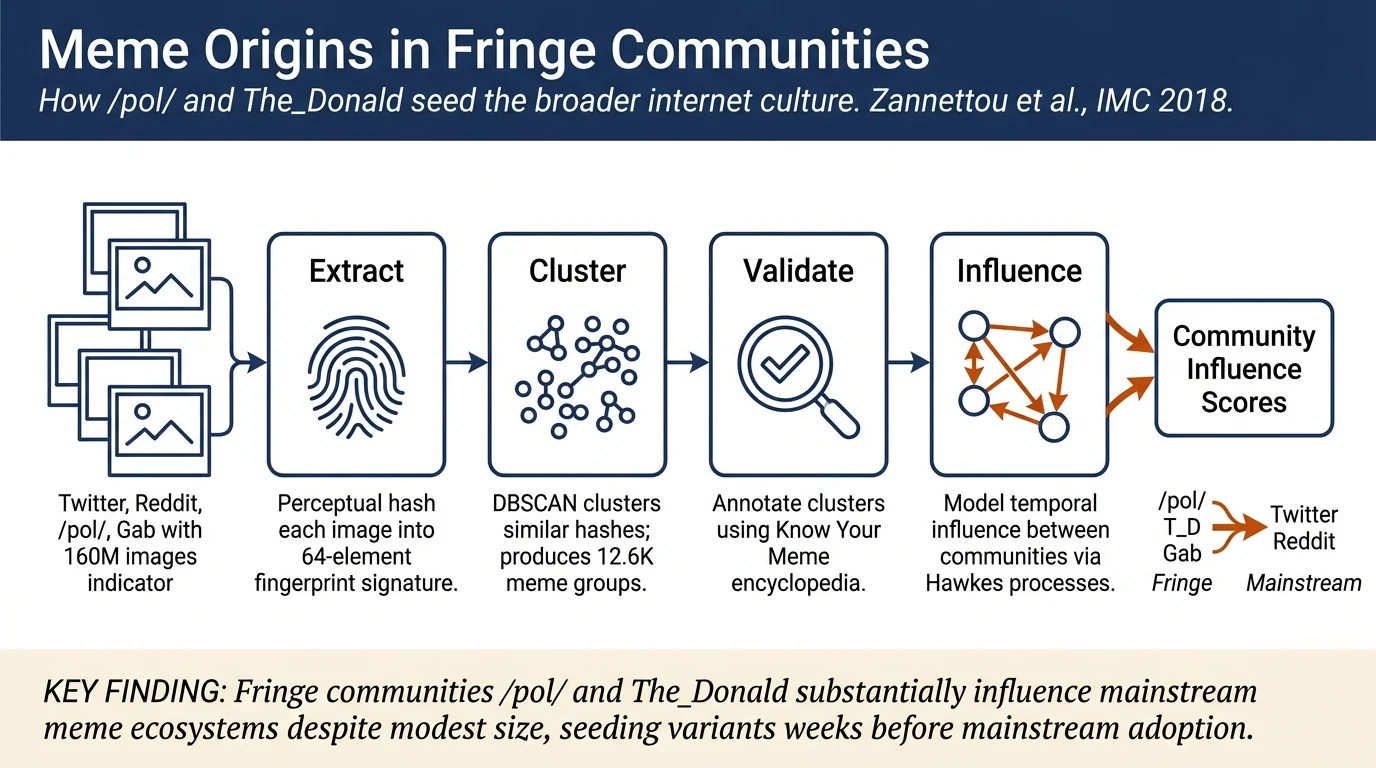
On the Origins of Memes by Means of Fringe Web CommunitiesLarge-scale empirical study of how image memes originate and propagate across fringe and mainstream Web communities. Analyzes 160M images posted to Twitter, Reddit, /pol/, and Gab (2016–2017) using perceptual hashing, clustering, and custom distance metrics.
 Spread & networksDetection methods
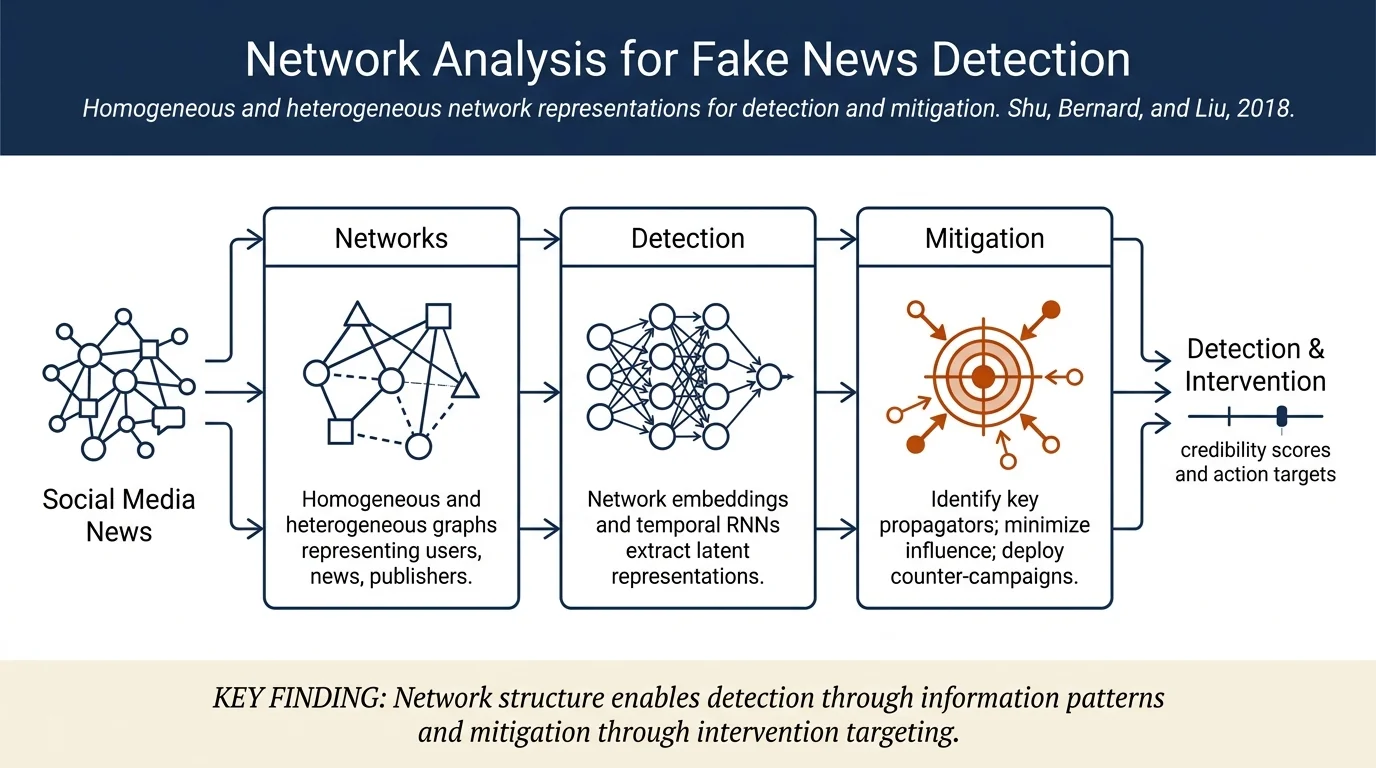
Studying Fake News via Network Analysis: Detection and MitigationThis chapter surveys network-based approaches to fake news detection and mitigation on social media, organizing fake news dissemination along three dimensions (content, social, temporal) and introduces methods exploiting network structure: homogeneous networks (friendship, diffusion, credibility) and heterogeneous networks (knowledge,…
 Psychology & interventionsPlatforms, policy & society
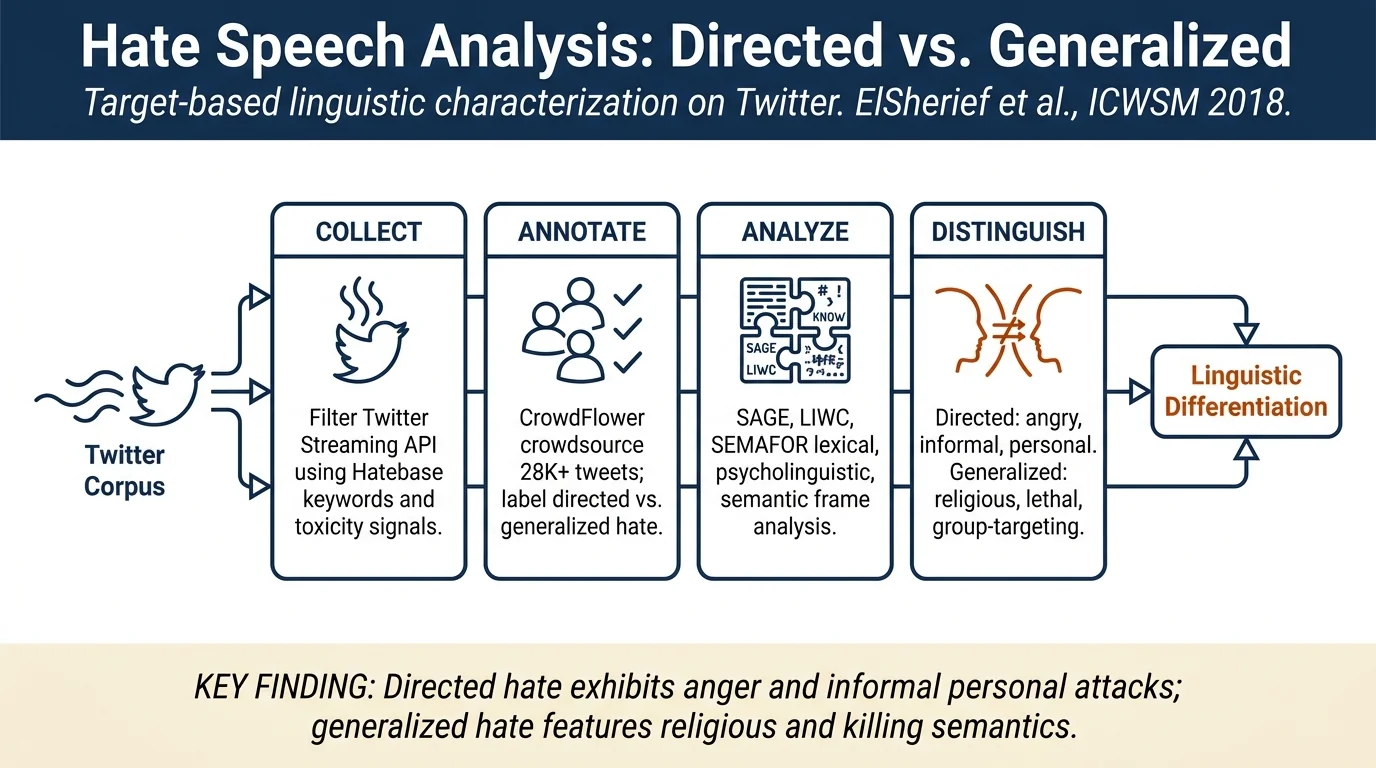
Hate Lingo: A Target-based Linguistic Analysis of Hate Speech in Social MediaThis paper presents the first large-scale linguistic and psycholinguistic analysis of hate speech categorized by its target: directed (personal attacks) versus generalized (targeting groups). The authors analyze 28,318 directed and ~2,500 generalized hate tweets, revealing that directed hate is more informal, angry, and explicitly…
 Spread & networksDetection methods
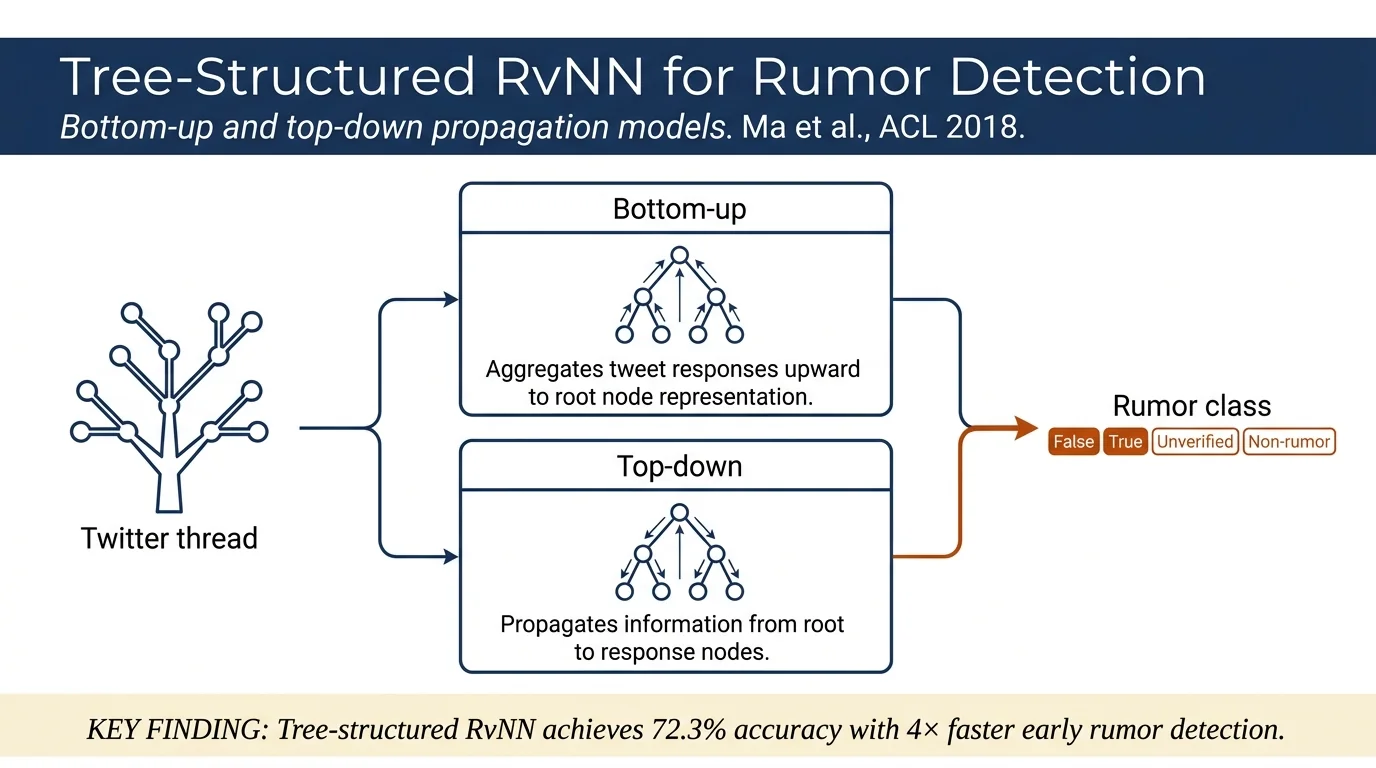
Rumor Detection on Twitter with Tree-structured Recursive Neural NetworksProposes two variants of recursive neural networks (RvNN)—bottom-up and top-down—that operate on propagation tree structures of tweets to detect rumors. Rather than treating tweets sequentially, the model learns representations that respect how tweets actually propagate in response threads.
 Bots & coordinated campaignsSpread & networks
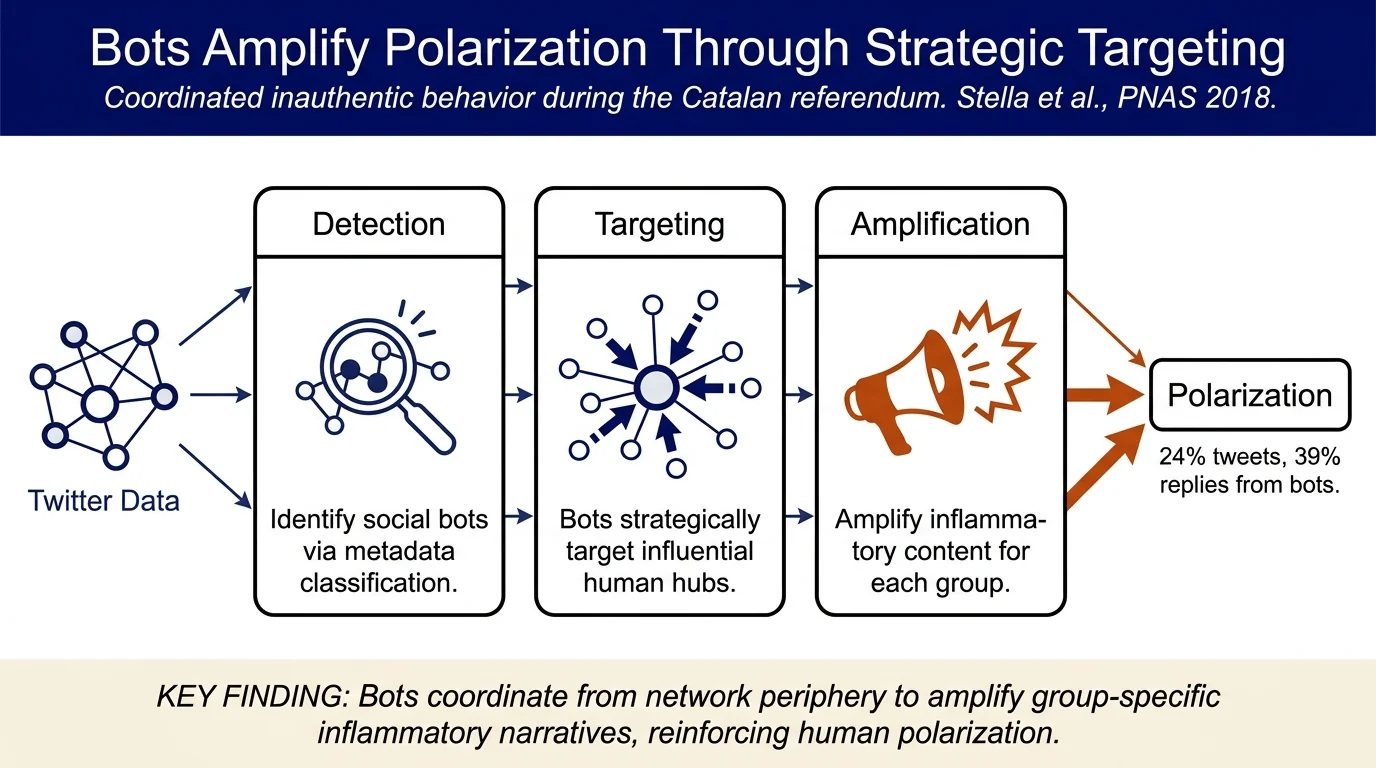
Bots increase exposure to negative and inflammatory content in online social systemsSocial bots during the 2017 Catalan independence referendum strategically targeted influential humans to amplify negative and inflammatory content. Operating from network peripheries, bots coordinated sentiment-driven amplification that exacerbated polarization, with approximately one in three referendum-related tweets generated by bots.
 Spread & networksBots & coordinated campaigns
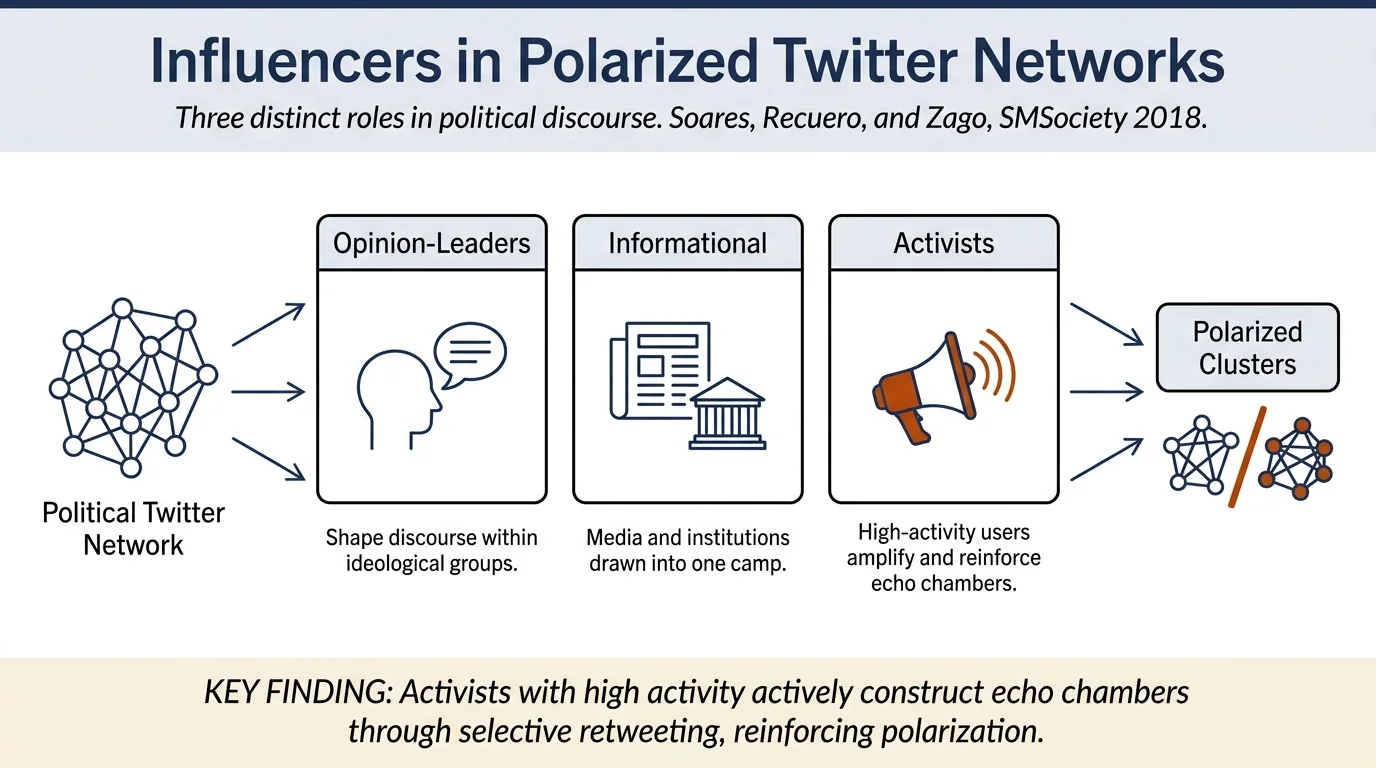
Influencers in Polarized Political Networks on TwitterThis paper identifies three types of influencers in polarized political Twitter conversations during Brazil's 2016 Dilma Rousseff impeachment: "opinion leaders" who shape discourse within ideological groups, "informational influencers" (media/institutions) drawn into one camp, and "activists" who amplify like-minded messages. The…
 Spread & networksPsychology & interventions
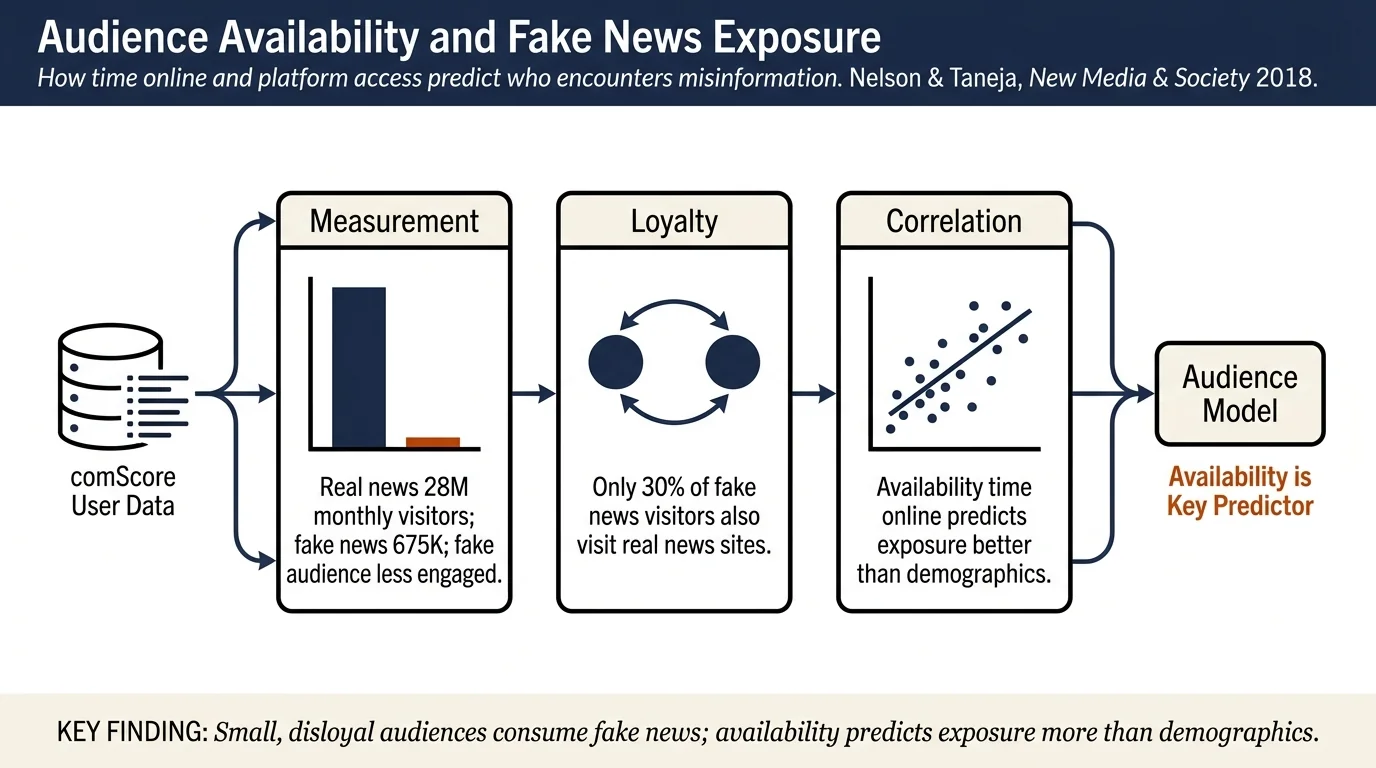
The small, disloyal fake news audience: The role of audience availability in fake news consumptionContrary to claims that fake news has reached a broad audience, this empirical analysis of comScore data shows the fake news audience is small and comprises heavy internet users. Applying the Law of Double Jeopardy from media theory, the authors show that fake news attracts disloyal audiences disproportionately from social platforms.
 Spread & networksPlatforms, policy & society
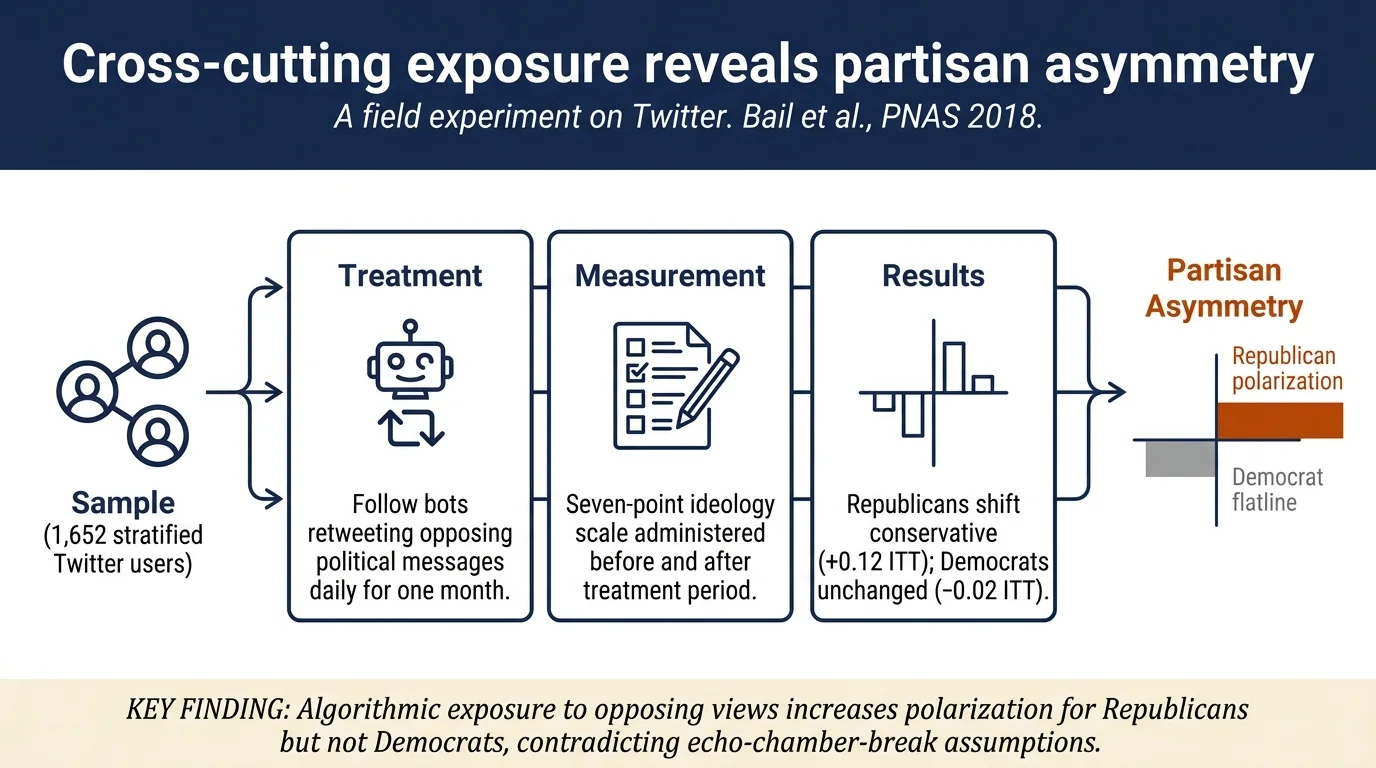
Exposure to opposing views on social media can increase political polarizationThis field experiment tested whether exposure to opposing political views on social media reduces polarization. Twitter users (Republicans and Democrats) were randomly offered money to follow bots retweeting messages from opposing politicians and opinion leaders for one month.
 Detection methodsSpread & networks
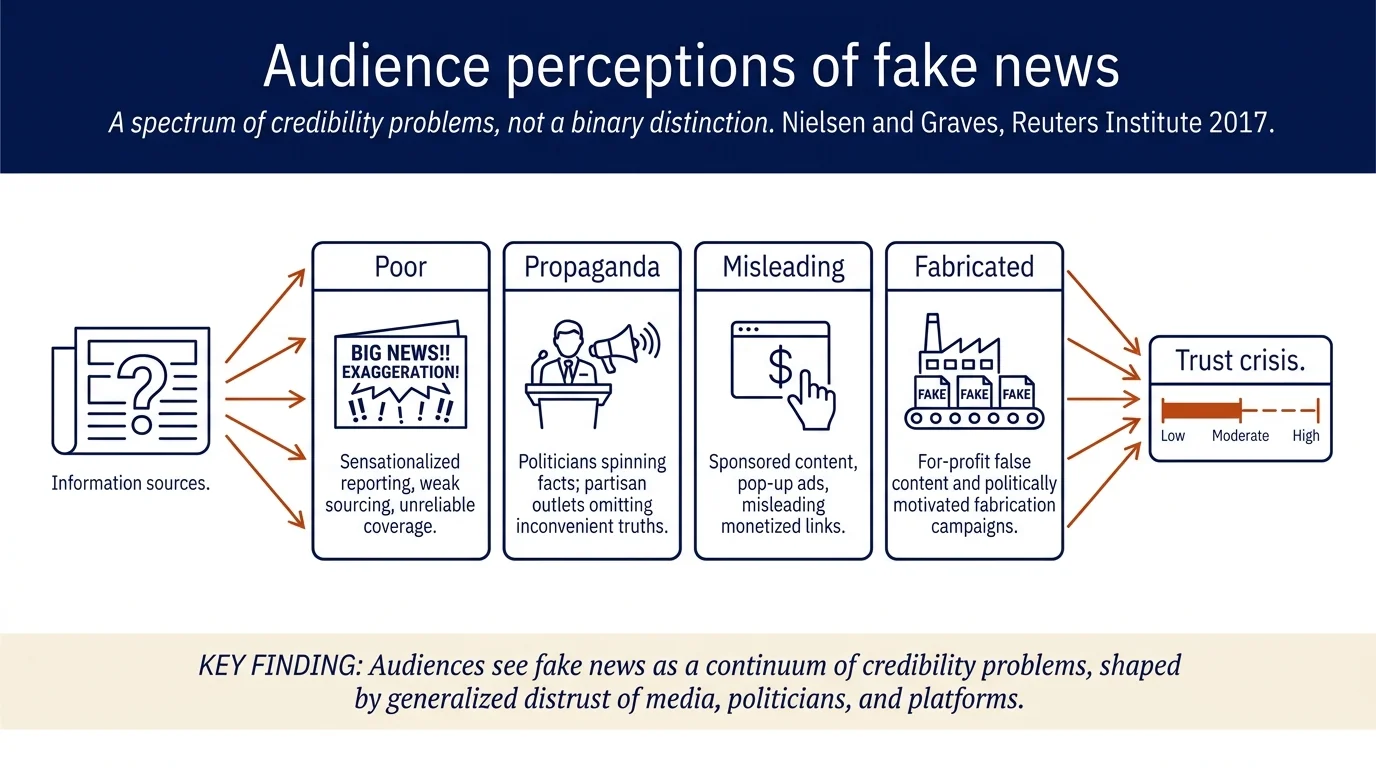
"News you don't believe": Audience perspectives on fake newsUsing focus groups and surveys across the US, UK, Spain, and Finland, Nielsen and Graves find that ordinary people see fake news as a spectrum rather than a binary distinction—encompassing poor journalism, political propaganda, misleading advertising, and fabricated content. Audiences experience the "fake news" problem as one of degree,…
 Spread & networksDetection methods
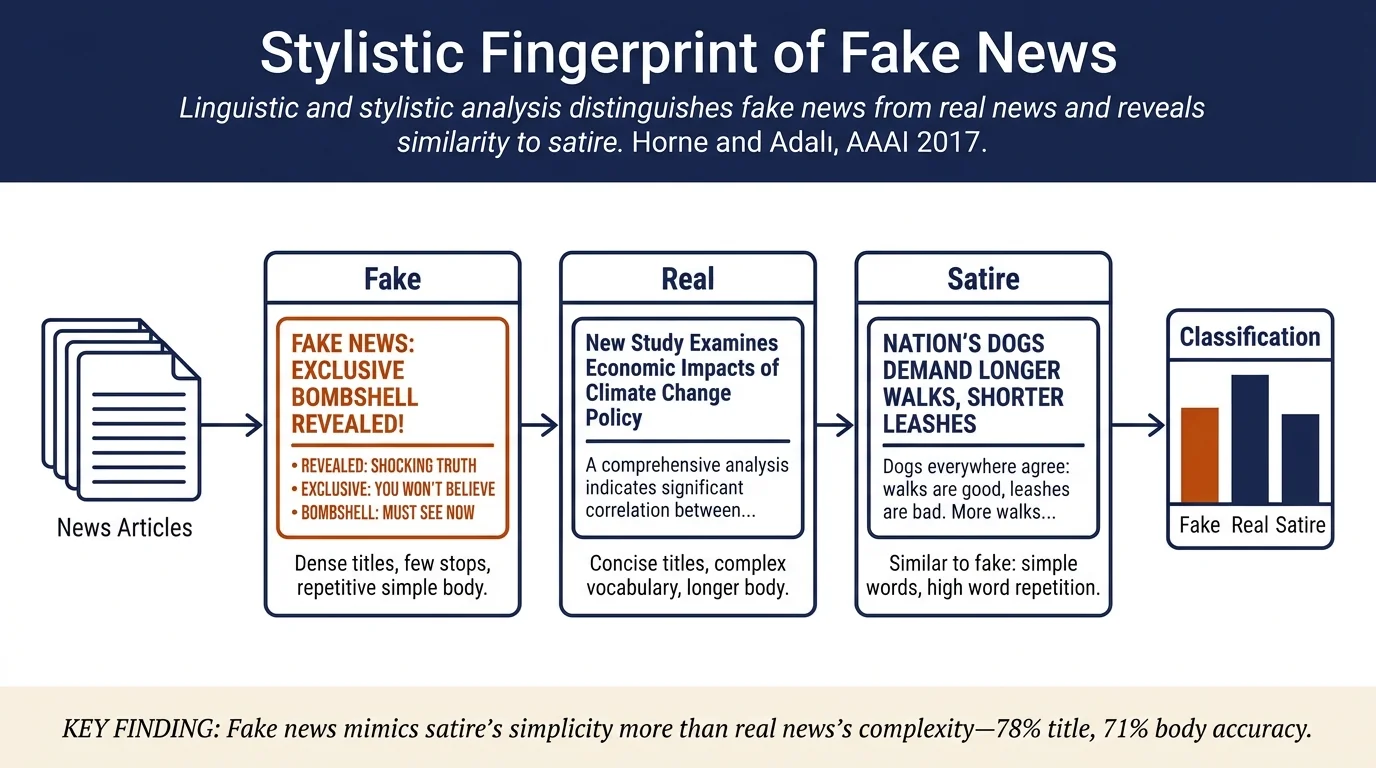
This Just In: Fake News Packs a Lot in Title, Uses Simpler, Repetitive Content in Text Body, More Similar to Satire than Real NewsFake news differs systematically from real news in stylistic features, especially titles. Contrary to the assumption that fake news mimics real news, it is actually more similar to satire: packed titles with fewer stop words and more proper nouns, combined with shorter, repetitive body text with simpler language.