Influencers in Polarized Political Networks on Twitter
Authors: Felipe Bonow Soares, Raquel Recuero, Gabriela Zago
Venue: SMSociety, Copenhagen, Denmark, 2018 — DOI
TL;DR
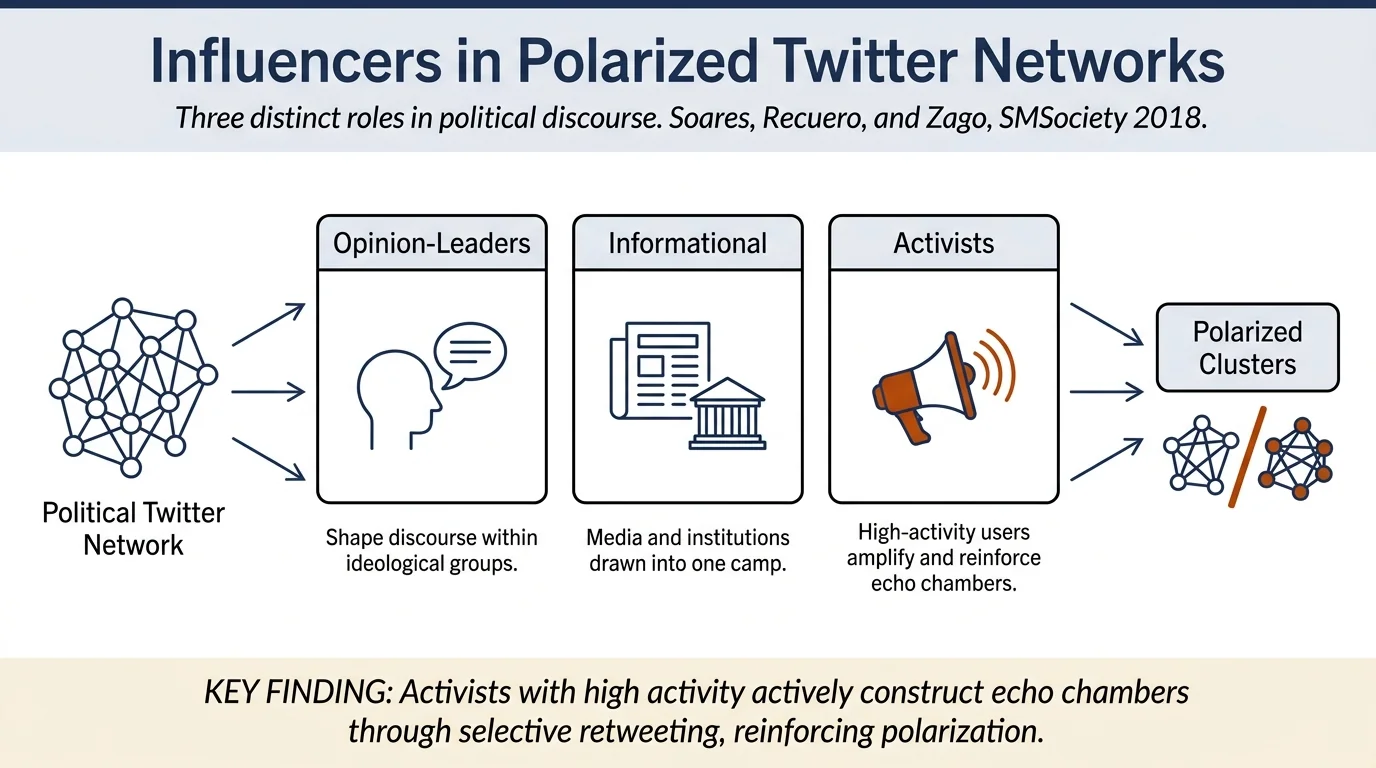
This paper identifies three types of influencers in polarized political Twitter conversations during Brazil's 2016 Dilma Rousseff impeachment: "opinion leaders" who shape discourse within ideological groups, "informational influencers" (media/institutions) drawn into one camp, and "activists" who amplify like-minded messages. The networks exhibit strong modularity and echo-chamber structures, with influencers reinforcing rather than bridging polarization.
Contributions
- Empirical identification of three distinct influencer roles in polarized political networks, moving beyond follower count as a proxy for influence.
- Social network analysis evidence of highly modularized Twitter discourse, with pro- and anti-impeachment clusters showing limited cross-group interaction.
- Demonstration that activist users with high activity (outdegree) actively construct echo chambers through selective retweeting, not just algorithmic filtering.
- Quantitative and qualitative characterization of how different influencer types affect political polarization on social media.
Method
The authors collected Portuguese-language tweets containing "impeachment" from March–September 2016 and analyzed networks from three critical dates: April 26 (commission instituted), May 18 (Senate vote favorable), and August 30 (final vote day). They used social network analysis metrics—modularity (to detect group structure), indegree (received mentions/retweets), and outdegree (sent mentions/retweets)—to identify influencers. The top 12 users by indegree and outdegree in each network were analyzed qualitatively by account type, follower count, and content patterns.
Network modularity was high across all dates (0.544–0.804), indicating strong clustering. Indegree analysis revealed opinion leaders (users with political positions whose messages spread within like-minded groups) and informational influencers (neutral institutions drawn into one camp by user perception). Outdegree analysis revealed activist accounts with high activity, low follower counts, but strong commitment to spreading ideology-aligned messages.
Results
All three networks exhibited highly polarized structures with two distinct clusters (pro- and anti-impeachment), with minimal bridging between groups. High modularity persisted across dates, confirming stable group separation.
Influencer types by indegree: Traditional media, politicians, and institutions dominated indegree rankings. Opinion leaders (e.g., @dilmabr, @georgmarques, @o_antagonista) had explicit political positions and influenced within-group discourse. Informational influencers (e.g., @g1, @senadofederal) were neutral but perceived as favoring one position, and thus drew followers only to that camp.
Influencer types by outdegree: Highly active users (outdegree 40–81 edges per day) with activist profile descriptions dominated outdegree rankings. These "activists" almost exclusively retweeted in-group users, especially opinion leaders, creating and maintaining echo-chamber structure. Pro-impeachment activists outnumbered anti-impeachment activists 3:1 overall.
Stability: Influencers consistently appeared in the same cluster across all three dates, indicating stable polarization and lack of opinion change.
Connections
- Related to work on political polarization on Twitter on how Twitter structures enable polarization at scale.
- Extends Sunstein's echo chambers theory with empirical evidence that users actively construct echo chambers beyond algorithmic curation.
- Part of growing literature on misinformation and polarization in Brazilian elections and political contexts.
- Connected to Habermas's theory of the public sphere; argues fragmented networks undermine democratic deliberation.
Notes
Strengths: The paper's combination of network metrics (indegree/outdegree) with qualitative account analysis (type, follower count, political alignment) is novel and well-motivated. The identification of "activists" as distinct from traditional opinion leaders is important—high-activity users actively reinforce polarization. The Brazilian context is timely and understudied. Using three strategic dates captures network dynamics across the impeachment process rather than a static snapshot.
Limitations: Only three days analyzed; patterns may not generalize to longer periods or other political events. Analysis relies on three metrics; other centrality measures (betweenness, closeness) might reveal different influencer roles. No analysis of bot/automated accounts, though two high-outdegree accounts were suspended. Qualitative analysis of 12 users per metric is selective and may miss outlier roles. No causal claim that influencers cause polarization—only that they reinforce it.
Open questions: Do opinion leaders' positions drive followers' ideology, or do followers already aligned seek them out (selectivity process)? Can activist users with high outdegree be productively redefined as "bridge-builders" if retweeting across groups? How do these roles differ in non-polarized discourse?