Explore papers
Filter by research area, year and venue. Every filter is in the address bar, so you can share a view as a link.
 Platforms, policy & societySpread & networks
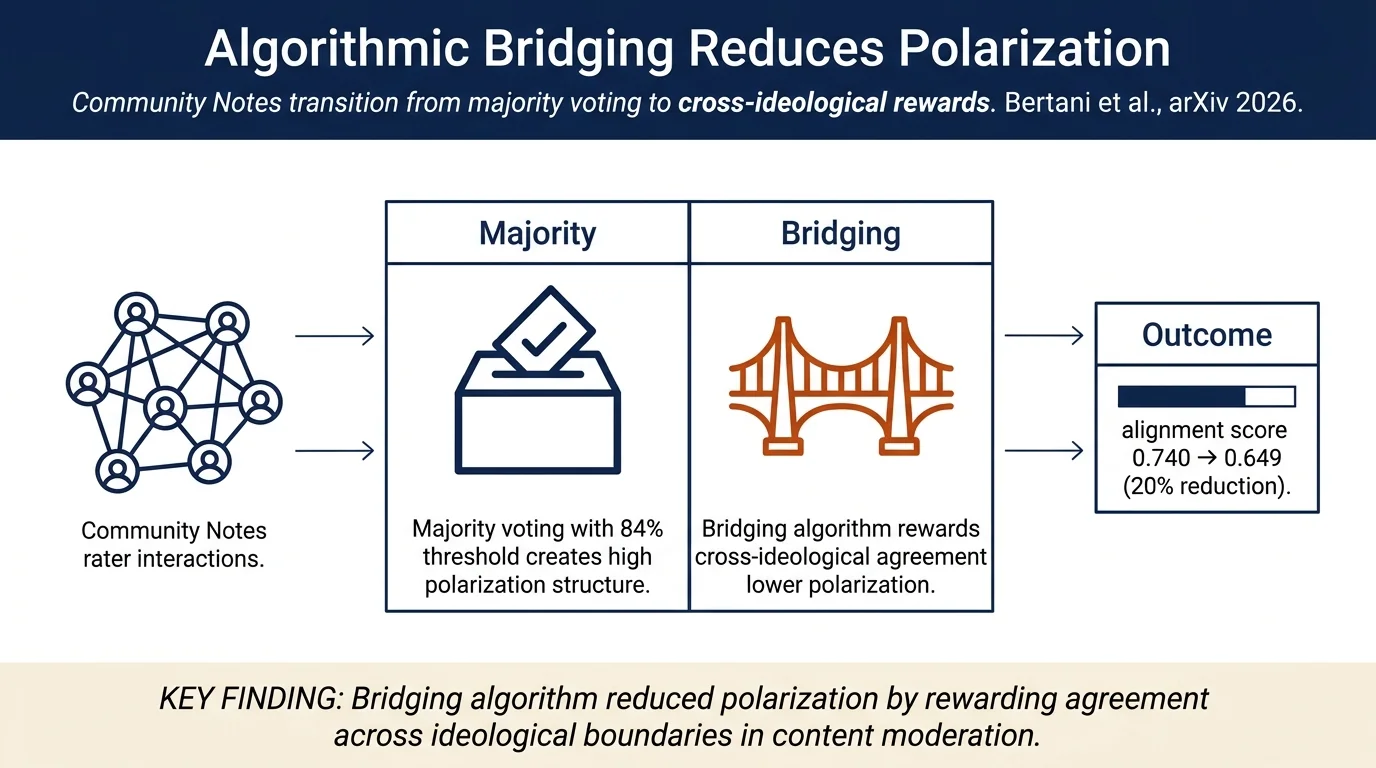
Algorithmic Intervention Decreases Polarization in Content ModerationX's Community Notes transitioned from simple majority voting to a bridging algorithm that rewards agreement across ideologically diverse contributors. Comparing 8,805 notes and 4,367 contributors before and after this change (July 2021–September 2022), ideological polarization in both contributor and note positions decreased…
 Spread & networksDetection methods
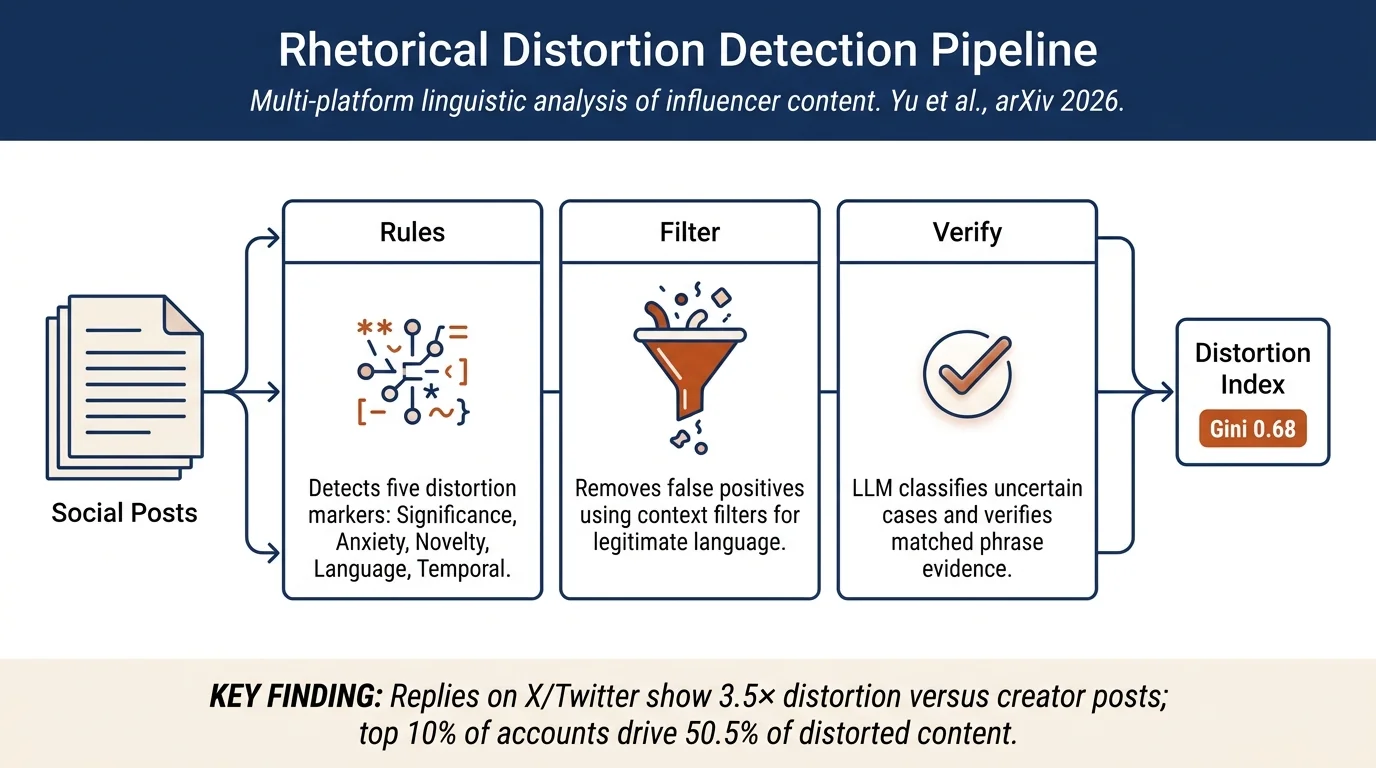
Where Does Rhetorical Distortion Live? A Multi-Platform, Multi-Language Measurement of Influencer ContentRhetorical distortion—misleading framing that inflates significance, manufactures anxiety, or misrepresents novelty—is not uniformly distributed across platforms or account types. This work measures five linguistic dimensions of distortion (Significance Inflation, Anxiety Manufacture, Novelty Claims, Loaded Language, Temporal Distortion)…
 Spread & networksPlatforms, policy & society
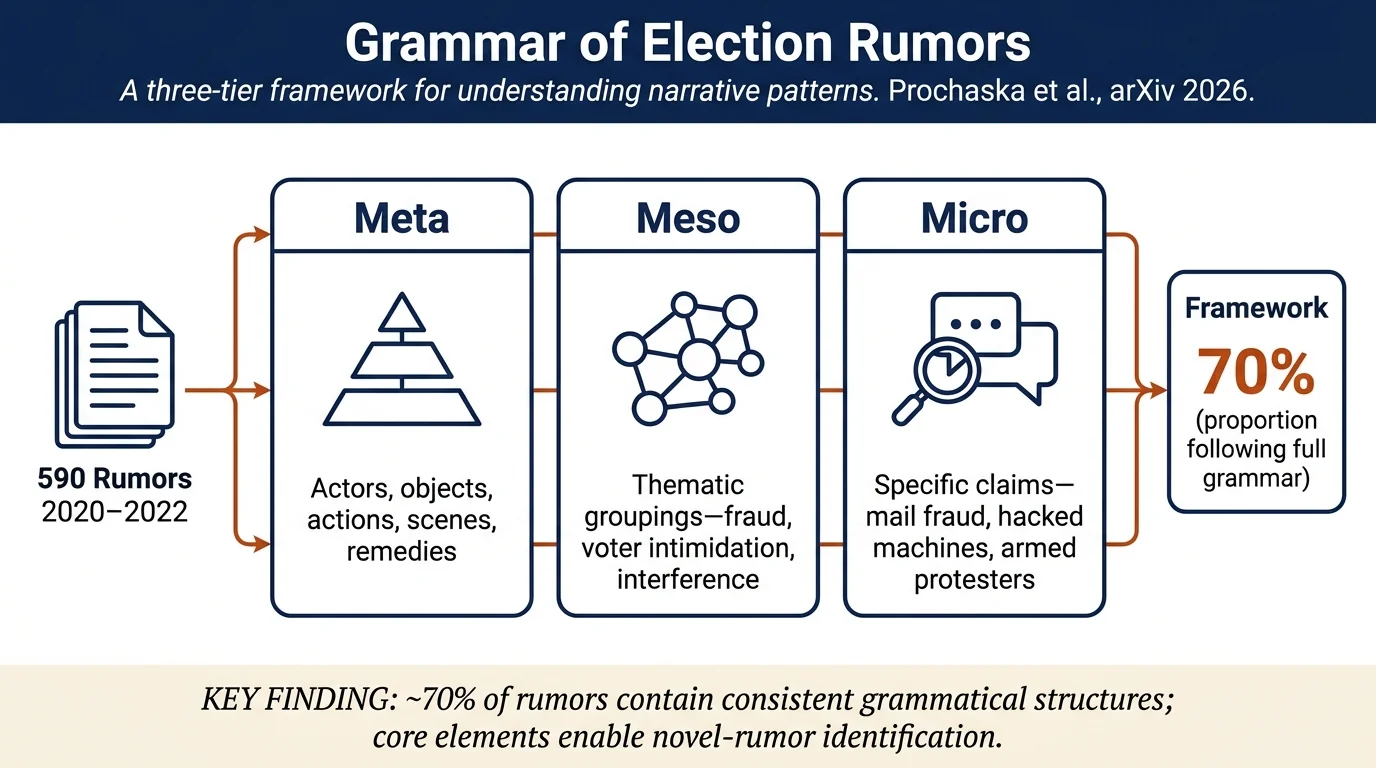
New Election, Same Old Story: How Tropes Form a Grammar of Election RumorsElection rumors follow recurring narrative patterns organized as a three-layer framework: meta-categories (actors, objects, actions, scenes, remedies) that combine into meso-tropes (villain, conspiracy, etc.), which manifest as micro-tropes (specific claims about mail voting, machines, etc.). Analysis of 590 rumors from 2020–2022 U.S.…
 Spread & networksDatasets & evaluation
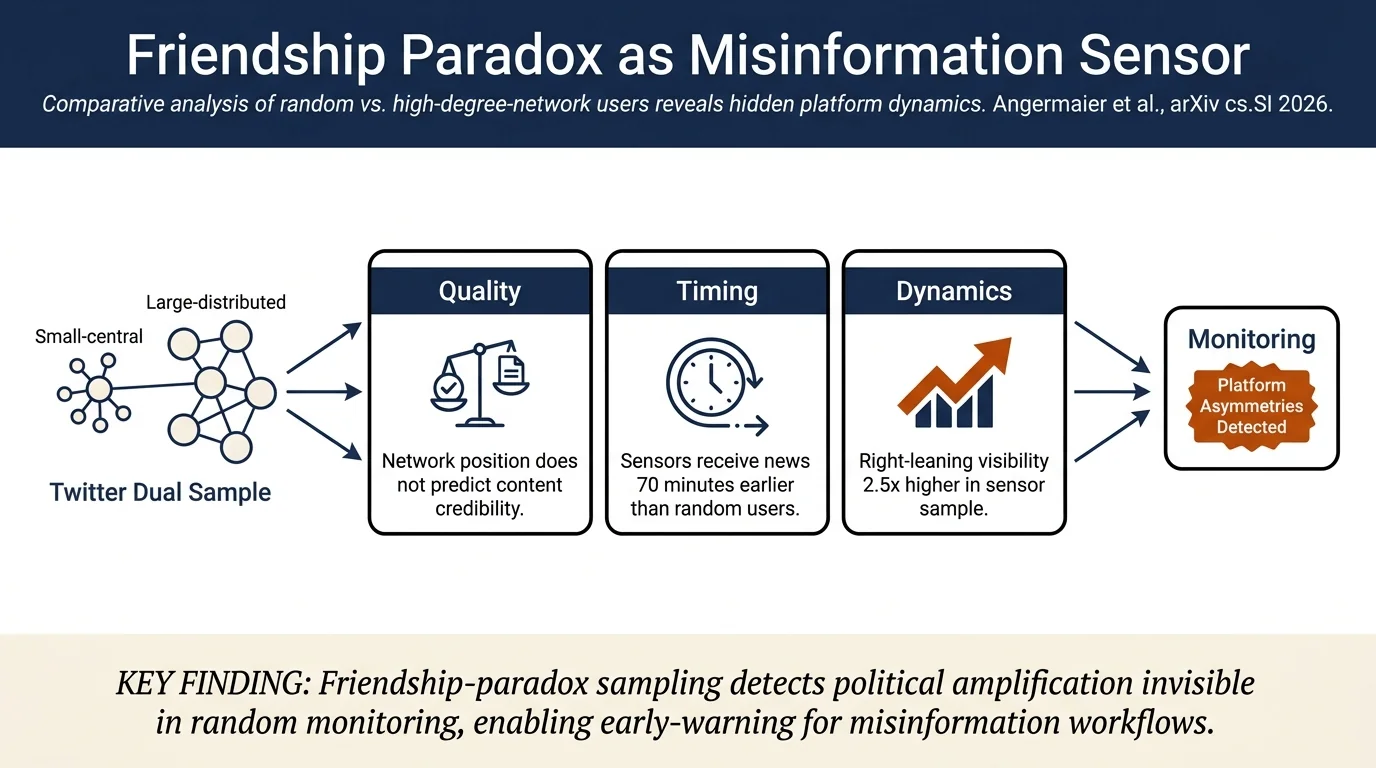
Friends as Sensors: High-Sensitivity Monitoring of Misinformation and Platform Dynamics via the Friendship ParadoxThe friendship paradox—a network property where a user's friends are, on average, better connected than the user themselves—enables high-sensitivity monitoring of misinformation on Twitter/X. Comparing ~27 million tweets from randomly selected users to ~31 million from accounts those users retweet (the "sensors"), the authors find: (1)…
 Bots & coordinated campaignsSpread & networks
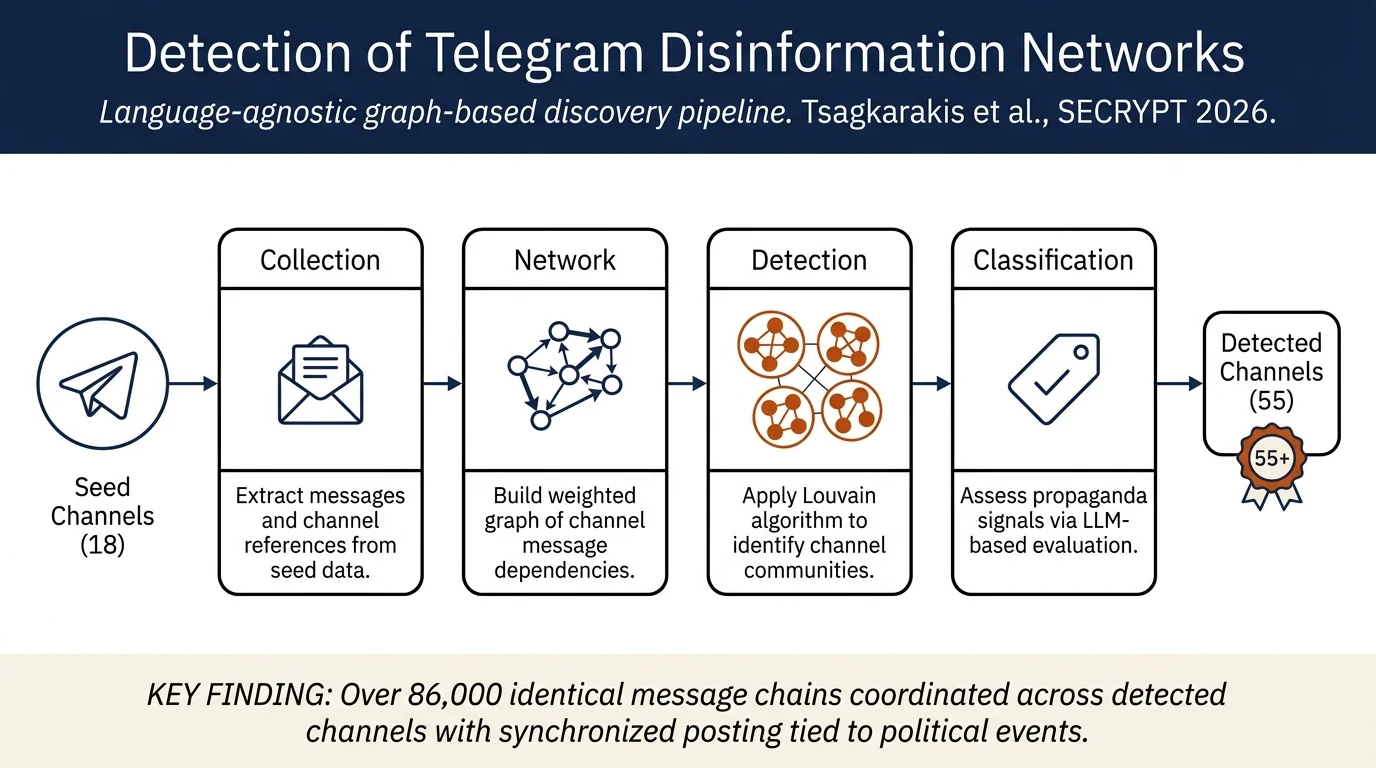
Birds of a Feather Flock Together: Network-Based Detection of Coordinated Disinformation Campaigns on TelegramA graph-based methodology discovers coordinated disinformation campaigns on Telegram by analyzing message-sharing patterns rather than content, requiring only structural relationships. The authors identified 55 disinformation channels and over 86,000 identical message chains spanning multiple channels, revealing a highly synchronized…
 Spread & networksPsychology & interventions
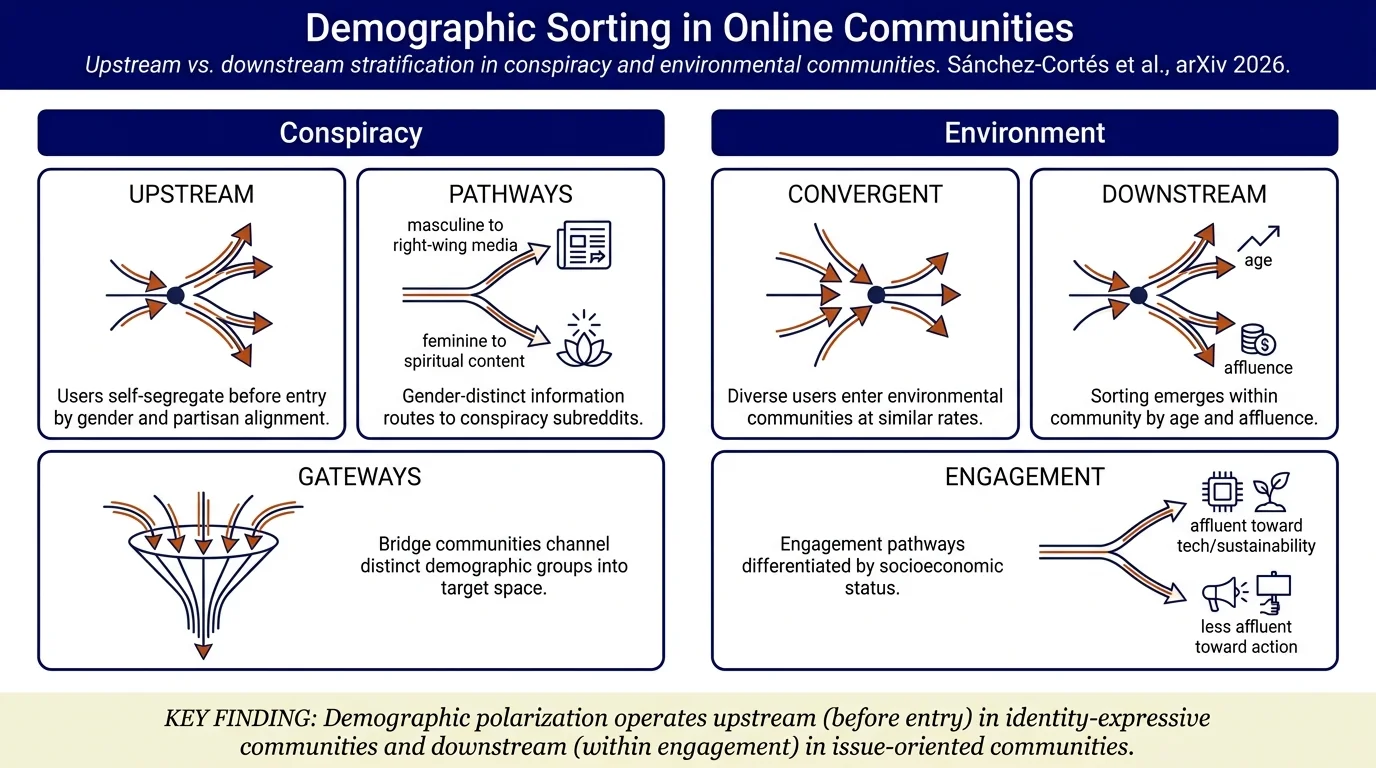
Conspiracy and Environment Communities on Reddit Sort Along Different Demographic AxesConspiracy and environmental communities on Reddit exhibit distinct demographic sorting mechanisms. Conspiracy communities show upstream sorting—users self-segregate by gender and partisanship before entry through ideologically-aligned information environments.
 Spread & networksPlatforms, policy & society
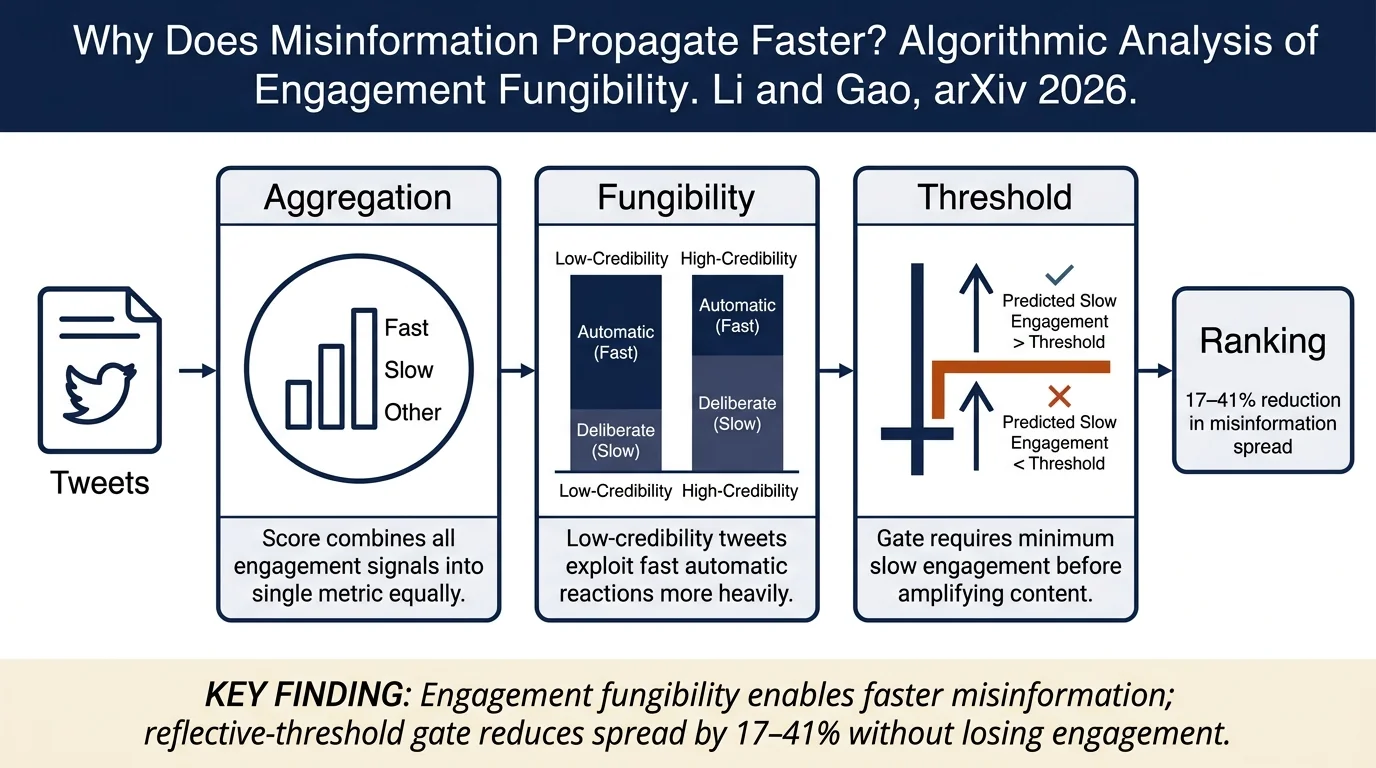
Why Does Misinformation Propagate Faster? An Algorithmic Perspective on XMisinformation propagates faster on X due to an "engagement fungibility mechanism" in the platform's score-aggregation layer: fast engagement signals (likes, retweets) are treated as interchangeable evidence of quality with slow signals (replies, quotes), allowing low-credibility content that draws disproportionately from instant…
 Spread & networksPlatforms, policy & society
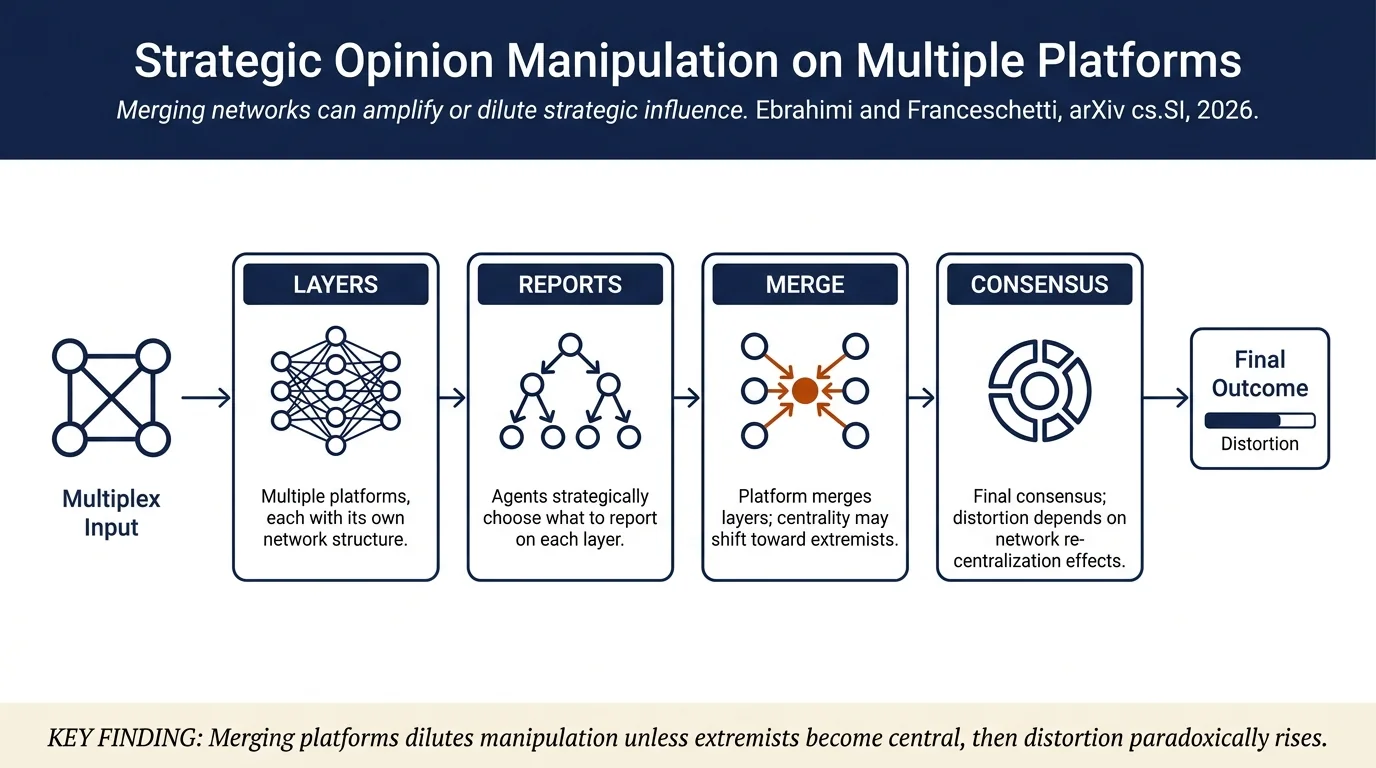
Strategic Opinion Manipulation in Multiplex NetworksThis paper models how agents strategically manipulate consensus when opinions are aggregated across multiple platforms or channels. By analyzing the resulting game as a DeGroot-like process on merged layers with strategic misreporting costs, the authors show that merging layers dilutes manipulation by default—but can amplify it through…
 Spread & networksPlatforms, policy & society
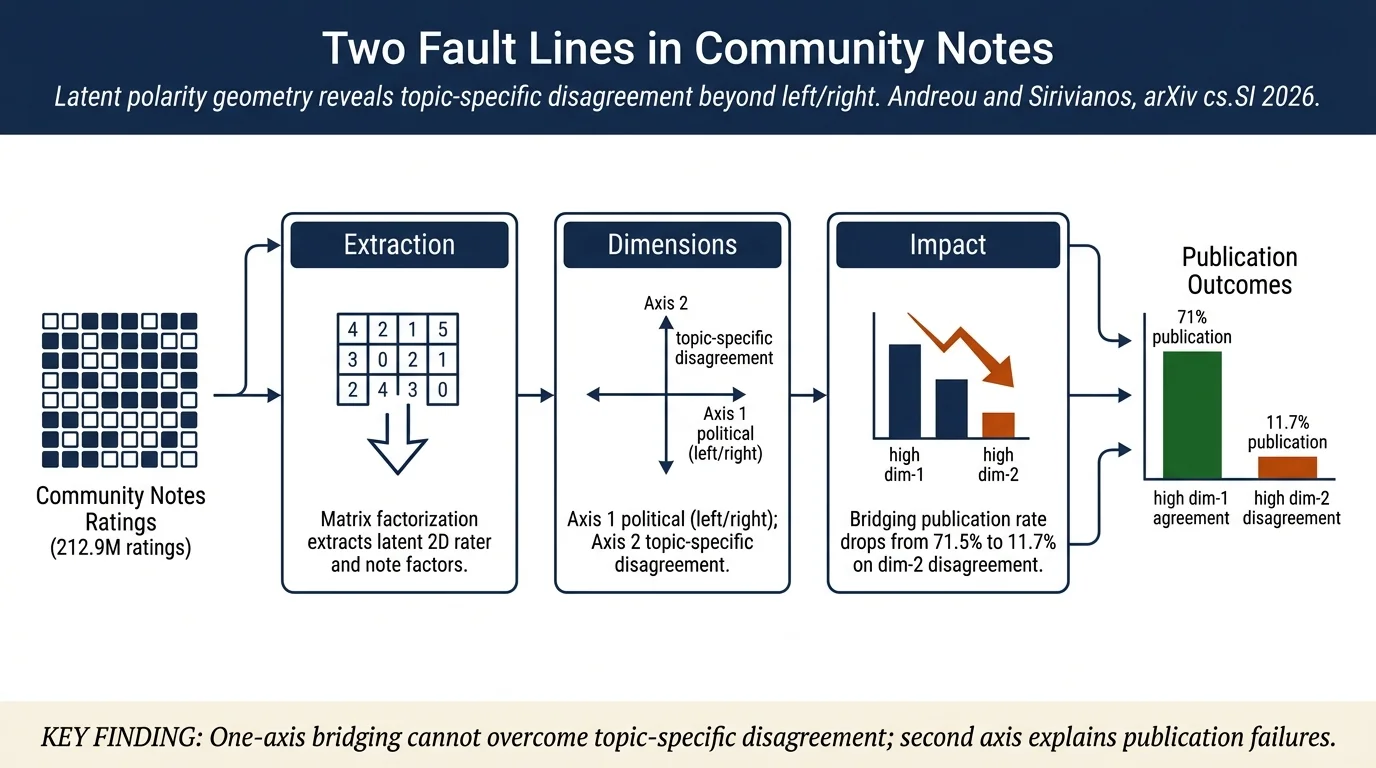
Two Fault Lines: Latent Polarity Geometry in X Community NotesX's Community Notes system assumes disagreement is one-dimensional (left/right politics) to decide when notes should be published via a "bridging" mechanism. This paper shows the space is actually two-dimensional: the first axis captures political polarization, while a second axis independently captures disagreement on topics like…
 Platforms, policy & societySpread & networks
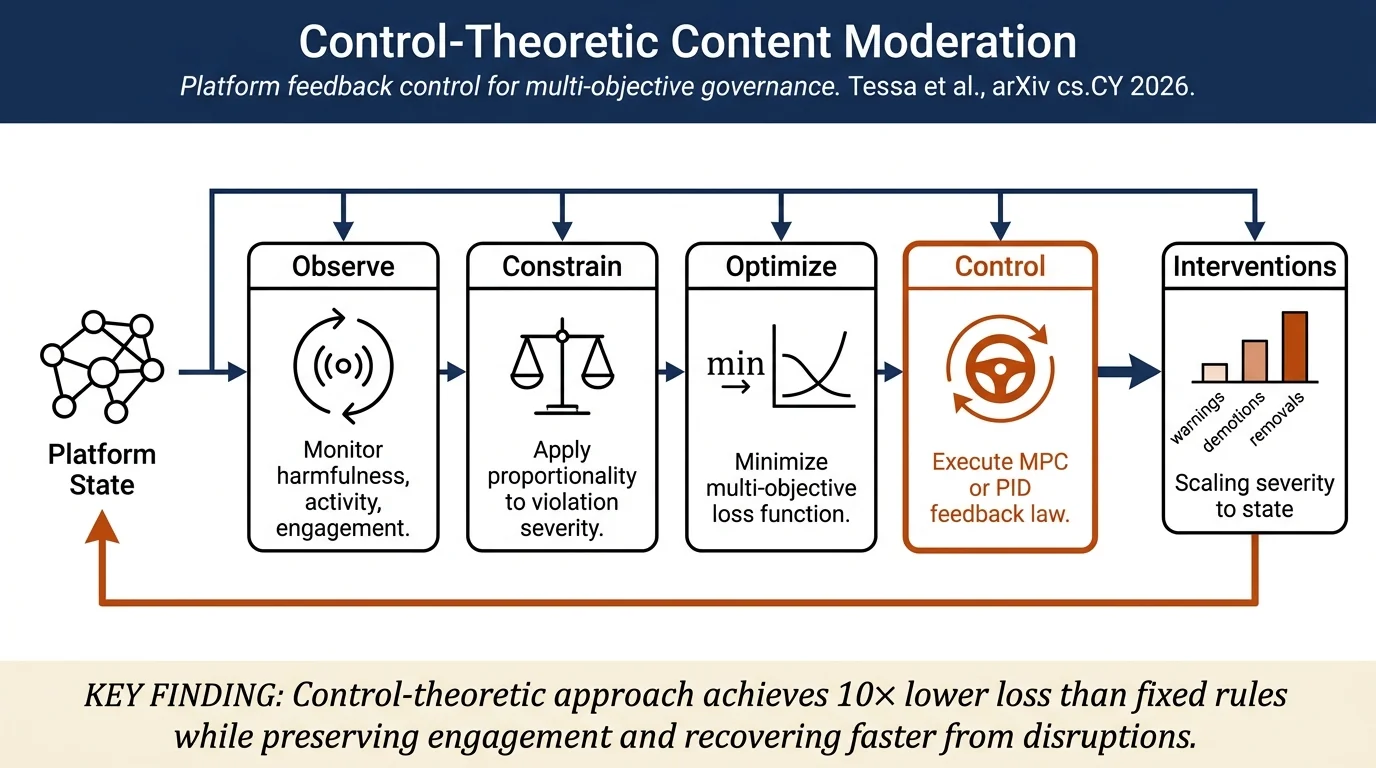
Control-Theoretic Content ModerationContent moderation at the platform level requires balancing multiple competing objectives (reducing harmful content, preserving engagement, maintaining activity). This paper formulates platform-level moderation as a feedback control problem with a multi-objective loss function, proposes control-theoretic moderators (including…
 Spread & networksPsychology & interventions
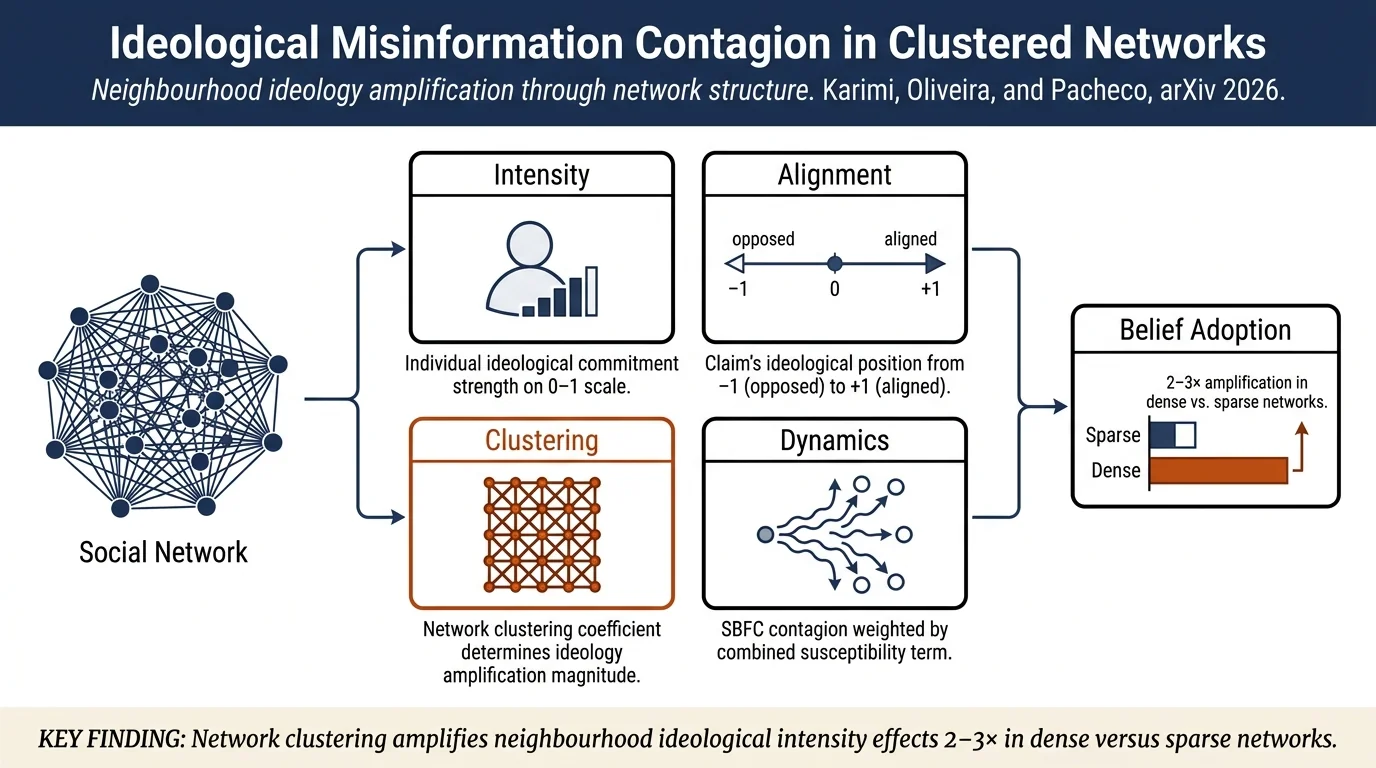
How neighbourhood ideology shapes misinformation belief in densely tied social networksPrior work decouples ideological bias and social influence when modeling misinformation propagation; this paper integrates them through an agent-based contagion model that distinguishes an individual's ideological intensity from a claim's ideological alignment. Simulation and analytical results show that in densely clustered…
 Psychology & interventionsSpread & networks
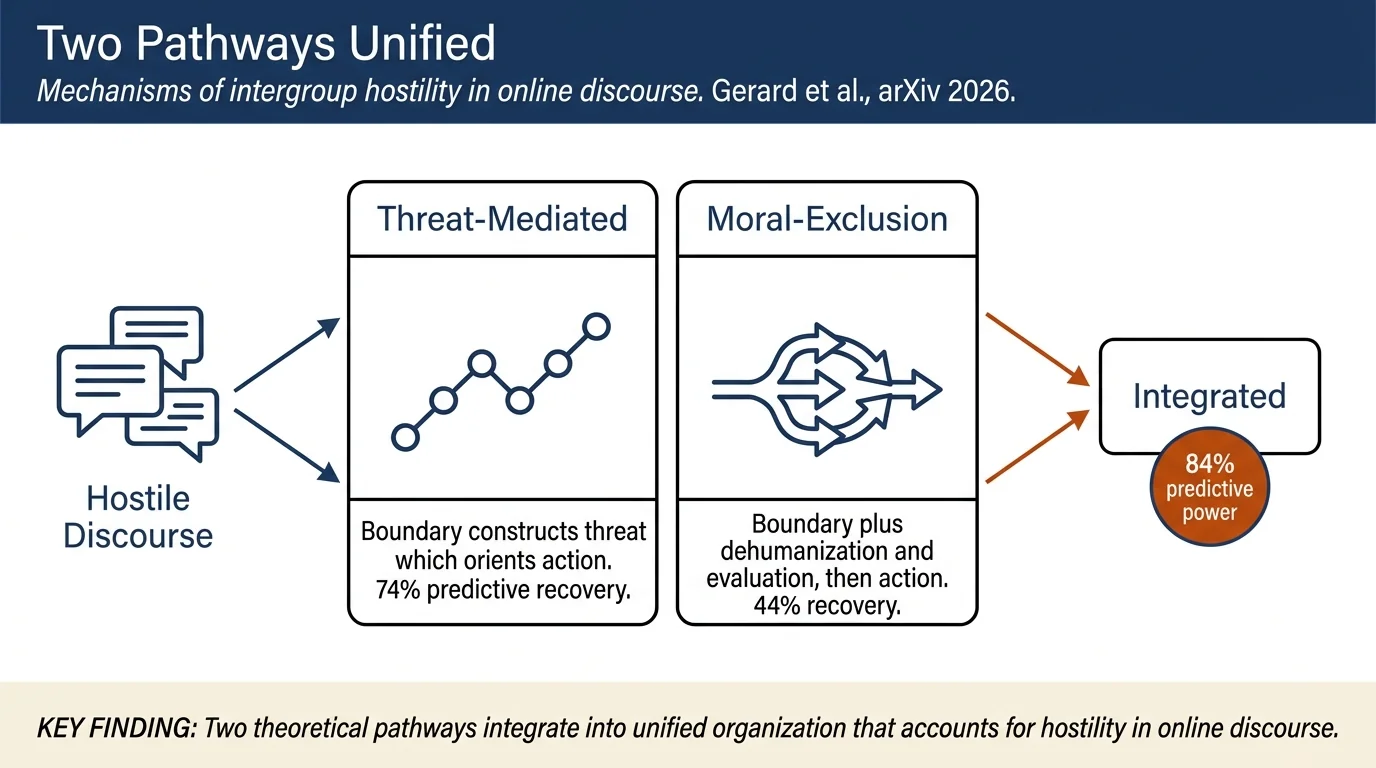
Unifying Models of Intergroup Hostility in Online DiscourseHostile rhetoric toward outgroups in online discourse can be modeled through six mechanisms (boundary construction, threat construction, scapegoating, negative evaluation, dehumanization, action orientation) whose structural and temporal relationships were previously understood separately through competing theoretical frameworks. By…
 Detection methodsPsychology & interventions
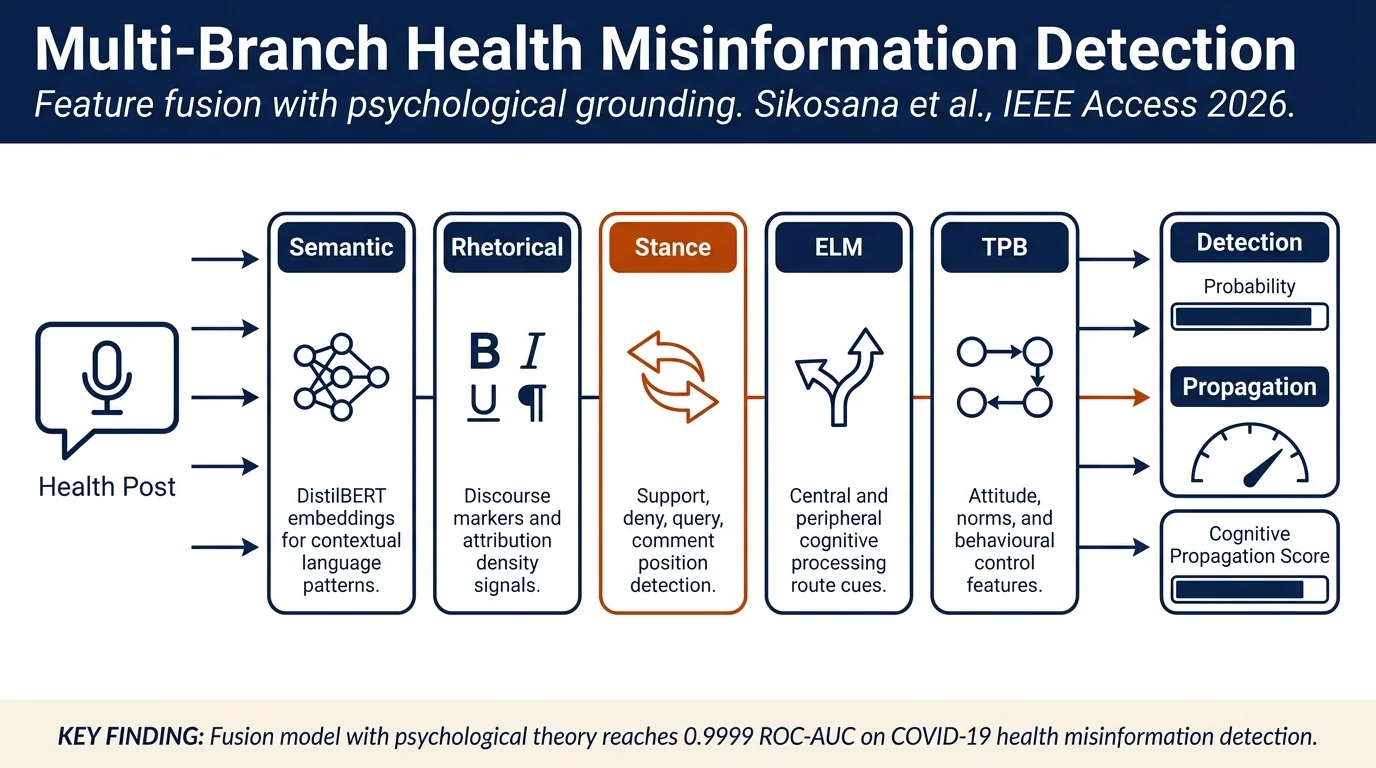
A Multi-Branch Feature Fusion Approach for Health Misinformation Detection and PropagationThe paper presents a multi-branch fusion framework for detecting and characterizing health misinformation on social media, grounded in psychological theories (Elaboration Likelihood Model and Theory of Planned Behaviour). The model fuses transformer embeddings with rhetorical, stance, and theory-motivated linguistic features in a unified…
 Spread & networksLLMs & generative AI
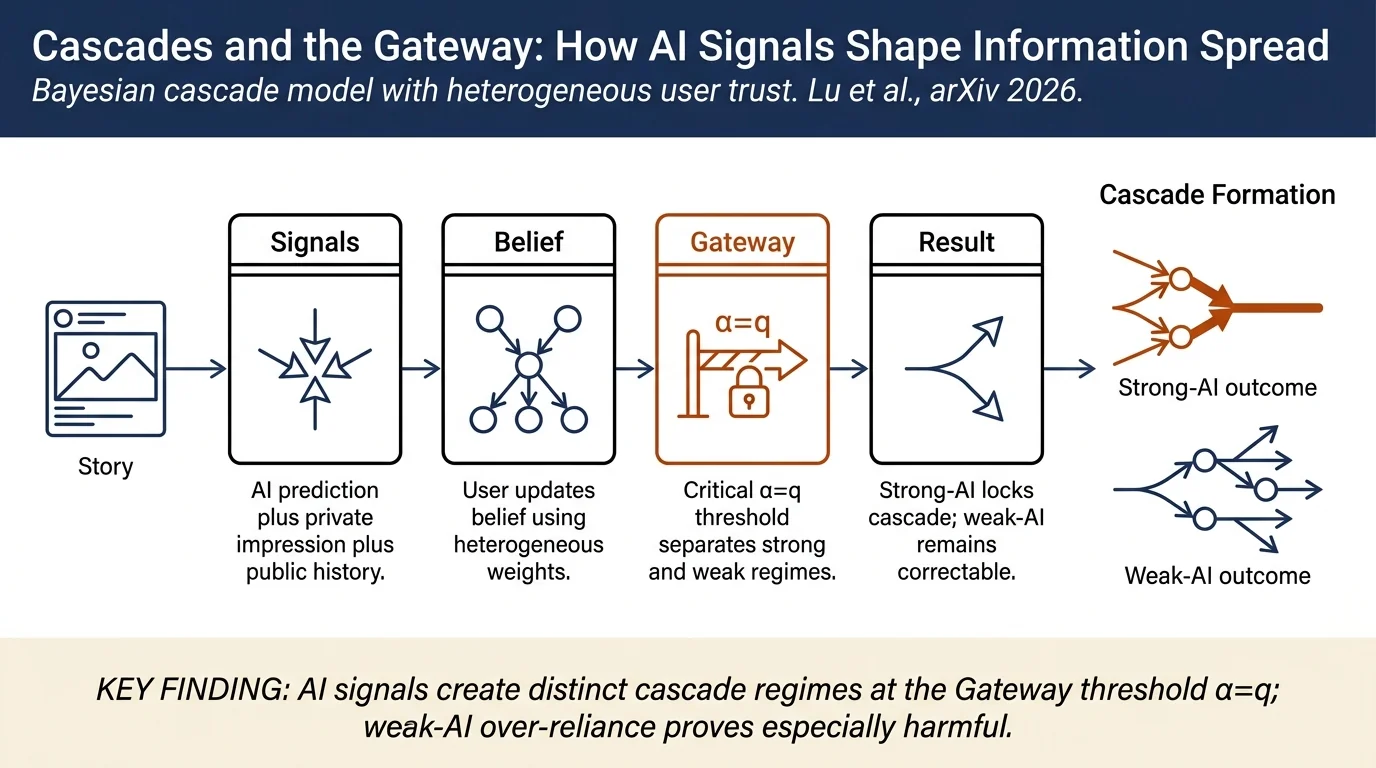
One AI Signal, Many Human Judgments: A Bayesian Cascade Analysis of AI-based Credibility Indicators in Online Information SpreadSocial media platforms increasingly deploy AI-based credibility indicators to help users judge misinformation. This paper extends classical Bayesian cascade models to treat AI credibility signals as a shared public signal seen by all users, then derives a critical "Gateway" threshold: above it, AI predictions dominate the public record;…
 Bots & coordinated campaignsSpread & networks
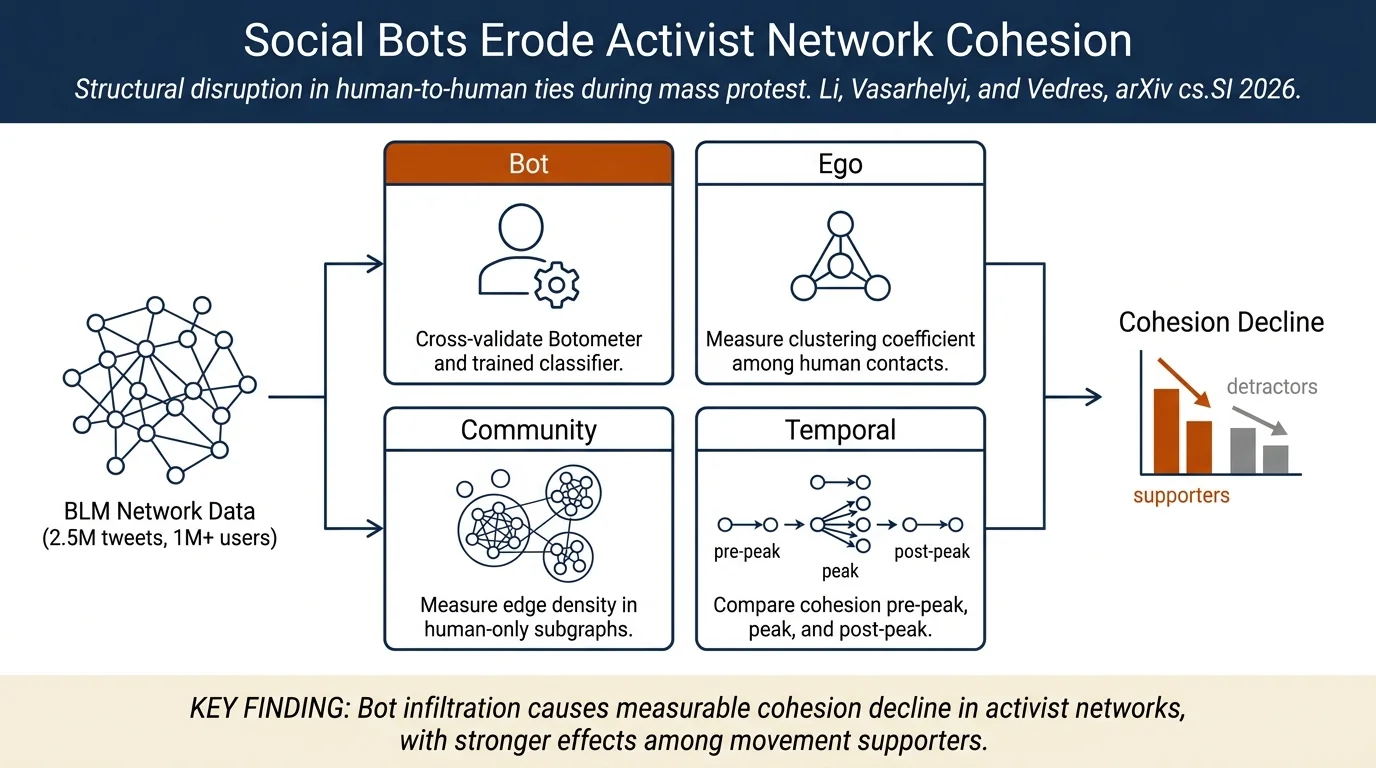
Social bots weaken activist cohesionSocial bots during protest peaks weaken the human relational infrastructure of activism. Analyzing 2.5M tweets from the 2020 Black Lives Matter protests, the authors show that networks more exposed to bot infiltration suffered steeper declines in human cohesion (triadic closure and edge density) after the peak, with effects concentrated…
 Spread & networksPsychology & interventions
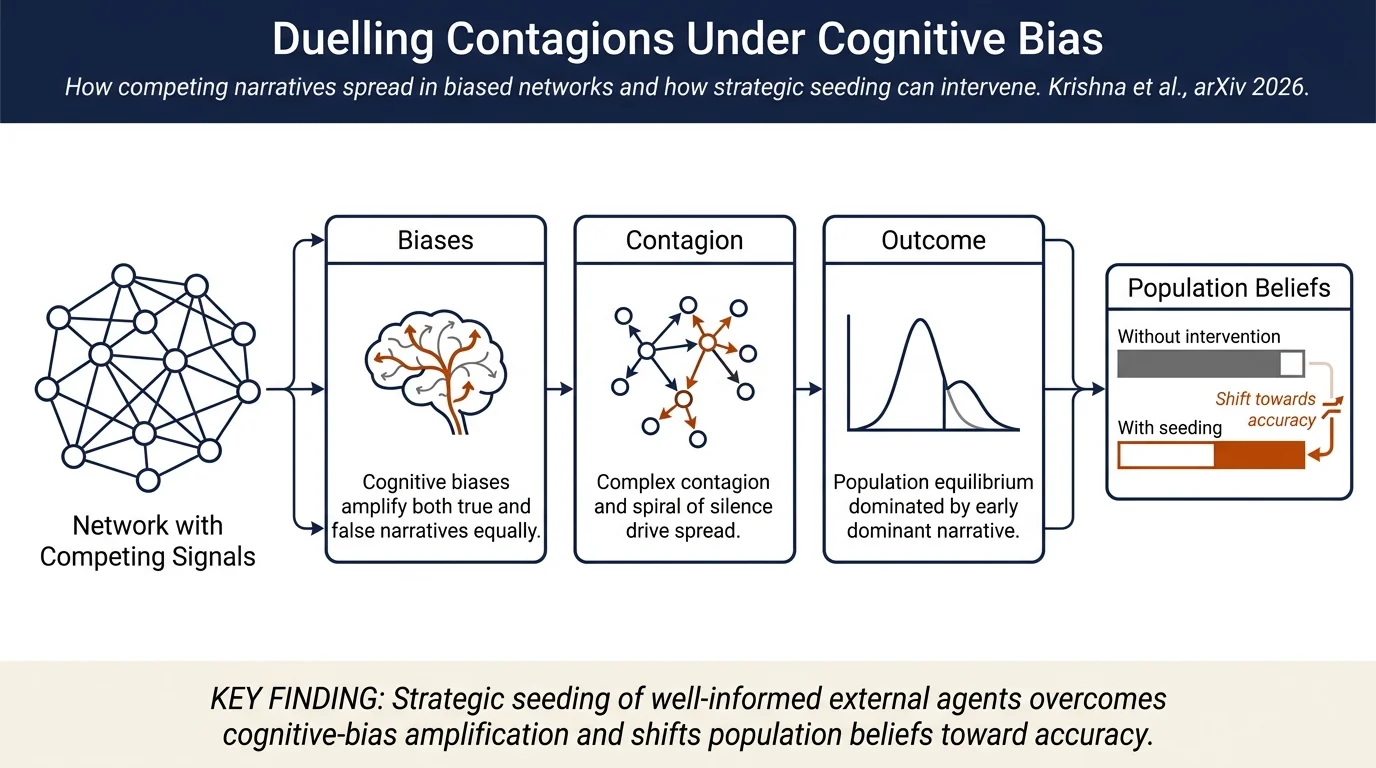
Modeling Duelling Contagions of True and False Information in the Face of Inherent Individual biasesThis paper proposes CI-SRW, an agent-based co-diffusion model integrating cognitive biases with network dynamics to explain how competing true and false information spread in social media. Using behavioral experiments and simulations, the authors find that manipulative narratives dominate when early spreaders hold them, cognitive biases…
 Spread & networksPlatforms, policy & society
Quantifying Political Partisanship for Cross-Platform AnalysesPolitical partisanship measurement in social media typically relies on platform-specific features (follower networks, community structure), making cross-platform comparison difficult. This work proposes a text-based partisanship measurement method grounded in external media bias ratings, and validates it on ~1.3 million posts from…
 Spread & networksDetection methods
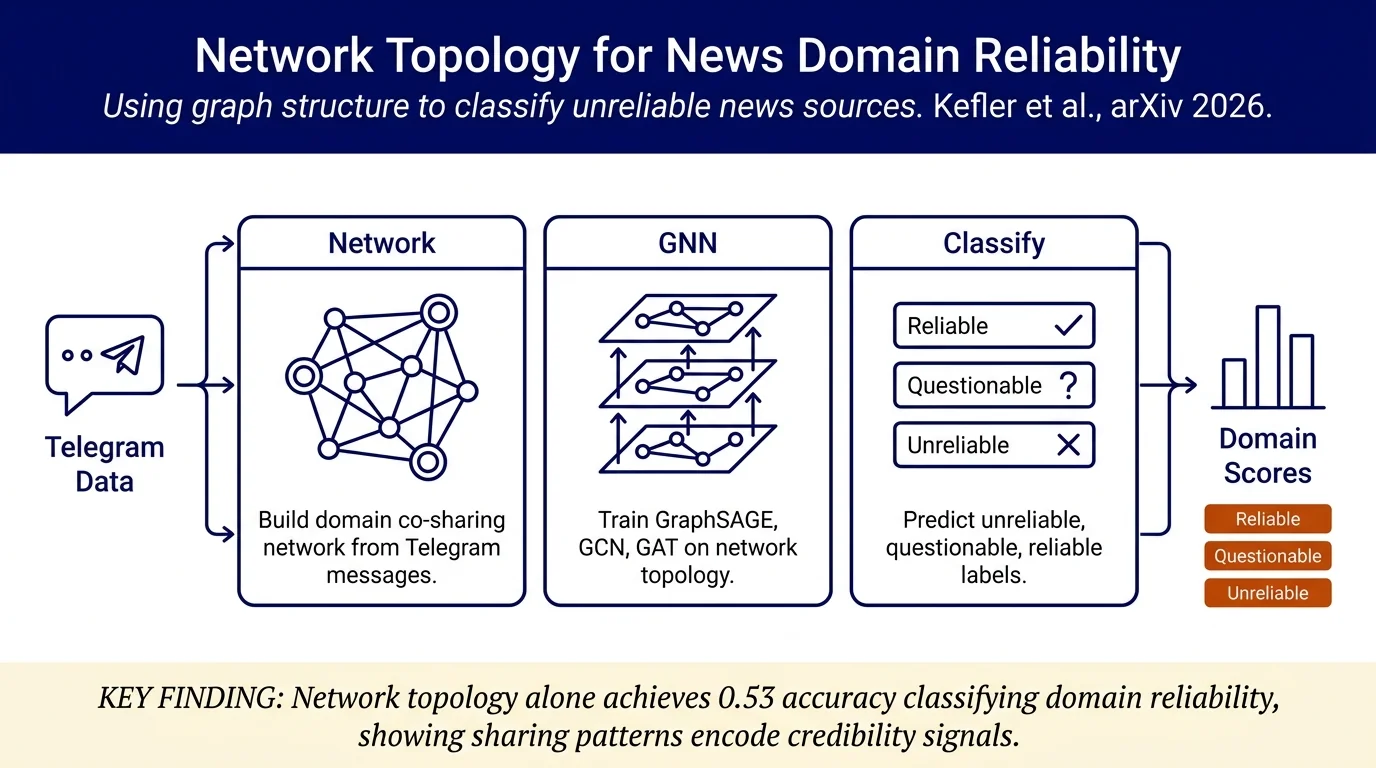
Network Information Enhances Unreliable News Domain DetectionContent-based detection of unreliable news is increasingly difficult as low-reliability sources mimic credible journalism. The authors show that network structure—how domains co-occur in social networks—can improve news-domain reliability classification.
 Spread & networksDetection methods
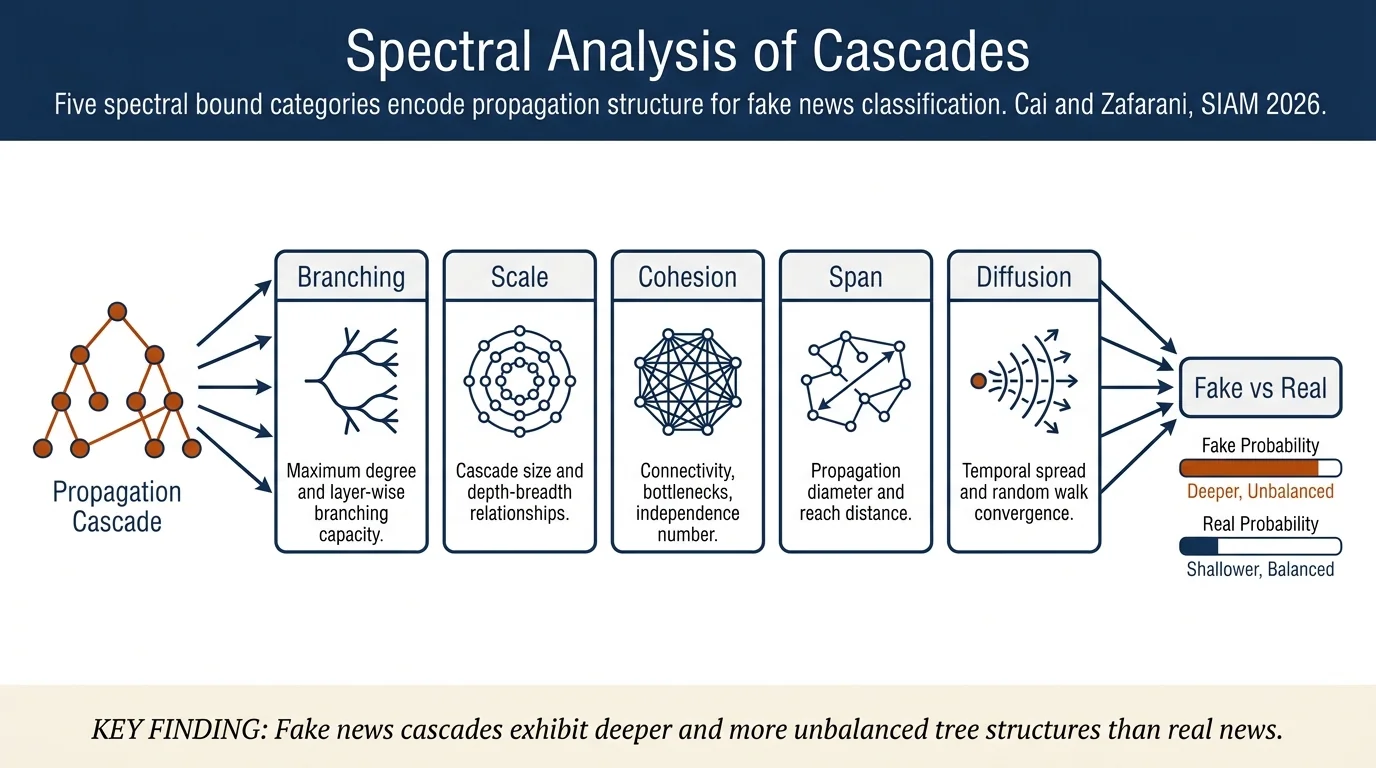
Spectral Analysis of Fake News PropagationThe paper develops a spectral view of fake news propagation by connecting graph spectra with structural properties of propagation trees. The authors derive spectral bounds capturing five key aspects of cascade structure—branching capacity, cascade scale, structural cohesion, propagation span, and diffusion dynamics—and use them as graph…