Friends as Sensors: High-Sensitivity Monitoring of Misinformation and Platform Dynamics via the Friendship Paradox
Authors: Mathias Angermaier, Jana Lasser, Stephan Lewandowsky, David Garcia
Affiliations: University of Graz, University of Bristol, University of Potsdam, University of Konstanz
Venue: arXiv cs.SI, October 14, 2026 — arXiv:2610.16907
TL;DR
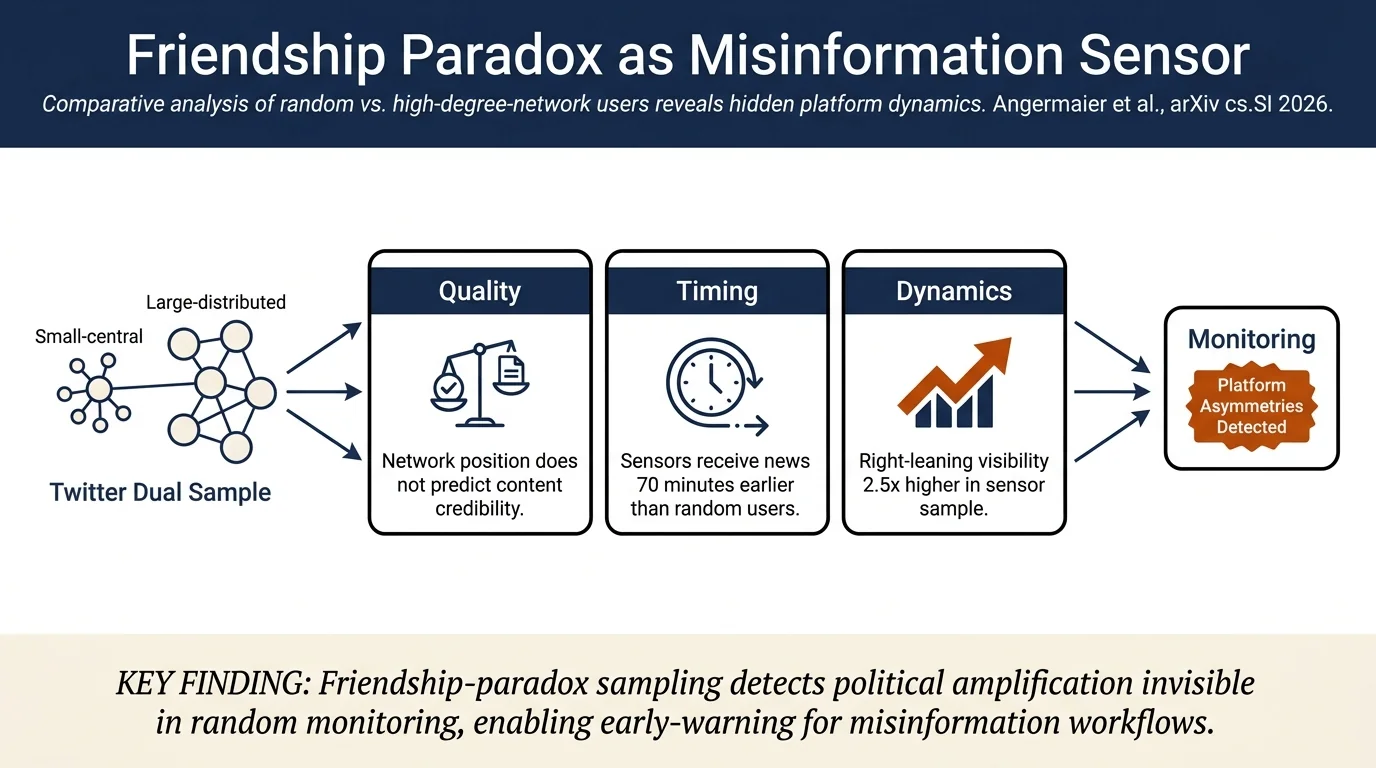
The friendship paradox—a network property where a user's friends are, on average, better connected than the user themselves—enables high-sensitivity monitoring of misinformation on Twitter/X. Comparing ~27 million tweets from randomly selected users to ~31 million from accounts those users retweet (the "sensors"), the authors find: (1) centrally-positioned users share news of comparable quality to random users, but information quality divides along political orientation, not network position; (2) news links reach sensors 70 minutes earlier than random users; (3) right-leaning content visibility rose 2.5-fold among sensors during June–October 2024, invisible in random samples. Friendship-paradox sampling thus enables platform-dynamics monitoring undetectable in conventional random samples.
Contributions
- Methodological: Validates friendship-paradox sampling as a general-purpose tool for monitoring platform-level exposure dynamics, extending prior work on epidemic spread and hashtag adoption to the domain of misinformation monitoring.
- Empirical: Large-scale comparative analysis (30.9M vs. 27.4M tweets across 9,100+ authors) during the 2024 U.S. election using NewsGuard credibility ratings and political orientation classification.
- Finding 1 — Network vs. Ideology: Network position does not predict misinformation sharing. Information quality divides along the political orientation of news outlets (left-leaning outlets consistently high-quality across both samples), not along users' network centrality.
- Finding 2 — Early detection: Sensor users receive news 70 minutes earlier than random users (median, 95% CI: 57–84 min), with time advantage stable across the quality spectrum—supporting early-warning workflows independent of content quality.
- Finding 3 — Invisible amplification: Right-leaning content impressions rose 2.5-fold in the sensor sample (June–October 2024, OLS: β = 0.019, p < 0.001), while left-leaning remained flat. This asymmetry is invisible in random samples and unmeasurable at the platform-wide content level, revealing a perception-gap: sensor users (central, high-reach accounts) experience a skewed political mix invisible to the platform's overall information production.
Method
Dataset construction: Two Twitter/X datasets spanning June–October 2024, with overlapping collections from January 2015 onward.
- Random dataset: 4.3 million eligible accounts sampled from Twitter's 1% random stream (Sept 28–Oct 11, 2024), filtered for activity, follower–followee balance, and language (English). Final: 10,000 accounts, ~27M tweets spanning 2015–early 2025.
- Sensor dataset: 10,000 accounts selected at random from retweeters of random-sample users. These sensors' tweets and retweeted content collected June 1–Oct 31, 2024. Final: 30.9M tweets from 9,121 authors.
Misinformation operationalization: Domain-level credibility via NewsGuard scores (nine-criterion rubric, trained journalists). Captures source-level trust, not factual accuracy of individual claims. Covers ~30–40% of shared links in the datasets after URL expansion.
Political orientation: Classified news outlets as left-, right-, or neutral-leaning using NewsGuard's domain-level political positioning. For unclassifiable tweets, inferred user orientation via their share of NewsGuard-rated content (orientation-share index, weighted by impressions). Isolated effects of political outlet choice from users' personal sharing behavior.
Time advantage analysis: For each news link appearing in both datasets, computed first-occurrence timestamp difference (sensor vs. random). Aggregated by NewsGuard score quintile to test whether time advantage depends on content quality. Bootstrap 50% CI reported at individual score levels.
Temporal dynamics (RQ3): Modeled impressions per tweet for left-, right-, and neutral-leaning content using geometric-mean aggregation in 3-day intervals. Tested trends via OLS regression on log-transformed means and non-parametric Mann-Kendall test; computed share-weighted impressions for users' general (non-NewsGuard) posting activity to distinguish content-level from user-level effects.
Results
RQ1: Do centrally-positioned users share more misinformation? No. Median NewsGuard scores: Sensor 91.25, Random 90 (Cliff's δ = −0.056, Mann-Whitney p < 0.001, negligible effect). Overall distributions nearly overlap. When split by political orientation, outlet credibility—not network position—explains variation: left-leaning outlets IQR 87.50–100 in both samples; right-leaning outlets IQR 20–69.5 in sensor, 30–69.5 in random. Political affiliation of the outlet, not centrality of the user sharing it, predicts quality.
RQ2: Time advantage (news reaching sensors earlier). Median lead time for NewsGuard-rated news links: 70 minutes (95% CI: 57–84). Mean: 199 min (95% CI: 153–245). For non-rated links (general tweet stream): 36 minutes (95% CI: 34.6–37.4). Lead time is stable across the NewsGuard quality spectrum (r = 0.001 within well-populated range, r = 0.051 across all pairs, both p > 0.05), indicating early detection is not quality-dependent—sensors catch early news in general, not just low-quality content. In 66.9% of pairwise comparisons, sensors posted first.
RQ3: Platform exposure dynamics (exploratory finding). Over June–October 2024, impressions per tweet for right-leaning media in the sensor sample rose significantly (OLS: β = 0.0086 log-units/interval, p = 0.001; Mann-Kendall: τ = 0.54, p = 0.001)—approximately 1.9% per 3-day interval, compounding to 2.5-fold growth. Left-leaning content showed no trend (OLS: β = −0.002, p = 0.10; Mann-Kendall: τ = −0.16, p = 0.10). Neutral content stable (p = 0.18). The same uptrend was not detectable in the random sample, where both left and right content remained essentially flat across the window. At the individual user level, the asymmetry holds even for tweets without NewsGuard links: sensor users whose NewsGuard-rated sharing leans right show increased impressions on unrated posts (β = 0.0086, p = 6.1 × 10^−10), while their peers show flat or declining engagement. Random-sample users show no comparable trend (p = 0.85 for right-leaning content-level series, p = 0.026 for downward trend on neutral content). This suggests the visibility concentration is specific to high-degree users and invisible to the overall platform mix.
Connections
- Network properties and misinformation: The echo chamber effect on social media documents homophily and political clustering; this work shows network centrality does not proxy for content quality even within clustered networks.
- Early detection methods: Related to Mining Disinformation and Fake News: Concepts, Methods, and Recent Advancements and Cascade Prediction literature; extends friendship-paradox methodology (validated by Friendship paradox) from contagion to news quality dynamics.
- Platform dynamics and measurement: Connects to Algorithm recommendation and Platform transparency work on how algorithmic ranking distorts user-perceived information distributions.
- Political polarization on social media: Relevant to Political polarization and ideological echo chambers and Partisan sorting; demonstrates that belief-quality divides follow outlet ideology, consistent with Osmundsen's work on partisan hostility.
Notes
Strengths: Large-scale empirical study with two complementary samples enabling triangulation. Methodologically sound: bootstrap confidence intervals, non-parametric validation (Mann-Kendall), exposure-weighting to separate content- from user-level effects. Clear finding that time advantage is independent of quality, enabling practical early-warning systems. Temporal analysis reveals platform-level asymmetries invisible to aggregate statistics.
Limitations: (1) Platform specificity—findings limited to Twitter/X during Elon Musk's ownership and 2024 election context; generalizability to other platforms or periods unknown. (2) NewsGuard operationalization captures domain-level trust (outlet credibility), not individual-claim accuracy; misses text-only misinformation and fine-grained falsehoods. (3) Temporal mismatch: random sample spans 2015–2025, sensor sample focused on June–October 2024; confounds platform changes over time with network-position effects. (4) Observational design cannot establish causation—cannot distinguish between algorithmic amplification, user-driven engagement concentration, and paid promotion on the temporal asymmetries. (5) Geographic and language bias: NewsGuard concentrates on North American and Western European outlets; news sharing in other regions is systematically unrated and omitted from quality analyses.
Broader implications: The practical consequence is that targeting misinformation interventions by network position alone will not reach the dominant sources of low-quality sharing—which concentrate among ideologically-motivated users, not structurally central ones. However, the 70-minute early-warning capability from friendship-paradox sampling offers a scalable monitoring approach for triggering human review or accuracy-check workflows before high-reach amplification occurs. The invisible amplification of right-leaning content in June–October 2024 highlights the feedback loop between platform visibility mechanisms and user perception of the information landscape: a small set of high-reach accounts experience a drastically skewed political mix, potentially reinforcing false-consensus beliefs even when the platform's actual output is balanced.