Social bots weaken activist cohesion
Authors: Linda Li, Orsolya Vasarhelyi, Balazs Vedres Venue: arXiv cs.SI, 2026 — arXiv:2609.00197
TL;DR
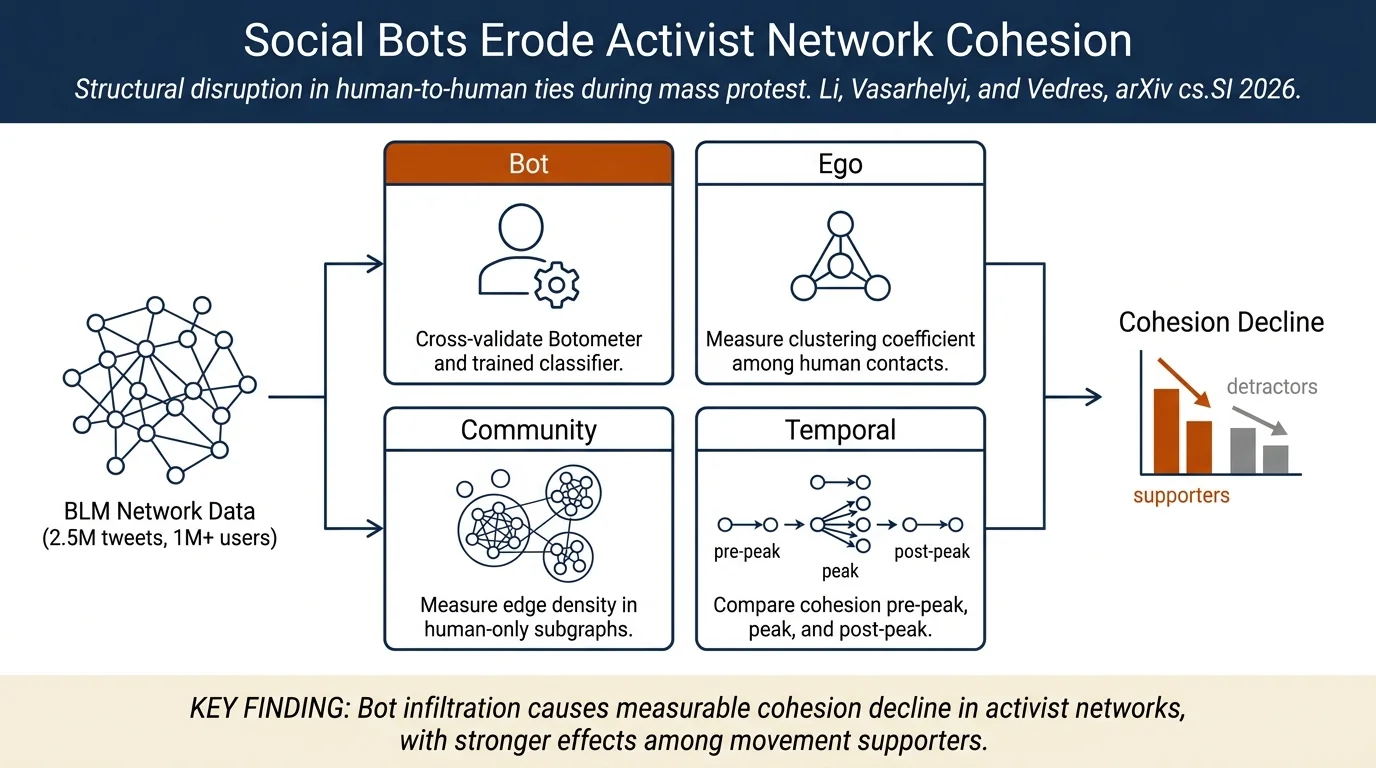
Social bots during protest peaks weaken the human relational infrastructure of activism. Analyzing 2.5M tweets from the 2020 Black Lives Matter protests, the authors show that networks more exposed to bot infiltration suffered steeper declines in human cohesion (triadic closure and edge density) after the peak, with effects concentrated among movement supporters. The erosion happens through structural disruption of human-to-human ties, not through bot-driven messaging.
Contributions
- Two-level analysis: Measures cohesion at both ego-network level (triadic closure) and mesoscale level (community edge density), revealing distinct dimensions of how bots disrupt collective action infrastructure.
- Temporal design: Pre-/peak/post-peak snapshots paired with k-core network restriction enable causal inference about bot influence during the protest peak.
- Movement heterogeneity: Shows bot exposure effects vary by users' pre-existing political orientation; supporters bear disproportionate cohesion loss compared to detractors, suggesting bots preferentially target the core.
- Hybrid network characterization: Quantifies bot prevalence in the BLM network (55% bot-bot / 42% bot-human / 12% human-human interactions at peak) and persistence patterns across periods.
Method
The authors study retweet networks centered on Black Lives Matter discourse surrounding George Floyd's death (May 25, 2020) and focusing on the protest peak window (June 7–8, 2020). They:
- Collect data: 2.5M tweets from 1M+ users over the 48-hour protest peak and post-peak periods; prebaseline snapshot from early May.
- Detect bots: Cross-validate between Botometer (public API) and a trained classifier; bots defined as accounts scoring >0.65; conduct sensitivity analysis across 0.65–0.75 thresholds.
- Define networks: Restrict to k-core to isolate the protest core; measure human-only cohesion (excluding bots) across snapshots.
- Measure cohesion at two scales:
- Ego-network level: Triadic closure (clustering coefficient) among a user's human contacts, computed before and after the peak.
- Community level: Edge density of human-only subgraphs within detected communities (Clique Percolation Method, k=4); communities identified as four-cliques with overlaps.
- Statistical analysis: OLS regression of cohesion change (peak→post-peak) on bot exposure (alter-bot edges for ego networks; bot-human density for communities), with controls for baseline structure, user activity, and network position. Include interaction terms to assess moderation by users' prior support for Black Lives Matter (operationalized via ChatGPT classification of pre-peak stance on binary scale).
Results
Main finding: Networks with higher bot exposure experienced steeper declines in human cohesion. Effect sizes:
- Ego-network level (Figure 3A): Each additional alter-bot edge (log scale +1) associated with ~0.04 decrease in clustering coefficient; effect negative and significant across all models.
- Community level (Figure 3B): Higher bot-human density (+0.01 log scale) associated with ~0.3 decrease in edge density; negative association robust across specifications.
- Moderation by support (Figure 4): The bot-exposure → cohesion-decline association is markedly stronger among movement supporters than among neutral/opposed users. Among supporters, predicted cohesion decline ranges ~0.2–0.3 (log scale); among detractors, effect flattens near zero.
Secondary findings:
- Human-only network structure was sparse (clustering ~0.055 at peak, 0.112 post-peak) and hub-dominated; retweet volume declined >1 order of magnitude post-peak.
- Bot prevalence stable across thresholds (0.65–0.75); results unchanged when restricting network to BLM-related edges only.
- Ego-network and community-level measures show consistent but distinct patterns; community analysis shows denser networks suffer steeper drops in edge density, suggesting bots' disruption concentrates where human cohesion is most tightly integrated.
Connections
- Social bots — automated account role in information ecosystems and activism
- Computational propaganda — strategic use of bots to disrupt collective action
- Bot detection — methods for identifying automated accounts
- Social movements — online organizing and network structure
- Online activism — vulnerability of digital activist infrastructure
- Network science — structural analysis of relational systems
- Cascade dynamics — how information and disruption propagate
Notes
Strength: The paper makes a methodological and conceptual advance by moving beyond "do bots spread content?" to ask "do bots disrupt the human-to-human ties that enable collective action?" The two-level analysis (ego vs. mesoscale) and explicit comparison of supporters vs. detractors reveals asymmetric vulnerability. The longitudinal design and robustness checks (threshold sensitivity, edge-definition checks, weighted network errors) strengthen causal claims.
Interpretation: The key insight is that bot impact on activism may operate through structural erosion rather than persuasion. Even if bots say nothing provocative, their mere presence as pseudo-members of human communities thinned triadic closure—the redundancy that makes networks resilient to link loss. This matters because movements depend on "thick" ties for trust, solidarity, and coordinated action; bot-driven thinning makes networks vulnerable to sudden collapse when attention fades.
Scope and generalizability: Results are specific to the BLM protests of June 2020; whether effects generalize to other protest moments, geographies, or anti-movement bots (rather than pro-movement infiltration) remains open. The paper does not address whether bot removal or inoculation (making users aware of bot presence) could mitigate cohesion loss.
Limitations: Because the study restricts to the k-core protest network, results apply to the most-engaged activists; peripheral supporters or those outside the online network are not analyzed. Bot detection is fallible and threshold-dependent, though sensitivity checks suggest conclusions are robust. The paper treats bot exposure as exogenous, but political actors may strategically deploy bots where network structure is already fragile.