One AI Signal, Many Human Judgments: A Bayesian Cascade Analysis of AI-based Credibility Indicators in Online Information Spread
Authors: Zhuoran Lu, Weilong Wang, Yangyang Yu, Xinru Wang, Zhuoyan Li, Zhiwei Liu, Sophia Ananiadou
Venue: arXiv cs.SI, August 2026 — arXiv:2608.30311
TL;DR
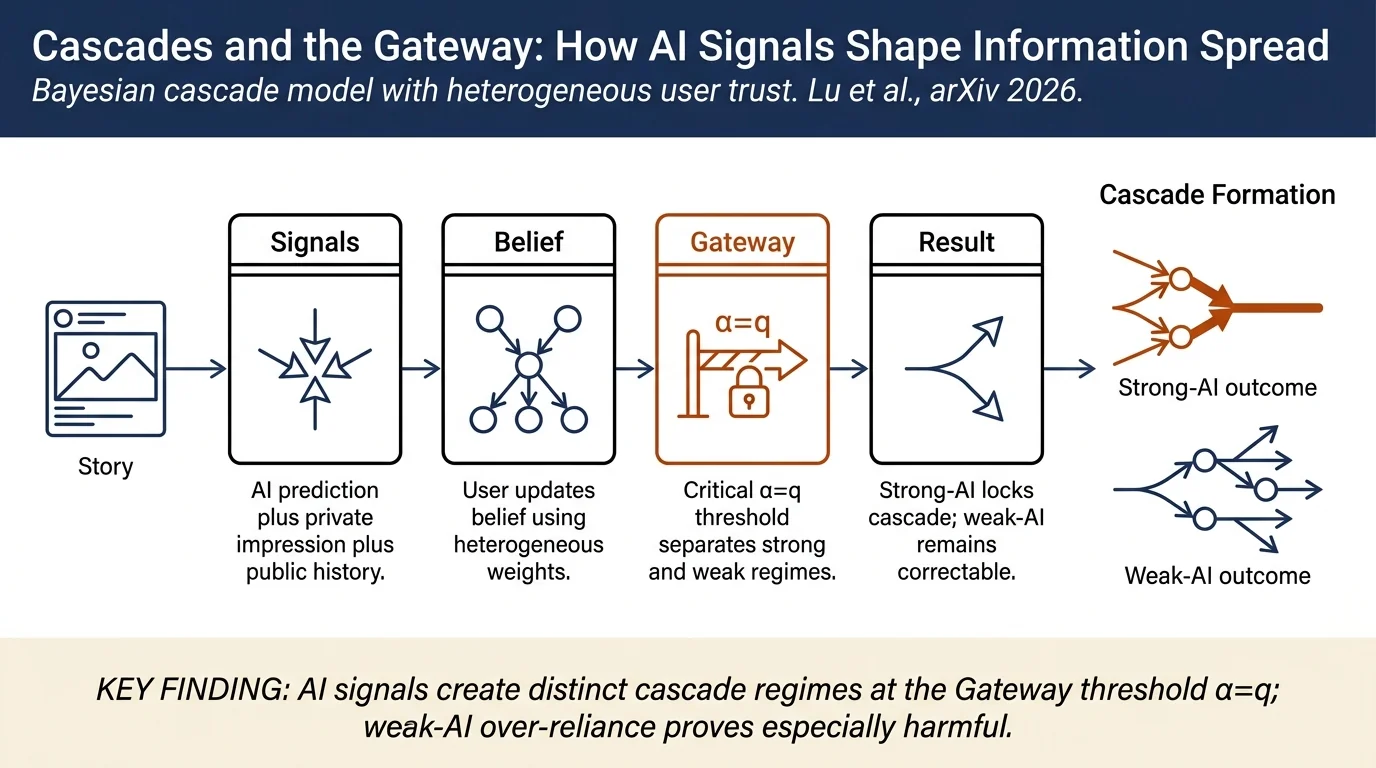
Social media platforms increasingly deploy AI-based credibility indicators to help users judge misinformation. This paper extends classical Bayesian cascade models to treat AI credibility signals as a shared public signal seen by all users, then derives a critical "Gateway" threshold: above it, AI predictions dominate the public record; below it, cascades can still correct wrong AI signals. Empirical calibration using human-subject experiments shows that average users weight AI moderately but heterogeneously, and that over-reliance on weak AI is especially harmful while diversity in AI signals breaks harmful dependence.
Contributions
- Theoretical framework: Extends Bayesian cascade models with AI credibility indicators as a platform-deployed shared signal, introducing the Gateway mechanism that describes when AI changes the direction of public consensus.
- Empirical calibration: Conducts human-subject experiments to measure how users update beliefs in the presence of an AI signal vs. earlier peer judgments, revealing heterogeneous behavioral weights and two distinct cascade regimes.
- Gateway condition: Derives a closed-form threshold (\(a = q\)) that separates "strong-AI" cascades (where AI predictions permanently lock in) from "weak-AI" cascades (where private impressions can still overturn public history).
- Design implications: Shows that over-trusting a weak AI is worse than having no AI; diversifying AI signals across users and expert review interventions can improve welfare while preserving correction.
Method
The paper models information spread as a sequence of users encountering a story online. Each user observes: - Their own private impression of the story's veracity - An AI credibility indicator (binary prediction, accuracy \(\alpha\)) - Judgments of earlier users visible in the public history
Users form Bayesian belief updates combining three signals: private impression, AI prediction, and public history. The key insight is that all users see the same AI signal—it becomes part of the public record and reshapes what later users learn.
The researchers define the Gateway condition: a critical threshold \(a = q\) (where \(q\) is the accuracy of the AI and \(\alpha\) is the user's estimated accuracy) that separates two behavioral regimes. When AI accuracy is above \(a = q\), the first user's cascade direction is identical to the AI prediction, and the public opinion locks in immediately—termed the "strong-AI" regime. When \(a < q\), early private impressions can still overturn the AI signal—the "weak-AI" regime. The paper derives closed-form expressions for cascade-formation time, direction, and the conditions under which cascades can abort.
They conduct empirical calibration using a human-subject experiment with 11 participants reviewing 40 news items under three conditions (AI-before showing the AI first, AI-after showing it after subjects form an initial impression, and control with no AI). Participants generate binary veracity judgments; the AI signal carries a fixed accuracy of \(\tilde{\alpha} = 0.750\).
Results
Behavioral heterogeneity: Subjects show two distinct behavioral clusters. About 46% under-weight the AI and never cascade on it alone; 34% remain in a learning regime and form cascades more readily; the remaining 20% are cascade-prone. The average user weights AI below their own private impression but above several peer judgments.
Gateway structure: The symmetric prior (\(\pi_0 = 0.5\)) and calibrated behavioral weights place subjects near the Gateway boundary. Two experimentally measured points (AI-before at \(\tilde{\alpha} = 0.75\) and AI-after at \(\alpha = 0.515\)) reveal that the empirical Gateway is located near the theoretical prediction, validating the model's core mechanism.
Welfare trade-offs: In simulations, diversifying AI signals across users (so not all users see the same signal) significantly reduces the risk of harmful cascades, even under weak AI. Expert review triggered when cascade formation is slow (Proposition 6) proves more effective than relying on the AI alone. Over-reliance on weak AI is especially harmful; the best outcome balances AI reliance with structural interventions.
Misalignment and interventions: Sections 6.1 and 6.2 show that users can dramatically over-trust weak AI (widening the perceived Gateway), while under-trusting strong AI (raising the threshold for first-user absorption). Corrective interventions—either diversifying AI predictions or triggering expert review—shift the regime structure without requiring changes to the underlying platform credibility mechanism.
Connections
- Extends classical Information Cascades (Banerjee 1992, Bikhchandani et al. 1992) by introducing a platform-deployed shared signal (AI) visible to all users sequentially.
- Related to Human-AI Interaction literature on how individuals calibrate reliance on algorithmic advice (Logg et al. 2017, Bansal et al. 2021).
- Applies Bayesian Inference and Social learning and belief transmission theory to the misinformation setting, connecting to cascades in rumor detection and fact-checking.
- Cited by recent work on Content moderation design and the role of credibility labels in slowing misinformation spread.
Notes
Strengths: - Rigorous theoretical framework connecting Bayesian belief updating to observable cascade dynamics. The Gateway mechanism provides a clean, interpretable threshold. - Empirical calibration grounds the theory in real human behavior, revealing that textbook rational Bayesian updating does not describe subjects; instead, a flexible behavioral model with heterogeneous weights fits the data. - Strong practical implications: the paper shows concretely when and why AI interventions fail (weak-AI regime, high reliance) and what structural changes (diversification, expert review) help.
Limitations: - The cascade model retains standard assumptions: conditionally independent private impressions, Bayesian agents, and two-state (binary) veracity. Real misinformation settings involve multi-dimensional claims and changing beliefs over time. - The human-subject experiment, while rigorous, uses small sample size (N=11 subjects, 40 items per treatment), limiting generalizability to large social-media populations. - The paper assumes the AI's accuracy is known to users; in practice, users may have incorrect beliefs about AI performance.
Follow-up directions: - Test the Gateway framework on real-world social-media data (Twitter, Facebook cascades) to validate threshold predictions at scale. - Investigate how uncertainty about AI accuracy affects behavior (does over-estimation of AI reliability explain over-trust?). - Study how platform interventions (e.g., flagging the AI prediction, separating AI signals per user, introducing delay) reshape cascade dynamics.