Network Information Enhances Unreliable News Domain Detection
Authors: Raphaela Kefler, Roman David Ventzke, Viola Priesemann, Giordano De Marzo Venue: arXiv cs.SI, 2026 — arXiv:2608.02399
TL;DR
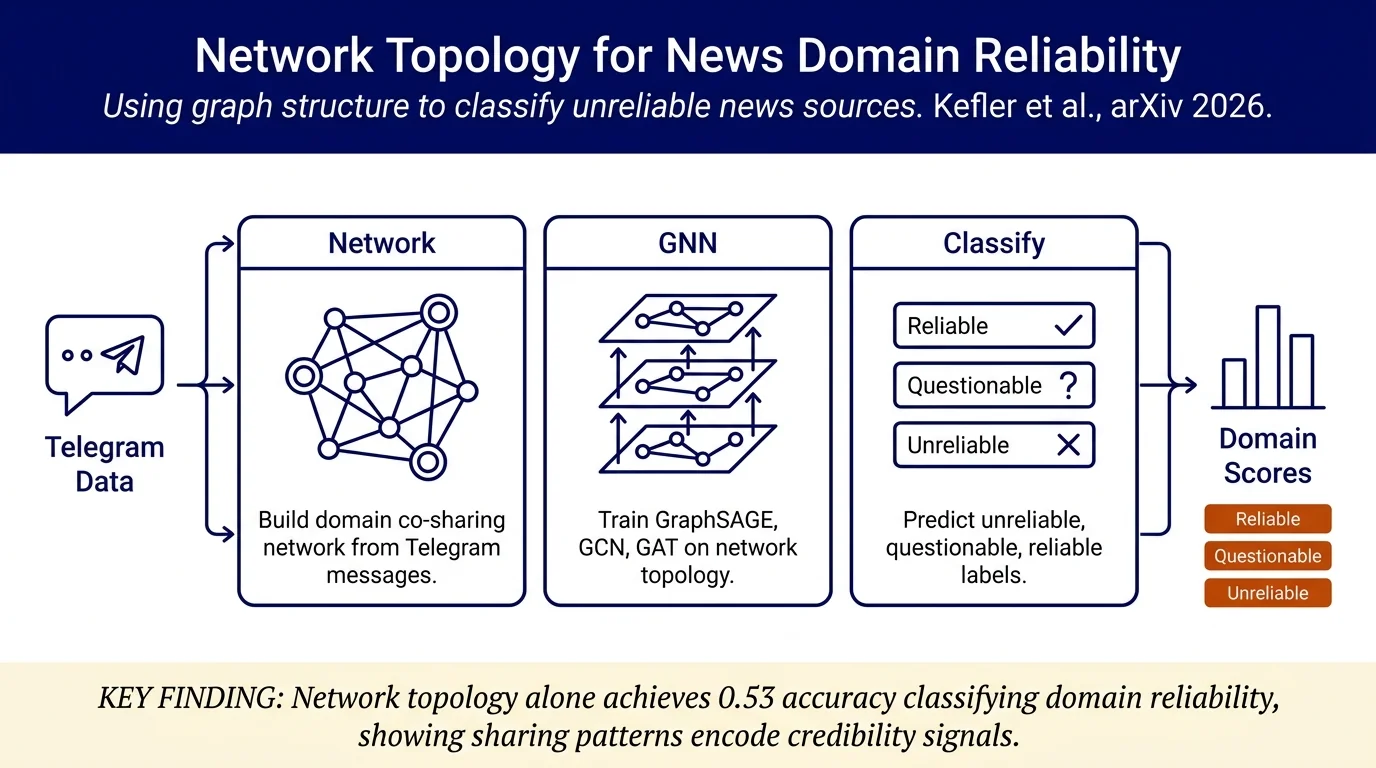
Content-based detection of unreliable news is increasingly difficult as low-reliability sources mimic credible journalism. The authors show that network structure—how domains co-occur in social networks—can improve news-domain reliability classification. Using a Telegram co-sharing network and Graph Neural Networks, they demonstrate that network topology provides valuable complementary signals for reliability assessment, even when content analysis is infeasible.
Contributions
- Constructed a statistically-validated domain co-sharing network from Telegram co-occurrences in chat messages, capturing implicit signals of domain reliability through user sharing behavior.
- Evaluated multiple Graph Neural Network architectures (GCN, GAT, GraphSAGE) against network-unaware baselines on domain reliability classification.
- Demonstrated that network structure systematically improves domain reliability assessment: GraphSAGE achieved 0.63 accuracy with 1–14% relative gains over content-unaware baselines.
- Showed that network topology carries substantial information about reliability independent of content features, enabling classification even when content analysis is infeasible.
Method
The paper operates at the domain level rather than individual-article level, using Telegram as a unique ecosystem for analysis.
Data and Network Construction. The authors collected a large Telegram dataset by crawling public channels and group chats (95% activity concentrated 2017–2023) and applied snowball sampling to identify news domains and sharing patterns. For each URL, they computed content-agnostic features capturing spreading dynamics—avalanches (bursts of temporal sharing), virality metrics, and reach. They discretized domain reliability into three classes (unreliable, questionable, reliable) using composite scores from six major fact-checking databases, yielding a unified domain-reliability score (PCI: Principal Component Index).
To construct a domain-level co-occurrence network, they aggregated URLs by domain and represented each domain as a node characterized by content-aware features (SBERT embeddings of articles) and content-agnostic features (spreading dynamics). A bipartite network was then projected into a domain-domain network using the Bipartite Configuration Model to validate statistical significance of co-occurrences, retaining only edges with significance threshold p ≤ 0.01.
Graph Neural Networks. The authors trained Graph Convolutional Networks (GCN), Graph Attention Networks (GAT), and GraphSAGE to predict domain reliability, comparing against a Multi-Layer Perceptron baseline. All models used the same input features and were trained with Adam optimizer on three-layer architectures with ReLU activation and dropout regularization.
Results
GraphSAGE achieved the best performance with an accuracy of 0.63 and F1-score of 0.63 in the content-based setting (using both content and spreading features). When removing content features entirely (network-only), GraphSAGE reached 0.53 accuracy, compared to 0.47 for MLP—demonstrating that network structure alone provides meaningful signals. The paper notes that the modest absolute performance reflects the inherent difficulty of the task: low-reliability sources mimic credible journalism and generative AI makes fabricated content harder to flag.
The domain co-sharing network exhibits clear assortative mixing by reliability: low-reliability domains cluster together, and high-reliability domains cluster separately, with a reliability assortativity coefficient of 0.22. This suggests users' sharing patterns naturally encode reliability information that can be exploited for automated assessment. On the test set, unreliable domains were correctly classified with high precision.
Connections
- Related to Network-based Fake News Detection: A Pattern-driven Approach and Hierarchical Propagation Networks for Fake News Detection: Investigation and on network-based approaches to misinformation detection.
- Extends Information Credibility on Twitter (early work on source credibility in social networks) to domain-level analysis with modern GNN architectures.
- Methodologically related to MVAE: Multimodal Variational Autoencoder for Fake News Detection and EANN: Event Adversarial Neural Networks for Multi-Modal Fake News Detection on multimodal misinformation detection, though this work focuses on network topology rather than content fusion.
- Complements FakeNewsNet: A Data Repository with News Content, Social Context and Spatiotemporal by offering a network-aware alternative to content-based classification.
- Uses GNN techniques similar to Rumor Detection on Twitter with Tree-structured Recursive Neural Networks and Fake News Detection on Social Media using Geometric Deep Learning on graph-based misinformation detection.
Notes
The paper makes a compelling case that network-based signals are complementary to content analysis and remain effective when content is infeasible to analyze (e.g., languages without good embeddings, paywalled articles, expired links). The focus on Telegram is particularly relevant given its role as a significant platform for low-quality information dissemination, especially in geopolitical contexts. A limitation is domain-level aggregation: domains may host mixed-quality content (some reliable, some fabricated articles), obscuring within-domain heterogeneity. The modest absolute performance reflects genuine difficulty in distinguishing unreliable sources that have learned to mimic credible journalism—a problem no single modality has fully solved. The use of Bipartite Configuration Model for validation is methodologically sound and ensures the observed network structure carries real signals rather than artifacts of random co-occurrence.