Spectral Analysis of Fake News Propagation
Authors: Weibin Cai, Reza Zafarani Venue: SIAM, 2026 — arXiv:2605.13861
TL;DR
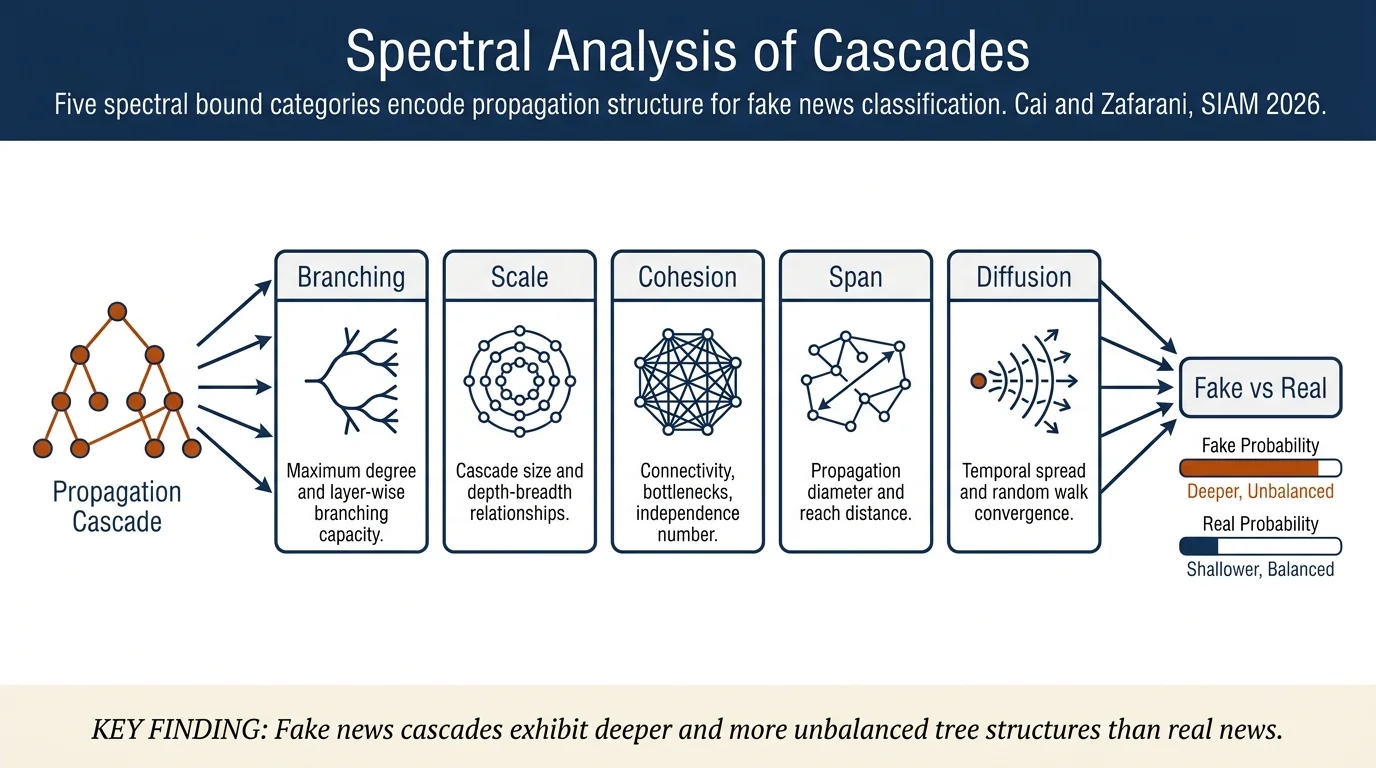
The paper develops a spectral view of fake news propagation by connecting graph spectra with structural properties of propagation trees. The authors derive spectral bounds capturing five key aspects of cascade structure—branching capacity, cascade scale, structural cohesion, propagation span, and diffusion dynamics—and use them as graph encodings for fake news classification. Experiments on Weibo22 and Twitter16 show spectral bounds reliably distinguish fake from real news and reveal that fake news propagates in deeper, more unbalanced structures.
Contributions
-
Spectral analysis of information propagation graphs: Develops a spectral representation of news propagation by connecting graph spectra with propagation-related structural properties through rigorous spectral bounds, providing a unified view of cascade structure that captures global patterns.
-
Spectral representation of propagation graphs: Introduces five complementary spectral bound categories (branching capacity, cascade scale, structural cohesion, propagation span, diffusion dynamics) that unify disparate topological features into a single interpretable spectral representation for downstream classification.
-
Structural optimization of propagation patterns: Proposes a discrete structural optimization framework with both score-guided and bound-guided objectives to trace how propagation graphs evolve, revealing interpretable structural evolution trajectories and their correspondence to fake-news classification.
Method
Spectral Bounds for Cascade Structure. The paper derives 35 spectral bounds organized into five categories, each capturing a distinct structural aspect of propagation trees. These bounds relate graph spectra (eigenvalues of adjacency and Laplacian matrices) to topological features:
-
C1. Branching Capacity (6 bounds): Characterizes how broadly news expands at each level via maximum degree, mean branching, and maximum branching at layer \(k\). Bounds include mean branching bound \(b \leq \frac{n\lambda_1}{2|I(T)|}\) and maximum branching at layer \(k\) via spectral radius.
-
C2. Cascade Scale (8 bounds): Captures overall cascade size through numbers of edges, nodes, and relationships between cascade depth and breadth.
-
C3. Structural Cohesion (6 bounds): Measures how tightly connected the propagation structure is via vertex connectivity, Cheeger constant, and independence number, using algebraic connectivity \(\mu_{n-1}\) to assess bottleneck behavior.
-
C4. Propagation Span (7 bounds): Characterizes how far information propagates via diameter and related spectral quantities, connecting to random walk convergence and routing time.
-
C5. Diffusion Dynamics (8 bounds): Captures temporal aspects of information spread via random walk convergence and conductance through spectral gaps.
Structural Optimization. The paper proposes discrete optimization algorithms to trace how propagation graphs evolve under different structural objectives:
-
Score-guided optimization: Modifies a cascade structure to maximize/minimize fake-news prediction score using leaf-node migrations, with first-order perturbation approximation for efficiency.
-
Bound-guided optimization: Directly optimizes specific spectral bounds (e.g., max-breadth, structural virality) to understand how different structural evolutions correspond to fake vs. real news patterns. Uses perturbation-based eigenvalue approximation (Eq. 5.2–5.8) to estimate bound changes.
Both methods generate interpretable evolution trajectories showing how cascades transition between structural states.
Results
Spectral Bounds as Graph Features. Table 6.1 evaluates the tightness of spectral bounds on the Weibo22 dataset. Key findings:
- Spectral bounds achieve strong correlation with true graph properties (Spearman \(\rho \geq 0.867\), Kendall \(\tau \geq 0.677\)) with relative errors \(\epsilon < 0.70\) for most bounds.
- Graph-size effects are minimal; even when numerical gaps are larger, spectral bounds remain reliable structural signals for fake-news classification.
Classification Performance. Table 6.2 compares spectral bound-based features against handcrafted topological features and graph neural networks (GCN):
| Method | Weibo22 ACC | Weibo22 F1 | Twitter16 ACC | Twitter16 F1 |
|---|---|---|---|---|
| Random | 47.92 | 49.16 | 22.98 | 22.94 |
| Structural Features (handcrafted) | 59.65 | 56.52 | 33.03 | 30.79 |
| GCN | 48.86 | 47.77 | 27.42 | 27.35 |
| Spectral Bounds | 59.40 | 57.65 | 33.55 | 32.20 |
- Spectral bound-based features outperform GCN and match handcrafted features while providing greater interpretability.
- Individual bound categories show distinct effectiveness: C1 (Branching) ranks highest, followed by C2 (Scale), C3 (Cohesion), C4 (Span), and C5 (Diffusion).
Structural Evolution Under Optimization. Figures 6.1–6.2 visualize propagation graph evolution:
-
Score-guided evolution (Figure 6.1): Initial real-like trees (shallow, balanced) evolve toward fake-like structures (deeper, unbalanced) when optimizing for fake probability. The \(P(\text{fake})\) score increases from 0.24 to ~0.65 over 6 iterations.
-
Bound-guided evolution (Figure 6.2): Optimizing for maximum breadth increases both breadth and depth monotonically, with intermediate graph structures exhibiting mixed fake-real characteristics. The trajectory reveals that broad cascades are not automatically fake-like; structural configuration (balance, depth interplay) drives the distinction.
Key Finding: Fake news propagation tends to be associated with deeper and more unbalanced structures. Figure 6.2 demonstrates that a broader propagation pattern does not necessarily produce a cascade more fake-like; rather, deeper and more unbalanced structures are more characteristic of fake news dissemination.
Connections
- Related to Propagation-based fake news detection via spectral analysis of cascade structure
- Extends Graph Based Detection by providing interpretable spectral encodings of propagation graphs
- Complements Network Based Misinformation Detection with rigorous graph-theoretic bounds
- Shares methodological foundations with Graph Neural Networks research but emphasizes interpretability
- Builds on spectral graph theory; see Jin & Newman (2010) for foundational work on graph spectra
Notes
Strengths: The spectral analysis framework provides a mathematically principled, interpretable alternative to neural network-based graph encoding. The 35 spectral bounds offer complementary perspectives on cascade structure, and the rigor of the theoretical framework (Propositions 4.1–4.3, detailed proofs) distinguishes this from ad-hoc feature engineering. The discrete structural optimization algorithms are elegant and generate human-interpretable evolution trajectories that reveal how fake and real cascades differ structurally.
Limitations: While spectral bounds achieve competitive classification performance (59.4% on Weibo22), they do not outperform all baselines; the gap between real-world classification and theoretical bounds remains substantial, suggesting unmeasured structural factors. The paper relies primarily on two datasets (Weibo22, Twitter16), which limits generalization claims across platforms with different interaction patterns (e.g., TikTok, Reddit). Temporal information is not explicitly modeled; the spectral analysis treats finalized cascades as static structures.
Future directions: Extensions might incorporate temporal spectral analysis (time-varying eigenvalues to capture early-stage cascade evolution), hybrid approaches combining spectral bounds with content or user features, and investigation of how algorithmic ranking and recommendation systems alter cascade structures on modern platforms. The interpretable evolution trajectories suggest potential for explainable detection systems that highlight which structural changes push a cascade toward fake-news patterns.