Why Does Misinformation Propagate Faster? An Algorithmic Perspective on X
Authors: Pan Li, Shuang Gao Venue: arXiv cs.SI, 2026 — arXiv
TL;DR
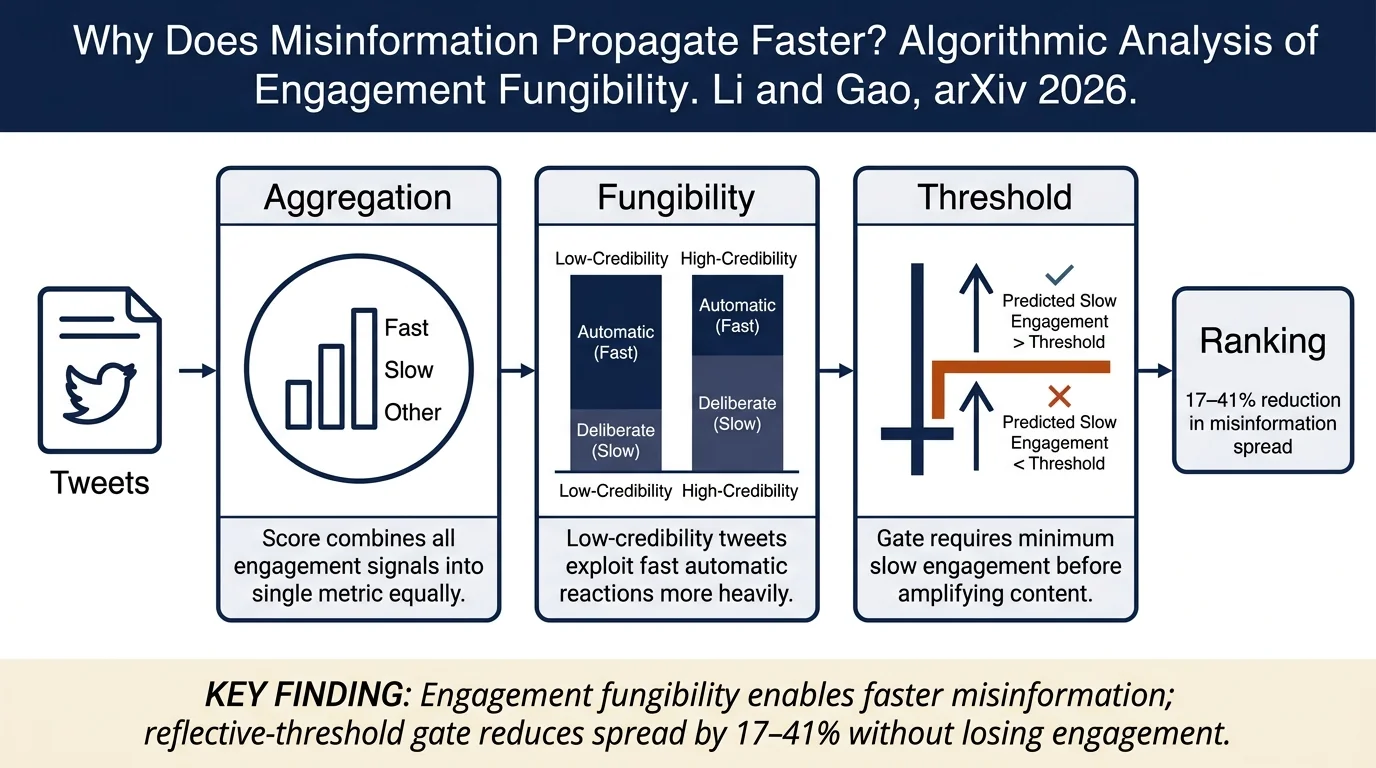
Misinformation propagates faster on X due to an "engagement fungibility mechanism" in the platform's score-aggregation layer: fast engagement signals (likes, retweets) are treated as interchangeable evidence of quality with slow signals (replies, quotes), allowing low-credibility content that draws disproportionately from instant reactions to receive amplification advantages. A "reflective-threshold gate" that requires predicted thoughtful engagement above a threshold before amplifying content can reduce this gap by ~8% without sacrificing overall engagement.
Contributions
- Identifies the specific algorithmic mechanism enabling faster misinformation propagation: engagement fungibility in the additive scoring rule that combines predicted engagement types
- Develops a calibrated simulation framework re-implementing X's recommendation algorithm on the USC X 2024 election corpus
- Proposes the reflective-threshold gate as a deployable, model-agnostic solution requiring no retraining, showing it outperforms simple weight re-tuning across 46 robustness checks
- Demonstrates via dual-process theory that fast-class engagement (System I) and slow-class engagement (System 2) should not be treated as perfect substitutes for content quality judgment
Method
The authors reconstructed X's "For You" recommendation pipeline using publicly open-sourced algorithm code. The pipeline stages are: (1) candidate sourcing (~1,500 tweets from user follows and out-of-network sources), (2) Light Ranker (logistic regression prefilter), (3) Heavy Ranker (MaskNet neural network producing engagement probabilities for six action types: reply, retweet, like, quote-tweet, profile click, negative feedback), and (4) score-aggregation layer (additive weighted sum of predicted engagement probabilities).
The key insight centers on the score-aggregation layer: \(S = \sum_k w_k p_k\) where \(p_k\) is predicted probability of engagement type \(k\) and \(w_k\) is its weight (reply=13.5, retweet=1.0, like=0.5, etc.). This additive formulation treats engagement types as fungible evidence—any strong signal can drive the final score alone.
The authors grounded their analysis in dual-process theory: fast engagement (likes/retweets) reflects System I (automatic, emotional) processing, while slow engagement (replies/quotes) reflects System 2 (deliberate, reflective) processing. They calibrated a full cascade simulation on the USC X 2024 election corpus (10M+ tweets) to study counterfactual modifications to the scoring rules.
Results
Hypothesis 1 (engagement fungibility): Low-credibility tweets draw 33.0% of their engagement from replies/quotes vs. 46.4% for high-credibility tweets, yet receive more recommendation exposure. Across 2,083 weight reconfigurations, 74.3% widened the credibility gap; only 1.0% reached half the reflective-threshold gate's gap reduction, demonstrating that simple reweighting cannot address the fungibility problem.
Hypothesis 2 (reweighting ineffective): X's 2026 algorithm reweight (cutting reply weight from 13.5 to 5.0) leaves the credibility gap statistically unchanged (gap +0.8, s.e. 0.71), confirming the mechanism is structural, not just parameter-tuned.
Hypothesis 3 (gate acts on engagement mix): The reflective-threshold gate (scaling down scores until predicted slow-class engagement exceeds threshold \(\theta\)) achieves: - At \(\theta=1.0\): 17.4% reduction in low-credibility exposure, +9.4% expected engagement per exposure - At \(\theta=2.0\): 37.2% reduction, +37.4% expected engagement per exposure - At \(\theta=2.2\): 41.4% reduction, +98.4% top-20% overlap with additive rule
The gate does not reduce overall engagement (top 10% of ranked tweets remain unchanged; gate reorders middle-ranked content) and passes targeting validation: demotion is driven by substitutability share (fraction of score from instant reactions), not credibility class.
Connections
- Related to recommendation-system design and algorithmic amplification via component-level analysis of ranking systems
- Extends engagement-based ranking literature by identifying the specific aggregation mechanism creating propagation asymmetries
- Builds on engagement-based ranking research showing that engagement-optimized platforms amplify low-credibility content
- Applies dual-process theory to explain how algorithms interact with cognitive processes (System I vs. System II) in content ranking
- Relevant to platform moderation research seeking design interventions
- Related to news feed algorithms and ranking algorithms
Notes
Strengths: - First component-level diagnosis of misinformation propagation inside a deployed platform's algorithm - Rigorous calibrated simulation grounded in observed data; all three hypotheses supported across 46 robustness checks - Practical, deployable solution (gate is model-agnostic, requires no retraining) - Clear theoretical grounding in dual-process theory - Comprehensive analysis of why alternative approaches (weight tuning, claim-level gates) fail
Limitations: - Reconstructed ranker, not production system; effect sizes are immediate, not long-run equilibrium - Credibility measured by source label, not claim-level truth; gate targets engagement patterns of low-credibility sources, not individual falsehoods - Corpus is keyword-filtered sample of X during one election period; generalization to other platforms/content types unclear - Content gate (Section 7.2.3) only proves concept; full deployment would require claim-level labels at scale
Open questions: - How do other platforms' engagement aggregation rules create similar or different asymmetries? (TikTok, YouTube, Facebook/Instagram engagement objectives differ) - What is the long-run effect if platforms adopt the gate—do users adapt sharing behavior, or does the gap narrow durably? - Can the gate be extended to reduce spread of misleading individual claims, or is it fundamentally limited to engagement patterns?