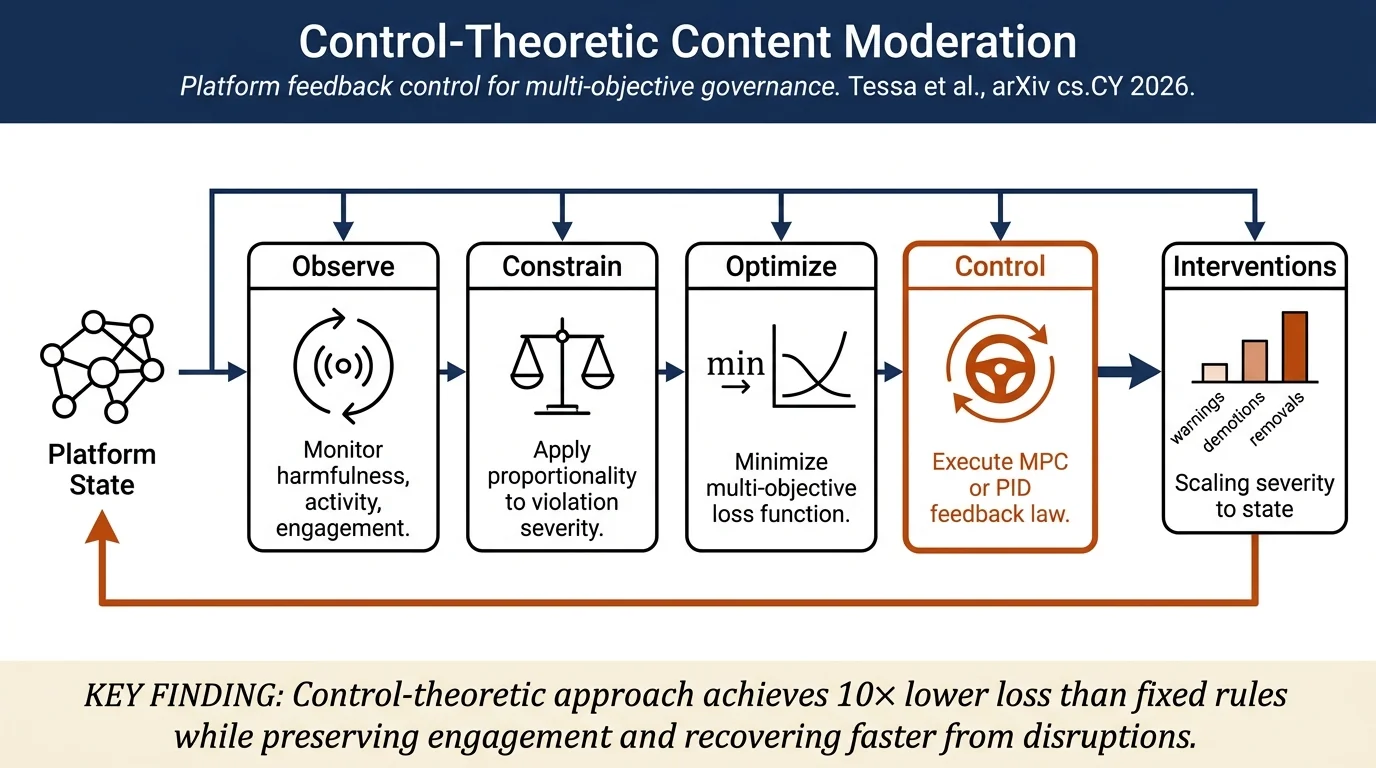
Control-Theoretic Content Moderation
Authors: Benedetta Tessa, Serena Tardelli, Marco Avvenuti, Anna Monreale, Stefano Cresci
Affiliation: IIT-CNR Pisa; University of Pisa
Venue: arXiv cs.CY, September 2026 — arxiv:2609.18822
TL;DR
Content moderation at the platform level requires balancing multiple competing objectives (reducing harmful content, preserving engagement, maintaining activity). This paper formulates platform-level moderation as a feedback control problem with a multi-objective loss function, proposes control-theoretic moderators (including proportionality constraints and Model Predictive Control approaches), and demonstrates via simulation that adaptive, control-theoretic strategies outperform fixed-rule baselines in achieving balanced platform properties.
Contributions
- Problem formulation: Formalizes content moderation as a global, closed-loop, multi-objective sequential decision problem. Shifts the abstraction level from individual moderation decisions to platform-level policy composition.
- Control-theoretic framework: Introduces a general, extensible framework for composing heterogeneous moderation interventions according to their expected effects. Models platform state (harmfulness, activity, engagement), user properties, and the dynamics of intervention feedback.
- Multi-objective design: Emphasizes that moderation decisions must account for competing objectives—platforms cannot optimize a single metric without specifying trade-offs. Provides quantitative mechanisms for balancing multiple platform properties simultaneously.
- Empirical evaluation: Simulates multiple moderation strategies (fixed removal, proportional, adaptive, MPC-based, PID-based) under stationary and perturbed (surge of harmfulness) platform conditions. Demonstrates that control-theoretic approaches systematically outperform naive strategies on total loss and recover better after exogenous shocks.
Method
The paper models a platform in discrete time where at each step \(t\), a moderator observes platform state \(s_t\) (comprising harmfulness, activity, and engagement properties), and must select intervention targets \(M_t\) and corresponding actions \(a_t\) from available actions: no action, warning, demotion, removal, or ban.
State and dynamics: User state \(u_i\) captures user propensity to post, produce harmful content, and receive engagement. Platform state aggregates across all users. A linear dynamics model captures how interventions and external events affect future state: $\(u_{t+1} = f_u(u_t, a_t, \xi_t), \quad s_{t+1} = f_s(s_t, U_t, a_t, \xi_t)\)$
Loss and optimization: The moderator aims to minimize a weighted multi-objective loss: $\(\mathcal{L}(s, r) = \sum_j w_j(s_j^{(p)} - r_j^{(p)})^2\)$ where deviations are normalized by reference values and weighted equally by default.
Proportionality constraint: A key innovation: interventions should be proportional to violations. The paper defines a proportionality penalty \(\mathcal{L}_{\text{prop}}\), enforcing that more severe violations receive more severe interventions. This constraint explicitly operationalizes the principle that interventions should match their justification in magnitude.
Moderators compared: - Fixed removal: Removes every post exceeding a severity threshold. - Proportional: Selects interventions proportional to violation severity. - Adaptive removal: Dynamically adjusts removal threshold based on platform harmfulness drift. - MPC-based: Model Predictive Control—evaluates candidate actions via lookahead horizon, selects to minimize expected loss over \(H\) future steps. - PID-based: Proportional-Integral-Derivative feedback control, a classical control-theoretic approach responding to cumulative and rate-of-change errors.
Results
Stationary platform scenario: Control-theoretic moderators (MPC and PID) achieve lowest total loss (\(\sim 0.06\)–\(0.08\)) vs. fixed removal (\(\sim 0.46\)), proportional (\(\sim 0.32\)), and adaptive (\(\sim 0.37\)). All control-based approaches preserve engagement better than naive removal.
Surge of harmfulness scenario: When platform harmfulness spikes suddenly, control-theoretic moderators recover faster and with less overshoot. MPC produces the smoothest response; PID recovers more aggressively but accepts higher activity loss initially.
Proportionality benefit: Models with proportionality constraints consistently outperform those without, especially under multi-objective weighting. Proportionality allows interventions to be more selective—avoiding over-moderation of mild violations and over-engagement on benign content.
Intervention composition: Detailed trajectory analysis shows that control-theoretic approaches compose diverse intervention types adaptively based on observed state, whereas naive approaches monotonically apply the same action. MPC and PID respond proportionally to severity, using warnings and demotions before escalating to removal.
Connections
- Work extends beyond single-outcome studies to multi-objective formulation in platform moderation.
- Applies classical control theory and feedback systems to platform dynamics.
- Platform governance — framework for operationalizing competing platform objectives.
- Relates to how moderation actions affect user behavior and downstream platform health, a growing area in intervention effectiveness research.
Notes
Strengths: The control-theoretic abstraction is novel and well-motivated. Formulating moderation as a feedback control problem naturally captures the dynamic, iterative nature of platform governance. The proportionality principle is intuitively appealing and empirically validated. The multi-objective loss function is more honest about trade-offs than most prior work, which optimizes single outcomes. The simulation environment is reasonably detailed (heterogeneous users, stochastic effects, user-intervention interaction modeling). Results are robust across sensitivity analyses (reference values, objective weights, time horizons).
Limitations: The framework assumes knowledge of intervention effect sizes, which in reality are estimated and noisy. The paper assumes linear or near-linear system dynamics and additive intervention effects—both simplifications. User behavior is modeled via parametric distributions; richer models of how user decisions adapt to interventions may not hold in all communities. The simulations do not model learning adversaries (users who modify behavior to evade moderation) or coordinated campaigns. The framework does not address fairness or distribute effects unequally across user groups. Application to real platforms requires large-scale calibration and validation against observed dynamics.
Follow-ups: Calibrating intervention effects on real platform data; extending to heterogeneous user subgroups and fairness constraints; incorporating adversarial user adaptation; analyzing how moderation decisions compound over longer horizons; connecting control objectives to legal/regulatory requirements.
Overall assessment: This paper makes a timely and important contribution by shifting the moderation research discussion from "what is the best single intervention?" to "how should a system of interventions be composed to achieve multiple objectives given platform dynamics?" The control-theoretic lens is not inevitable—one could formulate moderation as a Markov decision process or a bandit problem—but it has genuine advantages for systems thinking and is underexplored in this context. The work is technically solid, though the empirical scope (simulation only) limits confidence in real-world applicability. Recommended for researchers designing moderation systems, platform governance researchers, and control engineers working in socio-technical domains.