Explore papers
Filter by research area, year and venue. Every filter is in the address bar, so you can share a view as a link.
 Deepfakes & multimodalDetection methods
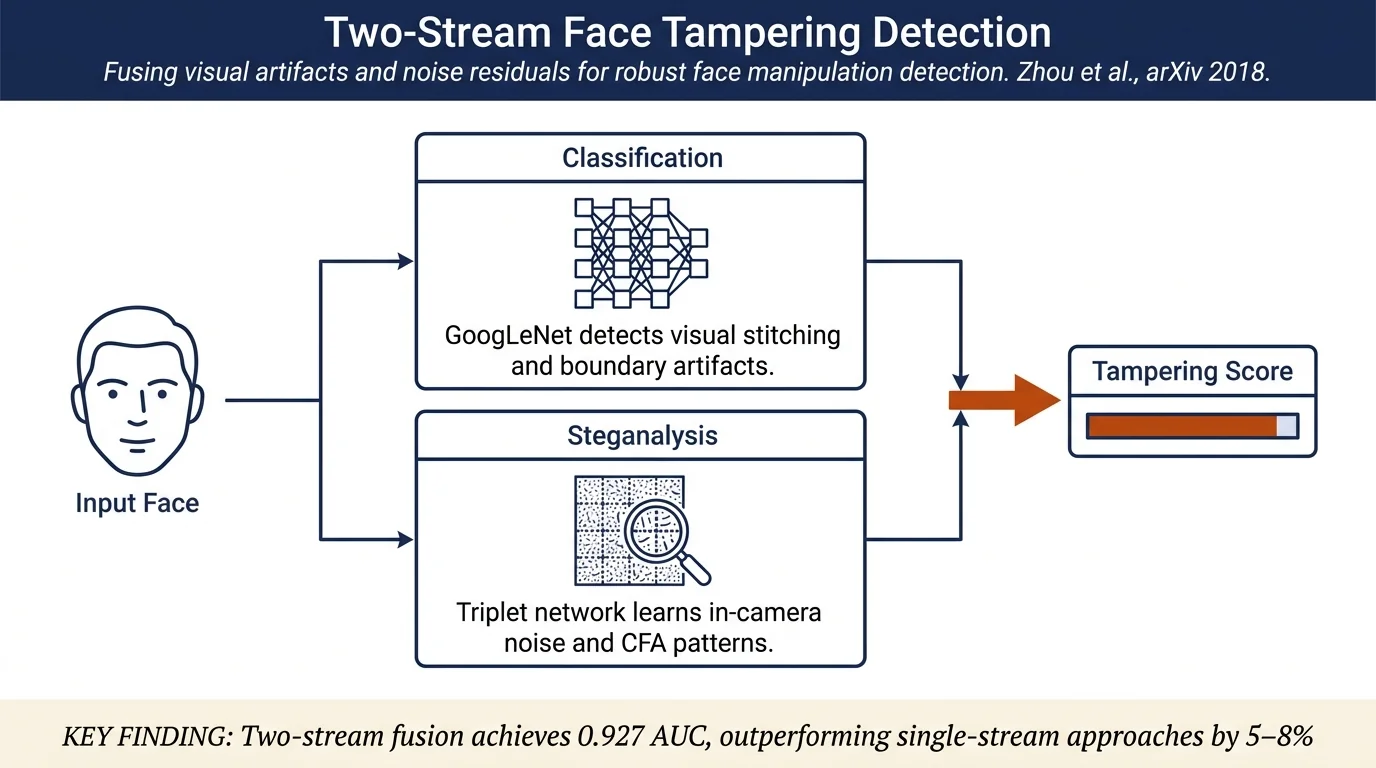
Two-Stream Neural Networks for Tampered Face DetectionThe paper proposes a two-stream neural network for detecting face tampering (face swaps) in images. One stream uses GoogLeNet to classify tampered faces by visual artifacts, while the second stream uses steganalysis features with a triplet network to capture low-level noise inconsistencies.
 Spread & networksDatasets & evaluation
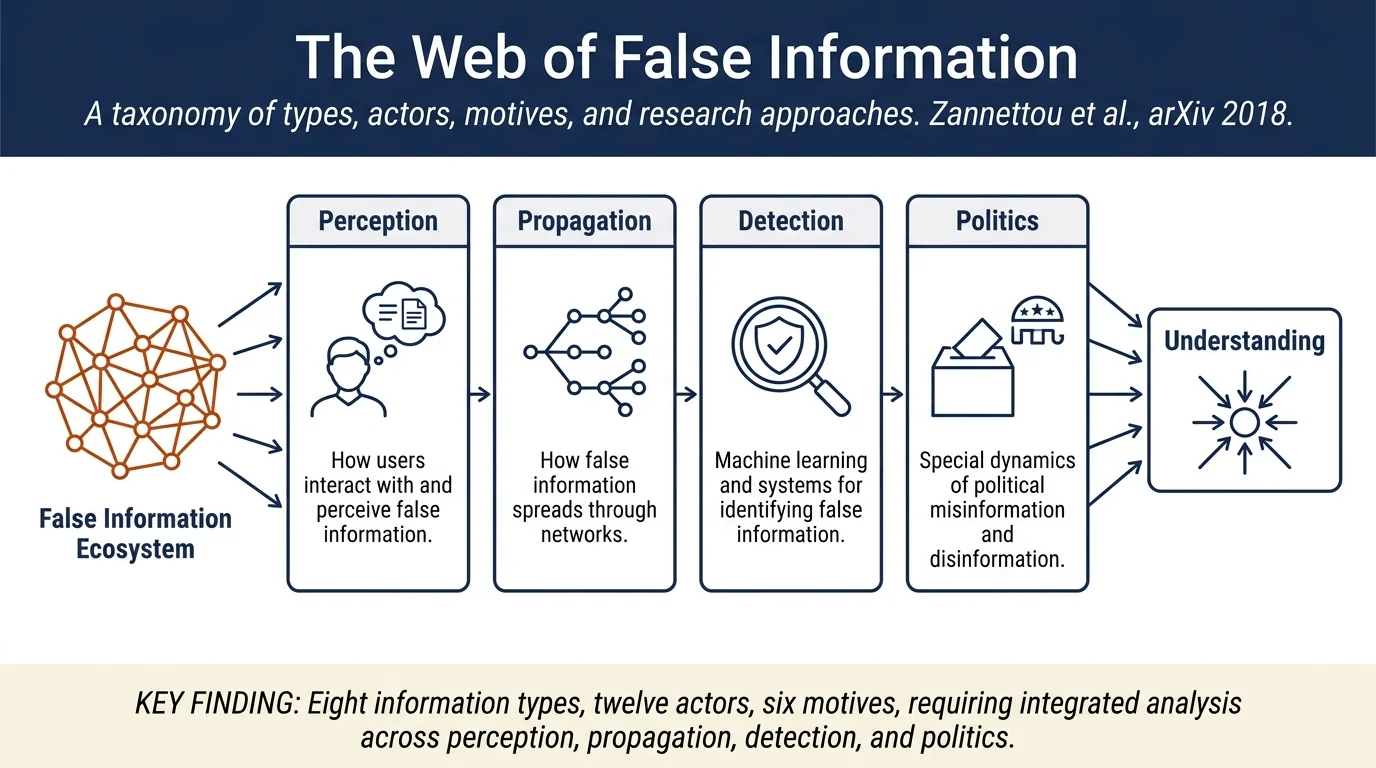
The Web of False Information: Rumors, Fake News, Hoaxes, Clickbait, and Various Other ShenanigansComprehensive typology of the false information ecosystem on the Web, identifying eight types of false information (fabricated stories, propaganda, conspiracy theories, hoaxes, biased news, rumors, clickbait, satire), twelve actor categories (bots, criminal organizations, activists, governments, paid posters, journalists, useful idiots,…
 Detection methodsDeepfakes & multimodal
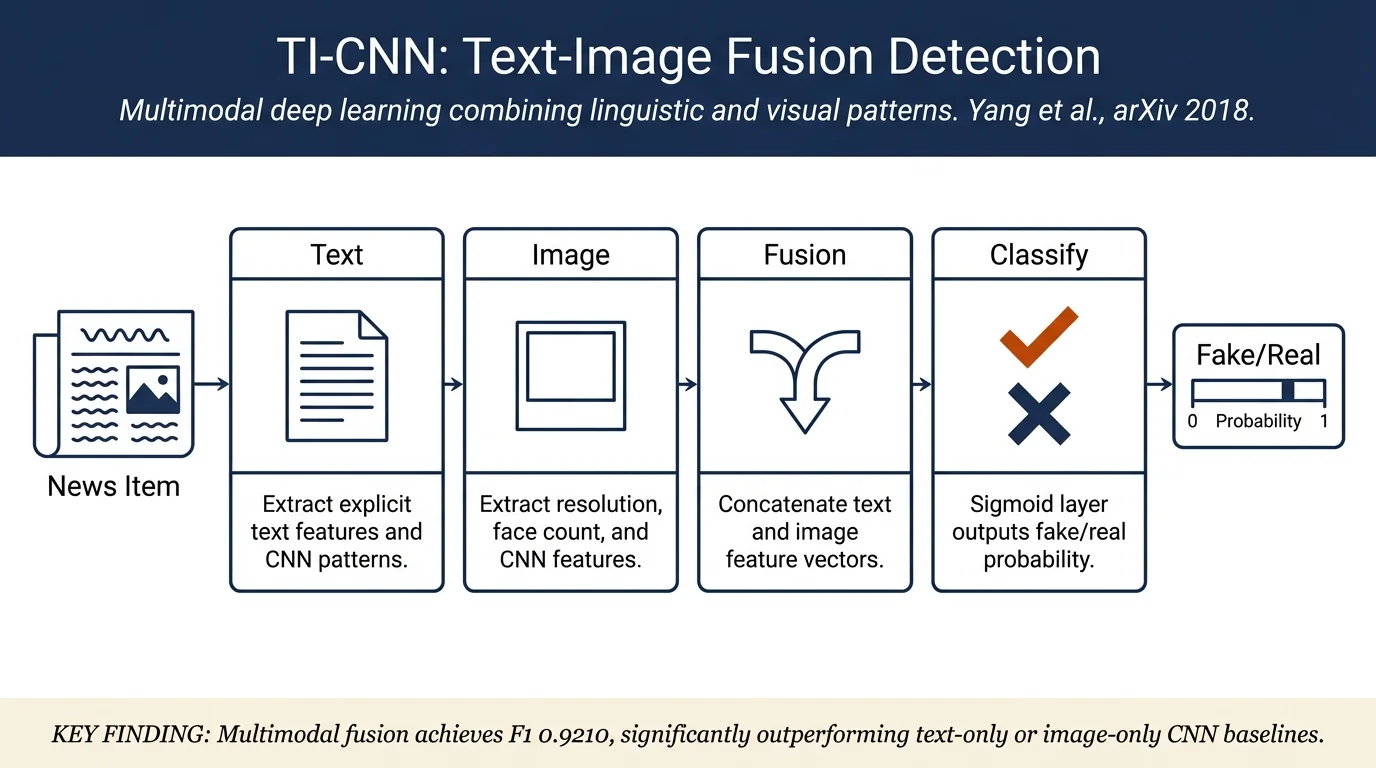
TI-CNN: Convolutional Neural Networks for Fake News DetectionThis paper proposes TI-CNN, a multimodal deep learning model that combines explicit and latent features from both text and images to detect fake news. Through analysis of 20,015 news items, the authors identify distinctive linguistic and visual patterns in fake versus real news, and demonstrate that their unified CNN-based approach…
 Fact-checking & verificationDatasets & evaluation
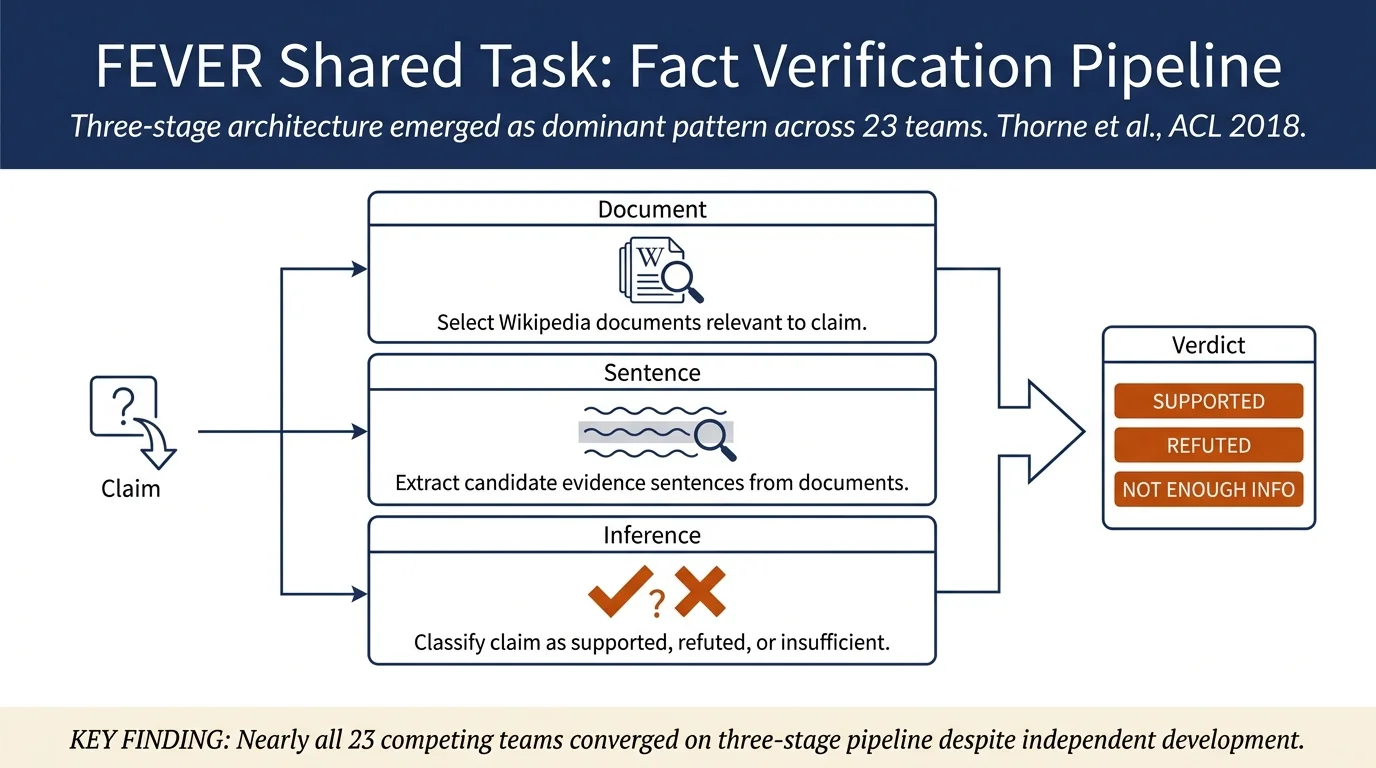
The Fact Extraction and VERification (FEVER) Shared TaskThis paper presents results of the first FEVER shared task competition, which challenged 23 teams to classify whether human-written factoid claims could be SUPPORTED or REFUTED using evidence retrieved from Wikipedia. The best system achieved 64.21% FEVER score, demonstrating the difficulty of joint evidence retrieval and natural…
 Fact-checking & verificationDatasets & evaluation
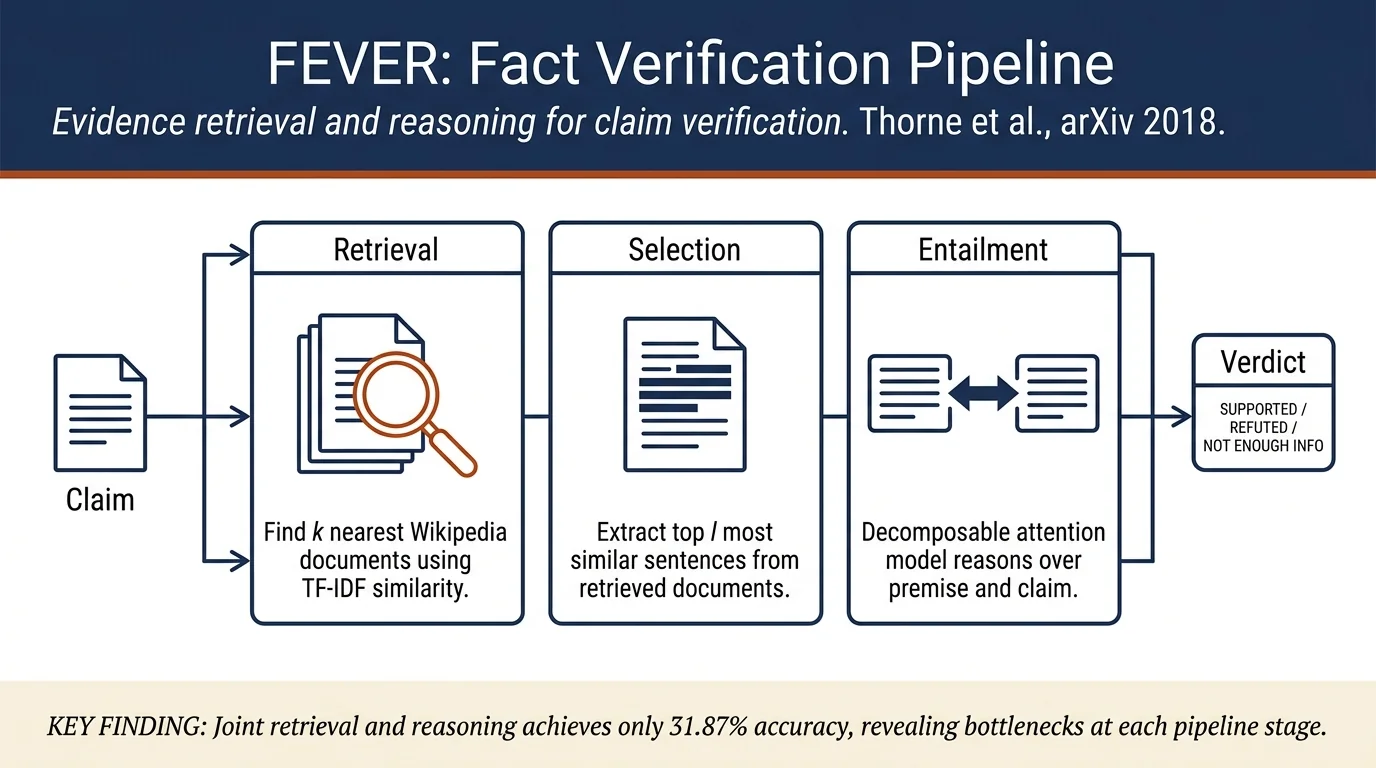
FEVER: A Large-Scale Dataset for Fact Extraction and VERificationThis paper introduces FEVER, a large-scale dataset of 185,445 human-verified claims with Wikipedia evidence for training fact verification systems. Claims are generated from Wikipedia and labeled as SUPPORTED, REFUTED, or NOT ENOUGH INFO; the paper presents a three-stage baseline pipeline (document retrieval, sentence selection, textual…
 Deepfakes & multimodalDetection methods
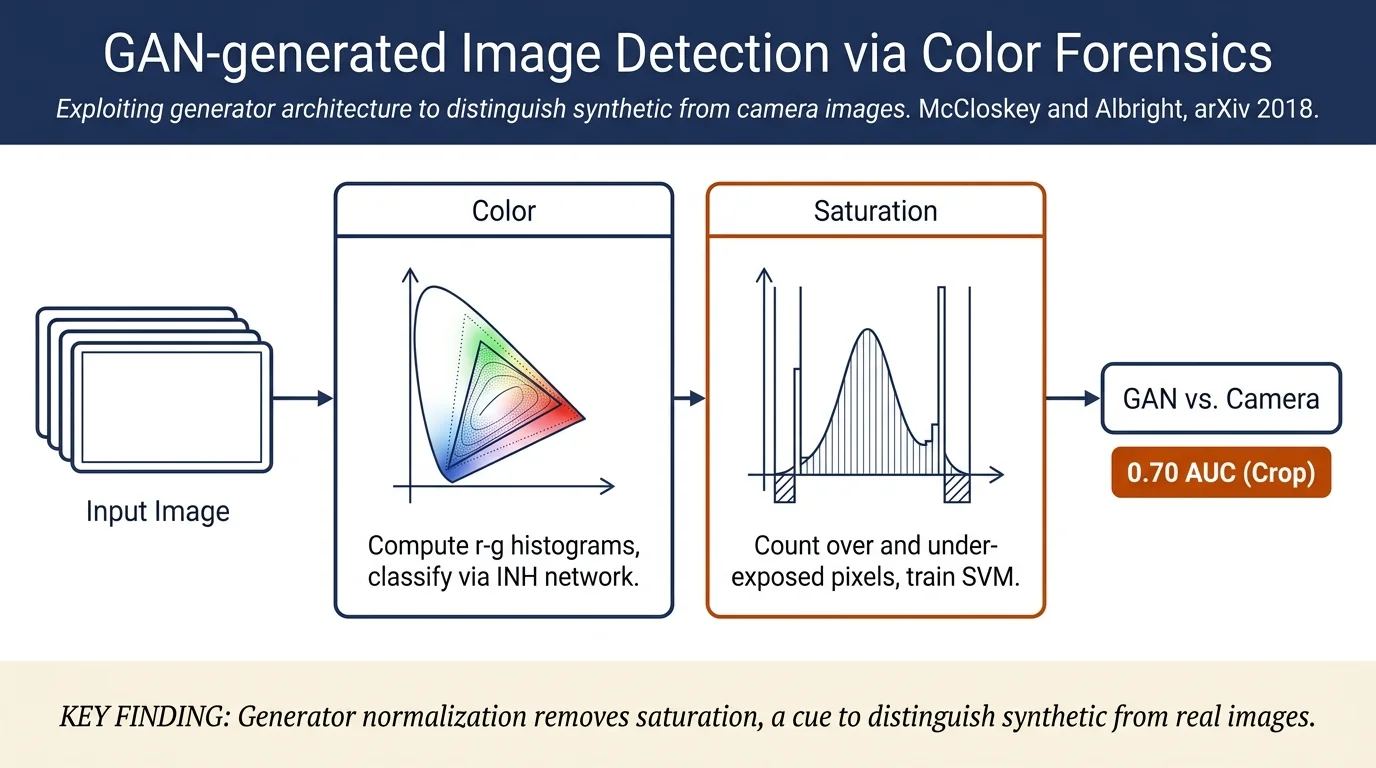
Detecting GAN-generated Imagery using Color CuesThis paper identifies two forensic cues to distinguish GAN-generated images from real camera imagery by analyzing how generator networks process color. The first cue exploits overlapping color channel weights in the generator (unlike camera spectral sensitivities); the second leverages the fact that generator normalization suppresses…
 Deepfakes & multimodalDetection methods
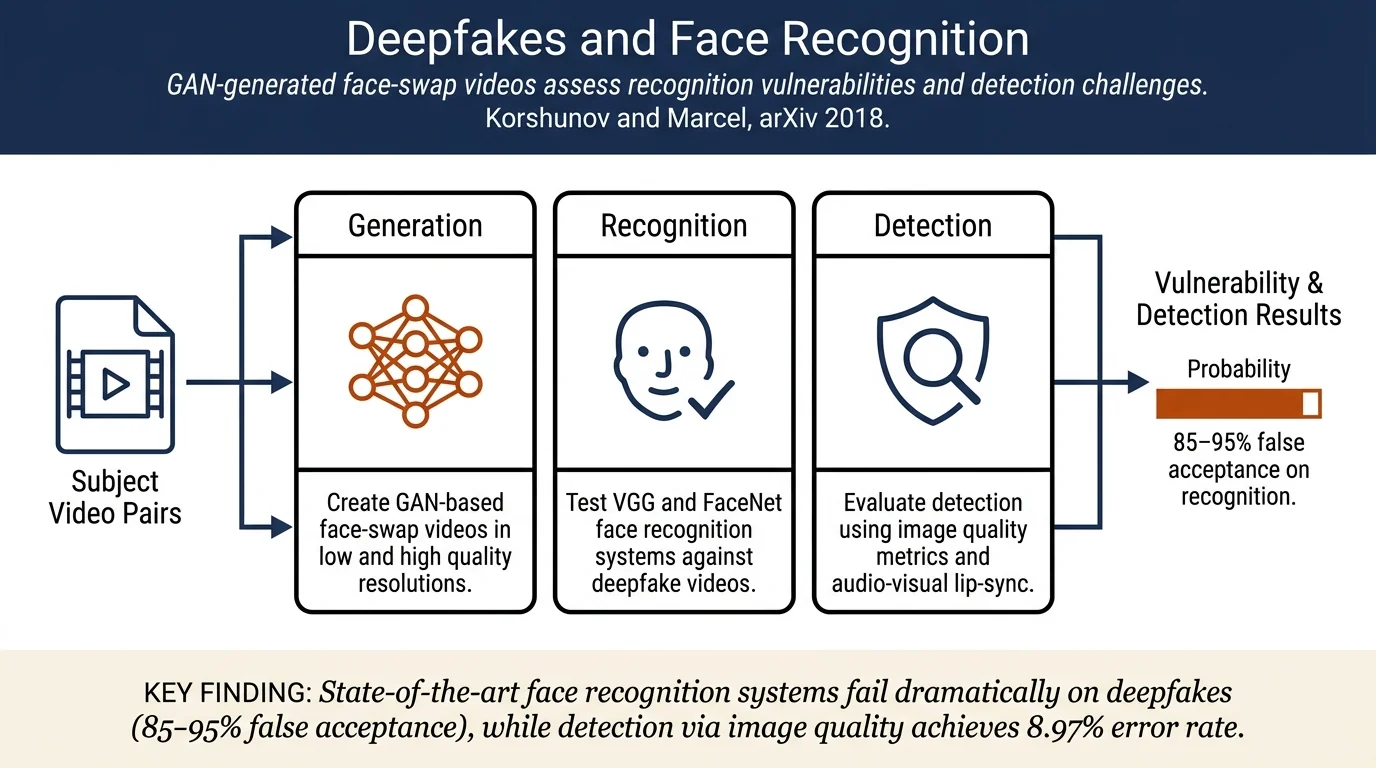
DeepFakes: a New Threat to Face Recognition? Assessment and DetectionGAN-based face-swapping (Deepfakes) pose a significant threat to face recognition systems: VGG and FaceNet achieve false acceptance rates of 85.62% and 95.00% on high-quality Deepfakes. The authors release the first public Deepfake video database (620 videos from 16 subject pairs) and show that image quality metrics with SVM achieve…
 Detection methodsFact-checking & verification
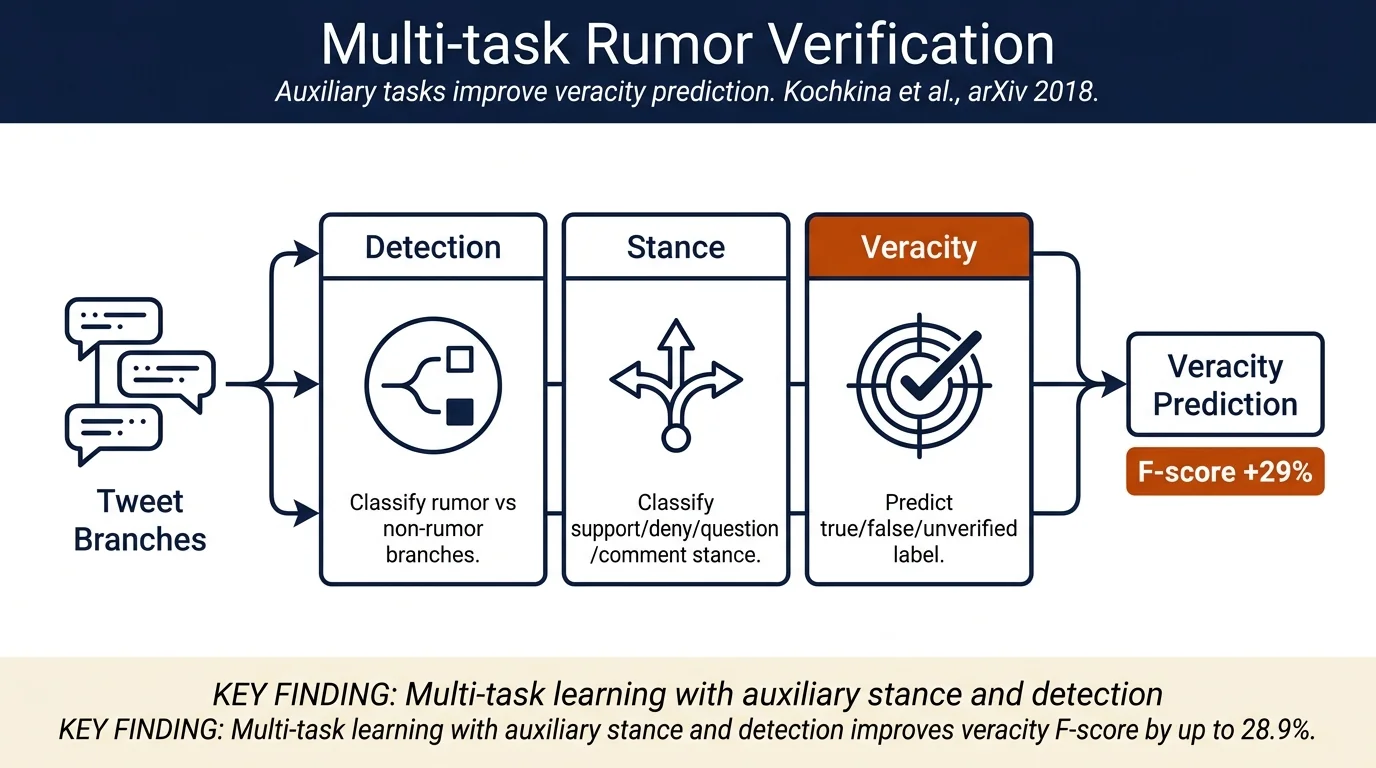
All-in-one: Multi-task Learning for Rumour VerificationThis paper proposes a multi-task learning framework for rumor verification that jointly trains veracity classification (the main task) with auxiliary tasks—rumor detection and stance classification. The approach outperforms single-task baselines on both RumourEval and PHEME datasets, demonstrating that sharing representations across…
 Datasets & evaluationSpread & networks
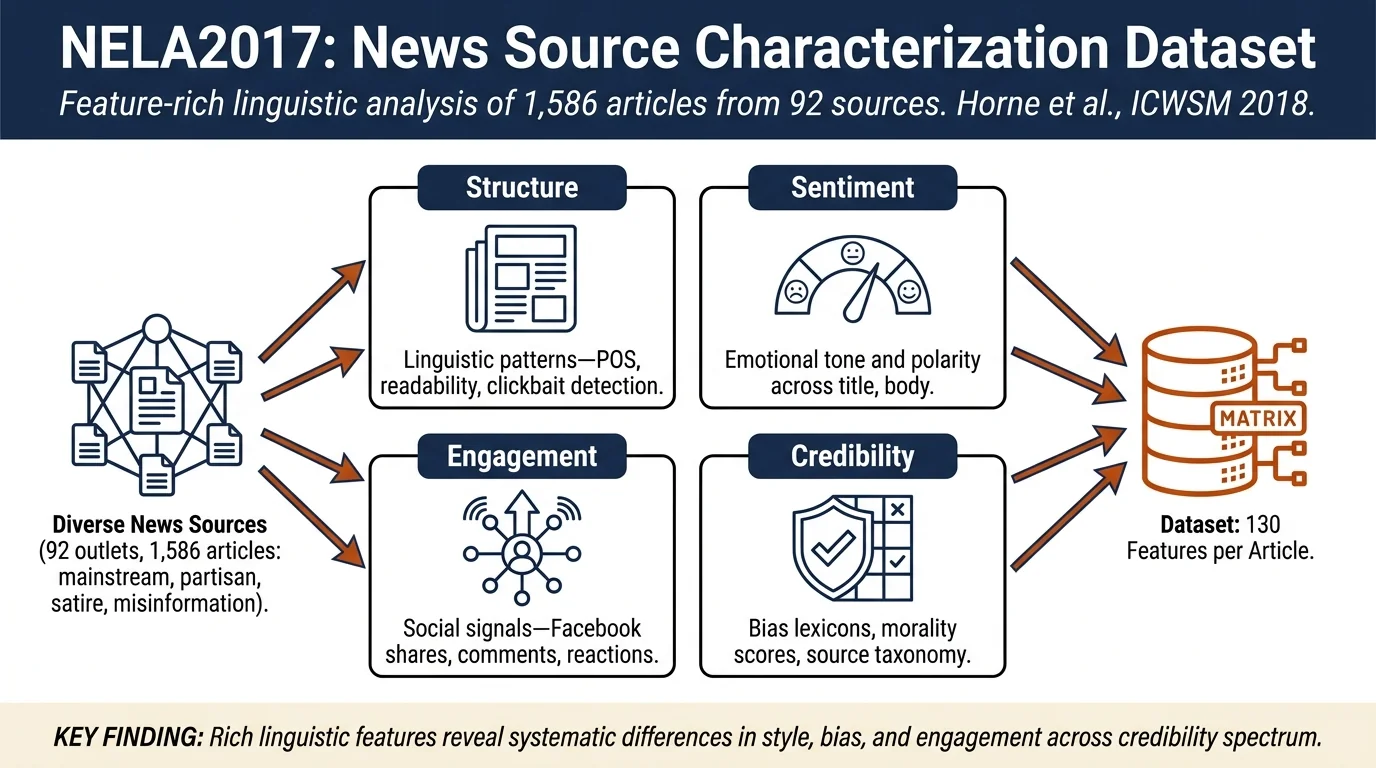
Sampling the News Producers: A Large News and Feature Data Set for the Study of the Complex Media LandscapeIntroduces NELA2017, a dataset of 1,586 news articles from 92 diverse news sources over 7 months (April–October 2017), including mainstream outlets, hyper-partisan sources, satire, and deliberately false news sites. Computes 130 content-based linguistic and engagement features on each article, enabling large-scale comparative analysis of…
 Fact-checking & verificationDatasets & evaluation
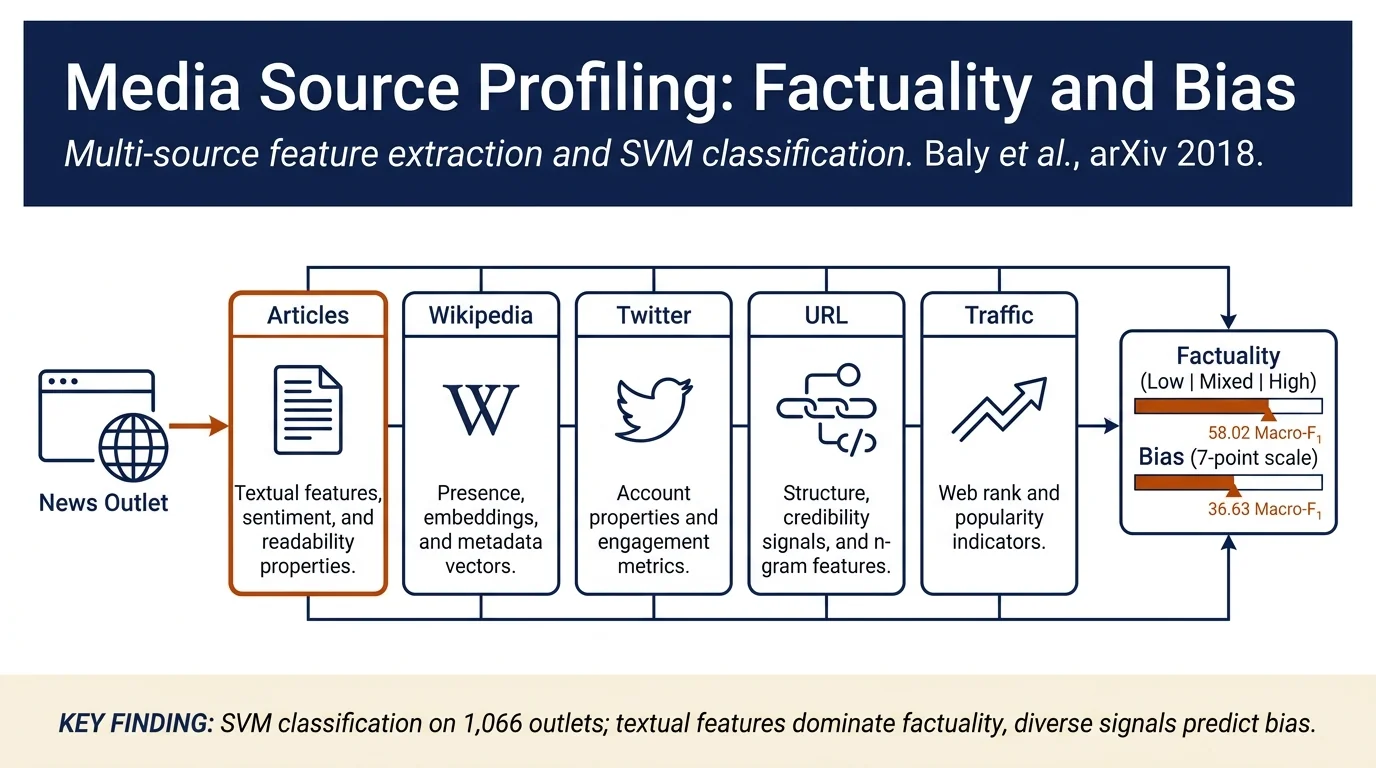
Predicting Factuality of Reporting and Bias of News Media SourcesThis paper frames predicting news media factuality and bias as classification tasks at the news outlet level rather than at the claim or article level. The authors extract 141 features from multiple sources (articles, Wikipedia, Twitter, URL structure, web traffic) and train SVM classifiers, creating a dataset of 1,066 websites manually…
 Deepfakes & multimodalDatasets & evaluation
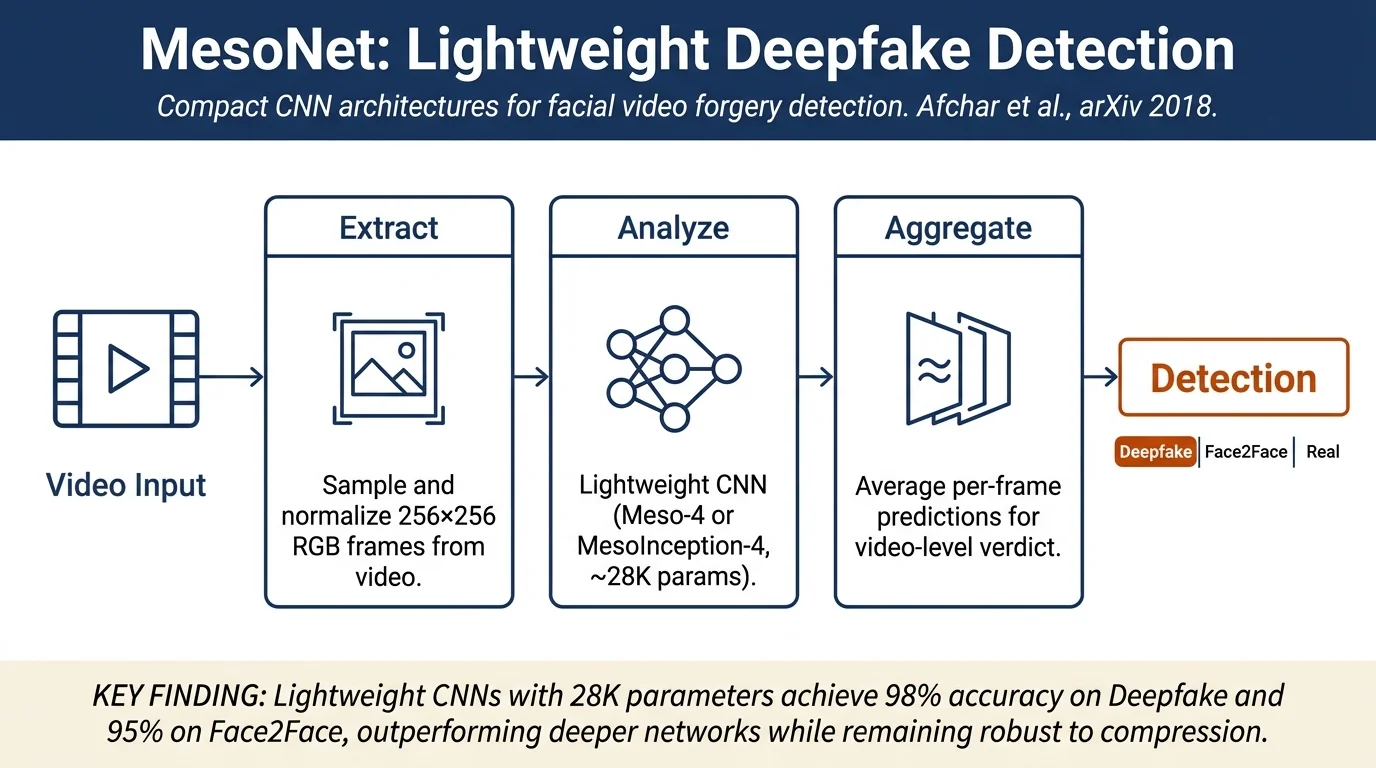
MesoNet: A Compact Facial Video Forgery Detection NetworkThis paper proposes two lightweight CNN architectures (Meso-4 and MesoInception-4) to detect facial video forgeries created by Deepfake and Face2Face techniques. Operating at the mesoscopic level of image analysis, the networks achieve 98% detection accuracy for Deepfake and 95% for Face2Face videos under realistic compression conditions.
 Datasets & evaluationSpread & networks
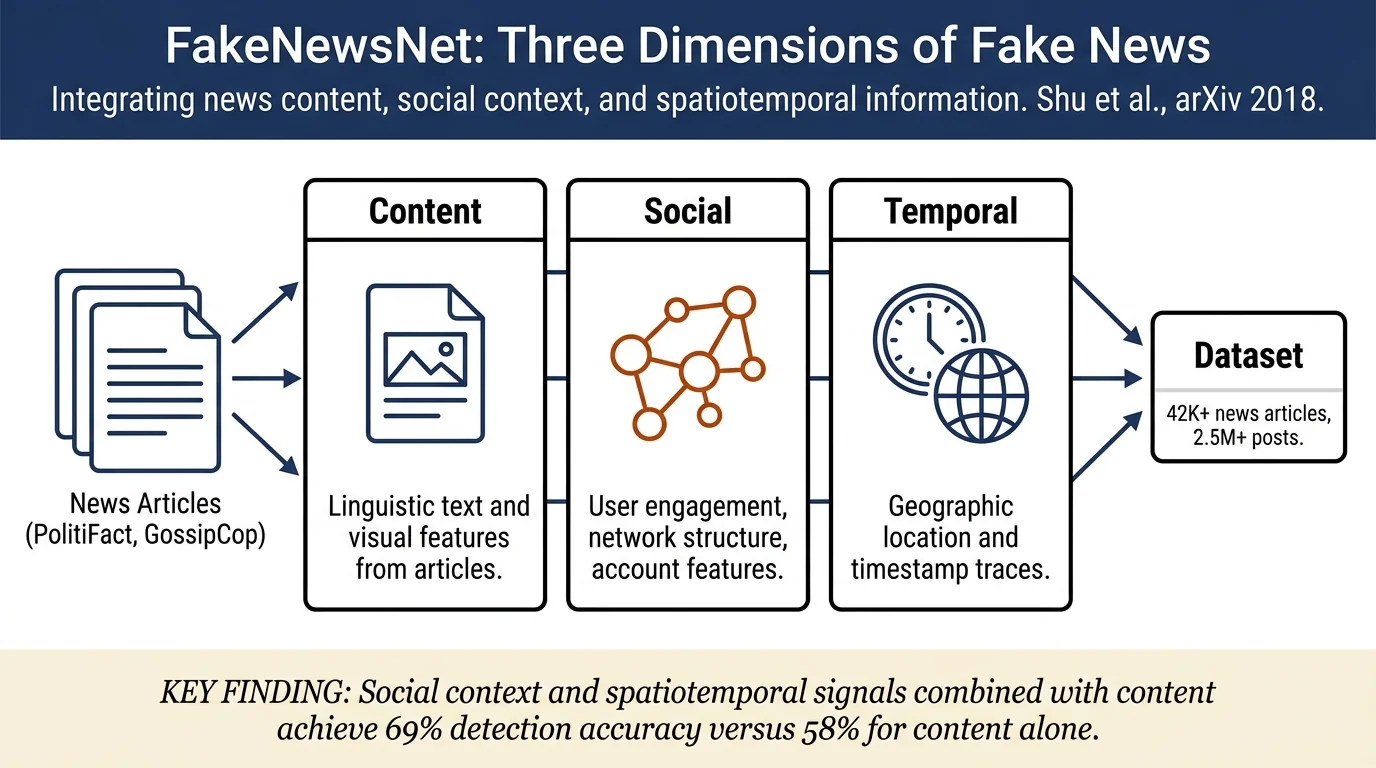
FakeNewsNet: A Data Repository with News Content, Social Context and Spatiotemporal Information for Studying Fake News on Social MediaFakeNewsNet is a multi-dimensional repository for fake news research on social media, integrating news content (linguistic and visual features), social context (user engagement, network structure, response patterns), and spatiotemporal information (location, timestamps). The dataset contains both fake and real news from PolitiFact and…
 Detection methodsDatasets & evaluation
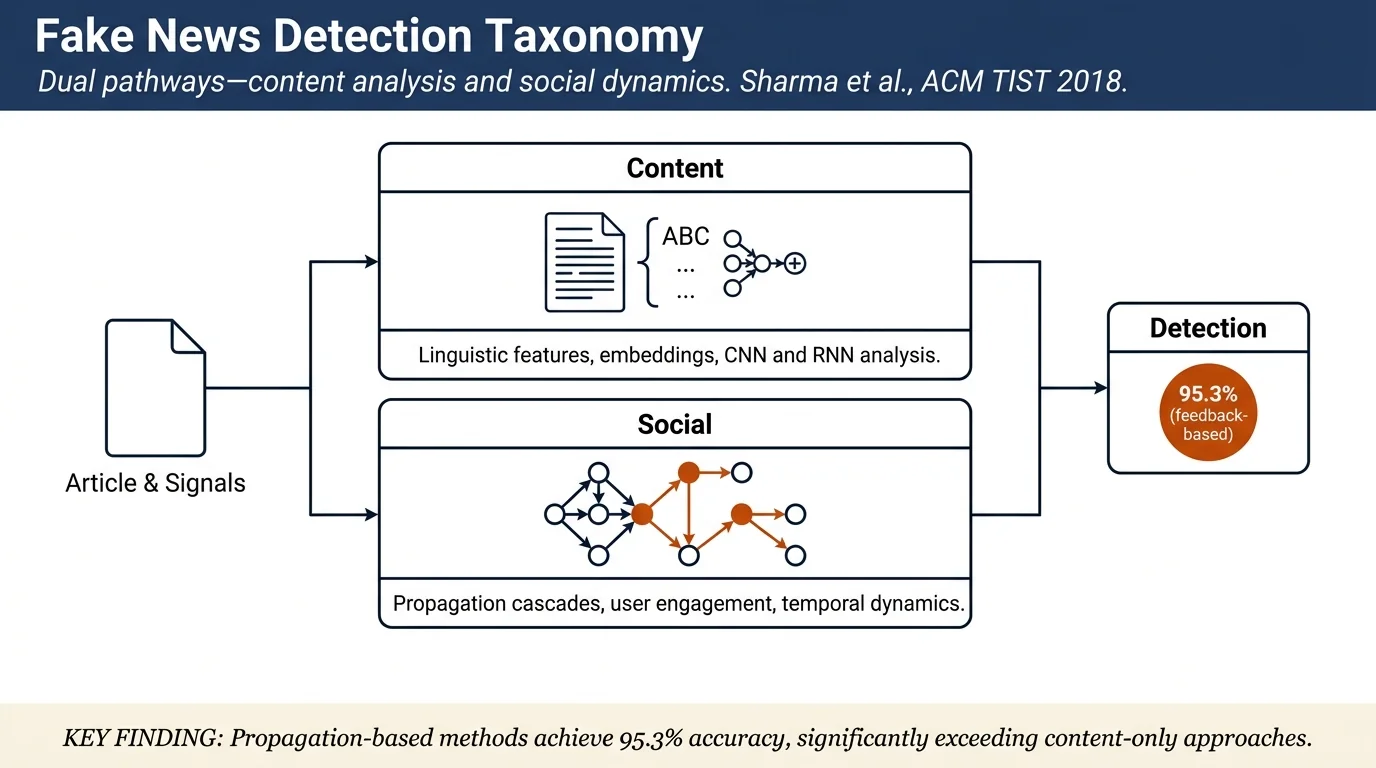
Combating Fake News: A Survey on Identification and Mitigation TechniquesThis comprehensive survey of fake news detection and mitigation organizes existing methods into two broad categories: content-based approaches (linguistic and deep learning methods) and feedback-based approaches (exploiting propagation patterns, user responses, and temporal dynamics). The authors consolidate 23+ publicly available…
 Deepfakes & multimodalDetection methods
EANN: Event Adversarial Neural Networks for Multi-Modal Fake News DetectionThe paper proposes EANN, an adversarial neural network that detects fake news on newly emerged events by learning event-invariant features. An event discriminator forces the multi-modal feature extractor to remove event-specific features while preserving shared patterns across events.
 Detection methodsDatasets & evaluation
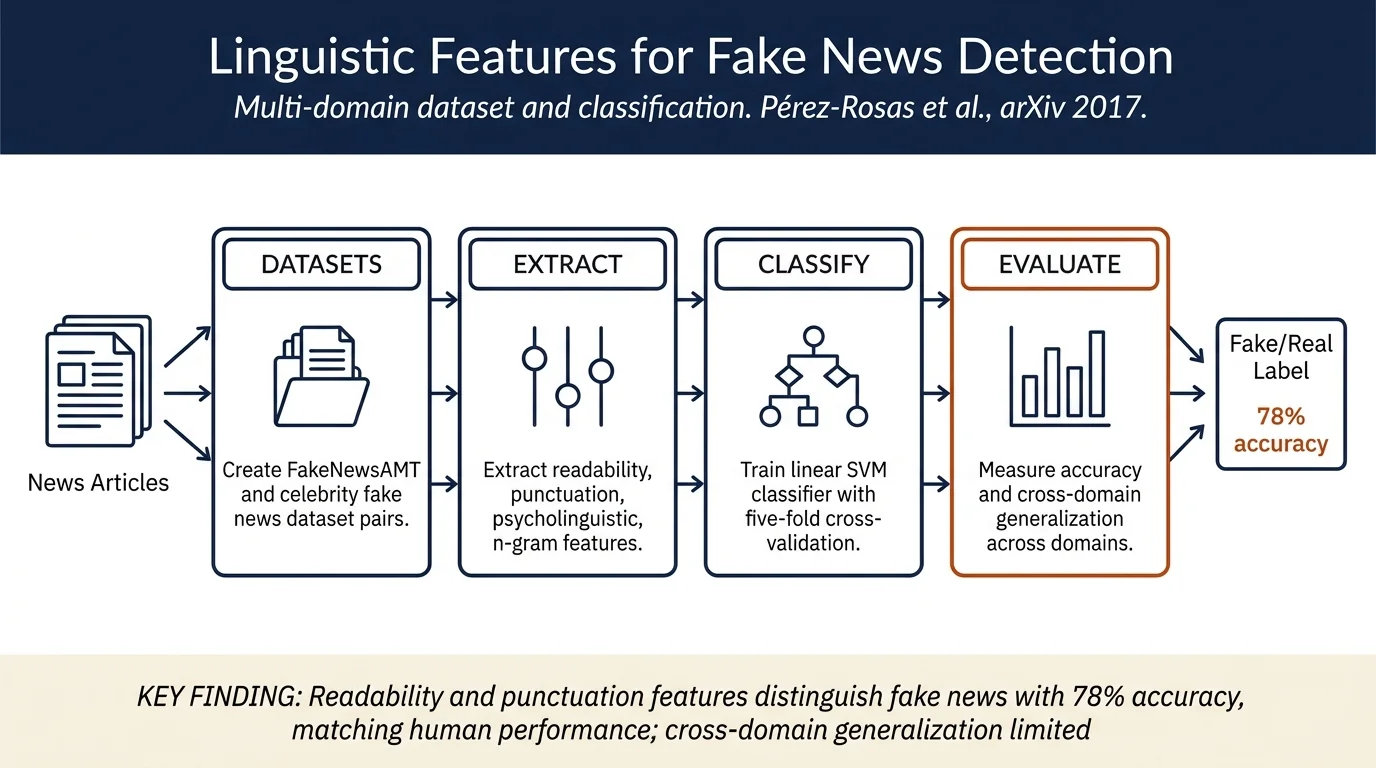
Automatic Detection of Fake NewsThis paper introduces two novel fake news detection datasets covering seven news domains and analyzes linguistic properties that distinguish fake from legitimate content. Using linguistic features including readability metrics, word categories, and punctuation patterns, the authors build classifiers achieving up to 78% accuracy and…
Fact-checking & verificationDatasets & evaluation
ClaimBuster: The first end-to-end fact-checking systemFoundational work introducing ClaimBuster, an end-to-end automated fact-checking system. Introduces a dataset of 23,533 human-annotated U.S. debate statements with check-worthiness labels, establishing baselines for automated claim check-worthiness detection and ranking.
 Detection methodsDatasets & evaluation
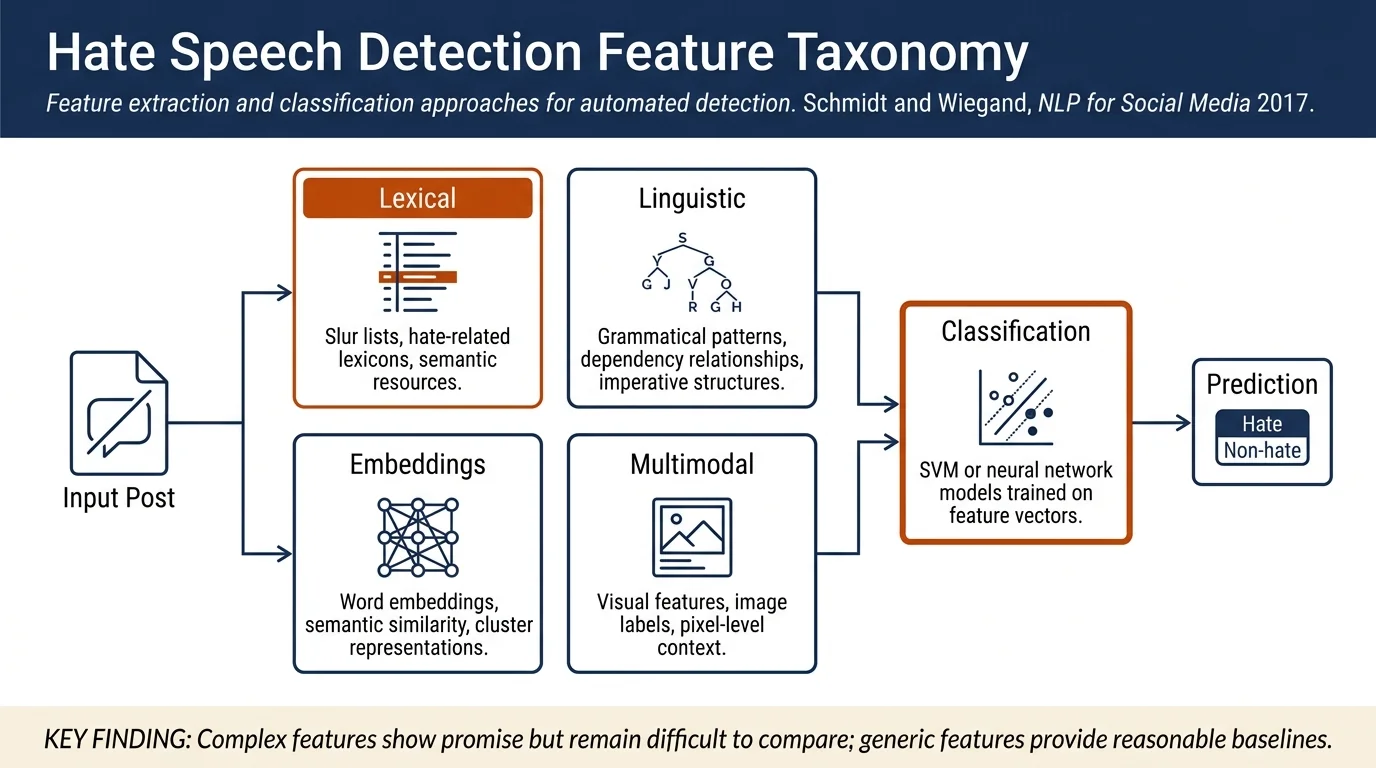
A Survey on Hate Speech Detection using Natural Language ProcessingThis survey systematically reviews automatic hate speech detection methods, covering feature extraction techniques (surface features, embeddings, sentiment analysis, lexical resources, linguistic features, knowledge bases), classification approaches (mostly supervised learning with SVMs and neural networks), annotation practices, and key…
 Datasets & evaluationFact-checking & verification
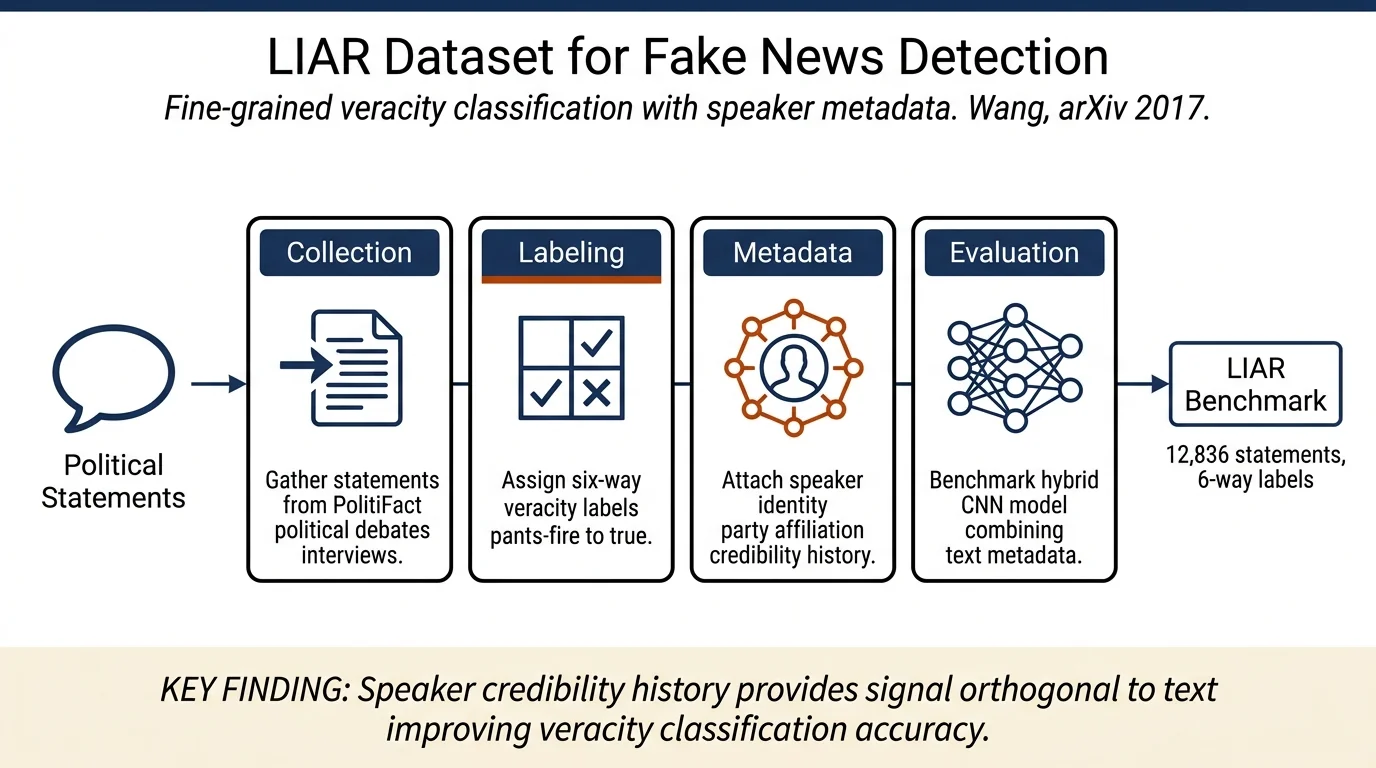
Liar, Liar Pants on Fire: A New Benchmark Dataset for Fake News DetectionThis paper introduces LIAR, a benchmark dataset of 12,836 manually labeled short statements from POLITIFACT.COM spanning 2007–2016, addressing the critical lack of labeled data for fake news detection. Each statement is annotated with fine-grained veracity labels (pants-fire, false, barely-true, half-true, mostly-true, true) and rich…
 Detection methodsSpread & networks
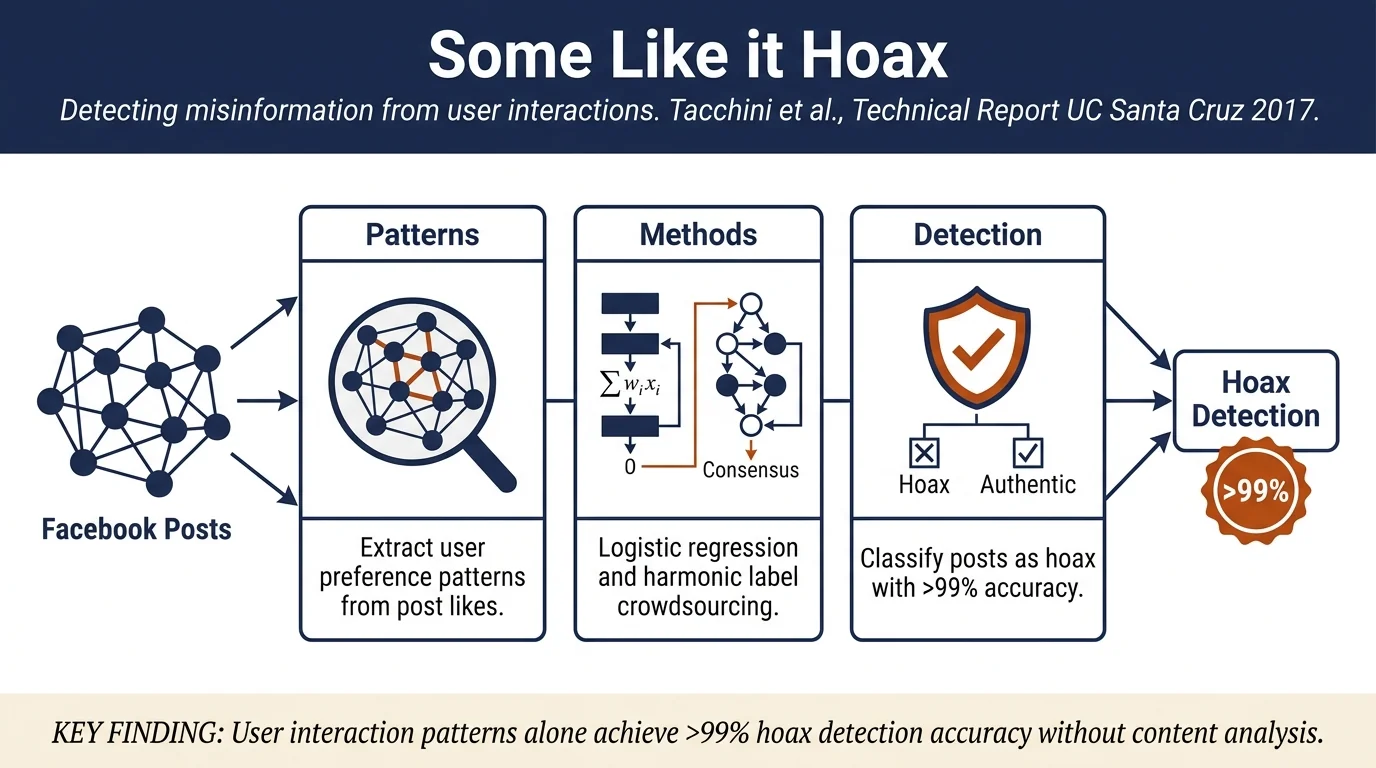
Some Like it Hoax: Automated Fake News Detection in Social NetworksHoaxes on Facebook can be detected with 99% accuracy using user interaction patterns (who "liked" posts) rather than content analysis. Two algorithms—logistic regression and harmonic boolean crowdsourcing—achieve high accuracy even with minimal labeled training data, and knowledge transfers across different Facebook communities.
 Fact-checking & verificationDatasets & evaluation
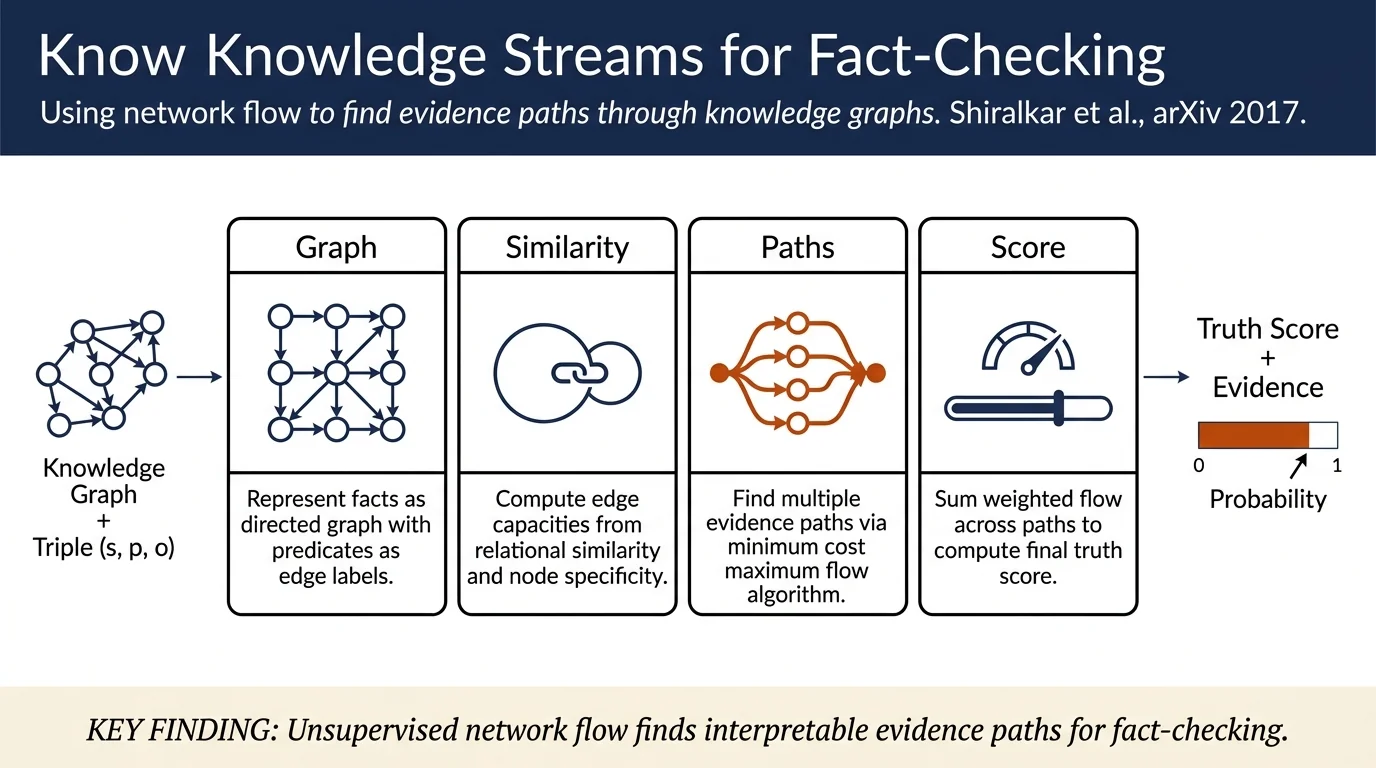
Finding Streams in Knowledge Graphs to Support Fact CheckingKnowledge Stream (KS) is an unsupervised network-flow approach for computational fact-checking that treats a knowledge graph as a flow network. For a triple (subject, predicate, object), KS finds multiple paths connecting subject to object and uses edge capacities (based on relational similarity and node specificity) to compute a truth…
 Bots & coordinated campaignsDatasets & evaluation
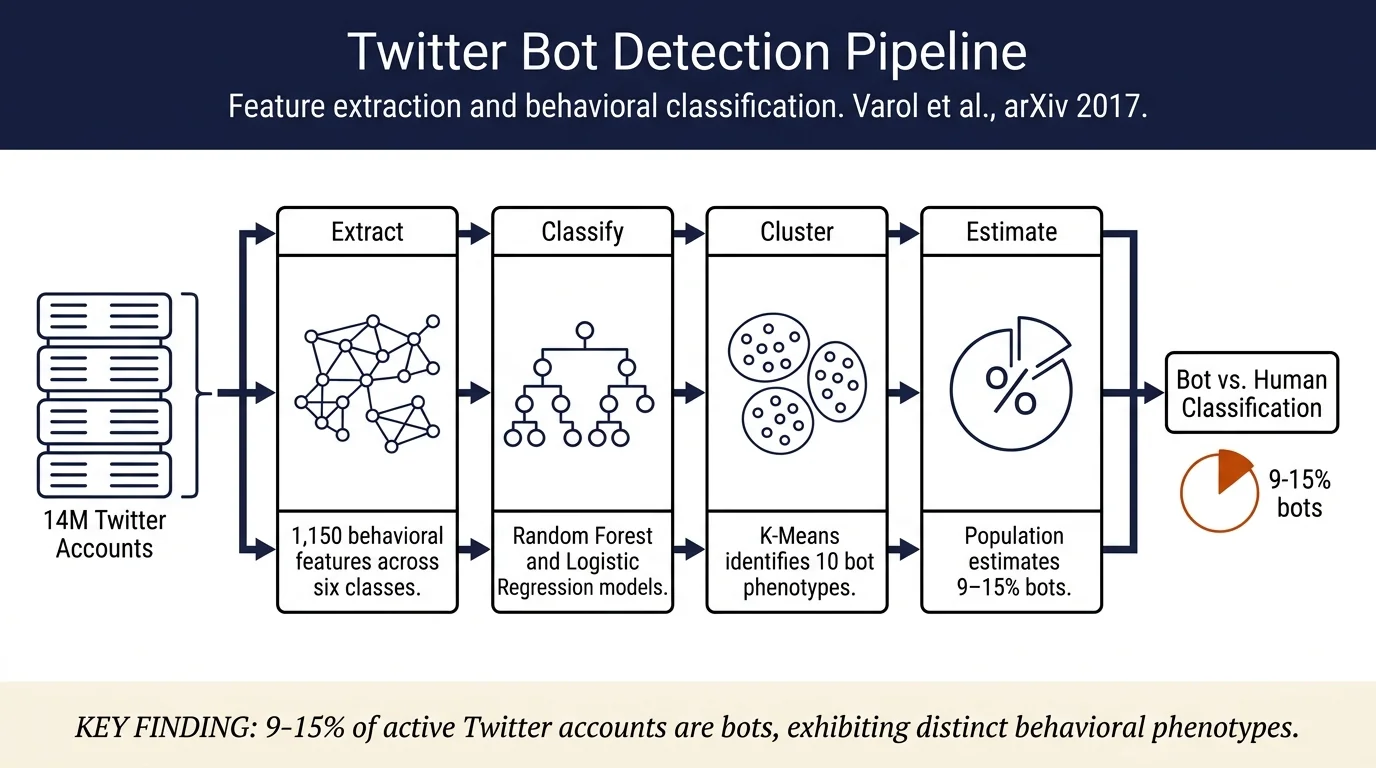
Online Human-Bot Interactions: Detection, Estimation, and CharacterizationSocial media accounts controlled by software can mimic human behavior while executing coordinated campaigns. This paper develops a machine-learning framework extracting 1,150 behavioral features from Twitter account metadata, posting patterns, and social networks to classify bots with 95% accuracy on honeypot data.
 Detection methodsDatasets & evaluation
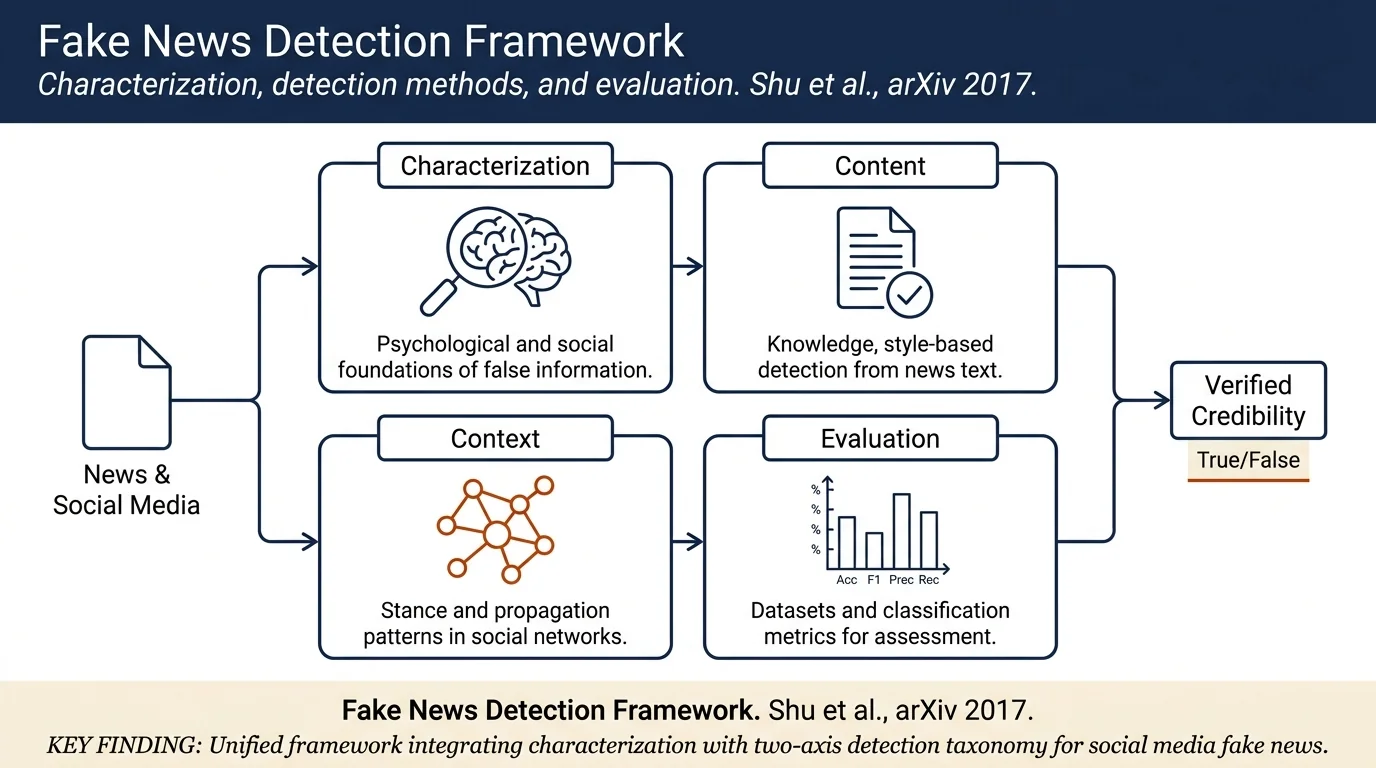
Fake News Detection on Social Media: A Data Mining PerspectiveThis comprehensive survey reviews fake news detection on social media through a data mining lens. It frames the problem around two key aspects—characterization (understanding the psychological and social foundations of fake news) and detection (building computational methods using news content and social context features).
 Detection methodsLLMs & generative AI
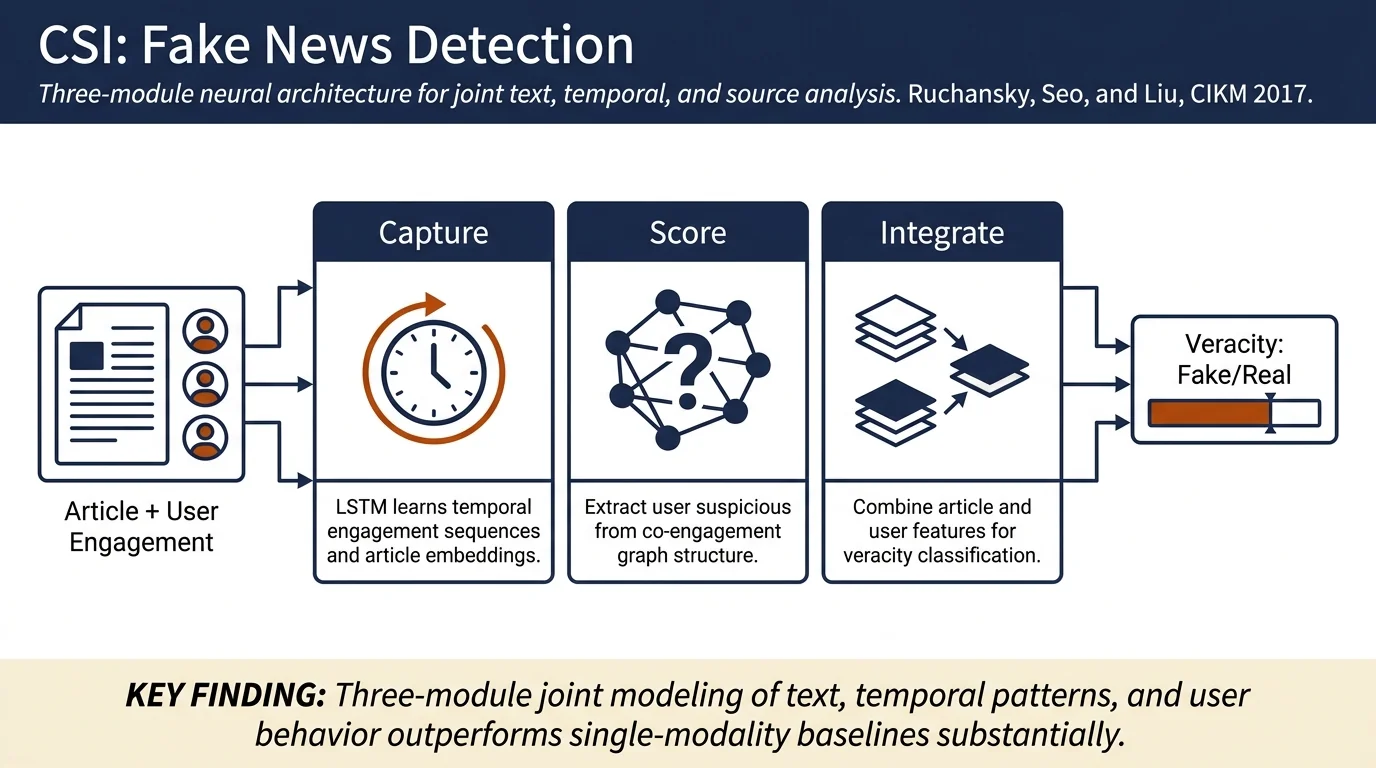
CSI: A Hybrid Deep Model for Fake News DetectionCSI is a three-module deep learning model that detects fake news by jointly modeling article text, temporal patterns of user engagement (response), and user behavior patterns (source). The Capture module uses LSTM to learn temporal response signals; the Score module learns user suspiciousness from co-engagement patterns; the Integrate…
 Detection methodsDatasets & evaluation
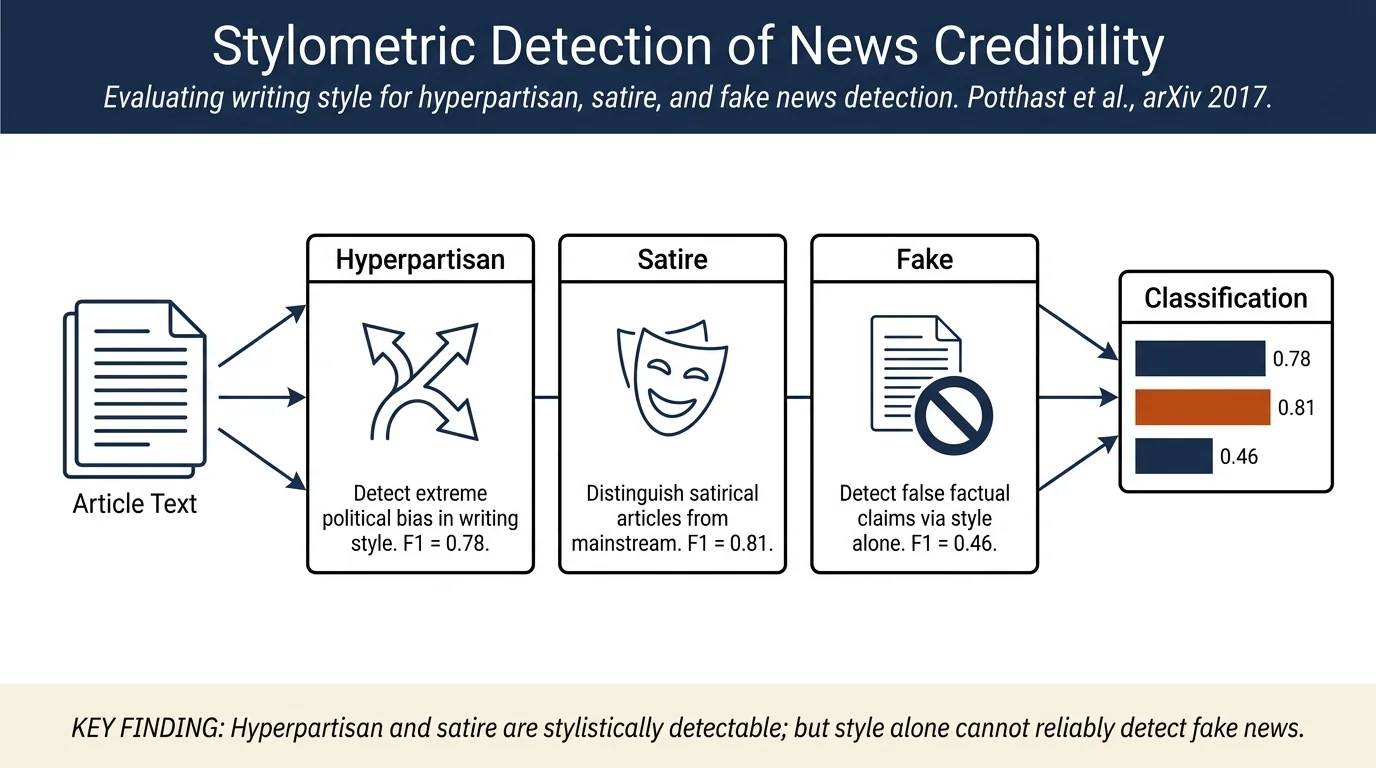
A Stylometric Inquiry into Hyperpartisan and Fake NewsThis paper investigates whether writing style alone can distinguish hyperpartisan news from mainstream and fake news from real news. Using a manually fact-checked corpus of 1,627 articles from BuzzFeed, the authors find that hyperpartisan news is stylistically distinct from mainstream (F1 = 0.78), satire is easily distinguishable from…