Fake News Detection on Social Media: A Data Mining Perspective
Authors: Kai Shu, Amy Sliva, Suhang Wang, Jiliang Tang, Huan Liu
Venue: arXiv, 2017 — arXiv:1708.01967
TL;DR
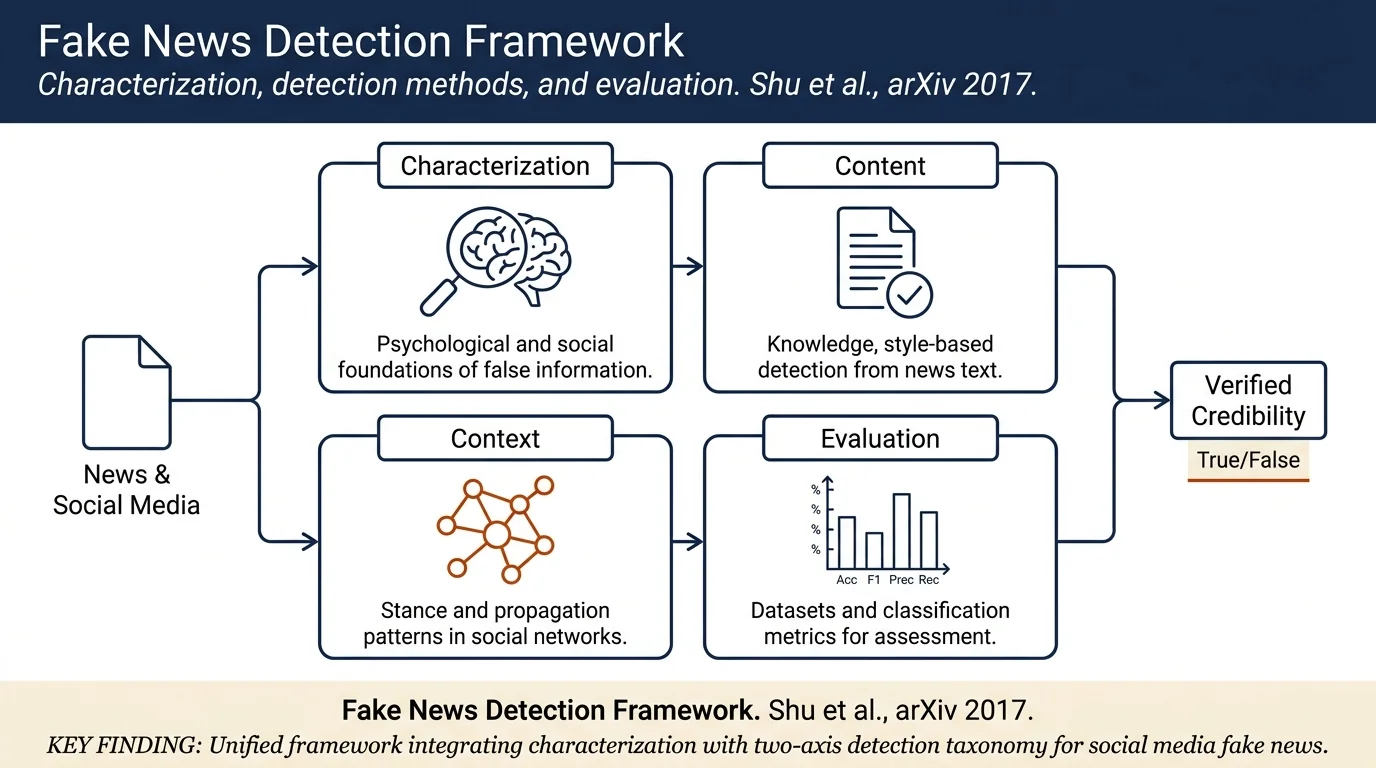
This comprehensive survey reviews fake news detection on social media through a data mining lens. It frames the problem around two key aspects—characterization (understanding the psychological and social foundations of fake news) and detection (building computational methods using news content and social context features). The paper organizes existing detection methods, discusses datasets and evaluation metrics, and identifies future research directions across data-oriented, feature-oriented, model-oriented, and application-oriented categories.
Contributions
- Unified framework for characterizing fake news on social media using theories from psychology and sociology.
- Systematic taxonomy of detection methods: knowledge-based, style-based, stance-based, and propagation-based approaches for news content; user-based, post-based, and network-based approaches for social context.
- Comprehensive review of publicly available datasets for fake news detection (BuzzFeedNews, LIAR, BS Detector, CREDBANK).
- Discussion of evaluation metrics for classification problems in fake news detection.
- Identification of open research problems and future directions.
Characterization
The paper grounds fake news in both traditional media contexts and the unique dynamics of social media. Traditional fake news involves intentional falsification and distribution bias, while social media fake news adds challenges: intentional writing to mislead, diverse linguistic styles, rapid virality, and distributed dissemination through non-human accounts.
Psychological foundations include cognitive biases that make people susceptible to false information: naive realism (people trust their own perceptions), confirmation bias (preference for consistent information), and the continued-influence-of-biased-information effect (difficulty correcting misinformation once internalized). Social foundations derive from prospect theory, social identity theory, and normative influence theory—people share information that aligns with their identities and social networks.
The paper defines "malicious accounts"—social bots, cyborg users, and trolls—that amplify fake news, and the "echo chamber effect" where polarized communities reinforce false narratives.
Detection Methods
The paper organizes detection approaches into two axes: news content models and social context models.
News Content Models
Knowledge-based: Fact-checking via external knowledge sources (open web, knowledge graphs). Approaches include expert-oriented (human expertise), crowdsourcing-oriented (aggregated human annotations), and computational-oriented (automated verification) methods.
Style-based: Exploiting linguistic features that distinguish deceptive writing—manipulative language, exaggeration, sensationalization. Methods include deception-oriented approaches (explicit false statements) and objectivity-oriented approaches (detecting biased, hyperpartisan language).
Social Context Models
Stance-based: Using user viewpoints and reactions to infer news veracity. Methods extract explicit stances (likes, replies) and apply topic models or latent directionlet allocation to predict credibility.
Propagation-based: Analyzing how news spreads through network structures. Homogeneous credibility networks (all similar entity types) and heterogeneous networks (mixed user, post, event entities) capture information diffusion patterns.
Datasets and Evaluation
The paper reviews four major datasets:
- BuzzFeedNews: 1,627 articles from 9 news agencies, human-annotated with ground truth, linked articles and metadata.
- LIAR: 12,800 labeled statements from PolitiFact, multiple-choice labels (true, false, barely-true, half-true, mostly-true).
- BS Detector: Crowdsourced links labeled by user voting.
- CREDBANK: 60 million tweets covering 96 days, crowdsourced credibility assessments by 30 annotators per event.
Evaluation metrics include precision, recall, F1-score, and accuracy for classification; area under the ROC curve (AUC) for ranking algorithms.
Open Issues and Future Directions
The paper identifies four research directions:
- Data-oriented: Temporal dynamics (early detection), dataset scale and temporal scope, psychological and temporal aspects of fake news.
- Feature-oriented: Richer feature extraction from visual/multimodal content, deep network-based features, linguistic patterns for deception detection.
- Model-oriented: Semi-supervised and unsupervised approaches for real-world scenarios; ensemble methods; probabilistic methods.
- Application-oriented: Fake news diffusion and intervention strategies (removing untrustworthy accounts, immunizing users, proactive interventions).
Connections
- Related to A Survey of Fake News: Fundamental Theories, Detection Methods, and Opportunities as a more recent comprehensive survey building on similar themes.
- Complements The Science of Fake News in framing fake news as a multidisciplinary problem.
- Builds on psychological theories discussed in The psychological drivers of misinformation belief and its resistance to correction and The Psychology of Conspiracy Theories.
- Network propagation approaches connect to The Spread of True and False News Online on cascade structures.
- Stance-based detection methods relate to SemEval-2017 Task 8: RumourEval: Determining rumour veracity and support for.
Notes
This foundational survey effectively bridges data mining and misinformation research by grounding computational methods in psychological and social theory. The characterization framework—distinguishing traditional from social media fake news—usefully frames the unique challenges. The taxonomy of detection methods (knowledge/style for content, stance/propagation for context) has become influential in organizing the field.
The paper's main strength is comprehensive coverage of methods and datasets available in 2017. However, subsequent work has shown that stylometric approaches alone are insufficient, visual deepfakes have become more prominent, and multi-platform coordination requires richer modeling of user accounts and networks. The paper presciently identifies these limitations and points toward richer multimodal and behavioral approaches as future work.