Explore papers
Filter by research area, year and venue. Every filter is in the address bar, so you can share a view as a link.
 Fact-checking & verificationDatasets & evaluation
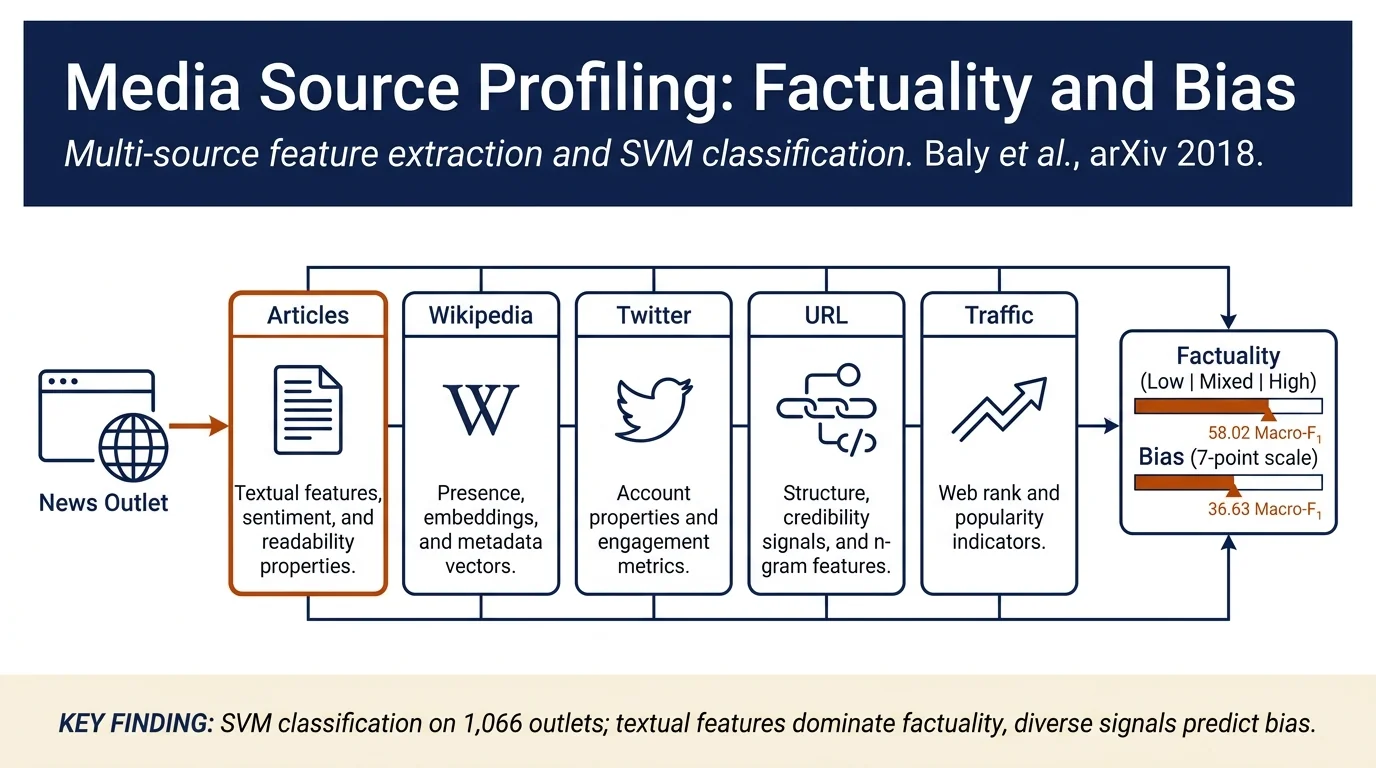
Predicting Factuality of Reporting and Bias of News Media SourcesThis paper frames predicting news media factuality and bias as classification tasks at the news outlet level rather than at the claim or article level. The authors extract 141 features from multiple sources (articles, Wikipedia, Twitter, URL structure, web traffic) and train SVM classifiers, creating a dataset of 1,066 websites manually…
 Deepfakes & multimodalDatasets & evaluation
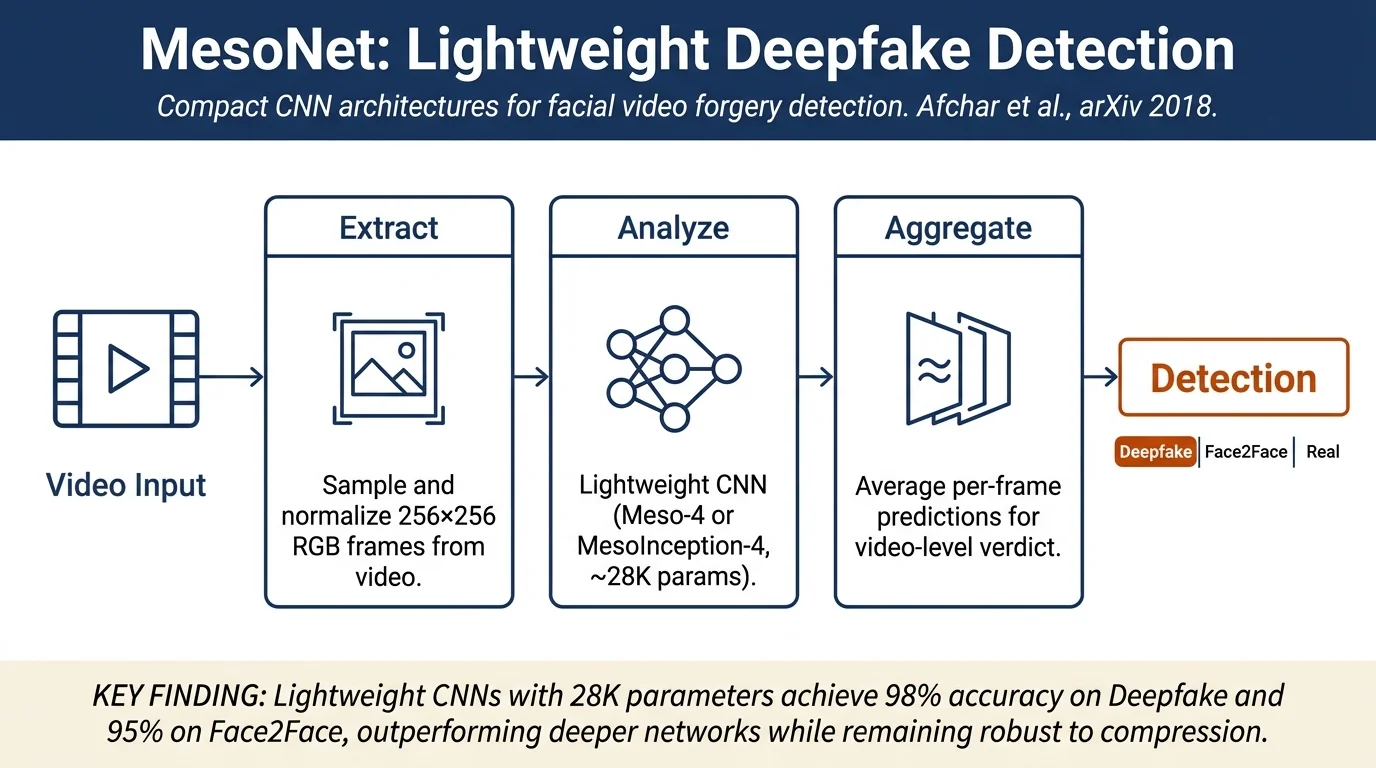
MesoNet: A Compact Facial Video Forgery Detection NetworkThis paper proposes two lightweight CNN architectures (Meso-4 and MesoInception-4) to detect facial video forgeries created by Deepfake and Face2Face techniques. Operating at the mesoscopic level of image analysis, the networks achieve 98% detection accuracy for Deepfake and 95% for Face2Face videos under realistic compression conditions.
 Datasets & evaluationSpread & networks
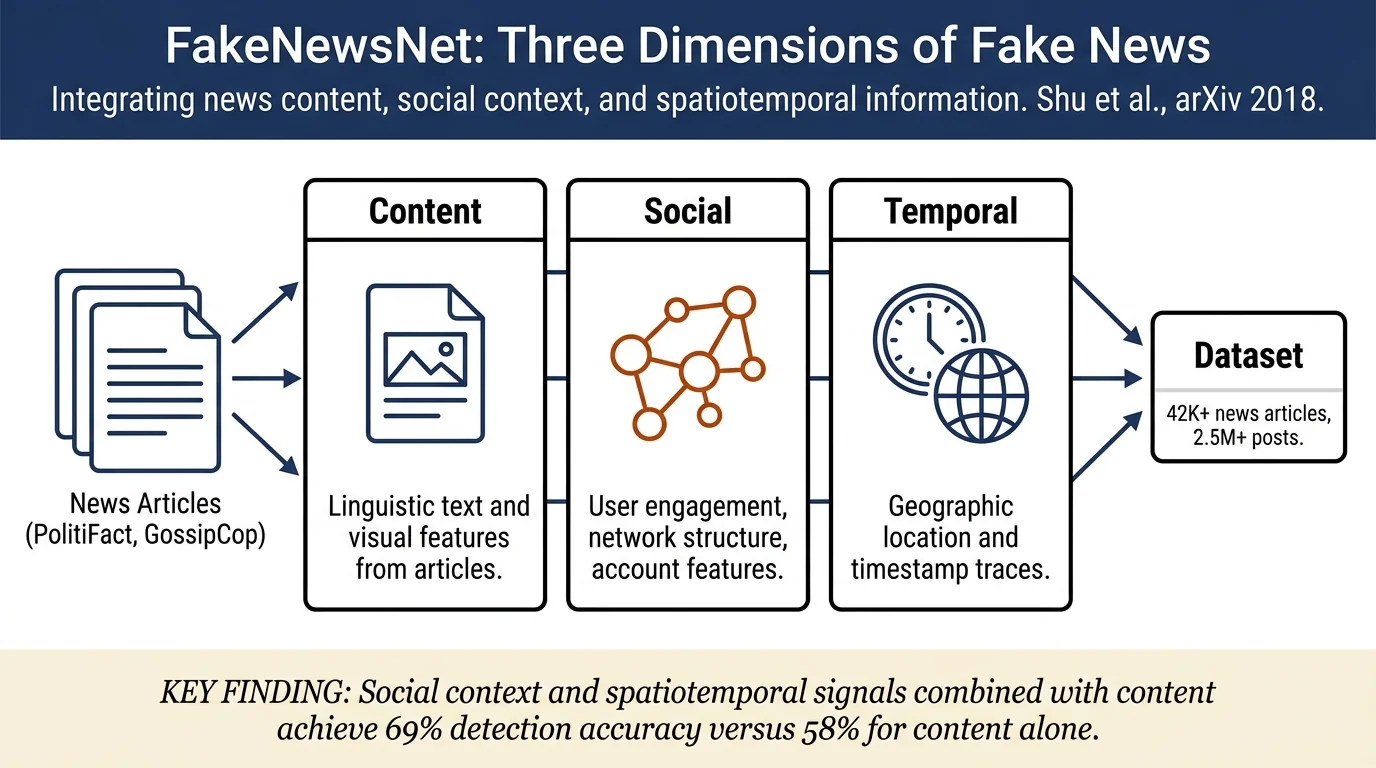
FakeNewsNet: A Data Repository with News Content, Social Context and Spatiotemporal Information for Studying Fake News on Social MediaFakeNewsNet is a multi-dimensional repository for fake news research on social media, integrating news content (linguistic and visual features), social context (user engagement, network structure, response patterns), and spatiotemporal information (location, timestamps). The dataset contains both fake and real news from PolitiFact and…
 Detection methodsDatasets & evaluation
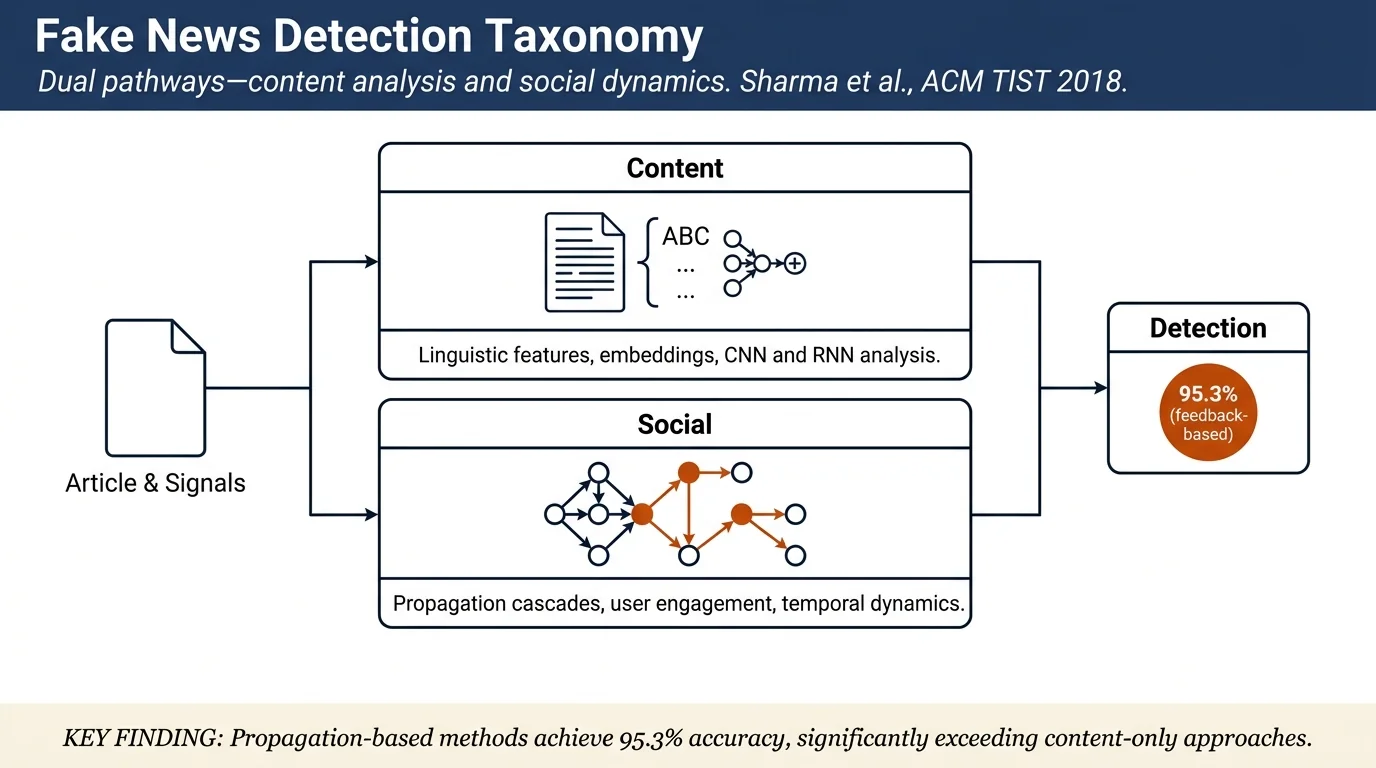
Combating Fake News: A Survey on Identification and Mitigation TechniquesThis comprehensive survey of fake news detection and mitigation organizes existing methods into two broad categories: content-based approaches (linguistic and deep learning methods) and feedback-based approaches (exploiting propagation patterns, user responses, and temporal dynamics). The authors consolidate 23+ publicly available…
 Spread & networksBots & coordinated campaigns
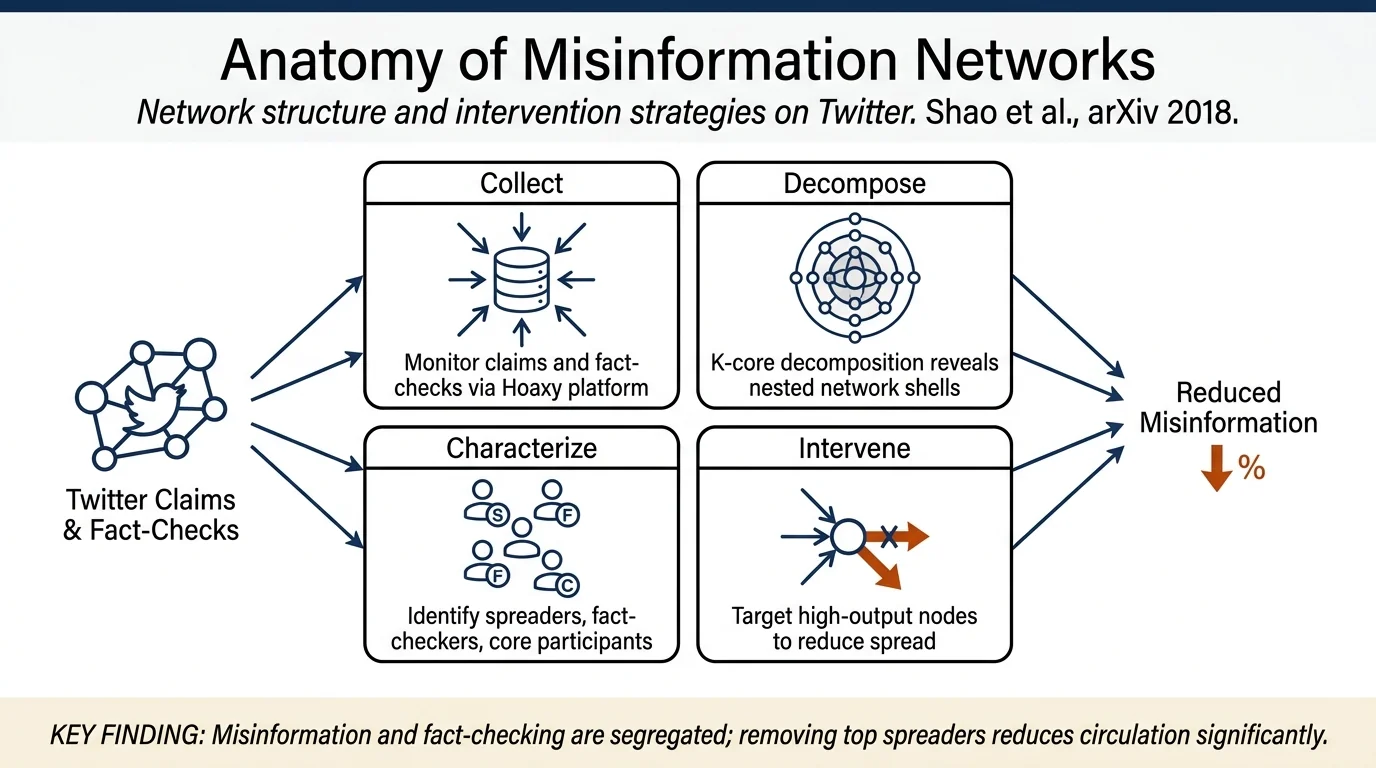
Anatomy of an online misinformation networkA network analysis of misinformation and fact-checking spread during the 2016 US Presidential Election reveals stark segregation between the two communities on Twitter. The core of the network is dominated by misinformation spreaders; fact-checking nearly disappears in the densest regions.
 Spread & networksDetection methods
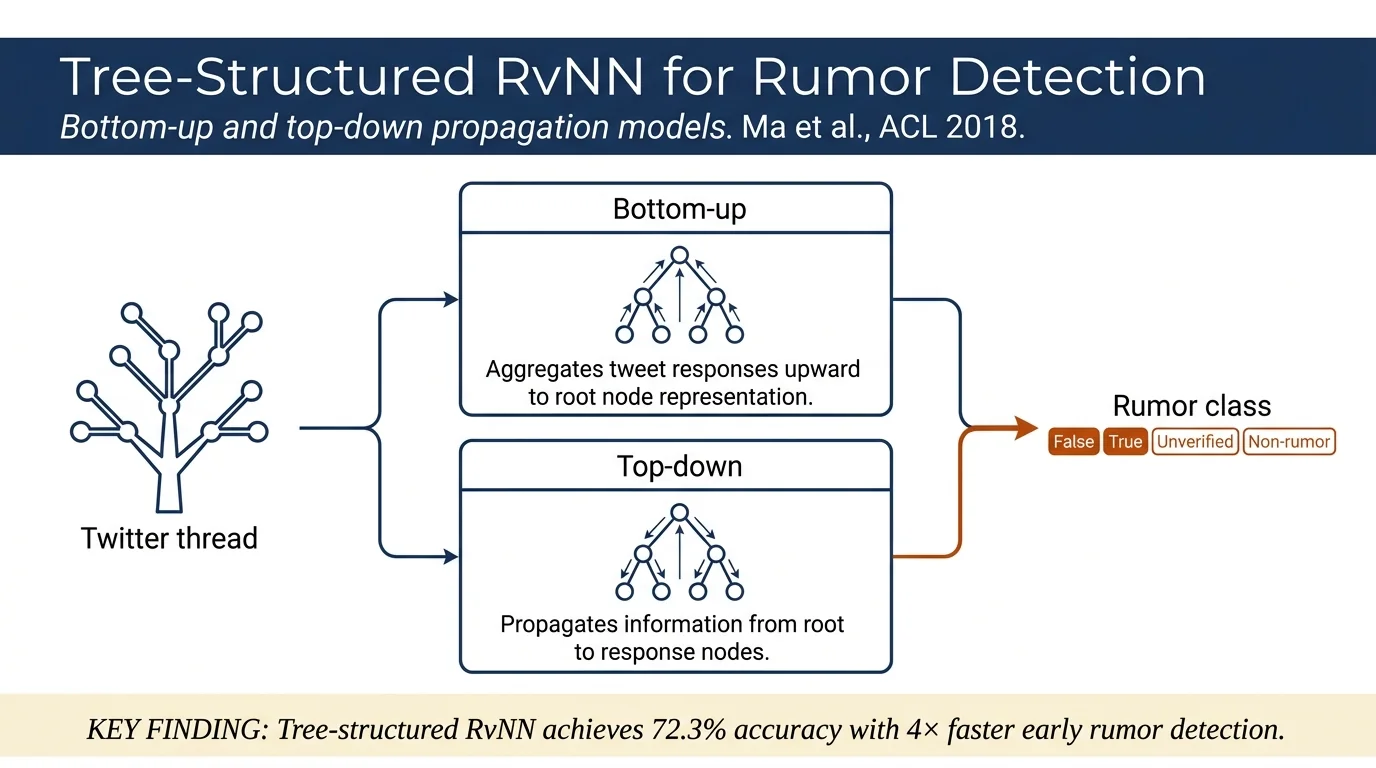
Rumor Detection on Twitter with Tree-structured Recursive Neural NetworksProposes two variants of recursive neural networks (RvNN)—bottom-up and top-down—that operate on propagation tree structures of tweets to detect rumors. Rather than treating tweets sequentially, the model learns representations that respect how tweets actually propagate in response threads.
 Platforms, policy & societyFact-checking & verification
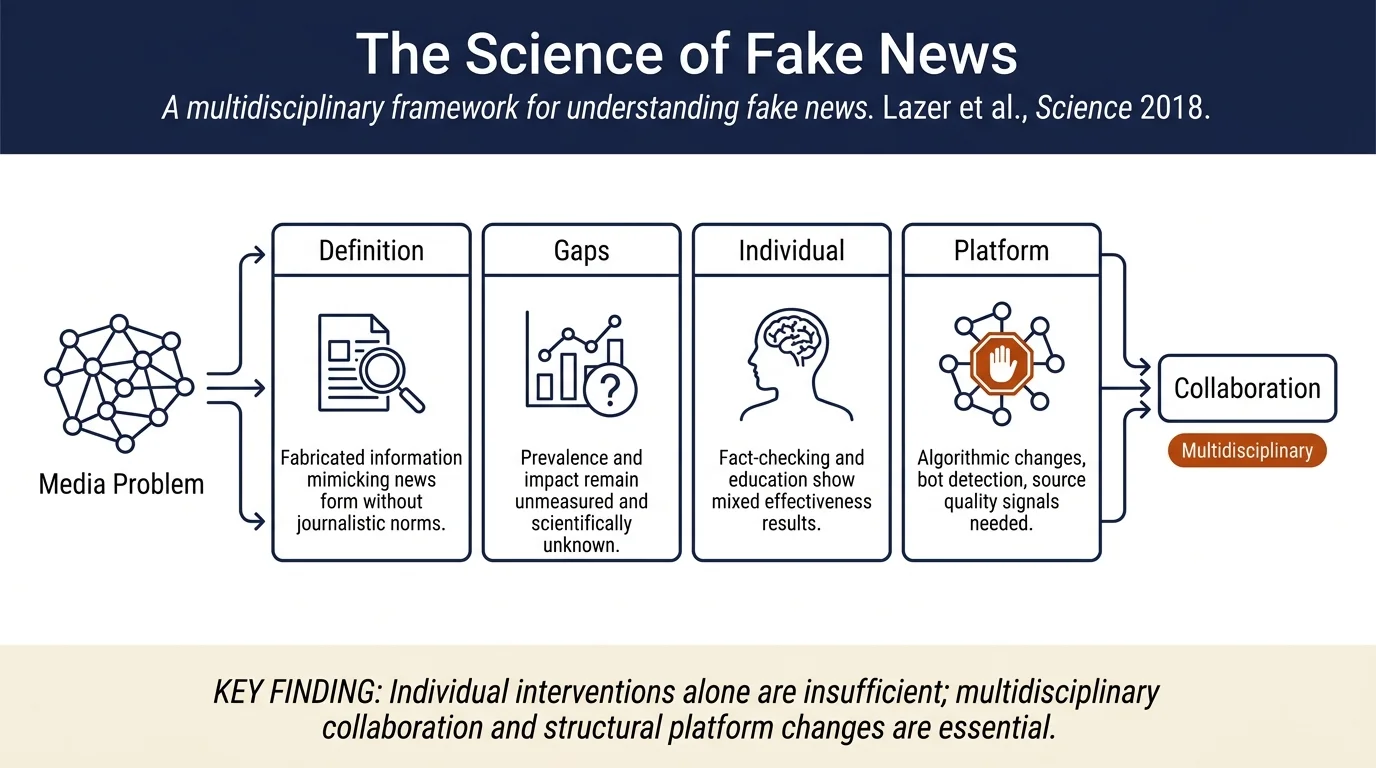
The Science of Fake NewsThis multidisciplinary review establishes a scientific framework for studying fake news, defining it as fabricated information that mimics news media form but lacks editorial norms. The paper identifies two mitigation strategies—empowering individuals through fact-checking and education, and structural platform interventions—while…
 Deepfakes & multimodalDetection methods
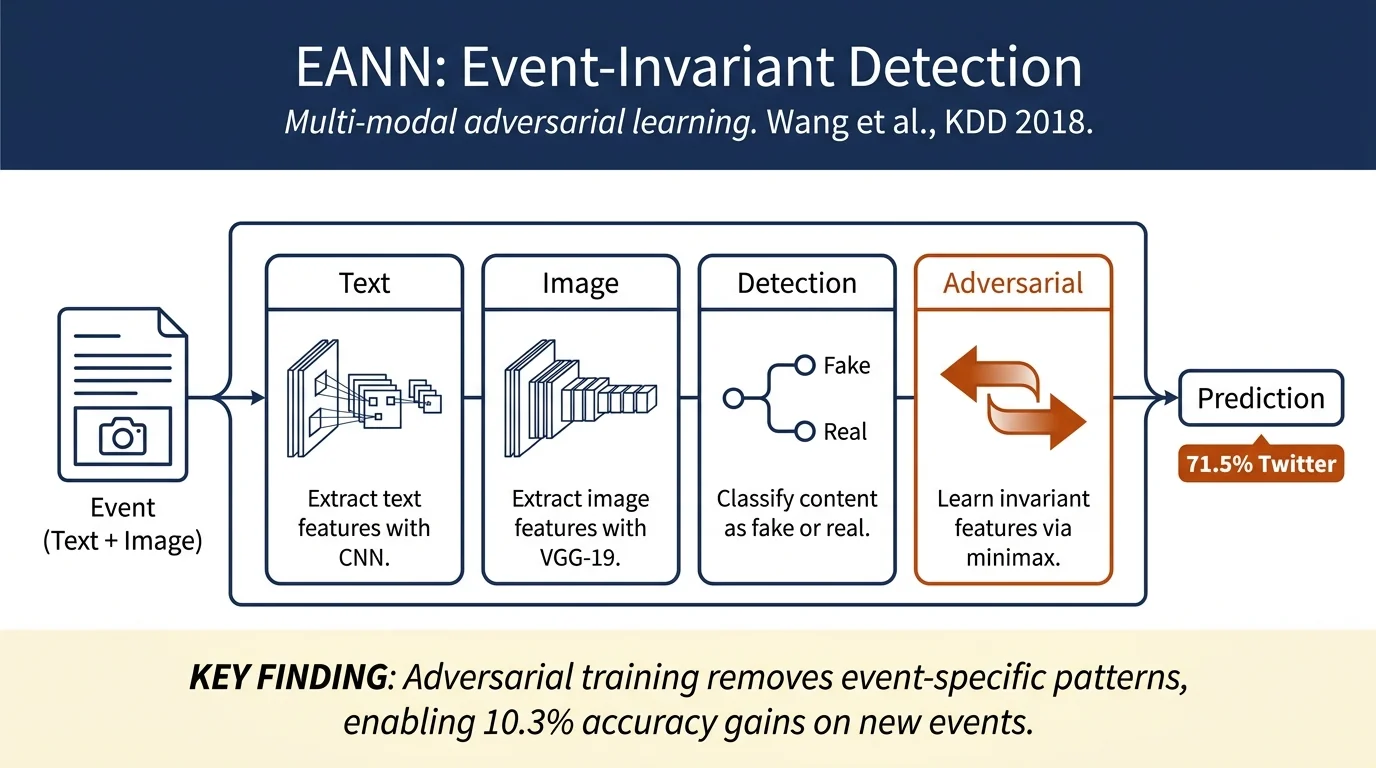
EANN: Event Adversarial Neural Networks for Multi-Modal Fake News DetectionThe paper proposes EANN, an adversarial neural network that detects fake news on newly emerged events by learning event-invariant features. An event discriminator forces the multi-modal feature extractor to remove event-specific features while preserving shared patterns across events.
 Psychology & interventionsPlatforms, policy & society
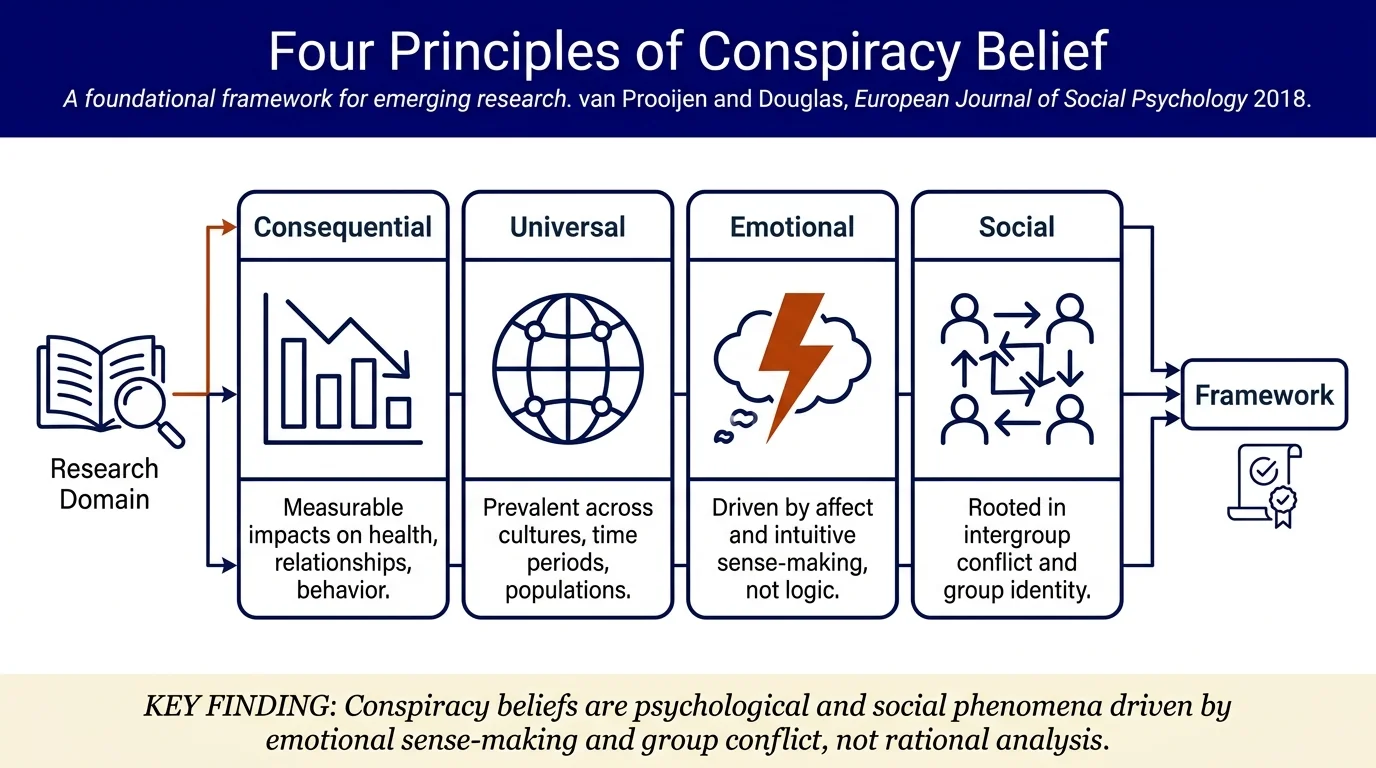
Belief in conspiracy theories: Basic principles of an emerging research domainThis special issue introduction proposes four foundational principles for the emerging scientific study of conspiracy belief: conspiracy beliefs are consequential (with real impacts on health and relationships), universal (across cultures and historical periods), emotional (driven by sense-making rather than logic), and social (rooted in…
 Bots & coordinated campaignsSpread & networks
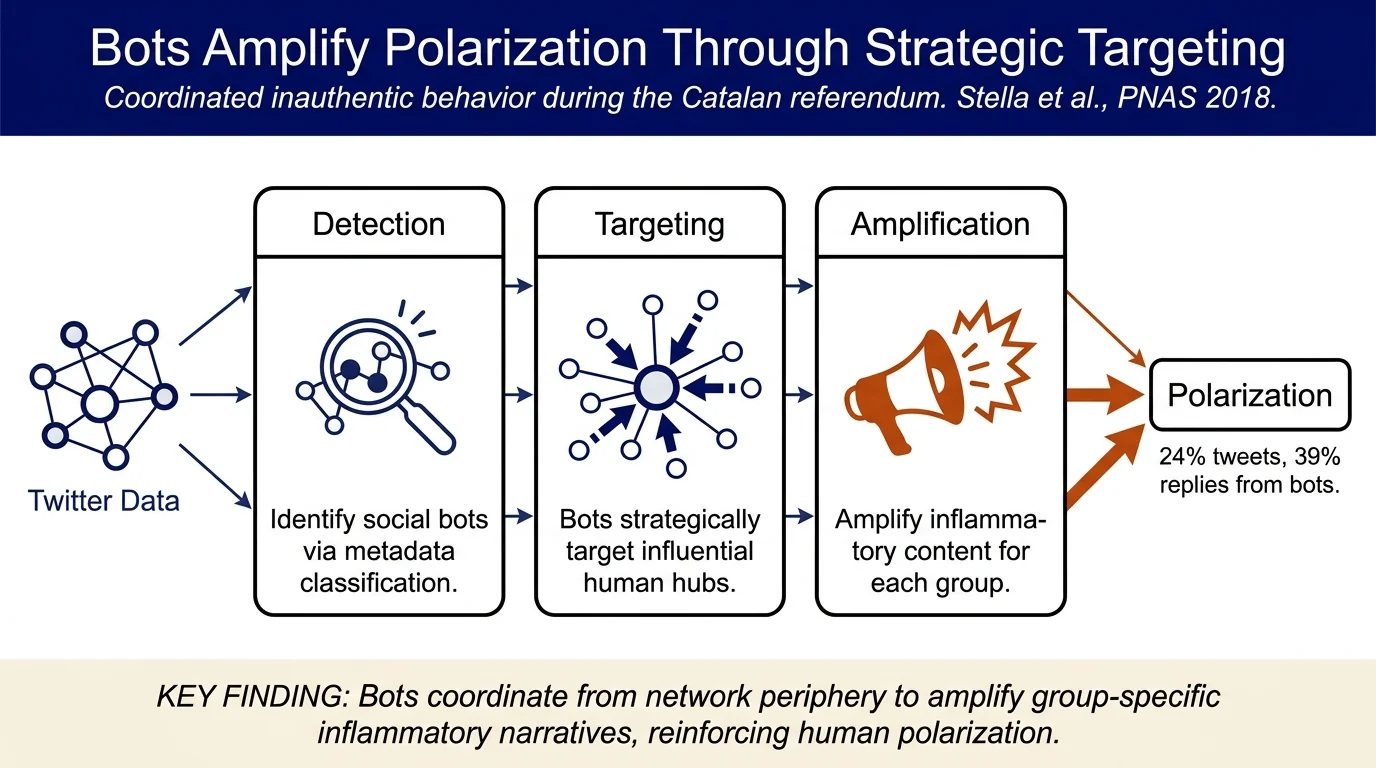
Bots increase exposure to negative and inflammatory content in online social systemsSocial bots during the 2017 Catalan independence referendum strategically targeted influential humans to amplify negative and inflammatory content. Operating from network peripheries, bots coordinated sentiment-driven amplification that exacerbated polarization, with approximately one in three referendum-related tweets generated by bots.
 Spread & networksBots & coordinated campaigns
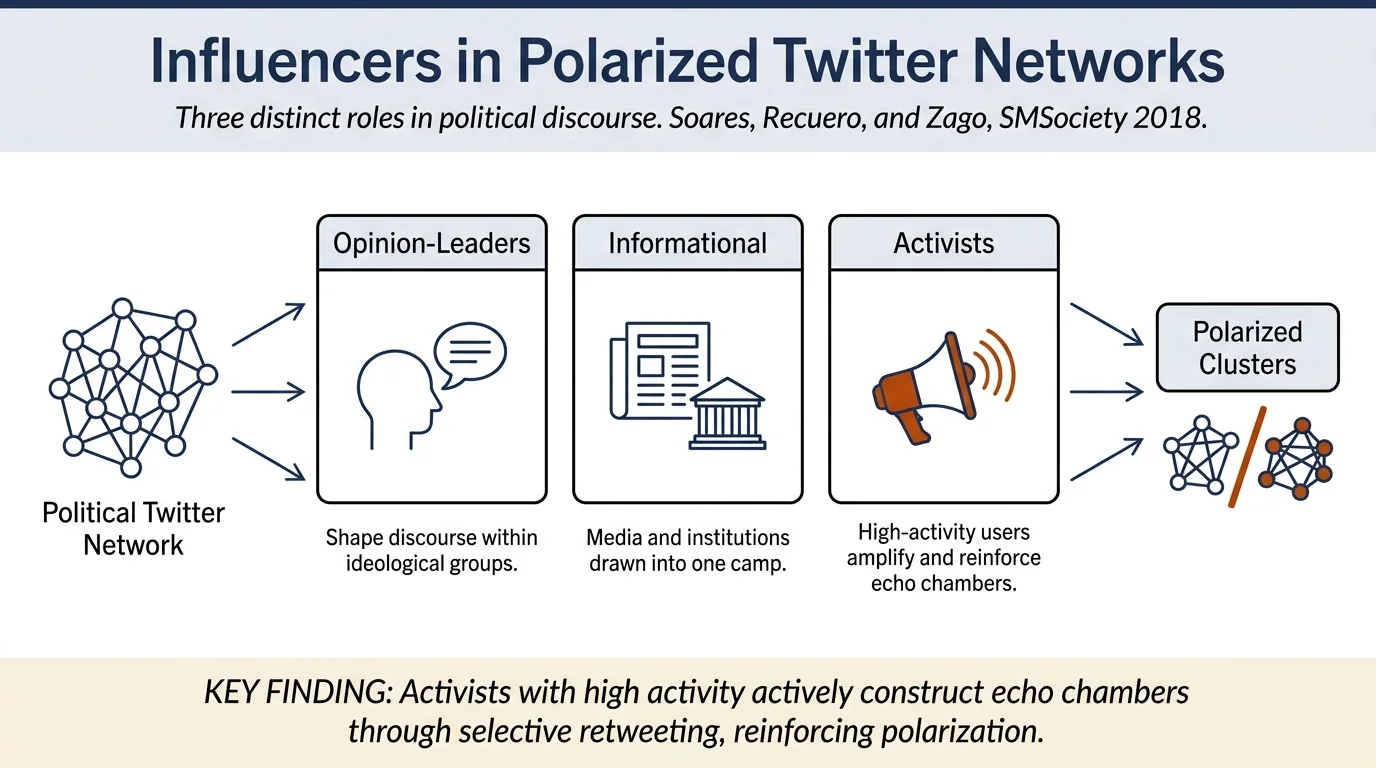
Influencers in Polarized Political Networks on TwitterThis paper identifies three types of influencers in polarized political Twitter conversations during Brazil's 2016 Dilma Rousseff impeachment: "opinion leaders" who shape discourse within ideological groups, "informational influencers" (media/institutions) drawn into one camp, and "activists" who amplify like-minded messages. The…
 Spread & networksPsychology & interventions
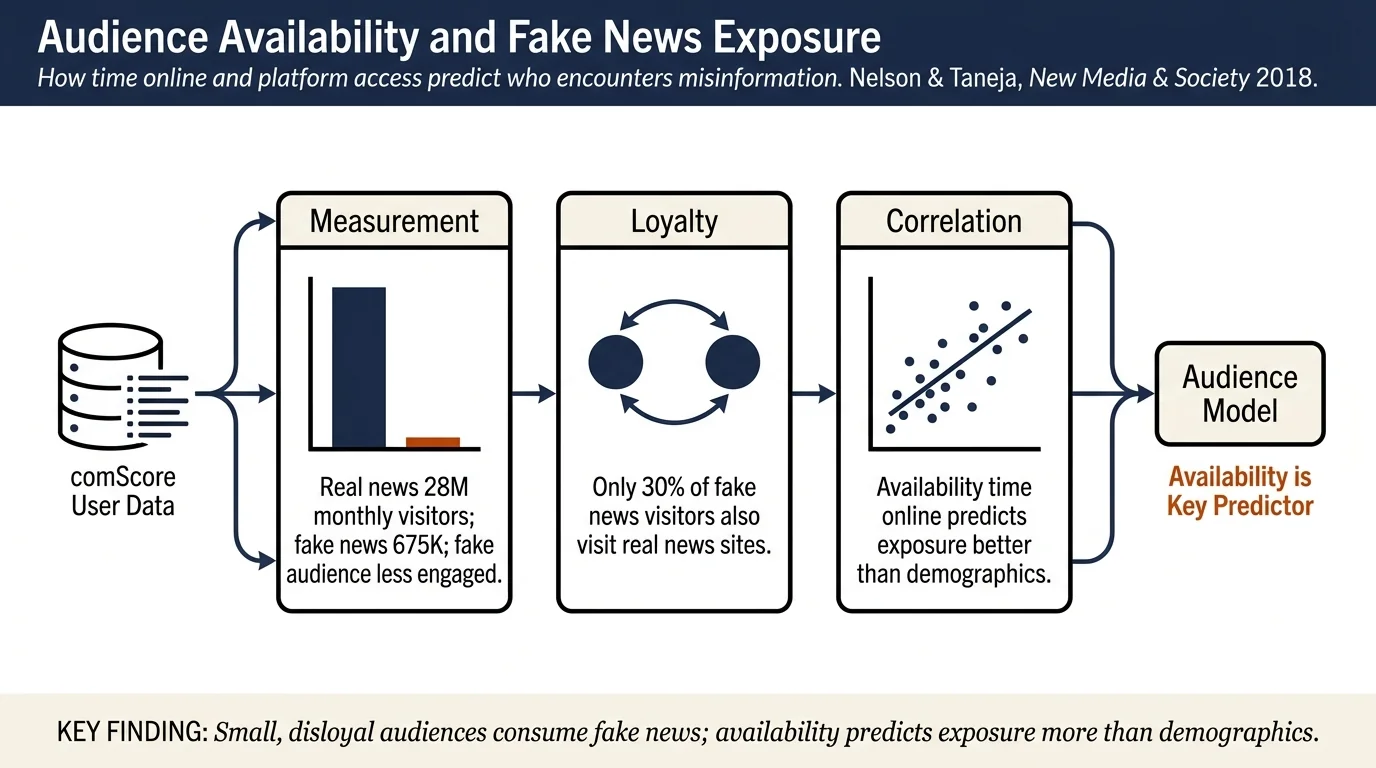
The small, disloyal fake news audience: The role of audience availability in fake news consumptionContrary to claims that fake news has reached a broad audience, this empirical analysis of comScore data shows the fake news audience is small and comprises heavy internet users. Applying the Law of Double Jeopardy from media theory, the authors show that fake news attracts disloyal audiences disproportionately from social platforms.
 Spread & networksPlatforms, policy & society
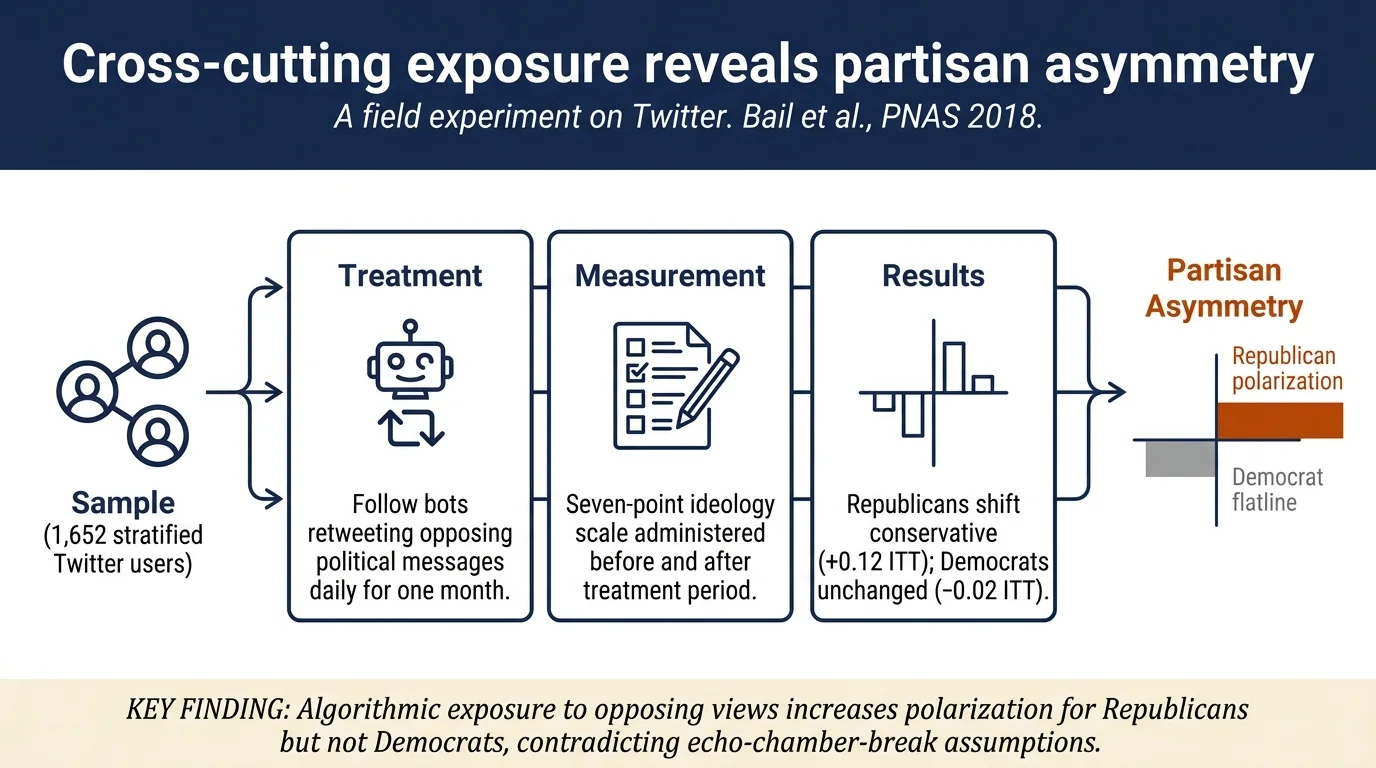
Exposure to opposing views on social media can increase political polarizationThis field experiment tested whether exposure to opposing political views on social media reduces polarization. Twitter users (Republicans and Democrats) were randomly offered money to follow bots retweeting messages from opposing politicians and opinion leaders for one month.
 Detection methodsLLMs & generative AI
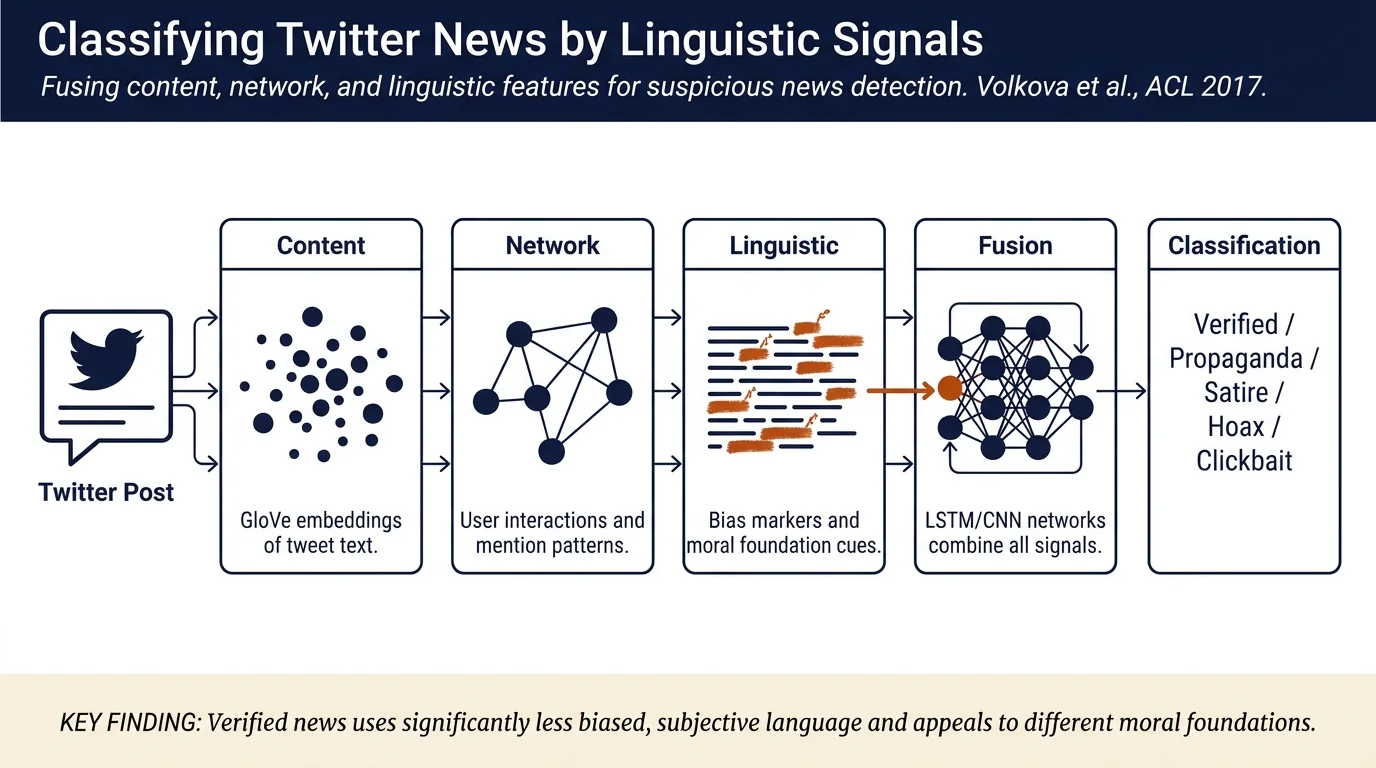
Separating Facts from Fiction: Linguistic Models to Classify Suspicious and Trusted News Posts on TwitterThis paper presents neural network models combining tweet content, social network interactions, and linguistic features (bias markers, subjectivity cues, moral foundations) to classify Twitter news posts as suspicious (propaganda, hoaxes, clickbait, satire) or verified. The models achieve 95% accuracy on binary classification and 0.7…
 Detection methodsDatasets & evaluation
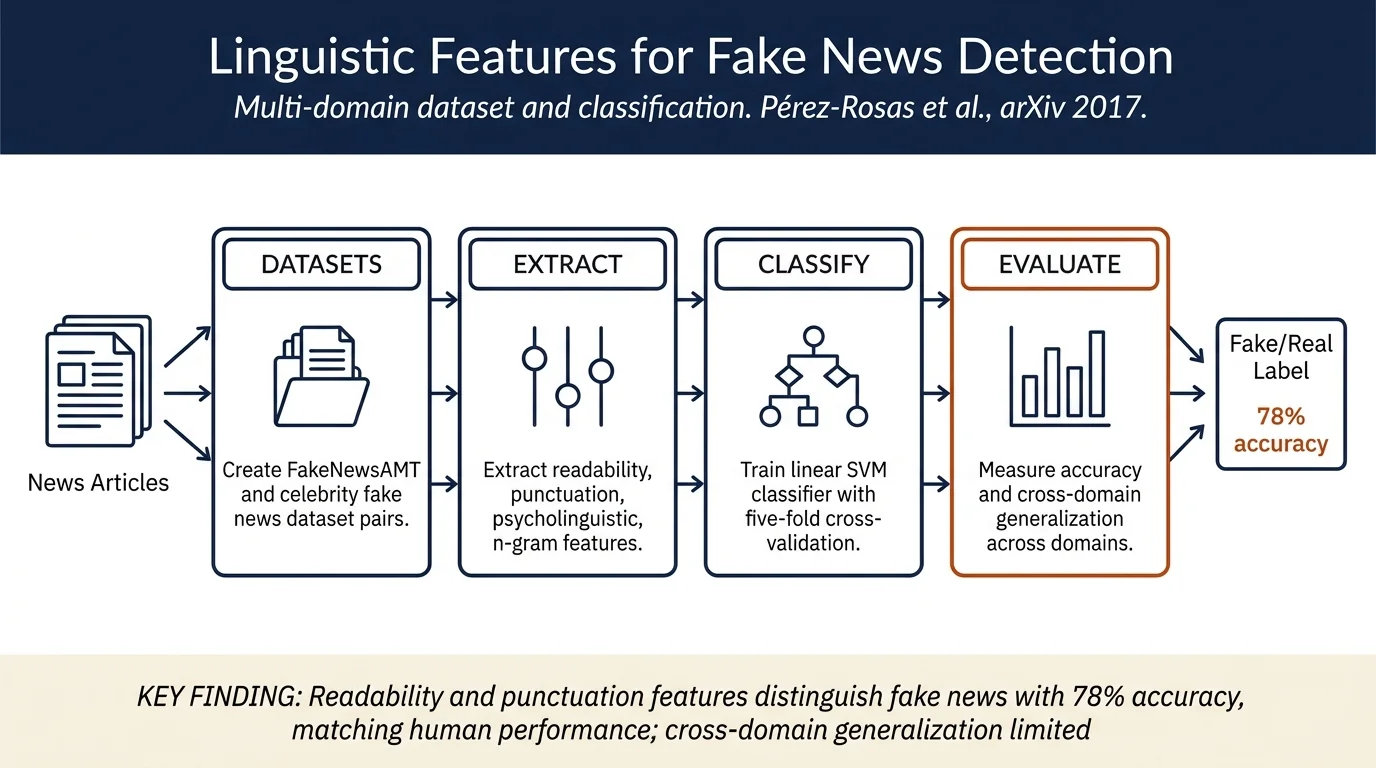
Automatic Detection of Fake NewsThis paper introduces two novel fake news detection datasets covering seven news domains and analyzes linguistic properties that distinguish fake from legitimate content. Using linguistic features including readability metrics, word categories, and punctuation patterns, the authors build classifiers achieving up to 78% accuracy and…
 Detection methodsSpread & networks
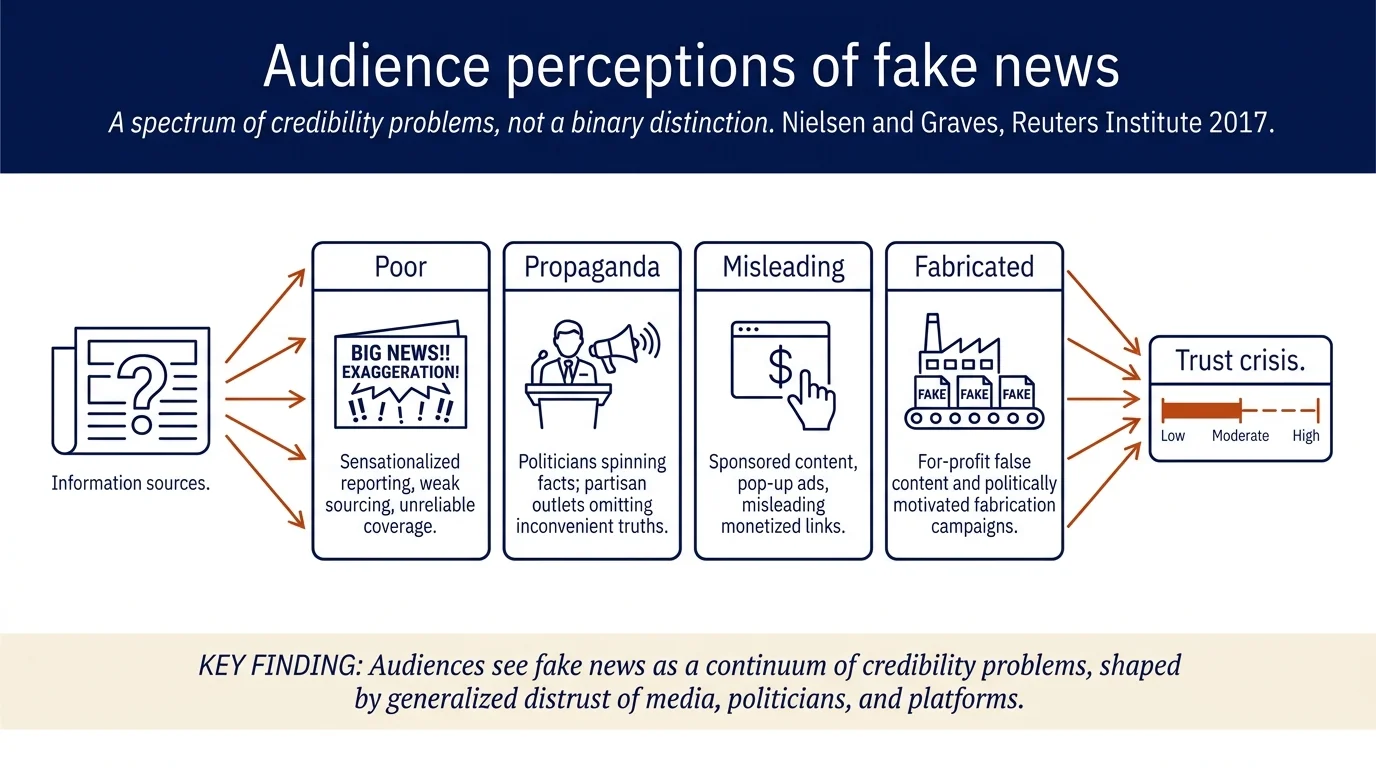
"News you don't believe": Audience perspectives on fake newsUsing focus groups and surveys across the US, UK, Spain, and Finland, Nielsen and Graves find that ordinary people see fake news as a spectrum rather than a binary distinction—encompassing poor journalism, political propaganda, misleading advertising, and fabricated content. Audiences experience the "fake news" problem as one of degree,…
 Spread & networksDetection methods
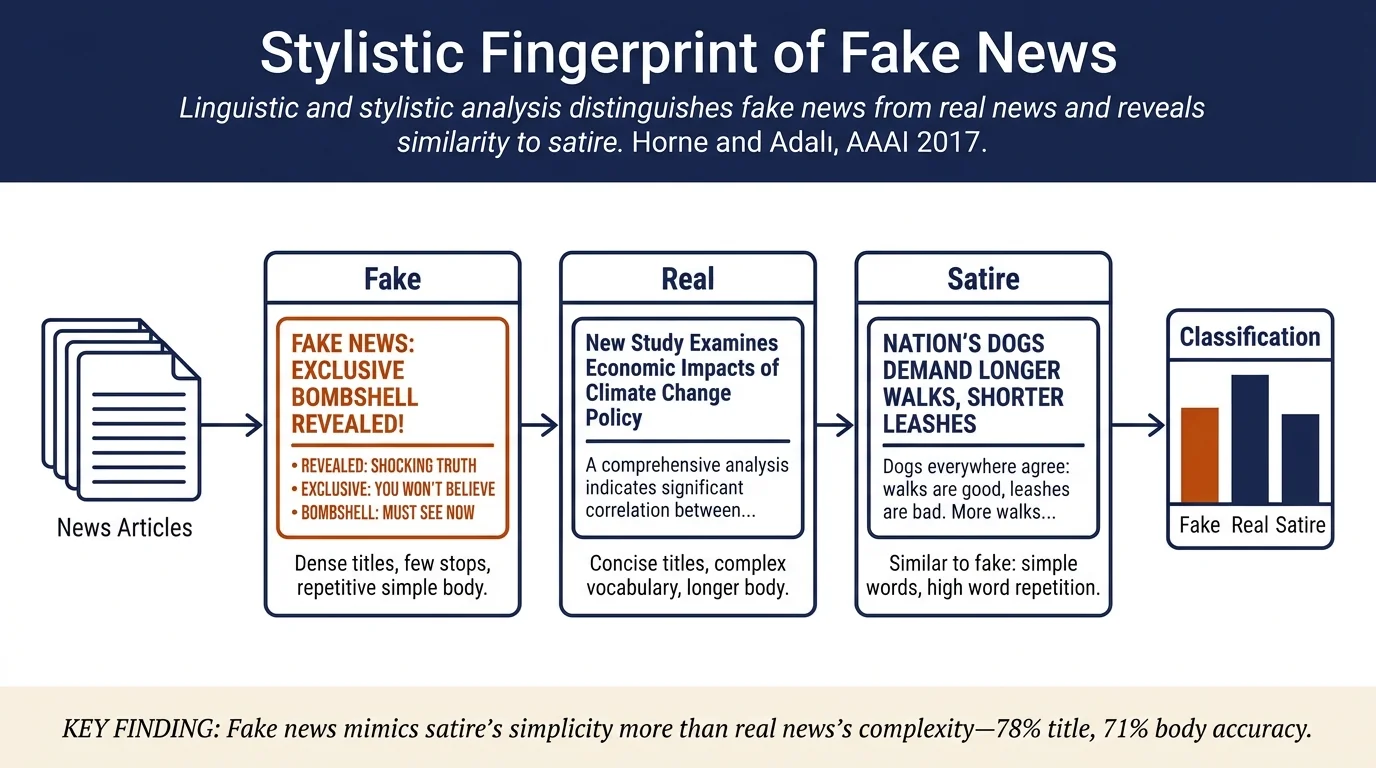
This Just In: Fake News Packs a Lot in Title, Uses Simpler, Repetitive Content in Text Body, More Similar to Satire than Real NewsFake news differs systematically from real news in stylistic features, especially titles. Contrary to the assumption that fake news mimics real news, it is actually more similar to satire: packed titles with fewer stop words and more proper nouns, combined with shorter, repetitive body text with simpler language.
Fact-checking & verificationDatasets & evaluation
ClaimBuster: The first end-to-end fact-checking systemFoundational work introducing ClaimBuster, an end-to-end automated fact-checking system. Introduces a dataset of 23,533 human-annotated U.S. debate statements with check-worthiness labels, establishing baselines for automated claim check-worthiness detection and ranking.
 Fact-checking & verificationPsychology & interventions
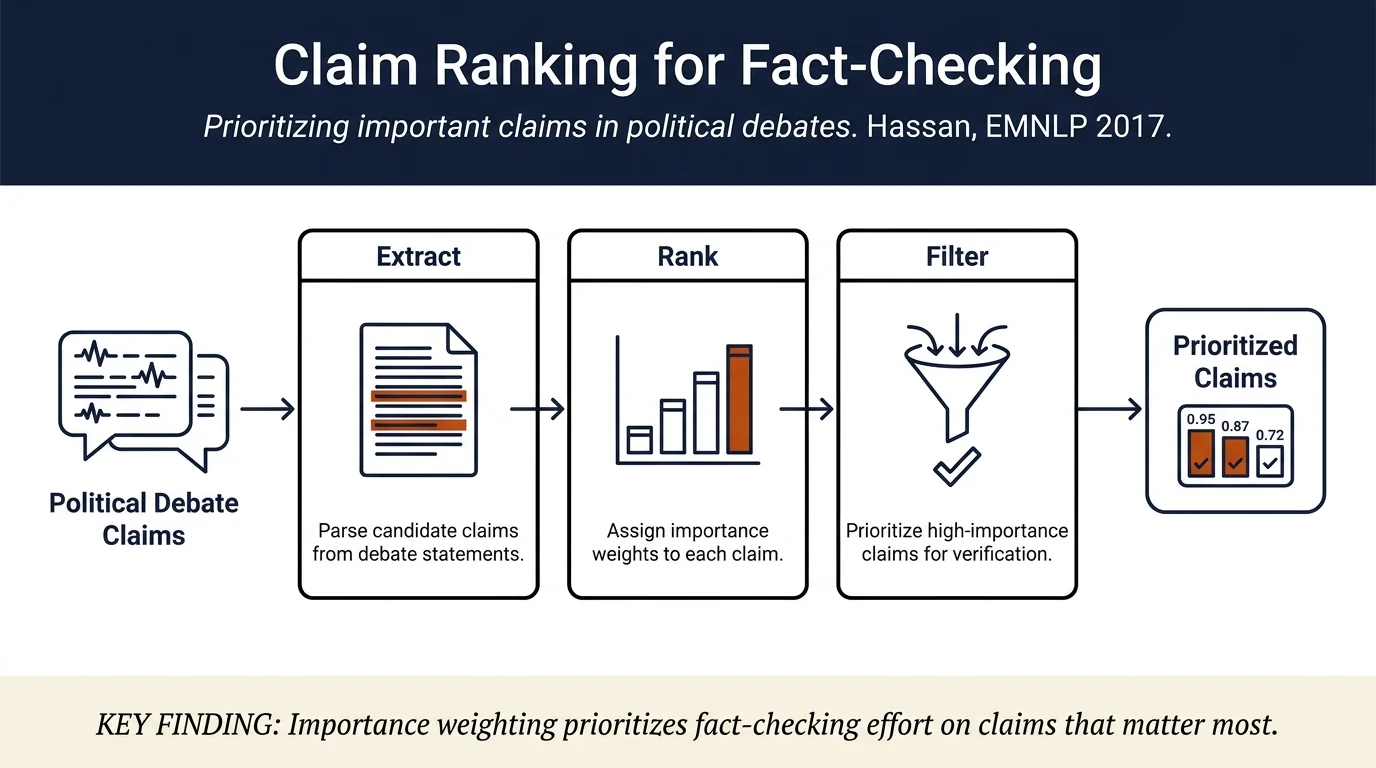
Claim Ranking in Political DebatesEarly work framing check-worthiness as claim ranking; introduces the notion of "importance weighting" for prioritizing claims for fact-checking in political debates. Foundational for understanding which claims warrant verification effort.
 LLMs & generative AI
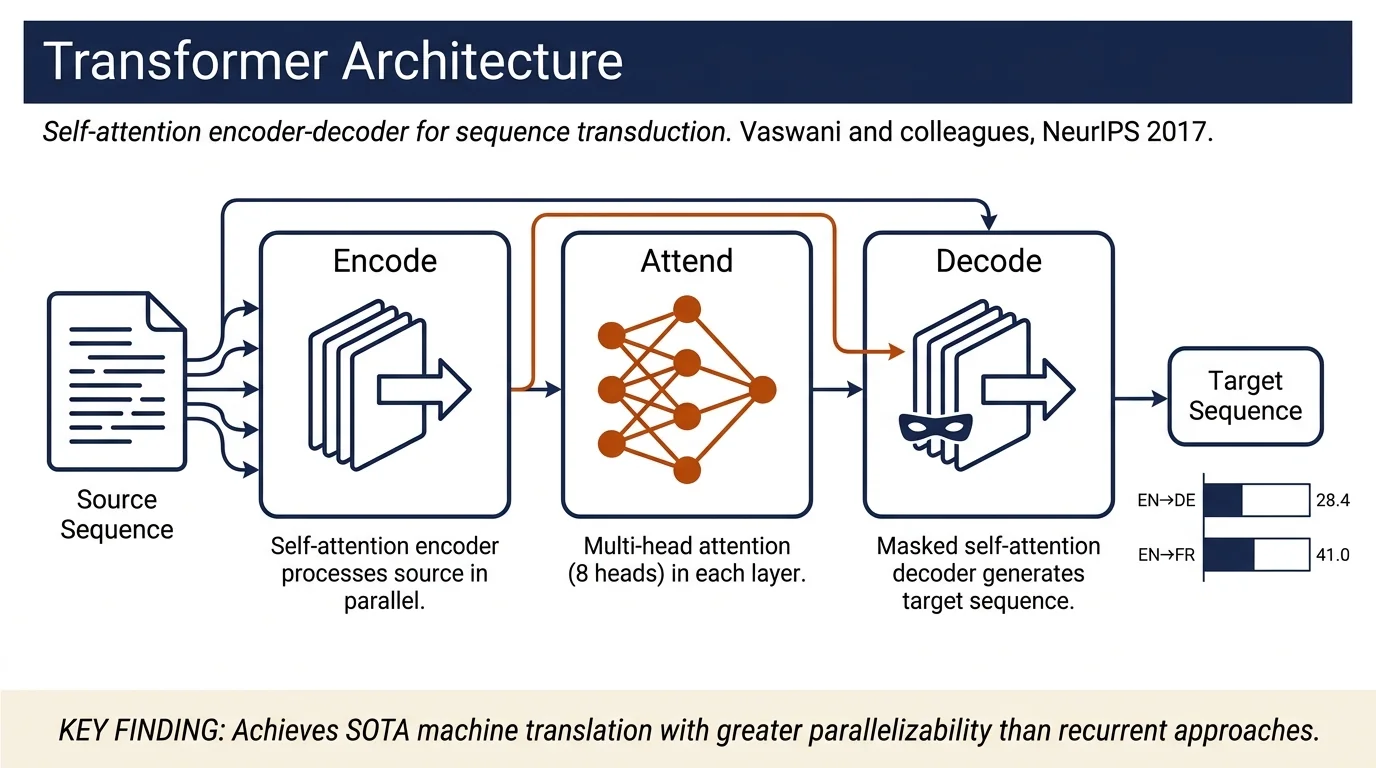
Attention Is All You NeedThe authors introduce the Transformer, a sequence transduction model based entirely on self-attention mechanisms that dispenses with recurrence and convolution. The model achieves state-of-the-art BLEU scores on machine translation tasks while being significantly more parallelizable and requiring less training time.
 Detection methodsDatasets & evaluation
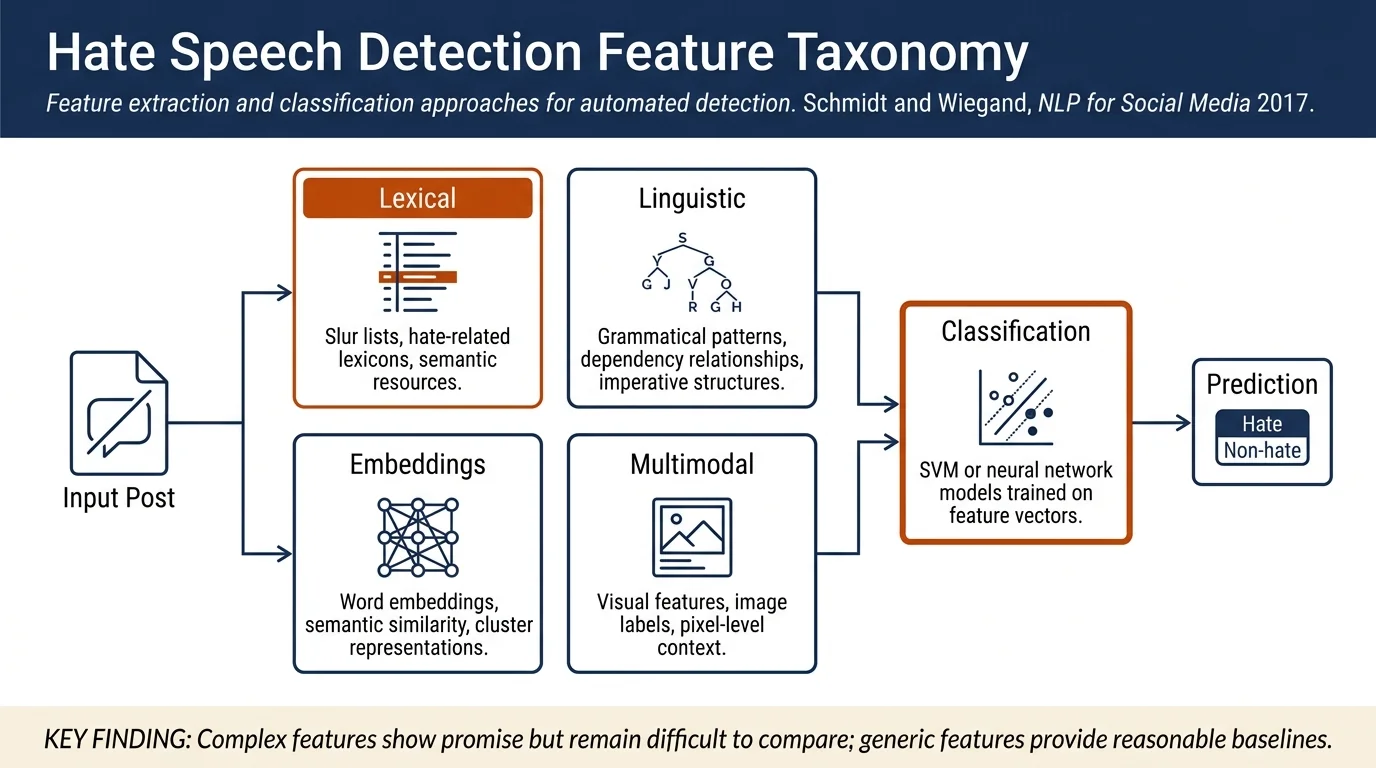
A Survey on Hate Speech Detection using Natural Language ProcessingThis survey systematically reviews automatic hate speech detection methods, covering feature extraction techniques (surface features, embeddings, sentiment analysis, lexical resources, linguistic features, knowledge bases), classification approaches (mostly supervised learning with SVMs and neural networks), annotation practices, and key…
 Spread & networksFact-checking & verification
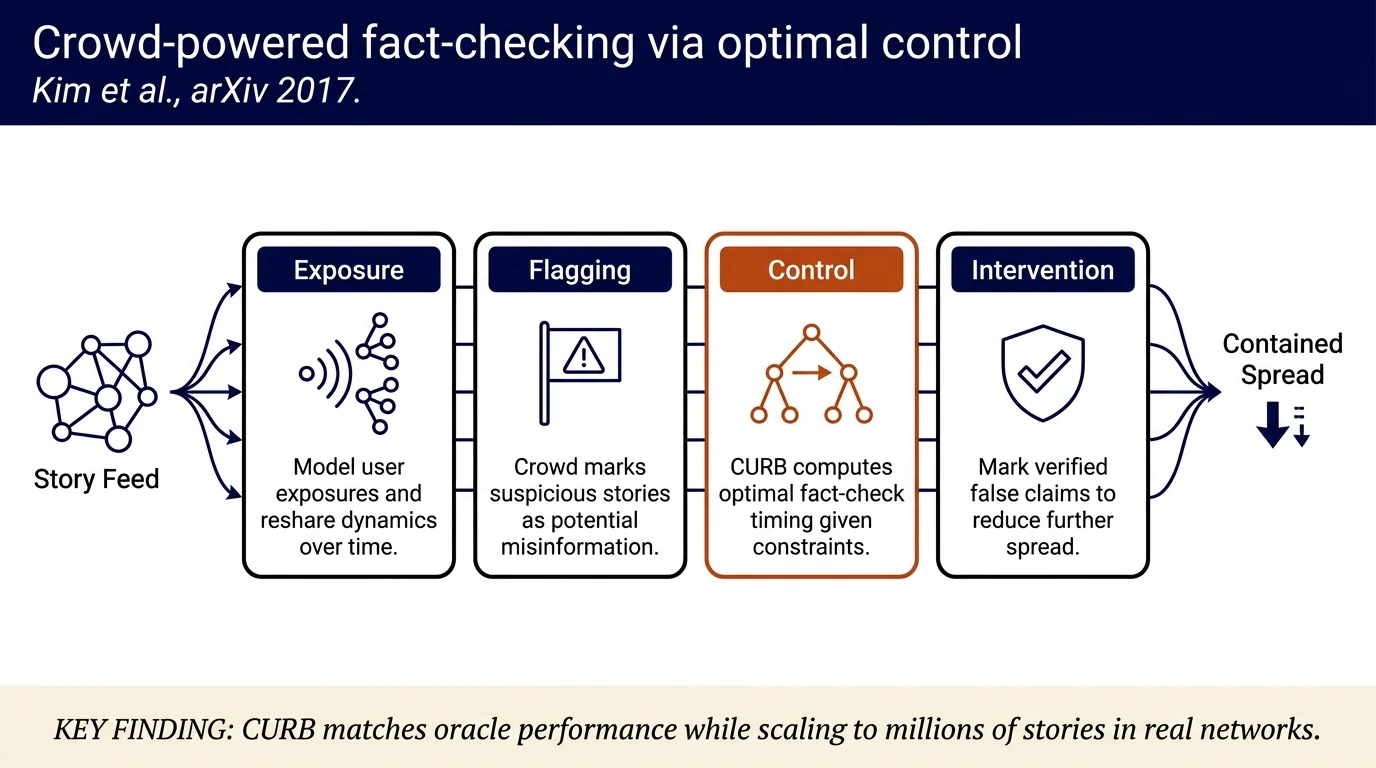
Leveraging the Crowd to Detect and Reduce the Spread of Fake News and MisinformationOnline social networks use crowd-powered flagging to identify misinformation: when users flag a story, enough flags trigger fact-checking, which disputes false claims. This paper formulates the problem of deciding which stories to fact-check and when, subject to limited fact-checking resources, as a stochastic optimal control problem.
 Spread & networksDetection methods
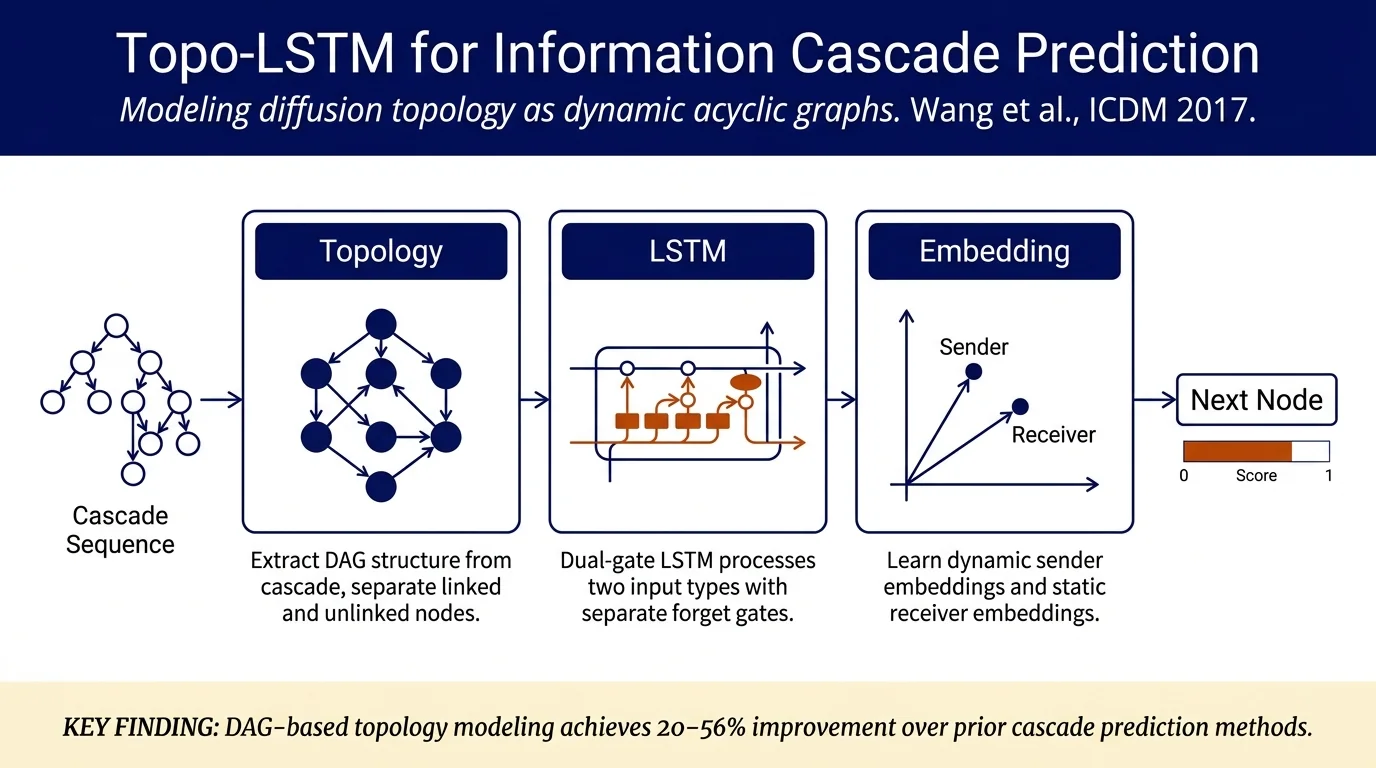
Topological Recurrent Neural Network for Diffusion PredictionWang et al. propose Topo-LSTM, a novel LSTM architecture for modeling dynamic directed acyclic graphs (DAGs) to predict which node will be activated next in information cascades. The key insight is that information diffusion on networks should be modeled explicitly as diffusion topologies—graphs showing how information spreads from…
 Datasets & evaluationFact-checking & verification
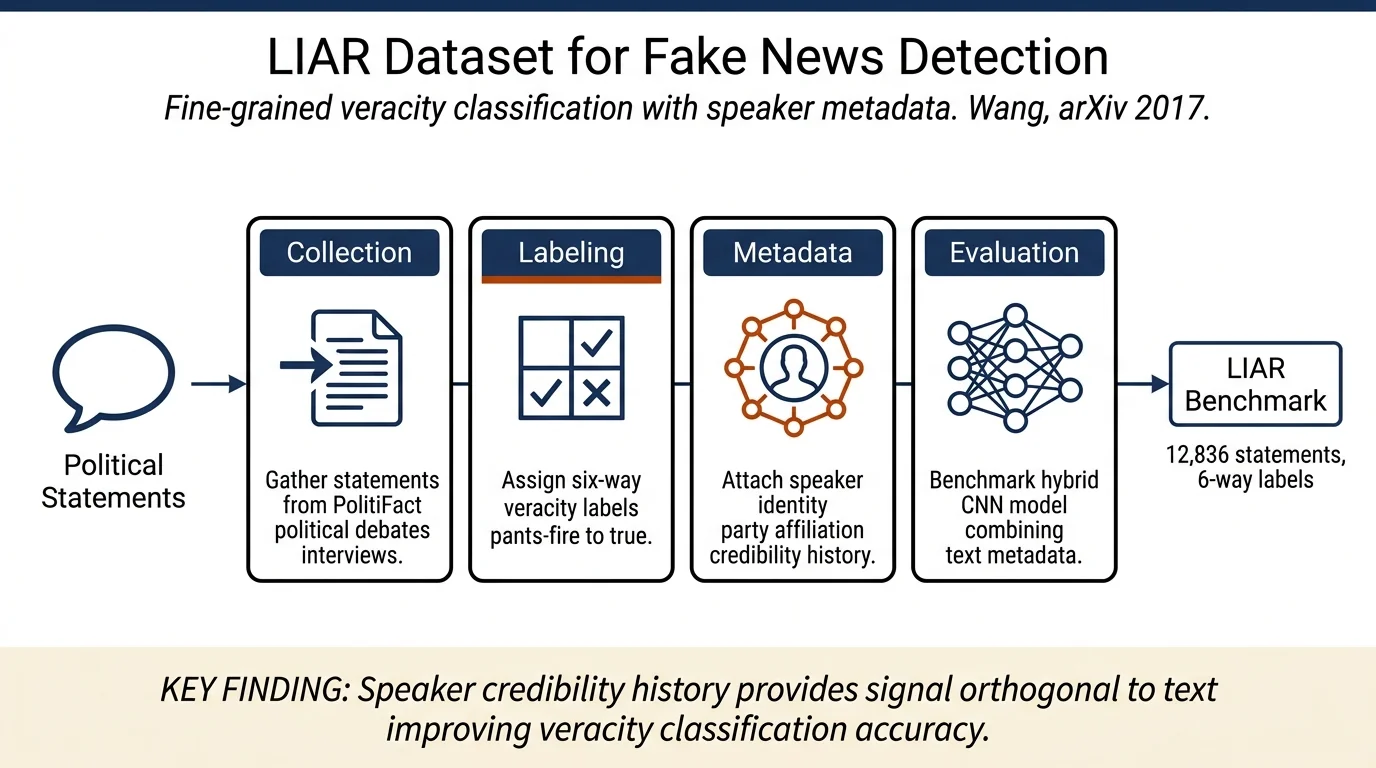
Liar, Liar Pants on Fire: A New Benchmark Dataset for Fake News DetectionThis paper introduces LIAR, a benchmark dataset of 12,836 manually labeled short statements from POLITIFACT.COM spanning 2007–2016, addressing the critical lack of labeled data for fake news detection. Each statement is annotated with fine-grained veracity labels (pants-fire, false, barely-true, half-true, mostly-true, true) and rich…