Explore everything
Filter by research area, year and venue. Every filter is in the address bar, so you can share a view as a link.
 Deepfakes & multimodalDetection methods
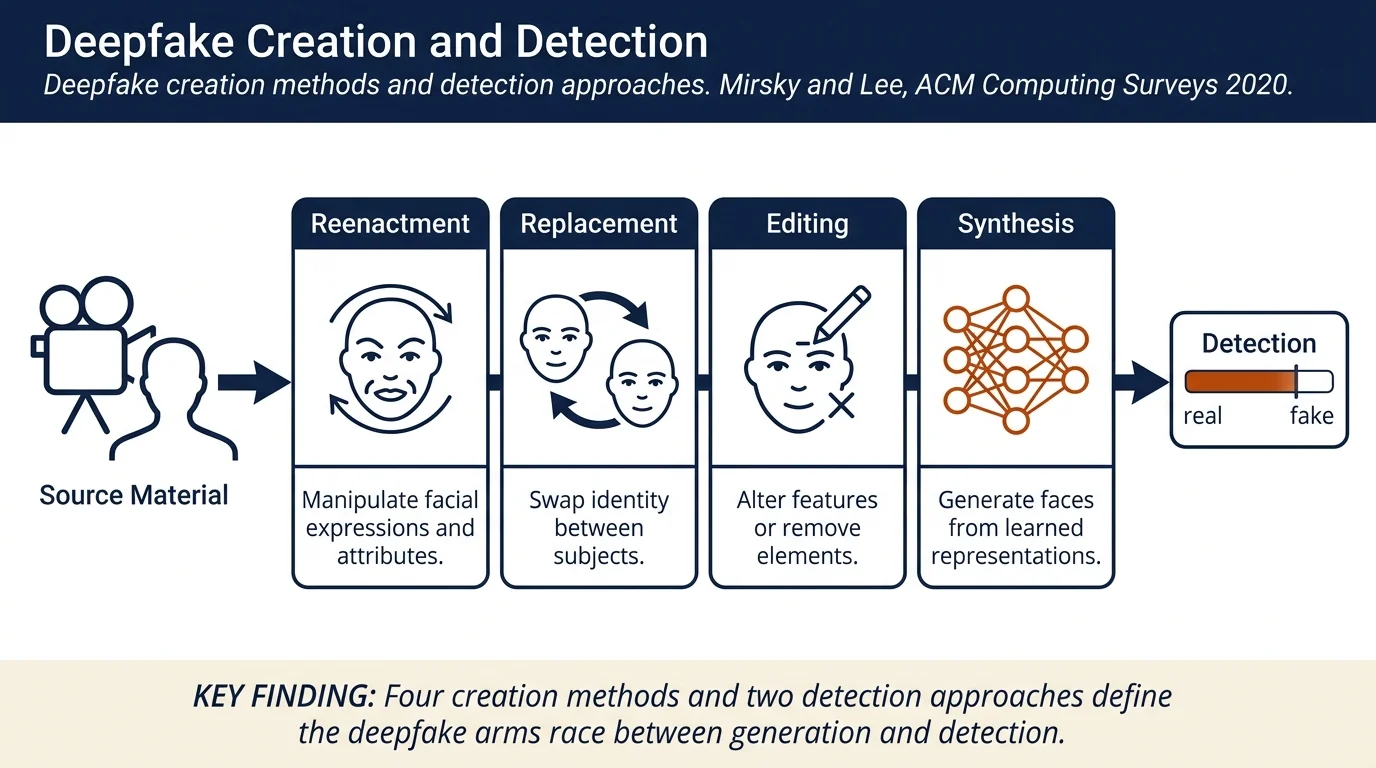
The Creation and Detection of Deepfakes: A SurveyComprehensive 38-page survey covering both creation and detection of deepfakes. Systematically reviews generative neural network architectures (GANs, autoencoders, CNNs, RNNs), technical approaches to reenactment, replacement, editing, and synthesis.
 Datasets & evaluationDetection methods
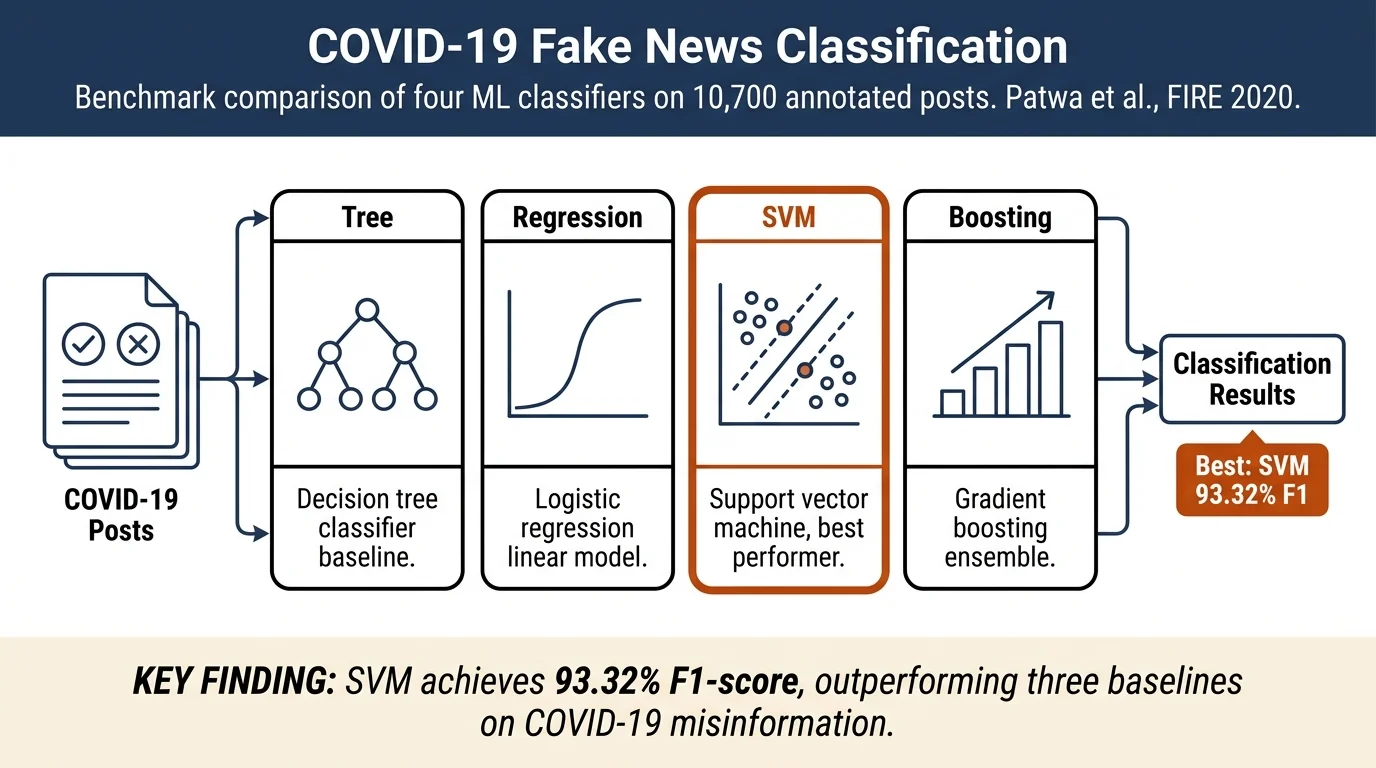
Fighting an Infodemic: COVID-19 Fake News DatasetThe authors present a manually annotated dataset of 10,700 COVID-19 related posts and articles (52% real, 48% fake) collected from social media and fact-checking websites. They benchmark four machine learning baselines (Decision Tree, Logistic Regression, SVM, Gradient Boost), achieving 93.32% F1-score with SVM, and release both the…
 Detection methodsSpread & networks
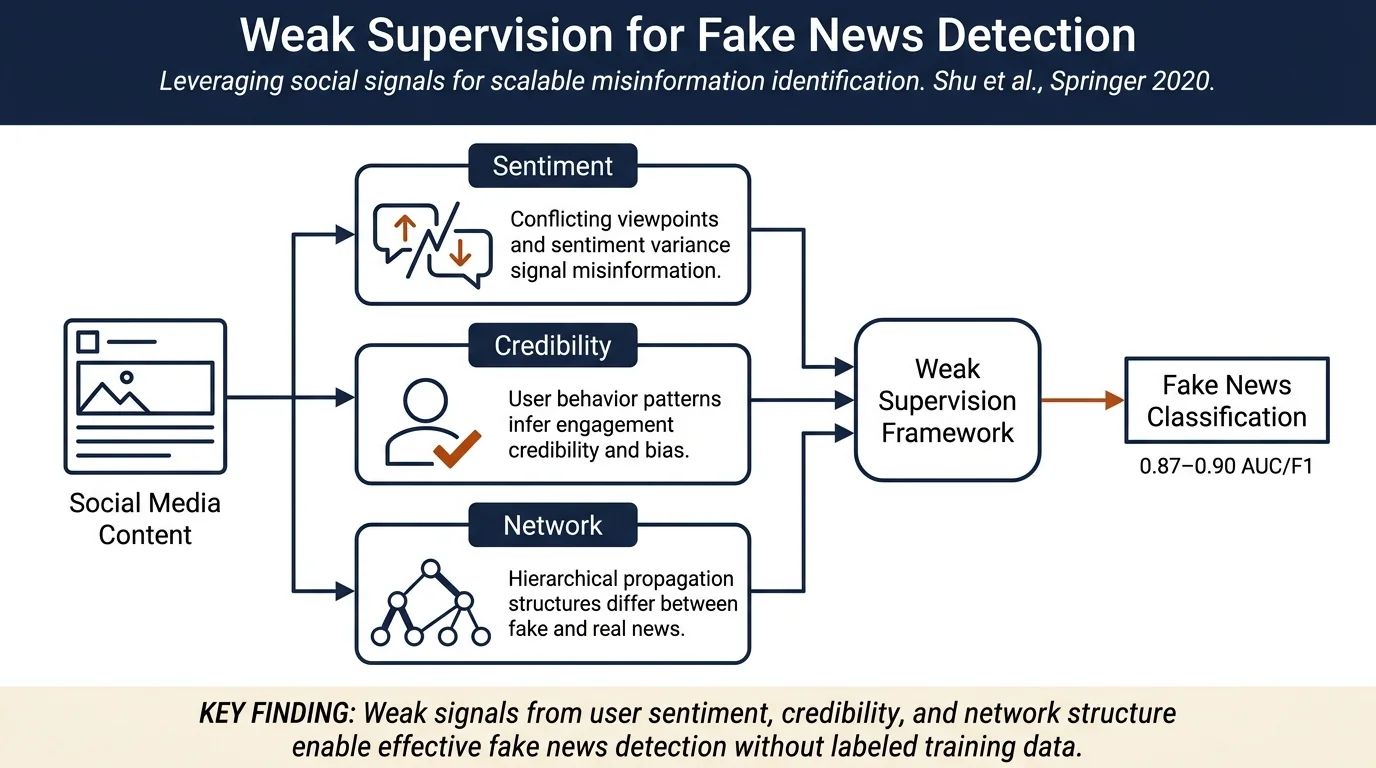
Mining Disinformation and Fake News: Concepts, Methods, and Recent AdvancementsThis comprehensive tutorial surveys the landscape of fake news and disinformation research across three dimensions: understanding user engagement in information disorder, techniques for detecting and mitigating false content, and emerging challenges like fake news literacy and neural generation. The authors emphasize weak social…
 Psychology & interventionsPlatforms, policy & society
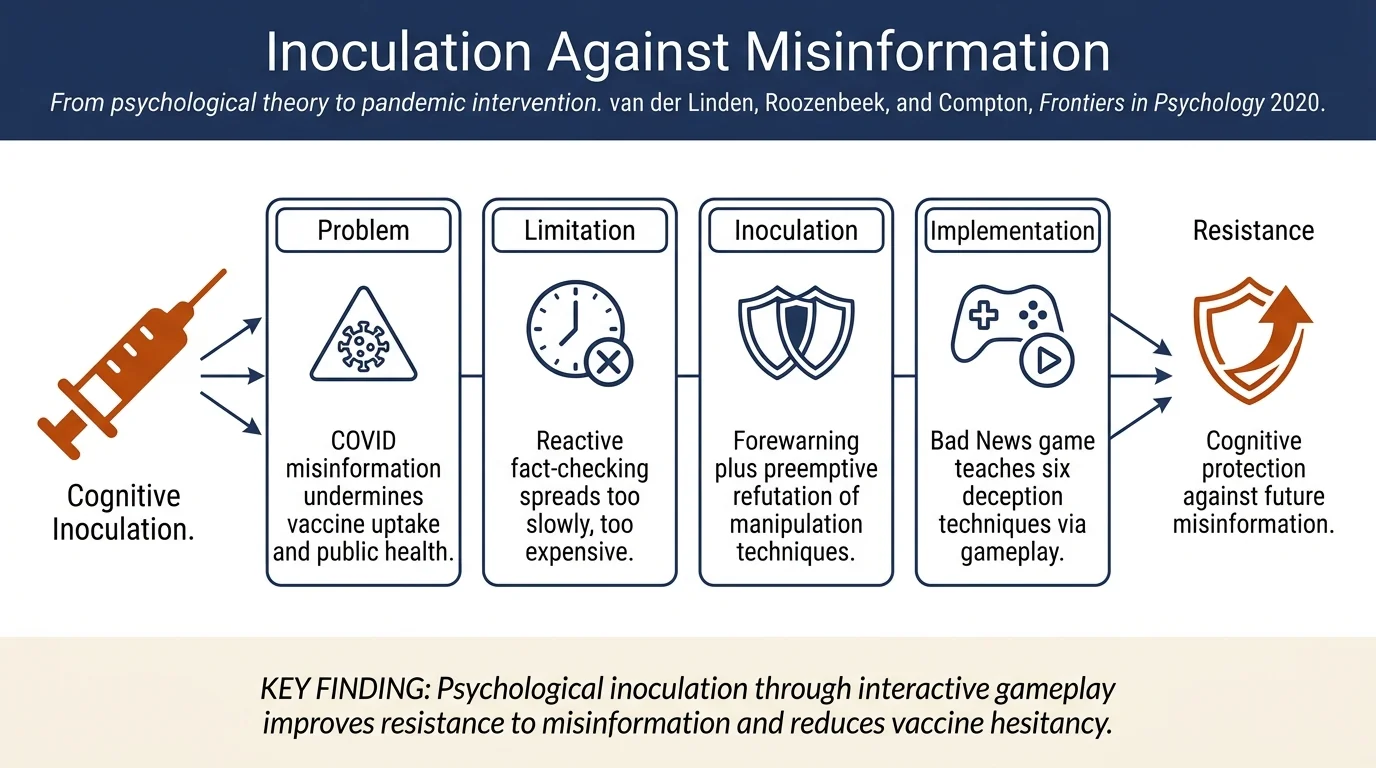
Inoculating Against Fake News About COVID-19COVID-19 misinformation has proliferated rapidly on social media, undermining public health responses and vaccination uptake. Rather than relying on post-hoc fact-checking (which spreads slower than misinformation), the authors propose psychological inoculation—exposing people to weakened doses of misinformation techniques beforehand to…
 Deepfakes & multimodalFact-checking & verification
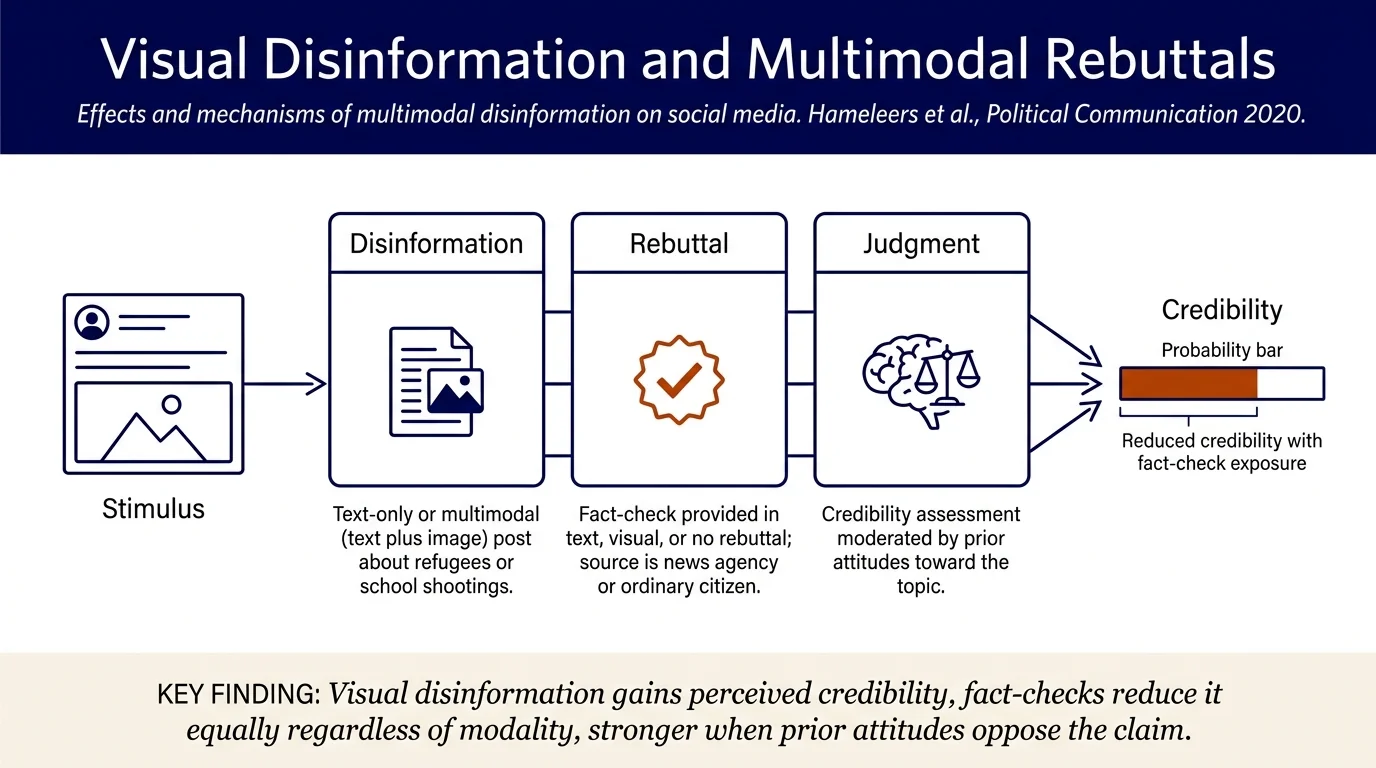
A Picture Paints a Thousand Lies? The Effects and Mechanisms of Multimodal Disinformation and Rebuttals Disseminated via Social MediaMultimodal disinformation (paired text and images) is perceived as more credible than text-only misinformation, but fact-checkers can overcome this effect. Importantly, the modality of fact-checks (visual or textual) matters less than their presence; fact-checks are more persuasive for people whose prior attitudes already oppose the…
 Spread & networksPlatforms, policy & society
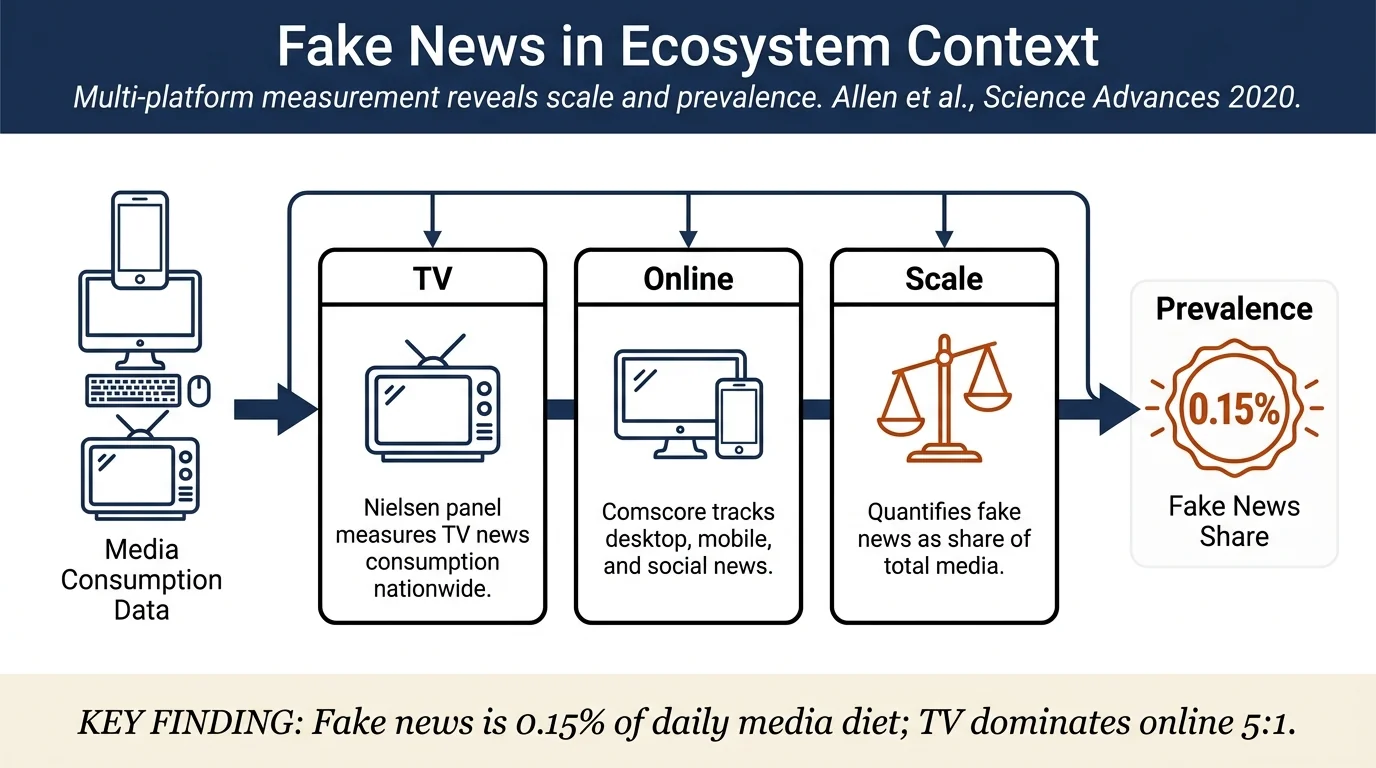
Evaluating the fake news problem at the scale of the information ecosystemUsing nationally representative data on mobile, desktop, and TV consumption spanning 2016–2018, the authors show that fake news comprises only 0.15% of Americans' daily media diet, while TV dominates news consumption by a 5:1 ratio over online. The paper challenges the widespread narrative of fake news as a pervasive crisis and suggests…
 Bots & coordinated campaignsPlatforms, policy & society
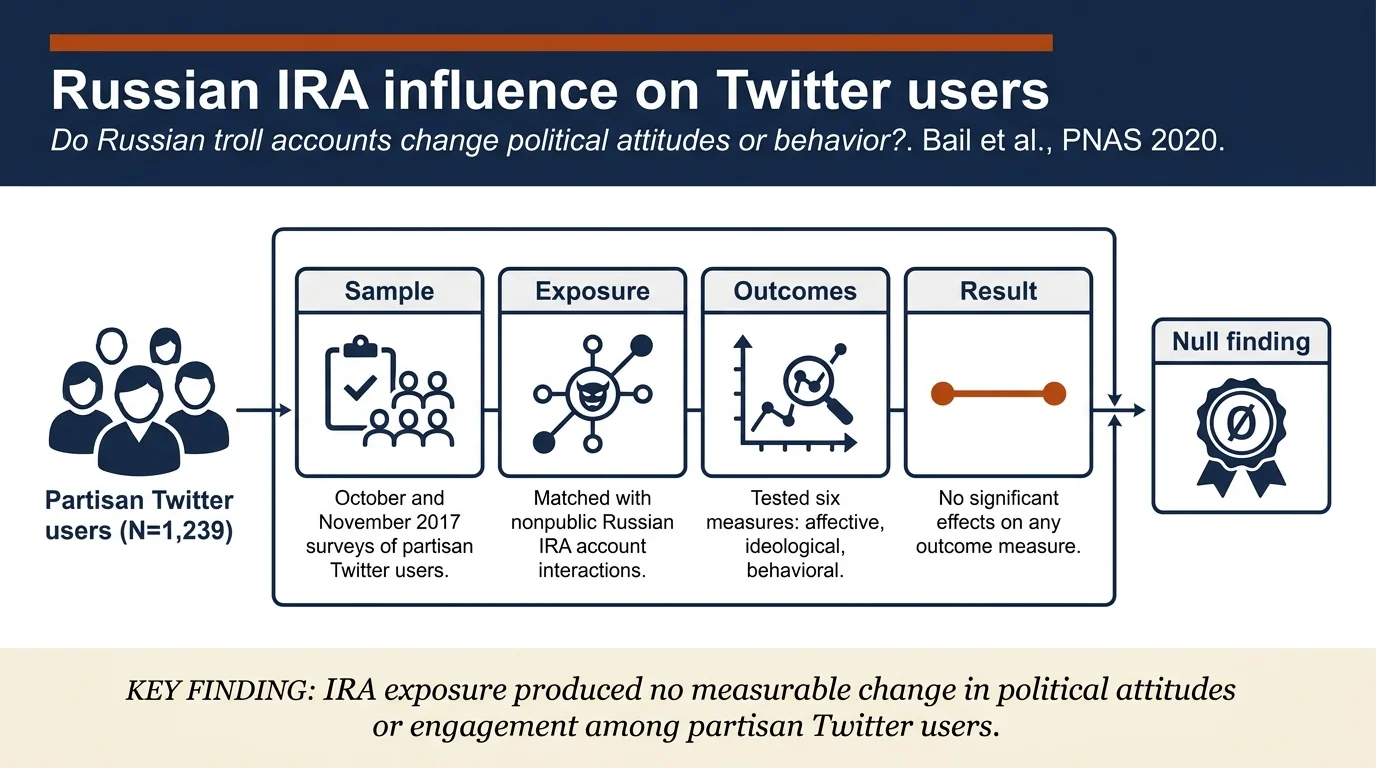
Assessing the Russian Internet Research Agency's impact on the political attitudes and behaviors of American Twitter users in late 2017Combining longitudinal survey data from 1,239 partisan Twitter users with nonpublic IRA account data, Bail et al. find no evidence that interaction with Russian Internet Research Agency accounts substantially impacted six measures of political attitudes (affective/ideological polarization) or behaviors (political engagement, network…
 Psychology & interventionsSpread & networks
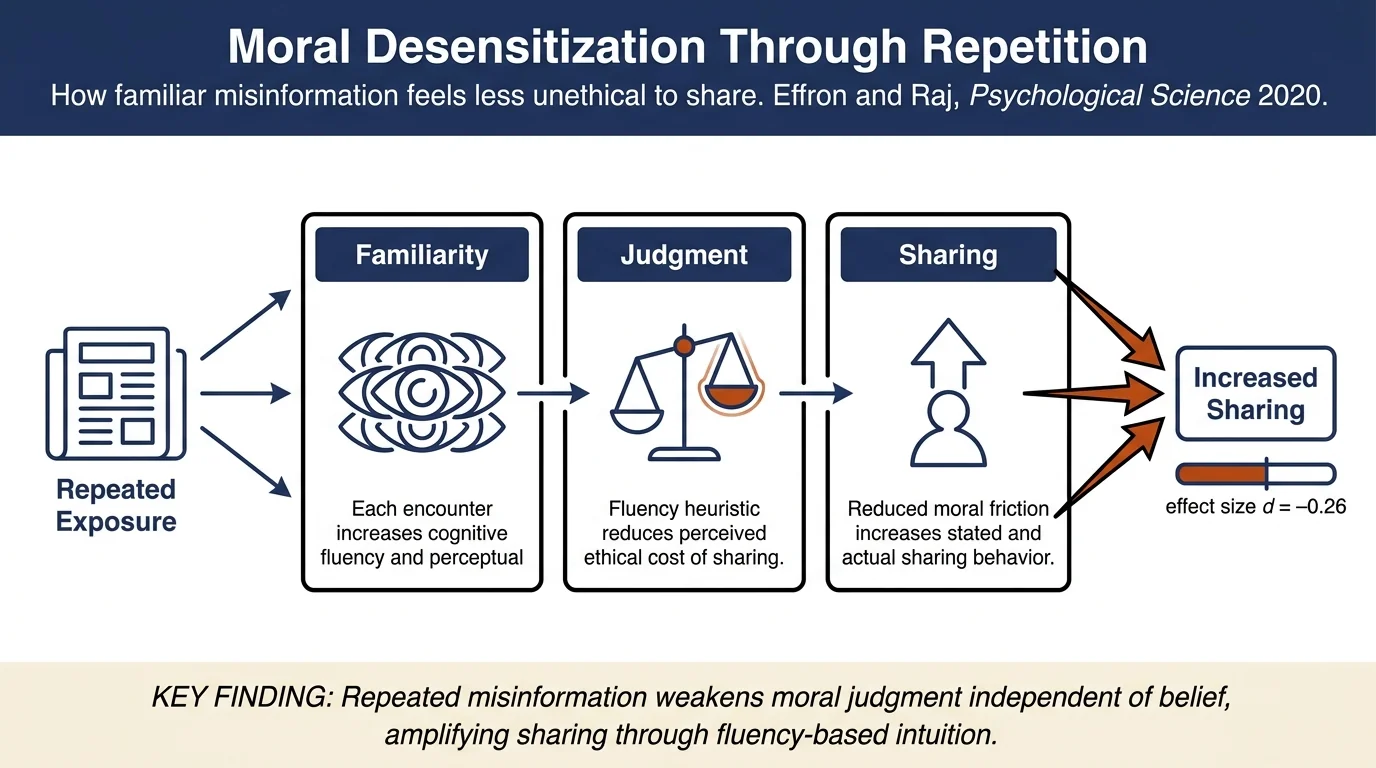
Misinformation and Morality: Encountering Fake-News Headlines Makes Them Seem Less Unethical to Publish and ShareFour preregistered experiments (N=2,587) show that repeatedly encountering fake-news headlines reduces moral condemnation of spreading them—regardless of whether people believe them. This "moral repetition effect" operates via fluency: familiar headlines feel less unethical to share, stronger inclinations to promote them online, and…
 Bots & coordinated campaignsSpread & networks
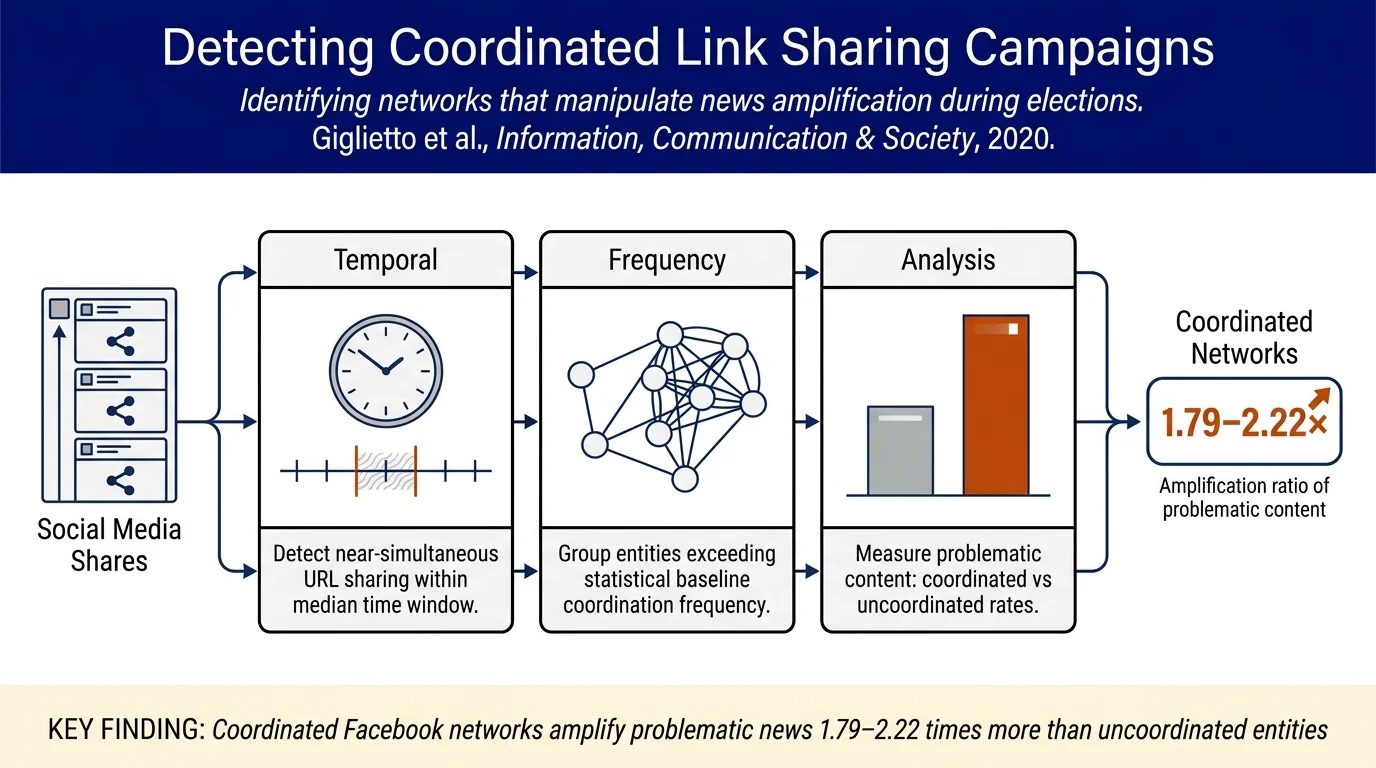
It takes a village to manipulate the media: coordinated link sharing behavior during 2018 and 2019 Italian electionsCoordinated networks of Facebook pages and groups substantially amplified problematic news during Italian elections: coordinated entities shared problematic domains 1.79×–2.22× more frequently than uncoordinated ones. The paper introduces a method to detect "coordinated inauthentic behavior" by identifying entities that…
 Bots & coordinated campaignsPlatforms, policy & society
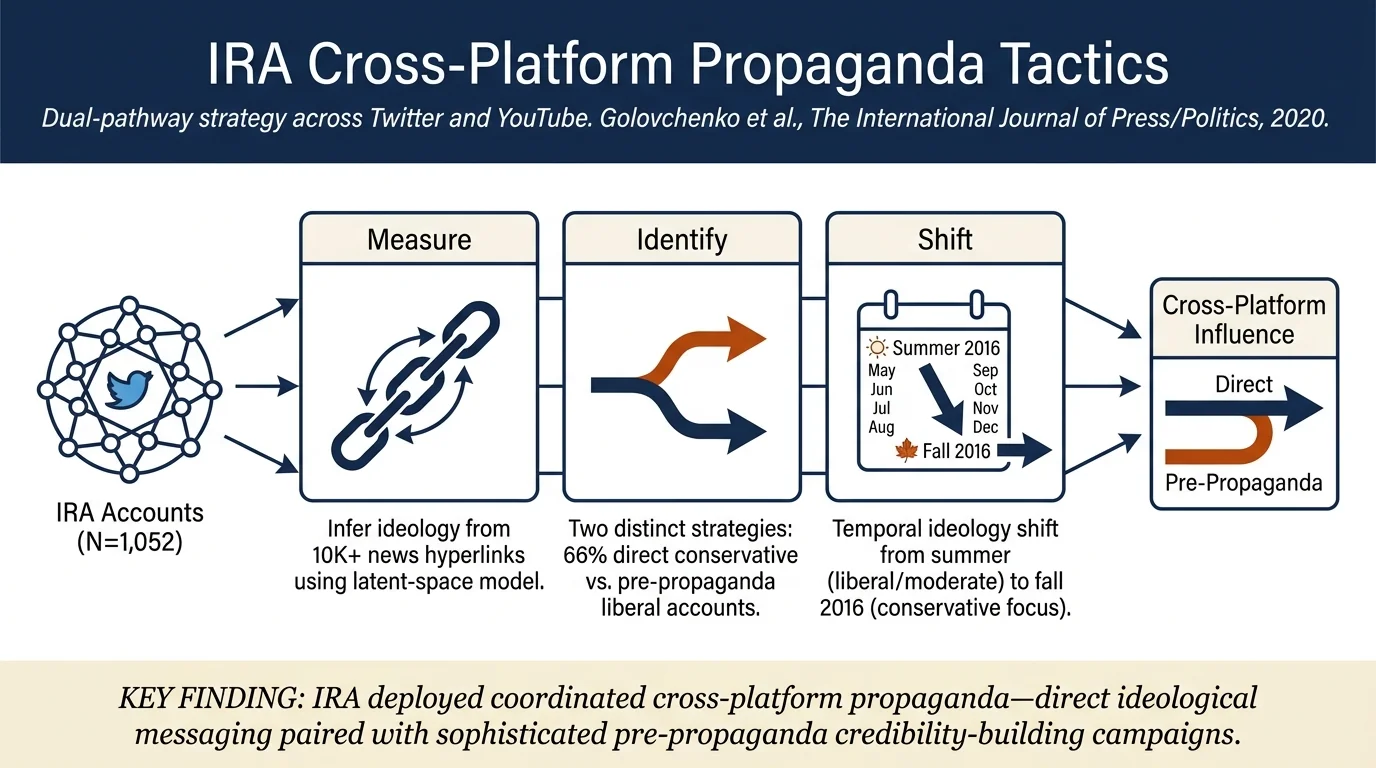
Cross-Platform State Propaganda: Russian Trolls on Twitter and YouTube during the 2016 U.S. Presidential ElectionThis paper analyzes 1,052 Russian IRA Twitter accounts to understand their propaganda strategy during the 2016 U.S. presidential election. By examining hyperlinks to news stories and YouTube videos, the authors find IRA accounts linked to conservative sources more frequently than liberal ones, consistent with supporting Trump.
 Psychology & interventionsPlatforms, policy & society
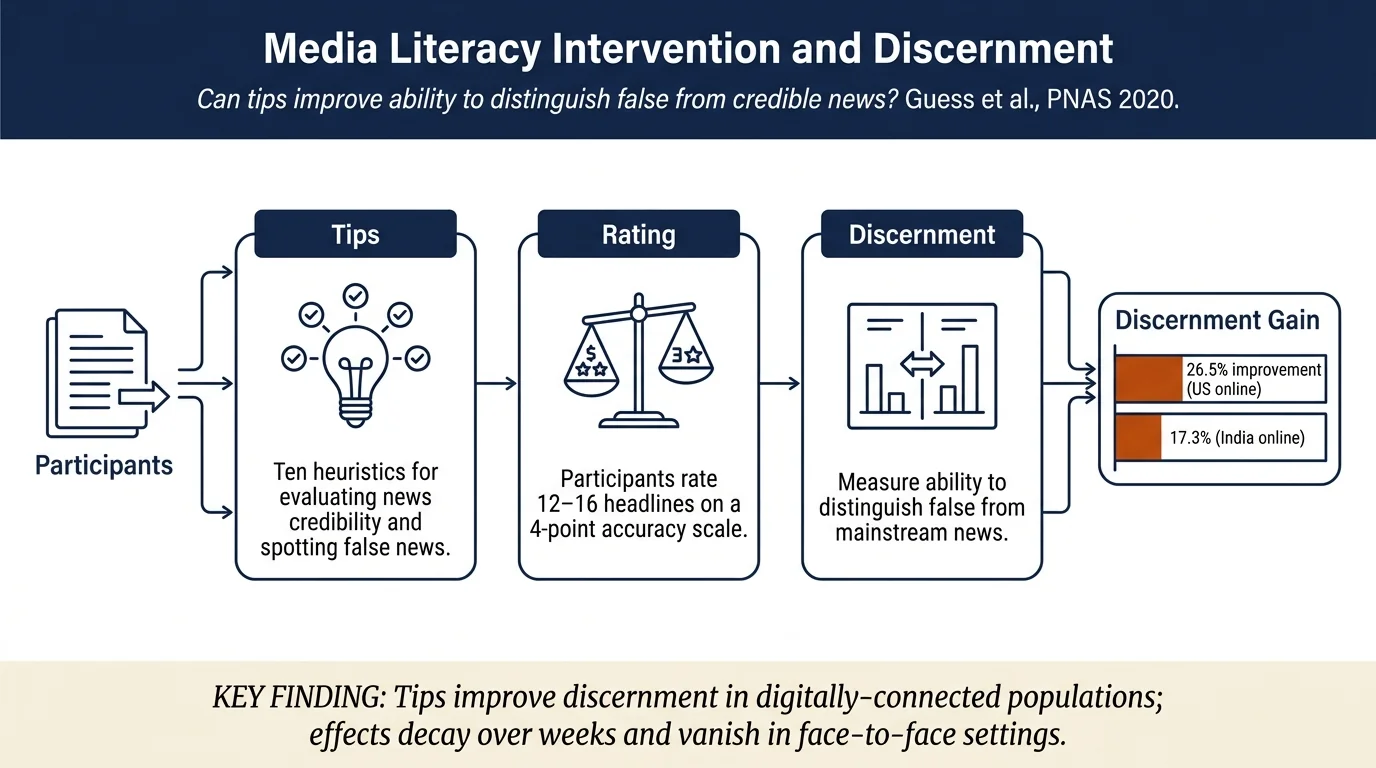
A digital media literacy intervention increases discernment between mainstream and false news in the United States and IndiaA randomized experiment tests Facebook's "Tips to Spot False News" intervention in the US and India, finding it increases discernment between mainstream and false news (26.5% in US, 17.3% in India online). The intervention reduces belief in false headlines more than it reduces belief in mainstream ones.
 Fact-checking & verificationPlatforms, policy & society
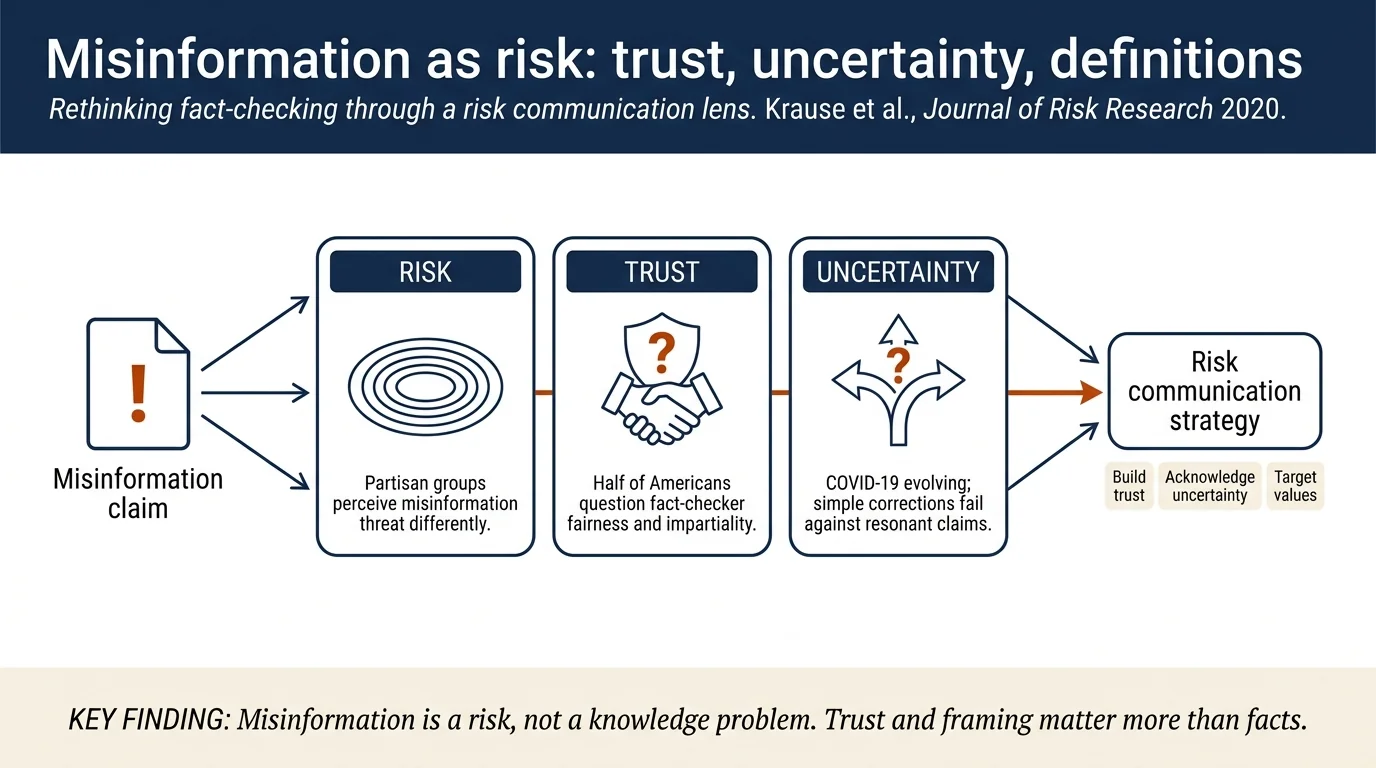
Fact-checking as risk communication: the multi-layered risk of misinformation in times of COVID-19COVID-19 misinformation should be viewed as a risk in its own right, not just a communication failure. Fact-checking efforts face three key challenges: defining misinformation differently across political subgroups, earning trust in an environment of low press credibility, and communicating amid genuine uncertainty.
 Bots & coordinated campaignsPlatforms, policy & society
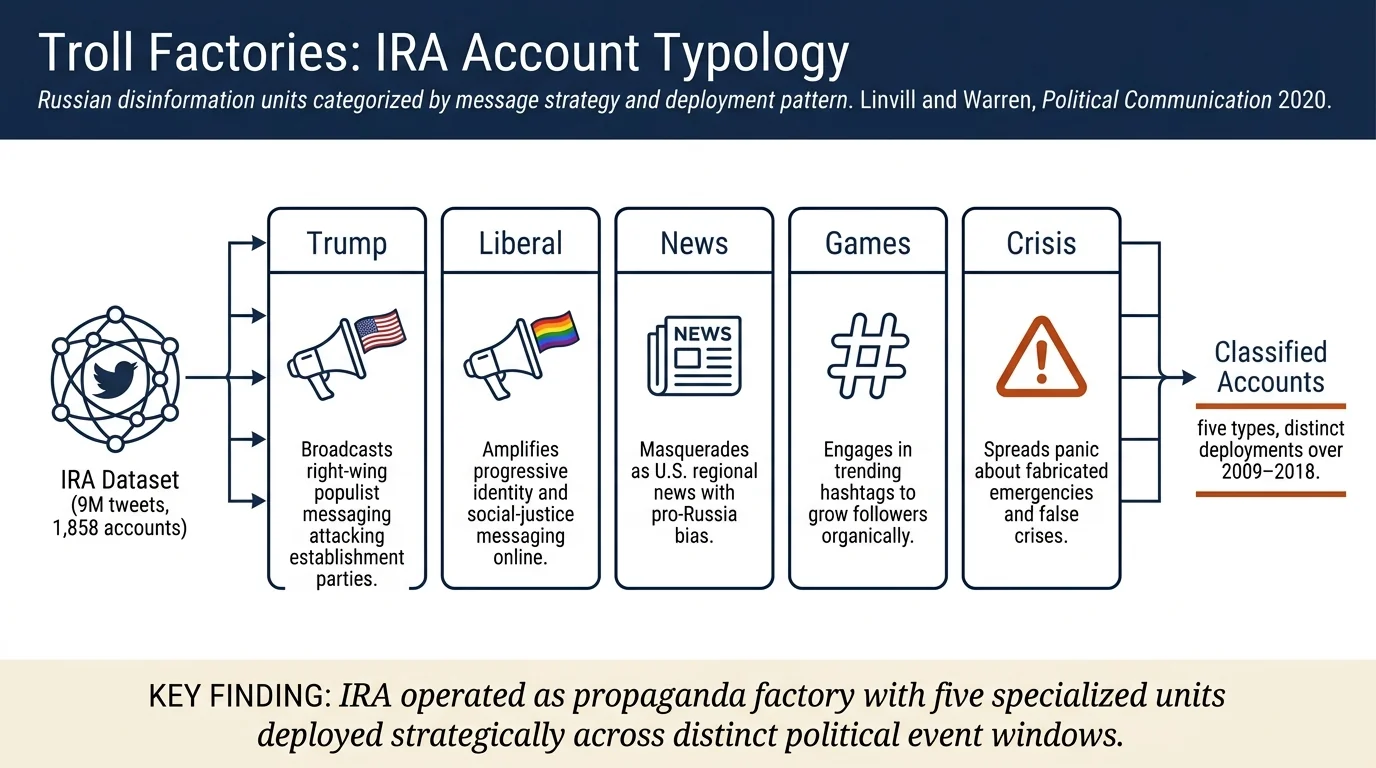
Troll Factories: Manufacturing Specialized Disinformation on TwitterLinvill and Warren analyze 9.04 million tweets from Russia's Internet Research Agency (IRA) spanning 2009–2018, identifying five specialized account categories—Right Troll, Left Troll, News Feed, Hashtag Gamer, and Fearmonger—each with distinct behavioral patterns, temporal deployment strategies, and communication styles. The authors…
 Psychology & interventionsPlatforms, policy & society
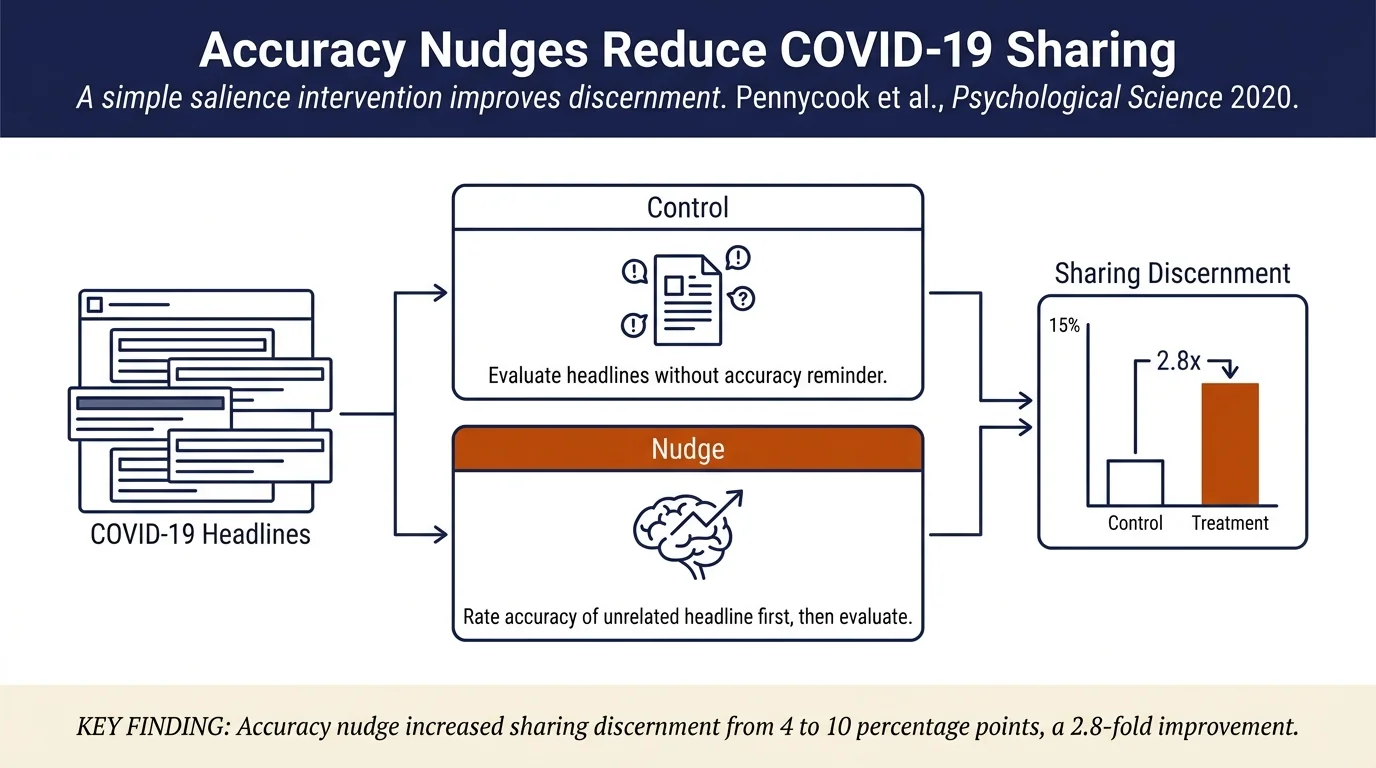
Fighting COVID-19 Misinformation on Social Media: Experimental Evidence for a Scalable Accuracy-Nudge InterventionTwo pre-registered experiments with 1,700+ U.S. adults show that a simple accuracy nudge — asking people to rate the accuracy of an unrelated headline before the main task — nearly tripled their ability to discriminate true from false COVID-19 headlines when deciding what to share on social media. The intervention is scalable, requires…
 Psychology & interventionsPlatforms, policy & society
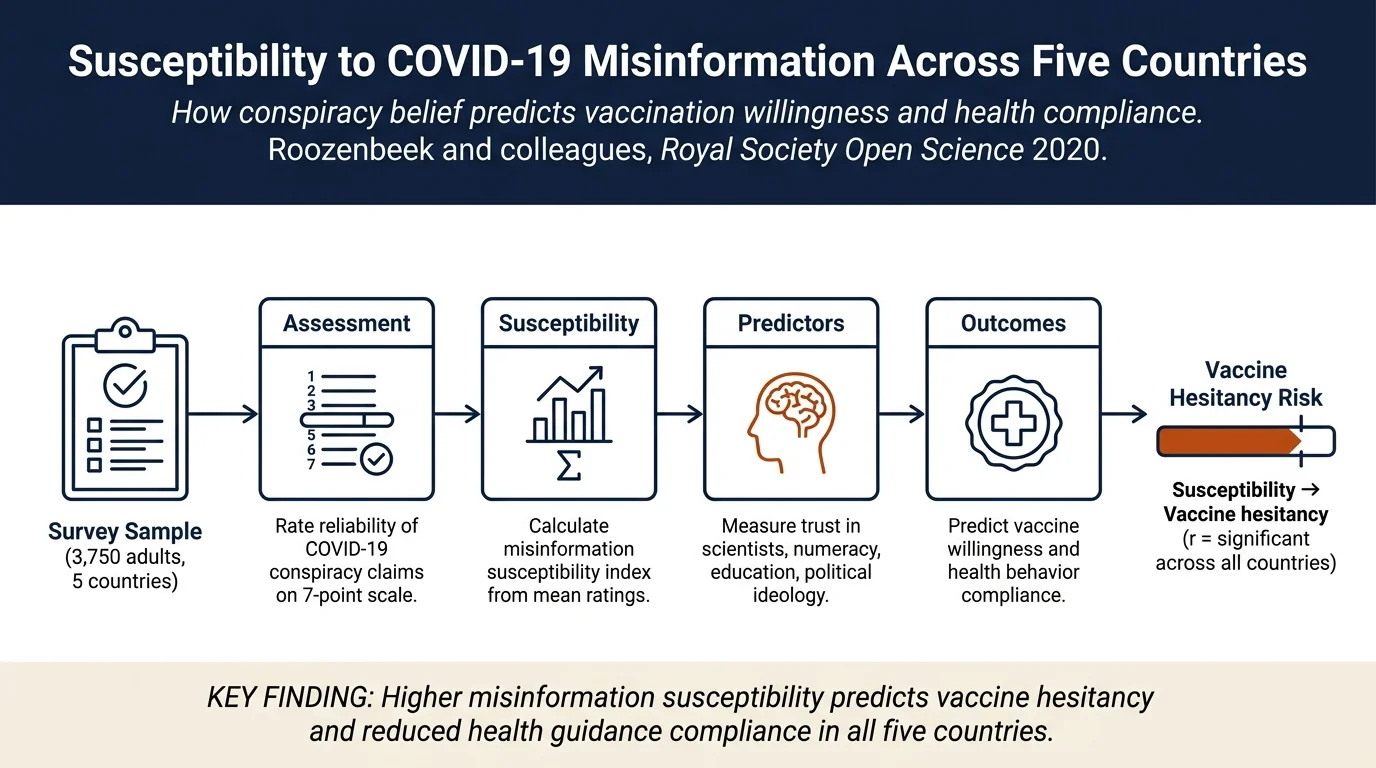
Susceptibility to misinformation about COVID-19 around the worldAn international survey of 3,750 adults across five countries (UK, Ireland, USA, Spain, Mexico) measured susceptibility to COVID-19 misinformation and examined how it predicts public health behaviors. While majorities in each country did not find COVID-19 misinformation credible, higher susceptibility to misinformation was strongly…
 Spread & networksPlatforms, policy & society
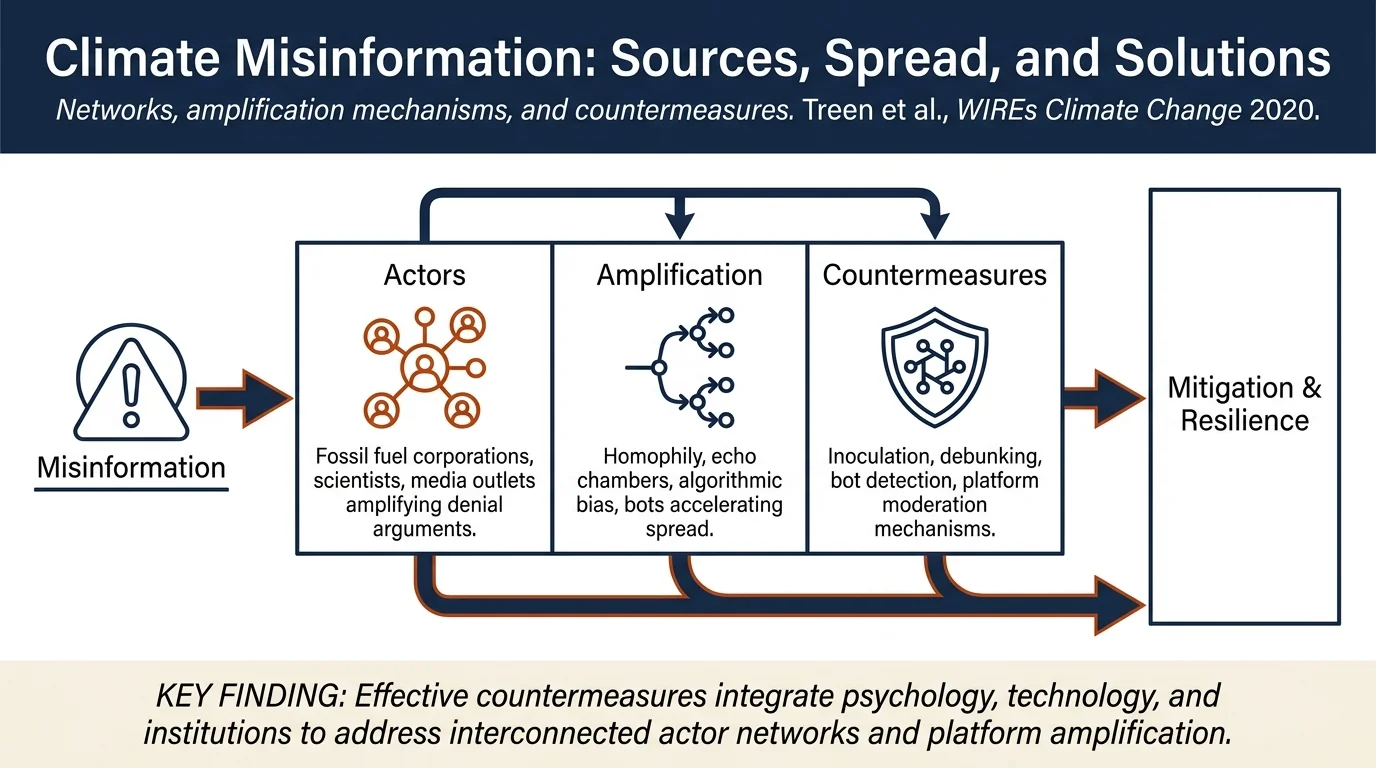
Online misinformation about climate changeComprehensive literature review examining climate change misinformation from multiple disciplinary angles. Defines misinformation vs. disinformation, identifies networks of actors (scientists, governments, industry, media) spreading false claims, examines how social media characteristics (homophily, echo chambers, algorithmic bias)…
 Spread & networksPlatforms, policy & society
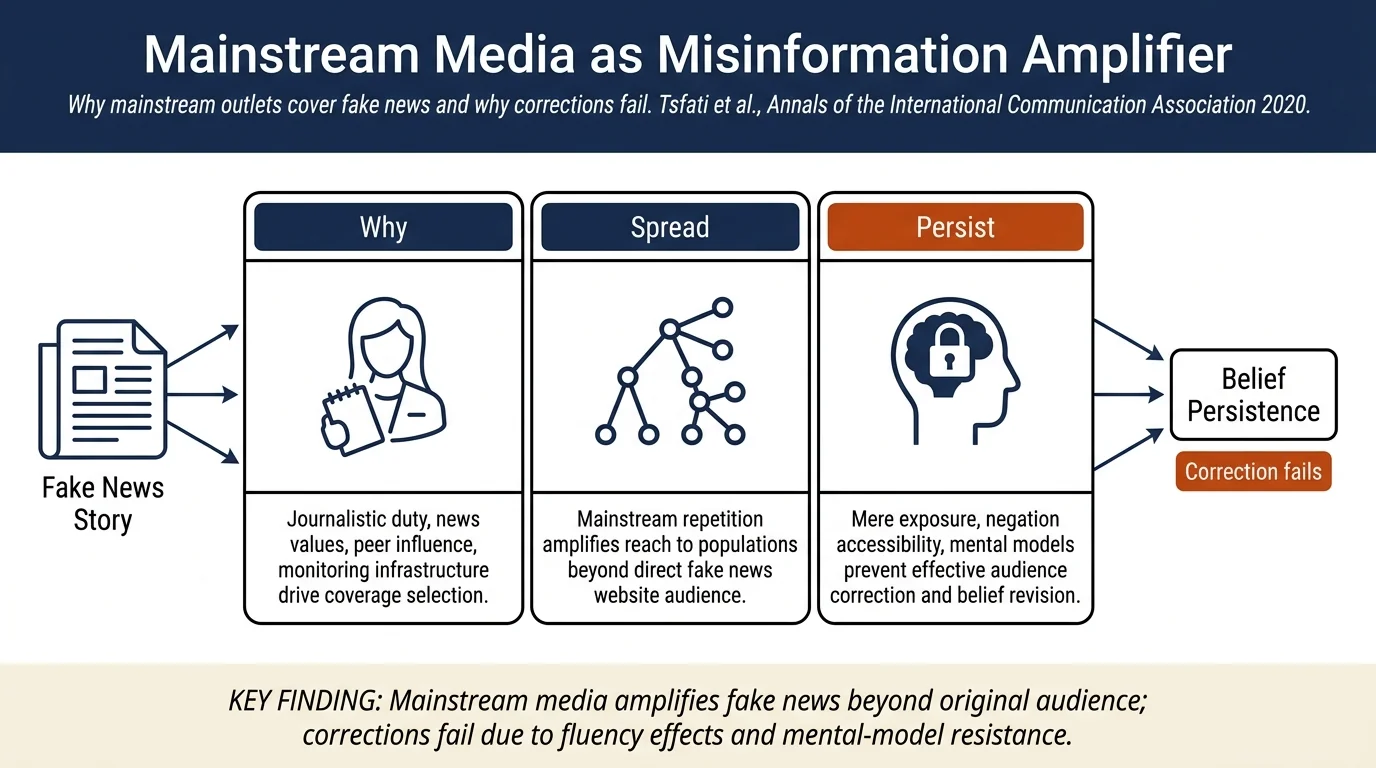
Causes and consequences of mainstream media dissemination of fake news: literature review and synthesisWhile fake news websites have limited direct reach, mainstream media coverage is probably how most people encounter fake news stories. This synthesis identifies why mainstream outlets cover falsehoods (journalists' professional duties, news values, peer psychology, technical infrastructure) and explores how mainstream coverage amplifies…
 Deepfakes & multimodalPlatforms, policy & society
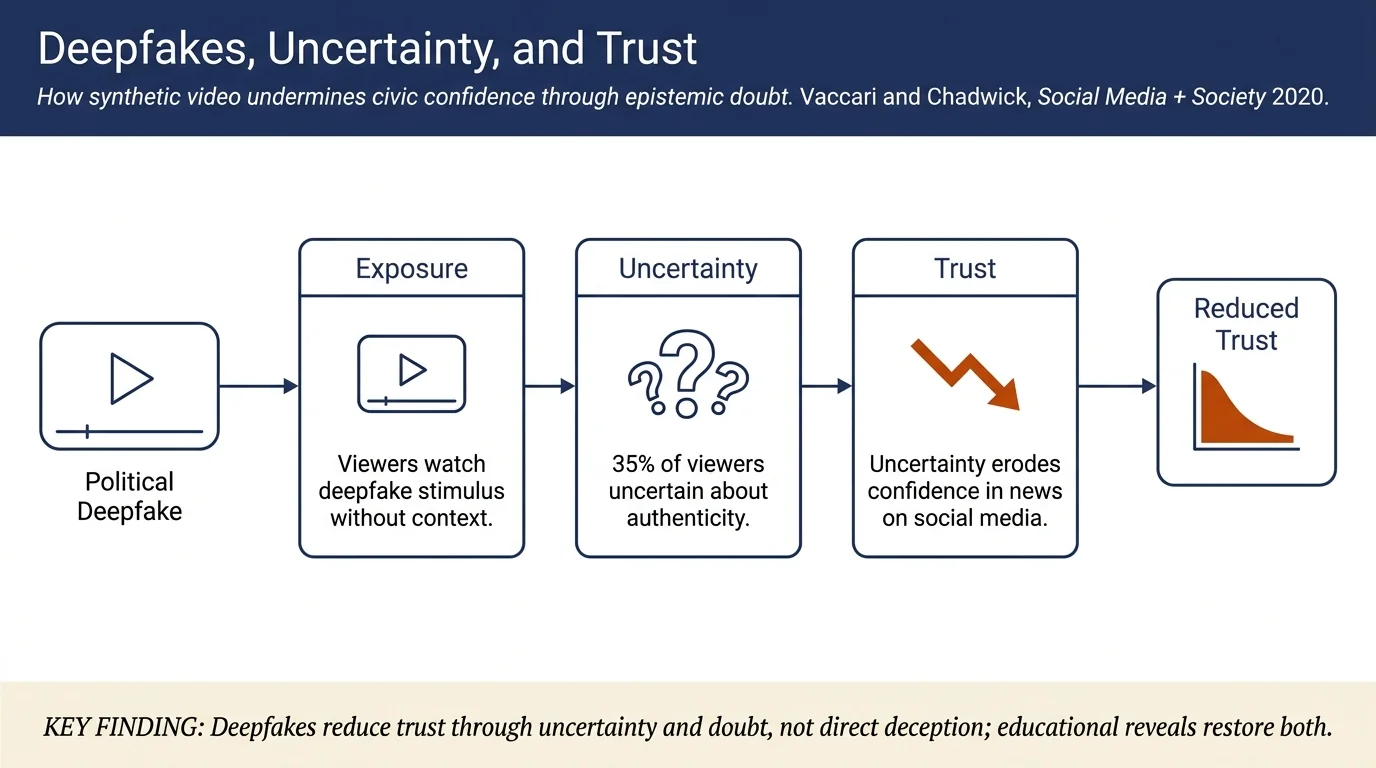
Deepfakes and Disinformation: Exploring the Impact of Synthetic Political Video on Deception, Uncertainty, and Trust in NewsExperimental study (N=2,005 UK respondents) testing how political deepfakes affect deception and trust in news. Deepfakes increased uncertainty about content, and that uncertainty mediated reduced trust in news on social media.
 Fact-checking & verificationPsychology & interventions
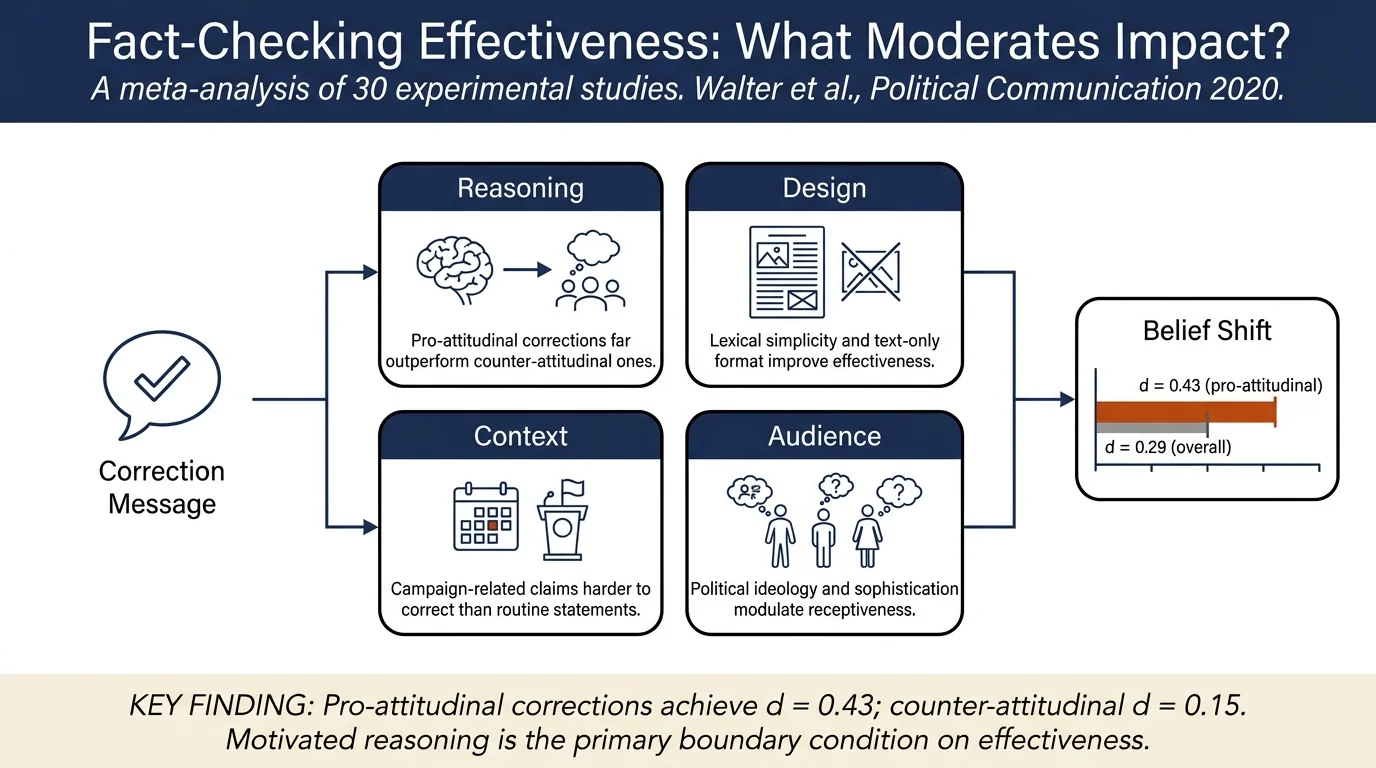
Fact-Checking: A Meta-Analysis of What Works and for WhomMeta-analysis of 30 studies on fact-checking effectiveness finds modest but significant positive effects (d = 0.29) on belief correction. However, effects are substantially moderated by motivated reasoning, political ideology, message design, and context: pro-attitudinal fact-checking works better than counter-attitudinal corrections,…
 Platforms, policy & societySpread & networks
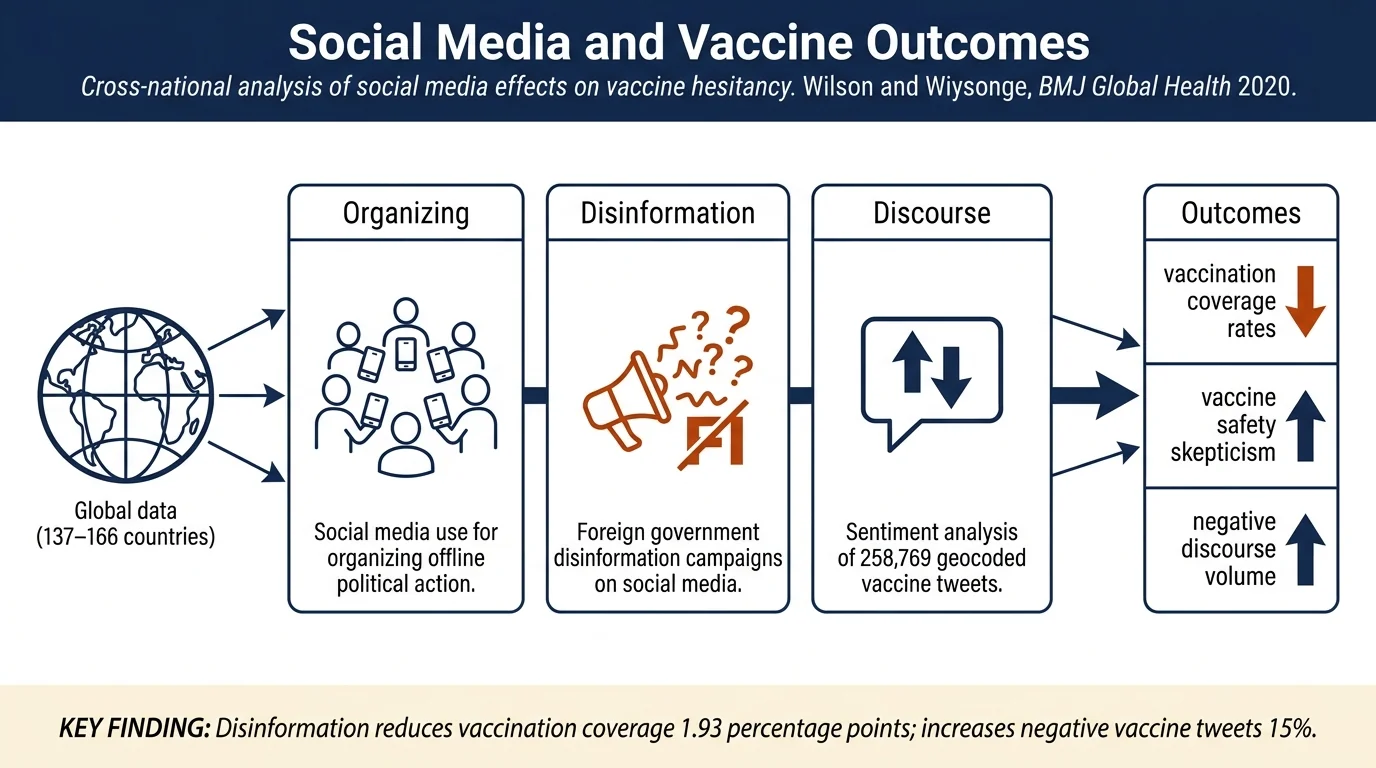
Social media and vaccine hesitancyLarge-scale cross-national analysis finds that social media use to organize offline action predicts public vaccine safety skepticism, while foreign disinformation campaigns significantly reduce vaccination coverage year-over-year. A one-point increase on the five-point disinformation scale correlates with a two-percentage-point drop in…
 Detection methodsLLMs & generative AI
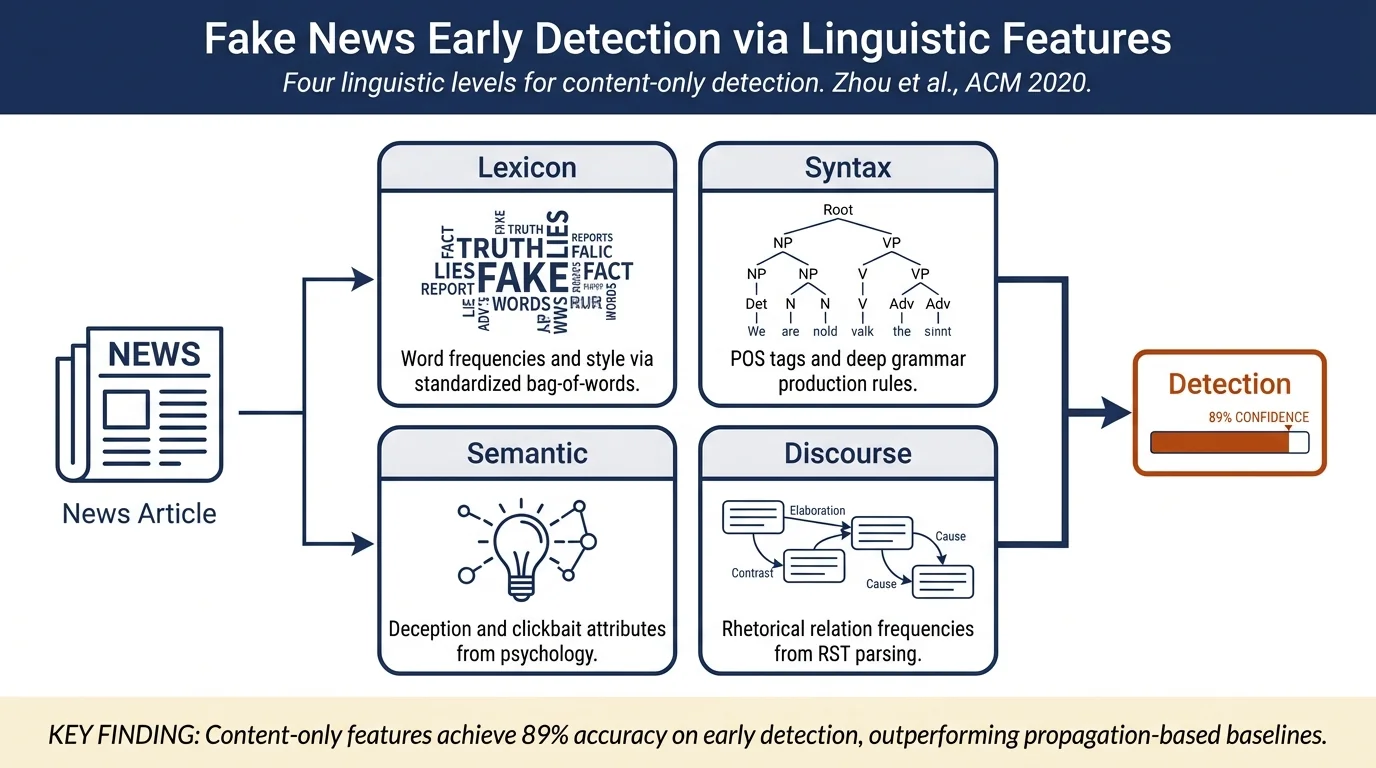
Fake News Early Detection: An Interdisciplinary StudyThis paper proposes a theory-driven, content-only model for fake news detection at publication time — before social-media propagation data exists. News articles are represented at four linguistic levels (lexicon, syntax, semantic, and discourse) using features grounded in social and forensic psychology; classical supervised classifiers…
 Spread & networksDetection methods
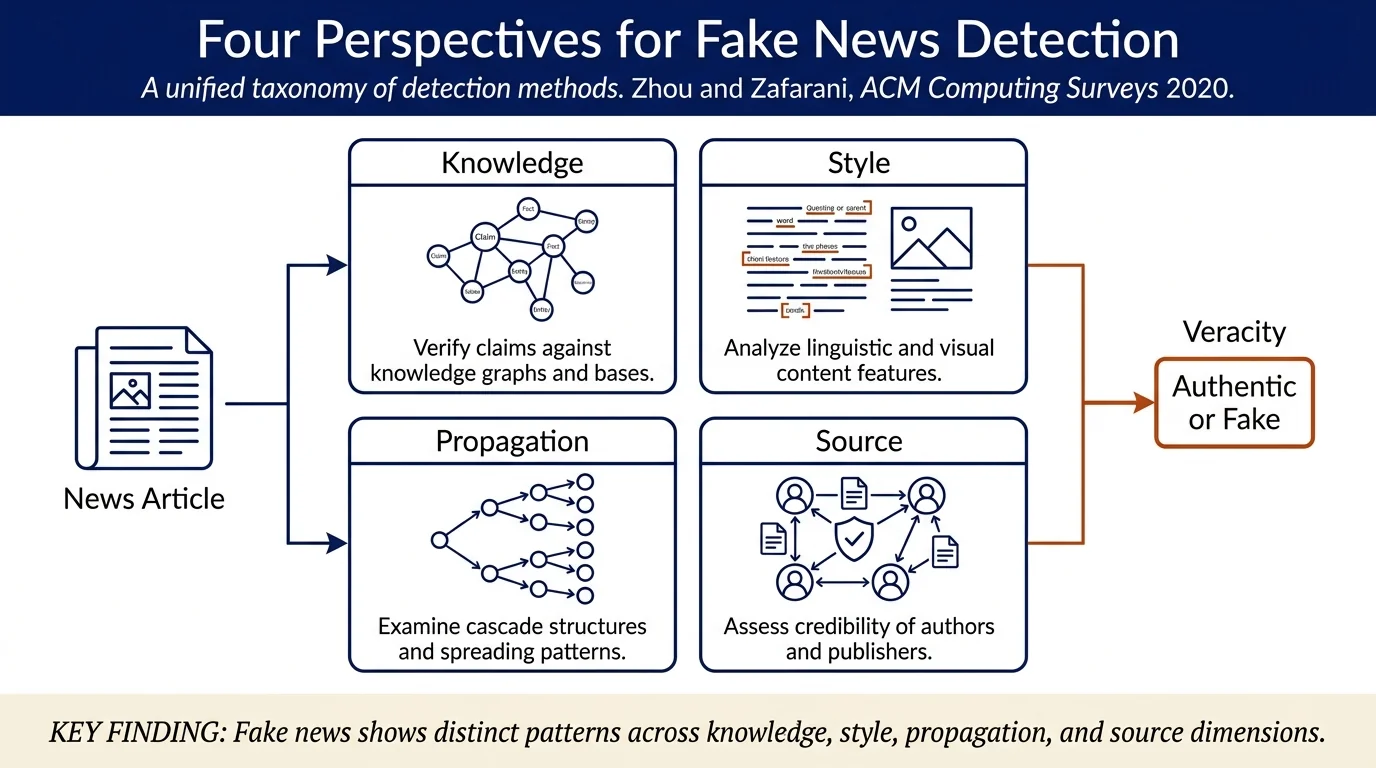
A Survey of Fake News: Fundamental Theories, Detection Methods, and OpportunitiesThis comprehensive survey defines fake news across both broad and narrow framings, systematizes detection methods across four perspectives (knowledge, style, propagation, source), connects detection strategies to interdisciplinary theories from psychology and social sciences, and identifies six open research challenges including early…
 Datasets & evaluationDeepfakes & multimodal
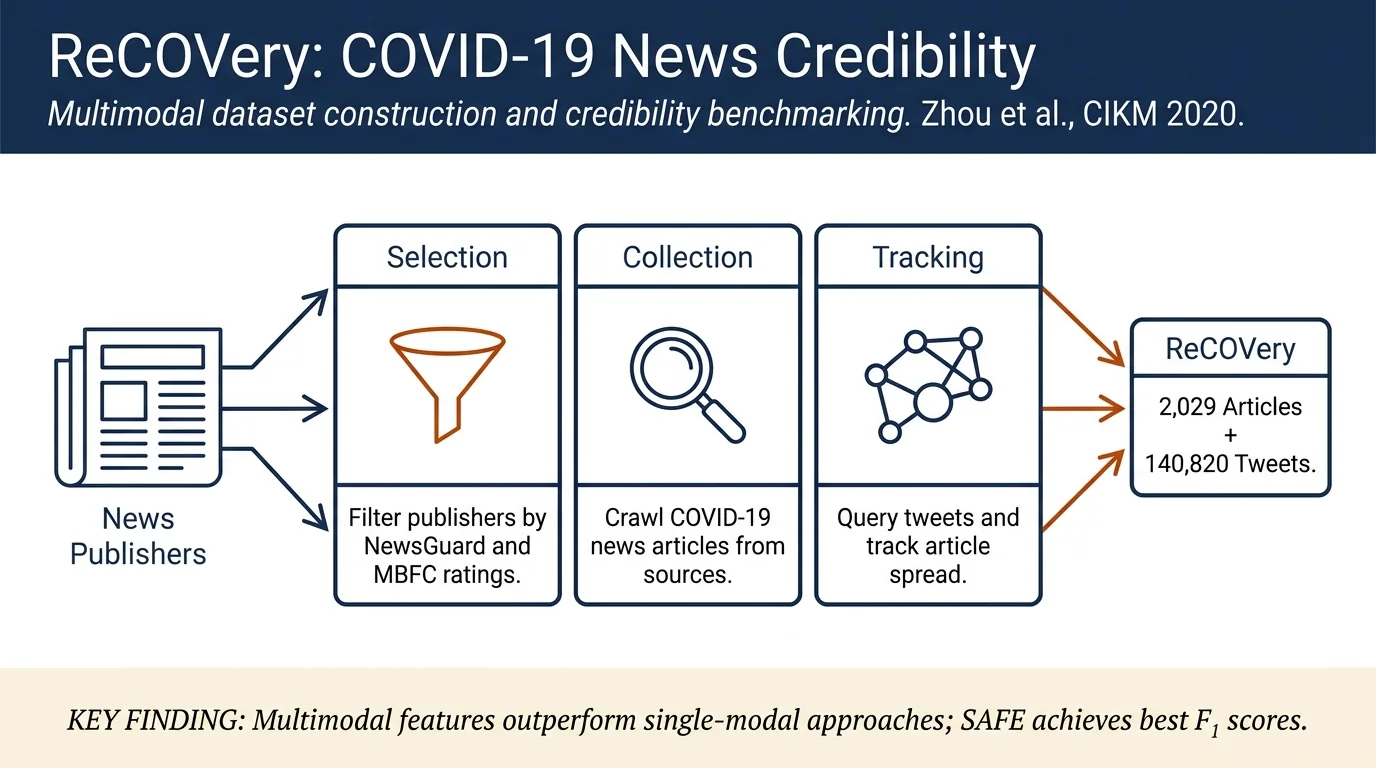
ReCOVery: A Multimodal Repository for COVID-19 News Credibility ResearchThe COVID-19 pandemic triggered a parallel "infodemic" of low-credibility news; this paper constructs ReCOVery, a multimodal repository of 2,029 COVID-19 news articles with binary credibility labels inherited from their publisher's NewsGuard/MBFC ratings, paired with 140,820 tweets tracking social spread. The key design trade-off is…
 Spread & networksDetection methods
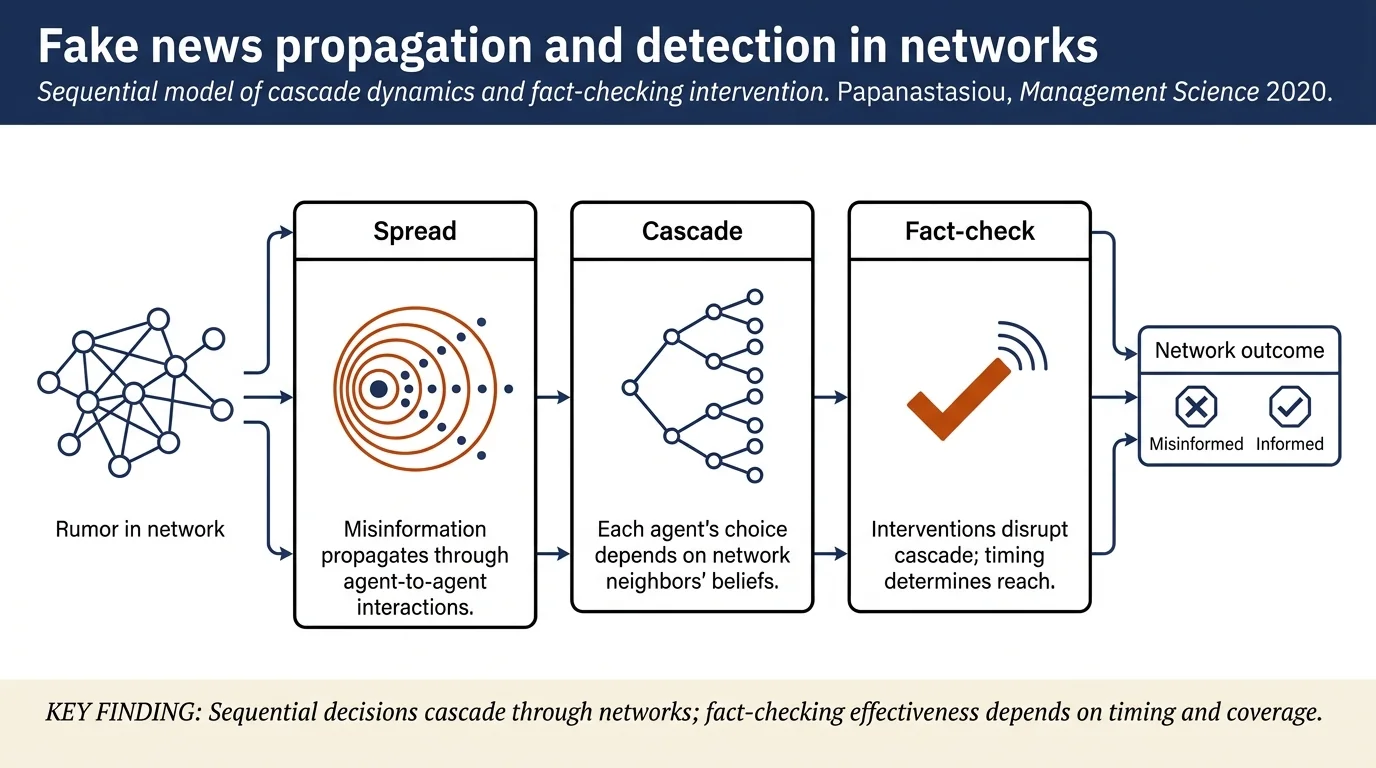
Fake news propagation and detection: A sequential modelFoundational sequential social learning model of misinformation spread and fact-checking. Introduces the framework for analyzing how agents' decisions cascade through a network and how fact-checking affects collective outcomes.