Social media and vaccine hesitancy
Authors: Steven Lloyd Wilson, Charles Wiysonge Venue: BMJ Global Health, 2020 — DOI
TL;DR
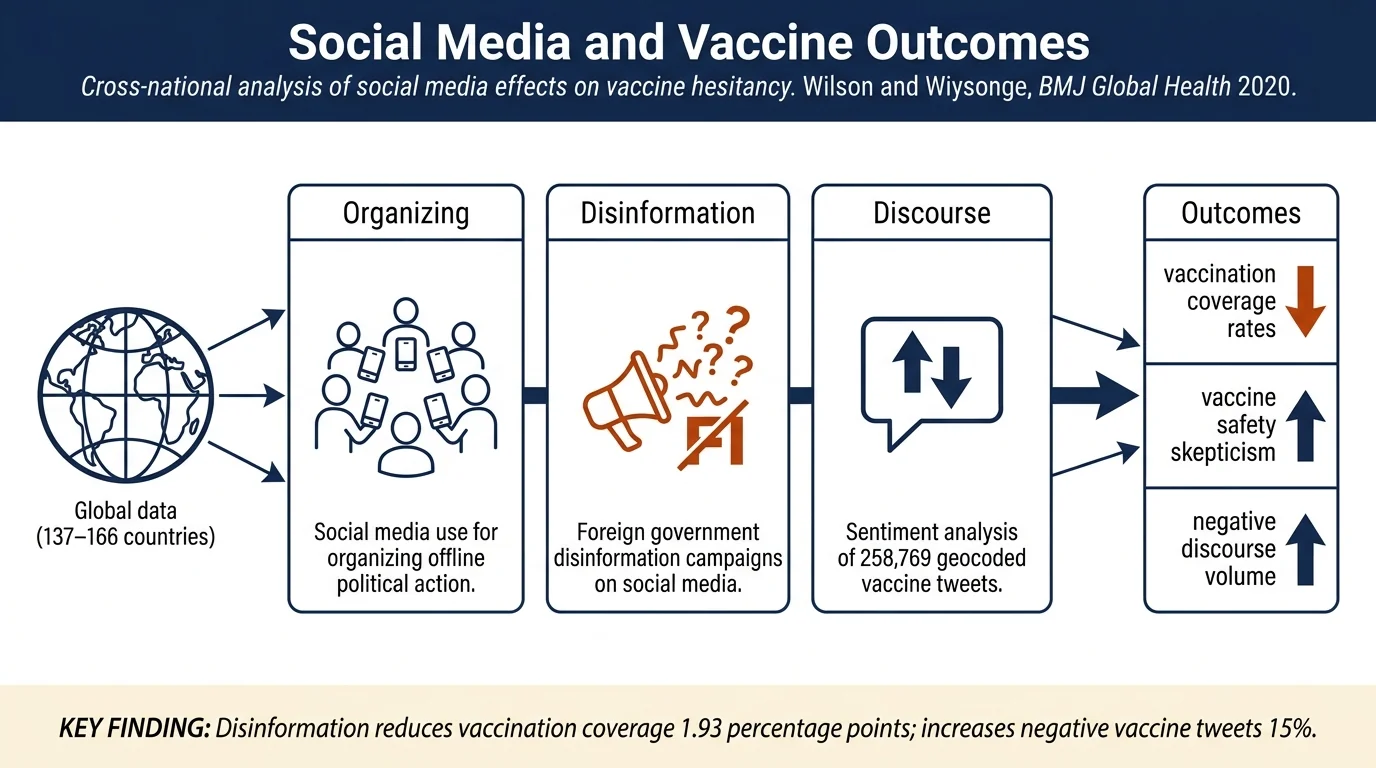
Large-scale cross-national analysis finds that social media use to organize offline action predicts public vaccine safety skepticism, while foreign disinformation campaigns significantly reduce vaccination coverage year-over-year. A one-point increase on the five-point disinformation scale correlates with a two-percentage-point drop in mean vaccination coverage and a 15% increase in negative vaccine tweets.
Contributions
- Large-n cross-national framework evaluating social media effects on vaccine hesitancy globally across 137–166 countries, filling a gap in literature dominated by single-country or small-scale studies
- Multidimensional operationalization of social media using: public use for organizing action (Digital Society Project), negative discourse prevalence (sentiment analysis of 258,769 geocoded tweets 2018–2019), and foreign disinformation campaigns
- Dual outcome measurement via both public attitudes (Wellcome Global Monitor polling on vaccine safety) and behavioral outcomes (WHO vaccination coverage data 2000–2018)
- Empirical evidence for disinformation impact on vaccination rates, controlling for socioeconomic factors (GDP, education) and regional structural differences
Method
Cross-country regression analysis examining two research questions:
Social media organisation and vaccine hesitancy: Does public use of social media to organize action predict population-level vaccine safety skepticism? Uses Digital Society Project expert-coded indicator (5-point Likert: "never" to "regularly") for the question "How often do average people use social media to organise offline political action of any kind?"
Foreign disinformation and vaccination rates: Do foreign government disinformation campaigns reduce vaccination coverage? Uses Digital Society Project indicator on foreign governments' use of social media to spread misleading information (5-point scale, inverted so higher = more disinformation). Measured as country-year panel data 2000–2018.
Data sources: - Sentiment analysis of geocoded tweets: 2.5 billion geocoded tweets (2018–2019) filtered to 258,769 vaccination-related tweets; classified as negative if negative word count exceeded positive (using Polyglot Python sentiment lexicon in 136 languages) - Public attitudes: Wellcome Global Monitor 2018 survey (140 countries) on statement "vaccines are safe" - Vaccination rates: WHO aggregate of top-10 most-reported vaccine doses (DTP3, MCV1, Pol3, Hib3, DTP1, HepB3, IPV1, BCG, MCV2, RCV1) - Controls: logged per capita GDP, expected years of schooling, internet penetration, region fixed effects
Specifications: Time-series OLS (Model 2, country fixed effects), cross-sectional OLS (Model 3), negative binomial count regression (Model 4 for tweet counts)
Results
- Foreign disinformation on vaccination rates (Model 2, time series): One-point shift upward on 5-point disinformation scale → 1.93 percentage point drop in mean vaccination coverage year-over-year (p<0.01); robust across specifications
- Social media organization and vaccine safety beliefs (Model 3): Strong positive association between public use of social media to organize action and percentage believing vaccines unsafe (β=1.437, p<0.05); effect stronger in younger age groups, lower education, lower income quintiles; no effect among self-identified secular individuals
- Disinformation and negative vaccine discourse (Model 4, negative binomial): Foreign disinformation associated with 15% increase in negative vaccination tweets for median country (p<0.01)
- Subgroup heterogeneity: Effect of social media organization on vaccine safety beliefs shows expected gradient across age, education, and income (larger effects in younger, less-educated, lower-income groups)
Connections
- Vaccine hesitancy — focal topic; this paper provides large-scale empirical evidence for social media's role
- Misinformation on social media — shared focus on online discourse; complements How Social Media Affects News Consumption methodologically
- Disinformation and public health — Russian state actor role in amplifying anti-vaccine messaging; related to COVID-19 misinformation context
- Related to Partisan Asymmetries in Media Consumption for Twitter methodology and sentiment analysis approaches
Notes
Strengths: - Uniquely global scope with 137–166 countries, moving beyond single-country case studies - Multiple data streams (sentiment-coded tweets, expert-coded political indicators, public polling, official vaccination statistics) strengthen causal inference potential - Timing is policy-relevant: written October 2020 anticipating global COVID-19 vaccine rollout - Clear practical implications for platform policy and diplomatic pressure on disinformation sources - Robustness across model specifications (with/without country fixed effects)
Weaknesses: - Foreign disinformation measure is generic (all foreign gov't disinformation, not specific to anti-vaccine content); no evidence other leading disinformation actors (China, Iran) conduct anti-vaccine campaigns - Twitter analysis limited by: (1) sentiment analysis using simple word-count polarity rather than nuanced NLP; (2) geocoded tweets represent ~1.5% of all tweets and skew toward countries with high Twitter usage; (3) non-representative of countries with low internet penetration - Vaccine safety attitudes only available as 2018 snapshot, precluding time-series analysis; 2008 vaccination rate used as proxy for pre-treatment attitudes (10-year lag is imperfect) - Cannot identify causal direction: does social media organization drive hesitancy, or do hesitant individuals self-select into organizing?
Follow-ups: - Extended to include Facebook data and post-COVID-19 vaccination campaigns - Longitudinal polling on vaccine attitudes to enable time-series analysis of disinformation impact - Deeper examination of which countries/actors drive anti-vaccine disinformation campaigns